Whispering Pines: A Testament to the Kintsugi of the Heart and the Rebirth of Home
CHAPTER 1: The Threshold of Regret
The gravel beneath John’s boots felt like crushed bone. Every step toward the house was a rhythmic labor, a reminder of the physical cost of his decade spent in the shadow of war. Ranger, his silent, scarred companion, paced with a fluid, predatory grace, his presence the only thing grounding John as the Montana sky bruised into a deeper, unforgiving violet.
The farmhouse stood as an impossibility. When John had left, the roof had been a spine of sagging shingles, and the walls had wept paint like dying skin. Now, it stood defiant against the twilight, a beacon of warm, golden luminescence that felt like a personal insult to his memory.
“Ranger, heel,” John murmured, his voice a low, gravelly rasp that caught in the throat.
The dog obeyed, his ears swiveling to catch the click-clack of the pump-action shotgun. The sound was mechanical, precise, and utterly terrifying in its calm delivery. John stopped. He held his hands at shoulder height, palms out, fingers slightly splayed—the universal gesture of an operator who had no desire to escalate, but every intent to survive.
The woman in the doorway didn’t look like an invader. She looked like a woman who had been hollowed out and filled back in with iron. Her knuckles were white against the wood of the stock, and her stance, while wide, carried the desperate rigidity of someone guarding the only thing left in the world.
“That’s far enough, mister.” Her voice wasn’t shrill; it was tired. That, more than the weapon, unsettled John.
“Ma’am,” John began, his eyes scanning the porch for secondary threats, his mind cataloging the structural vulnerabilities of the house in split-second intervals. “I am not here to cause damage. Lower the weapon. My dog is trained for protection, and he is currently the only thing keeping me from closing the distance.”
“I’ve already called the sheriff,” she retorted, though her gaze flickered toward the dark expanse of the fields behind him. “They’ll be here in ten minutes.”
“That works for me,” John replied, taking a slow, measured half-step forward. The porch light illuminated a small, deliberate imperfection: a rusted nail head poking through a freshly stained plank on the second step. It was a detail that didn’t belong in the pristine exterior, a tiny, jagged mark of unfinished labor. “But before they arrive, you should know that I’m not a stranger to this property. I’m John Mallister.”
The name hit her like a physical impact. He saw the shift in her shoulders, a momentary collapse of the resolve she had been holding for years. She didn’t lower the gun, but the barrel drifted a fraction of an inch off his chest, tracking toward the gravel driveway instead.
“Mallister?” she echoed, her voice tight. “The county records said the estate was abandoned. That the owner was… gone.”
“I’m very much alive,” John said, his voice quiet, stripped of the bravado of the battlefield. “And I suspect the man who told you that lied to both of us.”
As he spoke, the screen door pushed open, and an older man stepped out, leaning heavily on a cane that looked like a piece of driftwood polished by years of river water. He watched John with eyes that saw through the scars on his face, right into the exhaustion he’d been carrying across three continents.
“Put it down, Sarah,” the older man said, his voice soft, holding the weight of a long, heavy secret. “He’s telling the truth.”
Sarah stayed frozen for a second, her finger still curled around the trigger, before she finally engaged the safety. The click was louder than the wind. She leaned the weapon against the doorframe, but she didn’t step back.
“I’m Arthur,” the older man said, his pale eyes flickering toward the dark woods beyond the barn. “And I have a feeling that we’re both about to find out exactly why your father really left this farm to the weeds.”
John looked past them into the house. He saw the rocking chair, mended, sitting in the corner—a ghost he thought he’d outrun. He felt the cold iron of the threshold beneath his feet. He had come home to find peace, but as the first drops of rain began to dimple the dust, he realized he had walked directly into the center of a storm that had been waiting ten years for his return.
CHAPTER 2: The Architecture of Pain
John stood on the porch, the night air clinging to him like a damp shroud. Ranger pressed against his side, his fur coarse and warm, a living anchor in a world that suddenly felt unmoored. The farmhouse behind him—the site of his youth, his failures, and now, this strange, uncomfortable occupation—seemed to watch him with eyes of yellow, flickering light.
He didn’t move toward the barn immediately. He stayed in the shadow of the porch, listening to the muffled, fragmented sounds of movement from inside. A chair scraped against hickory; a low, hushed murmur of voices that sounded like a dispute being kept deliberately out of reach. His own hands were shaking, a tremor he hadn’t felt since the days in the desert when the adrenaline would finally drain away, leaving only the raw, exposed nerves of a man who had seen too much.
He pushed off the porch, his combat boots biting into the gravel. He moved toward the barn not because he wanted to hide, but because the structure was the only thing on this property that still possessed the familiar, rotting scent of the past. It was the place where everything had gone wrong.
As he stepped through the threshold, the barn sighed. The wind caught the loose tin of the new roof, a hollow, metallic rattle that sent a phantom shiver down his spine. He clicked his heavy-duty tactical flashlight on, the beam cutting through the darkness. Dust motes danced in the light, suspended in the stagnant air like tiny, frozen moments of history.
He didn’t look for his old tools. He looked at the floor, where the soil had been leveled and packed down.
The sound of the excavator—a diesel roar that tore the silence of the night apart.
The memory hit him with the force of an IED. He wasn’t in the barn anymore. He was twenty years old, standing on the edge of the lower sixty, watching his father’s silhouette in the cab of that Cat, his movements jagged and desperate. The memory was a visual glitch, a strobe effect of shadow and steel. He could smell the burning hydraulic fluid, that acrid, metallic tang that always preceded a catastrophe. He could hear the crunch of the boom arm, the scream—not of a human, but of metal failing under impossible stress.
Ranger let out a low, mournful huff, nudging John’s hand with his wet, cold nose.
The ghost evaporated, leaving John standing in the center of the barn, his breath coming in shallow, jagged gasps. He leaned against a support beam, the wood rough and splintered beneath his calloused palms. He was thirty-two now, not twenty. The war had changed the shape of his trauma, but it hadn’t erased the root. It had only taught him how to bury it under layers of tactical discipline.
He shone the light across the interior. It was clean—too clean. Arthur and Sarah hadn’t just painted the walls; they had scrubbed away the evidence of his father’s collapse. There was no rusted scrap from the old machinery, no trace of the oil-stained workbenches where his father had sat, nursing cheap whiskey and bad luck.
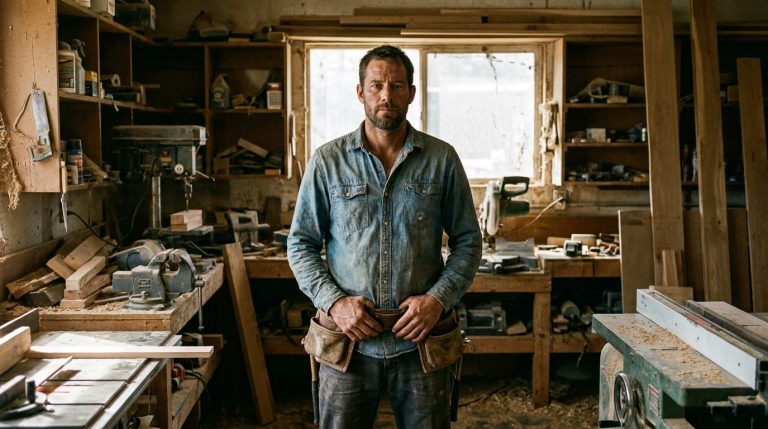
John walked to the back of the barn, where a new wall had been partitioned off. He pushed the door open. It was a workshop, organized with a precision that bordered on religious. A row of chisels, sharpened and oiled, hung from a magnetic strip. A block plane sat on the workbench, a thin curl of hickory wood still resting on its blade.
He picked up the plane. The wood was smooth, warm to the touch. This wasn’t the work of a hobbyist. This was the work of someone who was trying to find order in a life that had been defined by a sudden, violent vacuum.
“You’re looking for something that isn’t there, Mr. Mallister.”
John spun, his hand instinctively going to the small, empty space on his hip where his sidearm usually sat. Arthur Pendleton stood in the doorway, his silhouette framed by the faint, diffused moonlight filtering through the barn slats. He leaned heavily on his cane, his presence quiet, almost spectral.
“I’m looking for the truth,” John said, his voice steadying, though his heart hammered against his ribs. “You talked about debt. You talked about a life owed. My father was a broken man, Arthur. He didn’t build this. He destroyed it.”
“Your father was a man who couldn’t handle the weight of the land,” Arthur replied, limping into the barn. He stopped a few feet away, his eyes fixed on the workbench. “But he was also a man who knew things about this valley that the county clerks would kill to keep quiet. He didn’t just take that excavator to dig a trench. He was digging for something else.”
John stared at him. “He was digging for water. That’s what he told the neighbors.”
Arthur let out a dry, rasping laugh. “Water is gold in this part of Montana, yes. But the spring on this land isn’t just water, John. It’s a map. And your father spent his last days trying to keep the map from falling into the wrong hands.”
Arthur took a step closer, his face caught in the harsh, unflattering beam of the flashlight. “The lawyer, Higgins? He wasn’t just gambling that money away. He was working for a firm in Helena—a development group that has been buying up water rights for three years. They didn’t want the farm, John. They wanted the dirt underneath it.”
John felt the floor shift beneath him. Layer one—the simple narrative of a tax-deed sale and a grieving widow—began to peel away, revealing the jagged, ugly architecture of a much larger, more predatory game. He looked at the plane in his hand, then back at Arthur.
“Why tell me now?”
Arthur’s gaze drifted toward the farmhouse, where the light in the kitchen still burned. “Because Sarah is trying to turn this place into a home, and I am too tired to keep holding the fence line against people who have more money than God. We didn’t buy this place to hurt you, John. We bought it because we were the only ones who knew it was being targeted.”
The silence in the barn was thick, heavy with the weight of unshed tears and old secrets. Outside, the wind picked up, rattling the tin roof—a sound that, for the first time, didn’t sound like a ghost, but like an alarm.
CHAPTER 3: The Night of Echoes
The storm arrived not with a roar, but with a sudden, shivering drop in temperature that turned the mountain air brittle. Inside the barn, the sound was deafening—a thousand metallic fingertips tapping against the tin, creating a cacophony that made conversation nearly impossible. John stood motionless, his hand still gripping the flashlight, the beam cutting a steady, unwavering path toward Arthur.
“You’re saying Higgins wasn’t just a drunk with a gambling problem,” John said, his voice rising just enough to cut through the rain. “You’re saying he was the vanguard.”
Arthur didn’t answer immediately. He turned and began to limp toward the barn’s side exit, his silhouette merging with the shifting shadows. He paused at the door, glancing back. “This isn’t a conversation for the draft, John. The rafters have ears, and the wind in this valley carries more than just moisture.”
John followed, the tactical part of his brain shifting gears. He checked the barn’s perimeter out of habit—the heavy sliding door, the reinforced hinges, the lack of immediate cover for an interloper—before stepping out into the deluge. The rain was freezing, a sharp, stinging sleet that obscured the farmhouse lights. He kept one hand on the strap of the heavy flashlight, feeling the weight of the moment. He wasn’t just a veteran returning to his roots anymore; he was a liability in a game he didn’t know he was playing.
They moved toward the farmhouse, the mud pulling at John’s boots with a persistent, suckling sound. The porch light flickered, casting a jaundiced yellow glow across the path. Sarah was waiting at the door, her face a pale oval in the gloom, her expression shifting from relief to a sharp, defensive anxiety as she saw them emerge from the downpour.
“You’re soaking,” she said, pulling the door wider. Her voice lacked the edge of the previous evening; it was frayed, worn thin by the weight of the secret Arthur had just released.
They stepped into the mudroom, the transition from the chaotic, freezing exterior to the pressurized, cinnamon-scented interior of the farmhouse feeling like a violation of the sanctity she had fought so hard to create. John stood on the welcome mat, dripping onto the polished hickory, his presence in the house feeling entirely wrong. He was a creature of the open road and the hard bunk, and this room was an anchor.
“He knows,” Arthur said, shedding his rain-slicked coat. He moved toward the kitchen, his posture slumped with the fatigue of a man who had been holding a heavy load for too long.
Sarah looked at John. Her eyes were red-rimmed, the signs of a long, sleepless night spent staring at the walls she had meticulously repaired. She didn’t say anything, but she moved to the stove and poured a mug of tea, sliding it toward him. It was a gesture of truce, or perhaps just a calculated attempt to keep him from pacing holes in her floorboards.
“You have a basement,” John said, not touching the tea. He hadn’t asked a question; he had made an observation based on the structural geography of the house. Every farmhouse of this era in the county had a storm cellar, a place to hide when the sky turned black.
“We do,” Sarah whispered.
“Does it connect to the old trench lines?”
Sarah froze, the cloth in her hand hovering over the counter. “How did you—”
“I grew up here, Sarah. I know how the ground slopes. I know where the drainage lines were laid.” John took a step closer, his voice dropping into that low, resonant register he used to command a squad. “If your husband died because of a ‘faulty machine’ that was being used to dig in the middle of the night, and if that machine was sabotaged or used to uncover something that someone didn’t want found, then the evidence isn’t in the barn. It’s in the ground.”
The room grew very still. The only sound was the fire popping in the hearth and the relentless, driving rhythm of the sleet against the siding. John felt a strange, cold clarity descending upon him. The anger he had felt earlier—the indignant rage of the dispossessed owner—had been replaced by the focused, analytical drive of an operator tasked with a mission. He didn’t care about the deed anymore. He cared about the pattern.
“You didn’t fix this house to live in it,” John said, realizing the truth as the words left his lips. “You fixed it to protect it. You’ve been guarding a grave.”
Sarah didn’t deny it. She leaned back against the counter, her shoulders trembling. “Michael didn’t die because of an accident, John. He died because he found a survey stake on the north ridge—a stake that wasn’t ours. When he tried to pull it, the machine was already rigged. He never even got to tell me what the markings meant.”
John looked at the tea, then at his own hands, calloused and scarred. He had spent ten years trying to escape the shadow of this farm, believing he was running toward freedom. He realized now that he had been running toward a rendezvous. He reached into his pocket and pulled out his phone, staring at the empty signal bars. The isolation of the valley, which he had once viewed as a sanctuary, now felt like a cage—a locked room where a decade of secrets was waiting to be exhumed.
“Where is the survey stake, Sarah?”
She hesitated, her gaze shifting toward her father. Arthur, sitting in the rocking chair, stared into the embers of the fire, his grip on his cane white-knuckled.
“The ridge,” Sarah whispered. “But the storm is going to bury everything by morning.”
John turned toward the door, his jaw set. The rain was still falling, a freezing, driving wall of water that threatened to wipe away any trace of the past. He didn’t care. He had spent his life in the service of orders he didn’t write; tonight, for the first time, he was going to act on his own authority. He stepped out onto the porch, leaving the warmth of the farmhouse behind, and walked back into the freezing dark.
CHAPTER 4: The Trench of Understanding
The world beyond the porch was a monochrome nightmare of shifting grays and slick, treacherous mud. John moved with a practiced, heavy-footed gait, his senses tuned to the subtle shifts in the terrain. Behind him, Ranger stayed low, a dark, pulsing shadow that vanished and reappeared in the rhythmic flashes of lightning. The rain didn’t just fall; it scoured, stripping away the comfort of the farmhouse and leaving only the raw, exposed nerves of the land.
The North Ridge was a steep, punishing climb even in the best of conditions. In the dark, slick with the remnants of the season’s first freeze, it became a battle of attrition. John reached the base of the rise, his thigh muscle screaming in protest—a sharp, white-hot reminder of the shrapnel he carried in his femur. He paused, his hand gripping the trunk of a water-logged pine, his breath hitching in his chest.
“Easy, boy,” he whispered to Ranger, who was huddled near his boots, his own breath coming in ragged, steaming puffs.
The terrain here was scarred. He remembered this place—the boundary line where the Mallister property met the deeper, wilder timberland owned by the state. He moved up the incline, his fingers clawing into the wet, loamy earth. Every time he slipped, the weight of the past ten years seemed to pull him further down, anchoring him to the failure he had spent his life trying to outpace.
He reached the summit of the ridge, the wind gusting with enough force to threaten his balance. He pulled his heavy-duty flashlight from his jacket, the beam a frantic, slicing arc across the rain-swept grass. He was looking for a surveyor’s stake—a simple, orange-tipped wooden marker that shouldn’t have been there.
He found the site, but the stake was gone.
In its place was a jagged, muddy depression in the earth, as if something had been ripped out with significant force. He knelt, the mud soaking into the knees of his jeans, the icy water seeping through to his skin. He shone the light into the hole. There was a glimmer of something metallic at the bottom—a brass tag, half-buried in the slurry.
He reached down, his fingers numbing instantly as he worked the object free. It wasn’t just a survey tag; it was a property marker for an easement, one that predated his family’s ownership of the land. His heart skipped a beat. This wasn’t just a boundary dispute. This was a claim to the mineral and water rights beneath the homestead, documented and filed away in a dead-end account that Higgins had been paid to ignore.
“John!”
The shout came from below. Sarah was standing at the edge of the tree line, a hooded jacket pulled tight against the gale. Her voice sounded thin, overwhelmed by the storm, but there was a desperate urgency in it that stopped John cold.
“Get down here!” she yelled, gesturing wildly toward the house. “The sheriff’s truck is coming up the drive!”
John shoved the brass marker into his pocket and turned, but the mud beneath him gave way. He slid, the world turning into a blurred, spinning kaleidoscope of wet pine and rocks. He hit the base of the ridge hard, the impact jarring the breath from his lungs. For a moment, the sky went black, the familiar, suffocating darkness of the desert rubble rushing back to reclaim him.
He didn’t stay down. He forced his body to move, the pain in his leg acting as a cold, sharp focus. He scrambled to his feet, ignoring the blood slicking his palm where a rock had sliced the skin.
He reached the driveway just as the high beams of a vehicle crested the hill. The cruiser rolled to a halt, the red and blue lights reflecting off the standing water in the gravel, creating a strobe effect that made the entire scene feel like a slow-motion interrogation.
“Mr. Mallister?” The sheriff—a man with a face like worn leather and eyes that had seen too many domestic disputes in this valley—stepped out of the vehicle. His hand rested on the holster of his sidearm, a gesture of caution rather than aggression. “We got a call about a disturbance at the residence.”
John stood his ground, the freezing rain matting his hair to his forehead. He looked at Sarah, who was trembling violently in the shadows, then back at the sheriff. He realized then that the sheriff wasn’t here because of a “disturbance.” He was here because the firm in Helena had been alerted to a potential breach in their acquisition plan.
“Everything is fine, Sheriff,” John said, his voice level, stripped of all emotion. “Just a bit of property damage due to the storm.”
The sheriff’s gaze flickered past John to the farmhouse, then to the barn, his eyes narrowing. “That’s not what we heard. We heard there was a man trespassing. Someone who doesn’t belong here.”
John felt the brass marker in his pocket, a cold, hard secret that burned against his thigh. He stood straighter, his posture shifting into the rigid, unbreakable discipline of a man who had protected things much more valuable than dirt.
“I belong exactly where I am,” John said. “And if you’re looking for a trespasser, you’re looking at the wrong man.”
The air between them crackled with the static charge of the storm. The sheriff’s eyes drifted toward the barn, then back to John, the silence stretching out until the only thing left was the sound of the rain and the rhythmic, ominous heartbeat of the cruiser’s engine. The escalation wasn’t coming from the storm anymore; it was coming from the law, and John knew that the real fight was only just beginning.
CHAPTER 5: The Paper Trail
John sat in the passenger seat of the cruiser, his hands resting on his thighs. The interior smelled of stale coffee, damp upholstery, and the sterile, sharp tang of a police-issued cleaning agent. The sheriff didn’t move to pull away. Instead, he kept his eyes fixed on the house, the light from the dashboard casting long, skeletal shadows across his weathered face.
“You’ve got a lot of mud on those boots, John,” the sheriff said, his voice quiet, lacking any immediate aggression. “And the north ridge is a hell of a place to be hiking on a night like this. Especially for someone with a medical discharge that lists a shattered femur.”
John looked at the man. He saw the flicker of recognition in the sheriff’s eyes—a memory of the boy who had left this county ten years ago, now replaced by the man who had returned with a tactical shadow. “I wanted to see the boundary,” John said, his voice carefully neutral. “I heard there was some encroachment.”
The sheriff let out a slow, deliberate breath, his gaze shifting to the brass marker visible as a slight bulge in John’s pocket. He didn’t ask what it was. He didn’t have to. The way John’s hand shifted toward his jacket—a defensive, reflexive move—told the story.
“Higgins is dead,” the sheriff stated.
The statement hit John like a physical blow. He felt the cold iron of the seat beneath him, the way the world seemed to tilt on its axis. “What?”
“Five years ago. Accidental overdose in a motel in Reno. Or at least, that’s what the report said.” The sheriff shifted the cruiser into gear, the tires spinning momentarily in the saturated mud before gaining traction. “But the papers he left behind? The ones that were supposed to be filed with the county? They disappeared from the clerk’s office three days after he was declared deceased.”
John stared out the window as the farm disappeared into the darkness. “You knew.”
“I knew that something was eating this valley from the inside out,” the sheriff replied. He turned the vehicle onto the main road, the headlights slicing through the rain. “I knew that your father was scared of something more than just the bank, and I knew that Michael Jenkins wasn’t just working a construction job when he died. But in a place like this, John, you keep your head down. You do your job. You don’t ask questions that the state legislature has already answered.”
“So you’re taking me to the station to bury it?” John asked, his voice hardening.
“I’m taking you to a place where you can make a phone call,” the sheriff said, his voice dropping to a whisper. “To a federal land office in Bozeman. Not the local one. They’re all compromised.”
John felt a surge of doubt. Was this an act of redemption, or was he being driven into a trap? He looked at the sheriff’s profile—the set of his jaw, the steady, unwavering grip on the steering wheel. He remembered the Doctrine: Assess the terrain, identify the assets, forge a new path.
“Why now?” John pressed.
“Because the water rights for this entire basin are up for public renewal in 48 hours,” the sheriff said, his tone shifting into one of grim finality. “If the petition isn’t challenged by someone with a legitimate claim—someone like the heir to the original deed—the entire valley will be under corporate control by Monday morning. Your father didn’t just owe me, John. He owed this valley a chance.”
They drove in silence for a long time. John stared at the passing trees, his mind racing through the logistics. If the sheriff was telling the truth, the “tax sale” was just a tactical maneuver, a way to move the pieces into place before the real play began. He felt the brass marker against his leg—a physical piece of evidence that could blow the foundation out from under the developers.
He thought of Sarah, of Arthur, of the life they had built in the ruins of his family’s legacy. He thought of the rocking chair, mended and whole, and the way the farm had breathed back to life under their hands. He wasn’t just fighting for his father’s land anymore. He was fighting to keep a promise that had been made to him in the silence of his father’s death.
The cruiser pulled into the lot of a remote, nondescript building on the edge of the county. There were no lights, no signs of activity. The sheriff killed the engine, the silence that followed ringing in John’s ears.
“I can’t go in there with you,” the sheriff said, handing John a encrypted burner phone. “If anyone asks, I was checking a reported disturbance on County Road 9. The rest is on you.”
John took the phone. It was cold, metallic, and heavy. He stepped out of the vehicle, the rain hitting him with renewed force. He looked back at the sheriff, but the cruiser had already shifted into gear, the taillights fading into the storm.
He stood alone in the dark, the weight of the valley’s history pressing down on his shoulders. He felt a sudden, sharp clarity. The decoy—the idea that this was just a struggle over a homestead—was gone. He was standing on the precipice of a much deeper truth, one that was hidden in the very soil beneath his boots. He took a breath, the cold air filling his lungs, and started toward the door. The mission had changed; the stakes were no longer just his home, but the heart of the valley itself.
CHAPTER 6: The Harvest of Grace
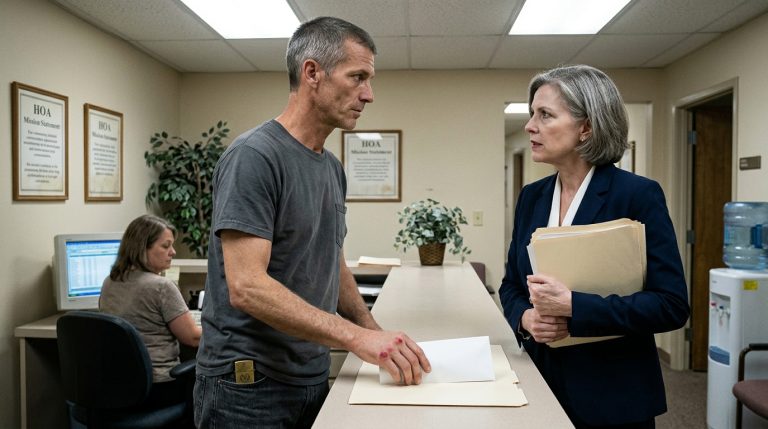
John pushed into the building, his combat boots clicking against the polished linoleum. The air inside was dry, sanitized, and smelled of ozone and paper—the scent of bureaucracy. He moved toward the records desk, his hand reaching into his pocket to touch the cold, brass marker. He didn’t wait for a clerk to acknowledge him. He walked straight to the public terminal, sliding the burner phone onto the counter as he pulled the brass marker from his pocket and laid it beside it.
“I need to file a challenge,” John said, his voice quiet but carrying the absolute, unshakable weight of his military training. “For the Oak Haven property. And the entire water-shed basin.”
The clerk, a young woman with tired eyes, blinked at the marker. “Sir, you need a lawyer for a federal easement challenge. You can’t just—”
“I have the original survey tag,” John interrupted, his eyes meeting hers. “And I have the evidence of fraudulent foreclosure tied to a deceased attorney. Look up the case file for Higgins. Then look up the water rights mapping for the Gallatin basin.”
The next hour was a blur of tactical precision. John didn’t waste time on pleas. He pointed to the inconsistencies in the digital record, the way the corporate entities had mapped the spring on his land as a “geological non-factor” while simultaneously lobbying for exclusive extraction rights. It was a game of numbers and maps, a language he understood with the same deadly clarity as he did the topography of a battlefield.
By the time he stepped back out into the morning light, the storm had broken. The sky was a pale, washed-out blue, and the air smelled of wet earth and beginning. The legal wheels were in motion, and while the battle would be long, the corporate claim on the basin had been effectively frozen.
He drove back to the farm in the sheriff’s cruiser, which he had left in the lot. The return journey felt different. He wasn’t running back to a sanctuary he didn’t own; he was returning to a home he was in the process of saving. When he pulled into the drive, the house looked different—no longer a ghost of the past, but a project in progress.
Arthur and Sarah were waiting on the porch. Arthur stood without his cane, leaning against the railing, his face showing a decade’s worth of relief. Sarah didn’t have a weapon. She had a mug of coffee in her hand.
“Did you do it?” she asked, her voice trembling.
John climbed the steps, the ache in his leg dull and manageable, a souvenir of a war he was finally leaving behind. He reached into his pocket and pulled out the brass marker, placing it on the railing. “The filing is in. It’s not just a homestead anymore, Sarah. It’s a protection order for the whole valley.”
Sarah leaned forward, her hand brushing his arm—a gesture of tentative, budding trust. Arthur nodded, a slow, deep motion that seemed to settle his entire frame.
The aftermath was not a parade, but a quiet, rhythmic settlement. The following weeks were filled with the mundane, glorious work of living. They formed the LLC, a legal armor for the land, and began the process of cleaning up the north ridge. They found the old, hidden trenches—not just water lines, but markers of a time when this valley was meant to be a resource, not a weapon.
John spent his days in the workshop, his hands learning the feel of wood again. He took the cherrywood rocking chair he had once hated and, with Sarah’s help, finished the repair. He didn’t see his mother’s ghost in the wood anymore. He saw the craftsmanship of a man trying to build something that could outlast the rot.
One evening, as the sun dipped behind the Baretooth Mountains, casting long, golden fingers of light across the pasture, John sat on the porch. Ranger was asleep at his feet, his head resting on his boot. Arthur was sitting in the rocking chair, his eyes closed in contentment, while Sarah worked in the garden, the smell of fresh soil and blooming flowers drifting up to the porch.
John looked at his hands. They were scarred, but they were steady. He had come here expecting a graveyard, a place to die in silence. Instead, he had found the grit of the ground, the friction of real life, and the heavy, beautiful weight of being needed. The valley was quiet, the water deep and still beneath the surface, protected and free.
He didn’t need to look over his shoulder anymore. The shadows were still there, as they always would be, but they no longer defined the shape of his life. He was home, and for the first time in a decade, the silence wasn’t a void. It was a foundation. He closed his eyes, listening to the steady, rhythmic sound of Sarah’s trowel turning the earth, and felt the earth itself begin to settle. The repair was complete.