Against All Odds in the South Pacific Jungle, Ordinary Workers Built the Unstoppable Machine of Victory
CHAPTER 1: THE BROKEN SHIP ARRIVES
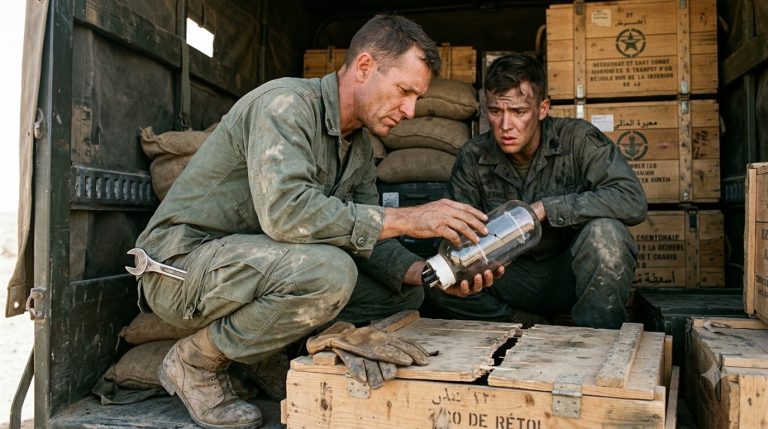
The diesel exhaust from the idling tractor smelled like burnt sour corn in the humid tropical air.
Frank Miller pulled the grease-stained rag from his rear pocket and wiped the salt-sweat out of his eyes before it could burn. Across the glass-still water of Palakulo Bay, the morning fog didn’t roll back so much as it split open under the weight of a giant.
The heavy cruiser USS San Francisco didn’t glide into harbor. She dragged herself.
Forty-five ragged steel punctures chewed along her superstructure, the jagged metal edges twisted outward like broken teeth. Her forward gun turret was scorched a dull, blistered black, and the stench of scorched oil and cordite drifted across the palm-fringed water long before her anchor chain ever rattled through the hawsepipe.
“Look at ‘er, Chief,” young Miller—no relation, just a kid from Ohio with grease under his fingernails—muttered beside the tractor tread. “Looks like she took a ride through the jaws of hell.”
“Shut the motor down, Kid,” Frank said. His voice was gravel, dried out by four months of tropical heat and twenty-hour shifts. “We ain’t wasting fuel while we stare.”
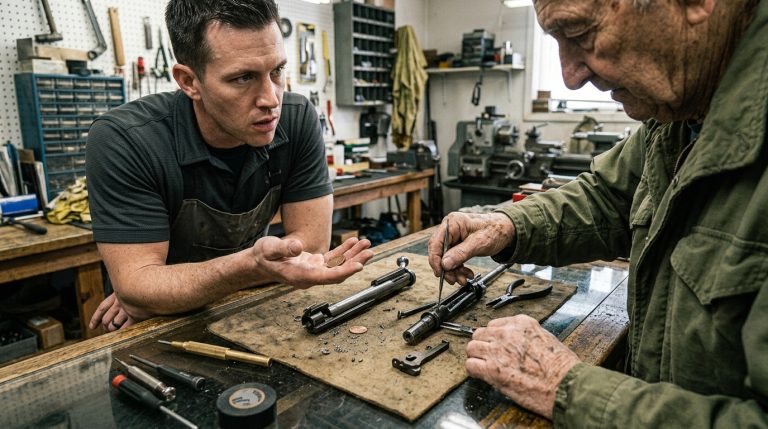
He reached into his shirt pocket and pulled out his brass micrometer, clicking the cold metal dial against the knuckle of his thumb. Click. Click. The rhythmic tap grounded him against the sudden, hollow drop in his stomach.
A cutter lowered from the cruiser’s side, cutting a white wake through the dark water toward the makeshift timber pier. When the young lieutenant stepped onto the wet coconut logs, his dress khaki shirt was torn at the shoulder, stained dark with oil and dried copper.
“I need the harbor master,” the lieutenant said. He didn’t look at Frank; he looked past him, scanning the raw red-mud tracks disappearing into the triple-canopy jungle. “We’ve got one hundred and seven dead on board. Rear Admiral Callahan went down on the bridge. Her hull is taking sea through three separate breaches below the waterline.”
Frank adjusted the micrometer’s thimble by two thousandths of an inch. “Harbor master’s three miles inland setting up a malaria tent. You’re talking to the chief civilian foreman.”
The lieutenant’s jaw tightened. “I need floating drydocks, crane barges, and a structural steel crew on that hull by noon. We have to clear her berth before the evening tide.”
“You get raw timber, three welding rigs, and forty men who haven’t slept since Tuesday,” Frank said plainly. He didn’t raise his voice. He didn’t have the breath to waste. “There ain’t no floating docks in this bay, son. You’re anchored in raw jungle.”
The lieutenant took a step forward, his boot sinking two inches into the churned red clay. “This is a Navy flagship, Foreman. She needs factory-grade structural steel plating or she doesn’t steam another mile.”
Frank looked past the officer’s trembling shoulder to the battered grey hull sitting heavy in the water. He could see the slight starboard list, the way the Atlantic-built warship settled unnaturally into the South Pacific silt.
“She’ll steam,” Frank said, slipping the brass tool back into his pocket. “Because my boys are going to patch her with whatever we pull out of the dirt.”
CHAPTER 2: INTO THE MUD AND CORAL
“Rain’s coming down harder, Chief!” Kid yelled over the thrum of the diesel motor, his oversized rain poncho flapping like a broken wing. “The trenching team on the south ridge is slipping out!”
“Then tell ’em to dig their boots in deeper!” Frank barked back, swinging himself off the tractor wheel.
The mud didn’t just cling; it sucked. Every step felt like dragging an extra fifty pounds of lead attached to his soles.
Frank slouched through the torrent toward the edge of the harbor slope where forty civilian workers—mechanics, steamfitters, and former riggers from Ohio and Pennsylvania—were hauling heavy timber cribbing by hand. Without a crane barge, every single log had to be dragged out of the jungle by raw muscle and tractor chains.
He pulled the brass micrometer from his pocket, his thumb flicking the cold dial. Click. Click.
“Chief!” Miller called out, wiping rain off his forehead with a mud-caked forearm. “We found four crates of six-inch angle iron behind the old copra shed! But they’re rusted through on the edges!”
“Rust don’t matter if the core’s thick enough,” Frank said, kneeling right in the slurry. He picked up a jagged piece of salvaged steel and tapped it with the side of his micrometer. “We cut the bad edges off with the torch, double-plate the seams, and heat-bend them to fit the cruiser’s bow curve.”
“We ain’t got enough acetylene gas for that kind of torch cutting,” Miller grunted, straining against a twenty-foot coconut log. “Gas ship was supposed to dock three days ago.”
Frank looked out at the bay. The grey curtain of rain was so thick now it almost swallowed the silhouette of the broken warship.
“Then we don’t waste gas on smooth cuts,” Frank said, his voice dropping into a flat, hard edge. “We use the cold-chisels and sledgehammers. We score the line and snap it.”
Miller stared at him like he’d lost his mind. “Score six-inch iron with hand chisels? Chief, that’ll take half the night!”
“Then we work through the night,” Frank said. “That ship’s taking on water right now, Miller. The sea don’t wait for acetylene.”
A sharp whistle blew near the tree line. Down the slick red path, a Navy jeep was skidding through the mud, its tires throwing up roostertails of orange slush.
Frank didn’t even turn his head. He just kept his thumb on the brass micrometer, feeling the cool metal groove against his calloused skin as the jeep slammed to a halt.
CHAPTER 3: CONFRONTATION AT THE DOCK
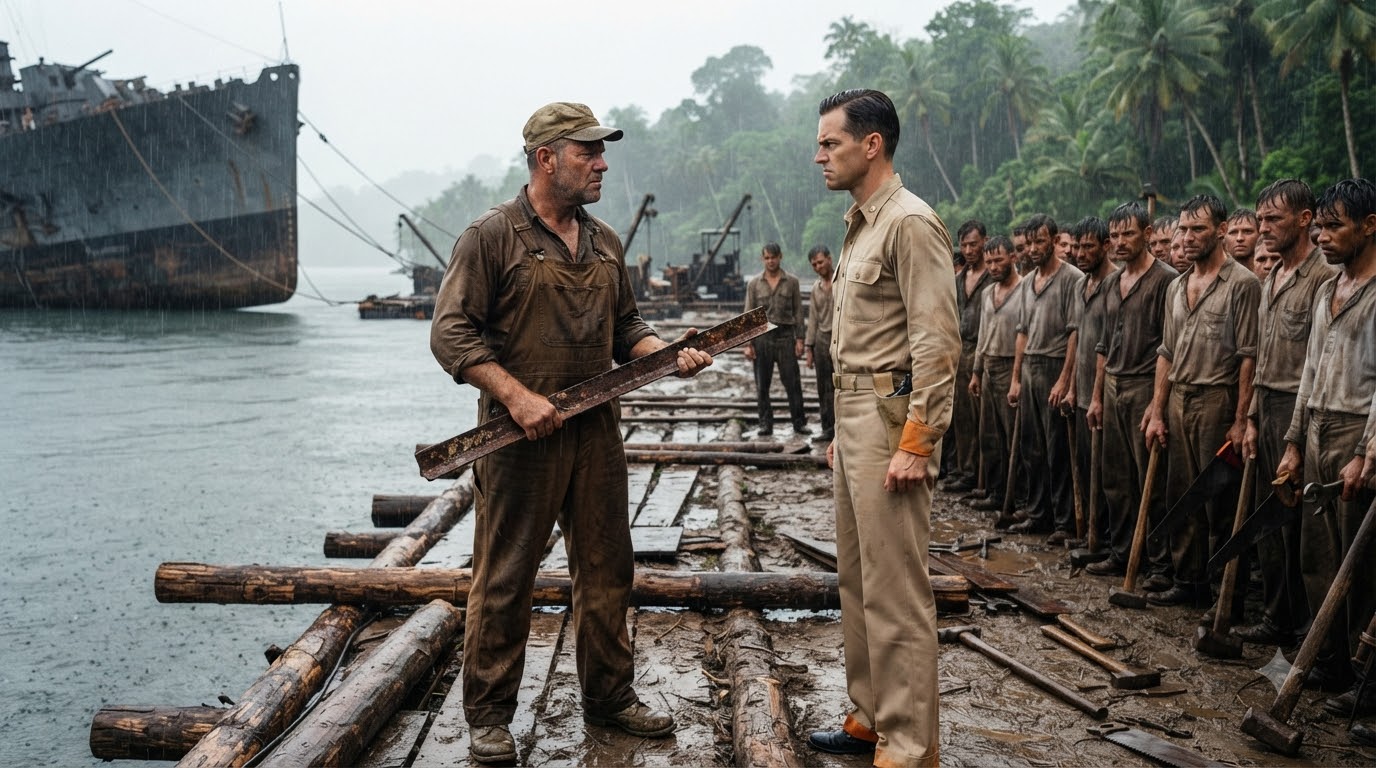
Lieutenant Commander Vance stepped out into the downpour, his spotless khaki trousers instantly soaking up dark rings of orange silt at the cuffs. He didn’t look like a man who had spent forty-eight hours ducking naval gunfire; he looked like an auditor who had just found a missing decimal point.
“Foreman Miller,” Vance said, his voice clipped and dry despite the storm. “Why are your men hauling salvage from behind the copra shed when I ordered a structural plating crew out to the San Francisco?”
Frank didn’t drop the rusted iron. He let the weight of it sit in his calloused palms, the iron oxide mixing with the rainwater.
“Because that copra shed is the only place on this island with structural metal thick enough to patch a three-foot breach below the waterline,” Frank said.
“That ship is an active combat vessel of the United States Navy,” Vance said, taking a short, sharp step forward. His posture was rigid, built on twenty years of peacetime regulations that had nothing to do with tropical rot or artillery holes. “She requires spec-certified mild steel plate, cold-riveted by certified shipyard personnel. You’re filling her hull with farm scrap.”
Frank slowly turned the pitted iron bar over, exposing the flaking edges. “You got a ship out there taking on five hundred gallons a minute. You want spec steel? Call Pearl Harbor. It’s four thousand miles east.”
“Don’t take that tone with me, contractor,” Vance snapped. His hand twitched toward his hip, his fingers catching the canvas holster of his sidearm. “You civilian crews operate under naval logistics authority here. If I direct you to deploy pneumatic riveting rigs to that berth, you move.”
Frank clicked his thumb against the micrometer inside his pocket. Click.
“Pneumatic rigs need compressed air, Commander,” Frank said softly, stepping closer until the brim of his rain-soaked canvas cap nearly touched the officer’s shoulder boards. “The generator for the air plant blew a head gasket six hours ago. My lead mechanic is sitting in two feet of water trying to turn a new gasket out of a leather boot.”
Vance’s jaw twitched. “Then patch the generator.”
“We are,” Frank said. “While my boys cut this scrap with cold-chisels. You can stand here in the mud telling me what the manual says, or you can let us weld this iron to her frames so your captain can turn his pumps off.”
Vance glared at the civilian crew lining the trench behind Frank. Forty exhausted men, their shirts plastered to their ribs, holding sledgehammers and hand saws, waiting in absolute silence for the officer to make a choice.
“Twenty-four hours,” Vance whispered, his voice cold as river ice. “If that patch leaks when she drops anchor at Numéa, I’ll have you court-martialed for sabotage.”
“She won’t leak,” Frank said, turning his back on the jeep before the door even closed. “Because we’re the ones driving the rivets.”
CHAPTER 4: THE DISCOVERY IN THE LOGBOOK
The shack was pitch black except for the yellow beam of a single flashlamp propped on a grease-stained crate.
Frank needed thirty extra kegs of heavy structural rivets. If they weren’t logged in the harbor ledger, his men were going to be driving wooden pegs into the cruiser’s outer skin before dawn.
He pulled open the bottom drawer of the desk, the swollen plywood groaning against the humidity.
Inside lay a stack of water-damaged logbooks, their leather spines white with mold. Frank flipped through the damp pages, his calloused thumb leaving dark smears on the margins. He wasn’t looking for logistics reports; he was looking for a serial number on a supply barge that should have docked two weeks ago.
His fingers caught on a loose sheaf of thick, unissued paper tucked deep behind the rear runner.
It wasn’t standard carbon stock. It was heavy bond paper, stamped at the top with the blue anchor of South Pacific Supply Command. Frank held it up to the flashlamp beam, his thumb clicking the micrometer inside his pocket out of pure habit. Click.
The document was a red-ink manifest for three heavy transport ships—carrying two floating crane barges, four pneumatic air compressors, and eighty tons of pre-milled structural steel plate destined for Espiritu Santo.
Across the center of the first page, a heavy rubber stamp blotted out the shipping schedule in bright, drying red ink: CANCELLED – SHIPMENT DIVERTED / LOST IN TRANSIT.
Underneath the red block, a handwritten note in neat navy script read: DO NOT PUBLISH TO BASE PERSONNEL. MAINTAIN REPAIR TIMELINES UNDER EXISTING LOCAL RESOURCE ORDERS.
Frank stood frozen in the dark, the smell of damp paper sharp in his nose.
Vance knew. Base command had known for a month that no cranes were coming, no steel was coming, and no factory ships were ever going to anchor in this bay. They had let his men drag coconut logs through knee-deep mud and cut rusted iron with hand chisels, pretending it was just a temporary delay until “official supplies” arrived.
“Chief?” Miller’s voice cut through the rain from the open doorway, his silhouette dripping onto the floorboards. “The boys got the forge hot. We need to know if we’re cutting more angle iron or waiting on the supply barge.”
Frank slowly folded the red-stamped paper and slipped it into his chest pocket, right behind his brass micrometer.
“There ain’t no barge coming, Miller,” Frank said, his voice flat as a iron bar. “Not today. Not next week.”
Miller wiped his chin, his eyes widening slightly in the dim flashlight beam. “Then how are we supposed to patch a warship?”
“Same way we built the road,” Frank said, stepping out into the pouring rain. “We make the jungle pay for it.”
CHAPTER 5: THE DESPERATE PATCHWORK
The air down on the timber staging pontoon smelled like ozone, hot iron, and burning coconut oil.
A red-orange glow illuminated the grey curtain of rain where two civilian blacksmiths pumped a pair of hand-bellows made from oil drums and canvas. Inside the coals, four-inch steel rivets glowed cherry red, spitting white sparks against the wet palm fronds overhead.
Frank dropped his hammer onto a coconut log with a dull thud. “Miller! Get those iron plates lined up on the lower hull seam!”
Miller was hanging by a hemp rope three feet above the dark, surging seawater, his boots braced against the cruiser’s scarred armor belt. His face was black with soot and rain.
“The holes don’t align, Chief!” Miller shouted up, his voice cracking from exhaustion. “The hull frame shifted when she took that shell hit! If we force this rivet, the seam’s gonna buckle!”
Lieutenant Commander Vance appeared at the top of the timber ladder, his dress uniform ruined, his eyes wide as a distant dull thud echoed across the bay—anti-aircraft fire from the northern ridge.
“Foreman!” Vance yelled, leaning over the rail, his fingers digging into the wet wood. “Radar picked up a Bogey formation thirty miles north! You have sixty minutes to get that lower compartment sealed or I’m ordering this ship to cast off into deep water!”
Frank didn’t look up at the officer. He pulled his brass micrometer out, clicked the dial once, and shoved it into Miller’s hand down on the staging.
“Measure the gap on the inner rib, Miller,” Frank said, his voice dropping into that immovable, steady gravel. “Tell me how many thousandths we’re off.”
Miller clamped the tool against the twisted frame, his hands shaking from fatigue. “Three-sixteenths of an inch! It’s too tight!”
Frank grabbed a six-foot steel pry-bar from the tool box, stepped down onto the slick, swaying pontoon, and jammed the wedge end right into the gap between the hull frame and the salvaged angle iron.
“Put your weight on this bar with me, Commander,” Frank said, glaring up at Vance.
Vance blinked, taking a step back. “I am an officer of the Navy, Foreman—”
“I don’t care if you’re the Secretary of the Navy!” Frank roared, the rain splashing off his jaw as he threw his full two-hundred-pound frame against the steel lever. “Grab this bar or watch your flagship sink to the bottom of this harbor!”
Vance’s face flushed red, but he dropped to his knees in the mud, grabbed the wet steel bar alongside Frank, and pulled until his knuckles turned bone-white. The iron groaned. The metal frame shrieked against the strain, the friction throwing off a sharp smell of hot iron.
“Now, Miller!” Frank screamed, his shoulders burning as his boots skidded on the wet timber. “Drive the rivet!”
Miller slammed a red-hot iron pin into the aligned hole, and two riggers swung eight-pound sledges in rhythm, the metallic CLANG-CLANG-CLANG echoing across the water like a anvil chorus. The hot metal mushroomed over, sealing the joint flush against the cruiser’s side.
Frank released the bar, breathing heavy through his nose, his shirt completely soaked through.
Vance collapsed back onto the wet coconut logs, gasping for air, his hands trembling violently as he stared at his torn, black-stained palms.
Frank pulled the folded, red-stamped manifest out of his wet breast pocket and tossed the soaked paper onto Vance’s lap.
“Next time you tell my men what tools we’re missing,” Frank said softly, wiping the sweat from his eyes, “you look ’em in the eye first.”
CHAPTER 6: THE QUIET DEPARTURE
The heavy cruiser’s propeller shafts turned over with a low, churning rumble that shook the coconut logs of the staging pier.
Her hull sat slightly higher in the water now, the three-foot patch of cold-chiselled angle iron and hand-driven rivets riding four inches above the harbor swell. It was rough, ugly work—a dark, raised scar of scrap metal against the ship’s grey flank—but the seam was dry.
Lieutenant Commander Vance stood near the gangway, his uniform still stiff with dried orange clay across the knees. He didn’t offer a salute, and he didn’t hand over a written commendation.
He reached out a hand, his palm rough and raw where the steel lever had torn the skin the night before. “She’ll reach Numéa, Foreman.”
Frank took the officer’s hand, gave it one firm, heavy shake, and let go. “She’ll reach wherever you point her, long as your engine crew keeps an eye on the bilge.”
Vance turned without another word and climbed the steel ladder onto the main deck.
The lines were cast off. The heavy warship slipped backward into the deep channel, her wake cutting a smooth, white furrow through the calm blue water of Palakulo Bay.
Miller walked up beside Frank, wiping grease off his knuckles with a rag that was more thread than cotton. “What do we do now, Chief? The forge is out of coal and the boys are dead on their feet.”
Frank pulled his brass micrometer out of his shirt pocket. He turned the thimble down until the anvil touched the spindle with a soft, clean click. Zeroed out.
He looked down the shoreline where the jungle met the water. Two supply transports were already dropping anchor near the reef, their booms swinging out toward the mud.
“We clean the torches, Miller,” Frank said, slipping the tool back into his pocket. “And we start cutting more timber.”