Silent Water: The Florida Gator Hunter Who Cleared a Philippines Swamp Alone
CHAPTER 1: THE WEIGHT OF DRY PAPER
Captain Reynolds pressed both palms onto the field desk, his thumbs digging into the paper map of San Manuel.
“The book says we bypass,” Reynolds said, his voice flat with the exhaustion of a man who hadn’t slept in thirty hours. “Two patrols went into those mangroves. Eighteen men. Zero came out. We don’t throw a nineteenth after them.”
Roy Mason didn’t look at the map. Paper didn’t tell you how deep the silt ran or where the bottom turned to liquid clay that pulled a boot off your foot. He leaned against the tent pole, paring the end of a hickory branch with his pocketknife, shaping a smooth round knob at the head.
“The book was written by someone who thinks water is just dirt you can’t walk on,” Mason said. His thumb slid over the fresh-cut wood, testing the grain. “Those eighteen boys made noise. They fought the water instead of sitting in it.”
“They had BARs and radio packs, Corporal,” the platoon sergeant snapped from the shadows by the supply crates. “Standard column formation. You’re talking about crawling into a three-mile cesspool by yourself like a damn wild animal.”
“A gator doesn’t care about a column formation,” Mason said softly. He didn’t raise his eyes from the wood. “It cares about the ripple. You send five men, you get five ripples. You send one, you get nothing if he knows how to set his heel.”
Reynolds leaned back, the canvas chair creaking under his weight. He looked at Mason’s hands—calloused, stained with swamp iron and old engine oil from years on Lake Okeechobee.
“Eight hours,” Reynolds said, pointing a dirty finger at Mason’s chest. “You get until 1400. You don’t take a radio because the mud will kill it anyway. You don’t get mortar support. If you get pinned, nobody is coming to drag you out.”
“Don’t need a radio,” Mason said, sliding the knife into his pocket. He rested his weight on the hickory stick, feeling the solid give of the dirt floor beneath it. “Radio just gives a man something to talk to when he ought to be listening.”
He stepped out of the command tent before the sergeant could answer. The morning air outside smelled of burning kerosene, wet wool, and the sour rot of the mangroves two hundred yards south.
He unbuckled his cartridge belt, stripping off the extra canteens and the heavy entrenching tool. He kept forty rounds of .30-06 in his pockets, the M1 Garand wrapped in a grease-soaked rag, and the machete slung low against his left thigh where it wouldn’t clatter against his hipbone.
At the edge of the tree line, the mud started. It wasn’t the red clay of the ridges; it was black, thick, and smelled of dead moss.
Mason stopped at the water’s edge. He thrust the hickory stick deep into the brown surface until it struck solid limestone two feet down. He didn’t look back at the encampment, nor did he check his watch.
He simply eased his right foot into the dark water without making a splash.
CHAPTER 2: INTO THE BLACK WATER
Mason didn’t look back at the encampment.
The sound of Reynolds’ dry-tent arguments faded, replaced by the low, wet hum of the mangrove basin. Mosquitoes came first, thick enough to taste, but Mason ignored them. A man who spent fourteen years waiting on twelve-foot gators in the Okeechobee mud didn’t waste energy slapping bugs.
He pushed the hickory stick two feet ahead, testing the bottom. Silt. Roots. Then a hard, flat ledge of dead coral.
He moved like grease over glass. Every step was a calculation: heel down first, rolling the outer edge of the boot along the submerged limestone, feeling for the draft of the current. In a swamp, water didn’t just sit; it flowed through hidden veins. If you crossed a vein too fast, you pushed a bow-wave ahead of you. A bow-wave meant a ripple, and a ripple meant every wild thing within fifty yards stopped moving to look for the intruder.
Thirty minutes in, the canopy closed overhead. Sunlight came through in thin, sickly green needles, reflecting off stagnant scum that coated the surface like spilled oil.
He stopped. Absolute stillness.
The silence here wasn’t quiet. It was made of rotting leaves dropping into the soup, the scrape of aerial roots against each other, and the low, wet gurgle of trapped air escaping the mud.
Then came the other sound. A rhythm that didn’t belong to the water.
Thump. Pause. Splash.
It was twenty yards to his left, behind a tangle of red mangrove trunks that looked like a thousand spiders standing on each other’s shoulders. Mason lowered his hips, submerging himself until the dark water hit his collarbone. He held the grease-wrapped Garand in his left hand, cradled high against his neck, keeping the breech two inches above the scum.
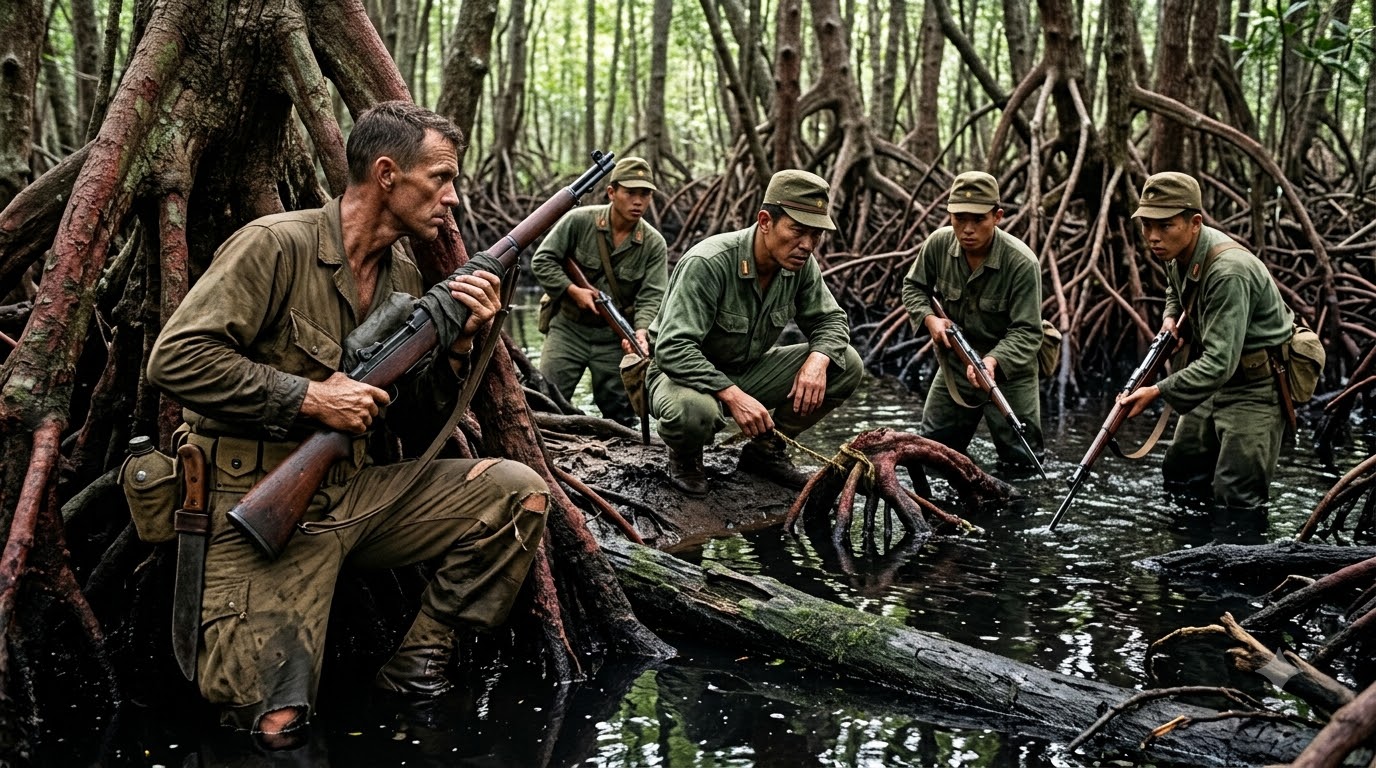
Through the gaps in the root wall, three men were wading.
They moved like infantrymen who hated the water. They slammed their boots down, fighting the suction of the mud, their eyes fixed on the dry tree line eighty yards east toward the American line. They carried Type 99 rifles slung high across their chests, their caps soaked through with grease and sweat.
They were watching for a patrol to walk out of the jungle. They weren’t watching the dark space beneath the root arch where the current pool sat still.
Mason let them pass.
He didn’t reach for the machete. He didn’t unwrap the M1. A hunter who struck the first three gators he saw in a breeding creek went home with an empty boat and a torn net. He needed to see where the mud led them.
He waited five full minutes after the last ripple flattened into the moss. The swamp settled back into its slow, rotting rhythm.
Mason edged forward, following the slick trail of disturbed silt left in their wake. The water shoaled, rising from his chest to his waist, then to his knees as he reached a hummock of packed root-earth no larger than a farm wagon.
A palm-frond lean-to sat in the center, pitched low to avoid aerial observation.
A single soldier sat on a wooden rice crate under the fronds, cleaning the bolt of an Arisaka rifle with an oily rag. His back was turned to the western channel. On a low stump beside him rested a brass tea tin and a small, square package bound in dark oilcloth, tied neatly with hemp cord to a thick mangrove root submerged in the silt.
Mason didn’t ask questions. He didn’t give the man a chance to turn around and look at the uniform.
He stepped out of the water onto the hummock, his boots making no more noise than a falling leaf. The hickory stick dropped into the soft moss. His right hand went to the horn handle of the machete.
One smooth, heavy stroke—not a wide swing, but a short, lethal chop born from years of severing the thick spinal chords of thrashing reptiles.
The soldier went limp before the rag hit the dirt. Mason caught the shoulders before the boots could scrape against the rice crate, lowering the weight silently into the fern growth beneath the shelter.
Mason didn’t check the body’s pockets. He crouched by the submerged root, his thumb tracing the coarse hemp rope tied around the oilcloth package. It was heavy, sealed with black pitch along the seams to keep the damp out.
This wasn’t a soldier’s personal gear. This was something built to survive the swamp longer than the men guarding it.
He sliced the cord with his knife, slipped the cold, heavy bundle inside his shirt next to his skin, and stepped back into the black channel without a splash.
CHAPTER 3: THE RIPPLES SPREAD
A sudden draft pulled through the mangrove root wall, shifting the stagnant water current against Mason’s thighs.
The water didn’t just move; it rose two inches as a tide pocket broke somewhere to the west. Mud silt churned up from the bottom, turning the dark channel into a thick brown soup that smelled of sulfur and dead vegetation.
Five men waded through the main channel thirty yards out, their boots dragging heavily through the thick mud.
They weren’t moving with the calm rhythm of sentries on routine watch. They moved with the jerky, erratic thrusts of men who knew a post had gone dead silent.
The lead soldier held a bare Arisaka bayonet low, probing the root tangles ahead while his squad leader barked short, harsh directions in Japanese, pointing toward the frond shelter Mason had cleared ten minutes prior.
Mason pressed his back into the slick bark of a red mangrove trunk, submerging himself until only his eyes and the bridge of his nose broke the surface scum. He held his hickory probing stick flat against his leg, pinning it beneath the waterline so the light wouldn’t catch the fresh-shaved wood.
The squad leader stopped at the edge of the hummock.
A sharp shout cut through the hum of the mosquitoes. The squad surged onto the small patch of dry root-earth, their heavy boots crushing the palm fronds underfoot.
Mason didn’t move a muscle. He didn’t blink as a water beetle skittered across his left collarbone. In Okeechobee, if you panicked when a water moccasin drifted past your chin, you died. The same rule applied here: the water belonged to the man who could become part of the mud.
The Japanese squad leader dropped to one knee beside the empty wooden rice crate. His hand went to the severed hemp cord dangling from the submerged root.
He pulled the frayed end out of the water, holding the raw fibers up to the pale green light filter. He didn’t yell this time. His voice dropped into a low, tense rasp that brought his remaining four men into a tight circle around the stump.
The squad leader turned his head slowly, scanning the black water channel in a full circle.
He knew. The package was gone, and the man who took it hadn’t used a grenade or a rifle burst to do it.
Mason watched through the gap between two aerial roots. He reached beneath his wet shirt, his fingers touching the sharp, rigid corner of the oilcloth bundle.
The squad leader gestured sharply, dividing his four men into two pairs. One pair stayed on the island, weapons braced outward; the other two stepped off the eastern ledge, plunging back into waist-deep water to search the roots.
They were coming down the exact channel Mason occupied.
Mason didn’t back up. Moving backward through chest-deep mud meant pushing a backward wave that would clatter against the root wall behind him.
He slid two inches deeper, resting the back of his neck against the submerged limestone shelf, letting his feet float free off the bottom. He let the natural draw of the shifting tide drift his body sideways into the shadow of a fallen cypress log, wedging himself beneath the rotting bark.
The searching pair waded past his position three feet away.
The drag of their legs stirred the silt, sending a cloud of black mud rolling over Mason’s face. The heel of a Japanese combat boot clipped the tip of his hickory stick beneath the surface, nudging it an inch to the left.
The soldier paused. He thrust his rifle muzzle into the water, probing the space beside the log.
The steel tip scraped along the hickory branch, missing Mason’s submerged ribs by two inches.
The soldier grunted, satisfied it was just deadwood, and pushed forward through the mangrove roots toward the open marsh.
Mason waited until the heavy splashing faded down the channel before he let his mouth break the surface to take a quiet, shallow breath.
They weren’t just patrolling anymore. They were hunting a ghost, and they were expanding their search grid toward the dry ridges where Reynolds’ command tent sat unaware.
Mason pulled himself upright using the cypress log, his boots settling onto solid rock. He turned his face away from the search team, looking deeper into the western maze where the water ran deepest and coldest.
They thought the swamp was an obstacle protecting their flank. He was going to turn it into their cage.
CHAPTER 4: THE SILENT LEDGER
Mason didn’t reach for a radio he didn’t have. He didn’t look back toward Reynolds’ command post, two miles behind him in the dry scrub.
The central hub wasn’t a collection of scattered foxholes. It was a fully built staging base suspended six feet above the tide on lashed mangrove poles, housing at least twenty men. Heavy wooden crates wrapped in oiled canvas sat stacked on elevated bamboo frames, completely hidden from aerial recon by the dense leafy ceiling.
A officer in a crisp khaki tunic stood on the central platform, pointing a wooden pointer at a detailed, large-scale topographical map tacked to a oak board.
Without artillery to call in, Mason had no way to flatten the structure from a distance. If he fired a single shot from his Garand, twenty rifles would cover every square foot of the surrounding water channel within three seconds.
He stayed submerged up to his cheekbones, his hickory stick pinned beneath his left knee.
To dismantle a position this size without heavy guns, you didn’t fight the men. You fought the structure holding them above the water.
Mason slid beneath the surface, letting his lungs fill with a slow, controlled intake before his nose went under. He moved purely by touch, his hands crawling down the submerged support posts beneath the lead platform.
The support poles weren’t iron or milled timber. They were raw mangrove trunks, cut fresh from the swamp and jammed four feet deep into the soft, shifting bottom silt.
Mason reached into his pocket, bringing out his pocketknife. He opened the main blade underwater, feeling along the thick hemp bindings that lashed the main platform support to the anchor poles.
He didn’t slice the rope clean through. That would cause the bamboo above to snap immediately, alerting the sentry standing six feet overhead.
Instead, he executed three precise, diagonal cuts through two-thirds of each binding strand, leaving just enough tension for the hemp to hold the static weight of the platform—until additional live weight shifted onto it.
He moved silently from pole to pole under the murky surface, his knife working in the pitch-black water.
Six support legs. Twelve weakened lashings.
When he surfaced five yards back inside the hollow trunk of a dead cypress, his lungs burned with a dull, steady heat, but his face remained completely expressionless.
Overhead, an officer shouted a command. Four soldiers carrying heavy wooden ammo crates stepped onto the weakened southern corner of the main platform simultaneously.
The hemp bindings didn’t snap with a loud report; they frayed and slipped through the slick mud.
The entire frame tilted violently at a thirty-degree angle. The heavy ammunition crates slid off the smooth bamboo floor, crashing six feet down into three feet of liquid silt, pinning two soldiers beneath the submerged weight.
Panic erupted across the elevated camp. Commands were screamed, men lunged toward the tilted edge to haul the crates out of the mud, their disciplined formation instantly dissolving into a chaotic, splashing mess.
Mason raised his Garand above the waterline, his wet finger resting against the cold steel of the trigger guard.
He didn’t fire into the crowd. He aimed at the wooden map board hanging from the center post, firing two rapid shots that shattered the frame, sending the document sliding face-down into the black tide below.
CHAPTER 5: THE CORNERED RAT
The officer didn’t jump into the water to swim.
He lunged forward onto the slick, tilting bamboo frame, his fingers clawing into the wet fabric of the document case Mason had shot down. Three soldiers surged up beside him, their boots skidding on the slime-coated poles as they tried to brace the collapsing superstructure with their shoulders.
Mason didn’t waste a bullet on the men fighting the weight of the bamboo.
He stepped out from behind the hollow cypress, his boots biting into the submerged clay ledge at the mouth of the narrow southern channel—the only deep-water exit leading out of the central hub.
The officer looked up, his jaw set in a hard line, eyes wide with the frantic realization that the path back to their main lines was blocked by a single man standing waist-deep in the mud.
He didn’t raise his hands. He reached for the holstered sidearm at his belt, screaming an order to the two surviving riflemen wading through the debris behind him.
Mason brought the hickory probing stick up in his left hand, jamming the rounded tip hard against the officer’s chest before the leather holster flap could unbuckle.
The physical strain was immediate. The officer fought the wooden pole, leaning his entire body weight forward, his boots churning the thick silt beneath the surface into a grey froth as he tried to bridge the four-foot gap between them.
“Stay in the water,” Mason said. His voice was flat, devoid of anger or excitement, the plain tone of a Florida farmer telling an unruly mule to back away from a gate.
The two riflemen splashed forward from the left, trying to flank the narrow channel through the root tangle.
Mason didn’t swing the rifle. He shifted his hips, using the resistance of the heavy water to pivot his shoulders, driving the heel of his boot into the lead soldier’s knee joint beneath the surface.
The joint gave way against the water pressure with a dull, heavy thump. The soldier went down sideways, his rifle clattering against the exposed mangrove roots before sinking into the black mud.
The officer didn’t stop. He grabbed the hickory stick with both bare hands, his knuckles turning white as he tried to twist the wood out of Mason’s grip, using the leverage of his position on the root mound to force Mason deeper into the channel silt.
The friction tore at the callouses on Mason’s palms. He didn’t pull back. He let his knees bend, lowering his center of gravity into the cold current, anchored by fourteen years of holding his ground against thrashing gators in Okeechobee mud.
He used the officer’s own forward momentum, stepping back two inches and twisting the hickory knob upward.
The officer lost his footing on the slick clay, sliding shoulder-first into the waist-deep soup.
Before he could push himself upright, Mason dropped the stick, his right hand locking around the officer’s leather belt, pinning him against the submerged limestone shelf.
With his left hand, Mason reached inside his own wet shirt, pulled out the heavy oilcloth document case, and held it six inches from the officer’s face, the pitch seal still glinting under the dim canopy light.
The officer stared at the package, his breathing coming in ragged, desperate gasps. He didn’t confess, and he didn’t surrender. His fingers clawed at the mud, his teeth bared as he tried to kick his way free from the immovable boundary holding him down.
CHAPTER 6: THE CALM SURFACE
The officer slumped back against the submerged limestone shelf, his lungs heaving as he realized his force in the central hub was entirely scattered.
He made one last, blind swipe with his forearm, trying to knock the oilcloth package into the deep channel current. Mason didn’t flinch. He simply shifted his weight an inch to the left, letting the thrust hit empty air, and pulled the officer up by his collar onto the root hummock.
The remaining Japanese soldiers didn’t attack. Without their command frame and with their staging platforms lying smashed in the mud, they withdrew silently into the deeper western mangrove channels, abandoning the sector completely.
The swamp returned to its heavy, timeless rhythm. The mud settled back to the bottom, the water cleared from murky brown to dark amber, and the surface ripples smoothed out into a mirror.
Mason picked up his hickory stick from where it floated against the cypress root. He dried the M1 Garand with his sleeve, slung it over his shoulder, and began the two-mile wade back toward the dry ridge.
Captain Reynolds was standing outside the command tent when Mason stepped out of the tree line at 1340.
The captain didn’t say a word at first. He looked at Mason’s boots—dripping with black silt—and then at the pitch-sealed oilcloth bundle resting under Mason’s arm.
“The book said it couldn’t be done without two companies and mortar coverage,” Reynolds said, his voice flat as he unbuckled his map case.
“The book was thinking about dry dirt,” Mason said, tossing the oilcloth package onto the field desk. It landed with a dull, heavy thud. “The swamp’s clear. They won’t be coming around your left flank.”
Reynolds reached out, slicing the pitch seal with his pocketknife, and unrolled the thick canvas. Inside lay the detailed topographical overlays—the complete layout of the planned flank ambush that would have shattered the division’s advance.
The platoon sergeant stepped out of the tent, staring down at the maps in dead silence.
“How many men did you need to take that hub?” Reynolds asked softly.
“Just me,” Mason said. He pulled his pocketknife from his pocket, opened the small blade, and began shaving a fresh, clean point onto the end of his hickory stick. “Water’s just terrain, Captain. You don’t fight it. You just sit still until it tells you what’s in it.”
He didn’t wait for a salute or an order. Mason walked over to a dry crate by the supply tent, sat down in the warm sun, and kept working on his wood.