The Quiet Pilot Everyone Mocked Just Handed The Loudest Captain A Deadly Reality Check
CHAPTER 1: THE COLD WELCOME
The flight line sat under a dying sun, washed in dull orange and drifting desert dust.
Engines ticked as they cooled, metal contracting in uneven, rhythmic clicks while ground crews dragged heavy fuel hoses across the gravel.
Inside the canvas command tent, bright yellow lantern light spilled through the open flap, casting long shadows of pilots clustered around the briefing table.
"Sound off with call signs," a voice called out from the darkness inside.
Voices answered back one after another—booming, familiar names backed by short bursts of confident laughter.
Mara Cole stood three feet outside the tent flap, her gray helmet tucked tightly under her left arm.
Her flight suit was faded to a dull slate from dozens of harsh detergent washes, showing zero morale patches, no custom stitching, and no colorful squadron art across the chest.
"Ghost-Seven," Mara said.
Her voice was level and compact, barely carrying past the canvas threshold.
A short laugh broke out inside the tent, followed by a loud, theatrical snort.
Captain Ror stepped into the light of the tent flap, a slick water bottle resting in his palm as he dragged out the syllables of her call sign.
"Ghost-Seven? Sounds like something a middle-schooler picked off a video game box."
Laughter rolled through the flight line, easy and loose, as three other pilots turned their backs to her to check their kneeboards.
Mara did not blink, nor did she shift her weight on the uneven stone.
Her right hand slipped into her pocket, fingers wrapping around a worn, graphite mechanical pencil.
She clicked the top cap once—click—a tiny, metallic snap swallowed immediately by the rumble of a distant generator.
"You lost, Captain?" Ror asked, leaning against the wooden support pole with a smirk. "Or did someone print the wrong assignment sheet back in the States?"
"I’m on the flight roster," Mara said quietly.
She pulled her hard-cover paper notebook from her side pouch, flipped to a blank page, and pressed the lead against the grain.
Without looking down, she noted the exact wind direction shifting against the tent canvas and the fuel truck’s license plate parked fifty yards off.
Ror shook his head, taking a slow sip from his bottle while the other airmen kept chatting like she was a piece of misplaced cargo.
"Right. Just stay out of the way when the real sorties get handed down tonight."
Mara clicked the pencil cap a second time, the graphite extending a millimeter.
She didn't answer his smirk, and she didn't defend the plain helmet at her feet.
She simply turned toward her assigned aircraft, her boots crunching evenly through the dirt as the laughter behind her faded into the dry desert wind.
CHAPTER 2: THE STOLEN CORRECTION
The briefing room inside the main command tent smelled like stale filter coffee, dry marker ink, and thirty men sweating through damp camouflage.
A overhead projector hummed against the back wall, throwing a map of the Western Valley across a white hanging screen that flickered whenever the diesel generator outside coughed against the sand.
Mara stood near the second row of folding chairs, her paper notebook rested on her knee, her pencil moving in tight, silent lines while pilots shouted over each other about fuel loads and ingress altitudes.
Captain Ror stood near the front, tapping his laminated map board with a red dry-erase marker like a high school coach leading a locker room chalk talk.
"We go in loud through the notch," Ror said, his voice easily booming over the generator’s drone. "Fast drop, minimum time in the corridor."
Mara didn't lift her head, but her pencil paused on the page.
"The valley wind channels straight through that notch at eighteen hundred hours," Mara said, her voice cutting horizontally through the noise without rising in volume. "If you push through on the inbound, the updraft will force a thirty-knot correction."
The room went dead quiet for two seconds as three pilots turned in their folding chairs to look at her.
"You'll lose twelve seconds and burn fuel you don't have," Mara added, her thumb clicking the pencil once. "Take the higher line over the eastern ridge, then drop."
Ror stared at her from the front of the room, his red marker held mid-air while the mission planner tapped his chin, looking momentarily uncertain.
"Noted, Captain," the planner murmured, his eyes already skimming past her to find someone with more patches on his sleeve.
Ror cleared his throat loudly, taking two steps toward the projector screen and slapping his palm flat against the white fabric.
"Hey, look at this notch," Ror called out, pointing aggressively at the exact same ridge line Mara had just named. "If we go through there, we’re gonna get tossed around like a paper plane. We ride higher over the ridge and drop in late—that's the play."
The planner’s face lit up instantly. "Good catch, Ror. Exactly the kind of aggressive reading we need on this strike."
A couple of junior officers tapped their kneeboards in approval, throwing amused glances back toward the second row.
Mara didn't sigh, nor did her shoulders drop a millimeter.
She simply lowered her eyes back to the white paper, her graphite tip tracing the exact elevation numbers of the eastern ridge while Ror soaked up the nods in the front row.
Let him own the words, she thought, her fingers adjusting her grip on the worn plastic barrel.
When the air turns rough, the sky doesn't care whose name was on the suggestion.
CHAPTER 3: THE BROKEN GRID
"—taking heavy small-arms fire, grid seven-six-five, three-two-one, break, nine-four-two!"
The voice on the speaker box was shredded by distance and wind, choking on the raw panic of someone taking rounds through the dirt.
Inside the command tent, three officers surged forward at once, their elbows knocking against the folding table as the mission planner snatched a red marker from the tray.
"I have grid seven-five-six, three-two-one," the planner yelled, drawing a thick circle over the map screen.
"Negative, he said seven-six-five!" Captain Ror shouted, shoving his shoulder into the planner's space to grab the marker himself. "Sloppy transmission—just launch the lead pair to the seventy-six box right now!"
Mara didn't yell, and she didn't join the scramble around the table.
She stepped quietly to the edge of the board, her graphite pencil tip hovering over the red ink line Ror had just slashed across the map.
Her eyes tracked down the easting digits, comparing the handwritten notes in her paper notebook with the projected satellite overlay.
There was a smudge on the board—a tiny, vertical marker streak dragging right over the second digit.
If you read the streak as a five, the grid fell on a dry riverbed.
If you read the raw digit underneath, it put four ground troops on the sheer face of a six-hundred-foot rock wall.
"The northing and easting are transposed," Mara said, her voice dropping clean into the chaos without raising a single decibel.
Ror didn't even turn his head. "Not now, Cole! We’ve got men pinned down!"
"You're sending the lead jet into solid granite," Mara said, her pencil cap clicking once against the wooden frame of the board.
The JTAC operator sitting at the radio console froze, his hand hovering over the mic key as his eyes flicked from Ror's frantic scribbles to the small, calm woman standing beside the map.
"Check the terrain elevation at those coordinates," Mara added, her thumb holding the pencil flat against the paper. "They aren't on a cliff face. They're in the wash."
Ror spun around, his face flushed red under the overhead bulb, marker cap clenched between his teeth.
"We don't have time to re-check your math, Captain! The target is the fifty-six box!"
"The target isn't the fifty-six box," Mara said softly, her eyes locked straight into his. "And if you send them there, you're flying three miles away from the gunshots."
CHAPTER 4: THE TACTICAL TRAP
"You want to launch airborne into a rock wall because you're too proud to re-read a dry-erase line?"
My voice didn't rise, but Ror took half a step back, his heel catching against the leg of the radio desk.
"Don't talk to me about pride, Cole!" Ror’s jaw worked furiously as a drop of sweat rolled down his temple, smearing the red marker dust on his knuckles. "I’ve got five years in this region—"
"—and a transposed digit on your primary board," I said, pointing the metal tip of my pencil straight at the smudged five.
The JTAC operator looked back and forth between us, his thumb trembling slightly against the mic switch as a fresh burst of gunfire crackled over the open frequency.
"Razer Two, this is Control," the JTAC blurted into his headset, ignoring Ror's glare. "Divert to alternate grid… seven-six-five… repeat, divert east of the ridge."
"Who authorized that diversion?!" Ror roared, slamming his water bottle flat onto the tactical table, sending paper charts scattering across the floor. "You don't take tactical calls from a transfer who sits in the corner taking notes!"
"I took it because the math works," the JTAC snapped back, his voice tight and defensive. "And if she's wrong, I'll take the reprimand."
Ten seconds dragged by inside the tent, heavy and suffocating, punctuated only by the rhythmic hum of the dying generator outside.
Then the speaker box sputtered, clearing into sharp, immediate audio.
"Control, Razer Two—visual on movement! Friendlies in the dry wash, taking heavy fire from the treeline! Repeat, visual on friendlies in the wash!"
The room went completely hollow.
Ror stared at the speaker box, his mouth slightly open, the red marker slipping from his numb fingers and rolling under the edge of the table.
If the lead jet had flown to his coordinates, four men would have bled out in the gravel while aircraft circled an empty cliff three miles west.
Nobody cheered, and nobody clapped.
The JTAC exhaled a long, shaky breath and looked over his shoulder at me, his eyes wide with a mixture of shock and sheer relief.
"Good catch, Captain," he muttered softly.
I clicked my pencil cap once—click—and pulled my notebook back against my chest.
"Get the standby pair spooled," I said, looking Ror dead in the eye while he fumbled to pick up his fallen marker. "The wind is turning. You're going to need someone who actually knows how to fly that ridge."
CHAPTER 5: THE DESPERATE COUNTERMOVE
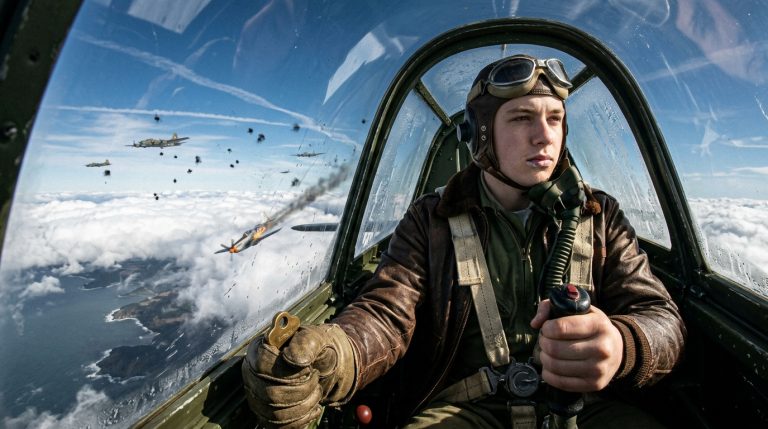
G-force pinned my spine back against the ejection seat as the jet cut through the low-hanging desert clouds.
Rain rattled like gravel against the acrylic glass, the canopy shivering violently as fifty-knot crosswinds slammed against the airframe over the notch.
"—Ghost-Seven, this is Control," the JTAC's voice crackled through my helmet, laced with high-altitude static. "Lead pair is low on fuel and pulling off. You are the only asset in the sector."
"Copy, Control. Ghost-Seven is in hot," I said, my thumb resting flat over the weapons delivery switch on the stick.
I rolled the aircraft left, dropping thirty degrees through the dark cloud deck until the black mouth of the dry riverbed opened up below.
Muzzle flashes strobed along the northern treeline—short, jagged bursts of light chewing into the dirt wall where four friendly soldiers sat pinned.
I didn't dump munitions blindly into the dark to make a loud impression.
I leveled the wings, rode the violent updraft over the notch, and laid down a single, surgically controlled burst directly into the tree ridge.
The sudden silence over the radio lasted three full seconds before the ground commander’s voice broke through, raw and panting.
"Control! Target neutralized! Enemy breaking contact—we are moving to the extraction point!"
I pulled back on the stick, the jet climbing smoothly back into the black rain as the radio frequencies quieted into operational order.
Down in the operations tent, Captain Ror stood red-faced by the tactical console, holding his headset away from his ear as the JTAC logged the official strike time.
"It was a lucky wind shift," Ror snapped loudly to the room, his hands trembling as he tried to roll up his laminated map. "Anyone could have made that pass once the coordinates were cleared!"
The JTAC didn't answer him, nor did the ground crew monitoring the live feed.
Ror looked around the room for support, but the other pilots kept their eyes fixed on their kneeboards, the silence heavy and suffocating.
Out on the runway, my aircraft rolled to a stop under the floodlights, the turbine whining down into a low, metallic murmur as the crew chief dragged the wheel chocks into place.
CHAPTER 6: THE UNSPOKEN RECKONING
The metal skin of my aircraft ticked softly as it cooled in the damp night air, heat radiating off the engine casing in faint, translucent waves.
I unzipped my cuff a quarter inch further, ensuring the faded, worn squadron patch remained hidden out of sight, tucked deep inside the inner lining where it had stayed for eight years.
Captain Ror stood near the entrance of the command tent, his flight suit collar unbuttoned, his hands shoved deep into his pockets while two maintainers dragged a heavy starter cart past his boots.
He didn't step forward with an apology, and he didn't offer a polite handshake to patch over three weeks of loud, arrogant taunts.
Instead, his shoulder hitched once, his throat swallowing hard as his eyes met mine across twenty yards of gravel.
Ror raised his right hand to his brow.
It wasn't a theatrical motion for an audience, nor was it a warm gesture of camaraderie.
It was a sharp, rigid, and completely silent salute—a total surrender of his unearned pride to the cold reality of raw, quiet competence.
I held my helmet under my left arm, brought my right hand up, and returned the crisp salute once, holding it for a single beat before lowering my arm.
Ror turned around, his eyes dropping to the dirt as he retreated quietly into the shadowed back corner of the briefing tent.
The JTAC operator walked past me a moment later, holding two hot paper cups of black coffee from the burner.
He set one cup on the wooden crate beside my flight gear without saying a word, nodding once before heading toward the maintenance shack.
I sat down on the crate, pulled my hard-cover paper notebook from my side pouch, and opened it to a fresh page.
I clicked the cap of my mechanical pencil once—click—and began writing down the fuel burn numbers and wind corrections for tomorrow's dawn flight.
No speeches, no gloating, and no noise.
Just the steady, quiet work that keeps people alive when the sky turns dark.