The Industrial Iron Tide: A Weary Veteran’s Stand Against an Unstoppable Machine
CHAPTER 1: THE SHATTERED FARMYARD
Rain hit the split pine beams like thrown pebbles, but the real sound was three kilometers west—a steady, industrial thud that shook the dry mud right out of my boots.
I pressed my shoulders hard against the remnants of the brick wall, feeling the rough mortar bite through my damp wool tunic. Across the ruined courtyard, young Müller sat crouched behind a overturned hay wagon, his fingers frantically working a stub of pencil across a scrap of wet paper.
“Stop rubbing your lip, Müller,” I said, my voice raspy from cold tea and two days of breathing cordite. “You’re going to bleed through the skin.”
The kid flinched, dropping his hand to his knee. “Unteroffizier, the road to the east is totally clear, but the artillery… it hasn’t shifted off the crossroads in forty minutes.”
“It won’t shift,” I muttered, wiping grease off my pocket-worn steel pry bar with my thumb. “They aren’t guessing where we are. They’re just sweeping the map like a broom.”
A low whistle cut through the air, followed by a heavy thump that vibrated up through the stone foundations under my soles. The barn roof groaned above us, raining down a fresh layer of dry straw and black plaster dust.
“Gefreiter,” I called out, motioning toward the rear of the collapsed structure. “Check the back wall for a tractor gap. We aren’t staying here until they decide to flatten the foundation.”
Müller scrambled over a mound of charred rafters, his boots making a heavy, awkward crunch against the scorched floorboards. Two seconds later, his face reappeared through a gap in the timber, drained of what little color it had left.
“Unteroffizier Bremer,” he called out, his voice dropping into a tight, disbelieving whisper. “You need to come look at this right now.”
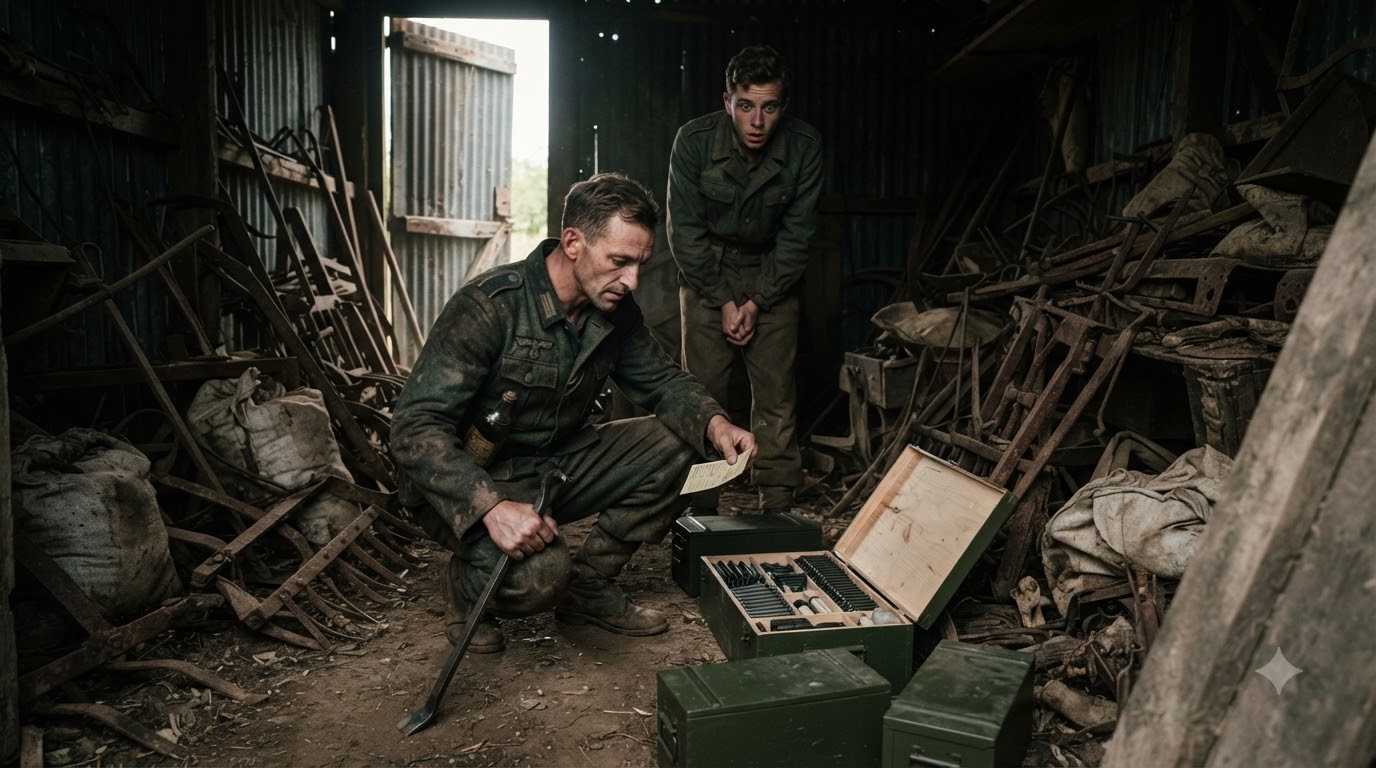
I picked up my Mauser, the worn walnut stock cold against my palm, and ducked under a sagging oak beam. In the corner of the dark tool shed, half-shielded by a fallen corrugated iron sheet, lay four rectangular wooden boxes.
They weren’t rough pine rough-sawn by field engineers. The oak boards were planed smooth, sealed with clear lacquer, and bound at every joint with crisp, zinc-coated steel bands that showed zero rust despite the damp air.
Stenciled across the top lid in thick, black ink were clean English characters: SUPPLY DIVISION – CAT 4 – LOT 882.
“American,” Müller whispered, touching the edge of the smooth timber like he was reaching out for a hot iron stove. “They were here. They just left them.”
“They didn’t leave them because they ran,” I said, wedge-fitting the sharp flat end of my steel pry bar under the corner of the nearest lid. “They left them because they have ten more trucks behind this one.”
I put my hip into the tool and leaned down. The nails gave way with a clean, sharp pop, revealing the oiled lining inside.
CHAPTER 2: THE LOGIC OF IRON
The nails screamed as the oak lid gave way, exposing a thick sheet of oiled paper that smelled sharply of paraffin and high-grade petroleum.
Müller leaned over my shoulder, his breathing shallow against the back of my neck. “Is it bombs?”
“No,” I said, peeling back the stiff, waxed wrapping. “It’s something worse.”
Row upon row of spring-steel M1 Garand clips sat wedged into fitted wooden slots, their dark blued metal completely free of dust or grease stains. Beneath them, neatly divided by clean pine partitions, sat small cardboard boxes stamped with lot numbers, dates, and factory locations from places like Illinois and Connecticut.
I reached in and pulled out a small, heavy canvas roll tied with a crisp cotton string. Unrolling it against my knee revealed three sectioned steel cleaning rods, a brass wire brush, a tiny glass bottle of gun oil, and pre-cut flannel patches stacked like fresh bank notes.
“They built a box just for cleaning gear?” Müller muttered, squinting at the English lettering. “Our armorer carries two brushes for the whole company, and one of them is missing half its bristles.”
“Look closer,” I said, pointing the tip of my pry bar at the lower compartment.
A small, sealed envelope made of heavy parchment rested between two spare rifle barrels. I hooked it with my thumb and tore the edge open. Inside was a small, pre-printed card listing every single internal component of the rifle, complete with checkbox columns for inspection dates, wear tolerances, and estimated replacement intervals down to the exact number of rounds fired.
It wasn’t just a box of bullets. It was an entire factory’s worth of maintenance logic, packed up, trucked across an ocean, and dropped into a French ditch so a nineteen-year-old farm boy from Iowa wouldn’t have to think about where his next extractor spring was coming from.
“They aren’t fighting us with tactics,” I said, my voice barely carrying over the distant, rhythm of the American guns three kilometers back. “They’re running a business, and we’re just the obstacle on the ledger.”
Müller’s hand hovered over a box of eight-round clips. “Should we take them? For the Mausers?”
“They don’t fit our chambers, kid,” I said, slapping his wrist away with the flat of my palm. “And we don’t have the trucks to haul forty pounds of American wood.”
I grabbed one small bottle of machine oil, shoved it deep into my tunic pocket alongside my steel pry bar, and stood up. The straw beneath my boots felt wet, soaked through by the rising humidity of the afternoon rain.
Outside, the heavy boom-boom-boom of the American battery suddenly cut off, leaving an eerie, ringing silence in the ruined barn.
“Unteroffizier,” Müller whispered, his head snapping toward the open doorway. “Why did they stop?”
“Because they don’t waste steel on empty fields,” I said, turning toward the back wall. “Move. Now.”
CHAPTER 3: THE RETREAT TO HURTGEN
Standing at the edge of the pine forest, boots sinking three inches into wet pine needles, watching the gray mist roll down from the ridge.
“We aren’t going to make the road before nightfall,” Müller said, wiping mud off his cheek with his wet wool sleeve. “The boots are waterlogged, Unteroffizier. My heels are raw.”
“Keep moving,” I said, tapping the cold steel pry bar against my thigh. “The road is where their spotter planes look. The timber is where we stay alive.”
The forest was dense, dark, and endless—stretching eastward toward the German border in a jagged wall of pine and slate rock. Every step required pulling a boot free from black mud that sucked at the leather seams like grease.
Behind us, three miles back, another salvo hit the valley floors with a dull thump-thump-thump. It was distant now, but the rhythm never changed—steady, unhurried, like a factory punch press stamping out sheet metal on a shift rotation.
Müller stumbled against a fallen trunk, catching himself with a sharp gasp. “How do they have the shells for this? Back at Kursk, our batteries had to clear every three-round salvo with division command.”
“They don’t ask permission,” I replied, grabbing his collar to haul him upright. “They just feed the belt.”
My hand brushed the small glass bottle of American oil in my tunic pocket. The smooth glass felt warm against my hip, a strange contrast to the freezing drizzle soaking through my shoulders.
A sudden crack echoed through the trees ahead—not artillery, but the sharp, snapping crackle of broken branches under heavy weight.
Müller went flat against the mud before I could even grab his webbing. I dropped beside him behind a moss-covered boulder, resting the Mauser’s barrel on the wet stone, my finger resting flat along the trigger guard.
Through the gray mist, two dark figures emerged from the tree line, moving slow and heavy, their heads ducked against the rain.
“Hold,” I whispered, feeling the cold water soak straight through my knee trousers.
CHAPTER 4: THE COMMAND POST IN THE FOREST
Crouched behind a mossy boulder, Mauser barrel leveled on two shadows emerging through the gray Hurtgen mist, my knuckle white against the trigger guard.
“Friendly!” a jagged voice barked through the pines. A hand pushed through the pine branches, holding an inverted helmet by its leather chin strap. “275th screening patrol. Don’t shoot.”
Müller let out a shaky breath that turned into a thin tail of steam in the cold air. I lowered the rifle, my thumb sliding the safety back into place with a dry click.
Twenty minutes later, the timber gave way to a half-collapsed brick farmhouse tucked into a ravine. The right wall was entirely gone, replaced by a dark green canvas tarpaulin that slapped continuously against the stone in the autumn wind. The smell inside hit first—stale tobacco, damp wool, and the thick, iron tang of men who had stopped expecting to dry out their clothes.
Major Westerhaus didn’t look up from his map table when we stepped over the threshold. He was fifty-three, built like a stone pillar, with a permanent slight lean forward as if bracing for a roof beam to drop on his neck.
“Report,” he said, his voice grating like gravel turning under a boot heel.
“Squad intact, Herr Major,” I said, stepping past a mud-caked signals crate. “Retreated from grid 447. The Americans have established a supply dump behind the ridge.”
Westerhaus held a wooden pencil across a contour line on his map. “Ammunition?”
“Not just ammunition,” I said, pulling the small steel pry bar from my tunic and setting it on the edge of his table alongside the small glass bottle of American oil. “It’s a whole maintenance unit. Pre-packaged, modular, labeled down to the last screw.”
Westerhaus finally looked up, his narrow eyes resting on the clear glass bottle. He picked it up with two fingers, turning it slowly against the dim yellow light of an oil lantern.
“They aren’t running short,” I added, looking him square in the eye. “They’re shipping system kits directly to their forward squads.”
The canvas tarpaulin flapped hard against the wall with a sharp crack that made Müller jump behind me. Westerhaus didn’t blink. He just set the bottle back down on top of his grid map, right over the symbol for our sector headquarters.
“Send for Vogel,” Westerhaus said quietly to the runner by the door. “Tell him the enemy brought his factory with him.”
CHAPTER 5: THE ASSESSMENT OF POWER
Standing inside the dark, flapping command bunker as Captain Vogel enters, adjusting his round wire glasses with a wet thumb.
“You called for signals, Herr Major?” Vogel said, his voice clipped as he brushed pine needles from his tunic.
Major Westerhaus didn’t speak. He simply nudged the small, clear bottle of American oil across the damp map surface until it tapped against Vogel’s brass pencil case.
Vogel picked up the glass vial, holding it up to the dim lantern light. “Machine oil. Refined petroleum. What about it?”
“It came out of an ammunition crate in grid 447,” I said, leaning my hip against the timber support beam. “Packed alongside twenty-four M1 Garand clips, spare firing pins, and a sectioned cleaning rod. Standard issue for forward squads.”
Vogel set his glasses straight on the bridge of his nose, his eyes narrowing as he calculated the industrial math. “A complete maintenance system at squad level. Not a single armorer required.”
“It means their supply chain isn’t just delivering steel, Captain,” Westerhaus said, his broad hand dropping onto the map with a heavy, flat sound. “It means their front line is designed to operate continuously without relying on a rear depot.”
“Their artillery response times,” Vogel muttered, his eyes drifting over the red grid markings on the paper. “Every forward team carries the same standardized capability. If they don’t have to stop to salvage parts or request cleaning gear, their operational tempo remains unbroken.”
“They aren’t smarter than us, Vogel,” Westerhaus said, turning his cold stare toward the canvas curtain snapping in the wind. “They just built a machine that doesn’t suffer from friction.”
Müller shifted his feet behind me, his waterlogged boots making a soft squelch in the floor mud. “So what do we do, Herr Major?”
Westerhaus reached out, grabbed the small oil bottle, and shoved it straight into his coat pocket. “We pull the forward screen back three hundred meters into the rock face. We don’t fight a machine in the open.”
CHAPTER 6: THE WALL OF STEEL
Standing at the rock face ledge, wet pine needles sticking to the collar, watching the first artillery round impact the empty valley floor below.
A wall of black earth erupted two hundred meters down the slope, spraying shredded pine needles and wet shale against the granite cliff. The shockwave hit my chest like a flat palm, rattling the loose teeth in my jaw.
Müller pressed his forehead flat against the cold stone beside me, his hands clamped tight over his ears. “They aren’t even looking at us! There isn’t an observer on that ridge!”
“They don’t need one,” I shouted over the rising whine of incoming iron. “They mapped this grid before breakfast!”
A second shell detonated forty yards to the left, taking out a cluster of birch trees with a violent, tearing crunch. The impact didn’t come as a surprise—it arrived on a precise five-second interval, dropping shells in a straight, mathematical line across the treeline we had abandoned twenty minutes prior.
I pulled my steel pry bar from my tunic belt, feeling the vibration of the exploding dirt travel right up through the mountain granite into my palm.
“Unteroffizier!” Müller yelled, his eyes wide as a shower of hot dirt rained over his helmet. “The path behind us is getting cut off!”
“It isn’t a strike on us, kid,” I said, grabbing his shoulder and dragging him deeper into the granite crevice. “They’re walking the line. Sweeping the sector methodically.”
The sheer audacity of it sat heavy in my gut—not a single infantryman in sight, no daring tactical maneuvering, just an automated wall of high explosives crushing every square foot of soil according to a pre-printed chart. They were clearing a forest the same way a farmer clears a field of stumps.
Another round slammed into the rocky outcrop above our ledge, showering us with sharp gravel and dark soot.
“We can’t stay in this crevice,” I muttered, scraping a layer of wet grit off my Mauser’s bolt. “When that line of fire hits the ridge apex, the whole overhang is coming down.”
CHAPTER 7: THE CORNERED RIDGE
Crouched in the narrow granite gap, shoulder pressed to wet slate, waiting for the exact pause between five-second artillery impacts to spring across the exposed ridge.
“Four,” I counted aloud under my breath, watching the smoke clear from the last crater. “Five—go!”
I yanked Müller by his leather webbing, dragging him out of the crevice and onto the slick, open slate. Our boots skidded across frozen mud and loose shale, the heavy Mausers slapping hard against our backs with every desperate stride.
Behind us, a high-pitched scream cut through the mountain air, followed instantly by a deafening CRACK that blew the granite overhang into a thousand flying splinters. The blast wave threw me forward onto my hands and knees, the sharp rock scraping right through my trousers.
“Up, kid!” I barked, grabbing the back of his coat collar and hauling him toward a thick stand of pine timber thirty yards ahead. “Don’t look back! Keep your feet moving!”
Müller scrambled forward on all fours, his breath coming in ragged, terrified gasps. He didn’t question the direction—he just followed the pull of my arm as we dived headfirst under the low, needle-heavy branches of the pine thicket.
We rolled down a short mud embankment, landing hard in a dead-end ravine lined with jagged basalt boulders. Above us, the mountain ridge was enveloped in a rolling cloud of gray cordite smoke, the continuous, five-second rhythm of high explosives walking relentlessly away toward the eastern valley.
Müller sat backed against a stone wall, clutching his rifle to his chest, his jaw trembling violently as he stared at the churning smoke above. “They blew the ridge away. They didn’t even know we were on it, and they just blew it away.”
I sat back on my heels, pulling the flat steel pry bar from my belt and scraping a thick chunk of burned soil off its metal tip. “They don’t care who is on the ridge, Müller. They just had an order to clear grid 448 by noon.”
“We’re trapped in this ditch,” he whispered, his eyes scanning the steep, mud-slick walls of the ravine. “There’s no way back to the command bunker.”
“We don’t go back,” I said, my voice flat and quiet as I stowed the pry bar. “We sit right here, let their iron wave roll over us, and stay alive.”
CHAPTER 8: THE ENDLESS HORIZON
Sitting back against a wet basalt rock in the quiet ravine, scraping mud off the steel pry bar while the distant artillery rumble fades into the east.
Müller lay on his side, his hands still loosely curled around the stock of his Mauser, his breathing finally slowing to a steady, even rhythm. The sky through the pine canopy had turned a dull, bruised purple as evening settled over the forest.
I worked the tip of the pry bar along the iron edge, knocking off the last stubborn flakes of dried French clay until the dull steel beneath showed clean.
“It stopped,” Müller whispered, his head turning slowly toward the ridge.
“It didn’t stop, kid,” I said, stowing the pry bar back into my belt loop. “It just moved to the next grid square.”
The realization sat between us, heavy and plain, with no room left for arguments or clever plans.
There were no supermen across that valley. There were no master strategists plotting brilliant encirclements or speech-makers rallying troops with heroic words. There were simply thousands of standardized wooden boxes moving west to east, packed by people who measured a war in lot numbers, assembly times, and pre-cut flannel patches.
Every squad had its kits. Every company had its spare parts. Every position we held was just a set of six-digit numbers waiting on a card inside a well-oiled machine that never ran out of paper or fuel.
You don’t defeat a factory by being brave. You don’t outsmart an assembly line with grit. You just hold your ground until the shift changes, or you get out of the way of the conveyor belt.
“Unteroffizier,” Müller said softly, reaching into his pocket and pulling out a small, crumpled piece of paper. “What do we do now?”
“We clean the rifles,” I said, pulling my Mauser across my knees and unlatching the floorplate. “Then we move east and find a dry place to sleep.”
I unstoppered the small glass bottle of American oil I’d taken from the barn, poured two clear drops onto a scrap of wool rag, and began rubbing the steel bolt clean.