The Cold Ridge Protocol: How a Montana Bear Tracker Silent-Hunted an Elite Enemy Squad in the Vosges
CHAPTER 1: THE COLD CHALKBOARD
Eleven dead men lay frozen in the mud of the Vosges, and the lieutenant was still arguing about regulations.
Carl Bear Whitlock kept his shoulder pressed flat against the damp bark of the fallen pine, feeling the bite of the thirty-eight-degree dirt soaking straight through his trousers. Across the valley, three hundred and eighty yards up the mist-heavy ridge, a faint metallic click echoed off the granite face—a German marksman adjusting his turret ring.
“You’re a guide, Sergeant, not an officer,” Lieutenant Morrison muttered, his knuckles white around his field glasses as he hunkered in the shallow depression. “Army doctrine says we sit tight for artillery.”
“Artillery denied us two hours ago, sir,” Whitlock said, his voice flat, low, and devoid of heat. He reached into his coat pocket, his calloused thumb rolling a single brass casing with a notched rim against his index finger. “And low clouds mean no planes. In forty minutes, the sun clears that eastern peak, and those nine boys up there will start shooting anything that twitches.”
A spray of gravel kicked into Whitlock’s face as a high-velocity round cracked through the freezing air, punching clean through a mess kit three feet away. Private Miller didn’t even scream; he just pulled his boots back deeper into the brush, hyperventilating in silent terror.
“They’re professionals, Whitlock,” Morrison hissed, wiping mud from his chin while keeping his head buried. “They went to specialized schools in Zossen. They know windage, range tables, overlapping fields of fire.”
“They know paper,” Whitlock said, thumbing the safety on his standard-issue M1 Garand—a heavy, wooden-stocked rifle with crude iron sights, completely lacking the fine optical glass he’d used for sixteen years back in Glacier. “They think this mountain is a chalkboard. They shoot, they check a box, they wait for us to do what the manual says.”
He peered through a tiny gap in the pine needles, ignoring the stinging cold in his nose and lungs. High on the eastern slope, a subtle shadow shifted—not a man moving, but the unnatural stiffness of a pine bough that didn’t sway with the morning breeze.
“They killed Matthews because he stopped to read a map in the open,” Whitlock whispered, watching the shadows settle. “They killed Davis because he ran out to grab Johnson without looking at the ridgeline first. They’re hunting us like livestock because you’re letting them set the pace.”
Morrison looked at his remaining thirty-four men, huddled like wet dogs in the frozen dirt, terrified to breathe. “You really think you can clear three ridgelines alone with iron sights?”
“I’ve tracked forty-seven grizzlies through the Rockies with less notice than this,” Whitlock said, adjusting the heavy wool strap of the Garand over his shoulder. “A bear doesn’t give you six hours to figure out where he is. Give me until noon. If I’m not back, you know the ridge is still theirs.”
Morrison stared at him for three long seconds, the absurdity of the situation hanging between them in the cold fog, before he finally gave a single, reluctant nod.
Whitlock didn’t waste words; he simply slid backward into the brush like a pine needle dropping into deep water.
CHAPTER 2: THE FIRST NOTCH
The frozen granite scraped against my ribcage through the wool jacket, but I didn’t stop sliding until the pine needles buried my boots. Sixty yards north of Morrison’s ditch, the air smelled of wet stone and crushed sap.
I didn’t use a scope to check the ridge. Glass catches the morning light if you’re careless, and those boys up there were trained not to miss a glint.
Instead, I pressed my cheek against the cold receiver of the M1 Garand, lining up the front post in the rear aperture, watching the tree line three hundred and eighty yards across the gap.
A grizzly in the timber doesn’t look for you; he looks for the space you’re filling. Humans leave jagged edges where the forest wants to curve.
My eye caught a small discrepancy twenty feet up a blue spruce—a pine branch bound tightly to the trunk with a twist of greasy bailing wire. The needles were dead, dried to a rust-red hue, forming a tiny, artificial window right toward our trench line.
It wasn’t a hide. It was a range marker.
Someone had climbed that tree weeks ago, long before Baker Company ever crossed the river, and measured the distance down to the inch.
A soft scrape of leather on bark rustled from the high rocks thirty yards to the left of the marker. The shooter was sitting comfortably in a natural notch, his Mauser K98 resting on a canvas sandbag, completely relaxed because he thought he owned the sky.
I rolled the notched brass casing in my pocket once, letting the sharp metal edge bite into my thumb to anchor my breathing.
A standard military marksman waits for a clean chest shot. A bear hunter shoots where the animal is going to be when the trigger breaks.
The German shifted his head to check his elevation turret, his helmet tilting just two inches past the grey shadow of the rock.
I didn’t wait for a better angle. I squeezed the Garand’s heavy trigger.
The rifle slammed backward into my collarbone with a flat, dry crack that shattered the mountain silence.
Across the canyon, the shadow behind the rock folded instantly, a heavy wooden stock clattering down the scree before wedging in a scrub bush.
The Garand’s steel pinged as the empty clip ejected, ringing out like a small bell in the freezing air. I didn’t watch him fall; I dragged myself backward on my elbows, slithering five yards deeper into the rock crease before the echo even died.
Two seconds later, a heavy 7.92mm round smashed into the exact patch of moss where my elbow had been resting, showering my neck with frozen dirt and pulverized stone.
The second shooter on the eastern peak had fired on my muzzle flash. He was fast, professional, and completely wrong about my position.
I lay dead still in the frozen dirt, letting the grey smoke drift away down the ravine, listening to the high, thin wind whine through the timber.
They knew there was a rifle in the brush now. But they still thought they were the only hunters on the mountain.
CHAPTER 3: BAITED BREATH
The iron receiver of the Garand was cold enough to stick to the skin of my right cheek, but I didn’t pull away. I lay in the frozen mud of the drainage ditch, listening to the heavy metallic clack of a Mauser bolt being cycled high up on the eastern peak.
That second shooter wasn’t panicking. He was methodical.
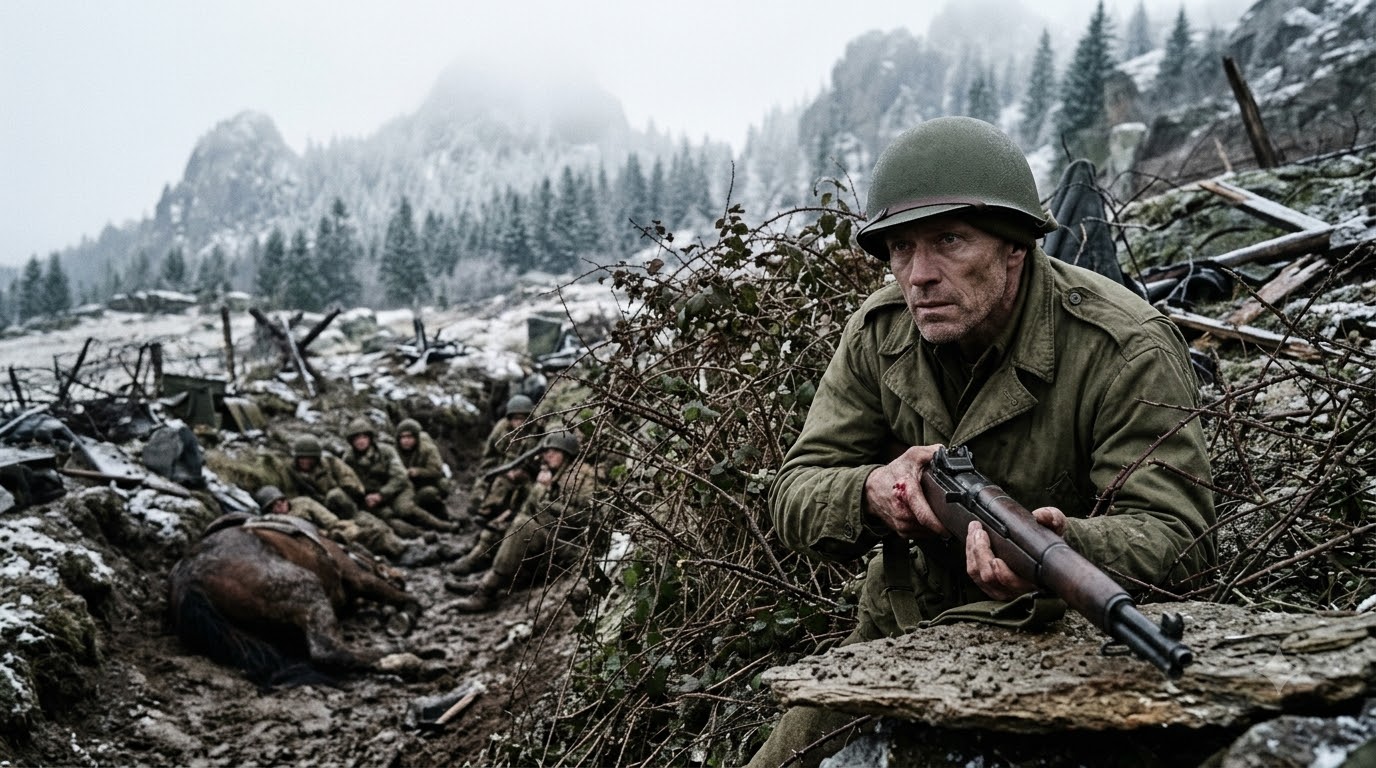
Down in the hollow, forty yards behind my left heel, Private Johnson let out a low, wet groan. He was hit in the thigh three hours before dawn, trapped behind a dead horse, his coat soaked through with freezing mud.
“Help…” Johnson whimpered, his voice carrying thin and sharp in the crisp mountain air. “Someone… please…”
From the eastern ledge, a pine cone rattled loose, bouncing down the granite face. I didn’t look at Johnson. I looked at the canopy above him.
They weren’t trying to finish Johnson. They were keeping him breathing on purpose. Every time he stirred, a fresh spray of dirt kicked up near Morrison’s trench as some terrified kid tried to crawl out with a bandage roll, only to be driven back by a near-miss.
It was an old livestock trick. You don’t kill the calf if you want the cow to come out into the clearing.
I dug the toes of my boots into the icy slush, inching four inches sideways until my front sight post lined up with a tiny gap between two boulder faces.
Through the rear ring, I saw the subtle shift of wool—a grey-green sleeve leaning out just far enough to keep eyes on Johnson’s boot. The shooter was sitting back on his heels, anchoring himself against a flat rock face, waiting for Morrison to lose his nerve and send an NCO out.
“Keep your head down, Johnson!” I called out, my voice raspy from the frost, keeping my throat low against the earth so the sound wouldn’t give away my angle. “Don’t move a muscle!”
The German’s shoulder twitched. He heard me. He leaned another half-inch forward, angling his scope down toward the source of my voice, expecting a man standing in the brush.
That half-inch was all he had.
I took a slow breath, letting the freezing air fill my chest, and caught the front post right on the fold of his collar. I didn’t snap the trigger; I rolled the pressure on smooth and steady until the rifle cracked.
The wood stock slapped hard against my collarbone. Across the gap, the grey wool sleeve jerked backward violently, the Mauser slipping from his grip and clattering down sixty feet of sharp shale before snapping its stock on a root.
I didn’t celebrate. I didn’t even rack a new round into the chamber before I rolled hard to my left, tumbling six feet down the bank into a tangle of wild blackberry thorns that tore through my trousers.
A third rifle answered instantly from a high ledge two hundred yards south. The heavy bullet punched deep into the dirt wall where my ribs had been resting a fraction of a second earlier, blowing a cloud of frozen grit over my face.
I pulled my knees to my chest in the thorn bush, wiping wet dirt from my eyes with the back of my sleeve, feeling the sting of scratches blooming along my jaw.
Five left. And now they knew the hunter wasn’t sitting in Morrison’s ditch.
CHAPTER 4: THE ANGLE OF THE SUN
A sharp branch from the blackberry bush tore across my left thumb as I pulled the Garand’s wooden stock tight against my ribcage, but I didn’t flinch.
The sun had just cleared the ridge behind me, painting the western rock face in a harsh, pale yellow light. Shadows were shrinking fast, turning every open patch of granite into a mirror.
Grizzlies in late autumn stay high on the timberline when the sun hits the valley, keeping the glare in your eyes while they watch you from the dark.
I hauled myself up forty feet of jagged scree on my elbows, feeling the sharp edges of shale grind against my kneecaps through the damp wool. My lungs burned with every breath of freezing mountain air, but I kept my nose low to the stone, tracking the subtle shifts above.
Two hundred yards up, a flock of black jays suddenly burst from a clump of stunted alpine firs. They didn’t scatter like they would for a falling branch. They circled twice, screeching in angry, sharp bursts, before settling forty yards farther down the ledge.
Something was occupying that fir patch.
I pulled myself behind a lichen-covered boulder, resting the heavy barrel of the Garand across a flat notch in the rock. Without a scope to bring the shadow closer, I had to read the mountain’s breathing.
The wind shifted from the west, bringing the faint smell of woodsmoke—not pine, but dry birch, burned in a tiny, concealed trench stove.
These men weren’t just passing through; they’d built an engineered encampment up here while Baker Company was still miles back in the valley. They had set up a permanent kill box, expecting us to run straight into the funnel like spooked deer.
A tiny flash—no bigger than a brass button—flickered near the base of the firs as the morning sun caught the edge of an optic lens.
The shooter was sitting behind a stone parapet, completely blind to his own reflection because the shadow of the overhang felt safe to him.
I rolled the notched brass casing in my pocket with my left thumb, calculating the drop. Two hundred and ninety yards. Downhill angle. The iron sights would overshoot if I aimed center-mass.
I aligned the front blade just below the bottom edge of the stone parapet, right where a man’s chest would rest if he was leaning over his stock.
I held my breath, letting my heartbeat slow until the front post stopped trembling against the grey rock.
The Garand barked, recoil shoving hard into my shoulder.
A high, metallic thunk echoed across the canyon as the heavy round slammed into the parapet wall. A rifle barrel whipped up into the sunlight, spinning twice before plunging into the gorge below.
Movement flickered fifty yards to the left—a second grey-coated figure scrambling out of a shallow rifle pit, abandoning his cover in a desperate bid to reach higher ground.
I didn’t wait for him to set his bipod. I racked the Garand’s bolt, lined up the front sight on his shoulder blades as he crossed an open seam of shale, and squeezed again.
The lead shooter collapsed sideways, sliding ten feet before catching on a dead root.
Four down. Three left.
I pressed my back against the boulder, gasping for air, the heat of the hot steel barrel warming my freezing knuckles as the shadow of the upper ridge crept over my boots.
CHAPTER 5: THE TRAP AT THE GAP
My boots found a two-inch ledge of frozen granite inside the chimney, my heels hanging over a hundred-foot drop, while the scrape of iron studded boots grew louder directly above my head.
The lead instructor from Zossen wasn’t running away. He was drawing me into the narrow throat of the gap where the rock walls pinched tight enough to scrape both shoulders.
A lone pine cone tumbled down the vertical seam, bouncing off my helmet before dropping into the dark abyss beneath my boots.
He knew I was climbing without glass. He knew an iron-sighted service rifle required a wide view, and this chimney turned the world into a five-inch vertical strip of grey sky.
I pressed my back against the wet, mossy wall, holding the heavy wooden stock of the Garand flat across my chest. The cold from the stone soaked straight through my wool coat, freezing the sweat along my spine into needle-points of ice.
A shadow crossed the top of the fissure—not a head or a rifle barrel, but a grey wool mitten dangling a piece of oiled canvas over the ledge.
He was testing the draft, seeing if my breath would steam up from the floor to give away my exact height in the chute.
I pulled my wool scarf over my mouth, suppressing the deep, burning rattle in my chest, and held my breath until my vision blurred around the edges.
Above me, a rifle bolt clicked back—smooth, oiled, and precise. A heavy 7.92mm round punched clean through the rock ledge four inches above my left ear, showering my neck and eyes with razor-sharp stone splinters.
He didn’t fire from where he stood. He had rigged a string through a piton, firing the trigger from ten feet back behind a solid slab of granite.
It was an textbook trap, designed to make a man panic, duck, and step out into the open ledge where his partner had a clear line of sight.
I didn’t step back. I jammed my left elbow deep into a granite crack, using the friction of my sleeve to anchor my body, and reached up with my right hand to roll the notched brass casing against the rock face.
A bird flared wildly from the northern ledge forty yards across the gap—a high-altitude crow spooked by the sudden movement of a second man shifting his weight behind the summit cairn.
Number eight was waiting for me to dodge number nine.
“I know you’re up there, Zossen!” I shouted into the rock face, my raspy voice bouncing off the granite walls like a hammer striking iron. “You measured this gap three weeks ago!”
The scraping stopped. A long, heavy silence stretched across the freezing chute.
An arrogant man who thinks he built the maze can’t stand when a subject names the walls.
A helmet rim extended an inch past the upper lip—just far enough for an instructor to look down and see why his trap hadn’t produced a falling body.
I swung the heavy Garand up with one hand, jamming the front iron sight post straight into the center of the grey shadow, and pulled the trigger.
CHAPTER 6: THE LONG SILENCE
The frozen granite pressed flat against my belly as I squinted through the Garand’s rear aperture, watching a tiny strip of hessian camouflage sway against the grey stone four hundred yards out.
The last instructor from Zossen wasn’t moving. He didn’t blink, he didn’t adjust his optical turret, and he didn’t shift his boots on the frost.
He was relying on his doctrine—the precise mathematical calculations his school had mapped into these slopes before my platoon ever set foot in France. In his mind, an American soldier with an iron-sighted service rifle couldn’t resolve a target past three hundred yards in this light.
He was waiting for me to run out of patience and walk into his field of fire.
I rolled the notched brass casing in my pocket one last time, feeling the sharp indentation under my thumbnail, and let it slip into the frozen dirt beside my elbow.
I didn’t need a four-power scope to tell me where his head rested.
A bear hunter doesn’t shoot at the fur; he shoots at the anatomy hidden beneath it, reading the angle of the shoulders and the way the weight settles against the earth.
I nudged the Garand’s front post two inches above the moving strip of netting, compensating for the wind sweeping through the northern gap, and exhaled half a lungful of freezing air.
My thumb squeezed the trigger guard. The heavy wooden rifle kicked hard into my collarbone, the report echoing off the granite faces like a crack of thunder.
Across the gorge, the camouflage netting jerked wildly. A long, scoped Mauser slid from the rock face, tumbling down three hundred feet of sheer cliff before shattering against the lower shale.
The mountain went dead silent.
No bolt actions clicked. No boots scraped against stone. The thin alpine wind whined through the pines, carrying off the last wisps of grey powder smoke.
All nine ridgelines were clear.
I pushed myself up from the mud, my knees popping in the cold air, and slung the heavy Garand over my shoulder. My hands were stiff, stained with dirt and pine sap, but the iron sights were intact.
When I reached the bottom of the draw, Morrison was standing at the edge of his ditch, his face pale and smeared with wet soot, staring at the quiet peaks above.
“It’s over, Lieutenant,” I said, stepping past him toward the supply crate. “The ridges are clear. Get Johnson on a stretcher.”
Morrison looked down at my battered service rifle, then up at the high rocks where nine elite marksmen had held an entire company hostage for eighteen hours.
“How did you clear a Zossen kill box with open sights?” he asked, his voice barely a whisper.
“They studied manuals, sir,” I said, reaching into my pocket for a piece of dry chalk to mark my cartridge belt. “They forgot that a mountain doesn’t care about your diploma.”
I sat down on a pine log, pulled a small rag from my pack, and began wiping the frozen mud from the steel receiver of my rifle, one smooth stroke at a time, while Baker Company quietly packed their gear to move.