The Networked Forest: How an Abandoned SCR-300 Revealed the Mechanics of American Victory
CHAPTER 1: THE COLD WEIGHT IN THE ROOTS
The pine needles held the damp right against the mud, slick and black around the exposed oak roots. Oberfeld Klaus Brener didn’t rise from his crouch. He kept his weight on the balls of his boots, the cold dampness eating through the wool of his trousers at the knees.
Behind him, Private Holtz stayed still. The nineteen-year-old’s breath came in thin, quiet hitches, his hand locked around the wooden stock of his Mauser. Brener reached out with his left hand, his thumb working the textured wheel of his brass trench lighter. Click. The flint gave nothing—just a dry, mechanical scrape against damp steel. He lowered his hand and reached into the depression between the roots.
The canvas bag was heavy with water, but the metal box inside was firm. Brener ran two fingers across the cold olive paint, searching the seam for fine tripwires or hidden tension leads. Nothing snapped. Nothing gave. He unhooked the brass latch and pulled the sheet-metal case out into the gray gloom of the Hurtgen.
“What is it, Oberfeld?” Holtz whispered, his eyes darting toward the western ridge where the birch trunks thinned out. “A generator?”
“A transmitter,” Brener said. His fingers traced the block letters stenciled across the top plate. STR300. On the inner side of the lip, a strip of beige cloth tape held four words written in faded graphite: CPL, Marcus T. Reeves, HQ.
Brener stood up slowly, the iron-cold frame of the radio tucked under his arm. To the west, two hundred meters off, a branch cracked under a heavy combat boot. A voice followed—short, sharp, American English—shouting a single syllable before the wind cut it clean away.
Brener didn’t raise his Kar98. He simply adjusted his grip on the cold metal handle, turned back toward the east, and started walking through the mud.
CHAPTER 2: THE ENGINEERS CALCULATION
The damp stink of wet wool and stale tobacco hit Brener before he even set his boots on the floorboards.
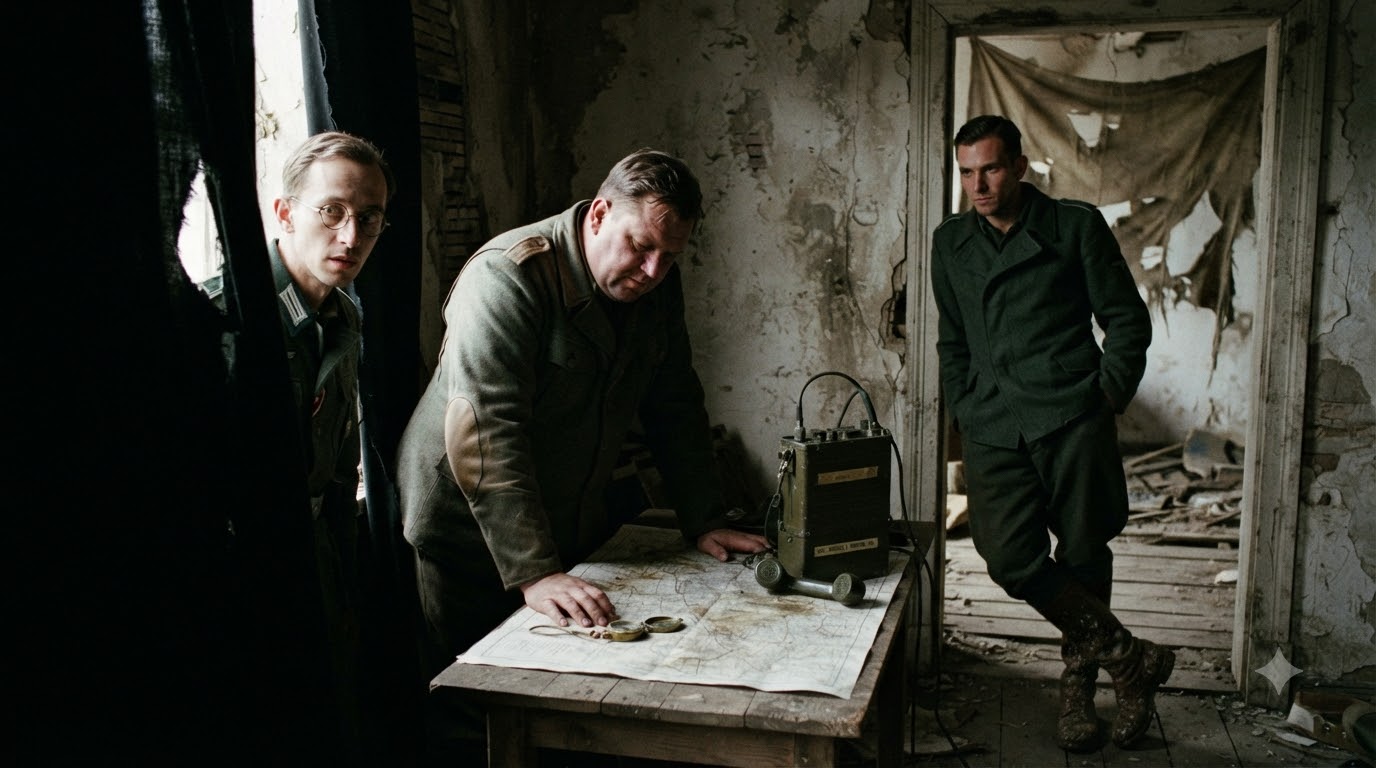
Major Friedrich Veesterhouse didn’t look up from his map table. He was a broad-shouldered man, his uniform worn smooth at the elbows, holding the quiet, heavy posture of someone who had ceased expecting good news back in 1942.
Brener stepped forward and set the metal case directly onto the edge of the paper grid. The sheet metal clinked against a brass compass.
Veesterhouse looked at the olive-drab box. He didn’t touch it right away. He looked at it the way a doctor looks at a dark spot on an X-ray—not surprised, just measuring the work it was going to take to deal with it.
“Dry creek bed,” Brener said, his voice flat. “Grid 447. Eight hundred meters inside our line. American bootprints heading west. They left it when Langanger’s machine gun opened up from the ridge.”
Veesterhouse leaned his knuckles on the table, the wood groaning under his weight. “You checked it?”
“Clear of wire,” Brener said. He reached into his pocket, his fingers curling back around the brass lighter, clicking the flint wheel once out of habit. Dry spark. No flame. “Inside the flap, there’s a name. Corporal Reeves.”
“Vogle,” the Major called out. He didn’t raise his voice, but Hauptmann Ernst Vogle emerged from the shadow of the canvas tarp within seconds.
Vogle was thin, his round wire-rimmed glasses held together at the bridge by a tiny strip of adhesive tape. Before the war, he had designed power transformers in Essen. Now he adjusted his glasses, stepped to the table, and looked down at the metal case.
His hand stopped an inch above the set. His face didn’t register panic—it registered the cold, slow realization of a man who had just worked out a complex equation only to find the answer was entirely wrong.
“SCR-300,” Vogle murmured. He didn’t ask it as a question.
“You know this set?” Veesterhouse asked.
“I read the intelligence summaries from Normandy,” Vogle said. He picked up the case with steady, methodical hands, turning it over to inspect the controls, the rubber seals, and the battery housing. “We wondered how their forward infantry was coordinating artillery bursts within three minutes of making visual contact. We thought they had observers pre-stationed in the trees.”
He set the box down and unscrewed the rear maintenance panel with a thumbnail. “It isn’t observers in the trees, Major. It’s this. Frequency modulation. FM.”
“Range?” Veesterhouse asked, his eyes still fixed on the map grid.
“In terrain like this? Two, maybe three kilometers,” Vogle replied. He pulled a small tool from his tunic pocket and tested the tension on the main dial. “Clear voice signal. No telegraph keys. No Morse code. A boy from Iowa can pick this up, press the switch on the handset, and talk directly to an artillery battery commander three miles back.”
Brener watched Vogle’s fingers. “Can we jam it?”
Vogle didn’t look up. “FM signals don’t bounce off trees the way our AM signals do. They cut straight through. To jam this, you need a high-power transmitter on the exact same channel, sitting less than five hundred meters from their front line.”
“We don’t have a high-power transmitter within twenty kilometers,” Brener said simply.
“No,” Vogle agreed, tightening the panel screw back into place with a small, metallic click. “We don’t. And even if we found their channel, they have forty channels on this dial alone. They can switch frequencies before our operators even log the static.”
Veesterhouse reached out and touched the white stencil on the casing. STR300. His thumb brushed over the metal corner where the paint had flaked off to reveal bare gray steel underneath.
“How many do they carry?” the Major asked softly.
Vogle took off his glasses, pulled a clean handkerchief from his sleeve, and wiped the lenses. He took three seconds to do it—not because the glass was dirty, but because he was choosing his words with engineer’s precision.
“The summary estimated mass production,” Vogle said. “Tens of thousands. They don’t issue these to generals or signals specialists, Major. They issue them to infantry platoons.”
Silence settled back over the broken farmhouse, heavy and thick, broken only by the sharp, rhythmic flapping of the canvas tarp against the ruined wall.
CHAPTER 3: THE GHOST IN THE GRID
The paper groaned under Veesterhouse’s weight as he dragged his finger two centimeters east, tracing the winding contour lines of the dry creek bed.
“Grid 447,” the Major said. His voice rasped, dry from hours of breathing damp cellar air and cheap tobacco. “Company headquarters sits two hundred meters back. Battery positions three kilometers south. We thought we were holding a defensive line.”
Brener leaned against the doorframe, his hands staying deep in his coat pockets. His thumb clicked the flint wheel of his lighter once—a quiet, metallic snap that yielded no spark. “We aren’t holding a line, Major. They’re surrounding us without moving a squad.”
“Explain,” Veesterhouse ordered, not looking up.
Vogle stepped closer, pulling a grease pencil from his chest pocket. He didn’t draw a line; he tapped three soft blue dots onto the map surface, circling the ridge above Langanger’s machine-gun bunker.
“Every time our forward squads open fire,” Vogle said, “they aren’t fighting the men in front of them. The man with this set on his back doesn’t fire a rifle. He ducked behind an oak root, gave three numbers into a mouthpiece, and went silent.”
“Three minutes,” Brener said quietly.
“Three minutes,” Vogle repeated. “Our runner takes fifteen minutes just to reach the battalion bunker if the wire is cut. By the time our battery gets the coordinates, the targets have already shifted. They aren’t faster soldiers, Major. They’re an integrated network.”
Veesterhouse slowly lifted his hand from the map. The paper stayed creased where his finger had rested. He looked down at the olive-drab box sitting beside his compass—the faded strip of tape bearing the pencil marks of Corporal Reeves.
“They aren’t fighting us with men,” Veesterhouse said, the realization settling like heavy iron in the small room. “They’ve built a machine. Every squad is an eye. Every radio is a nerve.”
A sudden, low vibration rattled the loose window pane on the surviving north wall. It wasn’t a explosion—just the distant, rhythmic thrum of heavy engines warming up miles behind the western ridge.
Vogle looked toward the flapping canvas tarp. “They’re registering targets for the night.”
“They don’t need to scout our positions,” Brener said, his voice dropping into a flat, cold register. “Reeves already gave them the grid before he dropped his pack.”
CHAPTER 4: REGISTRATION FIRE
The detonation hit four hundred meters to the south, shaking a shower of dry dirt and dead pine needles down from the exposed ceiling joists.
Nobody jumped. Brener didn’t even pull his hands out of his coat pockets. The concussion blew past the flapping canvas wall, rattling the loose iron oil lamp on the map table until Vogle reached out with two fingers and steadied it.
“First round,” Vogle said flatly, pulling his glasses off to wipe away a layer of fresh dust. “Standard four-inch high explosive.”
Veesterhouse didn’t look at the ceiling. His eyes remained locked on the olive-drab box sitting on his paper grid—on the small sheet-metal casing that weighed less than a soldier’s boot.
A second shell whistled through the fog, walking fifty meters closer to the dry creek bed. The blast shook the remaining glass out of the window frame, the shards tinkling as they hit the floorboards.
“They aren’t guessing,” Brener muttered, his thumb clicking his dry lighter once in the dark pocket. “They don’t need to sweep the ridge. Reeves gave them the numbers before his squad even cleared the birch stand.”
Veesterhouse pulled his hands back from the table and folded them behind his waist. The posture was rigid, built on twenty years of Prussian military discipline, but his shoulders sloped slightly under the heavy gray wool of his coat.
“Gather the maps,” Veesterhouse said. His voice was low, devoid of panic or command urgency—just the dry, measured tone of a clerk closing a ledger at the end of a shift. “Pack the company logs.”
Vogle paused, his glasses halfway back to his face. “Major? We are ordered to hold grid 447 until morning.”
“Grid 447 was erased three minutes ago, Hauptmann,” Veesterhouse replied, looking directly at the green metal box. “We are fighting an engine. You do not hold a line against an engine with twenty men and a broken landline.”
A third shell slammed into the ridge, the deep thump reverberating right through the soles of Brener’s boots. The dust settled slowly over the paper map, coating the blue marks Vogle had drawn in a thin, gray film.
Brener stepped over to the table, reached out, and picked up the SCR-300 by its cold canvas strap. He swung it onto his shoulder, testing the weight. It rested easy against his spine—light, compact, engineered for a war that moved faster than any man in the room could run.
Veesterhouse didn’t tell him to leave it. He simply turned back to the remaining wall, picked up a piece of chalk, and drew a single firm line through the sector log on the slate board.
Outside, the American guns fell silent, having locked their coordinates into the grid. The Hurtgen forest settled back into its heavy, damp quiet, waiting for the evening to finish what the radio had started.