The Weight of Steel and Black Sand: An Everyman’s Battle for Iwo Jima
CHAPTER 1: THE BURDEN ASSIGNED
The steel of the receiver felt cold against my palms, already slick with the sweat of a California afternoon. Sergeant Virgil Calhoun didn’t look me in the eye when he dropped the weapon into my grip; he just moved down the line with the steady, unfeeling motion of a man handing out heavy chores.
“Congratulations, Watson,” Calhoun said, his voice flat against the dust of Camp Pendleton. “You just became the most popular target on the battlefield.”
The weight dragged immediately at my shoulder, twenty pounds of solid machine before you even counted the twelve loaded magazines waiting in the canvas belt. My thumb traced the cold rim of a spent brass .30-06 casing I had slipped into my pocket after target practice, rolling the smooth metal between my calloused fingers to keep my mind quiet.
Around me, boys from Chicago and Philadelphia adjusted lightweight M1 Garands with quiet relief. They carried nine pounds of walnut and steel, moving like men uncluttered by heavy harness. I stood six feet tall in the red dirt, my shoulders already shaped by ten-hour days hauling hundred-pound cotton sacks across Crittenden County mud. The Marine Corps hadn’t built my back; Arkansas sharecropping had done that before I turned sixteen.
“It’s twenty pounds empty, private,” Calhoun added, turning back for a second to glare at the heavy barrel resting against my hip. “And every Japanese gunner in the Pacific is trained to shoot the man making that specific hammering sound first.”
I didn’t answer him. On the farm, when a landowner handed you a double-handled crosscut saw or a rusted post-hole digger, you didn’t argue about the rust or the weight. You squeezed the wood, set your feet in the furrow, and got to work until the sun dropped below the timberline. I shifted the heavy webbing across my chest, feeling the sharp corner of the magazine pouch bite into my ribcage, and rolled the small brass casing once more against my thumb.
CHAPTER 2: INTO THE BLACK ASH
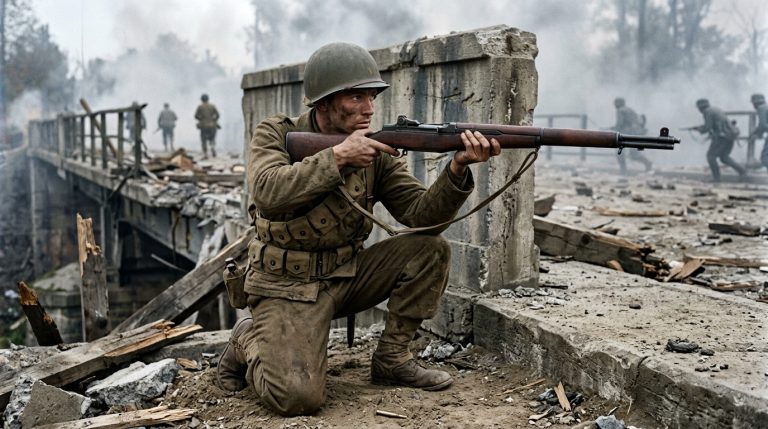
The volcanic ash didn’t pack under a man’s heel. You stepped, you weight-shifted, and the ground simply gave way, swallowing the combat boots up to the ankle while the twenty-pound Browning dragged your center of gravity down into the dust.
Around me, the sea behind us was a wall of gray metal and diesel smoke, but ahead, the bluffs of Motoyama Airfield rose up like a row of broken black teeth. Lester Grimes was three paces to my left, his face already smeared with dark sulfur soot, carrying four canvas bandoliers of extra magazines that clanked heavy against his hip.
“It smells like rotten eggs, Wilson,” Grimes spat, coughing into his sleeve as he dragged his back foot through the powder. “Like somebody set fire to a manure pile and buried it in ash.”
“Keep moving, Lester,” I said, my thumb instinctively rolling the spent brass .30-06 casing in my pocket. “Standing still just makes it easier for the landowner to measure you for a box.”
Sergeant Calhoun was forty yards ahead, crouching low near a shelf of jagged pumice, waving his arm in frantic, sharp circles to keep the platoon spread wide. We had been on the island for forty-seven minutes, and the silence was getting thick enough to taste—a heavy, metallic stillness that meant somebody was watching through a narrow aperture, counting helmets and waiting for the beachhead to clog up.
Then the bluffs tore open.
It wasn’t a single rifle crack or a warning shot; it was a sudden, roaring wall of crossfire that seemed to come out of the rock itself. Small arms, heavy machine guns, and the hollow thump-thump of knee mortars launching from the reverse slopes echoed off the stone, chopping the black sand into spurts of dust.
Marines went flat immediately, diving for cover that simply wasn’t there. Guys were trying to claw holes in the ash, but the powder just sloughed back into the divots like dry grain in a silo, leaving every man fully exposed to the hidden slits along the ridge.
“Watson!” Calhoun screamed over the chatter, his chest pressed flat against a rock that was already flaking under heavy rounds. “Get that BAR up! Set your bipod on that ledge and suppress those apertures!”
I looked at the flat stone ledge ten feet ahead, then down at the heavy steel bipod folded under my barrel. In the training manuals, that was the play—deploy the legs, lock the weapon into the stone, and pour lead at the mountain until the riflemen could advance. But as I watched a three-round burst from an invisible position chip the top edge of that exact stone into razor-sharp shrapnel, the math hit me with the cold clarity of a bad crop assessment.
The Japanese gunners hadn’t built those bunkers yesterday. They had every flat rock, every natural shelf, and every obvious support position pre-registered down to the inch. Setting up a fixed gun on that ledge wasn’t fire support—it was an invitation to take a mortar round straight to the teeth.
I reached down, grabbed the BAR by the receiver, and deliberately kept the bipod locked tight against the frame.
“Lester!” I shouted, turning my shoulder into the biting wind of sulfur and cordite. “Keep the bandoliers loose! We aren’t sitting down for this!”
CHAPTER 3: BREAKING THE CONCRETE
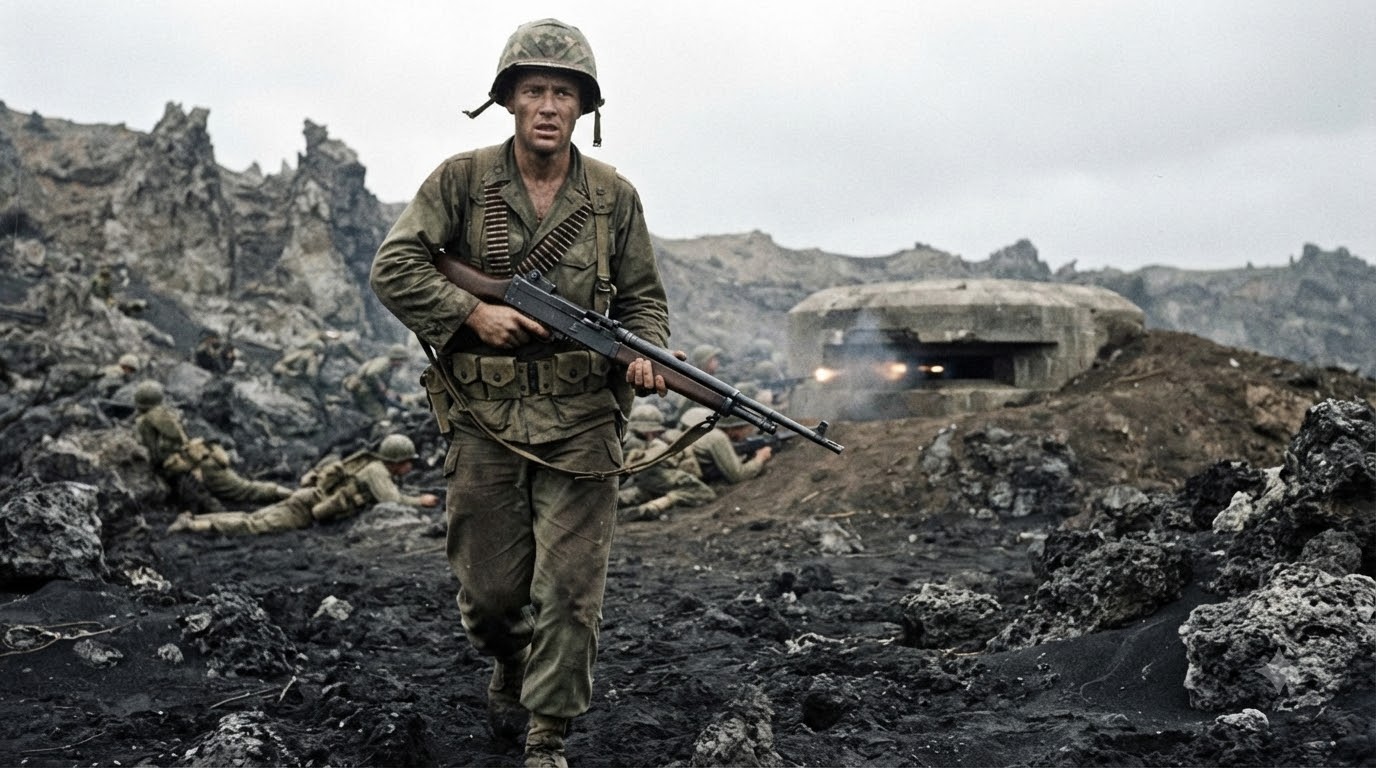
The concrete pillbox sat low in the volcanic rock like a square, gray turtle, spitting hot lead in rhythmic, three-second bursts. Every time a Marine tried to rise from the ash, the gun inside that embrasure walked rounds straight down the slope, pinning the whole platoon flat against ground that couldn’t stop a knife blade, let alone a high-velocity round.
“We need a mortar crew!” Sergeant Calhoun shouted, his face pressed into the dust ten yards back. “Watson, keep your head down until we get artillery on that radio!”
I looked back at Calhoun, then out at the forty yards of open, pitch-black ash between my boots and the narrow firing aperture. The radio operator behind us was already slumped over his pack, wire dangling useless, and waiting on artillery that wasn’t coming was just a slow way to bleed out in a crater.
I didn’t deploy the bipod. I didn’t ask for permission. I simply stood straight up out of the volcanic fold, bracing the twenty-pound steel receiver hard against my right hip with my forearm.
The heavy weapon bucked wildly as I squeezed the trigger, the brass casings spinning through the sulfur-choked air in a hot, continuous arc. I wasn’t aiming through the iron sights; I was walking forward at a steady, heavy pace, driving three-round bursts directly into the lip of the concrete opening. The massive weight of the gun absorbed the violent kick, keeping the muzzle steady as I moved straight down the barrel of their field of fire.
Bullets snapped past my ears, biting into the rock behind me, but a man running flat-out at a narrow embrasure presents a target that a fixed machine gun position isn’t built to track. They were used to shooting at men lying behind rocks; they weren’t ready for twenty pounds of automatic steel marching right through their front door.
The bolt locked back with a dry, metallic clack. Empty.
Without breaking stride, my left hand slapped the magazine release, dropping the spent box into the black sand while my right hand snatched a fresh twenty-round box from my belt. Lester Grimes was scrambling through the dust behind me, feeding another magazine into my reaching palm before the weapon even lost its forward momentum.
At ten yards, the concrete wall loomed huge and black. I shifted the heavy weapon to my left side, pulled a pineapple grenade from my webbing with my right hand, and yanked the pin with my teeth.
I hurled the iron sphere straight through the six-inch firing slit, stepped hard to the left, and flattened my spine against the outer concrete wall as the muffled thoomp shook the dust from the seams. Before the smoke could clear, I rounded the rear entrance, pulling the trigger again to clear the tunnel mouth before any surviving gunners could reach the secondary door.
The roaring chatter from the bluffs abruptly cut out, leaving a sudden, deafening silence across the entire sector. Calhoun scrambled up the slope, his eyes wide as he looked at the shattered concrete, then down at the heavy automatic rifle resting quietly against my belt.
“Don’t you ever do that again, Watson,” Calhoun panted, wiping grease and sweat from his forehead. “Unless you absolutely have to.”
I reached into my pocket, my thumb finding the smooth, familiar curve of the empty brass casing, rolling it once over my knuckles as I looked up at the steeper, jagged crest rising directly above us.
CHAPTER 4: THE LONE RIDGE
The incline rose at an angle that forced you onto three points of contact, the loose pumice sliding out under my boots with every hard push. Above us, the ridge line was a jagged wall of rust-colored volcanic rock, spitting heavy machine gun fire in a tight pattern that kept the rest of the platoon pinned flat in the lower gullies.
“Watson, it’s too steep!” Lester Grimes yelled from three paces below, scrambling on his knees while hugging two canvas magazine bags to his stomach. “We try to climb this, we’re just targets on a hill!”
“They’re shooting over our heads, Lester,” I grunted, dragging my right knee up into a narrow crevice and pulling the twenty-pound frame up with my shoulder. “If we stay down there, the mortar teams will pick off the squad one by one.”
The heavy steel of the receiver slammed against the rock face as I hauled myself up another four feet, the friction tearing through the denim of my trousers and biting into my skin. Up close, the enemy fire wasn’t aimed at individual men—it was pre-registered crossfire meant to sweep the base of the slope, leaving the steep face itself as a blind spot for gunners positioned on the crest.
I reached a narrow ledge ten feet below the top, my lungs burning with the sharp, sulfur-laden air. Grimes hauled himself up right behind me, gasping for breath, his hands trembling as he checked the spring tension on a fresh magazine.
“We go over this crest, we’re on our own,” Grimes panted, his voice cracking against the roar of small arms fire above. “Calhoun can’t see us from the gully.”
“Calhoun doesn’t need to see us,” I said, my hand slipping into my trousers pocket to touch the warm, smooth surface of that brass casing one last time before wrapping both hands around the BAR’s stock. “He just needs that gun on top to stop firing.”
I didn’t wait for a signal or a mortar barrage. I planted my boots against the stone ledge, leaned my body forward into the steep slope, and hauled my frame over the lip of the ridge.
The crest opened up into a flat, wind-swept expanse of black rock, completely exposed to three separate fighting positions dug into the reverse slope. Red tracer rounds snapped past my shoulders the second my boots hit the flat stone, but I didn’t drop to my knees, and I didn’t look for a rock to hide behind.
I brought the stock to my hip, squeezed the heavy trigger, and let the automatic rhythm of twenty pounds of steel clear the path ahead.
CHAPTER 5: FIFTEEN MINUTES ON THE CREST
The counterattack came in waves, emerging from hidden stone trenches and natural gullies along the back ridge. They were moving fast, advancing by bounds with the absolute confidence of troops who knew this mountain and believed they were swarming a single, isolated rifleman.
I didn’t drop into a prone position, and I didn’t search for a rock wall to take shelter behind. I kept my knees slightly bent, absorbing the steady, heavy recoil of the .30-06 rounds as I swept the barrel across the approaches in tight, controlled bursts.
The twenty-pound frame stayed rock steady in my hands, acting as its own gyro-stabilizer while I pivoted on my heels across the broken stone. Three rounds toward the left gully, a sharp step to the right, and two rounds into a cluster rising from a shallow trench—the hammering report rolling off the volcanic crest like heavy machinery at work.
“Watson, behind you!” Lester Grimes screamed, ducking behind a jagged rock shelf as mortar shells burst twenty yards out, showering us in dark gravel and cordite smoke.
I pivoted on my back foot, bringing the muzzle around in a smooth, continuous sweep to catch three soldiers scrambling up the eastern lip. The heavy rounds struck with devastating stopping power at twenty yards, breaking the forward momentum of the assault before it could gain a footing on the high ground.
The bolt locked back with a dry, hollow snap. Empty.
Grimes was already scrambling across the exposed rock on his knees, slapping a fresh, heavy steel box straight into my reaching left hand.
“That’s six!” Grimes yelled, his voice hoarse from sulfur fumes, his hands trembling as he yanked another magazine from his canvas belt. “We’re running low, Wilson!”
“Make every burst count, Lester!” I shouted back, slamming the fresh magazine home, releasing the bolt, and bringing the steel back to my waist without missing a beat.
They tried to coordinate, rushing simultaneously from two flanking positions to force a split in my field of fire. I didn’t panic and I didn’t spray the hillside; I held my ground, relying on short two-round bursts placed with the dry, methodical discipline of a hunter who couldn’t afford to waste ammunition on missed shots.
Step, pivot, fire. Step, pivot, fire. For fifteen long minutes, the hilltop belonged strictly to the heavy steel in my hands and the calloused fingers holding it steady against the wind.
When the final round cleared the chamber and the bolt locked back for the last time, an unbelievable silence settled over the smoking ridge. Down below, Sergeant Calhoun and the rest of the platoon were scrambling up the steep incline, reaching the crest to find sixty enemy soldiers fallen across the slopes, the assault broken, and the hill taken.
Calhoun stopped five feet away, his breathing heavy, his eyes staring at the empty weapon resting against my hip and then at the cleared ridge around us.
“You held the whole crest,” Calhoun whispered, his voice cracking with sheer disbelief. “Just the two of you.”
I reached into my pocket, my thumb wrapping around the cool, smooth brass casing one last time, feeling its weight before letting it rest quietly at the bottom of the seam.
CHAPTER 6: THE LONG ROAD HOME
The air in the White House East Room smelled of floor wax, fresh cut lilies, and heavy velvet curtains—a sharp, strange contrast to the sulfur and cordite that had been burnt into my skin for months.
President Truman stepped down the line, his brass-and-bronze Medal of Honor resting in a velvet box in his hands. When he looped the sky-blue silk ribbon over my head, the five-pointed star settled light against my chest, weighing less than a single loaded magazine, though every man in the room knew what it had cost to stand there.
The citation reader spoke in long, formal military phrases, talking about conspicuous gallantry and standing exposed on a crest against an entire company. They read the words out loud to the room, officially recording that I had fired twenty pounds of steel straight from the hip because the books said it couldn’t be done.
I stood straight in my pressed dress uniform, my shoes shined to a mirror finish, and listened without saying a word.
Three weeks later, the train pulled into Earl, Arkansas, and the entire town had shut its doors from one-thirty to three-thirty in the afternoon. People who had known me when I was barefoot in the cotton rows lined the main road, clapping and waving small paper flags as Governor Laney stood up on the high school stage to talk about heroics and duty.
When they handed me the microphone, the auditorium went dead silent, waiting for a speech about victory or military strategy.
“I guess I grew up with a gun,” I said into the microphone, my hand resting flat against my belt. “Now, I just want to take it easy for a while and get caught up with my hunting.”
The applause broke out loud and long, but I just stepped back from the podium and let the politicians finish their speeches.
Now, sitting on a mossy fallen oak in the quiet timber of Johnson County, the morning air is cool and clean, smelling only of damp pine needles and wet earth. My hands—calloused, steady, and quiet—rest across the wooden stock of a light hunting rifle, waiting patiently for the movement of squirrels in the high branches.
There are no mortars, no concrete pillboxes, and no heavy iron bipods to carry through the mud. Just the deep silence of the woods, a quiet job done, and a long, earned road home.