The Silent Tether: A Captain’s Grace in the Echo of a Hard-Won Military Command
CHAPTER 1: The Weight of Gold Stripes
The base was a tomb of concrete and shadow. Midnight at Norfolk never truly slept; it merely held its breath, the silence vibrating with the suppressed energy of machines and the men who fueled them. Mave Sandival sat on the edge of her rack, the weight of the air pressing against her temples. On the chair across from her, the service dress uniform lay draped like a ghost—four gold stripes on each sleeve, rigid and demanding.
She stared at them. They weren’t just fabric; they were the physical manifestation of twenty-eight years spent walking through walls that were never meant to open for her. Her father’s voice, a gravelly, worn-out sound, echoed in the periphery of her mind. You’re a good kid, Mave. But that uniform is for a different kind of person. He hadn’t been cruel. He had simply been measuring the world by the only yardstick he’d ever known: the hard, unyielding distance between those who did the work and those who wore the medals.
She stood, the floorboards cold beneath her feet. She couldn’t win the argument with her own mind tonight, not while the ghosts of the past were so eager to participate. She pulled on a plain coat—unmarked, nondescript—and stepped out into the night.
The walk to the officer’s club was a meditation on proximity. The trees hummed with the distant rhythm of the tide, a sound she had learned to read like a map. She needed the warmth of the club, the simple, mundane ritual of a late-night coffee, before the sun rose to bring the most significant morning of her life.
As she approached the brick building, the light from within bled out onto the pavement—a warm, amber rectangle that felt like an invitation she wasn’t sure she wanted. But she pushed forward. She had spent a lifetime proving that she belonged in spaces where she wasn’t invited, and she wasn’t about to stop now. She reached the door, her fingers brushing the cool, heavy metal of the handle, and for a fleeting second, she caught the scent of old woodsmoke and stale beer.
She stepped inside. The room was loud, filled with the brash, easy confidence of young men who hadn’t yet been broken by the things they were expected to survive. They owned the air, the chairs, and the very atmosphere of the room. And then, there was the hearth.
In the long shadow of the stone fireplace lay a dog, his muzzle grayed by time, his body scarred by a history she knew by heart. He didn’t look at her, not yet, but his ears flicked—a small, tectonic shift in the room’s balance. Mave felt the shift in her own blood. She approached the bar, the weight of the coming morning sitting heavy in her pocket like a stone. She hadn’t expected to find him here. She hadn’t expected the past to be waiting by the fire, watching the door, and suddenly, the bitterness of the coming coffee seemed like the least of her problems.
CHAPTER 2: The Silent Currency of Respect
The silence in the officer’s club wasn’t the absence of sound; it was the presence of a thousand unsaid things, vibrating in the stale air. Mave felt the heat radiating from the dog at her side, a steady, rhythmic warmth that anchored her to the floorboards. She didn’t look at the lieutenant. She didn’t look at his table. She kept her gaze fixed on the bartender’s hands, which were now hovering over a ceramic mug as if he were trying to remember the geometry of a simple coffee pour.
Behind her, the air felt dense, charged with the static of a dozen careers being weighed in the balance. The lieutenant—Brandt Keller—was still standing, his posture shifting from the loose, predatory confidence of a man who owned the room to something taut and rigid. The laughter from his peers had died a violent death, replaced by a suffocating, collective intake of breath.
Then, the phantom smell hit her: the dry, metallic scent of desert dust, mixed with the sharp, acidic tang of a broken radio. It was 2015. She was back in that tent, the ground beneath her vibrating with the percussive thud of nearby mortar fire. She could feel the weight of Argo’s head on her chest, a sixty-pound anchor of loyalty that defied the chaos. She blinked, the strobe-light memory flickering and fading back into the amber dimness of the Norfolk club. The gray-muzzled animal at her shin whined, a low, tectonic sound that had nothing to do with fear and everything to do with recognition.
He knew. The dog knew that the woman who stood here, plain-coated and weary, was the same woman who had crawled into the dark for him when no one else would. He pressed his shoulder against her leg with such deliberate, heavy pressure that it felt like a vow.
“I said,” the lieutenant’s voice cracked, losing its edge, “spouse’s night is down the hall.”
He wasn’t laughing anymore. He was trying to regain his footing, but he was stumbling over the unexpected reality of a legend appearing in his theater.
Mave finally turned. She didn’t move her head quickly; she moved with the measured, terrifying economy of someone who had spent decades observing the terrain before stepping into it. Her eyes locked onto Keller’s. She didn’t focus on his rank, or the youth that still clung to his jaw, or the desperate way he was looking to his friends for support they were no longer willing to offer. She looked at him as if he were a piece of equipment she was evaluating for failure.
“Is it?” Mave asked. Her voice was flat, a dull blade that cut through the remaining tension. She didn’t raise it. She didn’t need to. “I’m not looking for the spouse’s night, Lieutenant. I’m looking for a cup of coffee. And I’m standing where I please.”
She turned back to the bar, dismissing him entirely. The bartender slid the black coffee across the wood. The steam curled up in the stagnant air, catching the light in a way that made the room look like an old, faded photograph.
Delgado, the Master Chief who had recognized her, remained standing. He wasn’t looking at Mave; he was looking at the lieutenant. It was a look of profound, quiet disappointment, the kind that hurts more than a formal reprimand. Delgado took a slow, deliberate sip of his drink, his eyes never leaving Keller.
“I believe the Captain is having her coffee, Lieutenant,” Delgado said, his voice dropping into that register that signals the end of a long-standing tolerance. “You might want to ensure your chair is still under you.”
Keller’s face drained of its ruddy, overconfident glow. He looked at the dog—Argo, the animal the unit had kept as a mascot, a creature everyone fed but no one truly knew—and saw, for the first time, the tether. He saw the way the dog held Mave’s gaze, the way the ancient eyes were filled with a kind of recognition that demanded more than casual ownership.
The room began to murmur, a low, uneasy sound of people trying to reconcile the woman they had pigeonholed with the woman who commanded the silence of a combat-hardened dog. Mave ignored the noise. She took the cup, the heat seeping into her palms, and let the coffee settle the tremor in her hands. She knew what was happening. She knew that every word, every gesture, was being recorded in the collective memory of this unit.
She wasn’t going to pull rank. She wasn’t going to launch into a speech about the medals she had folded away in a small case in her room. That was the trap—the expectation that a leader must be loud to be real.
She took a sip, the bitterness coating her tongue, and then she felt a soft, cool sensation against her hand. Argo had nosed her palm, nudging her toward the door. He was ready to leave. He didn’t care about the lieutenant, or the club, or the hierarchy that defined the men in this room. He cared about the quiet, the darkness, and the walk back to a place where he was finally home.
Mave didn’t look back at the lieutenant as she walked toward the exit. She didn’t need to see his face to know it was changing. The lesson was already working its way into the fiber of the room. By tomorrow, they wouldn’t be talking about a woman in a coat; they would be talking about the Captain who walked in with the ghost of a war at her heels.
As she pushed the heavy door open, the night air rushed in, cool and biting, washing away the smell of beer and arrogance. The silence of the base greeted them—that vast, impenetrable quiet that existed only on an installation after midnight. She walked, and the dog matched her stride, his claws clicking on the concrete, a steady heartbeat against the pavement. She knew the morning would bring the formal command, the gold stripes, and the politics of leadership, but as she walked beneath the cold, distant stars, she felt the first true breath of peace she’d had in years. The debt was being paid, one step at a time, and the truth, as always, was taking its own sweet, measured time to settle.
CHAPTER 3: The Unspoken Accord
The walk back had been a study in quietude, the kind of stillness that precedes a seismic shift. Mave didn’t feel victorious. She felt like a person who had just waded through a river and was now waiting for the chill to set into her bones. Argo’s gait had been rhythmic, a steady cadence that matched her own, his claws striking the pavement with the familiar, comforting punctuation of a creature who knew exactly where he was going.
When they reached her quarters, she didn’t turn on the lights. She moved through the space by memory, the layout familiar, the air stale with the scent of unread reports and the faint, lingering ozone of a coming storm. She sat on the edge of the bed, the four-striped service uniform hanging in the closet like a sentinel. Argo circled the small space twice before collapsing onto his blanket with a soft, audible exhale, his head resting heavily on his paws. He was watching her. He had been watching her since they left the club, his eyes reflecting the sliver of moonlight filtering through the blinds.
She reached down, her fingers sinking into the coarse, graying fur at his neck. He didn’t move, only leaned into the touch, a physical bridge across the years. She thought about Delgado. The Master Chief had stood his ground in the club not because he wanted to pick a fight, but because he was a man who understood the weight of the truth. He had been there in 2015. He knew the cost of Danny Cobb’s absence.
A light rain began to tap against the window, a rhythmic, insistent sound. Mave stood, moving to the window. The base was waking up, the early shift lights flickering on like distant stars. She could hear the faint, muffled sounds of the morning watch shifting gears, the low rumble of a truck engine, the distant shout of a command. In a few hours, the formality of the change of command would begin. She would stand in front of the formation, the gold stripes catching the light, and she would accept the group from Rear Admiral Mayhew.
Her phone buzzed on the dresser—a sharp, jarring intrusion in the quiet. It was a message from the group’s administrative officer: Final prep for the 0800 handover, Captain. All hands briefed.
She stared at the screen. The politics of the day were already moving without her. Brandt Keller would be in that formation. He would be standing there, his jaw set, his eyes forward, waiting for his new commander to decide what kind of leader she was going to be.
She turned away from the window, her gaze settling on the case containing her medals. She’d never worn them. They were symbols of things that didn’t need to be displayed to be true. But tomorrow, they would be part of the uniform. She wondered if the men in the formation would look at them and see the heroism, or if they would see the woman who had simply been standing closest to the fire when it happened.
The morning light began to bleed through the clouds, a gray, diffuse illumination that turned the room into a study of fading textures. She began to prepare, the ritual of the uniform a grounding, mechanical process. Each movement was deliberate, a slow, methodical reclamation of her own authority.
As she tightened her belt, she heard a soft thud at the door—the morning delivery of the daily roster. She picked it up, her eyes scanning the names, the assignments, the fragile architecture of a unit that was currently holding its breath. She saw Keller’s name listed for a training evolution immediately following the ceremony.
She walked to the porch, coffee in hand, the air cool and damp. Argo followed, his movements stiff and slow. He sat beside her, his gaze directed toward the water.
“They’re waiting, aren’t they?” she whispered, the question not for the dog, but for the day itself.
Argo let out a low huff, his ears swiveling to catch the sound of footsteps on the gravel path. It was Delgado. The Master Chief was walking toward her, his pace slow, his hands tucked into his pockets. He looked tired—not the fatigue of a long shift, but the weariness of a man who had seen too much and said too little.
He reached the porch, stopping at the bottom step. He didn’t salute, not yet. He just looked at her, his eyes reflecting the same gray light that defined the morning.
“The unit’s tense, Captain,” Delgado said, his voice stripped of the formal cadence of the club. “They’re expecting the hammer to fall. They’ve spent a long time being led by people who think power is a blunt instrument.”
Mave looked at him, searching for the intent beneath the words. “And what do you think they need, Master Chief?”
Delgado shrugged, a slight movement of his shoulders. “They need to know that the person in charge can see the difference between a mistake and a character flaw. The Lieutenant’s young. He’s arrogant. He’s got the ego of a man who hasn’t been tested by anything that couldn’t be solved with a weapon. But he’s not malicious. There’s a difference.”
He leaned in slightly, his voice dropping. “There was an evolution last year—a botched tactical read during an urban clearance. Keller made a call that almost compromised the perimeter. He didn’t learn from it because the previous commander didn’t want the paperwork. He just moved him to the back of the line. The tension you saw last night? That’s the result of that kind of leadership. It wasn’t just the club, Captain. It was a long time coming.”
Mave felt a cold stillness settle in her chest. The decoy secret—the idea that Keller was just a loud, prideful kid—wasn’t the whole story. The unit wasn’t just waiting for her to punish him; they were waiting to see if she was going to perpetuate the same cycle of neglect. She wasn’t just taking command of a group; she was taking command of a culture that had been allowed to fester in the shadow of unspoken mistakes.
“I’m not interested in moving him to the back of the line, Delgado,” Mave said, her voice steady.
“Then what are you going to do?”
She looked at Argo, who had turned his head to watch the Master Chief with the same patient, assessing look he’d given the lieutenant. “I’m going to make sure he’s the one who realizes that looking twice isn’t an option; it’s a prerequisite. If he stays in this unit, he stays because he’s learned how to lead by looking at what’s actually there, not what he expects to see.”
Delgado held her gaze for a long moment, then slowly, he offered a crisp, professional salute. It wasn’t the salute of a subordinate to a superior; it was the recognition of one professional to another.
“I’ll see you at 0800, Captain.”
As he walked away, Mave turned back to the quiet, gray water. She felt the weight of the day pressing in, but for the first time, it didn’t feel like a burden. It felt like a responsibility—a tangible, heavy thing that she was perfectly capable of carrying. She knelt beside Argo, her hand resting on his back. He didn’t move, but the rhythm of his breathing slowed, matching the steady, quiet beat of her own. The morning was here, the stage was set, and for the first time in her career, she knew exactly what the next move had to be.
CHAPTER 4: The Crucible of Command
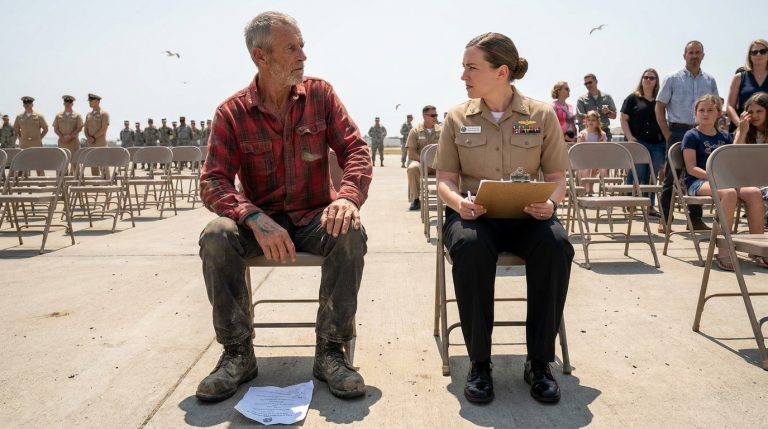
The ceremony was a blur of measured motions—the stiffening of shoulders, the snap of a crisp salute, the formal exchange of authority. Mave stood on the dais, her eyes scanning the formation before her. She saw the men who had been in the club, the ones who had laughed, and the ones who had remained silent. They were all there, their faces masks of professional indifference. Lieutenant Brandt Keller stood at the end of the line, his stance a model of textbook posture, yet she could see the tension in his neck, the way he stared past the podium as if he were trying to memorize the horizon.
When Rear Admiral Mayhew handed her the command plaque, the heavy wood felt cool against her palms. “The group is yours, Captain,” he murmured, his voice low, private. “They’re a difficult beast. But they’re yours now. Take care of them.”
She turned to face the formation, the gold stripes on her sleeves catching the harsh, unfiltered light of the morning. “Company,” she began, her voice carrying across the asphalt, steady and devoid of unnecessary embellishment. “We have work to do.”
There was no applause. There was no warmth. Just the sharp, unified movement of a unit that was waiting to see if she was going to be another name on a plaque or a leader who understood the weight of the dirt beneath their boots.
An hour later, the training evolution began. They were out on the edge of the base, a scrubby, desolate stretch of land that smelled of dry earth and old iron. The objective was straightforward: clear a series of derelict structures, assess the environment, and secure the perimeter. It was the kind of scenario where arrogance often masked as competence, and today, she was watching Keller lead his element.
She stood in the shadow of a rusted shipping container, her presence a silent, immovable point of reference. Argo sat beside her, his ears tracking the distant sounds of movement.
“They’re moving too fast,” Mave said, more to herself than the dog.
“They’re trying to look good for the new CO,” a voice replied. Delgado was standing a few paces back, his arms crossed. “They think speed is the same thing as efficiency.”
Just then, a sharp, dissonant sound echoed across the field—a metal latch failing, the screech of iron on iron. A heavy training gate, meant to simulate a fortified entry, jammed halfway open, its rusted hinges groaning under the pressure. The element stopped. Keller surged forward, his voice cracking with the strain of a man who was losing control of his scene.
“Force it!” he shouted, his hand dropping to his belt as if to pull a tool that wasn’t there. He was trying to bypass the complication, trying to bully the metal into compliance.
Mave didn’t move. She watched the chaos unfold. The men behind Keller were hesitating, their focus shifting from the objective to their leader’s mounting frustration. The tactical fluidity of the unit was shattering. The “butterfly detour”—a simple mechanical failure—had become a mirror. They weren’t fighting the gate; they were fighting their own inability to adapt to a reality that didn’t match their expectations.
“He’s going to break it,” Delgado muttered.
“No,” Mave said, her voice quiet. “He’s going to learn it.”
She stepped out of the shadows, her boots crunching on the gravel. She didn’t shout. She didn’t run. She walked toward the jammed gate with a slow, deliberate pace that forced the entire formation to pivot their attention toward her. Keller turned, his face flushed with the heat of the sun and the sting of his own failure.
“Ma’am, we’ve got a mechanical issue,” he said, his chest heaving. “We’re going to reset.”
Mave stopped in front of the gate. She didn’t look at him. She ran a gloved hand along the rusted hinge, feeling the grit, the friction, the way the metal had been neglected for years.
“The metal didn’t fail, Lieutenant,” she said, her voice devoid of judgment but heavy with the weight of the moment. “The planning did. You assumed the gate would move the way you wanted it to. You didn’t account for the possibility that it might be stuck.”
She looked up at him, her eyes steady. The men around them were silent, their weapons lowered, their focus entirely on the space between the Captain and their lead officer.
“You’re trying to lead a room you’ve already decided is empty,” she added softly. “But you’re standing in the middle of a war, and the enemy doesn’t care about your assumptions. They don’t care about your speed. They only care about your weaknesses. And right now, your weakness is your certainty.”
Keller stared at her. The anger was still there, but it was being eclipsed by something else—a dawning, painful awareness of the gap between his performance and the reality of the situation. He looked at the gate, then at his men, and finally back at Mave. He saw her standing there, unafraid of the rust, unafraid of the failure, simply existing in the middle of the mess he’d created.
“What do you want us to do, Ma’am?” he asked.
It wasn’t a question of surrender. It was a question of instruction.
“I want you to stop running,” Mave said. “I want you to look at the mechanism. I want you to figure out why it jammed, and then I want you to fix it. Not by forcing it. By understanding it.”
She stepped back, leaving him alone with the gate. She turned and walked back toward the shipping container, Argo falling into place at her heel. She didn’t look back to see if he listened. She didn’t need to. The lesson was already in the air, hanging in the dust and the scent of oil and iron, and she knew that the change of command had finally, truly, begun.
CHAPTER 5: The Fragile Varnish of Change
The weeks that followed the gate incident were marked by a strange, stifling precision. The unit performed with a level of technical excellence that would have impressed any observer, yet Mave felt the thinness of it, the way the discipline lacked the organic, lived-in quality of true transformation. It was a performance, a tactical mask worn by men who were still calculating their next move in a game she was ostensibly rewriting.
Mave sat in her office, the late afternoon sun casting long, skewed shadows across the desk. Her hand hovered over a stack of fitness reports, their edges crisp and clean. She had been observing Keller, watching him navigate the working dog program with a dedication that bordered on the obsessive. He was a changed man on the surface—he listened more, spoke less, and treated the handlers with a formal, almost sterile respect. But in the quiet moments, in the fleeting shadows of the kennels, she saw the flickers of the old arrogance, the quick, sharp glances of a man who still believed that he was merely biding his time.
Argo lay at her feet, his head resting on his paws, his eyes tracking the movement of a dust mote in the light. He was slowing down, the autumn air seemingly pulling the strength from his joints, yet his presence was a constant, steady anchor in the storm of her command.
There was a knock at the door. It was Delgado. He stepped in, his expression unreadable, his hands holding a thin, manila folder.
“Report from the range, Captain,” he said, placing the folder on the desk. “The element performed within the parameters. Keller led them through the drill without incident.”
Mave opened the folder, her eyes scanning the data. It was perfect. Too perfect. “There’s a tension here, Delgado,” she said, her voice dropping into the quiet, conversational register they had developed. “The unit isn’t growing. It’s hardening. They’re afraid of making a mistake in front of me, so they’ve stopped taking the risks that actually teach them anything.”
Delgado nodded slowly. “They’re walking on eggshells. They think if they show any flaw, they’re going to be held up as an example of what not to be. You made a strong point at the gate, but the message might have been taken too literally.”
Mave looked at the folder. She had intended to force an evolution of character, but she realized now that she had only forced a change in behavior—a varnish, not a transformation. The psychological phantom of the previous leadership’s blunt-force trauma was still coloring every interaction. They weren’t becoming better; they were just becoming more careful.
“It’s not enough,” Mave said, pushing the folder aside. “If they’re just performing, the first time something actually breaks, the mask will fall off. We need to strip away the performance.”
She stood up, the chair scraping sharply against the floor. “Get the unit together. Full gear. Night training. I want to run the simulated clearance again, but this time, I’m changing the variables. No clear objectives, no predictable gate, no safety net. I want them to have to figure out what the situation is before they decide how to react to it.”
“They’re going to push back,” Delgado warned. “They’re exhausted.”
“Good,” Mave replied, her voice firm. “Exhaustion is honest. It strips away the pretense.”
The training mission that night was a symphony of chaos. The rain had turned the training grounds into a sludge of dark, clinging mud, and the darkness was absolute, relieved only by the occasional flash of tactical lights. Mave stood in the observation point, watching through the lens of a thermal camera as the element struggled to maintain cohesion in an environment that refused to cooperate.
The simulated objective was a disaster. The radio communications were plagued by static, the terrain was treacherous, and the “hostiles” were moving with an unpredictability that sent the unit into a tailspin. Keller was in the center of it, his voice taut with frustration, his commands losing their sharpness as the reality of the situation shredded his carefully rehearsed plans.
He was failing. The element was scattered, their movements jagged and disconnected. Mave could see the panic beginning to creep into his decisions, the urge to return to the blunt-force tactics that had defined his career. He was on the verge of forcing an outcome again, of pushing through the confusion with a desperate, ill-advised gamble.
She turned toward the field, her eyes narrow. She wouldn’t intervene this time. She needed him to see the abyss—to feel the weight of his own limitation without her presence acting as a stabilizer. She needed him to realize that the only way to navigate the uncertainty was to accept it, not to fight it.
“Stay with me, Argo,” she whispered, her hand resting on the dog’s neck.
She watched as Keller reached the critical moment—the point where he had to choose between his pride and the reality of the team’s survival. He stopped. He wasn’t yelling anymore. He was standing in the mud, the rain pouring over his helmet, looking at his fragmented team. For a second, he seemed to be looking for her, waiting for a command that wouldn’t come.
Then, he did something she hadn’t expected. He knelt. He wasn’t giving up; he was positioning himself to better see the terrain, his focus narrowing from the grand plan to the immediate reality of his men. He started giving quiet, surgical commands, adjusting the team’s position based on the shifting, unpredictable movement of the targets. It wasn’t perfect, and the clearance was slow, brutal, and exhausting, but it was honest. They weren’t performing anymore. They were surviving.
When the evolution finally ended, the men trudged back to the staging area, their gear caked in mud, their faces hollow with fatigue. Keller approached her, his breath ragged, his uniform soaked through. He didn’t look at her with the familiar, defensive posture of a man who was expecting a lecture. He looked tired. He looked real.
“We couldn’t secure the perimeter, Ma’am,” he said, his voice flat. “The variables were shifting too fast.”
Mave looked at him, then at the men standing behind him, their gazes fixed on the ground. She hadn’t given them the closure of success, but she had given them the clarity of their own limits.
“You didn’t need to secure the perimeter,” she said, her voice cutting through the heavy, rain-soaked silence. “You needed to survive the confusion. And you did. You stopped forcing the situation and started reading it.”
She turned and began the walk back to the command center, the mud sucking at her boots. The lesson had finally gone all the way in. The performance was gone, and what remained was a unit that knew exactly how much they had yet to learn. The truth was finally surfacing, rising from the muck of their own failures, and she knew that when the sun rose tomorrow, the real work would finally begin.
CHAPTER 6: The Quiet Light of the Porch
The transition from the chaos of the field to the stillness of the house was not a sudden shift, but a gradual settling, like sediment finally finding the bottom of a glass. Mave stood in the entryway, the heavy gear feeling alien now, a relic of a tactical life that had suddenly, inexplicably, softened. She unbuckled her belt, the leather worn and familiar, and let the weight of the day slide from her shoulders.
Argo was waiting. He didn’t rise—he hadn’t the strength for the grand greeting anymore—but his tail gave a singular, rhythmic thump against the floorboards. The sound was a heartbeat in the silence of the house.
The ultimate truth—the thing she had spent her life chasing, the thing she had sought in medals and gold stripes and the forced respect of rooms full of men—wasn’t a victory to be claimed. It was a condition to be lived. She had spent twenty-eight years being the correction to a sentence nobody knew they were writing, searching for someone to acknowledge her worth. But as she knelt beside the dog, pressing her forehead against the cool, soft gray of his muzzle, she realized that she had been looking for external validation for an internal victory.
The “insubordination” she had faced, the resistance from Keller and the unit—it hadn’t been about her capability. It had been about the discomfort of a system confronted by someone who refused to play the game by the established, unspoken rules. Her Layer 2 revelation wasn’t a grand realization of power, but the quiet, devastating understanding that her worth had never been conditional. It was independent of the stripes, the medals, or the opinions of the “loud tables.” She had been “someone” long before she had been a Captain, and her path was not a climb, but a return.
She spent the next hour in a slow, deliberate rhythm of repair. She cleaned the gear, oiled the steel, and folded the uniform with the precision of a master craftsman, not a subordinate. She repaired the small tear in the edge of the blanket where Argo had tugged at it during the night, the needle moving through the fabric with a meditative, circular motion.
The evening stretched into a soft, golden twilight. She carried Argo out to the porch, his body a gentle, heavy weight in her arms. She set him down on his blankets and sat beside him, the scent of autumn woodsmoke and cooling earth rising to meet them.
The payoff of the journey wasn’t a final, thunderous confrontation. It was this: Brandt Keller pulled into the driveway, his car quiet, his posture hesitant. He didn’t stride up the steps with the arrogance of the club; he walked slowly, his eyes scanning the porch not for a superior to impress, but for a leader to learn from. He stopped at the bottom of the steps, his hands empty, his expression open.
“I finished the logs, Ma’am,” Keller said, his voice stripped of the performative edge. “I read the after-action reports for the last three years. The tactical errors… they weren’t just the gate. They were in the culture of the way we were doing business. I was part of that. I’m sorry.”
The poetic justice was not in his shame, but in his recognition. He had been defeated by his own previous assumptions, and in their place, he had built something new. He wasn’t begging for forgiveness; he was reporting for a different kind of duty.
“The culture is changed when the people change, Lieutenant,” Mave replied, her voice soft in the fading light. “You don’t need to apologize for who you were. You need to account for who you are now.”
He nodded, a sharp, respectful movement, and left without another word. It was the absolute, clean victory she had sought—not the destruction of an antagonist, but their evolution into an ally.
The cool-down of the evening was absolute. Mave watched the stars begin to prick through the velvet blue of the sky. She felt a profound, settling peace. The symbolic closure was in her hand—a simple, smooth stone she had picked up from the training ground, a fragment of the earth she had finally mastered. She placed it on the porch railing, a small, permanent marker of the transition.
Her emotional arc—the weary, cynical, searching woman who had arrived at Norfolk—was gone. In her place was someone who understood that the true strength of a commander was not in how they were perceived, but in how they could facilitate the growth of those who followed. She reached out, her hand resting on Argo’s side, and felt his breathing, slow and steady and content. She was no longer searching. She was simply, finally, home.