Twelve Minutes of Gray Steel: A Weary Pilot and the Fading Coast of Occupied Norway
CHAPTER 1: THE COLD HORIZON
The compass leg dug into the palm of Kenneth Moore’s glove through the worn brass joint. He rolled the metal instrument between his thumb and forefinger, feeling the small, steady resistance of the screw as the twin radial engines hammered a rhythmic, bone-deep vibration through the floorboards.
Four hours over black water, and the North Atlantic offered nothing but gray swells breaking against a leaden sky. Sergeant Thomas Reed shifted behind him in the dark well of the navigator’s station, a soft rustle of waxed paper marking where the Edinburgh schoolteacher tucked his wife’s photograph back into his breast pocket.
“Nothing on the band,” Reed’s voice crackled through the intercom, flat and dry from salt air. “Just static and a weather loop out of Scapa Flow.”
Moore didn’t answer. He adjusted the mixture lever by a millimeter, watching the fuel flow gauge settle. His fingers were stiff inside the sheepskin lining, the cold leaking through the aluminum skin of the cockpit despite the cabin heater’s feeble cough.
Below them, the jagged spine of the Norwegian coast cut a dark, jagged tear through the mist. It was a landscape of deep water and sheer stone, where German supply corridors moved like dark veins in the twilight of the war.
Then the horizon broke.
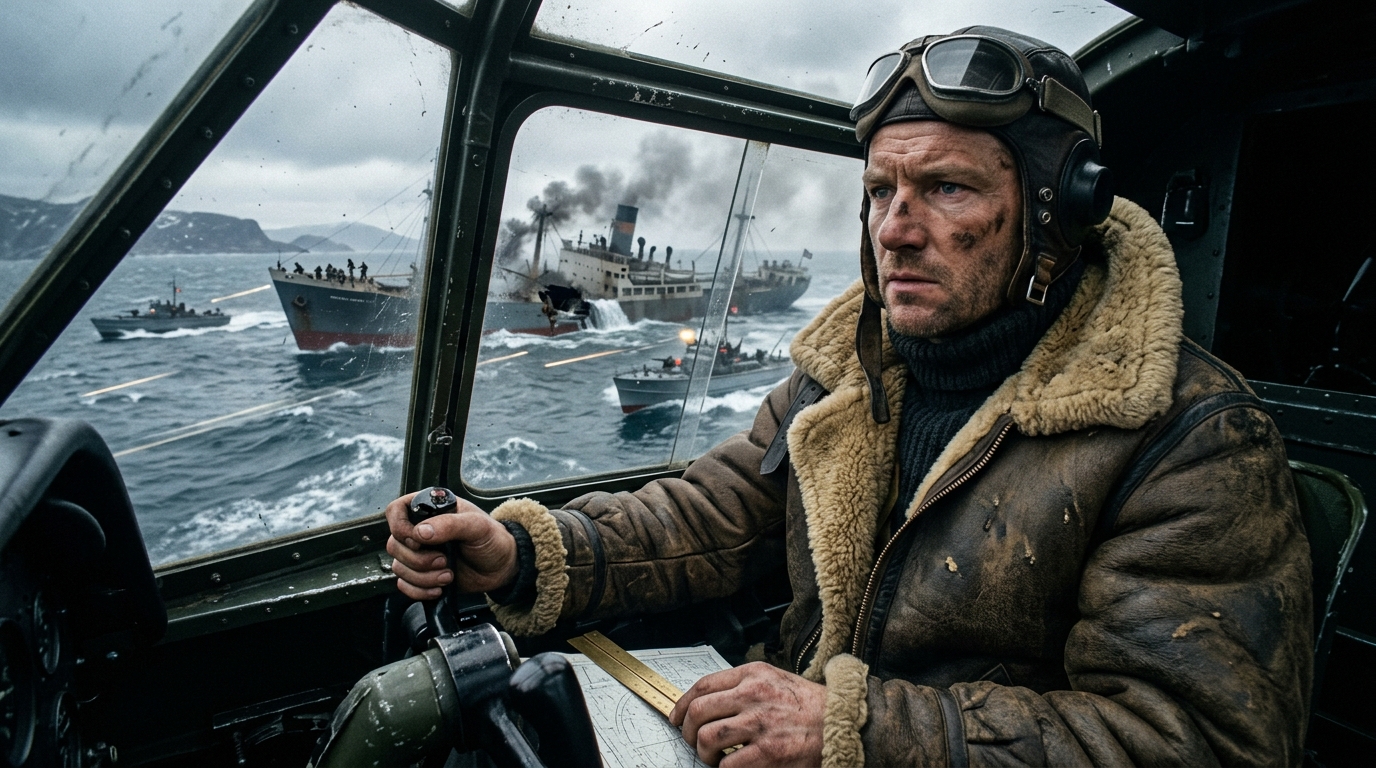
Three small, dark notches detached themselves from the gray shadow of a coastal cliff, moving south in a lazy, unhurried triangle. Moore eased the control column forward, dropping the nose of the Beaufighter without a word.
The altimeter unwound smoothly as they descended toward the salt spray, sliding into the damp gap between the clouds and the whitecaps. The silhouettes resolved rapidly into merchant hulls, medium-tonnage cargo haulers flanked by two small patrol craft, riding low and heavy in the swell.
No flak burst across their path. No frantic zigzagging broke their rhythm. They were crawling down the coast like they owned the gray water, trusting completely in the distance from Allied lines and the silence of an empty sky.
Moore’s thumb brushed the safety cover of the rocket rail switches on the instrument panel. His mind didn’t race with heroic adrenaline; it calculated angles, wind drift, and the inevitable dead weight of waiting.
“They’re too fat to be empty, Tom,” Moore murmured, his voice tight against the roar of the radial engines.
“Orders say observe and report, Ken,” Reed replied over the wire, his tone level, carrying neither panic nor agreement. “If we light up those rails, Washington and London will know about it before we clear the fjords.”
Moore didn’t touch the radio toggle. He knew the frequency was dead to him anyway, choked by atmospheric iron and the silent protocol of a reconnaissance run. He banked the heavy strike fighter into a wide, shallow arc, keeping the low winter sun directly behind their tail.
The target was right there in front of the windscreen, oblivious and slow, waiting for a war that had already forgotten how to wait.
CHAPTER 2: BREAKING THE SEAL
The sea rushed up to meet the Beaufighter’s belly, a flat slate of churning gray that blurred at two hundred knots. The rearmost freighter grew impossibly large in the optical sight, its rusted iron hull showing long streaks of orange scaling where the North Atlantic had eaten through the paint.
“Distance eight hundred,” Reed’s voice came through the throat mic, stripped of all emotion, sounding more like an accounting ledger than a man hanging three feet above open water. “Seven hundred.”
Moore felt the airframe shudder as a crosswind caught the heavy twin tail. He didn’t adjust with the rudder pedals; he held the nose dead center on the freighter’s waterline, right where the engine mounting met the forward hold. No alarm horns sounded from the deck. A lone sailor in a dark wool coat stood near the anchor winch, hand raised to shield his eyes from the low sun, mistaking the low twin radial rumble for a friendly Luftwaffe sweep out of Trondheim.
At four hundred yards, Moore squeezed the trigger.
The recoil hit the Beaufighter like a sudden, solid wall. Four 20mm cannons in the nose hammered in a blinding flash, showering the cockpit floor with heavy brass casings that smelled of cordite and hot oil. The first four high-explosive rockets slammed into the ship’s iron side with the dull, concussive thud of a sledgehammer striking an anvil.
A geyser of black water and shattered steel erupted fifty feet into the air. The freighter didn’t explode in a theatrical ball of fire; it simply stopped moving forward, its bow lifting three degrees as thousands of gallons of icy ocean poured into the ruptured forward compartment.
Moore pulled hard on the control column, banking the heavy fighter sharply to the left to clear the vessel’s aft mast. The g-force pressed him down into the leather seat, forcing a ragged breath from his chest as he cleared the funnel by less than twenty yards.
“Direct hits on the stern quarter,” Reed called out, his body leaning hard against the structural ribs as the plane leveled. “She’s taking on water fast, but the patrol boats are waking up.”
Behind them, the gray sea was no longer quiet. A steady line of bright yellow tracer fire began to arc lazily up from the leading escort vessel, reaching toward the sky like glowing beads on an invisible thread. The audacity of the easy passage was gone, shattered by forty pounds of high explosive and twelve seconds of cold calculation.
Moore straightened the wings, watching the second freighter open its throttle, black coal smoke belching from its stack as it tried to flee toward the narrow opening of the fjord. He didn’t look back at the drowning ship, but in the silence between engine beats, a strange, rhythmic metallic banging from the vessel’s lower deck seemed to carry across the water—a frantic, desperate clanging that had nothing to do with machinery.
“Line up the second one, Tom,” Moore said, his fingers tightening on the brass compass in his pocket before returning both hands to the throttle. “Before they reach the rock line.”
CHAPTER 3: THE IRON GRIP
The lead patrol boat was cutting a hard white wake through the dark swell, its forward 20mm deck gun firing in short, rhythmic bursts.
Tracing rounds snapped past the cockpit canopy, filling the cockpit with the sharp, ozone smell of burnt cordite and displaced air. Moore hauled back on the control stick, pitching the Beaufighter up onto its starboard wing tip to slip beneath the arc of the main battery.
“Port engine temp is spiking,” Reed reported, his voice cut short as the violent turn pinned him sideways against the radio racking. “We took metal through the outer cowlings.”
Moore didn’t check the temp gauge; he felt the drag in the left rudder pedal, a heavy, dead-weight resistance that meant oil was leaking into the airflow. He held the brass drafting compass tight in his left palm, the cold metal points biting into his skin as he calculated the turning radius of the second merchant ship.
The lead cargo vessel had already increased speed, its towering stern throwing up black coal smoke as it tried to clear the headland and slide behind the granite walls of the fjord. The second escort boat was maneuvering aggressively to block Moore’s approach vector, placing its hull directly between the Beaufighter and the escaping freighter.
“They’re overlapping their fire fields,” Reed called out, unbuckling his harness by an inch to lean over the navigation board and check their drift angle. “You won’t get a clean run without crossing the lead boat’s bow.”
“Then we don’t take a clean run,” Moore said, shifting his grip on the control column to counteract the engine drag.
He dropped the nose back down toward the water, skimming so close to the whitecaps that salt spray splashed across the lower windscreen panels. The patrol boat’s crew didn’t expect a twin-engine bomber to dive lower than their deck railings; the gunner on the forward mount hesitated for two seconds, sweeping his barrel down too late to track the oncoming shape.
Moore squeezed the firing button for one second—just long enough for the four nose cannons to hammer thirty rounds directly into the patrol boat’s wheelhouse.
Plumes of splintered wood and shredded steel burst from the vessel’s superstructure, forcing the escort to veer off its course to avoid running aground on the nearby shoals. The path to the second freighter cleared for a fraction of a minute, but the mechanical toll on the Beaufighter was already mounting as the port engine began to cough in ragged, uneven surges.
CHAPTER 4: THE FINAL RUN
The second cargo vessel was already turning its stern into the shadow of the fjord’s sheer rock face, its heavy iron bow pushing a thick wake against the shore reef.
“Rockets are gone,” Reed called out from the nav station, his voice raspy as he checked the empty switch indicators on his junction panel. “Six pods empty. We’re on guns only, Ken.”
Moore didn’t answer. He brought the Beaufighter down to fifteen feet above the dark water, lining up the crosshairs directly on the freighter’s exposed rudder assembly and twin propeller shaft.
Without explosive ordnance, knocking out three thousand tons of steel was a matter of mechanical leverage rather than brute force. He needed to destroy the steering quadrant before the ship slipped past the granite headland where the land-based batteries would have a clear line of sight.
The four 20mm cannons in the nose hammered in a single, sustained three-second burst.
Heavy steel-jacketed rounds chewed through the vessel’s wooden deck plating, tearing away the steering cable housing and severing the main steam pressure line feeding the rudder motor. A violent plume of white steam erupted from the stern, blinding the deck crew as the ship began to swing helpless in a wide, uncontrolled circle toward the coastal rocks.
“Rudder’s locked,” Reed said, leaning his forehead against the side window pane to watch the vessel’s erratic drift. “She’s losing headway fast.”
The third and largest freighter was already idling near the cliff entrance, its captain trying to reverse engines to avoid colliding with its drifting partner. Moore pulled up over the mastheads, the damaged port engine throwing a thin stream of scorched oil over the cockpit roof as he turned his nose back out toward the open sea.
Behind them, three supply vessels sat dead or dying in the water, blocking the entrance to the last functional German supply port in the sector.
“Fuel state says twenty minutes to bingo,” Reed noted, his finger tracing the red reserve mark on the mechanical tank gauge. “No radio to call in a tractor if we drop in the ocean.”
Moore set the brass compass flat on the instrument panel board and pulled the throttle back just enough to quiet the trembling wing.
“We’re not dropping in the ocean, Tom,” Moore said quietly, adjusting his trim tab to offset the engine drag. “Head us home.”
CHAPTER 5: THE SILENT RETURN
Squadron Commander Vance did not look up from the coastal grid map when the door latch clicked shut. He held a red grease pencil between two nicotine-stained fingers, its lead hovering over the precise sector grid where Moore’s patrol had originated four hours earlier.
“The ground crew says you returned with eight empty rocket rails, Kenneth,” Vance said, his voice flat, devoid of anger or warmth. “And your nose cannons were stripped to the firing pins.”
“Target of opportunity, sir,” Moore replied, his left hand remaining buried deep inside his flight jacket pocket, fingers locked tightly around the brass drafting compass. “Three merchant vessels heading south along the fjord entrance. Medium tonnage, heavy draft.”
“Standing orders for armed reconnaissance runs are explicit,” Vance snapped, the grease pencil finally making a hard, red mark across the grid before he lifted his eyes. “Observe. Encode coordinates. Maintain radio contact. You are not a independent strike package, Lieutenant.”
“The radio frequency was dead, Commander,” Reed spoke up from two paces behind Moore, his flight cap tucked neatly under his arm, his thumb nervously tracing the waxed paper envelope in his breast pocket. “Heavy atmospheric interference off the coast. We had no transmission window.”
Vance’s gaze shifted to Reed, sharp and unyielding, before cutting back to Moore. “You broke formation, ignored standing doctrine, and engaged a defended convoy without authorization or secondary cover. Do you have any idea how many administrative hours I will spend explaining this breach if those ships were neutral or empty?”
“They weren’t neutral, sir,” Moore said quietly, taking one step forward to set the brass compass down directly onto the map table, its twin steel points resting precisely over the fjord coordinates. “And they weren’t empty. They were riding low enough to carry iron or lead, moving fast enough to clear the port before dawn.”
Vance looked at the small brass tool resting on his operational chart, then back at Moore’s exhausted face, where grease and dried salt still lined the skin around his eyes.
“You will remain in quarters until the photo-reconnaissance package returns from tomorrow’s first light sweep,” Vance said, his voice dropping into a dangerous, low whisper. “If those hulls are intact, or if you misidentified the target, I will personally sign the court-martial papers before the week is out.”
Moore didn’t blink. He reached out, picked up the compass, and slipped it back into his pocket.
“Understood, sir,” Moore said, turning on his heel without waiting for a dismissal.
CHAPTER 6: THE LONG ECHO
Commander Vance tapped the glossy paper with the blunt end of his fountain pen, his mouth set in a hard, pale line.
The high-altitude reconnaissance shots showed three dark shapes wedged tight against the jagged granite line of the fjord. Two hulls sat half-submerged under forty feet of dark water, surrounded by wide, iridescent slicks of heavy fuel oil; the third sat beached on the rocks, its stern burnt out to the waterline.
“The Admiralty confirmed the tonnage twenty minutes ago,” Vance said, his voice clipped as he slid a typed dispatch across the desk. “The convoy was carrying heavy munitions and artillery spares meant to hold the northern redoubt. You disrupted an entire supply corridor.”
Moore looked at the glossy photo, his eyes lingering on the dark shadow beneath the water near the rearmost hull—the vessel that had echoed with that strange, frantic clanging before it sank.
“They’re filing it as an authorized engagement,” Vance continued, closing the manila folder with a sharp snap. “No reprimand. No medal either. Operational protocol is being updated to grant limited strike authority under similar tactical conditions.”
“And the men on board?” Moore asked softly.
Vance paused, his pen hovering an inch above his official ledger, his eyes growing cold. “The enemy lost three transports, Lieutenant. That is the only figure that enters this log.”
The ink dried dark blue on the tracing paper.
Kenneth Moore adjusted the brass screw of his drafting compass, tightening the joint until the twin steel legs locked firmly at three inches. He sat at a long pine drafting table in a quiet room overlooking the damp brick roofs of the Midlands, the steady hum of a peaceful city replacing the roar of radial engines.
Outside, a heavy spring rain washed against the windowpanes, dripping rhythmically off the iron drainpipe.
Reed sat across the small office, leaning back in a wooden chair as he folded a letter into a clean white envelope, his wedding ring catching the faint gray light from the glass.
“They’re rebuilding the bridge over the Trent first,” Reed said, smoothing the paper down with the flat of his hand. “They want the load calculations by Friday.”
Moore set the compass point on the blueprint paper, drawing a smooth, precise arc across the steel girder diagram. The lines were clean, the stresses balanced, and the math held true without any hidden variables or unaccounted weight.
He picked up a pink rubber eraser, blew away a small fleck of gray dust from the paper, and went back to work.