A Quiet Cul-de-Sac: Finding Resonance in the Silence of Five Loyal Hearts and Broken Glass
CHAPTER 1: THE WEIGHT OF SILENCE
The porch swing creaked, a rhythmic, iron-on-iron groan that usually lulled me into a stupor. Beside me, Rex let out a long, shuddering sigh, his chin resting heavy on my boot. He was old, his muzzle frosted with white, but his eyes were still tracking the wind, catching scents I hadn’t been able to identify in years.
Maplewood Estates was supposed to be the end of the line—the quiet place where the adrenaline finally stopped pulsing in my ears. I looked at the cedar fence, the way the late afternoon sun turned the wood a soft, muted gold. Everything about this life was meant to be static, a long, slow exhale after two decades of holding my breath.
But the silence was different today. It felt thin. Strained.
I shifted, the old joint pain in my knee flaring as I moved. My hand rested on Nova’s shoulder, feeling the steady, rhythmic thrum of her heart. She was tense. They all were. It wasn’t the kind of tension that preceded a threat; it was a confused, waiting energy. They were used to commands, to the clear “go” or “stay” of our past life. Here, there was no mission. Just the long, sun-drenched hours of waiting for the mail or the occasional neighbor’s car.
Then, I heard it. The sharp, rhythmic click-clack of heels on the asphalt.
It wasn’t a casual walk. It was a calculated, percussive sound that seemed to slice through the humid air. I didn’t look up immediately. I just let my hand drop from Nova’s neck, my fingers brushing the cool steel of the porch railing. Old habits, like ghosts, surfaced unbidden—the instinct to gauge the distance, to calculate the stride, to identify the intent behind the approach.
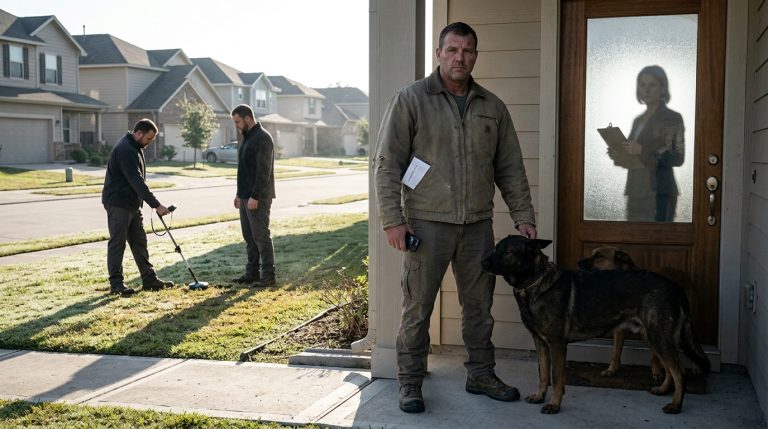
Emily Lopez stepped into the frame of my vision, her silhouette framed by the stark, over-manicured hedges of the neighboring yard. She held that clipboard like a shield. Her hair was pulled back so tight it looked painful, every strand disciplined into an architectural knot.
“Mr. Clark,” she said. Her voice was thin, pitched to carry across the lawn without ever sounding like a request. She didn’t walk up the path. She stood at the edge of the grass, eyes scanning my house as if she were tallying up structural sins.
I didn’t stand. I didn’t acknowledge the clipboard. I just watched her, noting the slight tremor in her left hand, the way her eyes darted toward the fence before settling on me.
“The noise,” she began, not waiting for a greeting. “The community requires a certain level of decorum. Your dogs. They… exist too loudly.”
Rex let out a low, vibrating hum from the back of his throat—not a growl, just a resonance. Emily flinched, a sharp, involuntary twitch of her shoulder. For a fleeting second, the mask of the HOA president slipped, revealing something raw and jagged underneath. It wasn’t just dislike; it was a desperate, clawing need for control that looked remarkably like a woman trying to keep the sky from falling on her own head.
I realized then that she wasn’t looking at the dogs. She was looking at the peace I had built, and she hated it because she couldn’t replicate it.
“They’re sleeping, Emily,” I said softly, the words feeling heavy in the quiet. “It’s a quiet day. Maybe you should try one.”
She gripped the clipboard so hard her knuckles turned the color of bone. She opened her mouth to speak, but the light hit her face, and for a moment, the architectural perfection of her appearance seemed to fray at the edges, revealing a tired, hollow vulnerability that had nothing to do with grass heights.
“You don’t understand what this place is,” she whispered, a sudden, sharp crack in her composure.
Before I could answer, she turned on her heel and marched away, leaving the heavy, suffocating silence of the cul-de-sac in her wake. I watched her go, and for the first time since I moved here, I felt the cold, hard tick of a clock starting in the pit of my stomach.
CHAPTER 2: THE CLINICAL INTRUSION
The stillness returned to the cul-de-sac, but it was a brittle, fragile thing now. I stood on the porch for a long time, my hand resting on Rex’s warm, steady head. He was watching the empty street with that heavy, focused intensity of a dog who had spent years learning to anticipate the shift in a suspect’s gait.
“Stay,” I murmured, more for my own benefit than his.
I stepped off the porch. The dew was still clinging to the grass, heavy and cold against my boots. I walked to the spot where Emily had stood—that thin line of demarcation between my property and the public sidewalk. That was when I saw it. Pinned to the cedar fence with a small, silver thumbtack was a piece of heavy, cream-colored cardstock.
It wasn’t a formal notice. It was a photograph.
I pulled the tack free. The paper was stiff, expensive, with a deckled edge. It was a photo of my own house, taken from the perspective of the street. It was crisp, clinical, and framed with the precision of a professional appraisal. I flipped it over. Scrawled in neat, tight, almost microscopic handwriting were the words: Violation: Unauthorized Personalization of Perimeter.
I stared at the house. My perimeter. The fence I had repaired, the stone path I had laid by hand—the very things that had made this house feel like a home after so many years in temporary housing. To anyone else, it was just a yard. To me, it was a barricade. A place where the world couldn’t reach me.
And now, I was being told, in the silent language of suburban warfare, that my barricade was a crime.
I went inside, the house feeling suddenly smaller, the air thick with the scent of old paper and the lingering, dusty smell of the afternoon. I didn’t go to the kitchen. I didn’t reach for the coffee. I went straight to the desk in the den where I kept the folders—the ones that had followed me from precinct to precinct, containing every certification, every commendation, and every piece of history I had built with five different dogs.
I pulled out the HOA manual, a pamphlet I had tossed into a drawer months ago. It was light, flimsy, and written in a language of vague threats. Failure to comply with community tone and decorum.
I walked to the window. Across the street, Emily’s house stood behind a screen of manicured boxwoods. The curtains were drawn, but I knew she was behind them. I could feel it. It wasn’t the surveillance of a neighbor; it was the calculated watching of someone who had decided I was an obstacle.
I sat at the desk, the silence of the house pressing against my eardrums. My knee throbbed—a dull, rhythmic pulse that reminded me of nights spent sitting in parked cruisers, waiting for a movement in the dark. I wasn’t in a cruiser now. I was in a living room filled with the soft breathing of five dogs. But the feeling was the same. The wait. The observation.
I reached for my phone, but stopped. I didn’t need to call the HOA. They wouldn’t help. This wasn’t about grass height. It was about the fact that Emily Lopez was trying to build a kingdom, and I was the only thing in the neighborhood that didn’t follow her rules of order.
I stood up and moved to the hallway, where a series of frames held the past: Rex, younger, his coat like polished coal, his eyes bright with the hunt; Nova, leaping over a fallen log in the rain; Scout, resting in the back of a truck, tongue lolling. They were the archive of a life spent in service. And now, they were being measured by a woman with a clipboard and a desperate need to feel like she held the reins of reality.
I heard a sound from the backyard—a sharp, sudden thud against the cedar fence.
It wasn’t the wind. It was the sound of something landing on the grass.
I didn’t rush. I didn’t grab anything. I simply walked into the kitchen, my movements fluid and quiet, my eyes scanning the room. The dogs were already at the back door, their bodies low, their hackles rising in a silent, rippling wave of tension. They didn’t bark. They just waited, their ears swiveling to track the intruder.
I opened the back door. The yard was bathed in the long, slanting light of the setting sun, turning the dust motes into tiny, suspended jewels. In the center of the lawn, near the fence line, sat a small, wrapped package. It looked like a brick of meat, neatly tied with twine.
I stopped. My breath hitched in my throat. I looked toward the fence, then back at the package, and finally at my dogs. They were standing in a perfect, rigid arc, blocking me from the yard. They weren’t just protecting me; they were identifying the threat.
That package wasn’t a gift. It was a test. And as I looked at the dark, dense mass on the grass, I realized the transition from petty nuisance to something dangerous had already begun. The silence of the neighborhood, once a comfort, now felt like a shroud.
CHAPTER 3: THE ESCALATION OF SHADOWS
The sun dipped lower, casting long, bruised shadows across the lawn. I didn’t reach for the package. Instead, I stood as still as a statue, letting the scene settle into my senses. The dogs remained motionless, a living wall of fur and focus between me and the object. They knew. They smelled the sharp, chemical tang of the tranquilizer masking the meat, a scent that stood out like a siren against the organic odors of damp earth and cut grass.
I turned back toward the house, my movements deliberate. I needed gloves. I needed evidence. I needed to document this before the transition from harassment to sabotage became an irreversible reality. I ducked inside, my heart rate steady, my mind cycling through the old sequences: secure the perimeter, document the scene, preserve the chain of custody.
Inside, the house felt too quiet, the air stale. I grabbed a pair of latex gloves from the utility closet and a plastic bag from the kitchen. I didn’t rush. The urgency was internal; the external world required a measured, controlled response. As I pulled the gloves on, the snap of the latex against my skin sounded like a gunshot in the sterile quiet of the kitchen.
When I stepped back into the yard, the light had turned a bruised, twilight purple. The package hadn’t moved. The dogs were still holding their formation, their eyes tracking the fence line, searching for the shadow that had dropped the bait. I walked over, crouched low, and carefully lifted the meat. The weight of it was wrong—too heavy, the texture too uniform. I slipped it into the bag, sealing it airtight.
I didn’t stop there. I walked the perimeter of the fence, tracing the wood with my fingertips. I found it on the third panel from the back corner: a small, splintered notch in the cedar where the latch had been tampered with. Not broken, just loosened, a subtle modification to allow for easier access.
A chill crept up my spine, not from the temperature, but from the realization of how long this had been happening. I had been living in a dream of peace, believing that the cedar fence was a barrier, while someone had been systematically picking the lock of my life.
I checked my phone. The security app showed a ten-minute gap in the footage from 3:00 a.m. the night before. I had dismissed it as a technical glitch, a momentary failure of a cheap sensor. Now, I saw the truth of it. It wasn’t a glitch. It was a window.
I needed help, but not the kind that came with a uniform and a report. I needed eyes on the outside. I walked back to the porch, Rex following at my heel, his presence a comforting, solid weight. I pulled out my phone and dialed Harris. He was still at the station, still working the graveyard shifts, still the only person who understood that some things didn’t fit into a standard police report.
“Harris,” I said, my voice low and steady. “I need you to look at something. Not as a cop. As a friend.”
“You okay, Clark?”
“I’m being watched. Someone’s testing the fence. And I think I know who it is.”
“The HOA president?” he asked, his tone skeptical but attentive.
“She’s acting like she has something to lose,” I replied. I looked at the dark silhouette of the neighboring house, the boxwoods looking like jagged teeth against the night sky. “She’s not just angry, Harris. She’s terrified. And people who are terrified make mistakes.”
I hung up, the silence of the yard returning, heavier now. I realized that the dogs were no longer just pets or companions; they were the only security system that mattered. I brought them inside, one by one, watching them settle into the living room. They were restless, their ears twitching at every gust of wind against the siding.
I sat in the dark, the only light coming from the faint blue glow of the kitchen clock. My mind kept returning to the photo on the fence. Unauthorized Personalization. It was such a strange, specific grievance. It wasn’t about the dogs barking; it was about the fact that I had made this place mine. I had created a stability that she couldn’t stand to look at, because it highlighted the exact thing she was failing to maintain in her own home.
I knew then that tomorrow wouldn’t be about waiting for another citation. It would be about anticipation. If she wanted to play the game of HOA rules, I would start playing it, too. I would document every violation, every intrusion, every shadow. I would mirror her obsession until the weight of it forced the truth to the surface.
I closed my eyes, but I didn’t sleep. I just listened to the rhythmic breathing of five dogs, the heartbeat of my sanctuary, and waited for the night to tell me what was coming next.
CHAPTER 4: THE SILENT VIGIL
The light on the porch clicked on, a sudden, blinding intrusion of artificial warmth into the cold, gray night. I didn’t move. I stayed pressed against the wall of the hallway, my eyes fixed on the feed from the doorbell camera displayed on my phone.
Nothing. Just the empty, wind-swept porch, the swaying branches of the ornamental tree, and the stillness of a street that had long since surrendered to the night.
I exhaled, the sound shallow and tight. I slid the phone into my pocket and moved toward the front door, my boots silent on the hardwood. I didn’t reach for the handle. I reached for the deadbolt, feeling the cold, familiar weight of the steel beneath my thumb. I peered through the peephole. The fish-eye lens distorted the cul-de-sac into a surreal, curved nightmare, but the street was clear.
And yet, the feeling remained—that prickling at the back of my neck that had saved my life more times than I could count on a single hand.
I walked back to the living room. Rex was standing in the center of the floor, his head low, his hackles barely raised but his posture radiating an absolute, locked-in readiness. He wasn’t looking at the door. He was looking at the window that faced the neighboring yard—Emily’s yard.
I crept toward the window, pulling the heavy curtain back just a fraction of an inch.
The moonlight washed the neighborhood in a pale, spectral blue. Across the way, the silhouette of Emily’s house looked different. The curtains weren’t just drawn; they were slightly askew, a jagged gap of darkness showing where someone had been peering out. I watched for a long, agonizing minute, and then, a figure stepped into the sliver of light from the streetlamp.
It was Emily. She was wearing a heavy, dark coat that seemed too large for her, her hair no longer in its architectural knot but hanging loose, unkempt. She wasn’t holding a clipboard. She was holding a flashlight, but she wasn’t using it to inspect the grass. She was using it to trace the line of her own fence, her movements erratic, frantic, almost surgical.
I felt a sudden, sharp pang of recognition. I remembered a case from years ago—a woman who had spent months meticulously cataloging the belongings of a man she barely knew, convinced that if she could just arrange his life to her own specifications, she could fix the chaotic, broken machinery of her own. She hadn’t been a criminal, not in the traditional sense; she had been a person drowning, trying to save herself by rearranging the furniture of someone else’s world.
Emily stopped, her flashlight beam sweeping across the street, cutting through the dark like a blade. It caught my window, and for a heartbeat, I was certain she saw me. I stood perfectly still, my breathing synchronized with the dogs around me. She didn’t look away immediately. She stared at the window, the light trembling in her hand, and in that moment, the distance between us seemed to collapse.
It wasn’t power she was seeking. It was a mirror. She wanted to see if I was as broken as she was.
I pulled back, letting the curtain fall. My pulse was a steady, rhythmic thrum in my ears. I walked back to the kitchen and sat at the small, scarred wooden table. The house was quiet, but it was a different kind of quiet now—no longer the peace of a sanctuary, but the tense, expectant silence of a tactical observation post.
I realized then that the decoy—the HOA complaints, the fines, the petty grievances—was beginning to shed its skin. She wasn’t playing a game of rules. She was playing a game of survival. If I continued to resist, if I continued to hold the line, she would eventually be forced to escalate. And that, I knew, was when the danger would shift from the theoretical to the physical.
I needed to be ready. I stood up and walked to the closet where I kept the old, heavy gear—the boots, the light, the tools. I didn’t take them out. I just touched the canvas, feeling the grit and the history of it.
Rex trotted into the kitchen, his nails clicking on the floor. He pressed his flank against my leg, a warm, solid reminder of the life I had built here. I looked down at him. His eyes were calm, trusting, untroubled by the darkness outside. He believed in me. He believed that as long as I was here, the perimeter would hold.
I took a deep breath and sat back down, watching the shadows stretch across the floor. The night was far from over, and for the first time in two years, I wasn’t just waiting for the morning. I was waiting for the inevitable moment when the mask would finally break.
CHAPTER 5: THE FALLING MASK
The phone vibrated against the wooden table, a dull, insistent hum that felt like a pulse. I didn’t reach for it immediately. I looked at Rex. He was already standing, his ears pricked, his body tuned to the frequency of a threat. The alert wasn’t a random glitch; it was the signal I had been bracing for.
I picked up the device. The screen illuminated the dark kitchen in a harsh, cold light. Front porch camera. 2:17 a.m. A figure in a gray hoodie, movements fluid and practiced, was navigating the steps. It was Emily. She didn’t look like an HOA president. She looked like a ghost, her movements jagged, her hands fumbling with a set of tools that caught the moonlight with a metallic, clinical gleam.
I didn’t wait for her to reach the door. I moved, my steps soundless, crossing the living room with the efficiency of a man who had done this a thousand times in different worlds, under different stars. I reached the front door and stood to the side, my hand resting on the lock. I signaled to the dogs—a sharp, single gesture. They moved into position, five silent shadows flanking me, their forms barely visible in the gloom.
I heard the click-scrape of a pick against the deadbolt. It was a rhythmic, scratching sound, the noise of a person trying to rewrite the boundaries of their own existence.
I didn’t open the door. I waited, letting her commit to the breach. I needed her to know that her authority didn’t extend past the threshold of my home, and that her need for control had finally run into something it couldn’t manage.
“It’s okay, babies,” a voice whispered from the other side of the wood. It was thin, frayed, a sound of profound, lonely desperation. “I’m here to save you.”
She wasn’t talking to me. She was talking to the dogs. She was talking to the very creatures that had been my anchor, attempting to project her own lost, chaotic identity onto the only thing in the neighborhood that appeared peaceful. She wanted them to belong to her because she had nothing left that she truly owned.
I gripped the handle and pulled the door open, swinging it wide with one decisive motion.
The porch light hit her like a physical blow. She froze, the lockpick clattering to the deck, her tote bag slipping from her shoulder. For a second, she was just a woman in the glare of a security lamp, her face pale and etched with a frantic, hollow exhaustion. She looked smaller than she had in the daylight, the “architectural perfection” of her life completely stripped away.
The dogs didn’t lunge. They didn’t bite. They simply stepped forward, a semi-circle of silent, watchful judgment that hemmed her in against the railing. She gasped, backing up until her heels hit the edge of the porch, her eyes wide, staring not at me, but at the dogs.
“Call them off,” she shrieked, the sound high and brittle. “They’re dangerous. They’re trained.”
I stepped out onto the porch, the air cold against my skin. I didn’t raise my voice. I didn’t move toward her. I just stood there, the weight of the last few months settling into the silence between us.
“They’re only as dangerous as the environment they’re in, Emily,” I said, my voice steady, stripped of any malice. “Just like you.”
She trembled, her hands clawing at her hoodie. She looked at me, and for a moment, the mask didn’t just fall—it shattered. I saw the reality beneath the HOA reports and the aesthetic policing. I saw a woman who had spent years trying to craft a version of perfection to hide a reality that had collapsed under its own weight. She hadn’t been fighting me; she had been fighting the fact that her own life was a ruin, and she couldn’t bear to let anyone else possess the peace she had failed to build.
“I just wanted it to be… right,” she whispered, her voice failing. “Everything is falling apart. I just wanted it to be right.”
She wasn’t a villain. She was a casualty. And as the distant, melodic wail of sirens began to rise in the night air—a sound I had triggered with a single, silent alarm—I realized that the “consequence” I had been waiting for was not punishment. It was the forced encounter with the truth she had been running from for years.
She collapsed onto the porch, her head in her hands, the fight draining out of her with the speed of a punctured tire. The dogs relaxed their formation, their heads dropping, their presence shifting from defensive to simply observant. They were done. They had held the line, and the perimeter was secure.
I stood over her, the cool night air feeling clean for the first time in weeks. The lights of the patrol cars began to flicker at the end of the cul-de-sac, casting long, sweeping beams across the lawns. The neighborhood would wake up to the truth, and the quiet, artificial serenity of Maplewood would finally have to contend with the messy, painful reality of the lives lived behind the closed curtains.
I didn’t feel triumph. I felt an immense, heavy fatigue. The battle was over, but the resolution was just beginning.
CHAPTER 6: THE AFTERMATH OF GRACE
The dawn came in shades of soft, muted gray, washing away the harsh glare of the patrol car lights and the frantic energy of the night. I stood on the porch, my hands resting on the railing. My skin felt tight, a reaction to the adrenaline-fueled hours that had bled into one another, but the air was still, clean, and strangely devoid of the tension that had gripped this cul-de-sac for so long.
Across the street, Emily’s house looked different in the daylight. Without the frantic, jagged movements and the artificial scrutiny of her night-time patrols, the structure just looked like a house—a place where people lived, struggled, and sometimes failed.
Harris walked up the path, his boots crunching softly on the gravel. He didn’t say anything at first. He just stood beside me, leaning against the railing, his eyes tracking the morning activity of the neighborhood. A few kids on bikes rattled past, their voices shrill and vibrant in the cool air. The world was moving on.
“She talked,” Harris said, his voice low. “Not to the officers, but to the crisis intervention team. It’s what you thought, Clark. It wasn’t about you. It wasn’t about the HOA. She lost her job six months ago. Then her husband moved out, and she couldn’t keep up the payments, couldn’t keep up the appearances. She started trying to curate this place because it was the only thing she felt she could still control.”
I looked down at the porch, where the wood had been marred by the lockpicking tools. I reached into my pocket and pulled out a small piece of sandpaper. I had carried it for days, a small, tangible reminder of the work that needed to be done.
“She broke in because she wanted to see if anyone else was living in a state of ‘order,'” I said, the words heavy but true. “She needed to believe that the peace she saw here was just as artificial as the life she was trying to maintain.”
“She’s getting the help she needs,” Harris said, clapping a hand on my shoulder. “Court-ordered, the whole works. It’s not going to be easy, but the cycle, at least, is broken.”
I nodded, feeling a strange, hollow sense of clarity. The mystery that had felt like a suffocating web of malice had revealed itself as something far more human, and far more tragic. It wasn’t a grand, evil design; it was the collapse of a person who had forgotten how to exist without a mask.
After Harris left, I stayed on the porch. I took the sandpaper and knelt by the spot where the lockpick had scarred the cedar. I began to work, the rhythmic shhh-shhh sound filling the space. It was a small action, but it was mine. I was repairing the damage, not because it erased what happened, but because the work itself was a form of closure.
Rex sat beside me, his warmth radiating through my jeans. Nova, Bear, Scout, and Atlas were gathered near the door, their ears relaxed, their eyes no longer fixed on the horizon but simply observing the soft, morning shift of light across the lawn. The perimeter held.
I looked at the house again. I had built this life for silence, for protection, and for the simple, grounded comfort of a home. I realized then that I had been guarding it the wrong way. I had been treating my sanctuary like a fortress, watching for threats, waiting for the breach. But the biggest threat wasn’t an intruder; it was the fear that the quiet couldn’t be maintained.
I finished the sanding and ran my hand over the wood. It was smooth, the grain restored, the mark of the intrusion fading into the natural history of the cedar.
I stood up, feeling the ache in my joints—a physical reminder of the cost of standing one’s ground. I walked over to the edge of the porch and looked toward Emily’s house one last time. There was no anger left, just a quiet, resonant understanding of the fragility of the human condition.
The cul-de-sac was waking up. A neighbor waved—a genuine, tired, morning-time wave. I waved back.
I went inside, the door closing behind me with a solid, reassuring sound. I locked it, but the action didn’t feel like a defense. It felt like a homecoming. I poured a glass of water and sat at the kitchen table, watching the sun hit the far wall. The dogs followed me in, their presence a steady, grounding weight.
I thought about the future, about the days to come, and the quiet, simple work of living. I had learned that peace wasn’t the absence of conflict; it was the ability to stand in the center of it, to recognize the truth, and to choose, every single day, to be the person who repairs the damage instead of the one who causes it.
I leaned back in the chair and closed my eyes, letting the morning light wash over me. For the first time, the silence didn’t feel thin. It felt full. It felt like home.