The Iron Road to Tebessa: How Plain American Steel Broke the Pride of the Luftwaffe
CHAPTER 1: DUST AND IRON
The sun hit the rusted hood of the M3 halftrack hard enough to cook grease off the engine block.
Sergeant Frank Miller didn’t look at the sky. He kept his head down, tapping a greasy half-inch open-end wrench against the pintle mount of the M2 Browning until the metal ringed in the hot air.
“Rattles in the housing,” Miller said, his voice flat as dry dirt. “You let that ring wobble, corporal, and the feed pawl jams on the third round.”
Corporal Evans wiped sweat off his chin with a sleeve already caked in yellow Algerian dust. “British drivers back at the depot said the Messerschmitts come in low over the western ridge. Said you don’t hear ’em till the engine noise hits the deck.”
“British drivers were running light trucks with rifle-caliber popguns,” Miller spat, sliding the wrench into his rear pocket. He grabbed the heavy steel spades of the .50 caliber, feeling the heat of the sun soaked deep into the receiver. “We aren’t running light.”
Behind them, twelve GMC two-and-a-half-ton trucks sat idling in a ragged line, their exhaust pipes belching blue haze into the shimmering heat. Every single vehicle had a canvas tarp stretched tight over the back, and every single cab carried a steel ring mount welded right above the passenger seat.
A low, vibrating hum rattled through the floorboards of the halftrack—not an engine on the road, but a high-pitched whine cutting through the heat haze beyond the ridge.
Miller didn’t jump. He didn’t scream an order or blow a whistle. He simply rack-cleared the heavy bolt on the M2, pulling the heavy steel charging handle back until it locked with a dense, oily click.
“Get on your ring, Evans,” Miller said, his eyes narrowing as he adjusted his boots on the floor diamond-plate. “They think this is a delivery route.”
Over the rise of the dry wash, two dark specks snapped into view, dropping low to the deck, trailing twin plumes of desert dust at four hundred kilometers an hour.
CHAPTER 2: THE SCREAMING SKY
The noise arrived before the shadows did. It was a high, thin whistling that ripped open the heat haze above the dry wash, turning into the raw, metallic roar of two Daimler-Benz engines screaming at four hundred kilometers an hour.
Evans squeezed his trigger too early. The ring-mounted .50 on the passenger side let out three deafening, rhythmic clacks—CLACK-CLACK-CLACK—sending bright orange tracer sparks arching wildly into the empty blue, hundreds of yards wide of the lead fighter.
“Hold your fire, damn it!” Miller barked, his voice cutting through the engine roar without rising into a panic. He didn’t lift his elbows off the armored plating. He waited. He watched the nose of the lead Messerschmitt drop, the thin wings angling flat as the pilot aligned his guns with the center of the truck column.
The lead German pilot didn’t expect a wall. For eighteen months, strafing a convoy meant watching Commonwealth drivers jump into ditches while light rifle-caliber bullets bounced off aluminum wing panels like hail.
At three hundred yards, Miller leaned his whole weight into the spades. He didn’t aim at the plane; he aimed at a patch of empty air fifty feet in front of the spinner nose.
The M2 heavy barrel shook the halftrack’s suspension, dumping heavy, smoking brass casings onto the steel diamond-plate floor with a heavy, chattering sound. Eight half-inch steel penetrators every single second, punching through the hot desert air in a tight, lethal arc.
Behind him, along the staggered line of GMC trucks, three more drivers caught the rhythm. They weren’t anti-aircraft specialists. They were former farmhands from Iowa and garage mechanics from Michigan who knew how to lead a moving target.
Streams of red and orange tracers erupted from the top of the truck cabs, converging into an absolute wall of lead directly in the path of the lead Messerschmitt.
The lead Bf 109 flew straight into the stream.
There was no clean explosion, no dramatic fireball. The heavy armor-piercing rounds slammed through the nose cone, shattering the DB 605 engine block and tearing through the coolant lines in a split second. A massive cloud of white, pressurized glycol steam burst from the radiator belly, instantly blinding the German pilot.
The fighter lurched violently upward, its engine seizing with a horrific screech of tearing metal. Miller held his thumb on the butterfly trigger, tracking the rising silhouette for one more two-round burst that stitched a line of holes across the cockpit canopy before the aircraft inverted and slammed belly-first into the rocky slope behind the ridge.
The wingman didn’t press the attack. Seeing the wall of heavy tracer fire crossing his path, the second pilot yanked his stick back, executing a violent, banking climb that pulled his aircraft out of range before he even opened fire.
Evans let out a ragged breath, his hands shaking as he clung to his mounting ring. “We got him! We blew him right out of the sky!”
Miller released the spades, his thumbs numb from the vibration. He picked up his greasy half-inch wrench from the tool chest, his face completely devoid of excitement as he looked down the line of idling GMC trucks.
“We didn’t get anything yet, corporal,” Miller said, looking at the black smoke rising over the ridge. “He saw the guns. Next time, they won’t come in low and polite.”
CHAPTER 3: DEAD RADIOS AND BARE WIRE
The copper wiring inside the terminal housing didn’t look melted; it looked completely shattered. A thin trail of acrid white smoke curled out from behind the BAKELITE dial, smelling strongly of burnt resin and ozone.
Miller dropped the heated barrel onto the rack with a heavy metallic clack, slid off his leather mitten, and poked his greasy wrench into the terminal box. The copper leads crumbled into fine black ash at the first touch.
“Vibration from the strafing run sheared the internal ground switch,” Evans said, leaning over the side of the cab with his face streaked in soot. “I tried dialing the escort depot at Tebessa. Zero carrier wave. The main receiver is stone dead.”
Miller didn’t answer right away. He tapped the open-end wrench against the fried casing, listening to the hollow, dead thump of ruined electronics.
Without radio link, nobody down the line knew they were coming, and nobody at the forward airfields knew that two fighters were actively hunting this route. They were twelve trucks moving through thirty miles of open desert canyon with zero early warning.
“We aren’t calling for air cover,” Miller said flatly. “And we aren’t waiting for a maintenance team that isn’t coming.”
He hopped down from the halftrack bed, his boots hitting the gravelly sand with a dull crunch, and walked toward the lead GMC truck. He pulled back the heavy, dust-caked canvas flap pinned to the wooden tailgate.
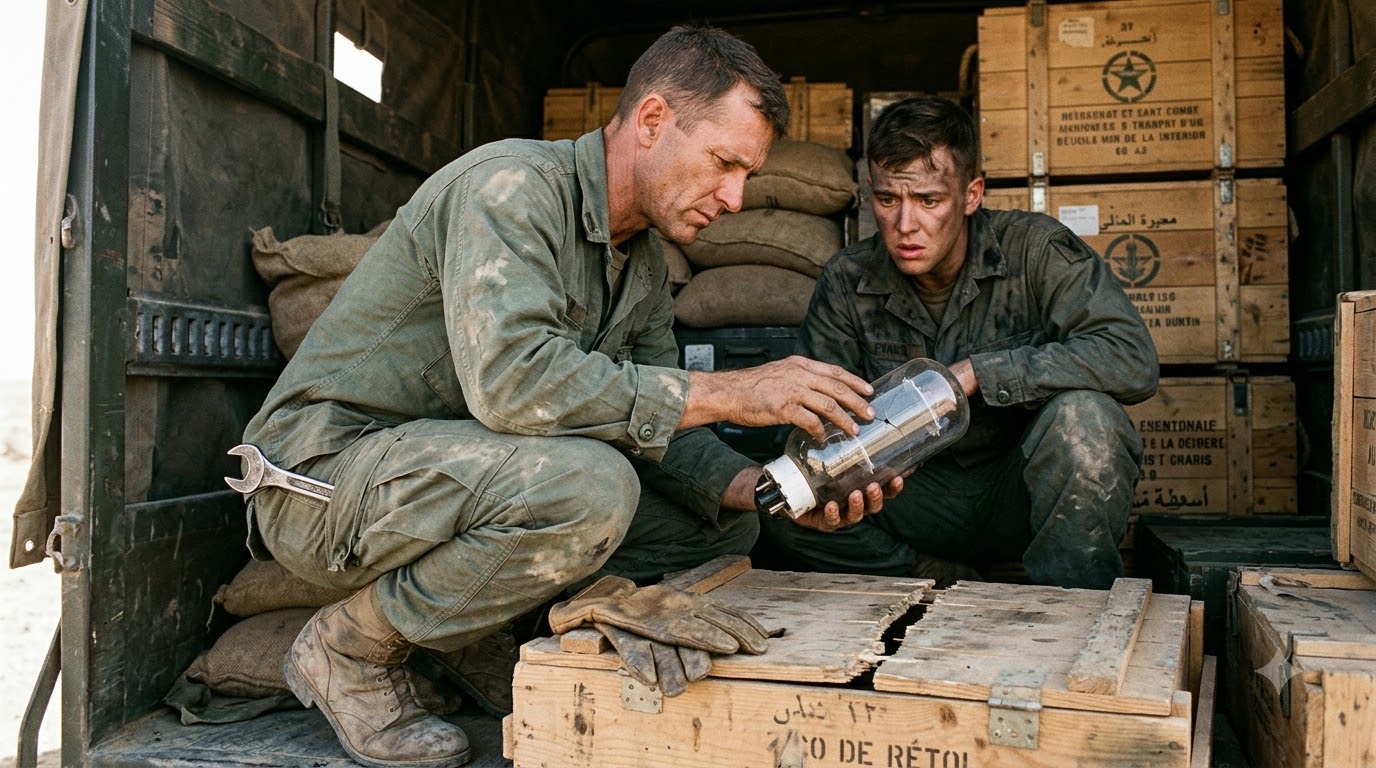
Inside, stacked three deep between crates of standard rations and grease tins, sat wooden shipping crates branded with yellow stencil paint. One box had split along its grain from the sudden braking during the attack.
Miller reached into the split wood, moving aside greasy burlap, and drew out a glass cylinder the size of a mason jar. Inside the clear casing, a thick copper-wound vacuum tube sat suspended in porcelain mounts.
A hairline fracture ran straight through the glass, catching the hard desert sunlight.
Evans appeared at Miller’s shoulder, peering over the tailgate. “What is that? Radar calibration valves? Drivers at the port said we were hauling motor oil and canned pork.”
“They lied to the drivers so nobody would fuss about keeping the convoy under forty,” Miller said, sliding his thumb gently over the cracked glass without pulling the tube from its housing. “The airbase at Tebessa is blind without these. That German pilot wasn’t dropping bombs on random trucks—he was checking crate markers.”
Evans swallowed hard, his eyes shifting back toward the empty sky above the western ridge. “If that wingman made it back to base…”
“He told his flight lead exactly where we are,” Miller said, shoving the burlap back over the crate and dropping the canvas flap. “And he told them we’re traveling alone.”
CHAPTER 4: THE RIDGE LINE TRAP
“We go into that cut, we can’t scatter,” Evans said, his boots crunching in the loose gravel as he walked up from the halftrack. “We won’t even be able to swing the ring mounts thirty degrees left or right without the barrels scraping rock.”
Miller gave the wrench one final, shoulder-straining heave until the nut groaned against the rim.
“That’s what he’s counting on,” Miller said, wiping grease onto his trouser leg. “He didn’t fly back to the coast, corporal. He climbed into the sun and waited for us to reach the bottleneck.”
Evans looked back at the open salt pan behind them—miles of flat, white alkaline crust shimmering under the afternoon heat. “We could disperse out there. Make him hunt twelve individual trucks across the flat.”
“Out there, he dives from ten thousand feet with the sun behind his tail and picks us apart while we waste ammunition shooting at glare,” Miller said, tossing the wrench into the cab floorboard with a sharp metallic clatter. “In the cut, he has to fly where the rocks let him fly.”
He didn’t wait for Evans to argue. He slapped the dented green fender of the lead GMC—a hard, flat signal—and swung himself up onto the halftrack’s steel foot-peg.
The convoy ground into the limestone gorge, twelve heavy engines echoing off stone walls so close the side-view mirrors brushed against dry desert scrub.
The temperature dropped ten degrees inside the shade of the canyon, but the air felt heavy, trapped between vertical cliffs that blocked out the sky to a single, narrow ribbon of blue overhead.
Then the rocks began to vibrate.
It wasn’t the rumble of their own tires. A high-pitched, metallic scream bounced off the upper canyon walls, echoing so hard from left to right that Evans swung his M2 muzzle toward the western cliff face, trying to track a sound that had no center.
“He isn’t coming from the sides!” Miller yelled over the engine roar, his hands locking onto the halftrack’s Spade grips as he stared straight down the throat of the road ahead. “He’s coming straight down the pipe!”
A silver wing-tip flashed over the northern rim line.
The Messerschmitt hadn’t attacked from above; the pilot had dropped his aircraft down to the canyon floor three miles ahead, flying fifty feet off the dirt road, using the winding rock walls to shield his approach until the absolute last second.
He was screaming straight toward their front bumpers at three hundred miles an hour, banking hard around the final bend of the gorge with his nose cannon already flashing orange.
CHAPTER 5: THE COLLAPSE OF THE STAFFEL
“He thinks we’re trapped!” Evans screamed, his arm muscles straining as he swung his passenger ring mount directly forward, locking the pintle pin into the forward notch. “He thinks he’s shooting fish in a barrel!”
Miller didn’t answer. He didn’t flinch as twenty-millimeter cannon shells began stitching a line of violent, exploding dust bursts down the center of the dirt road, walking straight toward the front bumper of his halftrack.
The German flight leader had traded his altitude for certainty. He was flying so low into the rock cut that his wingtips left swirling eddies of dust along the limestone walls, convinced that a line of truck drivers squeezed between sheer cliffs would break, panic, and jump for the rocks.
He had spent eighteen months watching men run from his guns. He hadn’t reckoned on twelve plain steel ring mounts lined up bumper-to-bumper in a straight, narrow chute.
“Now,” Miller said.
He squeezed the butterfly trigger down flat.
The single M2 in Miller’s hands slammed against his chest, but it wasn’t firing alone. Behind him, twelve truck drivers—men who had spent their lives adjusting carburetors, hauling grain, and fixing tractors—held their ground in the truck beds and cab rings.
Twelve heavy barrels opened up simultaneously into the narrow throat of the pass.
Instead of a scattered arc, the restricted canyon walls forced every single stream of armor-piercing tracer into a single, devastating corridor of lead. Over ninety half-inch steel projectiles per second hammered straight through the air, creating a solid wall of metal in the fighter’s exact line of flight.
The Messerschmitt hit the wall at three hundred miles an hour.
Heavy armor-piercing rounds tore through the propeller spinner, shattering the main drive shaft before punching straight through the pilot’s windscreen and engine housing. The DB 605 engine didn’t just overheat—it disintegrated under the sheer kinetic impact, its oil lines bursting into a violent, trailing sheet of black flame.
The German pilot tried to yank his stick back, trying to force his dying aircraft up and out of the rock cut, but the physical drag of shattered aluminum and destroyed lift surfaces slammed the nose back down.
The fighter veered wildly off-center, its port wing catching a jagged limestone outcrop with a deafening screech of tearing metal. The impact sheared the wing clean off at the root, sending the fuselage tumbling head-over-heels into the floor of the wash, where it skidded three hundred yards down the gravel before slamming into the far cliff face in a heap of twisted scrap and smoking iron.
The roar of the engine died instantly, replaced by the crackle of burning rubber and the steady, rhythmic idle of twelve American truck engines.
Evans lowered his gun, his mouth open, his chest heaving as grey gunpowder smoke drifted slowly through the shaded canyon air. “He… he came right at us.”
Miller released his grip on the spades. He pulled his half-inch wrench out of his back pocket, stepped down onto the running board, and looked back down the straight line of untouched GMC trucks.
“He thought we were soft because we were driving haulers,” Miller said, walking toward the lead cab as the dust settled over the gravel. “He found out different.”
CHAPTER 6: SILENCE ON THE ASPHALT
The heat coming off the wreckage was thin now, fading into the dry desert breeze that swept down the length of the limestone canyon.
Evans walked up carrying a canteen, his face covered in dark smudges of soot and grease. He handed the tin cup over without a word, staring down at the mangled wreckage pinned against the cliff base.
“Airbase ops at Tebessa is going to want a full report on this,” Evans said, wiping his brow with his dusty sleeve. “They’re gonna ask how twelve supply trucks without an anti-aircraft battery escort brought down a flight leader.”
Miller took a swallow of tepid water, tasting dust and iron, then pulled his grease-stained rag out to wipe the mouth of the canteen.
“They don’t need a report,” Miller said, sliding his wrench back into his hip pocket. “They just need these crates delivered so their radar grid stops sitting blind.”
He turned his back on the wreck and walked past the halftrack, checking the rear tie-downs on each of the twelve GMC trucks as he passed. Every single canvas tarp was drawn tight. Every ring-mounted M2 sat locked forward in its travel pin, its heavy barrel cooling down in the shadow of the rock walls.
The drivers were sitting on their running boards or leaning against the front fenders, unspooling wire, drinking water, and lighting cigarettes. Nobody was cheering. Nobody was bragging about marksmanship.
They were working men who had taken a job hauling freight down an uncomfortable stretch of road, and the job wasn’t finished until the tailgates were dropped at the depot gates.
Miller climbed up into the passenger seat of the lead halftrack, pulling the heavy steel door shut until the latch caught with a firm, solid click.
“Get in, Evans,” Miller said, leaning his elbow on the door frame as the sun began to dip behind the western ridge, painting the limestone pass in deep shades of purple and red. “We’ve got ten miles of dirt left before dark, and I want to be off this road before the mess tent closes.”
Evans hopped behind the wheel, hit the starter pedal, and double-clutched the transfer case into gear. The halftrack lurched forward, its rubber tracks gripping the loose gravel as the column rolled out of the gorge and onto the open asphalt leading down toward Tebessa.
Miller reached down, pulled the greasy half-inch wrench from his pocket, and dropped it into the steel toolbox beneath his seat, letting the lid fall shut with a quiet, final thud.