The Architect of Silence: A Measured Dismantling of Institutional Corruption in the Shadow of Duty
CHAPTER 1: THE WEIGHT OF THE BADGE
The knuckles connected with the side of Jack Harper’s jaw, a sharp, white-hot impact that should have sent a lesser man to the dirt. Jack didn’t blink. He didn’t stumble. He stood in the center of the restricted lot, his feet anchored to the asphalt like stone pillars, absorbing the force until it dissipated into the cold morning air. Across from him, Gunnery Sergeant Ryan Blake stared, his own hand still half-extended, his face drained of color as if he had just struck a marble statue instead of a man in a gray Henley.
The silence that followed was heavy, a vacuum that pulled the sound out of the naval base. Thirty feet away, a junior Lance Corporal named Reyes froze, his coffee cup suspended halfway to his mouth, the liquid motionless. Blake’s chest heaved, a rhythmic, frantic sound. He had come out of the duty shack looking for a fight to justify his own authority, and now, facing Jack’s terrifyingly empty gaze, he realized he had accidentally breached a perimeter he didn’t even know existed.
Jack felt the copper tang of blood blooming at the corner of his lip, a sharp, metallic reminder of the cost of entry. He didn’t wipe it away. He kept his hands at his sides, his breathing steady, rhythmic. “You going to stand there and take it?” Blake rasped, though the menace in his voice had thinned into something brittle.
Jack looked through him, his eyes tracing the physical geometry of the Sergeant’s stance—the flared shoulders, the over-extended reach, the clear markers of a man who relied on intimidation to secure his control. “I’m not taking anything, Sergeant,” Jack said, his voice flat, carryable, and utterly devoid of heat. “I am observing.”
“Observing?” Blake laughed, a sound that cracked like dry timber. He took another half-step forward, his cover nearly touching Jack’s forehead. “You’re a trespasser in a restricted lot with an unregistered dog. You’re a single dad playing soldier, and I’m about to have you escorted off this base in cuffs.”
Jack didn’t blink, even when Blake’s hand pressed against his chest—a clumsy attempt to force a reaction. Jack’s internal monologue was a rapid, precise stream of calculations. The risk of physical escalation: zero. The cost of revealing his status: permanent. The mission objective: K9 readiness integrity. He reached into his left pocket, his movements deliberate, unhurried, as if he were pulling out a set of keys rather than a weapon of bureaucratic mass destruction.
He revealed the badge. It was a dark, matte-black sliver no larger than a playing card, the embossed insignia catching the dull morning light.
The change in Blake was immediate and physical. The blood retreated from his face, leaving behind the pale, slack-jawed look of a man who just saw a ledge open up beneath his feet. The hand on Jack’s chest dropped as if it had touched a live wire.
“Tier One,” Blake whispered, his voice failing him.
Jack didn’t answer. He simply watched the Sergeant realize that his entire world—his rank, his lot, his authority—had been rendered invisible by a piece of steel smaller than his own ID card. Jack knew then that the confrontation was effectively over, but the disturbing realization was only beginning; he glanced toward the training field, noticing the way the shadows fell on the handler’s path, a subtle, jagged inconsistency in the landscape that told him this unit wasn’t just messy—it was broken.
CHAPTER 2: THE ECHO IN THE CORRIDOR
The transition from the open, chaotic space of the parking lot to the interior of the annex was not just a change in environment; it was a shift in atmospheric pressure. Inside, the air tasted of industrial floor wax and recycled oxygen, a sterile, flat scent that signaled the presence of command. Jack didn’t break stride. His boots clicked against the linoleum, a sharp, rhythmic sound that echoed ahead of him, broadcasting his arrival. Max matched his pace, his claws barely clicking, moving with a silent, flowing grace that made the two of them feel like a singular, deliberate force.
Commander Ellis was waiting at the interior security checkpoint, his face a neutral mask of professional distance. He had been expecting the arrival, but when he caught the faint, metallic scent of blood on Jack’s lip, his eyes narrowed by a fraction of a millimeter. He didn’t ask. He didn’t offer a tissue. He simply pivoted on his heel, signaling for Jack to follow him into the administrative belly of the base.
The corridor was long, lined with closed doors that hummed with the sound of servers and the muted cadence of hushed conversations. Jack’s internal focus shifted from the kinetic threat of Sergeant Blake to the systemic threat of the facility itself. He felt the familiar pull of the audit—the need to categorize, to cross-reference, to find the structural weak points in the paperwork. His mind, trained on the [Dark Resolve] lens, treated every shadow in the hall as a potential obfuscation.
“The duty officer at the gate,” Ellis said, his voice low, bouncing off the concrete walls. “He’s already been scrubbed. He’s telling anyone who asks that you were a civilian with a mislaid ID.”
Jack kept his eyes forward, noting the way the overhead fluorescent light flickered with a rhythmic, dying stutter. “That wasn’t a mistake, Ellis. That was an instruction.”
“It’s containment,” Ellis agreed. “Blake’s panic is being managed. By the time we reach the command suite, they’ll have him convinced he just had a run-in with an eccentric consultant, not a Tier One evaluation.”
Jack felt the weight of that management. It was a classic administrative maneuver—minimize, isolate, and re-label. It suggested a high level of institutional preparedness, a command structure that knew exactly how to prune the branches of truth before the trunk could be examined. He felt a cold, jagged edge of intuition prick at the back of his neck. His perception, often honed to near-paranormal accuracy in these scenarios, began to drift into a state of heightened paranoia. Was the flickering light just an aging fixture, or was it a signal? Was the silence of the guards as they passed the checkpoint genuine, or was it a rehearsed performance?
He leaned into the uncertainty, letting it sharpen his senses. Every doorway he passed was a potential witness; every sound in the vents was a potential eavesdropper. He wasn’t just walking into an evaluation; he was walking into a pre-constructed narrative.
“They’re expecting a routine check, Jack,” Ellis added, stopping before a heavy, reinforced door that led to the central records hub. “They think if they feed you the standard training logs, you’ll tick the boxes and leave by sunset.”
Jack finally stopped, his hand resting on the heavy steel handle of the door. He looked at Ellis, his expression as unreadable as the architecture around them. “Then we shouldn’t disappoint them. We’ll start with the training logs. But don’t look for what’s in them, Ellis. Look for the white space. Look for what they’ve carefully left out.”
He pushed the door open. The records hub was a cramped, climate-controlled space that smelled of ozone and aging paper. It was far smaller than he’d anticipated, a tactical oversight he intended to exploit. As he stepped inside, the temperature drop hit him—a literal hardening of the environment. Max moved to the center of the room, his ears swiveling to track the faint vibration of the air conditioning. He didn’t sit; he stood at attention, his gaze fixed on a stack of folders resting on the central console.
Jack stepped toward the desk, his mind already mapping the inevitable conflict. The audit wasn’t just about the dogs; it was about the lie that held them. And as he reached for the first binder, the feeling intensified—that the entire base was watching him, holding its breath, waiting to see if he would blink. He gripped the spine of the folder. It was cold, sharp, and entirely ready to be dismantled.
CHAPTER 3: THE ARCHITECTURE OF A LIE
The binder was heavy, bound in standard-issue navy blue vinyl, its edges worn from years of aggressive shelving. Jack didn’t open it immediately. He stood in the center of the records hub, letting his eyes roam the shelves. The room was a tomb of institutional memory, where thousands of hours of training and readiness were distilled into thin, dry sheets of paper. He felt the cold air from the ventilation system brushing against his neck, a sharp, sterile draft that served as the only movement in the room.
Beside him, Ellis stood with his arms crossed, watching the door. The silence in the room was not empty; it was dense, filled with the potential for sudden, corrective motion. Jack placed the binder on the central console and pulled the metal tab of the cabinet drawer shut with a deliberate, metallic clang that echoed like a gavel.
He began to read. His process was methodical, almost mechanical. He moved through the pages with a speed that belied his focus, his eyes scanning for the specific rhythm of a standard training cycle. He wasn’t looking for major failures; he was looking for the tiny, almost invisible fractures that appeared when a system was being forced to lie to itself.
On page forty-two, he stopped. His finger, calloused and steady, rested on a line of type. It was a routine entry: Handler Petty Officer Marcus Tate. German Shepherd Integration, Protocol 4. The date was October 14th.
Jack went back to the previous binder, the one labeled Administrative Readiness. He flipped through it, his movements sharp, efficient. He found the corresponding summary sheet submitted to the main command. According to this record, Tate had completed his required protocols on October 10th, four days before the entry in the raw log.
The discrepancy was subtle—a four-day gap that, in a world of rigid bureaucratic compliance, was the difference between readiness and failure. He pulled a fresh, blank sheet of paper from his pocket—a habit he’d developed over two decades of auditing—and wrote down the two dates in precise, block letters. He didn’t react. He didn’t curse the system. He simply observed the architecture of the deception.
“Ellis,” he said, not looking up.
Ellis stepped closer, his shadow falling across the console. “What is it?”
“The numbers are being backdated,” Jack said. His voice was quiet, a low vibration in the small, enclosed space. “They’re forcing the training logs to match the submission deadlines. It’s not just one instance. Look at this.” He pointed to the date. “They’ve systematically pushed completion dates forward to create a buffer for the review cycle.”
Ellis leaned in, his brows knitting together as he compared the two documents. “That’s a direct violation of protocol. If the audit catches this, the unit commander is looking at a formal inquiry.”
“That’s the decoy,” Jack murmured, his mind already shifting to the next logical step in the predator-prey dynamic. He felt the familiar weight of the investigation settling into place—the realization that the incompetence he was looking at was too organized to be accidental. “If I find this, they expect me to stop. They expect me to report the negligence, call for a disciplinary review of the local command, and walk away with a success. They’re sacrificing the unit commander to save the main base.”
He looked at Max, who sat at his feet, his ears pricked toward the hallway. The dog let out a low, barely audible huff, his focus shifting toward the door. Jack’s intuition spiked. He felt the presence of a silent observer, someone or something that was monitoring the activity inside this room.
He didn’t turn around. He didn’t acknowledge the feeling. He simply kept his posture relaxed, his hands continuing to flip through the pages with the same, unhurried rhythm. He was playing the part they expected—the meticulous, single-minded auditor—while his mind was busy constructing a different path.
He reached into the folder, extracted the relevant documentation, and tucked it into his jacket pocket. He did it with the fluid, hidden precision of a man who had performed similar maneuvers in rooms that were far more hostile than this one. He had to be smarter than their trap. He had to find the source of the order, not just the puppet who executed it.
“We need to see the equipment logs,” Jack said, his voice clipped, professional. “The training logs are the distraction. The equipment logs—specifically the maintenance schedule for the K9 gear—should tell us if they were actually using the equipment on the dates they claimed.”
He didn’t wait for Ellis to respond. He moved toward the next cabinet, his gait even, his mind dissecting the system he was meant to be healing. As he pulled open the heavy metal drawer, he realized the true scope of the lie. It wasn’t about the dogs; it was about the funding. The main base needed these units to appear operational, to appear elite, in order to maintain their budget.
Jack’s jaw set. The discomfort from the earlier strike in the parking lot faded into the background, eclipsed by the cold, tactical clarity of the mission. He wasn’t just fixing a unit; he was starting a fire that would burn all the way up to the major’s office. And as he pulled out the next file, his gaze remained unblinking, fixed on the truth hidden in the margins.
CHAPTER 4: THE FRACTURE IN THE FIELD
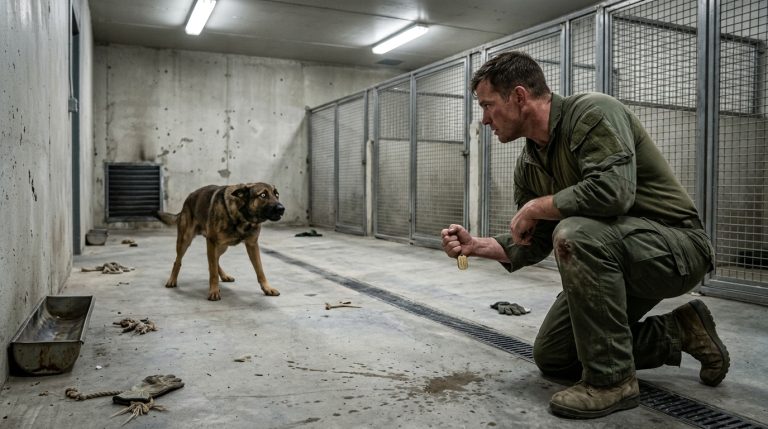
Jack stepped out of the records hub, the transition to the outdoor air feeling like moving from a vacuum into a storm. The training field was a vast, desolate stretch of packed, rain-slicked earth. Petty Officer Marcus Tate was already there, Rex pacing beside him, the Belgian Malinois’s movements tight and jerky, mirroring the handler’s own jagged rhythm.
Jack didn’t approach immediately. He stood at the edge of the chain-link fence, his hands pushed deep into the pockets of his jacket, watching. From this distance, he didn’t need to see the paperwork to know the story; he saw it in the geometry of the pair’s movement. Tate wasn’t leading the dog; he was reacting to him, a subtle but fatal flaw in the hierarchy of a working K9 team.
“Captain Harper,” a voice cut through the damp air.
Jack turned. It was the junior Lance Corporal from the parking lot, Reyes. He looked uncomfortable, his eyes flickering toward the duty shack before settling back on Jack.
“Sergeant Blake sent me to ensure the perimeter remains secure during your evaluation,” Reyes said, his voice strained.
Jack nodded, his gaze returning to the field. He saw the shift in the narrative before it happened—the way Reyes’s shoulders didn’t quite square, the slight tremor in his hand as he adjusted his radio. Blake wasn’t just managing the narrative; he was actively poisoning the well, using the junior enlisted as human sensors to relay every move Jack made.
“Tell the Sergeant,” Jack said, his voice low, “that I’m not interested in the perimeter. I’m interested in the truth of what happens on that dirt.”
He moved past Reyes without waiting for a reply. He walked toward the start marker where Tate was waiting. The ground beneath his boots was spongy, the scent of rot and wet iron rising to meet him. As he approached, he felt the atmosphere on the field harden. Tate stopped, his face a mask of practiced, hollow confidence. Rex sat at his heel, his ears pinned back, his eyes darting toward Jack with a wariness that was entirely earned.
“We’re ready for the sequence, sir,” Tate said. His voice was a thin, high-tension wire.
“I don’t want a sequence, Tate,” Jack said, stopping ten feet away. “I want you to explain the four missing protocol sessions from October.”
The silence that followed was absolute. Tate’s facade didn’t crack; it disintegrated. He opened his mouth, then closed it, his eyes darting to Rex, as if the dog were the one responsible for the inventory of his failures.
“I…” Tate stammered. “There was a conflict. Basewide exercises. Commander Walsh said—”
“I don’t care what Walsh said,” Jack interrupted, his voice dropping into that quiet, absolute register that left no room for negotiation. “I care about the dog. Look at him, Tate. He knows the gap. He’s running the sequence, but he’s not trusting your commands. He’s waiting for you to make a mistake because he’s already learned you’re inconsistent.”
As if triggered by the words, Rex let out a low, frustrated whimper, his tail tucked between his legs. The dog wasn’t being disobedient; he was suffering from the psychological weight of a handler who didn’t fully believe in his own commands.
“I can fix it,” Tate snapped, his defensiveness flaring into sudden, brittle aggression. “I can run the protocol again, right now. I don’t need—”
“You’re missing the point,” Jack said, stepping into Tate’s personal space. The air between them felt ionized, the tension reaching a snapping point. “You’re treating this like a performance to be graded. It’s not. It’s a language. And right now, you’re speaking a dialect that your partner doesn’t understand.”
He reached out, not to the handler, but to the dog. He crouched, his movements slow, deliberate, the predator-prey logic governing every fiber of his being. He ignored Tate’s flinch. He looked at Rex, really looked at him, acknowledging the animal’s stress, the fractured confidence, the simple, honest tragedy of a working dog being failed by the system.
“You’re going to be okay,” Jack whispered to the dog.
Behind him, he heard the sharp click of a weapon’s safety being disengaged. Reyes, in the distance, had moved closer, his hand hovering over his holster, the conflict between his duty to the sergeant and the reality of the scene in front of him reaching a breaking point.
Jack didn’t turn. He knew the trigger-puller’s dilemma better than anyone. He stayed crouched, his life in the hands of a dog who was currently more stable than the man holding his leash. He felt the cold drizzle begin to fall, mixing with the sweat on his brow, the physical world stripping away the bureaucratic theater. The decoy secret—the negligence—was shattering. He was looking directly at the casualty of the lie, and he realized with a sinking, jagged clarity that this was just the tip of the spear. The systemic failure was deeper, wider, and far more deliberate than a few missing sessions.
He stood up, his joints popping in the silence. He turned to face Tate, and for the first time, he saw the man’s eyes truly clear, the frantic need for validation replaced by the devastating realization of his own complicity.
“The sequence is over, Tate,” Jack said. “Go to the medical facility. Tell them I sent you. And tell them the truth about the protocols, or don’t bother coming back to the field.”
He left Tate standing in the center of the mud, a broken man in a broken landscape, and walked back toward the gate. The storm was coming, and for the first time since he arrived, Jack felt it in the weight of his own shadow.
CHAPTER 5: THE CONFERENCE OF SHADOWS
The walk from the gate to the command building was a study in controlled momentum. Jack did not accelerate, yet his pace was relentless, the cadence of a man who had already won the tactical engagement and was now simply completing the administrative procedure. Max moved at his left heel, the German Shepherd’s ears flattened against the wind, his body radiating a focused intensity that made the base guards instinctively step back as they passed.
The command building was a fortress of polished glass and sterile, white-tiled hallways. It smelled of industrial-grade floor wax and the faint, bitter scent of black coffee. As Jack approached the main conference room, the doors were already open. Major Dennis Carver sat at the head of the table, his posture a masterclass in the art of the defensive posture—shoulders squared, chin held at an aggressive tilt, eyes fixed on the entrance as if he were waiting to intercept a strike.
Jack entered, the sound of his boots on the tile muffled by the thick, expensive carpeting. He didn’t offer a salute. He simply walked to the empty seat at the far end, pulled it out with a screech of mahogany against the floor, and sat. Max settled underneath, his presence a dark, silent shadow that seemed to pull the light toward him.
“You’re late, Captain,” Carver said, though his voice lacked the expected bite of authority. It was thin, the vibration of a man who had spent the last hour anticipating the inevitable.
“I was finishing a conversation on the training field,” Jack replied. His voice was level, as steady as the pulse of the building’s climate control. He placed the folder he’d retrieved from the records hub onto the table. It landed with a soft, heavy thud that sounded like a verdict. “Petty Officer Tate has some things to report to the medical facility. I believe you’ll find his statements… illustrative.”
Carver’s face didn’t change, but his fingers, resting on the edge of the table, spasmed. “The training field is not your jurisdiction, Harper. You were sent here to evaluate readiness, not to dismantle the morale of my handlers.”
“Morale is a derivative of integrity, Major,” Jack said, his gaze fixed on Carver’s eyes. He felt the phantom of his past—the ghost of a failed mission, a decision made too quickly under fire—whispering in the back of his mind. He pushed the thought aside, anchoring himself in the present reality of the files before him. “When you provide your handlers with falsified certifications, you aren’t protecting morale. You’re trading their lives for a favorable review cycle.”
Carver stood, his chair clattering backward. “Watch your tone. This base is responsible for critical mission support. We operate under pressures that someone at your level doesn’t begin to understand. We provide clean numbers so that we can keep doing the work!”
“Clean numbers are a lie,” Jack said, rising slowly. He didn’t shout; he didn’t need to. He simply leaned forward, his hands flat on the table, the physical embodiment of the weight he had carried all day. “I’ve seen the emails, Major. I’ve read the directives from your desk to Walsh. You didn’t just order the numbers to be cleaned. You ordered the truth to be buried.”
The room went silent. A JAG officer, seated to the side, froze with her pen suspended over her notepad. The tension was no longer a disagreement; it was a structural collapse. Carver looked at the folder, then at Jack, his arrogance wavering as the reality of his position set in. He was a man who had spent his career managing the narrative, and he had finally encountered an auditor who dealt only in the unvarnished, brutal arithmetic of the field.
Jack felt a sharp, sudden coldness. The realization that he wasn’t just exposing a local problem, but the foundational rot of the entire chain of command, hit him with the force of a physical blow. He wasn’t supposed to find the email. He wasn’t supposed to be here. By uncovering the directive, he had effectively dismantled the Major’s entire reason for existing.
“You have no idea what you’ve started,” Carver whispered, his face turning an ashen gray. “If this report leaves this room, the ripple effect—”
“The ripple effect is exactly what’s needed,” Jack cut in. He reached into his pocket and placed the badge—the matte-black, playing-card-sized sliver—on the table. It sat there, a silent, damning anchor in the center of the polished wood. “I’m not here to end your career, Major. I’m here to stop the lie. Sign the acknowledgment, authorize the remediation team, and prepare for the IG referral. That’s the only way this confrontation ends today.”
Carver looked at the badge, then at the folder, then at Jack. For a heartbeat, Jack thought the Major would fight—that he would attempt one last, desperate grab for the control he had cultivated over twenty years. Instead, the man’s shoulders slumped. The structural integrity of his persona fractured, revealing the weary, pragmatic survivor beneath. He reached for a pen, his movements sluggish and heavy.
As the pen touched the paper, Jack felt no joy. He only felt the heavy, quiet exhaustion of the work being done. The decoy secret was dead. The truth was now sitting on the table, inked in black and witnessed by the room. He had done his part. Now, the system would have to reckon with itself.
CHAPTER 6: THE QUIET AFTERMATH
The conference room air had become poisonous with the scent of spent adrenaline and cold ambition. Jack didn’t linger. He gathered the folder, the weight of it in his hands feeling different now—no longer an object of investigation, but an anchor of fact. He looked at Major Carver once, a fleeting, clinical glance, and saw the man already mentally drafting his resignation. It was a complete, internal evaporation. Carver had been defeated not by an army, but by the relentless application of the very protocol he had tried to bypass.
Jack turned and walked out. The hallway was empty, the fluorescent lights buzzing with a sound that felt like a dying nerve. He moved toward the exterior exit, his steps heavy, his body feeling the cumulative fatigue of a day spent in the crosshairs of a system that didn’t want to be fixed. Max followed at his heel, a dark, rhythmic pulse of loyalty that had remained steady even as the foundations around them had shuddered and cracked.
As he reached the outer door, he saw Reyes standing guard. The Lance Corporal’s posture had changed; he was no longer rigid, no longer holding his weapon with the defensive tightness of the morning. He stood with his hands at his sides, looking at Jack with a profound, unsettled curiosity.
“Is it done?” Reyes asked. The question wasn’t about the evaluation; it was about the world.
Jack looked at the young man, noting the way the evening light caught the harsh, uncompromising lines of the gate. “The paperwork is signed, Reyes. The correction begins on Monday.”
“You could have stopped at the gate this morning,” Reyes said, his voice barely a whisper in the echoing hall. “You didn’t have to go in.”
“If I hadn’t gone in, the corruption would have continued until a dog or a handler paid for it with their life,” Jack said. He didn’t offer a platitude. He offered the hard, cold utility of the truth. He looked at the gate, then back to the guard. “Do the right thing when the moment arrives, Lance Corporal. It’s the only way to ensure the moment doesn’t own you.”
He pushed the door open. The transition to the evening air was sharp, the temperature having plummeted since the morning, carrying the faint, metallic taste of an approaching winter. He walked to the truck, his movements fluid and economical, the tactical exhaustion setting in now that the immediate threat was neutralized. He unlocked the driver’s side door and paused, looking back one last time at the Annex.
It looked exactly as it had that morning—the same gray concrete, the same chain-link, the same hollowed-out administrative facade—but everything had been fundamentally altered. The lie had been extracted. The unit now had a path back to reality, a roadmap of remediation that would force them to confront the gap between their reports and their performance.
He leaned against the truck bed, and for a moment, he let his guard down. He closed his eyes, hearing the distant, faint sound of a dog barking somewhere on the base—a sound that didn’t carry the tight, uncertain strain he’d heard on the training field, but a natural, honest bark. It was the sound of a living thing existing in its own skin.
He reached into the back of the truck and felt for his toolkit—a set of steel wrenches he’d used for the kitchen drain that seemed like a lifetime ago. He pulled one out, the metal cold and biting in the twilight. It was a simple, sturdy thing. He’d use it to finally fix the basketball net in his driveway, a small, tangible act of repair to offset the institutional damage he’d spent the day documenting.
Max hopped into the truck bed, shaking off the dust of the field. Jack climbed into the driver’s seat, the engine turning over with a steady, reassuring rumble. He drove toward the exit gate, his mind clear, the weight of the folder on the passenger seat no longer an burden, but a tool. He had done the work. He had followed the causality, confronted the friction, and arrived at the point where the system had been forced to bend back toward reality.
As the gate swung open, he didn’t look back. He merged onto the highway, the dark ribbon of the road stretching out before him, leading toward Oceanside, toward the kitchen phone, toward the fixed point of his life. He felt the cold iron of the wrench in his pocket, a grounding, physical reminder of the difference between an abstract theory of justice and the manual, gritty labor of making a thing work again.
He turned the heater up, the warm air curling around him, and for the first time in fourteen hours, he let his muscles relax. The mission was a success, not because of the badge, and not because of the Major’s surrender, but because somewhere in the Annex, a handler was now looking at their dog with the clarity that only comes from knowing exactly where they stood. He drove into the night, the road steady, the purpose clear, and the world—at least this small corner of it—made right.