A Fragile Silence: Lieutenant Commander Ryden’s Last Stand Against the Looming Shadow of the Ridge
CHAPTER 1: THE WEIGHT OF THE RIDGE
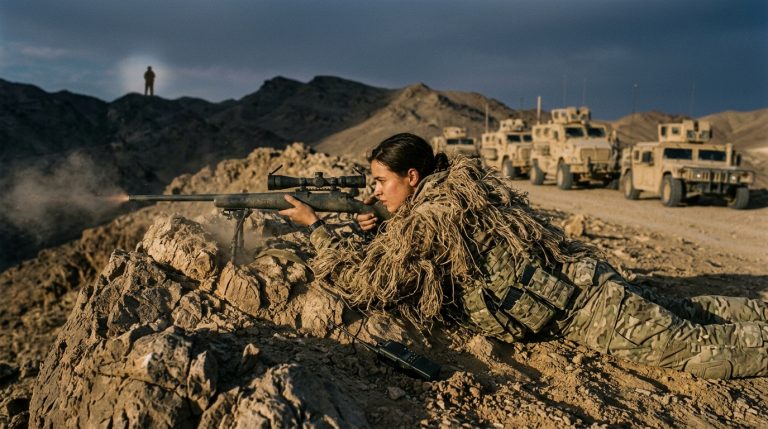
The valley floor was a tapestry of bruised grays and muted greens, seen through the fractured glass of a high-powered scope. Lieutenant Commander Jack Ryden kept his breathing shallow, a rhythmic, mechanical process that he had perfected over a decade of shadows. Beside him, the air tasted of cold stone and the metallic tang of an approaching rainstorm. He shifted his grip, the leather of his glove groaning against the stock of his rifle.
Seven nests. He counted them again, his pulse steady, a stark contrast to the tightening coil in his gut. They were positioned with an almost artistic grace, their lines of fire intersecting at the exact point where he had planned to lead his team. It was too precise. Too clean.
“Commander?” The whisper came from Miller, hunched low beside him. It was a soft, frayed sound, lacking its usual sharp edge of confidence.
Ryden didn’t look over. He couldn’t. His focus was glued to the third nest, where a glint of light—a reflection of a setting sun that hadn’t yet crested the peak—suggested a high-aperture optic. Not a standard-issue sniper scope. Something proprietary. Something that shouldn’t be here in this forgotten corner of the world.
He felt a phantom itch at the back of his neck, a warning bell ringing in the quiet. He tried to reconcile the geometry of the kill zone with the mission briefing, but the pieces wouldn’t fit. The logic was failing. He saw a shadow move near the ridge line, a fluid motion that mirrored his own. For a split second, he felt as though he were staring into a mirror. The realization hit him with the force of a physical blow: this wasn’t an infiltration. It was an arrival ceremony.
His radio crackled, a static-heavy hiss that sounded like sand pouring into a glass jar. He reached for the cord, his fingers tracing the fraying edges of the insulation.
“Silence,” he hissed into the comms, his voice low enough to be lost in the wind.
He pulled back from the scope, his eyes struggling to adjust to the dim light of the ridge. The world felt smaller now, enclosed by the tightening perimeter of an enemy he suddenly realized he knew. His gaze locked onto Miller. There was a look in the younger man’s eyes—a flicker of doubt, a momentary lapse in the mask—that terrified him more than the seven nests.
There was no exit strategy for this. Not anymore.
Ryden gripped his comms unit, the metal warm against his palm. He needed to move, but the very ground beneath them felt like a trap waiting to be sprung. And then, the radio flared to life, not with a command, but with a voice he recognized—not as an enemy, but as his own superior, whispering a name he hadn’t heard in years.
CHAPTER 2: THE TACTICAL PIVOT
Ryden didn’t move. He kept his finger hovering an inch from the radio’s transmit button, his thumb tracing the jagged, worn plastic of the casing. The voice—Colonel Vance—hadn’t delivered a tactical update or an abort signal. He had spoken a name. Solis.
It was a ghost from a past that was supposed to have been scrubbed from every database, every file, every memory. To hear it now, transmitted over an unsecured, high-altitude frequency while seven enemy sniper nests tracked their every heartbeat, was not a coincidence. It was a beacon.
“Commander?” Miller’s whisper was ragged, his hands trembling slightly as he clutched his sidearm. The younger man was watching the ridge line, his eyes wide and unfocused in the encroaching gloom.
Ryden finally looked at him. The fading light made Miller’s face appear like a sketch on parchment—worn, fragile, and utterly exhausted. Ryden knew he couldn’t afford to be shaken. He couldn’t afford to be the man who let the mission fall apart because he was distracted by the ghosts in the machine. He forced his hand to remain steady as he pushed the radio receiver down, cutting the connection. The silence that followed was absolute, a vacuum that pressed against his eardrums.
“We move,” Ryden said. His voice was a rasp, stripped of any emotion. “Not forward. We rotate south. Two hundred meters, low profile, through the scree.”
“The objective, sir?” Miller’s confusion was a palpable thing, a knot in the air between them. “The package—we’re here for the package.”
Ryden grabbed Miller by the tactical vest, pulling him down until their foreheads almost touched. He could smell the stale sweat, the faint scent of copper, and the damp earth of the ridge. “The objective is survival, Miller. Look at the shadows.”
He pointed toward the intersection of the enemy fire lanes. Even in the thinning light, the pattern was impossible to ignore. The nests weren’t just covering the path; they were funneling it. They were waiting for someone to try and move toward the center.
“They aren’t guarding that compound,” Ryden continued, his tone low and clinical. “They’re holding a perimeter around a void. If we go in, we aren’t being tactical. We’re being invited to a funeral.”
Miller swallowed hard, his gaze darting toward the distant, darkened structure they had been sent to infiltrate. He seemed to shrink, the reality of their position settling onto his shoulders like a lead weight. Ryden saw the exact moment the younger man realized the fragility of their situation—not the fear of dying, but the realization that the map they had been given was a lie.
They began the transition. The movement was a slow, agonizing crawl through the scree. Every loose stone that clicked under a boot sounded like a gunshot in the oppressive quiet. Ryden took the lead, his body a map of calculated tension. He didn’t look back. He kept his eyes on the ground, reading the texture of the rocks, the way the wind shifted the sparse mountain grass, searching for any sign of a follow.
He was essentially performing a geometry of retreat. Every step was a decision, a constant weighing of the distance between their exposed flanks and the safety of the southern draw. His mind was a cold engine, filtering out the memory of the voice on the radio, the name Solis, and the impossible truth that they were being watched by their own shadows.
As they reached the edge of the scree, Ryden pressed his back against a jagged outcropping of basalt. The rock was cold, biting through his tactical gear, an anchor in a world that felt increasingly ephemeral. He signaled for Miller to halt.
Miller slid in beside him, breathing hard, his chest heaving. “Sir, if we pull back, the report—”
“The report won’t matter if we’re dead,” Ryden interrupted, his eyes scanning the horizon. He checked his sidearm, the metal smooth and familiar. “Something is wrong, Miller. Not just with the mission. With the whole setup. We were sold a path, and that path leads straight into a kill zone.”
He didn’t explain the radio call. He couldn’t. To reveal that the command structure itself might be compromised was to invite a panic that would get them both killed before they even made it down the mountain. Instead, he reached into his vest, pulling out the rugged, encrypted drive he’d been issued. It felt heavy, a cold, dense weight that seemed to vibrate against his palm.
“If we’re being hunted,” Ryden whispered, his eyes locked on the darkness ahead, “then we need to know what they’re hunting for.”
He turned the drive in his hand, looking at the serial number etched into the side. It was a standard-issue asset tag, but as the faint, filtered light of the moon caught it, he noticed a minute, handwritten mark near the locking mechanism. A tiny ‘S’.
The cold in his gut turned to ice. He hadn’t been imagining it. He looked at Miller, who was now staring at the drive with a mix of confusion and mounting dread.
“Don’t connect it to the comms unit,” Ryden cautioned, his voice barely audible. “We’re going to open this the old-fashioned way.”
The silence returned, deeper than before. Ahead of them, the path down the mountain looked like a long, serrated tooth. They were exposed, exhausted, and carrying a secret that was likely the reason for the seven sniper nests. Ryden turned his attention back to the terrain, searching for a route that offered even a shred of cover, knowing that every move from here on out was not just a retreat—it was a gamble against an adversary who knew their next move before they even made it.
CHAPTER 3: THE ECHO OF ORDERS
The descent was a slow, punishing grind. Every muscle in Ryden’s legs screamed in protest as he navigated the loose shale of the southern draw. Beside him, Miller moved with a hesitant, jerky rhythm, his breathing jagged, echoing the erratic gusts of wind that whipped through the pass. They weren’t just fleeing a position; they were stepping into a vacuum of their own making, abandoning the coordinates they had spent months planning for.
Ryden kept his hand tight on the strap of his kit. Beneath the outer layer of nylon, against his own chest, he felt the drive. It was a cold, inert presence, but it seemed to hum with the weight of the secrets it held. Every few paces, he stopped, pressing his back against the cooling stone of the cliffside, ears straining for the sound of a pursuit that he knew, logically, should already be underway.
But there was nothing. Only the mountain, vast and uncaring, and the low, mournful whistling of air through the crags.
He reached down to adjust his boot, his fingers brushing against his radio gear. That was when he heard it—a faint, rhythmic clicking. It was rhythmic, a precise two-beat interval that seemed to emanate from the back of his own tactical rig. He paused, his heart hammering against his ribs. He traced the source, his calloused fingertips sliding over the webbing and the heavy-duty clips of his vest.
He didn’t want to alert Miller. He didn’t want to explain why he was suddenly tearing apart his own gear in the middle of a retreat. He pulled a small, multi-tool from his pocket, the metal biting into his palms, and began to work on the stitching of a pouch that should have been empty.
“Commander?” Miller’s voice was a soft, trembling thread in the darkness. “We’re drifting too far south. If we don’t hit the extraction point by dawn, the transport won’t wait. We’ll be ghosted out here.”
“The extraction point is part of the problem, Miller,” Ryden replied, his focus entirely on the hidden compartment he was excavating. He pried a small, circular device from the fabric—a black, matte-finish tracker, no larger than a coin. It was blinking a dull, sickly amber.
He stared at it for a long, frozen second. It wasn’t an enemy device. It was proprietary, the same grade as their own communications gear. It was a beacon. They hadn’t been sent to this ridge to infiltrate a target; they had been sent here to be tracked, to be anchored in a predictable location while someone—or something—waited for the right moment to close the net.
He didn’t speak. He simply held the device up so Miller could see the amber pulse.
Miller’s face went pale. The boy looked as though the ground had been pulled out from under him, his posture collapsing slightly as he leaned against the rock. “They tagged us? Why would Command tag us?”
“To keep us on the board,” Ryden whispered. He squeezed his fist, crushing the beacon until the plastic gave way and the amber light stuttered and died. “They needed us in that kill zone, Miller. They needed us exactly where the enemy would find us.”
The air grew colder. The realization felt less like a tactical discovery and more like a betrayal of the soul. Everything they had trained for, every order they had followed, every loyalty they had sworn to uphold—it was all being leveraged against them.
“What do we do?” Miller asked, his voice now devoid of any pretense of military discipline. He sounded like a man drowning.
Ryden looked back the way they had come. The ridge was a jagged silhouette against the bruised purple of the pre-dawn sky. They were alone in the dark, and for the first time in his career, Ryden didn’t have a plan. He had a set of tools, a silent radio, and a suspicion that the enemy they were supposed to be fighting was just another piece of the same board they were on.
“We stop being predictable,” Ryden said. He tucked the broken pieces of the tracker into his pocket and turned away from the ridge. “We head for the lower timber line. If they’re tracking us, they’re looking for a signature in the high ground. We give them silence instead.”
They moved again, their pace now forced and desperate. The terrain shifted from open shale to dense, suffocating pine. The trees crowded in, their branches snagging on Ryden’s equipment, the smell of damp pine needles and rotting wood thick in his throat. Every shadow seemed to reach out, an extension of the trap they had barely escaped.
Ryden’s internal clock was still ticking, a subconscious measure of the time remaining before someone realized the beacon had gone dark. He pushed Miller forward, his movements efficient and stripped of excess. He didn’t look at his watch. He didn’t check the stars. He just followed the slope of the land, letting the gravity of the valley pull them deeper into the gray, misty unknown.
They were ghosts now, drifting through the architecture of a mission that no longer existed, waiting for the first sign that the hunters had realized their prey had vanished.
CHAPTER 4: THE LOW GROUND
The transition from the exposed scree to the dense timber was less of a tactical move and more of a surrender to the claustrophobia of the valley. Here, the world narrowed. The sky, previously an expansive, terrifying dome, was reduced to jagged slivers of indigo seen through a canopy of black needles. Ryden moved with a methodical, predatory caution, his feet finding purchase on the slick, rotting vegetation without making a sound.
Beside him, Miller was fading. The younger man’s movements were sloppy, his shoulder catching on a low-hanging branch that sent a spray of freezing condensation down the back of his neck. He didn’t even flinch. He was locked in a state of shock, his eyes fixed on the narrow path ahead as if expecting the trees themselves to solidify into enemies.
Ryden stopped abruptly, his hand snapping back to intercept Miller’s chest, pinning him against the rough bark of a cedar.
“Listen,” Ryden hissed.
At first, there was nothing but the rhythmic, uneven thrum of their own heartbeats. Then, the forest revealed its own textures: the distant, rushing tumble of a mountain stream, the soft sigh of the wind in the needles, and—there. A sudden, sharp snap of a twig, echoing from the ridge they had abandoned hours ago. It wasn’t the sound of an animal; it was too deliberate, too heavy.
Ryden didn’t look back. He knew that looking would only confirm the nightmare. They were being followed, not by a storm or a patrol, but by someone—or something—that moved with the same, calculated lethality that he himself possessed.
He leaned close to Miller, his breath blooming in the frigid air. “We need to drop the gear. Now. Everything that identifies us as military. If they find the site, they need to find nothing but civilians caught in a crossfire.”
Miller nodded, his hands shaking as he began to unbuckle his chest rig. They worked in silence, a frantic, hushed assembly of discarded equipment. Ryden buried their comms units, the satellite link, and their sidearms deep beneath a rotting log, kicking layers of wet, decomposed needles over the cache. It felt like burying a piece of his own skin. Without the weight of the rifle, he felt impossibly light, exposed, and vulnerable—a stripped-down target in a theater of war he no longer understood.
Once the gear was stowed, Ryden moved again, his pace more fluid, more desperate. They pushed deeper into the low ground, where the mist clung to the earth like a burial shroud. It was here, in the suffocating damp, that Ryden finally allowed himself to reach for the drive.
He pulled it from his inner pocket, his fingers finding a soft, hidden seam in his jacket that he had reinforced years ago. He held the drive in his palm, feeling the cool metal. He didn’t have a computer. He didn’t have a power source. But he had a hunch—a professional, bone-deep suspicion—that the data wasn’t encrypted in a way that required a digital key.
He stopped beneath the shelter of a wide, drooping hemlock. “Miller, keep watch. North and East. If you hear anything, don’t signal. Just pull my sleeve.”
Ryden held the drive up to the dim light. He noticed the small ‘S’ again, but this time, he looked at the base of the drive, where the connection port was usually located. There was a tiny, recessed button, almost flush with the casing. He used the point of his knife to press it.
With a faint, mechanical click, the casing shifted. It wasn’t a standard storage device at all. The outer shell slid away, revealing a thin, transparent glass filament—an old-school archival index, a physical, optical record. It wasn’t meant to be read by a computer; it was meant to be read by a light-projection scanner, the kind used by the agency for secure, long-term storage of sensitive assets.
He held it up to the faint, filtered light of the sky. Tiny, crystalline etchings danced on the surface. They weren’t coordinates. They were names.
His own name was there, third from the top. Beside it, a date—a date from a mission that had been officially listed as a failure, a mission where he was the sole survivor.
The blood drained from Ryden’s face, leaving him cold in the middle of the humid, rotting forest. This wasn’t a list of enemy troop movements. It was a ledger. A list of assets—of people—who had been flagged for “disposal” after their usefulness had reached its expiration.
He looked over at Miller, who was shivering in the dark, watching the shadows with eyes that were slowly waking up to the reality of their situation. Ryden realized with a sudden, sickening clarity that the “intel package” was a list of names, and he and Miller weren’t here to capture it; they were the final entries on the page.
The forest seemed to close in, the trees appearing as tall, faceless sentinels in the gloom. He didn’t tell Miller what he had seen. He couldn’t. To speak it out loud would be to give the truth a shape that they couldn’t possibly survive. Instead, he slipped the glass filament back into its casing and tucked it away, his heart beating a slow, steady rhythm of survival. They weren’t soldiers anymore. They were ghosts, and for the first time, Ryden understood that the only way to win this game was to disappear completely before the people who had written their names caught up to them.
CHAPTER 5: THE WEIGHT OF THE PACKAGE
The forest did not stay silent for long. The mountain, a living, crumbling entity of tectonic unrest, decided for them that their path was no longer viable. A deep, grinding moan vibrated through the soles of Ryden’s boots, followed immediately by the terrifying, rhythmic chatter of shale giving way. Above them, the ridge—the very same ridge they had abandoned—spat out a torrent of rock.
“Move!” Ryden shouted, the sound swallowed by the thunder of the slide.
He didn’t wait for Miller. He launched himself sideways, his body a frantic blur of motion, diving toward a depression in the earth shielded by the gnarled, massive roots of a fallen cedar. The world became a deafening chaotic swirl of gray dust and kinetic force. Stones the size of fists pelted the canopy, turning the quiet forest into a barrage of flying shrapnel.
Ryden pressed himself into the mud, his face turned toward the earth, his hands shielding his head. The vibration was so intense it rattled his teeth. It lasted for a heartbeat, then an eternity, and then, as suddenly as it had begun, it subsided into a heavy, suffocating silence.
The air was thick with the taste of pulverized stone and ozone. Ryden coughed, his lungs burning, and pushed himself up. The path they had been taking was gone, buried under a fresh, jagged scar of rubble that stretched far down the slope.
“Miller!”
A muffled groan answered from beneath a nearby drift of pine needles. Ryden scrambled over, his movements desperate as he cleared the debris. He found Miller trapped under a heavy branch, his leg pinned, his face smeared with dark, drying blood.
Ryden worked with frantic, surgical precision. He didn’t ask questions; he didn’t offer comfort. He lifted, his muscles burning, until Miller could slide his leg free. The younger man was panting, clutching his knee, his eyes wide and vacant.
“We can’t stay,” Ryden said, his voice hard. “The slide will draw eyes. If they were tracking us, they know exactly where we are now.”
He hauled Miller to his feet. The boy winced, leaning heavily on Ryden’s shoulder. They looked like two broken things, hobbling through the wreckage of the forest. The slide had not only blocked their path; it had forced them to turn back toward the higher ground, directly into the territory they had been trying to evade.
Ryden looked at his compass—the one that had been malfunctioning since the start of the mission. It was spinning lazily, the needle unable to find true north. He tapped it, but it was dead weight. He was flying blind in a landscape that had become hostile to their very presence.
“We follow the stream,” Ryden decided, pointing toward the only feature that still made sense in the chaos. “Water finds the low ground. If we follow it, we might find a way to the valley floor without crossing the open slopes.”
The journey felt like an intrusion into a forbidden space. They moved through the mist, their bodies heavy, their spirits frayed to the breaking point. Every sound—a snapping twig, a falling rock, the rustle of a nocturnal animal—was a hammer blow to Ryden’s nerves. He was no longer just protecting Miller; he was carrying the burden of the truth he had discovered in the glass filament. The list. The names. The reality that their survival was an anomaly.
As they reached the edge of the stream, Ryden paused. He spotted something caught in the reeds—a piece of dark, synthetic fabric. He picked it up. It was a fragment of a tactical glove, the same kind their unit used, but the stitching was wrong. It was older, a previous iteration of the design.
He felt the hair on the back of his neck stand up. Someone else had been here. Someone who knew the mountain, someone who had left behind markers that were not for the enemy, but for the team itself.
He looked at Miller. “We’re not alone.”
“What do you mean?” Miller whispered, his voice trembling.
“We’re being herded,” Ryden said, his eyes scanning the fog. “The slide, the blocked path—it wasn’t just the mountain. It was a nudge. Someone is forcing us toward the valley floor, into a specific channel.”
He felt the cold reality of it. The list, the tracker, the controlled path—they weren’t just being hunted; they were being directed to a destination they had not chosen. He gripped the glass filament in his pocket, feeling the edge of it through the fabric. They were being led to their own end, and the only question left was whether they would arrive there as targets, or if he could find a way to break the pattern before the final turn.
CHAPTER 6: THE INVISIBLE ADVERSARY
The valley floor was a landscape of desolation, shrouded in a mist so thick it felt like walking through a damp, heavy wool. Ryden kept a hand on Miller’s shoulder, a tether in the gray, white-out conditions. Every step was a gamble. The ground here was spongy, a carpet of decaying cedar and ancient, waterlogged moss that muted their footsteps and seemed to swallow the very air they breathed.
Ryden’s ears were ringing—a low, persistent hum that he couldn’t shake. He kept hearing it: the static of the radio, the phantom voice of Colonel Vance, and the name Solis. It was beginning to feel like a psychological splinter, lodged deep in his mind. Was it a real transmission? Or was the high-altitude pressure, combined with the stress of the mission, finally breaking the seal on his sanity? He looked at the device again, its dead weight now a reminder of how quickly his perception had fractured.
“Sir,” Miller whispered, his voice trembling. He stopped abruptly, pointing toward a faint, shimmering irregularity in the mist ahead. “Look.”
Ryden focused his eyes. There was a structure, half-buried in the overgrown brush. It wasn’t the enemy compound they had been sent to target. It was something older—a disused observation shack, covered in decades of lichen and climbing ivy. It stood as a silent witness to a conflict long forgotten, a crumbling testament to the shifting borders of this desolate place.
“Stay low,” Ryden commanded, drawing his combat knife, the only weapon he had left.
They approached the shack with agonizing slowness. Every muscle in Ryden’s back was tight, anticipating the sting of a sniper’s bullet. The structure was quiet, though, empty of human presence. As they slipped through the rotting door frame, the interior smelled of dust and dry, stagnant wood. Ryden scanned the room—a single, cramped space with a heavy wooden desk and a rusted terminal that had long ago been stripped of its electronics.
It was a staging area. A long-term listening post, abandoned but clearly maintained. He swept his flashlight across the floor and found the dust patterns. They were fresh. Someone had been sitting at that desk within the last twenty-four hours.
Ryden felt a surge of adrenaline, cold and sharp. He moved to the desk and ran his fingers over the wood, feeling for anything hidden. Beneath the edge, he found a small, physical switch. He flipped it, and the rusted terminal panel groaned, a single red light flickering to life. It wasn’t a computer; it was a manual relay, connected to a buried landline.
He lifted the receiver, his hands shaking slightly. He didn’t expect a tone, but he got one—a crisp, clear hum that spoke of a high-bandwidth connection, active and waiting.
He didn’t speak. He listened.
There was a voice on the other end. Not Vance. Not a human voice at all, but a rhythmic, digital sequence—a packet of compressed data being sent on a loop. Code. He recognized the pattern; it was a verification sequence used to authorize “disposal” protocols.
He dropped the receiver, his breath hitching. They had been lured here to authorize the very thing they were trying to escape. If he stayed, if he confirmed the signal, he was effectively signing his own death warrant and Miller’s as well.
“We have to go,” Ryden said, his voice urgent. “Now.”
“What did you find?” Miller asked, his face pale as he watched Ryden scramble away from the terminal.
“A shadow,” Ryden replied, his eyes scanning the gloom outside the shack. “We were never supposed to survive the extraction, Miller. They were just waiting for us to stop moving so they could confirm the targets.”
He saw it then—a movement in the mist outside, the distinct, geometric shape of a thermal optic array. They had been found. The silence of the valley was broken by the sound of muffled, heavy footfalls approaching the shack. The hunters weren’t just coming; they were moving with the calm, terrifying certainty of people who were already counting their success.
Ryden grabbed Miller by the arm, dragging him toward the back wall. He kicked at a rotting board, the wood splintering under his boot to reveal a narrow drainage tunnel that led back out into the deeper, darker woods behind the shack.
“Get in,” Ryden ordered, shoving Miller into the darkness.
As he followed, Ryden took one last look at the terminal. The red light was still blinking, a rhythmic, mechanical eye watching them flee. He realized then that the adversary wasn’t just in the mist or behind the trigger; it was in the very architecture of the mission itself. They were running through a maze, and every exit they chose only brought them closer to the heart of the trap. He squeezed the glass filament in his pocket, the sharp edges digging into his skin, and pushed into the tunnel, the darkness swallowing them whole.
CHAPTER 7: THE CALCULATED EXTRACTION
Ryden pulled himself through the narrow drain, the stone ceiling scraping against the top of his pack. Every inch of movement was a transaction, paid for with the raw friction of skin against damp granite. Behind him, Miller’s breathing was a wet, jagged sound, rhythmic and panicked. The tunnel was ancient, a forgotten piece of infrastructure likely abandoned when the shack was first built, and it smelled of deep, stagnant earth and the lingering, sweet rot of long-dead vegetation.
“Stay close,” Ryden whispered, his voice sounding flat and dead in the cramped space. He reached out, his fingers searching for handholds, but the walls were slick with moisture.
As they crept forward, the beam of Ryden’s low-light tactical lamp flickered, illuminating a sudden, sharp change in the architecture. The rough stone gave way to smooth, reinforced concrete. He stopped, holding up a fist for Miller. The air here was different—less stagnant, touched by a faint, rhythmic draft. He swept the light across the wall and found an aperture, a vertical seam obscured by years of grime and cobwebs. It wasn’t a natural fissure; it was a ventilation shutter, partially jammed open, revealing a sliver of the world outside.
He peered through. They were beneath the ridge, deep in a natural fold of the mountain that provided a perfect view of the valley. And there, less than fifty yards away, was the extraction point they had been ordered to meet.
It was bathed in artificial light, a floodlit landing zone that looked like an open wound in the dark forest. A transport craft sat idling, its rotors churning the mist into a violent, cyclonic storm. But it wasn’t there to pick them up. Ryden watched as men in unmarked, matte-black gear emerged from the treeline, moving with a synchronized, terrifying efficiency. They weren’t soldiers; they were cleanup.
“They’re waiting for us,” Miller whispered, his voice breaking as he looked through the shutter.
Ryden didn’t answer. He felt a cold, hollow sensation settle in his chest. The extraction wasn’t an exit; it was a final collection point. The list—the names—were all they needed. Once the package was recovered, there would be no need for the assets who carried it.
“We have to move,” Ryden said, turning away from the shutter. He felt the weight of the glass filament in his pocket, the sharp edges pressing against his thigh. He had to decide: hold onto the truth and die with it, or find a way to make it count. He looked at Miller, who was hunched in the dark, his face a map of exhaustion and fear. Miller was a good man, a capable soldier, and he had been dragged into this because he followed orders.
“Miller, listen to me,” Ryden said, his tone softening but remaining absolute. “When we get out of this tunnel, we aren’t going to the extraction point. We’re heading for the communication relay we passed three miles back. If I can patch the data into the main feed, it’ll broadcast to every terminal in the sector. They won’t be able to scrub it.”
“They’ll kill us before we get there,” Miller said, but there was a flicker of resolve in his eyes.
“They’ll try,” Ryden replied. “But we’re the only ones who know where the bodies are buried. That gives us leverage.”
He turned back to the tunnel, pushing forward with a renewed, desperate intensity. The cramped space seemed to grow tighter, the darkness heavier, but Ryden moved with the focus of a man who had seen his own ending and decided to rewrite the final page. He didn’t think about the cold, or the pain in his muscles, or the hunters closing in behind them. He thought only of the relay, the data, and the chance to finally expose the machine that had been using them as fuel.
They emerged from the tunnel exit into a steep, shadowed ravine that bypassed the main valley floor. The mist here was thinner, the air colder, and for the first time, Ryden saw the stars—dim, distant lights that provided no guidance. They were alone, deep in the enemy’s web, but for the first time since the mission began, they were moving toward a goal they had chosen for themselves. Every step was a strike against the people who had planned their silence, and Ryden, feeling the jagged edge of the truth in his pocket, knew that the real extraction had only just begun.
CHAPTER 8: THE COST OF RETURN
The communication relay was tucked into a hollowed-out bluff, a relic of a time when the agency valued physical redundancies over cloud-based control. Ryden reached the terminal, his fingers raw and trembling, and slotted the glass filament into the reader. The console stuttered, a dim, sickly green light crawling across the screen as it began to ingest the data.
Miller slumped against the wall, his breathing a wet, ragged rasp. He was pale, the blood from his leg having soaked through his makeshift bandage, but his eyes were fixed on the screen. The names were cascading down the display—hundreds of them—a registry of ghosts.
“Is it working?” Miller asked, his voice barely audible.
Ryden didn’t answer. He watched as the progress bar crawled forward. It wasn’t just a broadcast; the relay was designed to force a sync with the agency’s central hub, an unblockable handshake that would push the list into the public, unencrypted channels of the sector’s network.
Suddenly, the screen flared white. The console erupted in a sharp, frantic chirping.
“They’ve locked the uplink,” Ryden said, his jaw tightening. “They know.”
A voice came over the internal speaker, clear and cold, cutting through the static. It was Colonel Vance—the real Vance, not the digital ghost Ryden had suspected earlier. “Lieutenant Commander. You’ve exceeded your operational mandate. You are currently in possession of classified assets that do not exist. Return the drive to the extraction team, and you will be permitted a quiet, private departure.”
Ryden looked at the screen, then at Miller. The choice wasn’t about the mission anymore. It was about the reality of the game they had been playing. He looked at the relay, then at the physical override switch he had identified minutes earlier—the manual kill-switch that would dump the data into the local broadcast loop, bypassing the agency’s gatekeeper.
“The assets you’re talking about are human beings, Colonel,” Ryden said, his voice calm, steady, and entirely devoid of the fear that had defined his earlier hours.
“They are data points, Ryden. Nothing more. Do not sacrifice a life of comfort for a gesture that will change nothing.”
Ryden placed his hand on the override switch. He felt the cold, hard weight of it, the simple, mechanical finality. Beside him, Miller struggled to stand, reaching out to steady himself on the console. There was no hesitation in the boy’s eyes, only a quiet, resigned strength. They were no longer the predators they had been on the ridge; they were witnesses, and that was a far more dangerous role to play.
Ryden pulled the switch.
The console shrieked, a high, piercing tone that vibrated through the stone walls, and then, a wave of data flooded the screen, scrolling at a speed that blurred the names into a single, cohesive stream of light. It was done. The broadcast was live, echoing through the network, unspooling the truth to whoever was listening.
The silence that followed was absolute. The voice on the speaker died, replaced by a soft, static hiss. Ryden turned away from the console. He saw the shadow of the extraction team at the edge of the clearing, their weapons raised, their movements precise, but they hesitated. The truth had arrived before they could stop it.
Ryden walked toward the entrance, his boots crunching on the dead, autumn leaves. He stepped into the light of the clearing. He was unarmed, his hands open, his posture relaxed. He walked past the extraction team, who stood frozen, their weapons lowering as the reality of the situation shifted around them. They were no longer the hunters; they were simply men standing in the dark, watching the ghosts they had been sent to erase finally walk free.
He found a spot beneath the wide, sheltering branches of an old pine, where the mist began to thin, letting the faint, cool light of dawn touch the valley floor. He sat down, the ground cold and hard against his back, and closed his eyes.
He pulled a small, damaged object from his pocket—his compass, the one that had been broken since the start of the mission. He looked at it, then began to work the casing, his fingers steady, aligning the pins, cleaning the grit from the gears. The silence of the forest was deep and profound. The air smelled of damp earth and coming winter, a clean, sharp scent that made his lungs feel clear for the first time in years.
Beside him, Miller settled into the pine needles, the boy’s head leaning back, his eyes closing in the soft light. There was no victory, no grand parade, no satisfaction beyond the quiet, simple fact of breathing.
Ryden clicked the compass casing back into place. The needle shivered, spun, and then settled, pointing north with a steady, unwavering hand. He smiled, a small, tired movement of his lips, and reached out to rest his hand on Miller’s shoulder. The forest was waking, the birds beginning a faint, tentative chorus in the canopy. It was quiet. It was peaceful. The burden of the list was gone, and for the first time, the path ahead was his own.