The Final Torque: A Legacy of Rust and the Weight of 1952’s Last Concrete Secret
CHAPTER 1: The Perimeter Line
Delmer Merritt didn’t like the silence that followed the breaker’s failure. It was a heavy, suffocating quiet that sat on the gravel of the job site, thick with the smell of hydraulic fluid and scorched concrete dust. He shifted his weight, his boots crunching into the dry, pulverized earth of Route 220, and stared at the gray mass of the abutment. Twelve feet of concrete that refused to behave.
Three days. Eighty thousand dollars. And the structure hadn’t so much as chipped.
His foreman, Kevin Shei, was hovering near the heavy-duty rigs, his face a map of frustration. He saw Merritt staring and jogged over, the gravel popping under his work boots. “The consultant is ready to call for a controlled blast, Delmer. He says the composition is anomalous. He’s using big words to say he’s got no idea why this thing is holding.”
Merritt pulled the report from his jacket pocket. The paper was stiff, creased along the edges, the ink holding the dry, clinical assessment of Dr. Paul Garver. He didn’t need to read it again; he knew the words by heart: compressive resistance, non-standard aggregate, beyond demolition scope.
“Tell him to hold off,” Merritt said, his voice flat. He looked toward the perimeter fence.
There was a man standing there. He had been there since seven, motionless, his hands gripped white-knuckled around the cold chain-link fence. The morning light caught the edges of his canvas jacket—a shade of gray-brown that looked like it had been scrubbed clean by decades of grit. He wasn’t looking at the crew; he was looking at the concrete, the way a surgeon might watch a patient he’d known since birth.
“Who’s the old guy?” Shei asked, squinting into the glare.
“I don’t know, but he’s been watching us since we broke ground on the expansion,” Merritt said. He started walking, his steps rhythmic, kicking up small clouds of dust.
As he approached, he saw the man’s hands. They were thick, mapped with the scars of long-forgotten mechanical battles, the nails worn down to the quick. When Merritt reached the fence, he expected a protest or a complaint. Instead, the man didn’t even turn his head. His eyes were fixed on the abutment’s base, tracing the jagged seams where the breakers had failed to leave a mark.
“This is a closed site, sir,” Merritt said, his tone professional, though the frustration bled through. “I need you to step back from the fence.”
The old man finally turned. His eyes were pale, sharp, and entirely unburdened by the stress that was currently eating Merritt alive. “Your breakers aren’t cracking it because there’s nothing to crack,” the man said. His voice was like dry leaves skittering on pavement—raspy, thin, but steady.
Merritt felt a chill that had nothing to do with the morning air. “Excuse me?”
“The outer two feet is standard mix,” the man continued, gesturing with a calloused finger toward the concrete. “But the core isn’t. Whoever poured this used a rubble-filled center—broken fieldstone, reclaimed brick, packed tight, grouted with lime mortar. Your breakers are hitting a pillow, not a wall.”
Merritt stared at him, the weight of the failed report in his pocket suddenly feeling like a lead weight. “How could you possibly know that?”
The man looked back at the abutment. For a split second, the indifference broke, replaced by a ghost of a memory that settled in the lines of his face. “Because,” he said, his voice barely audible above the distant rumble of the highway, “my father poured it.”
CHAPTER 2: The Ghost in the TwoBay Shop
The silence between us wasn’t empty; it was heavy, pressed down by the weight of decades. I stood there, my boots sinking into the loose gravel of the site, staring at the man who claimed to know exactly why my best equipment had choked. Walter Bryce. The name sounded like something from an old ledger, something etched into a foundation that had long since been buried.
“My father poured it,” he repeated, his gaze shifting from the gray concrete to the distant, rolling hills of Lycoming County. His hands, still gripping the chain-link, were like iron clamps—unyielding, stained with the permanent deep-set oil of a lifetime in the trade.
I looked back at the abutment. If he was right—if the core was really just fieldstone and reclaimed brick—it explained the anomalous absorption, but it didn’t explain the audacity of the construction. Sixty-three years ago, someone had made a choice to deviate from the state specs, and that choice was currently costing me a fortune in downtime.
“You’re telling me,” I said, keeping my voice low to avoid drawing the crew’s attention, “that a bridge foundation is built around a pile of farm rubble?”
“I’m telling you that you’ve spent three days trying to break a shell, when you should have been listening to the structure,” Walter replied. He finally released the fence, his knees popping with a dry, mechanical protest as he straightened his back. “My father, Harold… he didn’t just build to spec. He built to survive. If you want it down, you don’t use a hammer. Hammers are for men who don’t understand the physics of what they’re hitting.”
I felt a flash of irritation, but it was dampened by the sheer, unsettling confidence in his voice. I’d run highway jobs for eighteen years. I’d seen every shortcut, every bribe-fueled deviation, and every engineering oversight possible. But this felt different. This was a man speaking about his father’s work not as a job completed, but as a long-standing commitment that was now being challenged.
“If you’re so sure, Mr. Bryce,” I said, gesturing toward the shoulder of the road where a battered, faded-red truck sat, “then why are you here? You’re retired. You don’t owe me or the state a damn thing.”
Walter looked toward his truck—the 1949 Diamond T. It was a relic, a ghost of an era when steel was heavy and patience was a currency. Even from this distance, I could smell the faint scent of diesel and gear oil that seemed to cling to his jacket. The sight of it triggered something in my own memory—the rhythmic, loping idle of my grandfather’s old wrecker, a sound that felt like a heartbeat against the frantic, high-strung whine of my modern hydraulic breakers.
“I’m not here for the state,” Walter said, his voice dropping to a near-whisper. “And I’m not here for you. I’m here because I know the math behind that rubble. It’s not just broken brick. It’s a balance.”
He turned and began walking toward the truck, his gait stiff, favoring the left knee. I followed, moved by a sudden, irrational impulse to see what he’d do. The crew was watching now, their faces mirroring the skepticism I was trying so hard to suppress.
The truck was a masterpiece of rust and neglect, yet as we approached, I noticed the tires were properly inflated and the boom arm looked as if it had been greased yesterday. It sat on the shoulder like a predator waiting for a signal.
“The Diamond T,” I muttered, mostly to myself. “She still runs?”
Walter paused at the driver’s side door, his hand hovering over the handle. He turned to look at me, and for a fleeting second, his eyes were unnervingly bright. “A machine’s worth keeping if someone knows how to use it, Mr. Merritt. Otherwise, it’s just iron.”
He opened the door, the hinges groaning in a key that matched the ambient hum of the surrounding hills. He didn’t invite me in, but he didn’t tell me to leave. He climbed into the cab with a deliberate, agonizing care, and I watched him move. He wasn’t just a retired operator; he was a man returning to a workspace that he’d never really left.
As he settled into the seat, the smell of dust and old, dry earth rose from the cabin, a scent that felt like the history of the county itself. He reached for the ignition, and I took a half-step back, realizing that the standoff at the fence was over. The real work—or whatever this was—was about to begin.
“Don’t stand in the way of the sweep,” he warned without looking back.
I stayed where I was, watching the dashboard gauges—old, round dials with fading needles—as they seemed to wake up under his touch. The engine didn’t roar; it exhaled, a deep, uneven thrum that vibrated through the gravel beneath my feet. It was the sound of something waking from a long, deep sleep, and as the exhaust began to puff a steady, gray rhythm into the morning air, I knew the dynamic of this job had just shifted from a failure of equipment to a test of intent.
I looked back at the abutment. It looked different now—not just a pile of concrete, but a puzzle that had been waiting sixty-three years for the right hand to reach out and touch it.
CHAPTER 3: The Engineering Calculation
The idle of the 1949 Diamond T was a living thing. It didn’t purr; it throbbed, a low-frequency pulse that I felt in the soles of my boots more than I heard with my ears. Walter sat in the cab, his hands resting on the steering wheel, looking past the windshield at the Coldwell Creek abutment. He didn’t look like a man about to attempt a demolition; he looked like a man settling into a routine he had practiced in his mind a thousand times before.
Dr. Paul Garver, the structural consultant, had moved away from his SUV and was now standing a few feet from me. He looked uncomfortable, his crisp, pressed shirt a sharp contrast to the grime of the job site. He was holding his coffee cup with both hands, his knuckles white.
“He’s going to move it?” Garver asked, his voice tight. “With that? It’s a museum piece, Merritt. The tensile strength of a 1949 cable—or whatever he’s using—isn’t designed for a lateral load of this magnitude. If the chain snaps, it’ll whip back with enough force to kill anyone standing in the arc.”
“He knows,” I said, though I wasn’t entirely sure I believed it. “Look at the truck. Look at how he’s sitting.”
Walter had killed the engine. The silence that rushed back into the gap was profound. He stepped out of the cab—slowly, painfully—and walked to the back of the Diamond T. He opened the rear compartment, revealing a thicket of gear that belonged to another lifetime: heavy forged steel hooks, lengths of chain that looked like they had been forged in the fires of an industrial age, and custom-welded brackets.
He reached in and pulled out a length of chain. It wasn’t the galvanized, lightweight stuff we used for bundling materials. Each link was an inch thick, scarred by years of rust and high-torque stress, yet polished smooth where the metal had rubbed against metal.
Garver moved forward, his professional caution overridden by sheer, intellectual curiosity. “Mr. Bryce? If I may. The structural integrity of the abutment is fundamentally compromised by the failure of the hydraulic breakers. You’re introducing an unpredictable stress variable. If the core is what you say it is, you’re not just pulling concrete; you’re shifting a mass of loose, shifting internal components.”
Walter didn’t look up. He was testing the chain, running a calloused thumb over a weld. “You tested the shell, Dr. Garver. You measured the resistance of the concrete. You didn’t measure the gravity of the fill.”
“The gravity of the fill?” Garver blinked. “That’s not a technical term.”
“It’s a practical one,” Walter muttered. He began to uncoil the chain, moving with a deliberate rhythm that seemed to ignore his bad knee. He walked the length of the chain out toward the abutment, his boots scuffing the dry, cracked earth. I followed him, keeping a respectful distance, watching his eyes. He wasn’t looking at the height of the wall; he was looking at the way the light hit the ground line.
He stopped, crouching low, his hand hovering inches above the concrete. He moved his hand along the surface, feeling for something—a vibration, a seam, a weakness—that none of our sensors had registered.
“See this?” he asked, pointing to a small, nearly invisible hairline fracture near the upper left corner, about seven feet off the ground.
I leaned in. It was nothing. A trick of the light, perhaps a stress line from sixty years of frost-heave. “I see it.”
“That’s where he stopped,” Walter said. “Harold. He ran out of aggregate, or the weather turned, or the inspector came by and he had to finish in a hurry. He didn’t finish the pour properly. He tucked the rubble in, sealed the shell, and moved on. It’s a point of weakness that’s been holding a bridge for six decades.”
He stood up, his face showing the strain of the movement, but his eyes were locked on that tiny, unassuming crack. He began to feed the chain toward the point, his fingers working with a dexterity that defied his age.
“You’re going to hook it there?” I asked, a sudden coldness creeping into my chest. “That corner is barely reinforced. If you pull there, you’re risking a shear-off.”
“That’s the point,” Walter replied, his voice devoid of doubt. He lifted the hook—a massive, iron-forged thing that looked heavy enough to anchor a ship—and expertly looped it around the corner, cinching the chain tight. “You’ve been trying to break the concrete. I’m going to use its own weight against it. A bridge is a balanced machine, Mr. Merritt. You just have to know where to break the balance.”
He walked back toward the truck, the chain trailing behind him like a tether to the past. He didn’t look at Garver, he didn’t look at the crew, and he didn’t look at me. He was in his own world, a landscape of leverage and force that modern engineering had forgotten how to map.
I watched him go, the smell of damp iron and old earth hanging in the air. For the first time in eighteen years of construction, I felt like I was standing in the presence of a language I didn’t speak. Garver stood beside me, his coffee cooling in his hand, his eyes tracking the chain as it lay across the dust, a dark, heavy vein connecting the old machine to the unyielding wall.
“He really thinks he can do it,” Garver whispered.
“I think he already has,” I said. “He just hasn’t started the motor yet.”
CHAPTER 4: The FourMinute Assessment
The air felt thinner now, or perhaps it was just that I was holding my breath. Walter had walked away from the abutment, leaving the heavy, forged-steel hook clamped onto the concrete corner like a parasite. He returned to the Diamond T, his movements measured, precise, and entirely devoid of the nervous energy that was currently radiating from my crew.
I walked toward him, my boots kicking up fine, alkaline dust. Garver trailed me, his eyes darting between the truck’s frayed door frame and the looming concrete wall.
“Mr. Bryce,” I began, my voice sounding too loud in the stillness. “The angle you’ve set—that thirty-degree pull—it’s going to lift the load, not drag it. If the base doesn’t give, the chain will either snap or pull the truck over. You’re asking for a vertical force on a horizontal structure.”
Walter stopped with his hand on the truck’s handle. He turned, looking at me with eyes that seemed to see past the immediate problem of the bridge to some underlying structural truth I couldn’t grasp. “I’m not asking for vertical force, Mr. Merritt. I’m asking for a release. The tension is already there. It’s been waiting for sixty-three years for someone to find the right point of exhaustion.”
He pulled himself into the cab, the metal groaning in sympathy. I didn’t step back. I stood near the rear fender, watching the winch drum. It was a massive, rusted cylinder of iron, caked in dried grease that looked like it hadn’t seen a fresh application in decades. The cable was long gone, replaced by this heavy, industrial chain that shimmered with a dull, matte gray finish.
“He’s going to do it,” Garver whispered, his voice tinged with a mix of dread and professional fascination. “The man is actually going to do it.”
Walter’s shadow flickered behind the windshield. A moment later, the flathead engine turned over. It didn’t stutter this time; it caught with a wet, heavy cough that settled into a rhythmic, loping idle. The truck vibrated, a low-frequency hum that shook the loose gravel around my feet.
I looked at the chain. It was still slack, draped across the ground in an uneven arc. Walter engaged the gear—I heard the solid clunk of the transmission—and the winch drum began to rotate.
The sound was agonizingly slow. The chain didn’t snap taut all at once. It rose from the dirt, links clicking together like the teeth of a giant closing its jaw. The tension climbed, the links humming a high, thin pitch that vibrated against my skin.
I watched the abutment. Nothing happened. The concrete remained a monument of gray indifference.
But then, I saw the rust-streaked corner where the hook was seated. A tiny, hairline fracture, no wider than a blade of grass, began to weep dust. The concrete didn’t crack; it breathed. A faint, grinding sound—the noise of stone fighting against stone—rippled through the base of the structure.
“It’s shifting,” Garver said, his voice a disbelieving rasp.
“No,” I corrected him, feeling a sudden, strange detachment from the scene. “It’s giving up.”
I watched Walter in the cab. He wasn’t watching the abutment. He was watching the gauges, his eyes moving with the precision of a man who was reading a pulse rather than operating a machine. He was waiting for the exact moment when the friction coefficient of the rubble fill hit its breaking point.
I glanced at the ground line—the seam where the concrete met the earth. There was a subtle disturbance there. The soil was being pushed up, displaced by the subtle, agonizing rotation of the abutment. It was as if the earth itself was trying to push the structure away, and the Diamond T was the lever providing the final incentive.
My mind raced. Was this really how Harold Bryce built it? Or was there something else? A hidden anchor, a secret reinforcement that Walter knew about because he’d read the ledger? The thought made me feel like an intruder in a private conversation between a father and son. I wasn’t just watching a demolition; I was watching the conclusion of a sixty-three-year-old project.
The tension in the chain grew so great that the truck’s rear suspension began to sink. The tires flattened against the gravel, the steel springs groaning under the immense, concentrated force. The Diamond T wasn’t just pulling; it was bracing itself, rooting into the very earth Harold Bryce had graded back in 1952.
The grinding sound deepened into a low, guttural moan. The hairline fracture at the corner widened, a jagged vein of darkness running down the face of the concrete. It was moving, not breaking. The entire upper section of the abutment was beginning to lean, a slow, inevitable tilt that defied everything I knew about structural stability.
I felt a sudden wave of vertigo. For a moment, it seemed that the entire landscape was tilting along with the wall. The world of modern, high-pressure, high-cost demolition felt like a frantic, noisy distraction compared to the slow, heavy, certain physics playing out before me.
“Any second now,” I whispered, not realizing I was praying for the wall to fall.
Walter didn’t blink. He just sat there, one hand on the gear shift, the other on the wheel, feeling the weight of the abutment through the iron chain as if it were an extension of his own arm. He was waiting for the exact micro-second of total structural failure.
The silence of the crew was absolute. The site was no longer a place of work; it was a theater, and the only performer was an old man in a rusted cab, turning a key in the lock of history.
CHAPTER 5: The Sound of Structural Disagreement
The groan didn’t stay a low, structural moan. It spiked, shifting into a high-frequency scream that seemed to vibrate the very air between the Diamond T and the abutment.
“She’s going!” Kevin Shei shouted, his voice cracking. He started to run, not away from the site, but toward the perimeter fence, as if the proximity to the impending collapse was a gravity well he couldn’t resist.
I didn’t move. I couldn’t. I was locked in the orbit of the Diamond T’s rear end, which had dipped another two inches, the heavy iron frame of the wrecker shuddering as it bore the weight of the shifting wall. Walter was still in the cab, his posture frozen in a terrifying, calculated stillness. He wasn’t fighting the wheel; he was letting it happen, letting the torque of the winch do the work it had been designed for.
The crack at the corner—the one he’d called the ‘point of exhaustion’—was no longer just a line. It was a gaping maw. I could see into it now. Deep, gray, and shadowed, the interior of the abutment wasn’t solid. I saw the glint of old brick, the irregular edges of fieldstone, and the dried, powdery remains of mortar that had been poured during a different century.
A sudden gust of wind whipped across the job site, carrying the dry, metallic taste of dust and shattered history. As the pressure changed, the abutment let out another shriek, this one even more violent. The whole structure shuddered, leaning further into the pull of the chain.
“Merritt, get back!” Garver yelled, grabbing my arm. He pulled, but I planted my boots firmly in the dirt. I had to see it. I had to see the moment the math proved itself right.
The chain hummed, a sound like a taut piano wire under the weight of a continent. Then, a sharp, metallic ping—a single link stretching to its limit—echoed across the site. I flinched, expecting the chain to snap and tear through the air, but it held. It held with the stubborn, absolute refusal of forged steel.
The abutment lurched.
It wasn’t a clean fall. The rotational moment Walter had calculated was precise, but the internal composition—the very rubble core he’d warned us about—was shifting in ways he hadn’t fully predicted. The fieldstone was colliding with the brick, the mortar turning into a cloud of grit that billowed out from the widening cracks like smoke.
I saw a heavy piece of brick tumble from the top, bouncing off the side of the concrete as the entire upper section began to rotate outward. The physics of it were brutal. The heavy shell of the abutment was acting like a sail, catching the mechanical force of the wrecker and swinging away from the ground-line, leaving a hollow, jagged crater where it had sat for sixty-three years.
“It’s not falling,” Garver said, his voice breathless. “It’s peeling.”
He was right. The wall was swinging out in a perfect, terrifying arc, the chain a rigid line of black iron against the blue, dusty sky. The noise was overwhelming—the sound of 1952 meeting 2026, the crushing, grinding, tearing sound of a legacy being forcibly dismantled.
Walter shifted the gear, his hand moving with the fluidity of a man playing a complex instrument. The Diamond T groaned, the chassis twisting as if it were trying to pull the very foundation of the earth along with the concrete. I saw a puff of exhaust plume from the stack, a dark, heavy cloud that hung in the air like a signature.
Then, the secondary failure happened.
The center of the rubble core, the very heart Harold Bryce had packed with his own hands, began to disintegrate. It didn’t just fall; it dissolved. The fieldstone poured out, a cascading, thundering waterfall of debris that hit the ground and fanned out in a perfect, predictable pattern. It was an avalanche in miniature, a chaotic, swirling mess of stone and red clay brick that filled the excavation pit.
I watched, mesmerized, as the ground where the abutment had stood for over six decades suddenly went empty. The sheer size of the footprint surprised me. It was larger, deeper, and somehow more permanent than any of our modern blueprints had accounted for.
The dust became so thick it stung my eyes, coating my throat with the grit of a demolished farmhouse and an old, forgotten bridge. I couldn’t see the Diamond T, nor could I see Walter. I was alone in a storm of pulverized history, hearing only the rhythmic, uneven pulse of that 1949 flathead engine, which continued to run, steady and unbothered, through the middle of the collapse.
The sound of the falling masonry tapered off, replaced by the settle-and-slide of loose rubble hitting the bottom of the pit. The air began to clear, the wind dragging the dust cloud toward the distant treeline.
I coughed, waving my hands, and stepped forward, squinting through the haze. The abutment was gone. In its place was a wide, jagged hole in the earth, and in the center of the debris, the chain lay slack, the forged steel hook lying harmlessly on top of a pile of reclaimed brick.
The Diamond T’s engine pitch dropped, the idle smoothing out as the tension on the winch was released. I looked at the spot where the wall had stood, my heart hammering against my ribs. I had expected a clean, simple job. I hadn’t expected to feel like I’d just watched a ghost be laid to rest.
“Merritt?” Garver’s voice came from behind me. He was dusting off his shirt, his face pale beneath the grime. “Did you see where the core material went?”
I didn’t answer. I looked at the Diamond T. The red paint, faded to the color of dried blood, looked almost vibrant against the gray dust of the construction site. Walter was still sitting in the cab, his hands resting on the wheel, not moving. He looked tired. Not just physically exhausted, but tired in a way that went down to the marrow.
I realized then that this wasn’t just a demolition. The way he’d been watching the wall fall, the way he’d waited for the collapse with such silent, chilling patience—he hadn’t been watching the wall. He’d been watching his father. And as the dust settled, leaving behind a scarred, empty space where a piece of the world used to be, I felt a sudden, profound sense of being late to a party that had ended years ago.
CHAPTER 6: Clearing the Rubble Field
The dust took a long time to settle. It hung in the air, a thick, abrasive shroud that turned the mid-morning light into a murky, yellow-gray haze. I stood in the center of the pit, my boots sinking into the loose pile of fieldstone and broken brick. The silence was heavier now, almost physical, punctuated only by the rhythmic, mechanical heartbeat of the Diamond T.
Garver was the first to move. He stepped carefully over a jagged piece of concrete, his eyes glued to the exposed ground where the abutment had sat for over six decades. “Look at this,” he said, his voice hushed. “The base. It isn’t just leveled earth. It’s keyed.”
I followed his gaze. The area where the foundation had been was marked by a series of deep, angular channels cut directly into the hard-packed clay of the embankment. They looked intentional—a series of teeth designed to grip the foundation and prevent sliding. They weren’t in any of the current project schematics, and they certainly didn’t appear in the DOT’s original site surveys.
“That wasn’t in the official record,” I said, my voice sounding flat, drained of the professional authority I usually carried.
“Of course not,” Garver muttered, pulling out a measuring tape. “Whoever poured this didn’t just build a wall; they anchored it to the geology of the site itself. It’s brilliant. It’s also completely non-compliant with standard 1952 protocols.”
I wandered toward the center of the rubble pile. The debris was oddly organized. The largest fieldstones had settled to the bottom, while the reclaimed brick—some still bearing the remnants of mortar—formed a neat, almost conical heap. It looked less like a collapse and more like an unraveling.
As I sifted through the broken brick with the toe of my boot, I saw something. A series of marks, faintly indented into the surface of a larger, hand-molded red brick. I reached down, brushing away the grit. They weren’t random. They were letters, carved with a blunt instrument into the clay before it had been fired.
H.B. – 1952 – Q.E.D.
I stared at the brick, the initials of Harold Bryce etched into the very core of the structure I had been trying to destroy. Q.E.D.—quod erat demonstrandum. It was a mathematical signature, a way of saying “that which was to be demonstrated.” He hadn’t just been building a bridge abutment; he had been proving a point, and he had buried it in the center of the work where no one would ever see it.
“Merritt,” Garver called out. “Come look at the anchor point.”
I turned, leaving the brick where it lay. Garver was pointing to a metal rod, bent and twisted, embedded deep into the bedrock at the bottom of the foundation key. It wasn’t standard rebar. It was an old, iron rail spike, repurposed and driven deep into the ground, a structural pin that had been holding the entire mass in place against the seasonal shifts of the creek.
It was an engineering nightmare. It was technically illegal. It was also, as Walter had said, the reason the structure had lasted sixty-three years without moving a fraction of an inch.
I looked back at the Diamond T. Walter had climbed down from the cab. He was standing by the rear bumper, his back to me, coiling the long length of chain onto the drum with a slow, hypnotic rhythm. His movements were weary, the stiffness of his frame telling the story of an old man who had finally finished a task he had been carrying since the week his father died.
I started toward him, my mind buzzing with the weight of what I was looking at. This wasn’t just a demolition job anymore. I was standing in the middle of a private, sixty-three-year-old audit. Walter wasn’t just clearing the site; he was confirming the data.
“You knew it was keyed,” I said, stopping a few feet behind him.
Walter didn’t stop coiling. The chain clinked against the iron frame, a sharp, cold sound. “I knew he’d done it right. That’s what he wrote in the notebook.”
“And you brought that truck out here to prove it? To prove he was right?”
Walter finally stopped. He let the last loop of the chain fall onto the drum, then turned slowly. His face was etched with a weary, profound sort of satisfaction. “I brought the truck out here to finish the work, Mr. Merritt. My father left a ledger. He kept track of everything—the substitutions, the fixes, the shortcuts he had to take when the supplies were late. I spent my whole life knowing that this one job… this one bit of concrete… was the only thing he’d left unfinished. It wasn’t failing, but it wasn’t to spec.”
He looked at the empty footprint in the earth. “He wanted to know if the engineering held. I wanted to know if he was right.”
“And was he?”
Walter looked at the empty ground, then back at me. “Sixty-three years, two months, and four days. Yes. I’d say he was right.”
He moved to the rear of the truck, checking the tension one last time. I watched him, the weight of the realization pressing down on me. I had been worried about my schedule, my budget, and my reputation. Walter Bryce had been worried about a calculation that spanned two lifetimes.
I looked at the rubble field one last time. It wasn’t debris anymore. It was evidence. And for the first time in eighteen years of working on these roads, I realized that I wasn’t just moving dirt and pouring concrete. I was part of a chain, a line of people who spent their lives trying to leave something behind that would hold, even if the world around it changed.
“What now?” I asked.
Walter climbed back into the cab of the Diamond T. He didn’t look at me again. He just reached for the ignition. “Now, I go home.”
CHAPTER 7: The Professional Reckoning
The Diamond T pulled away from the site, its tires biting into the gravel, the engine note a low, receding growl that felt like the closing of a chapter. I didn’t follow it. I couldn’t. I stayed in the center of the pit, the smell of pulverized stone and ancient lime mortar clinging to my clothes. Garver was still nearby, his eyes fixed on the empty space where the concrete had been, his clipboard tucked uselessly under his arm.
“He’s gone,” Garver said, his voice quiet, almost reverent. “He just… left.”
“He finished what he came to do,” I replied, feeling a strange hollowness in my chest. I looked down at the brick I’d found earlier. H.B. – 1952 – Q.E.D. The letters seemed to vibrate in the harsh morning light. I turned it over in my hands. The edges were smoothed by sixty-three years of subterranean pressure, yet the inscription was as sharp as the day Harold Bryce had pressed it into the soft clay.
Garver walked over, his boots crunching on the debris. He peered at the brick, his brow furrowing. “Q.E.D. That’s not just a signature, Merritt. It’s a challenge. He was documenting a success that no one in the official record would ever acknowledge.”
“He wasn’t documenting it for the DOT,” I said, a realization dawning on me. “He was documenting it for the next man who had to pull it out. He knew. He knew that one day, some foreman would hit a wall he couldn’t break, and he wanted that man to know that he’d been beaten by a ghost.”
Garver reached out, hesitantly, and touched the brick. “This changes the report. All of it. I’ve spent the morning writing up the anomalous composition of this structure, the failure of our hydraulic equipment, the logistical cost of the delay. But how do I write ‘systemic structural genius from 1952’ into a government contract summary?”
I looked at him, seeing the genuine conflict in his eyes. He was a man of protocols, of data, of the modern, sanitized way of building things. But standing in the center of this crater, those things felt smaller, less significant.
“You don’t,” I said. “You write what you saw. You write that the demolition was achieved through the application of precise, non-standard mechanical leverage. You don’t have to explain the ghost in the machine, Garver. Just report the results.”
Garver sighed, the sound long and weary. He looked around the site—at the debris, the scarred earth, the empty footprint of the bridge. “I feel like we’ve been played. Not in a malicious way. But we’ve been participants in a play that started sixty-three years ago, and we’re just now reaching the final act.”
I thought about my own father. He’d been a road man, too—spent his life pouring asphalt and digging trenches in the same counties Harold Bryce had roamed. I remembered the way he used to walk a finished job, his hands in his pockets, his eyes scanning the grade as if he were reading a poem. I’d spent years trying to move past his legacy, trying to build things faster, bigger, with more efficient equipment. And yet, here I was, standing in the dust of a man who had understood the ground better than I ever would.
“It’s not a play,” I said, my voice steadying. “It’s a ledger. Every job, every substitution, every mistake fixed and noted. It’s the record of a man who cared enough to leave a trail.”
I put the brick in my jacket pocket. It felt heavy—uncomfortably so. “We have the rest of the site to clear, Garver. The road alignment isn’t going to build itself.”
Garver nodded, but he didn’t move immediately. He looked down at the iron rail spike embedded in the bedrock. “Do you think we should pull it? The spike?”
“No,” I said, a sudden, protective instinct flaring up. “Leave it. Let it stay. If anyone ever digs this up again, let them find the mark. Let them find what we found today.”
As the crew began to drift back toward the equipment, their chatter returning to the mundane complaints of a workday, I walked toward my truck. The site felt different. The tension was gone, replaced by a quiet, lingering weight. I looked back at the pit. It was just a hole in the earth now, a site to be filled with new base material and paved over with the indifference of modern progress. But for me, it would always be the place where the ghost of a builder had finally been given his rest.
I reached for my phone, thinking of the phone call Walter must have made to his daughter, or the one he would receive tonight. The chain of information had been closed. The ledger was balanced. And I, in my small way, had been allowed to witness the end of the line.
CHAPTER 8: The Final Entry
The drive to the edge of Williamsport was slow. The highway construction zone faded into the rearview mirror, replaced by the familiar, winding roads of the county. I pulled into the gravel drive of the two-bay shop, the same place where Harold Bryce had started his business in 1931. The Diamond T was already parked, its hood cooling, ticking with that rhythmic, metallic contraction that sounds like a machine whispering secrets to the dusk.
Walter was sitting in the doorway of the shop, a cup of coffee held in his calloused, steady hands. He looked up as I stepped out of my truck, his expression unreadable, though the lines around his eyes seemed to have softened, as if a great, heavy weight had been shifted off his shoulders.
“You followed me,” he said, not as an accusation, but as a statement of fact.
“I had to return this,” I said, reaching into my jacket pocket and pulling out the brick. I placed it on the workbench beside him. H.B. – 1952 – Q.E.D.
Walter looked at the brick for a long moment, then reached out to trace the letters with his thumb. “He knew. He always knew that someone would eventually come back to that site. He wasn’t building for the state. He was building for the future, proving that if you understand the physics of your own work, time is just another variable.”
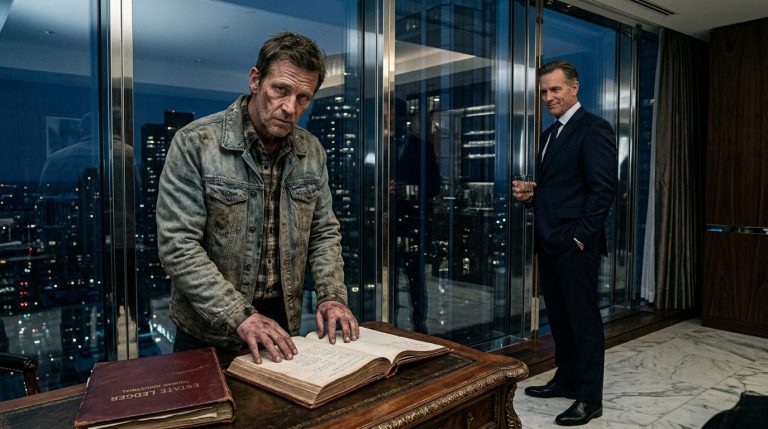
I leaned against the workbench, looking around the shop. It was a cathedral of iron and oil. Shelves lined the walls, stacked high with forty-one canvas-covered notebooks—the complete record of Harold Bryce’s life. “It wasn’t just about the bridge, was it? This whole thing—the notebooks, the truck, the wait—it was your own audit. You’ve been checking his work for sixty-three years.”
Walter nodded slowly. “I didn’t have to read the 1952 volume again, Mr. Merritt. I’d memorized every note by the time I was twenty. But I had to see it in action. I had to know that the logic held, even after the world had forgotten why he did it.”
He gestured to the rows of notebooks. “My daughter thinks I should sell the shop. Send the truck to a museum. And maybe she’s right. The work is done. The bridge is gone, and the ground is cleared.”
I looked at the Diamond T. It was a machine that had survived the passage of time because it had been maintained, repaired, and understood by someone who respected its purpose. It wasn’t just iron; it was a testament. “You shouldn’t sell it, Walter. Not yet.”
I picked up the 1952 notebook, the one that had sat on the shelf since the week after Harold died. It was worn, the corners softened by time, but the binding was still solid. I opened it to the page concerning the Coldwell Creek Bridge. There, in neat, vertical handwriting, were the details: the late aggregate, the farmhouse rubble, the deliberate keying into the bedrock. And at the bottom, the same three letters I’d found on the brick. Q.E.D.
“He left you the instructions,” I said. “He left you the truth.”
“He left me the responsibility,” Walter corrected. “But now, the responsibility is cleared.”
I spent the next hour with him, not talking about highway contracts or demolition schedules, but about the way things used to be built. We talked about the shift from mortar to concrete, from hand-molded brick to factory-pressed aggregate, and the loss of the quiet, deliberate knowledge that allowed a man like Harold Bryce to build a wall that could survive a lifetime of floods and frost.
When I finally stood to leave, the sun was dipping below the tree line, casting long, orange shadows across the shop floor. I felt a sense of clarity I hadn’t known when I’d started the project. The bridge was gone, the road would be built, and the progress of the world would continue. But for a few hours, I had stepped outside of that rush. I had stood in the quiet space where a father and son had communicated through time, using the language of stone and iron.
I walked to my truck, my boots silent on the gravel. I looked back one last time. Walter was still sitting in the doorway, his coffee cup set aside, his hands resting on his knees. The Diamond T sat silent in the twilight, its work finished, its legacy secure.
I started the engine and turned back toward the main road. I didn’t look at the job site as I passed it. I didn’t need to. I knew what was there, and more importantly, I knew what had been proven.
As I drove, I reached into my pocket and touched the brick. It was just a piece of clay and grit, but it felt like a foundation—something solid, something true, and something that, even in a world of constant change, would hold. The work was done. The ledger was closed. And for the first time in my career, I knew exactly what it meant to build something that mattered.