A Legacy of Echoes: One Nurse’s Quiet Revolution Against a World That Only Measures Gold
CHAPTER 1: The Weight of Paper
The hospital air did not mourn; it simply recycled itself, scrubbing away the trace of her existence as efficiently as the chemical solution they used on the trauma floors. Sandra kept her gaze leveled on the gray linoleum, her boots clicking a rhythmic, hollow cadence that felt far too loud for the sanctity of a hallway she had once treated like a cathedral.
She felt the paper bag shift. Her stethoscope, nestled atop her scrubs, bumped against her forearm—a cold, metallic reminder of a life defined by pulse checks and rhythmic breathing. She had walked these halls through the long, jagged nights of two decades, absorbing the grief of a thousand strangers, yet she was leaving today because of a single, missing ink stroke on a digital form. It was a clerical guillotine, sharp and clean, designed to remove the liability of a veteran nurse who sometimes cared more about patient comfort than institutional efficiency.
As she pushed through the final set of double doors, the chill of a November morning hit her—a raw, biting dampness that bit through her thin cardigan. She paused on the sidewalk, the city bustling around her in a blur of gray exhaust and indifferent faces. For twenty-two years, she had been a fixed point in this orbit. Without the ward, she felt untethered, a ghost in her own life.
She reached into her bag to steady herself, but her fingers brushed against something that shouldn’t have been there. She pulled out the stethoscope, its cold tubing coiled like a sleeping snake. It was meant to stay in the locker. She hadn’t put it in the bag.
Her heart did a strange, erratic stutter—the same feeling she used to get when a patient’s monitor would skip a beat. She looked back at the glass doors of Memorial General, the lobby teeming with people who would never know her name, and then down at the tool in her hand. It was the only thing she truly owned from the last two decades.
Her purse vibrated again, a sharp, insistent hum against her hip. She pulled out the phone she had tucked away days ago, the screen glowing with an unknown number. She stared at it, the gray light of the morning reflecting in the black glass. It was an invitation, or perhaps a warning.
She didn’t answer. Instead, she stood perfectly still, watching a single dry leaf skitter across the pavement. She had cleared her locker, she had signed the papers, and she had walked out. The world was demanding she choose a direction, but as she gripped the cold metal of the stethoscope, she realized she wasn’t just a casualty of a paperwork dispute. She was a witness to something the administration had tried desperately to hide, and that witness was now walking out the front door, fully awake.
The phone vibrated a third time, and for the first time in three years, Sandra felt the cold, sharp clarity of a hunger that had nothing to do with food. She tapped the green icon.
CHAPTER 2: The Invitation
The voice on the other end was not the voice of a man who dealt in apologies. It was precise, measured, and possessed the clipped cadence of someone who had spent their entire adulthood translating high-stakes danger into manageable variables.
“Sandra Reyes,” he said. It wasn’t a question, but a confirmation of identity, as if he were ticking a name off a manifest.
Sandra gripped the steering wheel, her knuckles pale against the worn leather. She didn’t speak immediately. The silence between them was not uncomfortable; it felt expectant. It was the silence of a transition, the moment before a patient wakes from anesthesia to find the world has irrevocably changed.
“I remember you, Corporal,” Sandra finally said. The name felt strange on her tongue, heavy with the weight of years.
“James,” he corrected, the edge of his voice softening just enough to betray the humanity behind the discipline. “I need you to be at Riverside Park tomorrow morning. 0900. Don’t bring anything from the ward. Just yourself.”
The connection clicked off before she could ask why.
She stared at the blank screen of the burner phone. The air inside the car had grown stale, smelling faintly of the coffee she’d spilled in the breakroom three hours—or three lifetimes—ago. She shifted the car into gear, the engine turning over with a low, metallic protest.
As she drove, her mind drifted, pulled backward by a sensory phantom. She heard the distinct, rhythmic click-hiss of the wall-mounted clock in the oncology ward, a sound that had acted as the heartbeat of her professional existence. For twenty-two years, that sound had told her when to administer pain management, when to check vitals, and when to prepare for the inevitable. Now, as the city blurred past her in a smear of wet gray, the sound echoed in her mind, out of sync with the world.
She caught herself checking the rearview mirror, not for traffic, but for the invisible supervisors who had spent the last month watching her every move for a discrepancy they could weaponize. She realized, with a jolt of cold clarity, that she was still driving as if she were under observation.
She reached her apartment building, a modest brick structure that seemed to sag under the weight of the encroaching winter. The stairs to her third-floor unit felt steeper than usual. Inside, the quiet was absolute. It was a space designed for a life that had ended three years ago, a tomb of half-finished projects and the lingering scent of her husband, Daniel.
She placed the paper bag on the kitchen table. The scrubs inside were wrinkled, the blue fabric faded from years of industrial laundering. She looked at them and felt a sudden, sharp urge to throw them in the trash, to burn the last vestige of the institution that had discarded her like a broken tool.
Instead, she sat by the window. She watched the pigeons on the ledge. They moved with a desperate, jerky purpose, negotiating for the smallest patch of warmth from the sun. She thought of James. She remembered him as he had been—terrified, nineteen, and holding onto her hand in the dark. She hadn’t known then that he would survive. She had only known that he couldn’t be left to face the silence of the room alone.
She had stayed past her shift because the protocol required the nurses to leave at 7:00 PM, and she had decided that protocol was a suggestion, not a moral imperative. She had sat there, talking to him about the rain in Portland and the way a person’s life could change between one heartbeat and the next, unaware that she was building a bridge that would eventually reach back to her.
She looked at her hands. They were steady, the hands of a nurse, but for the first time in decades, they had nothing to do. The uncertainty of it was a physical ache, a pressure behind her eyes.
She stood up and paced the small kitchen. She needed to know what had happened to the others—the patients she had fought for when the charts said they were liabilities. If James had found her, he hadn’t done it by accident. He had tracked her down, which meant he knew the state of her life, her history, and perhaps, the truth behind the “paperwork dispute” that had ended her career.
She walked to the closet and pulled out a heavy wool coat, its buttons loose and hanging by threads. She put it on, not because she was going out, but because the cold in the room felt like it was seeping into her skin.
She looked at the burner phone on the table. It was a lifeline she hadn’t known she was holding. She realized then that the hospital hadn’t just fired a nurse; they had inadvertently released a witness. She looked at her reflection in the darkened window. The face looking back was tired, worn by years of high-stakes empathy, but the eyes were sharp.
She wouldn’t wait for morning. She would go to the park early. She would find out what James wanted, and she would find out why he had chosen today, of all days, to break the silence.
She felt a movement in her chest, a slow, steady expansion—not of grief, but of something far more dangerous. Resolve. She walked to the door, her hand hovering over the lock. The hallway light flickered, the hum of the electrical wiring vibrating through the floorboards. She had spent twenty-two years keeping the world at bay for her patients.
Tomorrow, she would find out what it felt like to let the world in, or perhaps, to finally push back.
CHAPTER 3: The Assembly
Sandra didn’t sleep. She spent the hours between three and seven watching the shadows in her bedroom shift as the streetlights outside hummed against the darkness. The silence of the apartment, once a comfort, now felt like a pressurized chamber. Every creak of the floorboards, every rattle of the windowpane, sounded like a demand for her attention. She had lived in this space for three years, wrapping herself in the quiet as if it were a shroud, but tonight, the quiet was insufficient. It lacked weight.
At 7:00 AM, she dressed. She chose the same clothes she had worn the day before, finding a strange, grounded comfort in the routine. She pulled on her heavy wool coat, wrapping it tight until the rough fabric scratched against her neck. She checked her pockets—keys, the burner phone, and a small, folded notepad—before stepping out into the hallway.
The city outside was waking up, but it was a gray, muted awakening. The air smelled of wet pavement and dormant iron, a scent that clung to the back of her throat. Riverside Park, typically a place of weekend joggers and parents pushing strollers, was transformed by the early hour. The mist hung low over the grass, dampening the sound of her footsteps until she felt like she was moving through a vacuum.
She saw them from the parking lot.
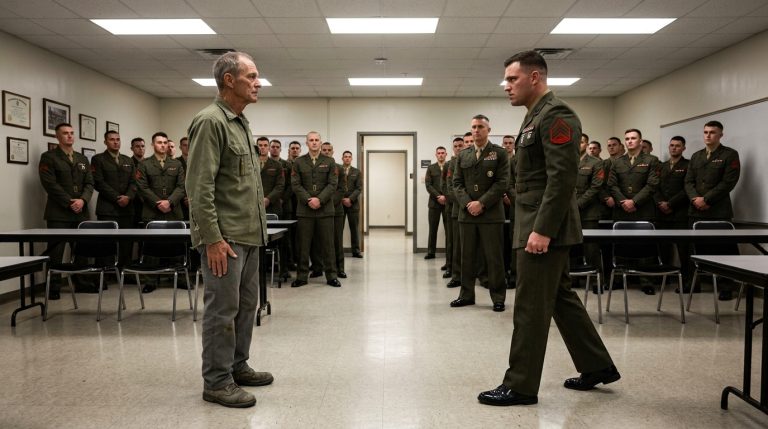
At first, she thought it was a trick of the light, a formation of stone monuments meant to honor the city’s past. But as she approached, the “monuments” shifted. There were twelve of them, standing in two lines along the walking path. They were dressed in uniform, their bodies held with a rigid, unnatural stillness that defied the biting cold of the morning. They did not move, they did not speak, and they did not acknowledge the world around them.
Sandra slowed her pace, her heart drumming a frantic, irregular rhythm against her ribs. She recognized the discipline. It was the same posture she had seen in James eight years ago—a protective stance that turned the body into a barrier.
As she reached the perimeter of the path, a man stood apart from the others. He was taller than she remembered, his shoulders built wide by a decade of unseen burdens. His face was weathered, mapped with the subtle lines of experience that eighteen-year-olds don’t possess. But when he turned his head, when those eyes locked onto hers, the years fell away. It was James.
He didn’t move toward her at first. He stood his ground, letting her take in the sight of him. The fear that had once defined his gaze was gone, replaced by a profound, terrifying stillness. He waited until she was only a few feet away, the space between them charged with the weight of things left unsaid.
He didn’t offer a polite greeting. He didn’t ask how she had slept. Instead, he lifted his right hand and held it there, perfectly level.
He saluted her.
The movement was sharp, clean, and devastating. One by one, the twelve men in the rows behind him followed suit. It was a silent, synchronized acknowledgment that cut through the gray morning air like a blade. Sandra felt a tremor start in her hands, a deep, resonant shaking that worked its way up her arms. She had spent twenty-two years on an oncology ward, watching the slow, quiet erosion of life, and she had never once been honored for the invisible, uncompensated work she had done in the dark.
“Corporal,” she whispered, her voice failing to carry in the wind.
James stepped forward, finally breaking the formation. He stopped three feet away, his expression unreadable. He looked at her not as a patient looks at a nurse, but as a peer.
“You aren’t on the clock, Sandra,” he said, his voice low and steady. “And for the first time in your life, you don’t have to worry about the paperwork.”
He gestured to the twelve men behind him. They were veterans, men who had walked through the same fires that had tempered James. They stood there as a wall between her and the world she had just left, a manifestation of a loyalty she hadn’t known she had earned.
“We heard about the hospital,” James continued, his gaze narrowing. “We heard about the ‘clerical lapse.’ And we decided that if they want to lose a witness like you, then they don’t deserve the silence that comes with it.”
Sandra looked past him, toward the river that flowed sluggishly in the distance. The mist was beginning to burn off, revealing the stark, jagged reality of the world she was now part of. She realized that James wasn’t just here to pay his respects. He was here to offer her a choice, and the weight of that choice settled onto her shoulders, heavier than any coat.
“What did you bring me here for, James?” she asked, her voice finally steadying.
He didn’t answer immediately. He looked at the row of men, then back to her. “I brought you here to show you that you aren’t invisible. And I brought you here to show you that the things you did when no one was watching—the things that weren’t in the chart—they didn’t disappear. They’re still here, Sandra. In us.”
He reached into his pocket and pulled out an envelope, its edges worn from handling. He didn’t hand it to her; he held it between them, a physical divide. “We have the files, Sandra. The ones you were fired for trying to protect. We have the data on the protocols they were using that year. And we think you might want to see what they were hiding, even from you.”
The air around them seemed to thin. Sandra felt the cold biting at her cheeks, but she didn’t look away from the envelope. She had spent years wondering if she had been wrong, if she had been too paranoid, too protective. James’s eyes told her the truth: she hadn’t been wrong. She had just been dangerous.
CHAPTER 4: The Revelation
Sandra took the envelope. The paper was coarse, recycled, and chilled from the morning air. She didn’t tear it open immediately; instead, she tucked it into the inner pocket of her coat, close to her heart, where the heat of her own body would start to warm it. James watched her, his expression a testament to the years of discipline that had turned him into a sentinel. The twelve men behind him remained as still as the trees, their silence a profound, echoing space that felt entirely removed from the city waking up just a few blocks away.
“You should look at it when you’re somewhere else,” James said softly. “The park isn’t for reading history. It’s for survival.”
He didn’t wait for her to process his words. With a curt nod, he stepped back, and in one fluid, rhythmic motion, the twelve men turned in unison. They didn’t march; they drifted, twelve shadows receding into the thinning mist, leaving Sandra alone on the path. The sudden absence of their collective presence felt like a physical weight being lifted, and yet, the silence that rushed back into the space was loud—deafening.
Sandra walked back to her car. Her movements felt mechanical, a series of calculated steps designed to preserve the integrity of the envelope she carried. She didn’t look back at the park. She didn’t look at the city skyline. She drove home in a trance, the streets passing by in a blur of gray and charcoal.
When she reached her apartment, she didn’t turn on the lights. She moved through the rooms in the pale, filtered glow of the morning sun. The kitchen table, where she had folded her scrubs the day before, was now a staging ground. She sat down, her breath visible in the chilly air, and carefully removed the documents from the envelope.
The first page was a spreadsheet. It was an internal audit of the oncology ward from eight years ago, the year James had been admitted. It was standard, mundane documentation—until she saw the highlighted entries. Her eyes scanned the lines of data: medication transfers, supply requisitions, and signatures. Her own name appeared frequently, always tied to the bedside care she had provided. But as she compared these dates against the hospital’s official ledger records—records she had kept personal copies of for years—a discrepancy emerged.
It wasn’t a mistake. It was a pattern.
The hospital had been billing for treatments that hadn’t been administered, using the “emergency” protocols of dying patients to secure funding for experimental, unproven procedures. And there, buried in the margins of a transfer request she had signed, was a date that didn’t align. The signature was hers, but the ink looked slightly different, the slant of the pen just a fraction off from the way she had held it for twenty years.
Her stomach lurched. The decoy secret—the idea that she had been fired for a minor clerical error—suddenly shattered. They hadn’t fired her because of the signature; they had fired her because she was the only one who could verify that the signatures on the most critical, high-cost files were not actually hers. She had been the unwitting keeper of a fraud that went deeper than the hospital administration.
She turned to the second document. It was a file marked with her husband Daniel’s name, dated three years ago. She had been told he died of a sudden cardiac event. She had held his hand while the machines hummed the final, flat melody of his passing. But the record here showed a different sequence of events—a series of adjustments to his heart medication that had occurred while she was off-shift, adjustments that directly contradicted the protocol she had personally authorized.
The room seemed to tilt. The faded texture of the wallpaper, the worn grain of the wooden table, the dim, flickering light from the hallway—all of it felt suddenly sharpened, the edges of her reality cutting into her resolve. She hadn’t been a nurse; she had been a component in a machine that viewed her loyalty as a liability and her husband’s life as a variable in a cost-benefit analysis.
She stood up, her legs feeling weak, and leaned against the counter. Her hand brushed against her bag, the stethoscope still coiled there, cold and heavy. For the first time, she saw the tool not as a symbol of her duty, but as a silent, recording device that had seen everything, even when her eyes had been closed by grief.
She wasn’t going to report this to the police. She wasn’t going to go to the papers. She knew now that the system wasn’t broken; it was operating exactly as it had been designed. And if she wanted to stop it, she couldn’t use the tools of the system.
She looked at the phone on the table. It was vibrating, a slow, insistent buzz against the wood. She picked it up. It was James.
“You’ve seen it,” he said, not as a question, but as a statement of fact.
“They killed him,” Sandra whispered, the realization finally breaking through the barrier of her composure. “They didn’t just let him die. They adjusted the dosage.”
“They’ve been doing it for years, Sandra,” James said, his voice hard as iron. “We’ve been tracking them. We needed someone on the inside who could confirm the signature discrepancies. Someone with the credibility to be believed.”
“I’m just a nurse,” she said, though the words sounded hollow now.
“No,” James replied. “You’re the only person who can prove that the entire foundation of that hospital is built on a lie. Are you ready to finish this?”
Sandra looked at the documents spread out before her—a history of theft, betrayal, and murder masked by the sterile white of hospital protocols. She felt the weight of her twenty-two years of service, and then she felt the cold, hard, unwavering resolve of the truth. She picked up her pen.
“I’m ready,” she said.
CHAPTER 5: The Confrontation
Sandra didn’t answer the door. She moved to the kitchen window and pulled the curtain back just enough to see the man standing on the landing: her former supervisor. He looked out of place in her modest building, his tailored coat a stark contrast to the peeling paint and dim, flickering light of the hallway. He didn’t look like a man who had come to apologize for a wrongful termination; he looked like a man who was performing a final, necessary audit.
She checked the deadbolt. It was secure. Her heart hammered against her ribs, but the fear was different now—it was colder, stripped of the confusion she had felt days ago. She looked at the documents on her table. They were no longer just papers; they were the evidence of a systematic erosion of human life, and she was the one who had finally cataloged the ruin.
The knocking stopped, replaced by a voice that drifted through the door, calm and polished. “Sandra. I know you’re in there. I know what you have, and I know what you’re planning to do with it.”
She didn’t speak. She moved to the table and gathered the files. There was no time to panic, no time to look for a way out. She had to be the driver of her own defense. She slipped the files into her bag, the weight of them against her hip a constant, grounding pressure. She grabbed her keys and moved silently toward the fire escape in the bedroom.
The air outside was biting, the city lights below casting long, distorted shadows across the alleyway. She descended the metal steps, the cold iron biting into her palms, each movement calculated to avoid the noise of the rusted hinges. She didn’t have a plan beyond leaving, but as she reached the bottom and hit the damp, trash-strewn pavement of the alley, she saw the silhouette of a black sedan idling at the end of the block.
They were waiting for her.
She ducked into the shadows, the smell of rotting refuse and wet brick filling her lungs. She realized then that the hospital’s reach was not confined to the oncology ward. It was a network, a grid of influence that extended into the veins of the city. She thought of James, of the promise of a clinic that could provide care without the cost of a life. She couldn’t let them reach him, and she couldn’t let them bury the truth.
She turned down a narrow path between two industrial buildings, the soles of her boots slipping on slick, mossy stone. She reached the main street, the traffic moving in a steady, uncaring pulse. She walked with purpose, head down, blending into the crowd of morning commuters. She felt the eyes of the city on her—every security camera, every passing vehicle, every glint of glass in a high-rise window felt like a tracking device.
She realized the audit had never been about her performance. The “paperwork dispute” had been a test. A way to see if she would remain silent, if she would follow the protocol even when it felt wrong. By challenging them, by keeping the records, she had moved from an asset to a threat.
She ducked into a pharmacy, the automatic doors sliding open with a soft, mechanical hiss. It was crowded, the aisles lined with shelves of sterile, packaged hope. She navigated toward the back, past the pharmacy counter where a young clerk stood, his eyes fixed on a screen. She reached the end of the aisle and stopped.
She needed to call James. But as she reached for her burner phone, she saw it—a man in a grey suit, standing by the entrance, his gaze scanning the store with a clinical, detached focus. He wasn’t browsing. He was waiting.
She felt a surge of adrenaline, sharp and electric. She had two choices: she could hide, or she could use the environment to her advantage. She stepped to the shelf and picked up a small, unimportant item, holding it as if she were comparing brands. She watched the man in the mirror above the counter. He moved forward, his stride steady, his attention locked on her.
She turned and headed toward the restroom, a small, enclosed space that offered a moment of absolute stillness. She locked the door, the sound of the latch clicking into place the loudest thing in the world. She pulled out the phone. Her hands didn’t shake.
“James,” she said the moment he answered. “They know. They’re here.”
“Where are you?” his voice was immediate, devoid of panic.
“The pharmacy on 4th,” she said, her eyes tracing the line of the door, the shadow beneath it. “There’s a man watching me. He isn’t from the hospital security. He looks… institutional.”
“Stay there,” James said. “Don’t engage. We have a car two blocks away. Get to the rear exit. If you can’t reach the street, wait for the signal.”
The signal. She hadn’t asked what that meant, and she didn’t have to. She waited, the silence of the room pressing in on her. She heard the soft chime of the store entrance, the sound of boots on the linoleum. She wasn’t just a nurse anymore. She was a piece on a board, and for the first time, she was playing for the win.
She unlocked the door, her movements precise, every action a calculation. She didn’t rush. She walked out, her pace steady, her eyes fixed on the rear exit sign. The man in the suit was already midway down the aisle, his eyes meeting hers. He didn’t smile. He didn’t threaten. He simply reached into his coat.
Sandra didn’t stop. She reached for the heavy fire door, pushed, and stepped into the blinding, absolute light of the afternoon sun.
CHAPTER 6: The New Foundation
The man in the suit stopped at the threshold of the pharmacy’s rear exit, his eyes narrowing as he adjusted to the shift in light. He reached for his coat, but a sudden, controlled motion from the darkness of the alley halted him. It was James. He emerged from the shadows with a calm, predatory grace, his presence alone enough to drain the air from the space. He didn’t use a weapon. He didn’t need one. He simply placed a firm, restraining hand on the man’s arm, a signal that the game had shifted.
“The audit is over,” James said, his voice a low, gravel-edged command.
The man in the suit froze. He looked at James, then at Sandra, and for a fleeting, desperate second, his mask of institutional indifference cracked, revealing the hollow, terrified ambition beneath. He was not a savior of the system; he was a functionary, and he had just realized that the function was obsolete. He backed away, turned, and disappeared into the labyrinth of the city’s backstreets, the suit jacket flapping like a wounded wing.
Sandra leaned against the brick wall, her breath hitching. She felt the heavy, suffocating pressure of the last three years finally dissipate, leaving her with a clarity that was both beautiful and agonizing.
“Is it done?” she asked, her voice barely a whisper.
“The documentation is already with the regulatory board,” James said, stepping toward her. He reached into his coat and produced a final file—the one detailing the specific dosage adjustments made to Daniel’s medication, signed by the administrator himself. “This was the missing piece, Sandra. The reason they were so desperate to keep you silent. You weren’t just a witness to their billing fraud; you were the only person who knew Daniel’s chart well enough to see the intervention.”
He handed her the file. The paper was smooth, the ink dark and permanent. Sandra opened it, her eyes tracing the lines of the medical record—the deliberate, lethal miscalculation. The truth didn’t hit her with a crash; it settled over her like a cooling quilt, heavy and absolute. Daniel hadn’t died of a cardiac event; he had been removed, a quiet sacrifice for a margin of profit that the hospital couldn’t afford to lose.
She looked up at James, the sun warming her face, the morning dampness finally yielding to the light. The anger she had anticipated didn’t arrive. Instead, she felt a profound, aching peace. She had honored his memory by surviving, and by doing so, she had broken the machine that sought to consume them both.
They spent the next several hours in the quiet of a small office building on the outskirts of the city—a temporary space for the clinic they were building. The air here was clean, smelling of fresh paint and wood. It was a blank canvas, a place where the logic of the hospital—the cold, transactional math of survival—held no sway.
Sandra took her stethoscope from her bag and laid it on the pristine wooden desk. She picked up a screwdriver from a nearby workbench, turning her attention to a loose hinge on the office door—a small, physical repair that required her full attention. She tightened the screw, the metal yielding to her grip, the door swinging silent and smooth. It was a small act, but it felt monumental. It was the repair of a physical space, the beginning of a foundation built on trust rather than extraction.
As the afternoon light began to mellow into the golden hues of a late-season sunset, Sandra sat in the quiet office. She thought of her years on the oncology ward, of the way she had held the hands of the dying when no one else was watching. She realized then that her life hadn’t been defined by the institution that fired her, but by the space she had carved out for others to feel less alone.
James entered the room, his movements quiet. He stood by the window, watching the city below, no longer a soldier on watch but a man standing on the threshold of something human. “The staff starts arriving tomorrow,” he said. “The clinic is ready.”
Sandra nodded, a small, weary smile touching her lips. She looked at the desk, at the stethoscope, and the medical records that had once been her burden, now transformed into a ledger of justice. She had reached the end of the road, and the path ahead was quiet, steady, and entirely hers. She reached out and touched the wood of the desk, the texture grounding her in the present. She was home.