The Weight of the Fence: A Cold Ledger of Property, Authority, and Hard-Earned Silence
CHAPTER 1: THE PERIMETER LINE
The cable snapped tight, biting into the harness with a sound that seemed to vibrate through the soles of my boots. Two men, their movements practiced and heavy, dragged my dog toward the HOA van. The concrete of my driveway, scorched by the summer heat, scraped against his paws. He didn’t bark. He didn’t claw at them. He simply set his feet, a living statue of discipline, his eyes fixed on a point somewhere over the men’s shoulders.
I moved before the thought even cleared my mind. My muscles tensed, a reflex burned in from years of operational conditioning. I reached the edge of the porch, the air tasting of exhaust and dust.
“Get him in,” one of the men growled, the catch pole sliding under my dog’s chest. He grunted, sweating, surprised by the sheer, unmoving mass of the animal.
“Stop,” I said. It wasn’t a shout. It was a command, cut from the same cloth as the dog’s training.
The man’s hands faltered. He looked up, his brow furrowed with annoyance, but then he saw the woman standing at the curb. Linda Hartwell, the HOA president, held her phone aloft. She was recording, her face an unmoving mask of administrative resolve. She didn’t look like a neighbor; she looked like an auditor closing a failing account.
“Property seizure,” she said, her voice dry and flat, lacking any human cadence. “Unregistered aggressive animal.”
I stepped off the porch, the gravel crunching beneath me like broken teeth. “He’s not aggressive, and you know it.”
She didn’t flinch. She barely acknowledged my presence, keeping her gaze locked on the lens of her phone. “Large working breeds create liability. You were notified.”
I looked at the dog. He was breathing slow, a rhythmic rise and fall that kept him centered. The men were cursing now, shifting their stance, trying to find a leverage point. They had no idea. To them, this was a Tuesday chore, a bit of physical labor to justify the HOA’s monthly dues. They didn’t see the tactical posture, the way he was already measuring the distance, the way he was waiting for a signal that I had no intention of giving—not yet.
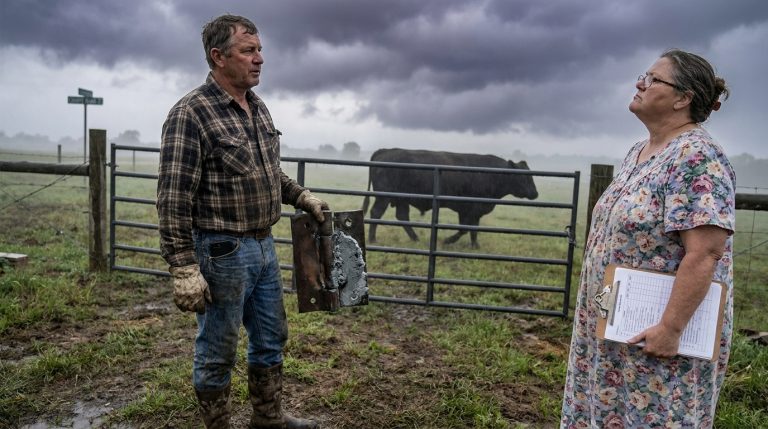
Linda stepped forward, her heels clicking on the asphalt with a precision that grated on my nerves. She tucked her phone away and lifted a clipboard, the paper rustling in the stagnant air. “You’re interfering with an enforcement action,” she said, her eyes finally finding mine. They were cold, reflecting the gray, dusty light of the dying afternoon. “If you cooperate, this stays simple. If you don’t, it escalates.”
I looked at the fence, at the rusted latch of the gate, and then back at her. She was banking on my fear, on the quiet, suburban expectation that I would apologize and yield. She was wrong. She was mistaking my silence for a lack of options, not realizing that I had already marked every move she had made.
The man with the pole pushed harder, and my dog shifted—just an inch—but it was enough to make the man stumble.
“Careful,” Linda whispered, her tone not of concern, but of calculation. “Don’t let him get agitated.”
I knew then what she was doing. She wasn’t just clearing a pet from the street. She was scrubbing a liability. And she was about to find out that some things in this neighborhood weren’t built to be erased.
CHAPTER 2: THE PAPER TRAIL
The latch clicked back into place, a hollow, metallic sound that echoed too loudly in the quiet of the cul-de-sac. My hand stayed on the cold iron of the gate, my fingers tracing the flaking, orange-brown rust. The men had retreated a dozen paces, standing by the van, whispering. Linda Hartwell had not moved; she remained at the curb, a static figure in a tailored suit, watching me with that same practiced, hollow smile.
I didn’t turn my back on them. I kept my weight centered, my body turned just enough to maintain a line of sight to both the van and the front door of my house. Beside me, the dog—my partner—remained a steady, warm weight against my thigh. His breathing was so slow it felt as if he were trying to conserve energy for a fight that hadn’t even begun yet.
The vibration of the gate’s metal against my palm triggered a sudden, unwanted phantom sensation. For a split second, the rusted iron transformed into the textured grip of a nylon leash during a low-light sweep in a sector that didn’t exist on any map. The smell of the damp, suburban evening momentarily gave way to the metallic tang of an airfield—the scent of hot fuel and ozone. I blinked, the image dissolving. I wasn’t there. I was in an HOA-regulated neighborhood, standing on cracked pavement, holding a line against a woman with a clipboard.
“You’re making a mistake, Linda,” I said, my voice steady, stripped of the reflexive anger that most would expect.
She tapped her pen against the plastic of the clipboard. “Mistakes are for people who don’t read the bylaws. I suggest you review the emergency addendum taped to your door by morning.”
She didn’t wait for a reply. She turned, her heels precise and rhythmic, and walked toward her SUV. The men by the van lingered for a second, their eyes tracing the dog’s posture—the way he didn’t twitch, didn’t growl, just watched them with a calm, analytical intelligence that seemed to unnerve them more than aggression would have. They climbed into the van, the doors sliding shut with a heavy, final thud that vibrated through the ground.
I stood there until the van pulled away, until the sound of its engine faded into the distance. Only then did I move. I walked back toward the porch, the dog moving in perfect synchronization with my stride, his focus never wavering from the perimeter.
Inside, the house was dark, the only illumination coming from the blue glow of my security server in the corner. I didn’t turn on the lights. I walked straight to the office, my boots heavy on the hardwood. I didn’t reach for the phone to call a friend or a neighbor. I reached for the hard drive.
The paper trail wasn’t going to be in the emails Linda sent. It would be in the back-end—the digital breadcrumbs left behind by the HOA’s automated system. I sat down, the dog settling into a down-stay by my feet, his head resting on his paws. I opened the file the HOA had sent me earlier in the month, a standard, boring notification about property maintenance. But I didn’t open the PDF. I opened the properties of the file itself, drilling down into the metadata, the source routes, the CC’d addresses.
There it was. A forwarded chain from the HOA board to an external insurance underwriter.
I scrolled through the text, my eyes scanning for the keywords that didn’t fit. Liability mitigation. High-value asset class. Prohibited working-breed clause. My skin grew cold. This wasn’t about the noise of a barking dog. This was about money—specifically, a six-figure premium drop that the HOA would be entitled to if they could prove the neighborhood was “low-risk.” And my dog, with his training, his certification, and his presence, was the primary obstacle to that payout.
Linda wasn’t just a petty bureaucrat looking for control; she was a liquidator. She was cleaning the balance sheet, and she had decided that my property was the easiest cut to make.
I felt a surge of something sharp and cold—not rage, but a chilling clarity. The “emergency addendum” wasn’t a policy change. It was a targeted weapon designed to force a surrender. I leaned back in the chair, the silence of the house pressing in around me. The dog lifted his head, sensing the change in my pulse, his gaze searching my face in the dim light. I reached down, running a hand over his ears, feeling the solid, dense muscle underneath.
They thought they were dealing with a pet owner. They had no idea they were dealing with a variable they hadn’t bothered to measure. I started typing, not an email, but a ledger—a list of every violation, every time-stamp, every name mentioned in those CC’d headers. I had the start of the paper trail. Now, I needed to see how deep the rot went, and exactly who else was holding the shovel.
CHAPTER 3: TACTICAL SILENCE
The blue light from the monitor hummed, a low-frequency buzz that felt like sandpaper against my exhaustion. I didn’t look up when the house shifted—the settling of floorboards, the wind brushing against the siding—because my focus was tethered to the screen. My dog hadn’t moved from his position at my feet, but his ears twitched, rotating toward the front window like radar dishes. I placed my hand on his flank, feeling the warmth of his steady breathing.
“Hold,” I whispered.
He didn’t need the command, but the sound of my own voice helped keep the rhythm of my internal clock synced. I was building the ledger. It wasn’t just a list of grievances; it was a map of intent. Every fine, every notice, every “emergency” clause was stamped with a digital timestamp, and when I aligned them against the board’s recent meeting minutes—which I had accessed via a guest portal that had been left embarrassingly unpatched—the pattern emerged in jagged, unmistakable lines.
Linda wasn’t just acting. She was reacting to a budget shortfall that the neighborhood didn’t even know existed. The insurance underwriter’s memo I’d uncovered in the forwarded chain was the linchpin. They needed to force a mass re-classification of the neighborhood’s property risk profile to avoid a massive hike in the association’s global insurance policy. My dog, with his high-value training pedigree, wasn’t just a nuisance; he was a liability that dragged the HOA’s safety rating down. Erasing him—or at least the paperwork associated with him—was a way to balance the books.
I saved the encrypted file to a thumb drive and pulled it from the port. The physical act of removing the drive felt like locking a bolt.
Outside, the porch light flickered, a sudden strobe of yellow against the encroaching dark. It was a dying bulb, the glass clouded with years of dead moths and dust, but the flicker was rhythmic. Tactical eyes didn’t like rhythms. It was a pattern, and patterns could be manipulated.
I stood, my knees popping, the chair scraping against the floor—a sound that seemed far too loud in the dead-quiet house. I walked to the window, keeping to the edge of the frame. Through the slats of the blinds, I watched the street. Everything looked normal—the manicured lawns, the sleeping cars, the stillness of a neighborhood that prided itself on being invisible. But then I saw it: a shadow near the edge of the driveway, moving with a fluid, unnatural grace that didn’t belong to a stray or a neighbor.
It stopped at the perimeter of my yard, right where the grass met the concrete. The figure leaned forward, the brim of a dark hat catching the light of the flickering bulb.
The dog rose, his movement silent, his muscles coiling. He didn’t growl. He didn’t bark. He just stood there, a shadow within a shadow, his eyes fixed on the intruder. I felt the familiar weight of the situation—the need for speed vs. the need for observation. If I went out there, I was playing their game, moving to the spot they had chosen. If I stayed in, I was a prisoner behind a dead-bolted door.
I chose the middle ground. I turned off the server, plunging the room into absolute darkness. The silence of the house became heavy, a physical weight that pressed against my lungs. I waited. The figure remained at the edge of the driveway, waiting for a reaction, waiting for me to step out and confront them.
They wanted a scene. They wanted the noise, the chaos, the proof of an “unstable” resident.
I didn’t give it to them. I moved to the hallway, staying low, and checked the perimeter cameras on my handheld device. Three cameras, all clear. The fourth, the one angled toward the back fence, showed a second figure—this one moving along the property line, testing the integrity of the gate.
My tactical sense surged, a cold, sharp blade of clarity. This wasn’t just intimidation anymore. They were scouting the defenses, looking for the softest point in the armor. I felt a grim satisfaction. Let them look. Let them think the gate was a weakness.
I turned to my dog, who was watching me with an intensity that bordered on human. “Steady,” I murmured.
I moved to the back door, not to unlock it, but to secure it with a secondary brace I had installed three days ago. Then, I sat on the floor, in the dark, and watched the camera feed. I wasn’t going to call the police. Not yet. The police were a sledgehammer, and I needed a scalpel. I was going to let them commit to the path they had chosen. I was going to let them realize that the property they were trying to dismantle was, in fact, a trap.
The flicker of the porch light finally gave out, leaving the house in total darkness. I closed my eyes, the image of the figures etched onto my retinas, and began to formulate the next move. They were playing with the rules, with the papers, with the bureaucratic theater of the HOA. They didn’t understand the geography of survival.
CHAPTER 4: THE AMBUSH
The house remained in a state of unnatural quiet, the kind of silence that amplifies the smallest friction—the shifting of floorboards, the settling of the house’s frame against the cooling air. I sat on the floor, the thumb drive feeling unusually heavy in my palm. The two figures on the security feed had vanished, melting back into the shadows of the neighborhood as if they were never there. They weren’t looking for a fight; they were testing the lock.
I moved to the kitchen, stepping carefully to avoid the floorboards I knew would creak. The dog followed, a shadow glued to my side. We reached the pantry, and I pulled the emergency kit from the back of the shelf. My hands moved with a cold, muscle-memory precision, checking the batteries in my flashlight, the integrity of the secondary locks, and the charge on my handheld radio. I wasn’t just preparing for a break-in; I was preparing for an eviction.
At dawn, the rhythm of the neighborhood broke. The sound of heavy tires on asphalt and the slamming of car doors shattered the morning quiet. I looked out through the blinds. Three vehicles, all sporting the clean, artificial aesthetic of the HOA’s branded security, were idling at the curb.
They weren’t here to talk.
I grabbed the printed stack of violation notices—the ones I had been meticulously collecting—and shoved them into a manila folder. My dog stood at the back door, ears pricked, his posture coiled. He wasn’t scared; he was waiting. He recognized the tone of the morning, the way the air shifted when a perimeter was compromised.
I walked to the front door, unlocked it, and stepped onto the porch just as Linda Hartwell reached the bottom of the steps. She was flanked by two men in crisp, matching HOA polos—too clean, too rehearsed. They looked like security guards, but the way they held themselves, the way they checked the blind spots, suggested something more calculated. Behind them, one of the board members clutched a binder that looked suspiciously thick.
“Inspection,” Linda said, her voice cutting through the morning stillness. She didn’t offer a greeting. She held out a document. “Emergency animal compliance inspection. Per the addendum.”
I didn’t take the paper. I stood my ground, my hands at my sides. “I’ve reviewed the addendum,” I said, my voice low and controlled. “It’s a fabrication. No vote, no quorum, no legal basis.”
Linda’s smile didn’t falter, but her eyes, hard and flat, narrowed. She gestured to the board member, who stepped forward and flipped open the binder. It was packed with sheets of paper, all printed on the same high-gloss cardstock.
“The board approved it unanimously,” the member said, his voice rehearsed. “We’re here to evaluate the animal for safety compliance.”
I looked at the binder. The edges of the paper were crisp, untouched by time or use. It was a prop. They had assembled this packet within the last forty-eight hours, a desperate, physical manifestation of their authority. But as he held it up, I noticed a discrepancy: the page numbers. They were out of order. Section 4b, which dealt with ‘Aggressive Animal Seizure,’ preceded Section 1, which defined ‘General Conduct.’
They were so intent on the look of power that they had neglected the logic of the document itself.
“You don’t have the authority,” I said, my voice echoing off the neighboring houses.
“We have the governing documents,” Linda countered, stepping closer. She leaned in, her voice dropping to a whisper that was meant only for me. “If you don’t surrender the dog for evaluation, the police will be called. We have already logged the noise complaints. We have the video of your refusal. You’re making this a criminal matter, and you will lose.”
She was right about one thing: it was becoming a criminal matter. But she was dead wrong about who was the target. I looked past them to the third vehicle—a plain, unmarked white truck parked at the very edge of the cul-de-sac. The two men leaning against the side weren’t wearing HOA patches. They were wearing standard tactical gear.
The ambush wasn’t just about the inspection. It was about the removal. They were planning to seize the dog while I was distracted by the board’s theater.
I kept my eyes on Linda, my heart rate steady, my breathing deep. I could feel the dog’s shoulder pressed against my calf, a solid, unmoving presence. They wanted me to lunge. They wanted me to grab the clipboard or push the board member. That was the trigger they needed to call in the “security” team from the white truck.
“I’m not surrendering the dog,” I said, loud enough for the neighbors watching from behind their curtains to hear. “And if you step one foot onto this property, you’re in violation of state law regarding the interference with a trained service animal.”
Linda’s face hardened. She signaled to the board member, who stepped forward with a camera, the lens clicking as it focused on my dog’s face. The trap was sprung. They were baiting the reaction. I stepped back, holding the door open just wide enough to retreat if necessary, but I didn’t back down. The game had moved from the desk to the driveway, and I had the ledger ready.
CHAPTER 5: THE OUTSIDE SHIFT
I didn’t retreat. I kept the door at my back, a physical anchor, and watched the line of communication fail. Linda’s smile had become a brittle thing, a mask stretched too thin across bone. She hadn’t expected the resistance. She had expected the neighborly shame, the quiet capitulation that usually accompanied an HOA notice. She hadn’t expected someone who knew the difference between an order and an opinion.
“The police are not going to side with a resident who ignores community bylaws,” Linda said, her voice sharp enough to draw blood. She gestured again to the board member, who was now fumbling with his phone, his confidence visibly hemorrhaging.
“Call them,” I said. “Please. I have the entire interaction recorded.”
I didn’t reach for my phone; I didn’t need to. The cameras were already live, the data streaming to a secure, off-site cloud server that wasn’t tied to the neighborhood’s grid. Linda hesitated, her gaze flicking toward the white truck at the end of the cul-de-sac. The men inside were watching, waiting for a signal that wasn’t coming. I knew then that the “security” team were private contractors—hired guns in clean shirts, looking for a quick payout, not a felony charge.
I shifted my stance, my weight balanced on the balls of my feet. The dog sensed the micro-movement, his muscles rippling under his coat, a silent, predatory energy that kept the board members rooted to the spot. They were afraid of him, not because he was dangerous, but because they couldn’t quantify him. He defied their rules.
“We don’t need the police to handle this,” the board member muttered, his voice losing its rehearsed cadence. “We have the emergency order.”
“You have a pile of printed paper,” I replied. “You don’t have a legal document.”
I didn’t wait for them to argue. I turned and walked back into the house, leaving the door standing open—a tactical invitation. I went straight to the desk, pulled the thumb drive I’d prepared, and returned to the porch. I didn’t hand it to them. I held it up, the small, silver casing catching the morning light.
“This has the insurance underwriter’s memo,” I said. “The one where they list prohibited liabilities. The one you’re trying to scrub to protect your payout.”
The silence that followed was different. It wasn’t the silence of confusion; it was the silence of recognition. Linda’s face went bloodless. The board member looked like he wanted to vanish into the concrete. They hadn’t just underestimated my resolve; they had underestimated my reach.
“We’re leaving,” Linda said, her voice stripped of its practiced administrative polish. She turned on her heel, the sharp click of her heels sounding like gunfire in the quiet street. “But this isn’t over. The board will take further action.”
“Take all the action you want,” I called after her. “Just make sure it’s legal.”
They retreated, the security guards scrambling back into their cars, the white truck peeling away with a screech of tires that left a black smear on the asphalt. I watched them go, but I didn’t feel relief. I felt a cold, hard knot of reality forming in my gut. I had forced them off my property, but I had also forced their hand. They were no longer playing the bureaucratic game. They were cornered.
I looked down at the dog. He was staring at the end of the street, his head cocked, listening to the fading sound of engines. I reached down and stroked his head, feeling the hard, dense muscle of his neck. I knew the next step. I didn’t call the police, and I didn’t call the city. I dialed the number for the veterans’ legal clinic, the one contact I’d been saving for the moment the “Emergency Addendum” became a threat to my safety.
“They’re escalating,” I said the moment the line clicked.
The voice on the other end was clipped, efficient, and entirely lacking in sympathy—the voice of someone who had heard this story a hundred times. “Documented?”
“Everything.”
“Good. Then you’re no longer in a property dispute. You’re in a conflict. If they come back, don’t talk. Don’t record. Just get out.”
I hung up. The reality hit me: this was no longer about a dog, or a fence, or an HOA. It was about who held the right to define the truth in this neighborhood. And for the first time, I realized that I couldn’t win this by standing on my porch. I was going to have to go into the room where the decisions were made, and I was going to have to make sure they couldn’t look away from the wreckage they had caused.
The wind picked up, a sudden, sharp gust that carried the smell of rain and iron. I closed the door, the lock clicking home with a finality that sounded like a warning. I had the ledger, I had the evidence, and I had the focus. Now, I just needed to survive long enough to deliver it.
CHAPTER 6: THE FINAL STAND
The lock clicked home, a final, definitive sound that seemed to vibrate through the walls of the house. I didn’t lean against the door; I stayed back, my boots silent on the hardwood, watching the perimeter through the gaps in the blinds. The neighborhood was quiet, but it was the wrong kind of quiet—the heavy, expectant stillness that precedes a drop in barometric pressure. My dog stood at my side, his focus absolute, his presence a grounding force in the rising anxiety of the room.
I walked to the kitchen and gathered the gear. It wasn’t about weapons—I had no interest in crossing that line—it was about leverage. I had the ledger, I had the evidence, and now I had the timeline. I spent the next hour reinforcing the points of entry, not with barricades, but with the subtle, calculated adjustments of someone who knew how a perimeter was breached. I pulled the heavy oak dresser in front of the back door, not to block it, but to create a bottleneck. I checked the window latches, the frame integrity, the sightlines.
The dog followed my every move, his movements fluid, his eyes tracking the dark spaces between the furniture. When I paused to check the feed on the server again, he rested his chin on my knee. The contact was a stark reminder of why I was doing this. He wasn’t just a partner; he was the primary target, the “liability” they needed to scrub from their books to keep their insurance premiums low.
The first car arrived at dusk—an unmarked sedan that pulled into the driveway, its lights doused. No one got out. They just sat there, a silent sentinel in the dark.
I went to the basement—the only room without windows—and laid out the final components of the case. I had the flash drive, the printed emails, the timeline of the “emergency addendums,” and the contact information for the district attorney’s office I’d secured from the legal clinic. I wasn’t going to wait for them to come to me. I was going to force the confrontation on my own terms.
My hands shook, just once, as I checked the integrity of the thumb drive. It was a small, plastic thing, but it contained the entire structure of the HOA’s corruption. I tucked it into a secure, waterproof pocket in my jacket.
I heard the sound of a vehicle door opening outside, then a heavier set of footsteps on the gravel. They were approaching the front door. I checked the camera feed. Two men in dark hoodies were walking toward the porch, their hands buried deep in their pockets. They weren’t there for an inspection. They were there to remove the liability, by any means necessary.
I looked at the dog. “You ready?”
He gave a soft, controlled huff of breath, his tail stiff, his attention fixed on the front door.
I moved to the hallway, but I didn’t go to the door. I went to the side window, the one that looked out toward the neighboring house. I saw the flash of a light—a high-powered beam sweeping across the siding. They were using tactical equipment. They were treating this like a clearing operation.
My pulse surged—not with fear, but with a cold, analytical focus. I had expected this. I had prepared for this. I grabbed the radio and keyed the mic, not to call for help, but to trigger the pre-recorded loop I’d set up on the external speakers—a sound file of a police dispatcher requesting backup, looped and amplified to carry across the block.
The effect was instantaneous. The men on the porch froze, their heads snapping toward the roofline where the speakers were hidden. They hesitated, their confidence fracturing.
It was a bluff, a piece of psychological theater, but in the dark, with the weight of the neighborhood’s eyes on them, it was enough. They scrambled back, retreating to the car, their movements erratic, rushed.
They weren’t soldiers. They were thugs who thought they were dealing with a victim. They hadn’t realized that the person they were trying to intimidate knew how to turn their own fear against them. I waited for them to leave, listening to the gravel crunch under their tires as they sped away.
I knew they would be back. And when they returned, they wouldn’t be in hoodies. They’d be bringing everything they had. I checked the time: 10:00 PM. I had until dawn to move the evidence, to get the truth out of the house and into the hands of someone who could make it stick. I wasn’t just defending my property anymore; I was executing a strategic withdrawal. The final stand wasn’t going to be on the porch; it was going to be in the courtroom.
CHAPTER 7: THE DISASSEMBLY
The community room was a pressure cooker of hushed voices and frantic motion, smelling of stale coffee and the ozone of electronic equipment. Deputies lined the perimeter, their faces unreadable, their postures suggesting they were waiting for a fuse to blow. At the front table, Linda Hartwell sat, her jaw locked in a rigid line. She was surrounded by the remaining board members, their collective focus shifting from the room to the door as I entered, my partner at my side.
Every step I took on the industrial carpet felt like a calculation. I didn’t rush. I didn’t scan the room for sympathizers. I walked with the measured, deliberate pace of a man who knew exactly where the cracks in the foundation were. The dog, undisturbed by the low-frequency hum of the room’s anxiety, stayed glued to my left knee. He was the anchor.
I approached the front desk, the flash drive in my hand feeling like a cold, heavy stone. Linda watched me, her eyes darting to the dog, then to the deputy stationed nearest the table. She looked as though she were rehearsing a speech, her hands fidgeting with the edge of her own clipboard.
“The meeting is currently in session,” Linda said, her voice strained, lacking its usual performative authority. “You weren’t on the agenda.”
I didn’t answer. I simply placed the flash drive on the table, the metallic clatter sounding like a gavel in the unnatural quiet of the room. A board member reached for it, but the deputy nearest to us stepped forward, his hand resting on his belt, effectively blocking access.
“I’m here to submit the evidence,” I said, my voice cutting through the murmurs of the crowd. I didn’t look at Linda. I looked at the deputy. “The documentation of insurance fraud, the fabricated emergency addendums, and the records of illegal intimidation tactics.”
A ripple of sound moved through the room, a collective intake of breath. Phones were raised, lenses clicking, capturing the moment the veneer finally started to flake away. Linda’s face drained of color, her eyes wide as she realized the game wasn’t just lost—it was being dismantled in real-time.
“This is private business,” Linda hissed, standing up so abruptly her chair scraped the floor with a screech that set my teeth on edge. “You’re trespassing on association property.”
“The association’s enforcement power is currently under review by the county,” I replied. “Which means you don’t have the authority to call this trespassing, and you certainly don’t have the authority to hide what’s on that drive.”
I turned to the room, not to address the crowd, but to ensure the deputy had a clear view of the evidence. On the projector behind the table, someone had clearly been trying to scrub the digital paper trail; the screen flickered, the images shifting from meeting minutes to corrupted file paths. It was a messy, amateurish attempt to bury the truth, and it only confirmed the desperation.
The air in the room was brittle, charged with the scent of impending collapse. One of the board members, a man who usually leaned on Linda’s cues, pushed his own binder away, his hands trembling. He looked at the screen, then at the deputy, and finally at me. He was breaking, and the entire structure of the HOA’s control was fracturing with him.
“We were told it was standard procedure,” the board member mumbled, his voice carrying clearly in the quiet. “She said it was to protect the property values.”
“It wasn’t about values,” I said, my voice cold, factual. “It was about a payout.”
Linda tried to speak, her mouth opening, but no sound came out. The deputy reached forward, his hand steady, and picked up the flash drive. He looked at it, then at Linda, his expression shifting from detached observation to something far more direct.
I stood back, watching the pieces fall. I didn’t need to do anything else. The system I had challenged was doing the work of destroying itself. I felt the dog move against my leg, a small, reassuring weight, his posture still, his eyes calm as he watched the deputy lead Linda toward the door. She didn’t look back. She didn’t have any more words, any more policies, or any more threats. The truth had finally arrived, and it didn’t need a loudspeaker to be heard.
The room began to empty, slowly, the residents still in shock, the power vacuum already being filled by the quiet, orderly arrival of county investigators. I didn’t stay for the aftermath. I turned, the dog following in lockstep, and walked out of the room, into the cool, dark air of the parking lot. The storm I’d been waiting for had finally broken, and for the first time in weeks, the air felt clean.
CHAPTER 8: THE QUIET AFTER
The parking lot was a landscape of receding red and blue lights, their rhythmic pulses fading into the dark, wet pavement. The humidity of the night clung to my skin, heavy and smelling of ozone and the damp earth of the neighborhood. I didn’t rush to the car. I stayed where I was, the dog at my side, his presence a warm, solid reminder of the fight that had been concluded. The silence that had descended on the cul-de-sac was absolute, devoid of the mechanical noise of patrol cars or the sharp, rehearsed shouts of the HOA board.
I walked the final block home, the pavement crunching under my boots. Every porch light I passed felt like an observation, but the neighborhood was no longer a cage; it was just a collection of houses. When I reached my driveway, I stopped. The orange “Dangerous Animal” notices were still there, flapping slightly in the breeze like the debris of a storm that had finally exhausted itself. I reached up and pulled one down. It tore away easily, the adhesive giving up the ghost, leaving behind a faint, sticky residue on the post. I didn’t look at it. I crumpled it into my pocket and moved to the next one.
I didn’t enter the house through the front. I went to the gate, the rusted latch finally yielding with a smooth, quiet click—the metal no longer protesting, as if the entire house were exhaling. Inside, the air was cool, smelling faintly of the server’s heat and the dry, metallic scent of the office.
The payoff hadn’t been a sudden explosion of triumph. It had been the methodical, grinding process of dismantling a lie piece by piece. Linda Hartwell was in custody, held without bond, her reputation—the only thing she had ever truly valued—shredded by the very documents she had forged to protect her empire. The board’s authority had been stripped, the insurance claims halted by the county’s immediate investigation, and the neighborhood was now left with nothing but the truth.
I went to the kitchen and poured a glass of water, the sound of the tap hitting the glass echoing in the empty space. I walked to the counter, where my toolkit sat—the same tools I’d used to reinforce the doors and secure the windows. I began to put them away, one by one. I picked up the heavy wrench I’d used to tighten the gate hinges, the cold steel familiar in my hand. I worked the mechanism, tightening a loose bolt, a small, tangible act of repair. The gate was mine again. The property was a home, not a battleground.
The dog followed me, his movements slow and deliberate, before settling in his usual spot under the table. He wasn’t on high alert anymore. He was just resting, his head on his paws, his breathing steady. I sat down across from him and looked at the house. It was just a house again, but it felt different—less like a structure and more like a shelter.
The five-pillar catharsis hadn’t arrived in a speech; it arrived in the quiet. The antagonist was gone, dismantled by the legal consequences of her own tactical arrogance. The neighborhood was settling into a fragile, tentative peace. And for me, there was the simple, profound reality of a night without a monitor feed, a night without the pressure of a looming, manufactured crisis.
I reached out and touched the edge of the table, feeling the solid, unmoving grain of the wood. My hands weren’t shaking. The adrenaline had bled out, replaced by a deep, hollow-bone exhaustion that felt earned. I had stood my ground not because I wanted a war, but because there was no other way to exist in a world that demanded I surrender who I was.
The dog let out a long, contented sigh, his eyes closing. I leaned back, letting the quiet of the room anchor me. There were no more notices on the fence. There were no more meetings on the calendar. Just the stillness of the house, the steady, rhythmic breathing of my partner, and the clear, cold promise of a tomorrow that belonged to me. The fight was over, and for the first time in a very long time, I was ready for the peace that followed.