The Measured Line: A Quiet War Against the Erosion of Home and the Weight of Truth
CHAPTER 1: The First Cut
The tow chain wasn’t just holding the van; it was holding my life. I watched the steel links pull taut, the van’s frame shuddering as it was yanked toward the asphalt. My tools were in the back, organized by size and necessity, the permits for tomorrow’s job still taped to the dashboard, now nothing more than scrap paper in a vehicle being hauled off by a stranger.
Sloan Reic didn’t look at me. She watched the van reach the road with the detached focus of an accountant auditing a ledger. Her clipboard was tucked under her arm, the laminated edges gleaming in the morning sun.
“Emergency safety removal,” she said. Her voice had no serrated edges, just the smooth, synthetic tone of someone reading a script she’d practiced in the mirror.
I stepped off the porch, the heat of the day already rising from the packed dirt of my driveway. “That’s my van. That’s my work.”
She shrugged, a small, controlled movement that dismissed my existence. “You should have checked your boundaries, Mr. Carter. Obstruction of public safety corridor is a serious violation.”
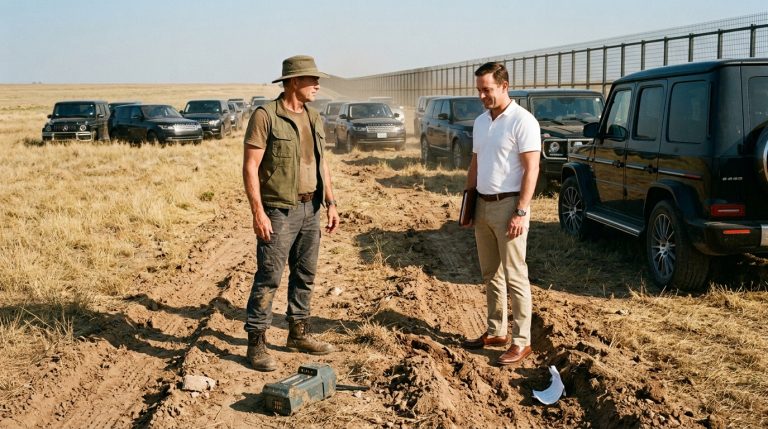
She turned slightly, and that’s when the light hit the yard differently. I looked past her, toward the fence line where the oaks usually blurred the edge of my lot. A line of rebar stakes had been driven deep into the ground. They were capped with neon orange plastic—bright, aggressive, and entirely new. They traced a straight, mathematical cut through my property, slicing through the hydrangea bushes my father had planted twenty years ago.
“The lot is under review for stormwater access,” she continued, finally turning those pale, analytical eyes toward me. “Cooperature is in your interest. Resistance is… expensive.”
She didn’t wait for a reply. She turned toward the tow truck as it completed the turn, leaving nothing behind but deep, ugly grooves in my gravel and a thin layer of tire dust settling over my boots.
I looked back at the fence line. The rebar stakes hummed in the heat, marking a territory that didn’t exist an hour ago. The air smelled of dry iron and disturbed earth. I reached into my pocket for my phone, but my fingers stopped. The space on the dashboard where my work permit usually sat was empty. But then I noticed it—something small, silver, and out of place caught in the grass near the driveway edge.
It was a small, brass bolt—part of my van’s internal tool rack. It had rattled loose and fallen during the violent extraction. I picked it up, feeling the sharp, rusted threading against my thumb. It was a fragment of the order I’d spent years building, now scattered. I looked up to see Sloan walking toward her sedan, phone already to her ear, the line of orange markers standing like soldiers across my yard. The van was gone, but the stakes were still there, and as the breeze picked up, I could hear the faint, rhythmic metallic clicking of the rebar settling into the ground.
CHAPTER 2: The Boundary Line
The sound didn’t stop when the tow truck disappeared. It lingered, a low-frequency, metallic vibration that seemed to emanate directly from the orange-capped rebar driven into my yard. I stood at the edge of the gravel drive, the brass bolt from my van still cold and biting against my palm. The heat of the morning was rising, shimmering off the asphalt, but I felt a strange, localized chill radiating from those stakes.
They weren’t just random markers. They were a declaration.
I walked the perimeter, my boots crunching rhythmically on the dry, compacted earth. The line they’d cut was surgical, bypassing the established tree line and instead slicing through the foundation of the garden. My father had spent four years grading this slope, terracing the beds to prevent the soil from eroding toward the creek. Now, a bright neon-orange flag was tied to a branch of a dying hydrangea, fluttering in the breeze like a mocking signal. I reached out and touched the stake. It was solid, driven deep into the clay, immovable.
The weight of the situation began to settle into my chest, heavy and precise. This wasn’t just a dispute over a van. It was a calculated intrusion. I looked at the line again, closing my eyes for a split second, and the sensory memory of my father’s work rushed back—the smell of damp mulch, the specific weight of the shovel, the way he’d argued with the original surveyor about the property pins. He had been meticulous, a man who believed that boundaries were the only thing that kept a life from drifting away. He’d taught me that you didn’t just own land; you held it in trust.
I opened my eyes, the reality of the orange plastic snapping back into focus. Someone had spent time out here, measuring, marking, and deciding that my trust was obsolete.
I moved to the fence line, tracing the path toward the street. The neighbor, Mr. Henderson, was in his garage, his back to me, the steady rhythmic thud of a hammer striking wood filling the gap between our properties. He hadn’t looked over once since the tow truck pulled away. I knew Henderson; we’d swapped tools for a decade. He was the kind of man who would have been at the fence line in a heartbeat if a stray dog had wandered into my yard. But today, the garage door was only partially open, a dark, defensive slit.
“Henderson,” I called out, my voice tight, cutting through the heat.
The hammering stopped instantly. There was a long, pressurized silence before he stepped into the sliver of light. He didn’t come to the fence. He stayed in the shadows of his workspace, his hands wiped clean on a greasy rag. He looked past me, his eyes flickering toward the street as if he were expecting a patrol to round the corner at any second.
“You shouldn’t be out here messing with those, Carter,” he said. His voice was thin, stripped of its usual neighborly gravel.
“They’re on my property, Henderson. They’re cutting through the garden.”
He looked at the orange flags, then back at me, a flicker of something—not fear, but exhaustion—crossing his face. “Doesn’t matter where they’re at. They’ve got the papers. Sloan… she’s been around. Everyone’s been getting notices. You’re just the first one they’re making an example of.”
“What notice?” I took a step closer, but he retreated a half-step back, pulling the garage door down just enough to signal the end of the conversation.
“Check your email,” he whispered, his eyes darting toward the street again. “And for God’s sake, don’t try to pull them out. That’s exactly what they want.”
He didn’t wait for a rebuttal. The garage door groaned shut, leaving me standing alone with the rhythm of the wind against the flags. I stared at the closed door, the sense of isolation blooming. My phone, still heavy in my pocket, felt like an anchor. I didn’t check the email yet. I stood there, watching the boundary line, realizing that the stakes weren’t just marking the land—they were marking the silence of everyone around me.
I looked down at the brass bolt in my hand again. It was a tiny, inconsequential piece of metal, but it was real. Everything else, the flags, the stakes, the HOA’s sudden interest in “stormwater,” felt like a stage play. I turned and headed toward the house, my pace steady, moving with a deliberate, slow-burning focus. If they wanted to play with boundaries, I would start by finding out exactly where the real ones were hidden. The house looked different as I approached—less like a home, and more like a besieged outpost. I didn’t go inside immediately. I walked to the mailbox and pried the neon tape off the post. It was sticky, clinging to my skin, smelling of industrial adhesive. I folded it once, twice, and slipped it into my pocket alongside the bolt.
The ground under my feet felt like it was shifting, a slow, geological change in the neighborhood’s foundation. I wasn’t going to pull the stakes. I was going to find out who had ordered them driven, and exactly how much it was going to cost them to pull them back out.
CHAPTER 3: The Clubhouse
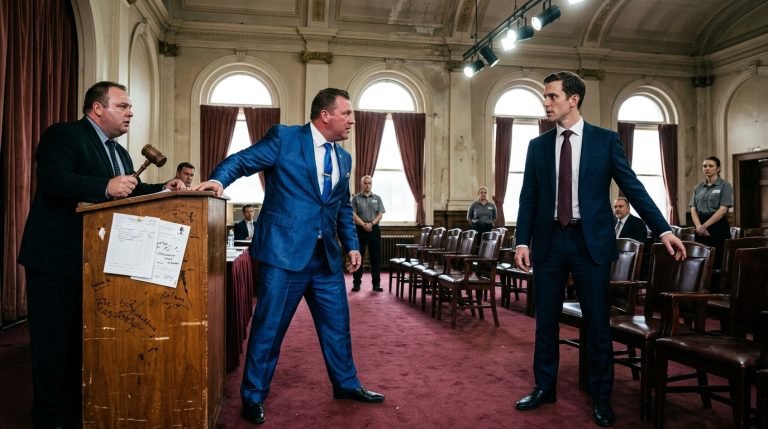
The transition from the open, cooling air of the driveway to the climate-controlled stagnant atmosphere of the clubhouse felt like walking into a pressure chamber. I didn’t enter with a plan, only with the burning, tactile memory of the neon tape and the cold, brass bolt in my pocket—physical anchors in an increasingly fluid reality. The parking lot had been crowded, but the interior was unnervingly orderly. Folding chairs were arranged in rigid, concentric arcs, facing a projector screen that looked like a blank, judging eye.
I took a seat in the back row, near the heavy, emergency-exit door. The room smelled of ozone—likely the HVAC unit struggling—and the faint, bitter scent of burnt coffee from a percolator in the corner. There was no casual chatter. People sat with their shoulders hunched, eyes fixed on the front. It wasn’t the silence of a community gathering; it was the silence of a waiting room.
Sloan Reic stood near the podium, her presence as sharp and deliberate as a papercut. She wasn’t holding the clipboard tonight; it sat on the table beside her, alongside a thick, spiral-bound binder. She didn’t look at the crowd. She was adjusting the focus on the projector, her movements fluid, almost mechanical.
A few rows ahead, I saw Henderson. He wasn’t looking at me. He was staring straight ahead, his hands gripping his knees so tightly his knuckles were white. The air felt thin. Every time someone shifted in their chair, the sound seemed to amplify, a dry rasp of cloth against plastic. I felt a prickle at the back of my neck—the distinct, irrational sensation that the clubhouse windows, though blacked out by the night, were acting like one-way mirrors. I couldn’t shake the feeling that my arrival hadn’t gone unnoticed by the surveillance patrol, and that the tension in the room was a performance designed to keep me contained.
“Thank you all for prioritizing this,” Sloan said. Her voice didn’t carry; it seemed to be absorbed by the acoustic tiles of the ceiling. “We have a critical infrastructure amendment to finalize. The board has reviewed the engineering requirements for the stormwater corridor, and we’re moving to an immediate adoption vote.”
She didn’t invite questions. She didn’t acknowledge the people. She tapped the projector remote, and a map bloomed onto the screen. It was a high-contrast graphic—shaded in aggressive, bruised purples and yellows. A distinct, clean line carved through the center of the neighborhood’s map, a jagged artery that bypassed the existing drainage system to punch a hole through my property.
“The corridor is a matter of community health,” she continued, her laser pointer dancing over the shaded strip with surgical precision. “Postponement is not an option. The county’s flood mitigation standards have changed, and if we don’t act, we face potential liability.”
“Liability for whom?”
The question came from a man near the front, but before Sloan could answer, a man in a crisp, dark suit—someone I didn’t recognize, likely the HOA attorney—stood up. He didn’t rise to defend the project; he rose to dismiss the doubt.
“The liability rests with the community, Mr. Gable,” the attorney said, his voice smooth as polished stone. “The board has already reviewed the delegated authority. Our primary directive is to protect the asset value of the Ridge. Does anyone wish to challenge the board’s fiduciary responsibility?”
The room went completely still. It was a masterclass in deflection. He hadn’t addressed the safety issue; he’d reframed the entire conflict as a matter of property value and legal necessity. The threat was subtle but absolute: challenge the plan, and you challenge the value of your own home.
I shifted in my seat, the brass bolt in my pocket pressing against my thigh. It was a small, grounding weight. My mind raced, trying to bridge the gap between their “stormwater mitigation” and the rebar stakes I’d seen in my garden. The two didn’t align. The corridor on the screen was too uniform, too perfectly placed to be an organic drainage solution. It was a line drawn by a ruler, not by topography.
I looked at the board members seated to Sloan’s right. Two of them were staring at the floor. Another, a woman I’d known for years, kept glancing at the door, her face pale, almost translucent in the flickering light of the projector. They weren’t partners in this; they were captives.
Sloan’s eyes swept the room, her gaze stopping briefly on the back row. She didn’t blink. She knew I was here, and she knew the weight of the silence she’d cultivated. I felt a surge of cold, pragmatic resolve. They were so busy building the framework of their lie that they’d forgotten to check if the foundation was level.
“We’ll proceed with the vote,” Sloan announced, her finger hovering over the clicker. “By show of hands, those in favor of the current infrastructure adjustment.”
The silence in the room became heavy, a physical weight pressing against the eardrums. A few hands went up—the ones who were too afraid to be anything but compliant. Then, slowly, others began to rise, not out of conviction, but out of a desperate need to disappear into the majority. I didn’t raise my hand. I watched the tally, my eyes tracking the subtle, microscopic tremors in the board members’ hands. This wasn’t a vote; it was a roll call of who was already bought and who was just broken.
When the count was settled, Sloan didn’t smile. She just turned back to the screen, the purple and yellow map still glowing like a neon wound. “Motion carried. Implementation begins at dawn.”
As the room began to stir, the sound of metal chairs scraping against the concrete floor grated against my nerves. I remained in my seat, watching them file out, the atmosphere of the room shifting from suffocation to a frantic, whispered exit. They were leaving, but they weren’t going home—they were going to ground. And I was going to the county portal. The game had just moved from the surface, where they could control the view, to the records, where the truth had to be written down.
CHAPTER 4: The Portal
The drive home was a blur of static. The dashboard lights of my secondary vehicle—a battered sedan—glowed a dim, reassuring amber against the dark road. I didn’t take the highway; I took the back routes, my eyes habitually scanning the rearview mirror for the courtesy patrol. The clubhouse meeting had been a performance, but the fear I’d seen in the eyes of my neighbors was the real output. They were terrified of a system they didn’t understand, and that was exactly how Sloan Reic maintained her friction-less grip on the ridge.
I pulled into my garage, the metal door groaning as it hit the concrete floor, sealing me into the relative safety of my workspace. My house wasn’t just a dwelling; it was a repository of my work life. Shelves lined the walls, stacked with blueprints, old property tax assessments, and journals spanning fifteen years of site preparation. I didn’t turn on the main lights. I clicked on a single desk lamp, casting a tight, focused cone of light over my desk.
The computer hummed to life, the fan chattering like a trapped insect. I didn’t check my email. I went straight to the county’s municipal infrastructure portal. It was a labyrinthine, archaic database—the kind of site designed to discourage casual curiosity. I bypassed the main menu, digging into the sub-layers of the “Provisional Plat Overlays.”
My pulse thudded in my ears, a slow, rhythmic drumbeat of irritation. I found the file. It was labeled, innocuously enough, Brookil Ridge Infrastructure Adjustment: Stormwater Mitigation Phase 2. I opened the document. The PDF was large, the resolution surprisingly crisp. I zoomed in on the border of my property. The line was clean, sharp, and entirely fictitious.
But it was the metadata that pulled me in.
I checked the upload timestamp. It was marked for 11:42 p.m., two days before the clubhouse meeting had even been announced. My brow furrowed. I cross-referenced the file with the county’s general ledger. The ledger listed the receipt of the amendment, but it had a different status: Pending/Unverified.
I leaned back, the leather of my chair creaking. The HOA had acted as if the document was official, as if the state had already blessed the intrusion. But the portal told a different story. It hadn’t been recorded; it had been pushed. An upload was just a suggestion until a county official logged it, witnessed it, and finalized it.
I opened a second window and pulled up the last officially recorded survey for the Brookil Ridge subdivision. I placed the two side-by-side, aligning the plot numbers. The discrepancy was like a crack in a dam. The HOA’s overlay didn’t just bend the drainage path; it completely ignored the registered utility easements that had been in place since the ridge was first developed.
My finger hovered over the mouse, then clicked on the “Attachments” tab of the overlay file. A list of supplemental documents appeared. There were three: the HOA board minutes, the survey authorization, and an invoice. I clicked the invoice. It was from Ridgeway Civil Consulting.
My breath hitched. I knew the name—they were a major firm, typically involved in massive highway projects, not residential drainage issues. The amount was $18,000. It wasn’t listed as a standard engineering fee; it was tagged as a “Consulting/Planning Retainer.” I looked at the date on the invoice. It was issued three days before the overlay was even uploaded to the portal.
They weren’t planning a solution; they were paying for a blueprint to facilitate a land-grab.
I grabbed a notepad and a pen, the scratch of the graphite sounding deafening in the quiet room. I wrote down the file ID, the timestamp, and the Ridgeway invoice number. I wasn’t looking for a fight in court—not yet. I was looking for the structural flaw in their deception. If Ridgeway was a massive firm, they wouldn’t risk their licensure on a botched HOA drainage project unless the payout was significantly higher than $18,000.
I stared at the screen, the blue light washing out the room. My reflection in the monitor looked pale, determined. They had overestimated the apathy of the residents and underestimated the patience of a man who spent his life analyzing how things were built. They’d constructed a house of cards, thinking no one would check the load-bearing requirements.
I minimized the browser and opened an empty text file. I began to map out the connections, not as a homeowner in distress, but as a contractor documenting a site failure. I needed to see who had signed the authorization, and more importantly, who had verified the upload at the county level.
The hum of the computer seemed to change pitch, a mechanical whine that mirrored my own mounting resolve. The brass bolt sat on my desk, a small, cold reminder of the van they’d already stolen. They’d taken my equipment to silence me, but they’d left me with the very thing I needed most: access to the records they’d tried to bury. I saved the log file, encrypted it, and sat back, the silence of the house finally beginning to feel like a space I could inhabit, rather than a prison I was trapped in. The next step wasn’t a protest; it was a deposition.
CHAPTER 5: The Ghost in the Machine
The darkness didn’t come gradually. One moment, the screen was glowing with the intricate, damning web of Ridgeway Civil Consulting’s invoice trails; the next, the entire room was swallowed by a heavy, suffocating black. The hum of the computer fan—the steady, rhythmic companion to my investigation—died instantly.
I sat frozen, my hands still hovering over the keyboard. The sudden absence of the blue light made the silence of the house feel thick, almost viscous. My first instinct was to reach for the power strip, but I stopped. If this was a routine outage, the house would be silent, but it wasn’t. Outside, I could hear the distinct, rhythmic clack-clack of a neighborhood patrol vehicle rolling slowly down the street, its tires crunching against the gravel.
They weren’t just monitoring the property; they were monitoring the activity.
I slid my chair back, the movement careful and deliberate, and stood up. I didn’t reach for a flashlight. I knew the layout of this room by heart—the stacks of blueprints, the heavy oak desk, the filing cabinets that held the history of this land. I moved toward the window, keeping my profile low. Through the blinds, I saw the patrol car pause at the corner of my driveway. The high-beam searchlight flickered once, a deliberate, probing sweep of the house, before the car continued its slow, predatory crawl.
I reached into my pocket and touched the cold, brass bolt—the small, tangible piece of my life they hadn’t been able to erase. It was the only real thing in a world that felt like it was being systematically digitized, rerouted, and sold off to the highest bidder. I needed that invoice. I needed the digital trail that linked Sloan Reic to the Ridgeway kickbacks. If I lost the access to the county portal now, I would be back to being just another homeowner screaming at the wind.
I moved to the hallway and navigated to the utility closet. My hand found the breaker panel, the metal cold and biting. The main switch had been tripped—not by an overload, but manually. A jagged, deliberate flick. I pushed it back up, and for a heartbeat, the house groaned as the power surged. The hallway light flickered, then died again, but not before I saw a figure at the edge of my fence line—a silhouette, perfectly still, watching the house.
Panic, sharp and acidic, clawed at the back of my throat. I pushed it down, forcing my breath to remain steady. If they were watching, I couldn’t be a victim. I had to be a ghost.
I grabbed my laptop from the desk, its battery still holding a charge, and retreated into the basement. It was a space my father had reinforced years ago, a storm cellar with a secondary exit that led to the woods behind the property. I didn’t need to flee; I needed to finish the transfer. I found the hidden junction box for the internet uplink—a manual bypass I’d installed for security backups—and plugged the laptop in.
The screen illuminated the damp concrete walls, the blue light casting long, distorted shadows. I navigated back to the county portal, my heart thumping a frantic, irregular rhythm against my ribs. I had maybe three minutes before they realized the power was back on and someone was still inside.
The file I’d been working on was still cached in the browser’s temporary storage. I didn’t try to download it—that would trigger a server-side alert. Instead, I opened a screen-capture utility and began to copy the invoice data, the timestamps, and the specific plat-overlay coordinates.
The progress bar was agonizingly slow. 30 percent. 45 percent.
Above me, I heard the heavy thud of footsteps on the porch. Then, a sharp, metallic rapping on the front door. It wasn’t the sound of a neighbor. It was the rhythmic, authoritative command of someone who knew exactly who was inside and what they were looking for.
60 percent.
I didn’t move. I stared at the screen, my entire existence reduced to the movement of the loading bar. Every creak of the floorboards above me felt like a deliberate move in a chess game where my opponent had already taken my queen. They weren’t just trying to stop me; they were trying to recover the evidence before I could make it public.
85 percent.
The handle of the front door turned. The lock, sturdy but antique, groaned under the pressure. I held my breath, my fingers hovering over the ‘Copy’ key, waiting for the final confirmation. If they entered now, they wouldn’t just find a man with a laptop; they’d find the person who had pulled back the curtain on the Brookil Ridge redevelopment.
98 percent. 99 percent. Done.
I yanked the USB drive from the port and slammed the laptop shut just as the basement door at the top of the stairs began to moan under a heavy, calculated force. I didn’t wait for them to finish the job. I slipped into the shadows of the storm cellar, my feet finding the uneven dirt path that led out into the woods, leaving the house, and the ghosts of my father’s garden, behind for the dark, unforgiving expanse of the ridge. I wasn’t running away—I was making sure they were chasing a shadow while the truth went on the move.
CHAPTER 6: The CounterMove
The forest was a tangled, unforgiving maze of black shapes and treacherous footing. I moved by instinct rather than sight, my hands held out to deflect the low-hanging branches that clawed at my jacket. Every time I stopped to catch my breath, the silence of the woods seemed to expand, magnifying the frantic cadence of my breathing. They were searching for me, I knew that. The patrol car was likely idling at the end of my driveway, the officers waiting for the realization to dawn that I hadn’t gone out the front door.
I reached the edge of the creek—a shallow, muddy artery that wound through the lower end of the ridge. I waded in, the icy water seeping into my boots, chilling my feet instantly. I walked downstream for a hundred yards, intentionally breaking the trail I’d left through the brush. I needed to reach the old surveyor’s shed on the north property line, a dilapidated structure that still housed an old, hard-wired landline connection to the county engineer’s regional office—a relic of the days when field data had to be transmitted in real-time.
My legs burned with fatigue, a deep, aching reminder that I had been running on nothing but adrenaline since the chain snapped on my van. My mind, however, was unnaturally sharp. I kept replaying the scene in the county portal. The timestamps, the Ridgeway invoice, the suspicious gaps in the plat-overlay logs—they weren’t just data points anymore; they were ammunition. I needed someone on the inside who could see the corruption for what it was, someone whose professional integrity was tied to the very maps Sloan Reic was trying to erase.
The shed emerged from the darkness, a skeletal structure of rotting timber and rusted corrugated metal. I slipped inside, the air heavy with the smell of damp pine and metallic corrosion. I fumbled in the dark for the junction box, my fingers scraping against the rough, splintered wood of the workbench. There—the phone. It was caked in dust, a thick, gray mantle that felt like velvet under my touch.
I lifted the receiver. There was no dial tone, only a faint, hollow hum. I reached behind the desk, tracing the wires until I found the master line, and spliced it back into the secondary feed I’d repaired months ago for a security project. The hum deepened, grew steady. I dialed the number—the private, internal extension of the engineer I’d worked with years back.
He picked up on the second ring. “This is Miller. State your business.”
“It’s Carter,” I said, my voice sounding strained and brittle in the confined space. “I’m in the field. I’ve got the overlay files, the Ridgeway invoices, and the timestamps. It’s all there, Miller. It’s not just a zoning adjustment. They’re building a ghost record.”
There was a long silence on the other end, the kind of silence that suggests a man is weighing the cost of a long-standing friendship against the cold reality of his career. “You’re talking about the Brookil Ridge project, aren’t you?” Miller asked, his voice dropping to a low, guarded register.
“I’m talking about a $18,000 kickback paid three days before the system was compromised,” I said. “I’m at the north shed. You need to pull the digital audit logs for the provisional plat folder, file 88-Beta. Do it now, before they realize the files have been exfiltrated.”
“Carter, if you’re right, this goes to the County Attorney’s office. I can’t just open a back door into the system for a personal dispute.”
“This isn’t a personal dispute, Miller! Look at the signatures. Look at the witness logs for the overlay. There aren’t any. It’s an unauthorized, backdated push.”
Another silence, punctuated only by the distant, muffled sound of a car door slamming somewhere on the perimeter of the ridge. My heart hit my ribs. They were closer than I thought.
“I’ll pull the logs,” Miller said, his voice hard. “But you need to be at the county office by 8:00 a.m. with that drive. If you’re not there, I’m locking the audit to protect my own team.”
“I’ll be there,” I said, and hung up.
I stood in the dark, the weight of the shed pressing down on me. I had forced the door open, but I was still standing in the dark with no exit. I needed to get to the county office, but the ridge was effectively locked down. I looked out through a gap in the corrugated wall. A flash of a strobe light—blue and amber—pulsed against the trees near the main entrance. They were setting up a blockade.
I checked my watch: 3:15 a.m. I had four hours to bridge the gap between this rotting shed and the county office. I wasn’t going to go out the front gate. I was going to use the infrastructure they were so desperate to hide. The old stormwater runoff tunnel, the one they claimed was “too damaged to use,” was exactly where I needed to be. It ran beneath the entire subdivision, a hidden vein of concrete and silt that lead straight to the county service road.
I took one last look at the phone, then stepped out into the night, the cold air hitting my face like a slap. The game had turned, but the terrain was now on my side. They wanted to hide the truth under the soil—well, I was about to walk right through it.
CHAPTER 7: The Verification
The county building was a hollow, echoing cage of polished granite and fluorescent humming. It was 7:55 a.m. when I stepped through the main entrance, my boots echoing with a finality that felt out of place in the sterile, administrative silence. I wasn’t just here to report a crime; I was here to anchor the truth before they could scrub it.
I headed straight for the land records department, my hand tight around the USB drive in my pocket. My clothes were damp, stained with the gray silt of the drainage tunnel, and I knew I looked like a man who had spent the night battling a system that didn’t want to be caught.
Miller was waiting at the counter. He looked older than he had in my memory—his face etched with a fatigue that mirrored my own. He glanced at my mud-streaked jacket and didn’t ask questions. He simply leaned over the partition, his voice a low, urgent murmur.
“The audit logs are flagged, Carter. But the system is locked down. Sloan’s team pushed a ‘maintenance override’ at 4:00 a.m. They’re purging the server.”
I didn’t let the panic take hold. I stepped up to the counter and placed the drive on the polished marble. “Override it. You have the administrative access to verify the plat-overlay against the original parcel map. If you do it now, you can lock the sequence before the purge completes.”
Miller hesitated, his eyes darting toward the security cameras mounted in the corners of the ceiling. “If I do this, it goes on my personal access log. I’ll be the one they come for when the HOA starts throwing lawsuits.”
“If you don’t do it, there won’t be a community left to protect,” I said. My voice was steady, stripped of all artifice. “They aren’t just building a drainage corridor, Miller. Look at the invoice trail again. It’s a staging area for a commercial rezoning. They’re clearing the ridge to build a high-density complex. Once they get the corridor approved, the rest of the land becomes ‘non-viable’ for single-family residences. That’s how they’re squeezing everyone out.”
Miller stared at me, the realization dawning in his eyes. He reached out and took the drive, his movements stiff. He didn’t speak. He walked to the back workstation, his silhouette stark against the glow of the monitors. I watched him work, my focus fixed on the double doors of the lobby. Any second now, I expected to see them—Sloan Reic, the attorney, the security team—arriving to stop the verification.
Then, a discrepancy caught my eye. On the counter beside the clerk’s workstation sat a sealed, heavy-duty box labeled Brookil Ridge Infrastructure Review. The security seal—a tamper-evident tape that should have been pristine—was peeled back at the corner. Someone had already been in the box.
My stomach plummeted. I reached out and gently pushed the lid; it was unlatched. I peered inside, my heart hammering. The maps inside were copies, not the originals. They were altered. They’d already replaced the source documents.
“Miller!” I hissed.
He looked up from his screen, his face drained of color. “It’s gone, Carter. The server just wiped the 88-Beta file. It’s like it never existed.”
The silence in the room was absolute, shattered only by the sudden, aggressive click-clack of heels on the marble floor coming from the main lobby. Sloan Reic walked through the double doors, a clipboard in her hand, her expression one of practiced, devastating calm. She wasn’t running. She didn’t need to. She walked directly to the counter, her eyes meeting mine with a flicker of cool, predatory amusement.
“Good morning, Mr. Carter,” she said, her voice smooth and resonant in the open lobby. “I see you’re still confused about the administrative process. We’ve been looking for you.”
She placed a formal document on the counter—a cease-and-desist order, heavy with official-looking stamps. “The board has initiated an injunction regarding your recent, unauthorized interference with infrastructure property. You are advised to vacate the perimeter of the project immediately.”
Miller stepped away from the counter, his hands held up in a gesture of retreat. The room felt like it was shrinking. Sloan had the box, she had the server, and now she had the legal authority to silence me. I looked down at the empty drive on the counter. The truth wasn’t on the drive. It wasn’t in the box. It was in the fact that she was standing here, in a county office, trying to keep a man from speaking.
I didn’t answer her. I turned to Miller, my eyes locking onto his. “The audit,” I whispered. “Did you save the bridge log before the wipe?”
Miller paused, his hand hesitating over a small, inconspicuous notepad on his desk. He nodded, once, almost imperceptibly.
Sloan’s smile thinned. She knew we were hiding something, but she couldn’t see what. She raised her clipboard like a weapon. “Security,” she said, her voice turning sharp. “Escort Mr. Carter from the building. He’s in violation of an active infrastructure order.”
I stood my ground, my posture firm, the cold of the tunnel still in my bones. They were going to drag me out, but they weren’t going to get the last word. I wasn’t just a homeowner anymore; I was the witness to the collapse of their entire project. As the security guards moved toward me, I felt a strange, quiet sense of peace. The storm was here, and for the first time, I wasn’t the one bracing for the impact.
CHAPTER 8: The Final Anchor
“Stop.”
Miller’s voice didn’t boom; it cut through the room like a steel wire. He stepped out from behind the counter, holding his tablet up. The screen displayed a series of red-flagged lines—the digital audit trail of the Brookil Ridge overlay.
“The audit is complete,” Miller said, looking directly at the security guards. “And the records hold has been verified by the County Attorney’s office. Anything that happens to Mr. Carter from this second forward is an obstruction of a federal land-title investigation.”
The guards hesitated, their hands dropping from my shoulders. The tension in the room, once so thick you could taste the ozone of artificial control, evaporated. Sloan Reic didn’t turn. She stood perfectly still, her back to us, her clipboard still clutched in her hand. For a second, I saw her shoulders slump, just an inch, before she forced them back into a rigid, defensive posture.
“That log is a system error,” Sloan said, her voice finally losing its synthetic smoothness. It sounded thin, brittle—the voice of someone realizing the walls were no longer holding. “It’s a glitch in the migration.”
“It’s not a glitch, Sloan,” Miller replied, stepping toward her. “It’s a timestamp. Your consulting firm—Ridgeway—cleared the payment three days before you uploaded the corridor map. That’s not infrastructure planning. That’s a land-grab.”
The lobby had gone deathly quiet. A few county clerks peered over their partitions, their faces pale. Sloan turned then, and I saw it—the fear. It wasn’t the fear of losing a board seat; it was the raw, primal fear of an architect seeing the entire structure collapse. She looked at me, her eyes darting to my muddy boots, then to the folder on Miller’s desk.
She tried to laugh, but it came out as a sharp, jarring noise. “You’re ruining this community,” she hissed. “You think you’re a hero because you can read a map? You’re just a man in a van who can’t understand the complexity of progress.”
“I understand,” I said, my voice quiet, cutting through the noise. “I understand that the ridge was built by people who knew their boundaries. And I understand that people like you think they can rewrite the rules if they print enough paperwork. But the paper is done, Sloan.”
She looked around the room, searching for an ally, a board member, or even a sympathetic guard, but everyone was looking at the floor or the screen. Her leverage had dissolved. She realized, in that moment, that she was no longer the president of a neighborhood—she was a trespasser in a room filled with people who were finally done being afraid.
She turned and walked toward the double doors. She didn’t look back. She didn’t offer a defense. She just left, the doors swinging shut behind her with a final, muted thud.
The aftermath wasn’t loud. There were no cheers. Just the slow, methodical process of returning to reality.
In the days that followed, the change was granular. It started with the removal of the rebar stakes. I watched from my porch as a county crew, acting under direct order, pulled the orange-capped metal from the earth. The holes they left behind were deep, ragged scars in the soil, but as I stood there with a shovel and a bucket of topsoil, I felt the tension drain out of the land.
I worked the earth, filling the gaps, packing the soil down with the back of my shovel. It was physical, grounding labor. I replaced the hydrangea bushes my father had planted, ensuring the roots were seated deep in the familiar, dark clay. I spent the afternoon repairing the perimeter fence, the metallic click of the wire staples echoing against the backdrop of a quiet, undisturbed afternoon.
The van was back in the driveway, its engine quiet, its interior cluttered with the tools of my trade. It looked like an extension of the house again, not an obstacle to be cleared.
As the sun began to dip below the ridge, the light turned golden, catching the dust motes in the air. I sat on the porch, a cup of coffee in my hand, and looked out over the yard. The orange flags were gone. The boundary was just what it had always been—a line in the dirt, defined by history and law, not by the whim of a spreadsheet.
I felt a deep, resonant connection to the space, a sense of having restored something that was essential. It wasn’t just about the property lines; it was about the act of holding on. My phone buzzed—a message from Miller. County has finalized the parcel map. Everything is restored to the original plat. No corridor.
I tapped the phone screen off and set it aside. I leaned back against the porch railing, the wood cool and solid under my hand. The neighborhood was quiet—really quiet. The sound of a neighbor’s lawnmower in the distance, the wind through the oaks, the settling of the house—it was a symphony of normal. I picked up the small, brass bolt from the porch table, feeling its weight, and placed it inside the toolbox I’d left open.
The repair was done. The land felt like itself again, and for the first time in weeks, the silence didn’t feel like a threat—it felt like peace. I watched the shadows lengthen across the garden, the boundaries of my home clear, firm, and, most importantly, my own. I wasn’t fighting the world anymore; I was living in it.