The Granite Ledger: A Master Sergeant’s Tactical Dismantling of a Suburban Empire Built on Lies
CHAPTER 1: THE DRIVEWAY AMBUSH
The granite slab was still cool to the touch when I felt the vibration of a minivan engine shuddering against the quiet of the morning. It was the color of weak tea, a pedestrian machine that stood out like a sore thumb against the rugged landscape of my property. I didn’t turn around immediately. I was busy checking the mortar consistency on the final course of the chimney, ensuring the joint was tight enough to survive a century of freeze-thaw cycles.
When the screen door slammed, I didn’t flinch. I just finished wiping the excess grout from the stone’s rough edge.
“That abomination comes down by Friday, or I’ll have it torn down myself and bill you for the demolition.”
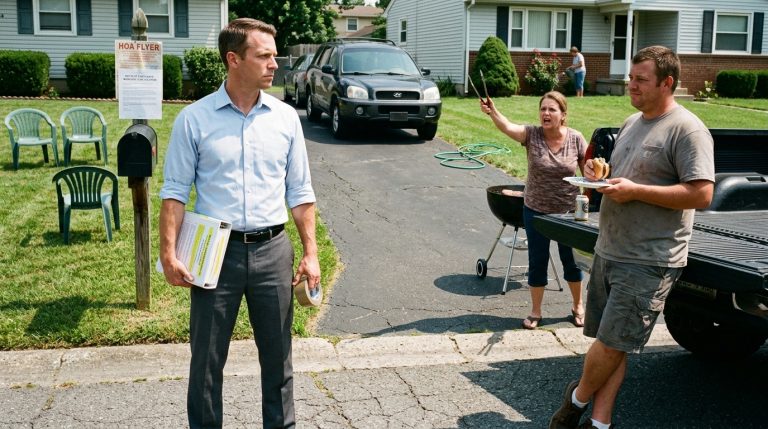
The voice was thin, sharp, and carried the specific, grating cadence of a woman who had spent too many years practicing authority in front of a mirror. I turned, wiping my hands on a dust-caked rag. Karen Miller stood at the edge of my lawn, her floral pantsuit looking like it was losing a war against her own posture. She held a laminated badge against her chest, the sunlight reflecting off the plastic with an artificial glare.
I looked past her, toward my neighbor Eleanor Vance’s property. Her front yard, usually anchored by a modest concrete bird bath, felt strangely hollow. The bird bath was gone.
“Mr. Cwell,” she said, taking a step onto my gravel, her manicured finger pointing toward the towering granite structure behind me. “This isn’t some backwoods hovel. We have standards.”
I didn’t answer. I looked down at the paper she was brandishing—a notice of violation that felt like an intrusion of personal space I hadn’t felt since my last tour in the sand. My hands, still steady from twenty years of field discipline, were itching to find a grip on something other than a trowel.
“It’s an abomination,” she repeated, her eyes darting to the chimney, then to my face, looking for the flicker of submission she expected to see in an aging man living on a non-conforming lot.
“It’s a memorial,” I said, my voice low. It wasn’t a question. It was a statement of fact that hung in the humid air between us.
She didn’t hear it. She was too busy scanning the fine print on the page, the $5,000 penalty circled in a red ink that looked almost like dried blood. She was weaponizing the HOA bylaws, treating them not as rules for community living, but as a manual for state-sanctioned extortion. She didn’t realize that in her haste to assert dominance, she had stepped onto ground where I knew every hidden seam and structural weak point.
She shoved the paper toward me. I didn’t take it. I just looked at the way her knuckles were white against the cardstock. She was trembling, not with rage, but with the adrenaline of a bully who had finally found an easy target.
“Friday, Jack,” she said, turning on her heel. “Or you lose everything.”
As she marched back to her minivan, I looked down at the spot where the bird bath should have been in Eleanor’s yard. A circular patch of dead grass, a ghost of a structure now gone. It wasn’t just a violation of aesthetics; it was a physical discrepancy that didn’t match the bylaws she claimed to serve. The math didn’t add up.
I turned back to the chimney, laying a hand on the granite. It was solid, rooted, and unmoving. She wanted a fight? She had picked the wrong terrain.
CHAPTER 2: THE TACTICAL AUDIT
My palm remained flat against the granite face of the chimney. The stone had absorbed the morning sun, radiating a steady, ancient heat that stood in stark contrast to the hollow patch of dead grass over in Eleanor Vance’s yard. Karen Miller’s minivan had long since disappeared down the winding, manicured asphalt of Oakwood Estates, but the exhaust fumes still lingered, a metallic taint in the humid air.
I traced the edge of a perfectly pointed mortar joint with my thumb. She wanted the chimney gone by Friday. She wanted to erase this monument, this physical anchor to my wife, using nothing but the weight of a bureaucratic threat.
I turned away from the stone. I walked over to my wheelbarrow, the rubber tire crunching loudly against the gravel. I picked up my trowel, the steel blade ringing faintly as I scraped the last remnants of wet mortar against the metal rim. I wiped the tools down meticulously with a damp rag, methodically organizing them into the canvas bag. In the Marine Corps, you didn’t leave your gear unsecured. You didn’t leave a mess on the battlefield. You cleaned your weapon, you consolidated your position, and you prepared for the counter-attack.
I slung the heavy canvas bag over my shoulder and walked the fifty paces to my back door. I didn’t rush. Every step was deliberate, measured against the soft turf of a lawn that had been here a decade before the developer’s bulldozers ever arrived. I unlocked the heavy deadbolt, stepping into the cool, shadowed interior of the house.
The silence hit me immediately. It always did. The absence of Sarah was a physical weight in the hallway, a heavy atmospheric pressure that I had learned to navigate over the past year. I walked to the kitchen sink, turned the faucet to cold, and plunged my hands into the stream. I grabbed a stiff bristle brush and began scrubbing the dried, alkaline dust from my knuckles. The water turned a milky gray, spiraling down the stainless-steel drain.
I dried my hands on a towel, the coarse fabric biting into my raw skin. Then, I walked into the dining room.
The oak table sat in the center of the room, wide and unyielding. It was the table where Sarah and I had mapped out our lives, and now, it was going to serve as my command center. I pulled out the heavy bottom drawer of the filing cabinet tucked in the corner. My fingers bypassed the neatly tabbed utility bills and property tax records, gripping the thick, three-inch spine of a black plastic binder.
I hauled it out and dropped it onto the oak table. It landed with a dull, heavy thud.
This was the Oakwood Estates Homeowners Association Welcome Packet—the Covenants, Conditions, and Restrictions. It was three hundred pages of weaponized legalese, forced upon us in a hospital waiting room when the bank demanded our property be integrated into the new development for a second mortgage.
I pulled out a yellow legal pad, a fresh black ballpoint pen, and a neon-yellow highlighter. I sat down in the wooden chair, the joints creaking slightly under my weight.
I opened the binder. The pages were crisp, sterile, smelling faintly of toner and cheap paper. I began to read. I didn’t skim. I advanced through the text paragraph by paragraph, treating the document like an enemy terrain map. I was looking for the minefields, the supply lines, and the structural weak points of Karen Miller’s authority.
After thirty minutes, I clicked the pen and wrote a single figure at the top of the legal pad: $5,000.
The ink was stark against the yellow paper. I stared at the zeroes, and suddenly, the sterile smell of the binder shifted. The ambient temperature in the room seemed to drop. The [V-2] psychological phantom hit me without warning. The bold black numbers morphed into the itemized lines of a hospital bill. Chemotherapy. Anesthesia. Palliative care. I felt the phantom grip of Sarah’s frail, thin hand squeezing mine in that freezing waiting room, the rhythmic beeping of monitors echoing in my skull as a slick-haired bank representative slid these very same HOA papers across a plastic table. Sign here, Mr. Caldwell, or the loan doesn’t clear.
My jaw tightened. I squeezed the pen until the plastic casing groaned in protest. I forced the memory back into its box, locking it down tight. The grief instantly hardened, crystallizing into a cold, sharp tactical edge. Karen Miller wasn’t just threatening my savings; she was threatening the very survival mechanism I had built to honor the woman who had fought so hard in that hospital bed.
I snapped the highlighter open and returned to the text, my eyes moving with mechanical precision.
By the second hour, I found the first crack in the fortress. Section 4, Paragraph B. Addendum for Pre-Existing Structures. I dragged the yellow marker across the text, the felt tip squeaking against the paper. The clause clearly stated that while lot one was subject to future rules, its original footprint and permitted designs were grandfathered in. I had pulled the county permits for the chimney design eleven years ago. It wasn’t an alteration; it was a delayed completion.
It was a solid defensive line, but it wasn’t a weapon. I kept digging.
I flipped to Section 12: The Architectural Review Committee. This was the mechanism Karen had used to issue the fine. I read the bylaws, tracing the lines with the tip of my pen. The ARC must consist of three to five members, elected by the community, serving two-year terms. Decisions must be recorded in official minutes and made available upon request.
I stopped. I looked out the window toward Eleanor’s yard. The missing bird bath. The $200 fine.
If Karen Miller was enforcing these rules, where was the committee? In all the time I had lived here, I had never seen a ballot for an ARC member. I had never seen a notice for an ARC meeting.
She was operating a ghost ship.
I pulled the legal pad closer and began drafting a response. It wasn’t an appeal. It was a targeted strike. I formally cited the pre-existing structure exemption. Then, I wrote the kill-shot: I formally request the immediate delivery of the ARC’s meeting minutes from the past 24 months, and a current roster of its elected members.
I folded the drafted letter, creasing the edges sharply. I reached to the back pocket of the HOA binder to grab a blank envelope. As I pulled the flap back, a loose piece of paper fluttered out and landed face-up on the oak table.
It wasn’t an HOA document. It was a glossy, trifold brochure that must have been slipped into the packet by the developer years ago, or perhaps mass-mailed to the neighborhood.
I picked it up. The edges were sharp against my thumb. It was an advertisement for a vendor. The bold, blue lettering at the top read: Miller’s Quality Contracting – The Only HOA-Approved Source for Exterior Upgrades.
I stared at the name. Miller.
I looked at the drafted letter demanding the committee minutes, and then back at the glossy brochure. The silence in the dining room suddenly felt electric, heavy with the weight of a massive, quiet collision. The math was finally starting to add up.
CHAPTER 3: RECONNAISSANCE
The brochure felt like a jagged piece of evidence in my hand. I placed it on the table, side-by-side with the HOA’s rigid, unforgiving bylaws. The name Miller was printed in a confident, sans-serif font—the same name I had seen on the violation notices, the same name that currently possessed the legal power to seize my home. The synchronicity wasn’t an accident; it was a structural seam.
I pushed the binder aside. The heavy oak table felt smaller now, crowded by the weight of these paper connections. I didn’t need to shout about it; I needed to prove it. I grabbed a pen and began scribbling notes on the yellow legal pad, mapping out the relationships I had uncovered, drawing lines between the ARC, the fines, and the vendor list.
My house was quiet, but it wasn’t the dead, heavy silence of the previous year. It was a tactical quiet—the kind that exists before a mission begins.
I stood up, moving with a controlled efficiency that felt more like a patrol than a afternoon task. I walked to the kitchen and grabbed a metal tin from the pantry. I’d spent the morning baking. The scent of oatmeal and raisins hung in the air—a classic, unassuming tactical asset. I packed a dozen of the cookies into three separate plates, covering them with plastic wrap. They weren’t just a snack; they were an invitation, a social lubricant designed to lower the guard of those living behind the beige stucco walls.
I stepped out the front door, the late afternoon sun casting long, sharp shadows across the driveway.
My first stop was three doors down. Eleanor Vance’s house. Her lawn was a masterpiece of maintenance, a green carpet that looked like it had been trimmed with scissors, but the void in the flower bed where the concrete bird bath had sat was a wound.
I rang the doorbell. It chimed twice, a cheerful, hollow sound. A moment later, the door creaked open, revealing Eleanor. She was thin, her skin like parchment, and her eyes widened when she saw the plate of cookies.
“Jack,” she said, her voice faint but surprised. “Is something wrong?”
“Just doing a little house call, Eleanor,” I said, offering the plate with a steady hand. “I was thinking about that bird bath of yours. It’s a shame to see such a nice garden space sit empty.”
Her smile faltered, her gaze drifting toward the empty patch of grass. She opened the door wider and beckoned me into her foyer. The interior was cool, smelling of dried lavender and old books.
“Karen,” she said, the name sounding like a curse. “She was here for twenty minutes. Said it violated the aesthetic code. She gave me a brochure—the same one for that Miller company. She said if I wanted to replace it, I’d have to use their line of fountains. They were five times what I paid for the original.”
I took a mental note. The brochure I held in my dining room was the same one she had been pressured to use. “Did she give you a copy of the violation notice, Eleanor? The one with the ARC committee signature?”
Eleanor laughed, a thin, bitter sound. “Committee? Jack, she signed it herself. ‘President, HOA Board.’ She didn’t mention any committee. She told me the fine was non-negotiable because the board had already voted on the matter.”
The lie was blatant. I nodded, keeping my face neutral, my training forcing me to suppress the rising heat in my chest. I wasn’t there to vent; I was there to map the enemy’s movements.
“If you find that notice, Eleanor, would you mind if I took a look at it? Just to see the language she used?”
“Of course,” she said, her eyes softening. “I still have it on my desk. It’s been sitting there like a paperweight.”
I spent the next hour moving from house to house. The Rodriguez family, two doors down, were younger, their stress manifesting in the way they kept checking the front door as we spoke. They told me about the blue paint, the $50 ‘processing fee’ for every denied attempt, and the way Karen had personally visited their home to ensure they hadn’t touched the trim.
Each story followed a precise, repeating pattern. A violation was flagged, a fine was levied, and a ‘solution’ was offered in the form of Rick Miller’s services. It wasn’t just a racket; it was a closed-loop system designed to squeeze revenue out of the community’s fear.
As I walked back to my house, the sun dipped behind the rooftops, casting the street into a deep, jagged gray. My boots clicked against the pavement, a steady rhythm that matched my pulse. I had the confirmation I needed. The paper trail wasn’t just a suggestion; it was an active operation.
I reached my driveway and stopped. I looked at the chimney one last time before going inside. The granite was cold now, having lost the warmth of the sun. It looked immovable.
I had been a Master Sergeant for twenty years. I knew how to hold a position, but I also knew when to advance. I stepped into the house, and instead of heading to the living room to sit in the quiet, I walked straight to my office. I pulled out my phone and dialed a number I hadn’t called in years.
“Gunny,” I said when the voice answered, gravelly and familiar. “I need you to run a background check. Not on a person—on a business. And I need everything you can find on the president of my HOA.”
The silence on the other end was short, followed by a sharp, knowing intake of breath. The operation was live.
CHAPTER 4: THE GUNNY REPORT
The phone in my hand felt like a cold stone. I didn’t set it down immediately; I watched the screen go dark, the reflection of my own face staring back at me from the black glass—gaunt, focused, and utterly devoid of the patience I’d held only hours ago.
Gunny hadn’t held back. He didn’t have to. The data he’d pulled was raw, unfiltered, and pointed directly at the rot.
“Jack,” he’d said, his voice vibrating with a grim, professional amusement. “You hit the jackpot. Karen Miller’s maiden name is Peterson. Her brother, Rick, is the sole proprietor of a little business registered last year called—wait for it—Miller’s Quality Contracting. It’s a shell, Jack. P.O. Box address, two bankruptcies in the last four years, and a paper trail that looks like it was drawn in crayon.”
I walked over to the oak table, my steps measured. The dining room air felt thick, the silence now punctuated by the distant, rhythmic ticking of the wall clock. Every second was a resource. I sat down and pulled the yellow legal pad into the light. I began to draw a flow chart, mapping the money from our HOA dues to the ‘remediation’ fees Karen mandated, then straight into Rick Peterson’s failing bank accounts. It was a closed circuit of extortion.
The Miller name on the brochure wasn’t just a coincidence. It was a digital fingerprint.
I looked at the invoice Eleanor Vance had given me—the one for the bird bath removal and the ‘approved’ replacement fountain. The address listed for Miller’s Quality Contracting was a P.O. Box at a suburban UPS Store ten miles away. I pulled out the HOA incorporation papers I’d spent all morning cross-referencing. The registered address for the HOA’s management account was a different P.O. Box, but I noticed a shared contact email on both filings: [email protected].
It was clumsy. It was arrogant. She hadn’t even bothered to scrub the metadata of her own fraud.
I stood up and paced the length of the dining room. My reflection caught in the china cabinet glass—a man who had spent twenty years in the Corps learning how to deconstruct complex insurgent networks, now applying that same, cold logic to a suburban HOA president with a floral pantsuit and a minivan.
I reached into the canvas bag where I’d stashed my tools. I didn’t pull out a trowel this time. I pulled out a small, digital voice recorder—an old piece of gear from my retirement days that I’d used to dictate masonry specs. I checked the battery. It was still good.
I needed a record of the next interaction.
I went back to the table and picked up the phone. I didn’t call Karen. I wasn’t ready to face her directly yet. Instead, I opened the HOA’s directory—a small, flimsy booklet that had come in the welcome packet—and found the name of the board’s treasurer, a man named George.
I’d met him once at a community gathering, a soft-spoken, nervous guy who worked in accounting for a local firm. He was exactly the kind of person Karen would have steamrolled.
I dialed. The line rang three times.
“Hello?” George’s voice was hesitant, tinny through the receiver.
“George. This is Jack Caldwell. From lot one.”
“Oh,” he said, and I could hear the immediate shift in his breathing—a quick, sharp intake of air. “The… the chimney matter. Karen told us you were, ah, being difficult about the violation notice.”
“Karen is running a private, for-profit operation using our dues, George. She’s not upholding the bylaws; she’s violating them to line her brother’s pockets.” I kept my voice flat, devoid of emotion. I was laying out the facts, not the opinion. “I’ve got the corporate records for Miller’s Quality Contracting. I’ve got the invoices. I’ve got the marriage certificate linking her to Peterson.”
The silence on the other end was absolute. I could hear the faint hum of a refrigerator in the background of his house.
“That’s… that’s impossible,” he whispered. “She’s the president. She… she told us she was streamlining the architectural review process to save the community money.”
“She’s saving her brother’s business, George. She’s charging us three times the market rate for shoddy work, and she’s pocketing the difference. If you want to see the proof, meet me at the community park in twenty minutes. Bring a notebook.”
“I can’t just—”
“You’re the treasurer, George. You’re legally responsible for the HOA’s fiduciary conduct. If the DA comes knocking, it’s your name on the audits, not just hers. Do you want to be an accomplice, or do you want to be the one who fixed it?”
I didn’t wait for his answer. I clicked the phone shut, the mechanical click sounding like a bolt sliding home on a rifle. I grabbed my keys, the metal biting into my palm, and walked toward the door. The sun was gone, leaving the sky a bruised, deep purple.
I stepped onto the driveway and looked at the chimney one last time. It stood in the dark, a silent witness to everything I was about to do. I had the intelligence. I had the motive. And now, I was starting to build the army. The reign of Karen Miller wasn’t just going to end; it was going to be dismantled, stone by cold, hard stone.
CHAPTER 5: THE STRATEGIC ALLIANCE
The night air was a physical weight, cold and damp against my skin as I stepped out into the dark. My garage door hummed a low, mechanical groan as it rose, and I felt the familiar, grounding shift of the pavement beneath my boots. Twenty minutes. It was a standard deployment window, but in the sterile, manicured silence of Oakwood Estates, it felt like I was crossing into occupied territory.
I walked the distance to the community park. The streetlights overhead flickered with a rhythmic, buzzing intensity, casting pools of harsh, yellow light that carved the neighborhood into segments of sharp geometry. I kept my head down, my pace brisk and professional, my eyes scanning the periphery.
The park was a cluster of beige-painted structures—a small community center, a playground, and a central gazebo. As I rounded the corner of the maintenance shed, the high beam of a truck’s headlights cut through the darkness, blinding me for a second. It wasn’t the maintenance crew. It was a heavy-duty pickup truck, the bed filled with landscaping supplies, parked diagonally across the entrance to the gazebo.
[V-3] The maintenance truck wasn’t supposed to be here at 9:00 PM. It was an anomaly.
I paused, pressing myself into the shadow of a large oak tree. I watched as the driver’s door opened. A man stepped out, his movements heavy and unhurried—Rick Peterson. He was carrying a bag of commercial fertilizer, heading toward the flowerbeds bordering the center. The presence of the antagonist’s brother in the heart of the community at this hour was a complication I hadn’t mapped, but it was an opportunity. I had a clear look at the truck now; the logo on the side panel was peeling, the letters Miller’s Quality Contracting cracked by the sun.
I stayed silent, my heartbeat a steady, rhythmic pulse in my ears. I couldn’t meet George near the gazebo now. I shifted my position, moving through the periphery of the playground, the metal chains of the swings jingling softly as I passed. I circled behind the maintenance shed and found a small, overgrown access path that led to the backside of the community center’s parking lot.
George was there, sitting in his sedan, the dome light casting a pale, sickly glow over his face. He looked like a man waiting for his own execution.
I reached his car and tapped once on the passenger-side window. George jumped, his hands hitting the steering wheel. He unlocked the door with a frantic click.
“You’re late,” he hissed, his voice cracking. He looked over his shoulder toward the main road, then toward the gazebo. “I saw the truck. Rick Peterson is over there. If he sees me here with you, he’ll tell Karen. She’ll… she’ll make my life a misery, Jack.”
“Rick Peterson is a symptom, George, not the disease,” I said, sliding into the seat. I didn’t let him look at me; I stared straight ahead, keeping my voice low and authoritative. “Did you bring the files?”
He fumbled with a thin manila folder on the seat between us. His fingers were trembling so violently that the papers inside rattled. “These are the invoices for the last six months. They don’t match the budget reports. They’re inflated—I knew that, I suspected it—but I didn’t want to look too closely because Karen… she’s always been so aggressive about the ‘streamlining’.”
I opened the folder. The glare from the streetlight illuminated the line items: Labor: $450/hour for basic lawn cleanup. Material procurement: 300% markup on standard pavers. It was a textbook extraction of wealth. I pulled the small voice recorder from my jacket pocket and placed it on the console.
“I need you to tell me exactly how she forced these through the board,” I said, pressing the record button. “Every detail. Every time she invoked the ’emergency’ authority. Every time she bypassed a vote.”
“She said we didn’t have time for the committee review,” George stammered, his eyes wide and unfocused. “She kept saying the community was failing, that if we didn’t upgrade the aesthetics immediately, the property values would crash. It was constant. She made me feel like if I didn’t sign off on the checks, I was the one hurting our neighbors.”
He was still afraid, but the fear had shifted. It was no longer just fear of Karen; it was the dawning, terrifying realization that he was an accomplice. I let the silence stretch for a moment, letting the weight of his own complicity settle over him.
“The audit is going to show all of this, George,” I said, my voice cold. “When the district attorney looks at these invoices, they aren’t going to care about Karen’s excuses. They are going to care about the signatures at the bottom of these checks. And your signature is on every single one of them.”
He let out a ragged, uneven breath, leaning his head back against the seat. The hum of the truck’s engine drifted across the park—the sound of the enemy going about his business, unaware that the foundation of his sister’s empire was being hollowed out, one invoice at a time.
“What do I do?” he whispered.
“You stop being a spectator,” I said. “Tomorrow, you request a formal review of the ARC status. You tell the other board members that you’ve found discrepancies in the vendor procurement process. You force an emergency meeting. And you make sure that every single member of the board is present.”
“She’ll destroy me,” he said.
“She can’t destroy us if we’re all standing in the same room,” I replied. “And by tomorrow night, she won’t have the authority to destroy anyone.”
I gathered the papers, tucking them into my jacket. The alliance was no longer a theory; it was a physical stack of evidence, a blade aimed at the heart of the HOA’s corruption. I opened the door, the damp air rushing in to meet the stale, anxious heat of the car.
“George,” I said, pausing before I stepped out. “Keep your head down. Tomorrow is the day we start the fire.”
I closed the door and began the long walk back home, the dark houses of Oakwood Estates looming on either side like silent, watching sentinels. The park was behind me, but the tactical shift was irreversible. The wheels were in motion.
CHAPTER 6: THE PAPER STRIKE
The morning air tasted like iron. I stood on my porch, the wood beneath my boots damp with the residual dew of a long, restless night. My hands were steady, but the muscles in my shoulders were knotted, the tension of a long-range operation finally reaching its zenith. In my hand, I held the document Arthur and I had finalized. It wasn’t just a letter; it was an ultimatum, printed on heavy-gauge stock that felt substantial, almost dangerous.
We had followed the bylaws to the letter. Every citation of the ARC statutes, every reference to the corporate charter, every demand for financial transparency—it was all there, laid out with the surgical precision of an after-action report. It was addressed to Karen Miller and the entire board of directors. It was a demand for accountability that they could not ignore, could not bury, and could not fine away.
I walked to the curb and slid the envelope into the mailbox, the metal flag clanking as I raised it. The act felt small, almost insignificant, yet I knew it was the first detonation in a chain reaction. By the time that mail was collected, the board members—men and women who had spent years operating in the shadow of Karen’s ego—would be forced to acknowledge the ground shifting beneath their feet.
I didn’t linger. I walked back toward the house, my eyes tracing the perimeter of the lawn. [V-4] Every rustle of a leaf in the wind, every shadow stretching across the cul-de-sac, felt like a potential threat. I was being watched. I could feel the invisible weight of a gaze from one of the neighboring houses—perhaps Karen herself, monitoring my movements with the same paranoid fixation she applied to every other detail of the community. I kept my movements natural, tactical, and deliberate, showing nothing of the internal fire I was shielding.
Once inside, I moved to the dining room. The oak table was cleared of the clutter from the previous days. No yellow legal pads, no scattered invoices. Only the copy of the letter remained. I sat down and looked at the phone, but I didn’t reach for it. The next phase wasn’t about communication; it was about position.
I spent the next several hours in a state of hyper-focused maintenance. I cleaned the masonry tools again, checking each one for micro-fractures, my mind cycling through the potential counter-moves. Karen was not going to concede. She had too much to lose—the illicit revenue stream, the power, the illusion of control she had built for herself. She would react, and she would react with the erratic, desperate force of a wounded animal.
Around noon, the first shockwave hit. My phone vibrated against the wood of the table. I picked it up, expecting George or Arthur, but the caller ID was blocked.
“You have no idea what you’re doing,” a voice hissed. It was Karen, her tone stripped of the haughty, floral-pantsuit affectation she usually wore. It was sharp, jagged, and terrified. “You’re threatening the stability of this entire community. You’re going to bankrupt the HOA, destroy our property values, and for what? Because you think you’re above the rules?”
I stayed silent, letting her voice fill the empty room, letting her monologue reveal exactly how much she had already lost.
“I’m going to make sure the board knows exactly who you are, Jack,” she continued, her breathing heavy, erratic. “You’re a disgruntled, aging man who doesn’t respect the laws that keep our neighborhood safe. I’m going to make sure your property is declared a hazard. I’ll bring the building inspector out here, I’ll find the violations, I’ll—”
“The bylaws are very clear on the definition of a hazard, Karen,” I said, my voice quiet, cutting through her vitriol like a knife. “And they’re even clearer on the duties of the board members. We’ve already notified every single one of them of the legal ramifications of your ‘streamlined’ management. Do you want to know what the legal word for that is? It’s not ‘leadership.’ It’s ‘breach of fiduciary duty.'”
She gasped, a sharp, choked sound.
“You’re done,” I said. “Read the letter. We’ll see you at the annual meeting.”
I ended the call, the silence returning to the room, but this time, it felt heavier, charged with the finality of the confrontation to come. I walked to the window. Across the street, I saw a car pull into Karen’s driveway—a sleek, dark sedan. Two men in suits stepped out, carrying briefcases. Her legal council. She wasn’t just panicking anymore; she was arming herself.
The escalations had moved from the private to the professional, from the shadow to the daylight. I gripped the windowsill, the wood grooving into my skin. The conflict wasn’t over. It was, in fact, just beginning to accelerate toward the only conclusion that mattered. I had the truth, they had the resources, and the meeting room at the community center was the battlefield where the matter would be decided once and for all.
CHAPTER 7: THE PUBLIC EXECUTION
The double doors of the Oakwood Estates community center swung open with a heavy, protesting screech. I stepped inside, the sudden transition from the cool, damp night into the artificial, humming glare of the hall feeling like a physical blow. The room was packed. It wasn’t the sleepy, sparse affair of previous years; the air was thick with the scent of damp wool, nervous breath, and the sharp, ozone tang of high-voltage lighting.
Every seat was filled. Neighbors I had lived alongside for years sat with their shoulders hunched, the collective energy in the room buzzing with a volatile, unresolved friction. At the front of the room, behind a long, skirted table, sat Karen Miller. She had abandoned the floral pantsuit for a structured, severe blazer that looked like armor. She was flanked by her two loyal board members, both of them staring at the floor, refusing to meet the eyes of the crowd.
I walked down the center aisle, the sound of my boots against the linoleum echoing like rifle shots in the silence. I carried the manila folder—the physical manifest of everything we had built, a compilation of invoices, corporate records, and the crushing weight of the evidence we’d gathered.
I didn’t stop at the chairs. I walked straight to the podium.
Karen looked up. For a second, the mask of imperial authority slipped. Her eyes, magnified by the harsh overhead glare, were wide, darting toward the side entrance where Rick Peterson’s truck had been parked hours earlier. She looked cornered, and the realization was a jagged, satisfying truth that settled into my chest.
“Mr. Caldwell,” she said, her voice tight, a thin veneer of control cracking at the edges. “This is a closed board meeting agenda. You are out of order.”
“The agenda is a public record, Karen,” I said, my voice cutting through the hall with the practiced, effortless projection of a drill sergeant. I laid the folder on the podium. I didn’t look at her; I looked at the crowd. I looked at Eleanor Vance, sitting in the front row, her hands folded tightly in her lap. I looked at the Rodriguez family, who were leaning forward, their faces pale but expectant.
“I’m here to talk about the Architectural Review Committee,” I announced.
A murmur rippled through the room, a low, tectonic shifting of intent. Karen gripped her gavel, her knuckles white, her entire posture radiating the frantic, desperate energy of a queen realizing the walls of her palace were made of glass.
“There is no discussion to be had regarding the ARC,” she snapped, banging the gavel. The sound was flat and meaningless. “The board has already—”
“The board hasn’t done anything,” I countered, the words dropping like lead. I opened the folder, revealing the document that detailed the lack of minutes, the absence of elected members, and the systematic bypassing of the corporate charter. “Because the board hasn’t existed as a legal entity for over eighteen months. It’s been you. Just you.”
[V-2] As I spoke, the sharp scent of the room—the cleaning solution on the floor—suddenly triggered a phantom memory: Sarah, holding a pen, her hand steady as she signed the mortgage papers, her belief in our future absolute and unwavering. The contrast between her integrity and the fraud laid out in front of me was a physical ache, a reminder of why I was standing here. I wasn’t just here to win. I was here to account for the dignity she had carried until her last breath.
“I have the invoices,” I continued, my voice gaining a relentless, driving momentum. I gestured toward George, who was sitting at the far end of the table. He didn’t look up, but he had a folder open in front of him, his posture shifting, his hands finally still. “I have the corporate registration for Miller’s Quality Contracting. I have the proof that every single fine you levied was a direct revenue stream for your brother’s failing business.”
The room erupted. It wasn’t a roar; it was a confused, chaotic surge of realization. Shouts of fraud and embezzlement bounced off the high ceiling. Karen was on her feet now, screaming into the chaos, but the gavel was forgotten.
“You’re slandering me!” she shrieked, her finger pointing at me, her arm trembling. “I’ve done nothing but protect this community!”
I waited. I didn’t yell. I stood perfectly still, letting the noise of the crowd—their collective, long-suppressed anger—do the work. I watched her disintegrate. She was searching for an ally, looking toward the side exit, perhaps hoping for a physical intervention that would never come.
Then, the final, decisive movement happened. George stood up. He walked to the center of the board table, his face devoid of its usual nervous tremor. He picked up his own folder—the documents we had reviewed in his car—and placed them on the table for all to see.
“The treasurer requests a formal audit of the last twenty-four months,” George said, his voice quiet, clear, and absolutely devastating. “I second the motion for a board resignation, pending an immediate investigation.”
The hall fell into a sudden, vacuum-sealed silence. The transition was complete. The authority she had wielded for years had evaporated, leaving her standing alone under the harsh, clinical light of the community center, exposed and utterly stripped of her identity. She looked smaller, thinner, the armor of her blazer failing to hide the fact that she was nothing more than a woman who had bet everything on a lie.
I closed the manila folder. The work was done. The mechanism of the revolution had triggered, and there was no power on earth—or in the HOA bylaws—that could stop the collapse of the empire she had built.
CHAPTER 8: THE HEARTHS QUIET
The silence that followed the board’s vote was not empty; it was heavy, filled with the collective exhalation of a hundred people who had finally been permitted to breathe. Karen Miller had vanished through the side exit long before the final gavel hit the wood, her exit marked only by the frantic click of her heels against the concrete—a retreating sound of a reign dissolving into the dark.
I remained at the podium for a moment longer, watching the room settle. The veterans from the VFW post were still sitting in the front row, their posture rigid, their faces masks of silent, granite-jawed approval. They had been the anchor, the necessary presence that turned a neighborhood dispute into a matter of principle. As the crowd began to break, flowing out into the cool night air in low, murmuring clusters, I walked to the edge of the dais.
Arthur Kensington stepped up beside me. He didn’t speak immediately. He just looked at the empty seat where Karen had sat, then at the scattered papers of the agenda we had forced onto the table.
“She was overextended,” Arthur said, his voice a low, gravelly baritone that carried no triumph, only the weary satisfaction of a case closed. “I had a look at the financial records George pulled while the meeting was in full swing. It wasn’t just the kickbacks, Jack. She was hemorrhaging money from her own accounts. She’d leveraged every asset she had to keep the facade of that construction company afloat. She wasn’t just a petty tyrant. She was a bankrupt woman trying to survive on the blood of the community.”
The realization settled over me, a final piece of the architecture clicking into place. The cruelty, the greed, the weaponization of the HOA—it hadn’t just been malice. It had been a frantic, desperate scrabble for air. The Layer 2 truth was as cold and hollow as the vanity project she had forced upon the neighborhood.
“She’s gone,” I said, my voice steady.
“She is,” Arthur agreed. “And she won’t be coming back. The evidence is too comprehensive, and the board has already drafted the referral to the district attorney. The house of cards didn’t just fall, Jack. It was incinerated.”
I nodded, touched him briefly on the shoulder, and walked toward the double doors. I didn’t stay for the congratulations or the handshakes. My work was finished. I stepped out into the night, the air crisp and clean, purged of the stifling, ozone-heavy tension of the last hour.
I walked the distance home, the neighborhood looking different under the familiar, soft glow of the streetlamps. The houses were just houses again—homes, not assets to be protected or targets for extortion. The silence of the cul-de-sac was profound, the kind of peace that can only be earned through friction.
When I reached my driveway, I stopped. The stone chimney stood tall against the starlit sky, its silhouette solid, immovable. It was the same chimney I had built to honor Sarah—a monument to a life that had meant something.
I went inside, the house welcoming me with the familiar, quiet scent of wood and stone. I walked to the hearth, where I had laid the kindling earlier that day. I struck a match, the small, bright flare of light dancing in the reflection of the stones. I watched as the flame caught, the wood beginning to crackle and pop, a warm, rhythmic sound that filled the room.
I sat in my chair, the one where I had spent so many hours reading and planning, and I felt the tension of the last year finally unraveling. It was a physical release—a long, slow exhale that pulled the exhaustion from my bones.
I reached down to the small, damaged corner of the brick foundation near the floor—a spot where a stone had chipped during the construction, a detail I had never gotten around to fixing. I picked up a small mallet and a chisel, the tools feeling balanced and right in my grip. With steady, deliberate taps, I cleared the mortar, prepared the bed, and set a new, perfect piece of granite in its place.
Symbolic closure. The foundation was whole.
I sat back, watching the firelight play across the stone. The world had shifted, but the hearth remained, a permanent record of a promise kept. The battle had been long, the cost high, but as the fire warmed the room, I felt a deep, quiet sense of growth. I wasn’t just the man who had lost his wife; I was the man who had fought to reclaim his home. The silence of the house was no longer a weight. It was a shelter. And as the flames flickered and settled, I knew that for the first time in a long time, I was exactly where I was meant to be.