The Paper Line: A Rancher’s Quiet War Against the Iron Gate of Subdivision Authority
CHAPTER 1: THE GATE OF IRON
The morning sun hadn’t yet burnt the dew off the cheatgrass when I saw it. A steel gate, freshly installed, chained across the only path that led from my porch to the county highway. I didn’t get angry. Anger is a flash fire; this was something colder. This was a statement of intent.
I killed the engine. The silence that followed was heavy, broken only by the ticking of the cooling manifold. Twenty years I’d driven this track. Twenty years of watching the same fence posts bow under the weight of winter snows and the same dust clouds bloom under my tires. Now, someone had decided the road was theirs.
Karen stood on the other side of the gate, her posture calibrated to suggest that the world—and this dirt—operated according to her schedule. She didn’t move. She didn’t smile. She held the chain like a tether, a small, silver serpent of logic that she believed could erase two decades of established history.
“You’re making a mistake, Karen,” I said, my voice sounding raspy against the vast, empty morning.
“The board reviewed the boundary records,” she replied. She didn’t look at the road, but at the subdivision signs behind her, where rows of identical houses sat like sentinels. “The development corridor requires containment. This is for the safety of the community.”
She was speaking in the language of bylaws, a dialect that didn’t understand the geography of the land. She didn’t see the easement; she saw an administrative loophole. As she reached for the padlock, the metal clicked—a sharp, final sound that resonated deep in the hollows of my chest.
She turned to leave, her boots crunching dismissively on the fresh gravel. I didn’t follow. I stayed in the driver’s seat, watching the sunlight play off the new steel, noticing for the first time that the posts weren’t just driven into the earth—they were bolstered by concrete poured into the old, sun-baked soil.
The thought wasn’t a roar; it was a whisper. If they had invested this much—the gate, the concrete, the official-looking notice taped to the bars—then this wasn’t a misunderstanding. It was a calculated maneuver. And if it was calculated, there had to be a ledger, a map, or a hidden surveyor’s report that justified it.
I shifted the truck into reverse, the gears grinding in the quiet. I had to get to the ranch office. There were papers in the bottom drawer, records from the eighty-eight land split that predated every shingle in that subdivision. My hand hovered over the gear shift, my eyes fixed on the gap between the gate and the fence line—a space wide enough for a man to walk, but not a truck.
I turned the wheel, gravel spraying against the wheel well. As I drove back toward the house, a sudden realization caught the back of my throat. I looked at the side-mirror. A small, blue SUV was idling near the subdivision entrance, an observer. They weren’t just claiming the road; they were watching to see if I would fold.
The lock was still clicking in my head, but the real mystery wasn’t why they’d closed it. It was what they were so desperate to hide on the other side.
CHAPTER 2: THE ARCHIVE SILENCE
The ranch office was a graveyard of ambition. Floor-to-ceiling filing cabinets stood like rusted soldiers, their faces etched with decades of labels that nobody had read in years. I leaned against the heavy oak desk, my breath hitching as I pulled the bottom drawer open. It didn’t slide; it groaned—a sound of metal grinding against metal that felt uncomfortably similar to the chain clicking into place on the road outside.
I sifted through the folders. The paper was dry, brittle to the touch, smelling faintly of cedar and the kind of dust that only settles when a room is forgotten. 1982. 1985. 1989. The dates flickered past like a deck of cards. I was looking for the original parcel maps—the ones drawn when my grandfather still had the energy to fight the county for every acre.
My fingers paused on a thick, manila envelope, its edges frayed. I pulled it out, and a small, heavy object tumbled from the folds: a brass plumb bob, tarnished almost to black. I picked it up, feeling the cold weight of it in my palm. My grandfather used to say that a level didn’t care about opinions or HOA board votes; it only cared about the truth of the earth. Staring at it now, I felt a sharp, intrusive phantom ache—the sudden, piercing awareness that the world outside this office was moving on, turning my life into a historical footnote. The subdivision was encroaching, hungry for the very dirt I considered my sanctuary.
“Paper remembers,” the clerk had said.
I discarded a bundle of utility agreements. They were worthless. I needed the deed, the original survey, the line in the sand that defined the easement. I flipped through property tax statements until I reached a yellowed, translucent sheet of vellum. It was a partial survey map of the original ranch acreage, dated April 1974.
I spread it across the desk. The lines were precise, inked with a drafting pen that had likely been discarded decades ago. I traced the diagonal slash that represented the access road. It wasn’t just a track; it was labeled: Ingress/Egress Easement – Permanent Record.
I sat back, the chair springs creaking in the silence. The air in the room felt thinner. I looked at the map, then at the window. Beyond the glass, the ranch stretched toward the horizon, a vast expanse of knee-high yellow grass that seemed to sway in defiance of the encroaching development.
If this map was accurate, Karen’s gate was a legal fiction. She was playing a game of intimidation, banking on the fact that I would be too exhausted by the bureaucracy to check the archive. It was a predatory calculation, cold and precise. She wasn’t just blocking a road; she was testing the friction of my resistance.
I stood up, the map held firmly in one hand, the brass plumb bob in the other. I needed more than just this scrap of vellum. I needed the county’s seal. I grabbed my jacket, the material heavy and stiff, and walked toward the door. As I stepped onto the porch, the sunlight hit me with a harsh, white intensity. The wind had picked up, carrying the smell of dry earth and impending heat.
I looked toward the subdivision again. The gate was still there, a thin, metallic line against the landscape. I knew I couldn’t tear it down myself—that would be the trap. That would be the moment I became the aggressor in their tidy, rule-bound narrative. Instead, I climbed into the truck, started the engine, and let it idle.
I would go to the records building tomorrow. I would find the official copy, the one with the embossed stamp that would render their chain and their confidence utterly meaningless. But as I pulled out of the drive, taking the long way around to the county road, I realized the real danger. Karen wasn’t acting alone. The board had approved this. And boards, I knew, didn’t pivot on simple mistakes. They acted on consensus. If they were this wrong, they were doing it on purpose.
I drove past the subdivision entrance, keeping my eyes fixed on the road ahead. I didn’t look at the houses. I didn’t look at the residents watching from their driveways. I just kept my hands steady on the wheel, letting the rhythm of the road sharpen my focus. The silence in the cab was no longer heavy; it was a sharpened blade.
CHAPTER 3: THE DECOY REVEAL
The drive from the subdivision entrance back to the county records building was an exercise in suppressed motion. I kept my hands at ten and two, the steering wheel vibrating with the uneven tread of my tires against the asphalt. Every time I glanced at the passenger seat, where I’d tossed the roll of blueprints I’d recovered from the HOA’s outdoor disposal bin, a new piece of the puzzle clicked into place—not with a satisfying sound, but with the hollow thud of a warning.
I hadn’t meant to stop at the clubhouse. I had intended to head straight to the city office, but something about the way the streetlights illuminated the facility—the too-clean pavement, the lack of tire tracks—pulled me in. It was a ghost town of modern convenience. In the bin behind the board room, beneath a pile of coffee-stained notices and discarded mailers, I’d found the roll.
I reached the brick façade of the county records building just as the late afternoon sun began to bleed orange across the horizon. My boots hit the pavement with a heavy, rhythmic finality. Inside, the building felt like a tomb of intent. The clerk, a man with glasses balanced precariously on the end of his nose, didn’t look up as I approached the counter.
“I need to check the current filing status for the North Corridor expansion,” I said, my voice steady, stripped of the fatigue that had clung to me since morning.
He tapped a few keys, the sound sharp in the quiet space. “That’s a restricted access project, sir. Developers haven’t fully publicized the intent yet.”
“It’s adjacent to my property,” I pressed, keeping my gaze level with his. “I have a right to know if their ‘safety corridor’ touches my line.”
He hesitated, then slowly turned a monitor toward me. I scanned the digital records. There it was: a permit application for ‘Infrastructure Improvement.’ It was innocuous, bureaucratic, and entirely misleading. It described the gate I’d faced that morning as a ‘security and access-control installation’ meant to protect the subdivision from ‘unregulated ingress.’
I took the roll of blueprints from under my arm and spread them out on the counter. The clerk’s eyes widened as I pointed to the faint, penciled-in lines that marked a significant expansion beyond the currently fenced perimeter. These weren’t plans for a gate. They were plans for a secondary phase of construction—a luxury tract that required the quiet acquisition of my ranch land to make the math work for the developers.
“This gate,” I said, my finger hovering over the location of the barrier, “is the anchor point. They aren’t controlling traffic. They’re choking off the access easement to force a land devaluation.”
The clerk looked from the plans to my face. For a second, the mask of administrative indifference slipped. He looked tired. “If there’s an easement on the books, they can’t build over it. It’s an encumbrance on the title.”
“Exactly,” I murmured. “Which is why they need me to stop using it. If the road goes dormant, if the traffic stops, they can argue the easement has been abandoned in the next round of development hearings.”
I felt the weight of the moment settling into my bones. This was the decoy. Karen had been the face of it, the HOA board the shield, but the architects were developers waiting in the wings to turn my family’s history into a series of foundation plots. They weren’t fighting for the neighborhood; they were laundering a land-grab through the legitimacy of a homeowners association.
I rolled the plans back up. The friction of the paper against my palms felt like the grit of the dirt road itself. I wasn’t just fighting a neighbor; I was fighting an invisible, corporate momentum that viewed my life as a rounding error in a feasibility study.
I left the building and stepped back into the cooling air of the parking lot. The sun was gone, leaving only the long, purple shadows of the buildings. I stood by the truck, looking at the city skyline—a jagged, artificial silhouette against the deepening blue of the sky.
They thought I was a relic. They thought the old rancher would see the gate, get frustrated, and stop driving the road, surrendering the easement by attrition. They hadn’t counted on the fact that I still had the records. And they hadn’t counted on the fact that once you see the pattern, you can never go back to thinking it was just a coincidence.
I climbed into the driver’s seat. The truck roared to life, a low, guttural growl that felt like an answer to the quiet oppression of the plans sitting on the seat beside me. I turned the ignition and drove, not toward the ranch, but back toward the subdivision, my mind calculating the exact distance between the truth in these blueprints and the lie standing in the middle of my road. The next move wasn’t mine to make; it was theirs. And I was going to be standing right there when they tried to make it.
CHAPTER 4: THE GATHERING STORM
The sky didn’t just open; it collapsed. In the span of minutes, the heat of the day was smothered by a wall of gray water, the kind of torrential downpour that turns dirt tracks into impassable sludge. I killed the headlights, leaving the truck in the dark, fifty yards from the clubhouse. The rhythm of the rain against the metal roof was a chaotic, drumming percussion that masked any sound from the building ahead.
I stepped out, the air instantly biting into my skin. The ground under my boots, usually firm and compacted, surrendered to the water. Every step was a negotiation with the earth, my soles fighting the slide of slick clay. I didn’t head for the front door. The blueprints I’d recovered had highlighted an auxiliary service entrance near the back, meant for maintenance crews, which would keep me out of the direct line of sight from the main parking lot.
My breath came in sharp, ragged plumes. The subdivision, usually so manicured and bright, was blurred into a smear of indistinct shapes and wet pavement. I reached the service door, my fingers searching the dark until they hit the cold, unyielding metal of the handle. It was unlocked. A lazy oversight, or perhaps just the product of a community that believed its own security theater was impenetrable.
I slipped inside. The transition from the violent, wet chaos of the storm to the climate-controlled silence of the building was jarring. The carpeted hallway smelled of industrial floor cleaner and stale coffee—the sanitized scent of bureaucracy. I could hear them now: voices emanating from the boardroom. Karen’s voice was the loudest, sharp and brittle, carrying the unmistakable tone of a woman who felt her authority being questioned.
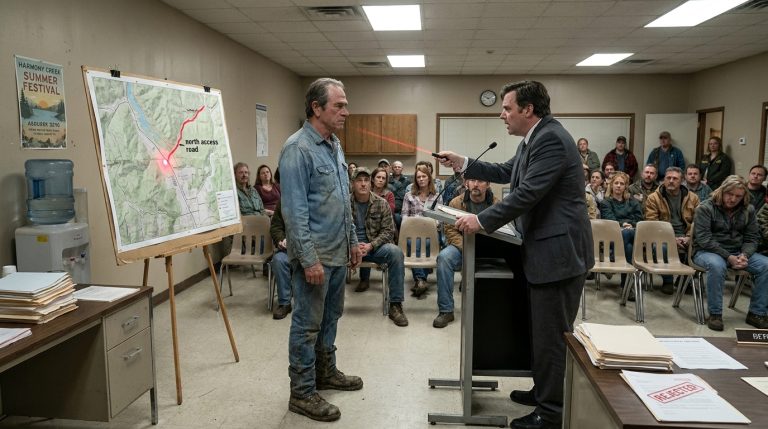
“It’s a simple matter of compliance,” she said, her words hitting the hallway like dropped coins. “The board has already approved the closure. We don’t need to debate the history of a road that no longer serves our zoning requirements.”
I moved forward, my boots silent on the plush carpet. I reached the door frame and pressed my back against the wall, peering around the edge. The boardroom was lit by the harsh glow of overhead LEDs. Karen sat at the head of the long wooden table, her iPad open, the blue light washing out her features. Across from her, the HOA president looked unconvinced, his fingers drumming a restless beat against a stack of thick, bound documents—the very ones I had been tracing in the county office.
“The easement, Karen,” he countered, his voice lower, rumbling with a sudden, uncharacteristic caution. “We looked at the map, but there’s a discrepancy in the developer’s supplemental filing. If that easement is still active, we’re exposing the association to a massive legal liability. We can’t just vote away a property right.”
“We aren’t voting it away,” Karen snapped, leaning forward. “We are declaring it dormant. There is a difference. If he doesn’t use the road, if we make it physically impossible for him to access it, the legal argument for ‘active use’ vanishes within the year. It’s a standard administrative maneuver.”
My grip tightened on the survey map I had shoved into my jacket. The air in the hallway seemed to vibrate. This wasn’t just a neighborly dispute; it was a premeditated, tactical strike against my property rights, designed to bypass the law through the slow, suffocating process of attrition.
I pushed away from the wall, the adrenaline spiking through my veins like ice water. I didn’t wait to hear more. I stepped into the doorway, my boots still caked with mud, the rain-soaked scent of the outside world trailing in with me. The room fell into an abrupt, agonizing silence. Karen’s head snapped toward me, her face hardening into a mask of calculated indignation.
“You’re trespassing,” she said, her voice dropping to a low, dangerous register.
“I’m here to talk about an easement,” I replied, my voice raspy but steady. I walked to the table and laid the map down, the wet edges of the paper leaving dark, muddy rings on the polished wood. “And the secondary phase of your expansion project that isn’t on the public record.”
The president’s eyes darted from the map to Karen. For a second, the power dynamic in the room fractured. I saw the doubt written in his expression, the realization that they were being pushed into a corner by someone who didn’t care about their bylaws.
Karen didn’t blink. She stood up, reaching for her phone, her thumb hovering over the screen. “We’re done here,” she said, her voice devoid of emotion. “Security is already on their way. You’ve crossed a line.”
“No,” I said, looking her directly in the eye, ignoring the threat. “I’m just reclaiming the one you decided didn’t exist.”
The room felt small, the air thick with the friction of opposing truths. The storm outside hammered against the windows, a relentless, deafening reminder that while they were playing with paperwork, I was fighting for the dirt beneath their feet. I didn’t back down. I didn’t move. I stood my ground, waiting for the crack in their confidence to widen.
CHAPTER 5: THE FINAL CLANK
I didn’t move. The mud on my boots began to crust, a dark, hardening ring against the pristine boardroom carpet. Karen’s thumb held the button on her phone, but she hadn’t pressed down. She was waiting for me to break, to offer some concession, some apology that would allow them to maintain the fiction of their authority.
“You’re making a public scene,” the HOA President said, his voice stripped of the caution he’d shown moments before. He shifted in his chair, his posture hardening. “We have the bylaws, we have the board consensus, and we have the backing of the development firm that handles our zoning permits. You are one man with a map that belongs in an archive, not a courtroom.”
“That map is a title encumbrance,” I said, my voice steady, though my heart was hammering against my ribs like a trapped bird. “And the moment you try to enforce that gate, you aren’t just violating a zoning permit. You’re committing an illegal seizure of private property. Every day that gate stays locked is a day of damages I can take to the county prosecutor.”
Karen laughed, a sharp, humorless sound that cut through the room. “The prosecutor? They’re the ones who signed off on the security-corridor ordinance. You’re playing checkers while we’re running the board.”
I looked at the blueprints one last time. It was all there—the decoy secret of the expansion phase hidden in the margins. They needed to clear my access easement because it was the only thing standing between the current development and the high-value drainage basin they intended to convert into a luxury enclave. The gate was never about security; it was about financial leverage.
“The expansion,” I said, my voice dropping.
The silence that followed was absolute. Karen’s thumb froze on the phone screen. The President’s gaze shifted to the blueprints, his face paling by a fraction.
“We know,” I lied, projecting a confidence I didn’t entirely feel. “The county records office is already tracking the unauthorized drainage modification. The moment you move to restrict that easement, the entire permit application for the secondary phase gets pulled for environmental review.”
It was a bluff, but it was the only one I had. The room seemed to shrink. I could see the sweat beading on the President’s forehead, the way Karen’s jaw tightened. They were architects of a controlled environment, and I had just introduced an element of chaos they couldn’t account for.
“Get out,” Karen whispered, her voice trembling with rage. “You have until sunrise to take that map and leave this property. If you aren’t gone, we’ll let the police handle the encroachment claim.”
“I’ll be gone,” I said, turning toward the door. “But the easement stays open. Test me.”
I walked out of the boardroom, my steps measured and deliberate. The hallway was empty, the fluorescent lights humming overhead like trapped insects. I reached the service entrance, pushed through the heavy door, and stepped back out into the rain. The storm had settled into a steady, miserable drizzle.
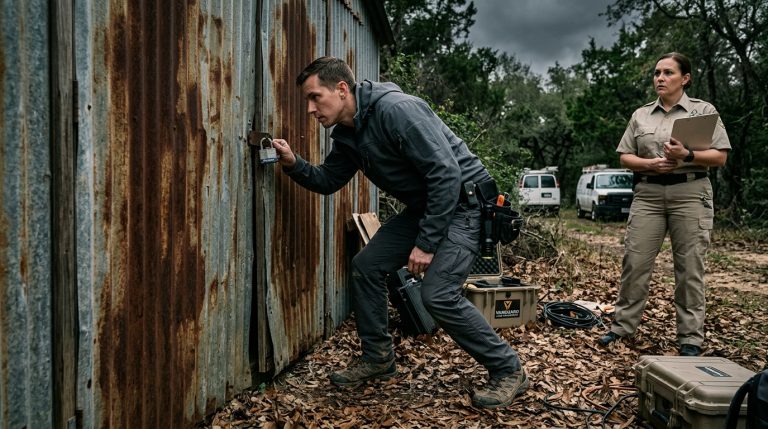
I didn’t go to my truck. I walked straight to the main road, the asphalt slick and black. The gate stood like a prison in the dark, the chain glinting in the faint spill of light from the streetlamps. I didn’t have a key, but I had the knowledge of the chain’s anchor. It was a standard, hardware-store padlock, secured to the weakest point of the gate’s frame.
I reached into my pocket, pulling out the heavy, brass plumb bob I’d found earlier. It was solid, dense, and perfectly capable of providing the leverage I needed. I didn’t need to break the lock—I just needed to loosen the bolt on the frame.
It took me ten minutes. My hands were freezing, the cold biting into my knuckles, but the sound of the metal bolt sliding free was the sweetest music I’d ever heard. The gate sagged. I didn’t push it open, but I didn’t have to. The chain now hung loose, a tether to a power that had been severed.
I stood in the rain, watching the clubhouse lights. The blue screen of Karen’s phone illuminated the window for a split second, then went dark. They wouldn’t come out. They were paralyzed by the uncertainty I’d planted. I climbed into my truck, turned the key, and instead of driving away, I drove forward.
The gate creaked as my bumper nudged it. It swung open, wide and unyielding, revealing the dark, winding track that led back to my home. I didn’t look back. I drove with my headlights off, feeling the familiar hum of the ruts beneath my tires, knowing that for the first time in weeks, the road was exactly what it had always been: a path that belonged only to the land.
CHAPTER 6: THE QUIET HORIZON
I drove through the gate, the tires crunching over the loose gravel and discarded chain links I’d cleared earlier. The house was a dark silhouette against the star-dusted sky, but the porch light was still burning—a warm, amber eye in the vastness of the ranch. I didn’t kill the engine immediately. I sat there for a moment, listening to the tick-tock of the metal cooling, the sound rhythmic and steady. The confrontation in the boardroom felt miles away, a frantic, high-pitched static that had finally been tuned out.
The resolution had been as quiet as the archive. The developer’s firm had folded the moment their primary local advocate—Karen—had realized the easement documentation was legally airtight and ready for a county-level discovery process. They were professionals of the margin and the loophole; they had no appetite for a prolonged, public battle that would expose their secondary drainage-basin expansion as a bad-faith land grab. By the following afternoon, a curt email from the HOA president had confirmed that the gate was to be removed and the “security ordinance” rescinded.
I stepped out of the truck and walked to the porch. My muscles ached, a deep, resonant thrum of exhaustion that felt earned. I reached into my pocket and pulled out the brass plumb bob. It was still cold from the night air, its surface dull and honest. I walked to the edge of the porch, where the wood had been rotting for seasons—a project I had ignored, a small scar on the property’s maintenance record.
I set the tool down on the railing, then turned back to the office window. The room inside was still filled with the remnants of my research: the maps, the vellum, the blueprints that had almost cost me my access. I knew what I had to do next. I walked inside and spent the next hour organizing the folders, creating a permanent, accessible file for the easement. It wasn’t just a matter of law; it was a matter of stewardship. Paper remembers what people forget, and I would make sure this paper never grew dim again.
When I finished, I sat in the desk chair and looked out the window. The road was empty. The subdivision, once a looming, encroaching threat, now just looked like what it was: a cluster of lights and rooftops that had nothing to do with the rhythm of this soil. The battle had been won not with a shout or a dramatic courtroom flourish, but with the patient application of forgotten truth.
The Payoff arrived two days later when a truck pulled up to the gate. It wasn’t Karen. It was a crew of contractors, their uniforms devoid of any HOA insignia. They spent the morning dismantling the steel posts, their torches hissing as they cut the concrete anchors free. I stood on the porch, watching them work. When they finally loaded the last steel bar onto their flatbed and drove away, the road looked exactly as it had for forty years. The ruts were the same, the wind-bent fence posts remained, and the curve of the track toward the county highway was unobstructed.
Poetic Justice, I realized, was a slower process than I had imagined. The developers hadn’t been shamed; they had simply been out-maneuvered by the very records they thought they could bury. They had spent thousands on a gate that stood for less than a week, a monument to their own hubris.
The Cool Down began in the following weeks. The subdivision residents, previously emboldened by the gate, now walked their dogs past the ranch line with a quiet, lingering uncertainty. They didn’t wave, but they didn’t stop to stare, either. The tension had evaporated, replaced by a strange, newfound respect for the border.
I spent a Saturday afternoon replacing the rotting boards on the porch. The work was simple, physical, and rhythmic—a grounding act of maintenance that solidified my connection to the house. As I hammered the final nail, I felt the last of the anger dissipate, replaced by a deep, atmospheric peace.
My character arc, if one could call it that, had been a return to the fundamentals. I had been forced to defend a legacy, but in doing so, I had learned that the most profound strength doesn’t come from defiance. It comes from knowing exactly where you stand, why you stand there, and the truth that sustains you. The road was open. The documents were filed. The ranch remained, silent and steady under the wide, unbothered sky. I stood up, wiped the sawdust from my hands, and watched the sun dip below the horizon, painting the world in shades of gold and iron. The truth hadn’t just saved the road; it had anchored me to the land in a way I hadn’t felt in twenty years.