The Signal Corps Lighter: A Tactical Audit of Oakridge Estates
CHAPTER 1: THE BOUNDARY LINE
The mounting bracket on the pin-oak side had shifted three millimeters south.
Someone had leaned their full body weight against the galvanized steel stay within the last forty-eight hours. The vibration dampener was scuffed with fresh green rubber from a cheap, mass-market boot sole.
“You have seven days, Mr. Garrison. Then the fines start at five hundred dollars a morning.”
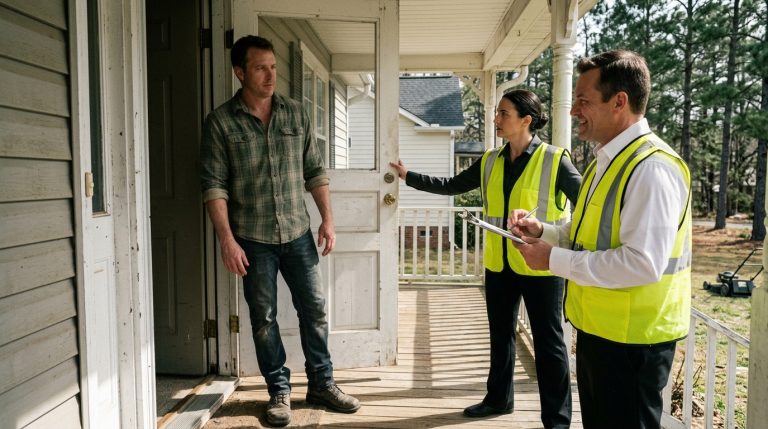
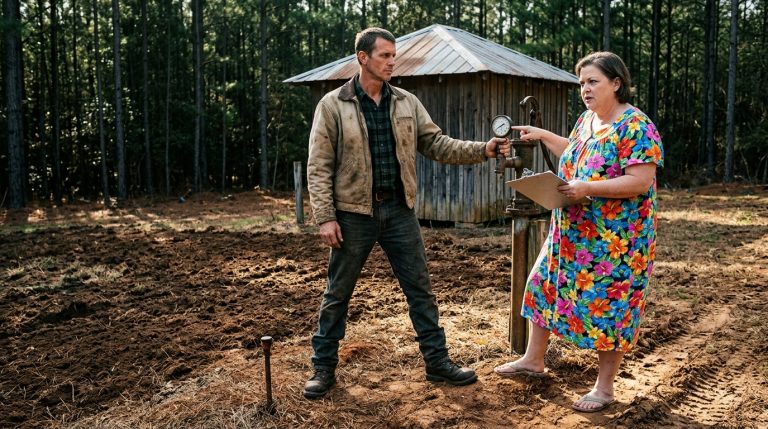
Karen Vance didn’t look at my face. She looked at the satellite dish mounted behind the lower branches of the oak. Her floral pantsuit was synthetic, thick enough to hold heat, smelling faintly of citrus perfume and stale upholstery. Her arms were crossed over her chest like a padlock.
Snap. Clack.
I rolled the brass Zippo across my knuckles. The metal was pitted around the Signal Corps crest, cold despite the Texas humidity sticking my shirt to my shoulder blades.
“It’s a VSAT terminal, Mrs. Vance,” I said. My voice stayed below eighty decibels. Flat. “It stays within the federal OTARD height limit. Six inches below the roofline.”
“The Architectural Review Committee defines what stays.” She stepped forward. Her left heel sank half an inch into my damp Bermuda turf, leaving a dark, raw circle in the green. “The board didn’t approve the visual profile. That dish is an eyesore. It devalues every lot on Oakridge Drive.”
I didn’t tell her about the signal bridge.
I didn’t tell her that the small, directional patch antenna hidden inside the dish’s plastic casing was currently firing a clean five-gigahertz beam nine hundred yards through the tree line. I didn’t remind her that the digital security gate at the main entrance—the one keeping four hundred suburban homes behind automated iron bars—was running its camera feeds directly through my router because her board forgot to trench fiber to the guard shack six weeks ago.
Show the wound. Never explain the knife.
“The CC&Rs require thirty days’ written notice for an aesthetic violation,” I said. Clack. The lighter wheel struck sparks without taking flame. “Article Four, Section B.”
“I am the notice, Jack.” Her eyes narrowed into wet slits. “Seven days. Or we slap a lien on the deed.”
She turned on her heel, pulling a chunk of my topsoil with her foot, and marched toward her white SUV idling at the curb. The exhaust smelled like unburnt sulfur.
I stood on the lawn until the engine noise died down the hill.
My thumb rubbed the raw, red blister on the side of my knuckle—a habit from twenty years in bad radio huts from Tikrit to Fort Meade. My heart rate didn’t spike. It dropped. Panic was heat; calculation was ice.
I walked down the driveway to the mailbox. The metal latch was rusted orange at the hinges. Inside lay a single white envelope, thick paper stock, embossed with the Oakridge Estates logo in gold foil.
No stamp. Hand-delivered.
I tore the flap open with my thumb. Inside was a formal notice of violation, signed in dark blue ink. At the bottom, squeezed under the legal boilerplates, was a hand-written line: Notice served in person. Default judgment applies.
Beside my driveway, the Millers’ yard sat quiet. Old Arthur Miller was on his knees near the property line, his thin hands shaking as he clipped dead leaves off a row of crimson rose bushes. He didn’t look up when I approached, but his shoulders were hunched, tight as piano wire.
“She came by your place too, Jack?” Arthur asked. His voice sounded like dry gravel dragged across concrete.
“She likes the sound of her own voice,” I said.
Arthur reached out, his gnarled fingers touching a yellowing leaf. A small yellow plastic tag dangled from the main stem of the bush. Violation Code 12-A: Unapproved Flora.
“She gave us three days,” the old man whispered. He didn’t look at me. He looked at the dirt under his fingernails. “Ellie cried all night. Said we’d have to sell if they start taking the pension money for fines.”
“Don’t cut them, Arthur,” I said.
“You don’t know her, son. She’s got lawyers on retainer. Uses the HOA money to pay ’em.”
I didn’t answer. I reached down, took the yellow tag between my index finger and the edge of my Zippo, and snapped the cheap zip-tie with a sharp jerk. The plastic popped like a dry twig.
“Go inside, Arthur. Keep Ellie away from the front window.”
I walked back up my driveway, the heavy paper notice folded once inside my back pocket. The sun was hitting the roof of the guard shack a quarter-mile away, glinting off the little white receiver box I’d mounted on its fascia board with my own ladder and my own screws.
Inside my kitchen, the air conditioning hummed a low, mechanical flatline. Sarah was at the island, a yellow legal pad in front of her, her laptop open to the HOA portal page.
“She was loud enough to hear through the glass, Jack,” Sarah said without looking up. Her pen was hovering over the paper. “Can she take the house?”
“No.”
“The fine schedule says—”
“The fine schedule is paper,” I said. I pulled the heavy binder of community bylaws off the bottom shelf of the pantry and dropped it onto the granite counter. The noise echoed off the subway tile like a gunshot. “Paper burns.”
I flipped to Section 8: Financial Disclosures and Vendor Contracts.
The ink was small, printed in 1996. But buried under three layers of amendment stamps from two years ago was a single line item under Sub-Contracted Maintenance:
Vance Services, LLC — Account #4092-B.
My thumb found the Signal Corps lighter in my pocket. Clack.
CHAPTER 2: PAPER WEAPONS
Clack.
The flint wheel struck, throwing a single spark that died against the cold steel hood of the Zippo. The green status light on the router flickered three times—data packets moving back and forth across the five-gigahertz beam to the guard shack at the front gate.
“Vance Services,” Sarah read over my shoulder. Her finger came down near mine, her short nail tracing the faint violet mimeograph ink of the vendor ledger. “They paid them fourteen thousand dollars last year for ‘perimeter grounds maintenance.’ Jack, Arthur cuts the grass on the common strip himself because the board canceled the landscaping crew in March.”
“I know,” I said.
I didn’t turn the page. I pulled a yellow legal pad across the polished granite and wrote the name down. Beneath it, I copied the state tax entity number: TX-88301-C.
V-1 Micro-Discrepancy: In the far margin of the ledger sheet, squeezed next to the binding staple, someone had used a black ballpoint pen to scrawl a secondary location tag: Parcel 14-B / Retention. The ink was fresh—darker than the faded 1996 printing on the rest of the sheet.
“Is that a lot?” Sarah asked, her voice dropping into the quiet octave she used when the mortgage statements came in early.
“It’s enough to buy three commercial-grade commercial mowers,” I said. “Or pay off a small municipal lien.”
I reached into my pocket, pulled out my smartphone, and opened a web browser. No search engines. Just the direct public portal for the Travis County Comptroller’s office. Twenty years of tactical comms doesn’t just teach you how to align directional antennas; it teaches you how to map networks. People leave trails in data the same way soldiers leave broken grass in a tree line.
I typed in the entity number.
The search loaded slowly, fetching data over the VSAT link. The screen flashed once, then displayed the registration summary. Vance Services, LLC. Formed: June 14, 2021. Registered Agent: Harold Vance.
Harold. Karen’s husband. The retired civil engineer who sat on his porch every afternoon in a faded golf shirt, watching the street through binoculars.
“They’re billing the community for work Harold isn’t doing,” Sarah whispered. Her hand tightened on my shoulder, her fingers digging in through the cotton of my t-shirt. “That’s… that’s fraud, Jack. That’s real crime.”
“It’s leverage,” I corrected her. “Fraud requires a prosecutor who cares about a fifty-thousand-dollar HOA account. Leverage only requires two people in a room.”
I closed the browser, pulled a fresh sheet of paper from the pad, and began drafting a letter. I didn’t use a computer. I wrote it by hand, using a black ballpoint pen, in block capital letters—the same clear, impersonal script I’d used for tactical situation reports in Field Manual logbooks.
TO: BOARD OF DIRECTORS, OAKRIDGE ESTATES HOA
FROM: JACK GARRISON, LOT 42
SUBJECT: FORMAL NOTICE OF PROCEDURAL DEFECT & DISCLOSURE REQUEST
RE: VIOLATION NOTICE DATED 12 OCT. THE ARCHITECTURAL REVIEW COMMITTEE FAILED TO PROVIDE WRITTEN DENIAL WITHIN THE MANDATED 30-DAY WINDOW FOLLOWING SUBMISSION ON 04 MAY. PER SECTION 4, PARAGRAPH C OF THE COVENANTS, THIS CONSTITUTES DEEMED APPROVAL.
PURSUANT TO TEXAS PROPERTY CODE SECTION 209.005, I HEREBY REQUEST IMMEDIATE COPIES OF ALL VENDOR INVOICES, CANCELED CHECKS, AND CONTRACT AGREEMENTS ASSOCIATED WITH ACCOUNT #4092-B (VANCE SERVICES, LLC) FOR THE PAST 36 MONTHS.
COPIES TO BE PROVIDED WITHIN 10 BUSINESS DAYS TO PREVENT FORMAL REPORTING TO THE STATE ATTORNEY GENERAL CONSUMER PROTECTION DIVISION.
I stopped writing. The tip of the pen dug a small hole through the paper into the legal pad beneath.
“You’re giving her ten days?” Sarah asked. “She gave us seven.”
“Ten days is the statutory minimum under Section 209,” I said. “If I give her seven, her lawyer can throw the request out on a procedural error. We give her the exact line of the law. We make her walk the edge of the blade.”
I folded the paper twice, slid it into a plain white envelope, and sealed it.
“Where are you going?”
“To the Millers,” I said. I picked up the Zippo and slipped it into my front pocket. “And then to the post office. Certified mail. Return receipt requested.”
Outside, the Texas afternoon heat had reached ninety-four degrees. The air was thick, heavy with the smell of dry cedar and asphalt. I walked across the boundary line between my property and Arthur’s.
Arthur was still on his front porch, sitting on a rusted metal glider that squeaked every time he shifted his weight. His hands were folded in his lap, the knuckles red and swollen from arthritis. Beside him on the small side table sat a white ceramic mug of cold black coffee.
“Jack,” he said, his eyes tracking my boots as I stepped onto the wooden porch steps. “You shouldn’t be over here. Karen’s SUV drove by five minutes ago. She saw you take that yellow tag off my roses.”
“Let her watch,” I said.
I sat down on the top step, the rough cedar biting into my jeans. I pulled the legal pad out from under my arm and laid it flat on the porch boards between us.
“Arthur, how long have you lived on Lot 43?”
“Twenty-two years,” the old man said softly. “Built the place before the developer put the gate in. Back when this was just scrub oak and dirt roads.”
“Did you ever hear of a plot called Parcel 14-B?”
Arthur froze. The glider stopped squeaking. His head turned slowly toward me, his pale blue eyes milky around the irises with age, but sharp behind his wire-rimmed glasses.
“Where’d you hear that name, Jack?”
“It’s stamped on the HOA vendor ledger,” I said. “Right next to the payments for Harold Vance’s company.”
Arthur looked down at his coffee mug. A dead gnat was floating on the dark surface. He didn’t skim it out.
“Parcel 14-B isn’t in the neighborhood,” Arthur said, his voice dropping an octave, losing its raspy edge. “It’s the five-acre strip right behind my back fence. The drainage basin. Belongs to the county, or it used to. The HOA’s been trying to put a Retention Lien on it for three years to force a tax sale.”
“Why?”
“Because if you connect 14-B to your lot and mine,” Arthur gestured toward his house and then toward my oak trees, “you’ve got enough contiguous road frontage to build a commercial gas station on the corner of the highway.”
The puzzle piece didn’t just fit. It snapped into place with a dull, heavy thud.
It wasn’t about an ugly satellite dish. It wasn’t even about a power-tripping suburban tyrant wanting her lawn rules followed. The dish was just an excuse to start piling fines on my property. Fines lead to liens. Liens lead to foreclosure.
“They want the land,” I said.
“They want the whole corner,” Arthur said. He reached out and touched the yellow paper envelope sticking out of my pocket. “They’ve been squeezing me for two years, Jack. Fines for the paint. Fines for the bushes. Fines for the mailbox being two inches too low. They’re trying to break me so I sell cheap.”
I stood up. The cedar steps creaked under my boots.
“They aren’t breaking anyone, Arthur.”
I walked down the steps and turned back toward the old man.
“Keep your roses,” I said. “And tell Ellie to turn the front porch light on tonight.”
I didn’t go straight to the post office. I walked down the long, asphalt driveway toward the main entrance of Oakridge Estates. The air grew hotter near the road, shimmering off the dark pavement.
The guard shack sat under the shadow of two dying mesquite trees. Inside, through the tinted glass, I could see young Steve, the shift guard, sitting on a tall stool with a cheap plastic fan blowing warm air across his face.
On the roof of the shack, my little white directional antenna caught the full glare of the afternoon sun. The green power LED was solid. The link light was pulsing steady and rhythmic—a heartbeat in the dust.
I pulled out my phone, tapped the screen, and accessed the router’s admin panel remotely.
[SYS_ADMIN: USER_AUTH_OK]
[INTERFACE: BRIDGE_VLAN1]
[STATUS: ACTIVE – 100 Mbps]
[ACTION: EXECUTE SCRIPT?]
I didn’t press execute. Not yet.
I loaded a pre-written configuration script into the router’s temporary cache. A simple command loop. One tap, and the bridge would sever its link, dropping the guard shack’s bandwidth from a clean hundred megabits to zero in under four milliseconds.
Snap. Clack.
I closed the Zippo in my pocket, feeling the cold steel edge bite into my palm.
“Ten days, Karen,” I whispered to the empty road.
CHAPTER 3: THE SHELL GAME
The heat radiating off the asphalt felt like standing in the exhaust path of a turbine.
My phone screen flickered once under the direct glare of the Texas sun. The text string remained locked in the temporary buffer: [ACTION: EXECUTE SCRIPT?]. One press of my thumb and the bridge would sever, dropping the front gate into analog silence.
I didn’t press it. Not yet. A weapon unrevealed carries twice the weight of a weapon discharged.
V-2 Psychological Phantom: For a fraction of a second, the dry cedar smell on the wind merged with the memory of supply-line interdiction outside Fallujah in ’04—mapping fuel depots and communications nodes, finding the single copper trace that, if severed, brought an entire armored patrol to a dead stop without firing a single round.
I slipped the phone back into my pocket, right beside the Zippo.
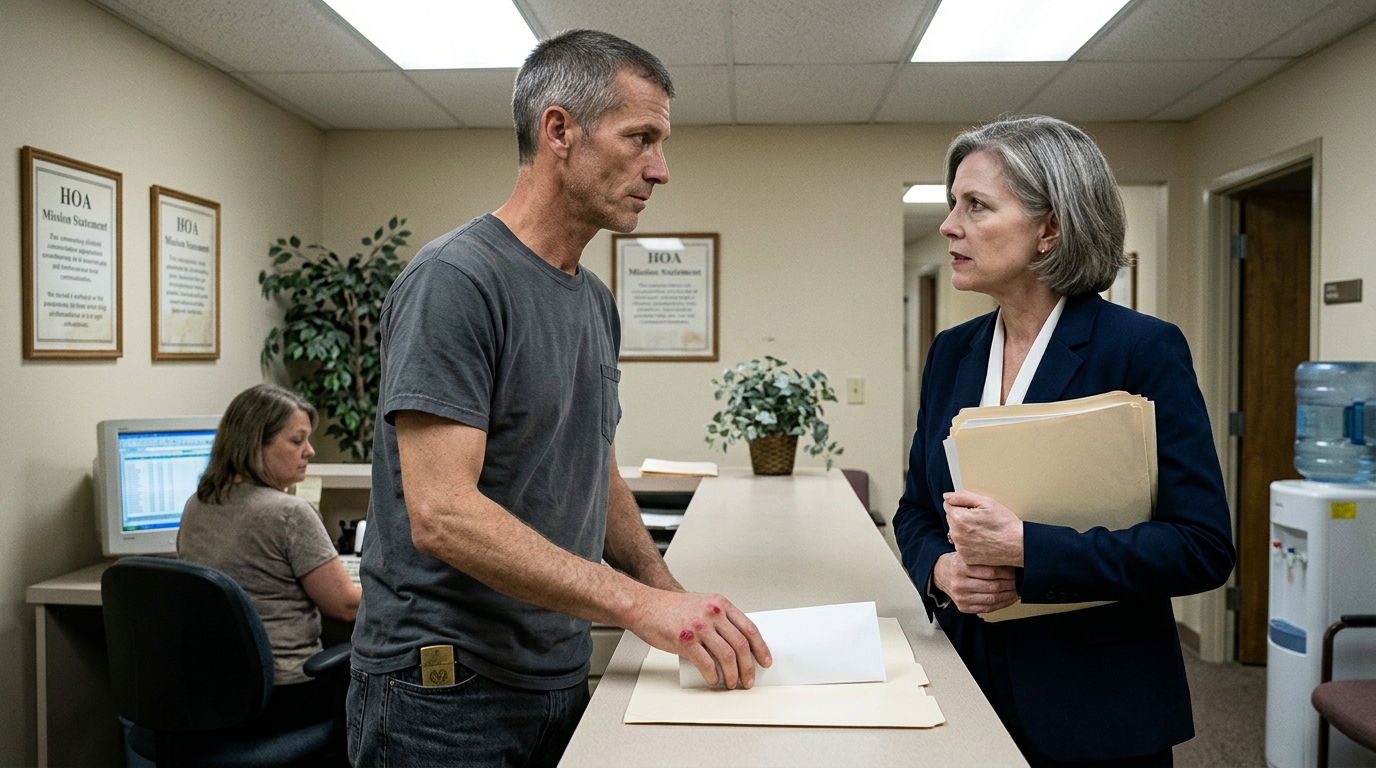
Thirty minutes later, I stood in the reception area of the Oakridge Estates clubhouse. The air conditioning was set too cold, smelling faintly of chlorine from the community pool next door and commercial floor wax.
Behind the laminate front desk sat Brenda, the board’s administrative secretary. She was middle-aged, wearing a knitted cardigan despite the ninety-degree weather outside, her eyes glued to a computer screen running a outdated spreadsheet program.
“I need this stamped as received,” I said, placing the white envelope flat on her blotter.
Brenda looked up, her glasses sliding down the bridge of her nose. “What is it?”
“A formal Section 209 records demand,” I said. My voice was level, monotone. “Certified copy. The original is already in a mailbox bound for the county clerk.”
She reached out a manicured hand, picked up the envelope, and read the typed addressee block. Her face didn’t pale, but her fingers twitched—a micro-stutter in her posture that betrayed her.
“Mr. Garrison,” a voice called from the inner hallway.
Karen Vance stepped out from the board office. She didn’t have her floral pantsuit on today; she wore a sharp navy blazer over a white blouse, tailored to project the authority of a district magistrate. In her right hand, she held a thick beige file folder.
“Brenda, leave us for a moment,” Karen said.
The secretary didn’t hesitate. She grabbed her mug and slid out the side door toward the breakroom, the latch clicking shut behind her.
Karen didn’t offer a chair. She walked around the desk, stopping four feet away—just outside personal space, well within striking distance for a verbal engagement.
“You’re making a catastrophic mistake, Jack,” she said. Her voice was low, devoid of the theatrical pitch she’d used on my lawn two days ago. “You think you’re the first military man who moved in here thinking he could read a rulebook and play lawyer?”
“I don’t play lawyer,” I said. Clack. My thumb opened the lid of the lighter inside my pocket, the metal click muffled by the denim. “I read vendor ledgers.”
Karen’s posture didn’t break, but her throat moved as she swallowed once.
“You filed a request for Vance Services accounts,” she said, raising the beige folder. “I have the authority to deny administrative requests that are deemed predatory or intended to disrupt board operations.”
“Texas Property Code Section 209.005 doesn’t contain a discretionary exemption for board comfort, Mrs. Vance,” I said. “You have ten business days to produce the canceled checks, the itemized invoices, and the tax disclosures for Account #4092-B.”
She took one step closer. The scent of citrus perfume was overpowering in the small room.
“Let me tell you what happens in ten days, Jack,” she said, leaning in slightly. Her eyes were hard, gray as slag iron. “The Architectural Review Committee will issue a secondary finding. The satellite dish will be assessed a non-compliance surcharge of two thousand dollars. By month’s end, we file a Retention Lien against Lot 42.”
There it was. The second seed noun, spoken aloud. The Retention Lien.
“A lien requires a board vote,” I said.
“I have three proxy votes in my desk,” she replied instantly. “George will sign whatever I put in front of him. The rest don’t show up to meetings.”
“And Harold?” I asked.
The silence that followed was heavy, pressurized. The hum of the ice machine in the corner sounded like a drill bit hitting stone.
“What did you say?” she whispered.
“Harold Vance,” I repeated, keeping my tone entirely flat. “Registered agent for Vance Services, LLC. Formed three years ago. Right about the time the board started billing fourteen thousand dollars a year for grounds maintenance on Parcel 14-B.”
Karen didn’t flinch, but her right hand closed into a tight fist against the side of her navy blazer, the fabric wrinkling under the pressure of her nails.
“You don’t know what you’re touching, Garrison,” she said softly. “Parcel 14-B is community property.”
“It’s county drainage overflow,” I corrected her. “And the invoices aren’t for maintenance. They’re shell disbursements.”
She looked at me for three long seconds. The arrogance wasn’t gone, but it had morphed into something colder—the calculated assessment of a adversary who realizes the target isn’t going to step into the trap quietly.
“Ten days,” she said, stepping back toward her office door. “Make sure your internet bill is paid, Mr. Garrison. You’re going to need all the bandwidth you have left.”
She pulled the door shut behind her. The lock clicked into place with a sharp, heavy snap.
I turned around and walked out of the clubhouse into the heat.
The walk back up Oakridge Drive was quiet. The sun was beginning to drop toward the western ridge, casting long, dark shadows across the manicured lawns and identical brick facades.
When I reached my driveway, Arthur Miller was standing by my mailbox. He wasn’t wearing his gardening gloves. He had an old wooden clipboard in his hands, held tightly against his chest like a shield.
“She called the county sheriff, Jack,” Arthur said as I approached.
I stopped at the edge of the grass. “On who?”
“On me,” the old man said, his chin trembling slightly before he forced it still. “Said I was trespassing on common elements when I cleared those dead leaves off the boundary marker behind Lot 43. Deputy came by twenty minutes ago. Issued a formal warning.”
I looked past Arthur, down the street toward Karen’s house. Her white SUV was parked in the driveway, the tinted windows reflecting the orange glare of the setting sun.
She wasn’t backing down. She was accelerating the timeline, trying to force a mistake before the ten-day clock ran out.
“Arthur,” I said, reaching into my pocket and bringing out my phone.
“Yeah, Jack?”
“Call the Rodriguezes. Call Dr. Chen down on the corner.” I unlocked the screen, opening the network administration interface once more. “Tell them to bring their copy of the HOA bylaws to my kitchen at seven o’clock tonight.”
“What are we doing?”
“We’re setting up a counter-battery,” I said.
I tapped the screen, confirming the script parameters in the router cache. The green light on the dish up on my roof blinked twice, holding the connection steady for now—a single thread holding up a guillotine.
CHAPTER 4: SEVERING THE NERVE
The screen went dark in my palm, the cached command locked into RAM like a round chambered in an open-bolt receiver.
By seven-fifteen that evening, my kitchen smelled like stale coffee and damp paper.
Arthur Miller sat at the head of the granite island, his swollen fingers holding a yellow highlighter. Beside him, Dr. Emily Chen had spread three years of printed HOA balance sheets across the counter, her silver mechanical pencil making rapid, rhythmic ticks against the margins. Across from her, Carlos Rodriguez sat silently, his arms crossed over a grease-stained work shirt, his jaw clenched tight enough to show the muscle strain along his cheek.
“She billed the community forty-two thousand dollars over thirty-six months for ‘drainage basin clearing,'” Dr. Chen said, her voice sharp and clinical. “Look at the line items. Every check made out to Vance Services was capped at two thousand four hundred and ninety dollars.”
“Ten dollars under the threshold requiring a full board vote,” I said. I stood by the sink, rolling the brass Zippo across my knuckles. Snap. Clack. “She signed every single disbursement voucher herself as board president.”
“That’s not just a violation of the bylaws,” Carlos said, his voice a low growl. “That’s theft. My wife had to sell her mother’s ring to pay a twelve-hundred-dollar fine for our kid’s basketball hoop, and Karen’s lining her husband’s pockets?”
“It’s not just theft, Carlos,” I said. “It’s leverage for the land.”
I pulled out the county survey map Arthur had brought over and unrolled it across the center of the island. My thumb held down the curling corner over Lot 42.
“Parcel 14-B,” I said, pointing to the shaded gray strip looping around the rear boundaries of our three properties. “She’s using the fines to force default notices. If she attaches a Retention Lien to Lot 42 and Lot 43, the HOA takes legal title at foreclosure. Combine those with 14-B, and she delivers a five-acre commercial corner to a commercial buyer.”
Arthur looked at the map, his eyes wide behind his wire-rimmed glasses. “She isn’t trying to keep the neighborhood clean. She’s trying to clear us out.”
“She has three days left on her ultimatum,” Dr. Chen said. “What’s the play, Jack?”
“We don’t attack,” I said. “We let her strike first.”
The heat came up early the next morning, thick and suffocating before eight o’clock.
At 10:03 a.m., an unbranded white utility van pulled up to the curb in front of my house. The driver’s side door creaked open, and a man in oil-stained gray overalls stepped out onto the hot asphalt. He carried a heavy aluminum ladder on his shoulder and a pair of long-handled cable cutters in his right hand.
I walked out onto the front porch, letting the screen door slap shut behind me. I didn’t rush. I sat on the top step, my boots resting on the concrete, the Zippo resting loose in my right palm.
“Mornin’,” the handyman said, wiping sweat from his forehead with the back of his sleeve. He looked uncomfortable, his eyes darting toward the satellite dish mounted on the side wall near the oak branches. “Got a work order from the HOA office. Removal of unauthorized exterior equipment.”
“I know,” I said.
He paused, his hand resting on the ladder. “You ain’t gonna cause trouble, are you? Lady said you might try to physically stop me.”
“You’re doing a job you were paid to do,” I said, keeping my voice flat, conversational. “The work order is signed by Karen Vance?”
“Yeah. Signed it this morning.” He pulled a crumpled carbon copy from his back pocket and held it out.
I took it, scanned the signature line—Karen Vance, HOA President—and slipped it into my pocket next to my phone.
“Go ahead,” I said. “Just don’t break the oak branches.”
The man blinked, surprised, then set his ladder against the brick fascia. He climbed four rungs, reached up, and positioned the hardened steel blades of the cutters around the thick black coaxial cable running from the dish feedhorn into the junction box.
V-3 Environmental Detour: A blast of dry wind hit the side of the house, rattling the dry oak leaves. Down at the front entrance, the mid-morning heat had already pushed the temperature inside the unventilated guard shack past ninety-eight degrees, stressing the backup battery unit powering the gate controls.
The handyman squeezed the handles together.
CHUNK.
The sound was heavy, metallic, and definitive. The severed cable dropped away, swinging lazily against the brickwork like a dead vine.
“All done,” the handyman called out, stepping down the ladder and unbolting the dish from its steel footplate. “Sorry about the hassle, chief.”
“No hassle,” I said. “Have a good afternoon.”
I watched his white van pull away down the street, its exhaust pipe rattling against the bumper.
The moment the van cleared the corner of Oakridge Drive, I pulled my phone from my pocket. I opened the network interface. The status indicator for the wireless bridge was flashing bright red: [SIGNAL LOSS – DISCONNECTED].
Five seconds later, my phone began to vibrate.
The caller ID showed the gatehouse landline. I answered on the third ring.
“Garrison,” I said.
“Jack! Jack, it’s Steve down at the gate!” The guard’s voice was borderline hysterical, the background noise filled with the frantic blare of car horns. “Everything just went dark! The security monitors froze, the scanner software crashed, and the main entrance arm dropped straight down and locked up! I can’t override it!”
“Did you lose power, Steve?” I asked smoothly.
“No! The lights are on, but the computer says ‘No Network Connection’! There are six delivery trucks and ten residents backed up out onto the state highway! Traffic is stopping on the main road! What happened?”
I leaned back against the porch railing, looking out over the quiet, manicured street.
“Karen Vance had her contractor cut my satellite feed five minutes ago, Steve,” I said. “I sent the board a formal notice last week explaining that my dish was hosting your gate bridge. She chose to remove it anyway.”
A long, suffocating silence hung on the line, broken only by the angry blare of a semi-truck horn through Steve’s receiver.
“She… she knew?” Steve squeaked. “Jack, I’ve got thirty angry people screaming at my window! What am I supposed to do?”
“Give them Karen’s personal cell number, Steve,” I said. “And tell them she personally signed the work order.”
I ended the call.
I opened my email client, selected the pre-assembled distribution list containing three hundred and fourteen neighborhood addresses, attached the PDF of my legal notice, the scanned work order signed by Karen, and the timestamped video clip of her handyman severing the cable.
Subject: URGENT: Explanation of Front Gate System Failure and Security Collapse.
My thumb hovered over the screen.
Clack.
I pressed send.
CHAPTER 5: THE AUDIT TRIBUNAL
The vibration against the cedar rail sounded like a hornet trapped in paper.
Within forty-eight seconds of pressing send, three hundred and fourteen inboxes across Oakridge Estates delivered the payload. The screenshot of Karen’s signed work order, the video clip of the cable cutters snapping the line, and the formal notice of security collapse hit every screen in the subdivision simultaneously.
The response wasn’t a trickle. It was a dam breaking.
By six o’clock that evening, two hundred and ten residents had signed Arthur Miller’s recall petition. By eight o’clock, the county fire marshal had to approve an emergency venue shift from the ninety-person clubhouse to the local middle school gymnasium to handle the crowd.
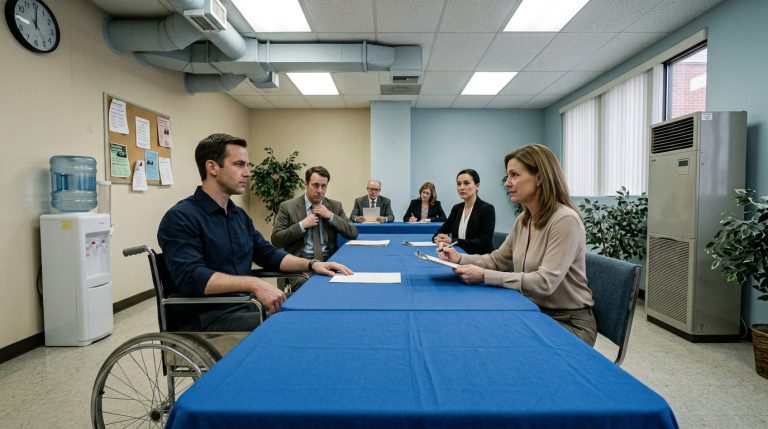
Now, under the buzz of overhead metal-halide lights, four hundred people sat on bleachers and folding chairs. The air in the gym tasted of floor wax, dry dust, and cold sweat.
At the center court table sat Karen Vance, her husband Harold, and two remaining board members who looked like men waiting for a verdict in a capital trial. Karen wore a dark gray suit, her chin set high, but her fingers twitched rhythmically against the edge of her Manila folder.
I stepped up to the microphone standing on the hardwood baseline. My boots made no sound on the finished floor.
Clack.
I slipped the brass Signal Corps lighter out of my pocket, setting it on the podium edge next to my tablet.
“We aren’t here tonight to talk about satellite dishes,” I said into the microphone. My voice echoed off the concrete block walls, flat and clear. “We aren’t here to talk about unapproved rose bushes or painted mailboxes.”
I tapped the tablet screen. Behind me, a heavy projection screen lowered from the ceiling beams, displaying a high-resolution scan of Travis County Land Record #2021-0941.
“What you see on the screen is Parcel 14-B,” I said. “Five acres of drainage overflow behind Lot 42 and Lot 43. Owned by the county since 1994.”
A murmur rippled through the bleachers.
“Over the last three years,” I continued, “the HOA board has paid forty-two thousand dollars out of community reserve funds for ‘maintenance’ on Parcel 14-B. Every disbursement voucher was issued under two thousand five hundred dollars to avoid a full board vote. Every check was made out to Vance Services, LLC.”
I tapped the screen again. A corporate registration document zoomed into focus.
“Vance Services is registered to Harold Vance,” I said. “The work was never performed. The funds were funneled into a private account.”
Karen stood up so fast her metal chair scraped across the hardwood like a screeching tire.
“This is an outrage!” her voice blasted through the PA speakers, cracking at the edges. “This man is a disgruntled homeowner under active fine enforcement! He is spreading malicious lies to cover his own violations!”
“Sit down, Karen,” Arthur Miller called out from the third row of bleachers. His voice wasn’t raspy tonight. It carried twenty-two years of quiet endurance. “Let him finish.”
“I have the right as president to maintain community standards!” Karen shouted, turning to face the crowd, her face flushed dark red under the harsh lights. “We are protecting your property values! Without strict enforcement, this neighborhood devolves into chaos!”
“You weren’t protecting property values, Mrs. Vance,” I said, keeping my voice at eighty decibels. “You were building a commercial assembly.”
I advanced the slide. A third document filled the screen—a draft option agreement with a regional fuel distributor, dated two months prior.
“The fines on Lot 42 and Lot 43 were never meant to be paid,” I said. “The goal was to trigger default, apply the Retention Lien, and seize the deeds through non-judicial foreclosure. Once Lot 42, Lot 43, and Parcel 14-B were consolidated, the board had a six-acre commercial corner worth two point four million dollars.”
The gymnasium went completely silent. The hum of the overhead lights sounded like a high-voltage line in the rain.
Karen looked at the screen. The confidence didn’t drain from her face instantly; it fractured, revealing the sharp, desperate panic underneath. She looked down at Harold, but her husband was staring straight at the floorboards, his hands locked between his knees.
“The recall petition requires two-thirds of voting members,” I said into the quiet room. “We have seventy-eight percent signed and verified.”
The neutral third-party moderator—a retired county magistrate hired for the session—stepped up to the side microphone.
“The motion on the floor is the immediate recall of President Karen Vance and the dissolution of the current board of directors,” the magistrate announced. “All those in favor, raise your hand.”
A sea of four hundred hands went up in the air simultaneously.
Karen stood behind the long folding table, her hands clenched into tight fists at her sides, her chest heaving as she stared at her neighbors. Her mouth opened, but no sound came out. The authority she had built out of paper notices, threat letters, and petty fines had evaporated in thirty minutes under the weight of documented facts.
She picked up her folder, turned, and walked out the side exit door toward the parking lot. Harold followed two paces behind her, his head down.
No one cheered. No one yelled. The crowd simply watched them go in steady, heavy silence.
I reached out, picked up the Signal Corps lighter from the podium, and slipped it back into my pocket.
CHAPTER 6: THE SALTED EARTH
The brass casing clicked shut inside my pocket, cold against my palm.
Behind me, the middle school gymnasium didn’t dissolve into chaotic shouting. It settled into a thick, functional quiet—the kind that follows a heavy artillery barrage when the smoke clears and the ground stops shaking.
Three days later, a commercial moving truck with faded yellow lettering backed up the steep incline of Karen Vance’s driveway.
The hydraulic brakes hissed, spitting a cloud of pressurized air across her manicured zoysia lawn. Two men in thick canvas aprons began loading dark mahogany furniture, rolled carpets, and plastic storage bins into the dark interior of the trailer.
I stood on the boundary line between my property and Arthur’s, a rusted steel torque wrench resting in my right hand.
Beside me, Arthur was kneeling in the damp earth near his fence posts. He wasn’t clipping dead stems today. He was spreading a thick layer of dark cedar mulch around the bases of his crimson rose bushes, his old hands working the soil with steady, unhurried rhythm.
“Her lawyer signed the settlement agreement at nine this morning,” Arthur said without looking up. His thumb pressed a loose root firmly into the dirt. “Fifty thousand dollars back into the community reserve account. Vance Services surrendered its vendor registry. No criminal referral if the check clears by Friday.”
“The check cleared at eight-fifteen, Arthur,” I said.
A white utility van—a different one this time, belonging to a local telecommunications contractor—pulled up to the corner of Oakridge Drive. Two technicians in orange high-visibility vests got out, unreeled a heavy spool of black fiber-optic cable, and began trenching the line directly toward the guard shack.
No shortcuts. No informal handshake bridges. A clean, dedicated municipal feed, paid for out of the recovered reserve funds.
“She tried one last move yesterday,” Dr. Chen said, walking up the driveway with two cold aluminum cans of lemonade. She handed one to Arthur, then extended the second toward me. “Filed an administrative challenge with the county clerk claiming the recall vote violated notice protocols.”
I took the can. The metal was sweating, cold drops trickling down over my knuckles.
“What happened?” I asked.
“The clerk took one look at the certified transcript from the magistrate, stamped ‘Dismissed with Prejudice,’ and charged her eighty dollars in filing fees,” Dr. Chen said, a thin, rare smile touching the corner of her mouth. “They’re listing the house for cash liquidation by the end of the week.”
I looked down the street.
Harold Vance was standing by the rear bumper of the moving truck, holding a folded cardboard box. He looked smaller without his binoculars, his faded golf shirt hanging loose over his shoulders. He didn’t look up at the street. He didn’t look toward my oak trees. He slid the box into the truck bed, pulled the metal roll-up door down, and locked the latch with a heavy steel padlock.
Snap. Clack.
I didn’t open the Zippo. I just turned it over in my pocket, feeling the pitted Signal Corps emblem against my thumb.
The price had been paid. Not in blood or broken bone, but in the quiet, merciless math of public record. My kitchen counter still held the faint yellow highlighter marks where we’d traced the ledger lines. Sarah’s legal pad was filed away in the bottom drawer of my desk—a permanent record of the network we’d mapped and dismantled.
“Jack,” Arthur said, pushing himself up from the dirt with a grunt, his hands muddy, his eyes clear behind his wire-rimmed glasses. He looked down at the row of deep red petals stretching along his property line. “They’re going to bloom double this autumn.”
“They look solid, Arthur,” I said.
I turned and walked back up my driveway toward the side wall of the house.
The old mounting bracket for the VSAT dish was still anchored into the brickwork six inches below the roofline. The steel footplate was bare, the four lag bolts tightened flush against the mortar.
I set my torque wrench on the lower rung of my stepladder, reached into my tool bag, and pulled out a new galvanized steel stay. It was a standard, commercial-grade mount—simple, heavy, and built to withstand seventy-mile-an-hour straight-line winds.
I fitted the bracket over the existing bolts, took the wrench, and set the socket over the first nut.
Click. Click. Click.
The steel tightened against the brick, solid and immovable.
The directional antenna wasn’t bridging a guard shack anymore. It was connected directly to my own private terminal, routing clean, encrypted data through the upper atmosphere for my own work, on my own land, under my own roof.
Above me, the branches of the mature pin oak rustled in the cool morning air, casting long, fractured shadows across the driveway. Down at the entrance, the automated gate swung open with a smooth, silent mechanical hum, letting a local delivery van pass through without stopping.
I stepped off the ladder, picked up my tool bag, and placed the Zippo on the wooden workbench inside my garage.
The house was quiet. The signal was clear. The line held.