The Midnight Cannon: How a Weary Crew Salvaged Scrap Steel to Break the Tokyo Express
CHAPTER 1: SCRAPING CORAL AND RUSTED STEEL
The humidity hit like a wet wool blanket the second I stepped onto the runway apron at Henderson Field.
My boots sank two inches into crushed coral, the heat radiating off the white rock and burning straight through my leather soles.
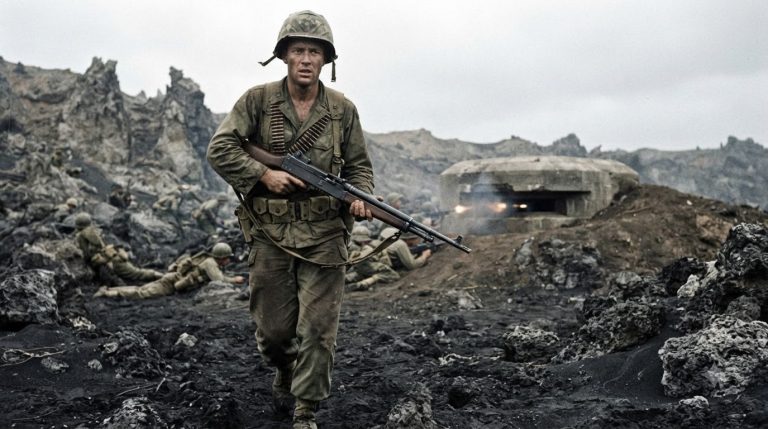
Spread out across the dirt lay twenty-three wrecked P-39 Airacobras, their aluminum skins twisted, scorched, and stripped bare of anything useful.
Sergeant Kugan didn’t even look up when I stopped beside the nose of a downed fighter.
He was sitting on a rusted oil drum, scraping dried red dirt out of the socket head of a 15/16-inch wrench with a dull pocket knife.
“They took the radios, Lieutenant,” Kugan spat, his voice raspy from aviation gas fumes and salt air. “They took the instruments, the control cables, and the seat cushions. You’re looking at scrap iron.”
“I don’t want the instruments, Sergeant,” I said, wiping a mixture of sweat and diesel soot off my forehead with the back of my sleeve. “I want the Oldsmobile cannon sitting in the nose.”
Kugan paused his scraping, the dull blade clicking against the steel socket.
He looked toward the tree line where the jungle met the edge of the strip, then turned his bloodshot eyes back toward the wooden hull of PT-48 docked down at the point.
“That gun weighs two hundred and eighty pounds,” he said, tapping the wrench against his knee. “It fires a thirty-seven millimeter high-explosive shell at a hundred and fifty rounds a minute. Put that on an Elco plywood deck, and the first three-round burst will tear your bow clean off.”
“The torpedoes pass five feet under their barges,” I replied, grabbing the heated edge of the engine cowling to steady myself as a generator backfired in the distance. “Our fifty-calibers bounce off their steel armor plate like dry peas. We either find a way to punch a hole through four-millimeter steel, or we stop going out at night.”
Kugan grunted, sliding off the drum and stepping toward the mangled nose of the P-39.
The fighter’s prop hub was buried three feet into a coral mound, the long steel barrel of the M4 cannon protruding from the center like a broken bone.
He reached into the dark fuselage cavity, his grease-stained fingers wrapping around the seized mounting bolts.
“The threads are fused,” Kugan muttered, pulling back a hand covered in black, congealed hydraulic sludge. “Salt air got to the recoil cylinders two weeks ago. I don’t have penetrating oil, and I don’t have the right socket.”
He held up the 15/16-inch wrench, the heavy jaw chipped at the corner.
“We have aviation gasoline,” I said, pulling my shirt collar away from my neck as the afternoon sun baked the back of my skull. “And we have six hours until the tide turns.”
Kugan didn’t argue.
He splashed a cup of raw aviation fuel directly onto the seized engine reduction gear housing, the blue liquid hissing against the hot metal.
He fitted the slightly oversized socket over the first bolt, leaned his entire body weight against the iron handle, and gritted his teeth as his shoulder muscles strained under the wet fabric of his shirt.
The metal shrieked—a sharp, violent pop that echoed across the airfield—before the bolt yielded an eighth of an inch.
CHAPTER 2: WELDS AND GREASE
The heavy 280-pound cannon housing hit the coral dirt with a dead, metallic thud that rattled my teeth.
Kugan wiped a line of black grease off his chin, leaving a dark smear across his sun-baked cheek.
“That’s three,” he grunted, kicking the metal casing of the salvage gun. “The recoil cylinder on the first one is split wide open, but this one’s clean. Now tell me how you plan to bolt a plane’s nose-gun to an eighty-foot plywood eggshell.”
“Chief Frey is waiting at the machine shop,” I said, hauling one side of the heavy steel barrel assembly while two sailors grabbed the breech. “He says he can build a pedestal.”
“Frey’s got one lathe and a broken generator,” Kugan muttered, but he grabbed the trailing edge of the frame anyway, his boots grinding into the sharp white coral as we hauled the iron toward the shed.
The machine shop smelled of burnt transformer oil, arc-welder ozone, and stale diesel.
Chief Machinist Mate Donald Frey didn’t offer a greeting when we dragged the cannon through the corrugated metal double doors.
He was standing over a scrap sheet of quarter-inch aluminum, sketching a rough circle with a grease pencil while the shop generator thumped rhythmically in the corner—coughing once every four seconds like a dying dog.
“Four bolt holes,” Frey said, not looking up from his aluminum scrap. “Matching your deck frames forward of the chart house. We take two main landing gear struts from a crashed B-17, cut the hydraulic tubes, and weld them to a twelve-inch steel plate.”
“Will it rotate?” I asked, leaning against a work bench cluttered with metal shavings and half-stripped carburetor valves.
“It’ll rotate if the generator stays running long enough for me to lay the bead,” Frey snapped, picking up a heavy cutting torch. “The base plate takes forty minutes. The rotating collar takes an hour—if the bearing surfaces don’t bind.”
He struck the striker, and a pale blue cone of fire hissed into the humid room.
Frey lowered his goggles, the dark glass reflecting the white-hot glare as he brought the flame down onto the scrap landing gear casing.
Ten minutes in, the overhead bulb flickered, dimmed to a dull amber wire, and died as the generator sputtered to a complete halt.
Frey swore softly, killing the gas valve on his torch in the sudden, heavy dark of the shop.
“Diesel rationing,” Frey said into the silence, his breath smelling of bitter coffee and tobacco. “Quartermaster cuts the line every two hours to save fuel for the airfield pumps.”
“We don’t have two hours to wait for the Quartermaster,” I said, stepping toward the dead generator.
I grabbed the manual hand-crank handle hanging from the fly-wheel frame, my palm sticky with old grease, and jammed it into the drive shaft.
“Kugan, get on the choke,” I ordered, bracing my boots against the dirt floor. “Chief, hold that torch ready. When this fly-wheel turns, you weld until the metal turns red.”
I threw my back into the crank, the heavy iron wheel resisting before yielding with a dull, wet clunk.
My shoulder muscles burned, the tropical heat trapping every drop of sweat against my uniform as I forced the cold crank through three full rotations until the diesel engine coughed, spat black smoke, and roared back to life.
Frey didn’t waste a second.
The arc welder struck bright blue, white sparks showering over his leather apron as he fused the steel pipe to the heavy base plate, the smell of melting iron filling the tight shed.
By twenty-one hundred hours, the crude pedestal mount sat on the dirt floor, its fresh welds still glowing a dull, angry orange in the dark.
It looked thick, heavy, and completely unapproved by any naval textbook in the Pacific.
“Three degrees of wobble on the collar,” Frey said, tossing a scorched rag onto the bench and wiping the sweat out of his eyes. “The bearings are salvaged from a bomber’s nose wheel. It ain’t pretty, Lieutenant.”
“It rotates,” I said, testing the heavy yoke with both hands.
The steel moved with a rough, grinding resistance, but it swung a full circle without seizing.
“Now get it down to the dock,” Frey said, turning back to his grease pencil. “Before Calvert finds out I used his landing gear scrap.”
CHAPTER 3: THE FOURBOLT SACRIFICE
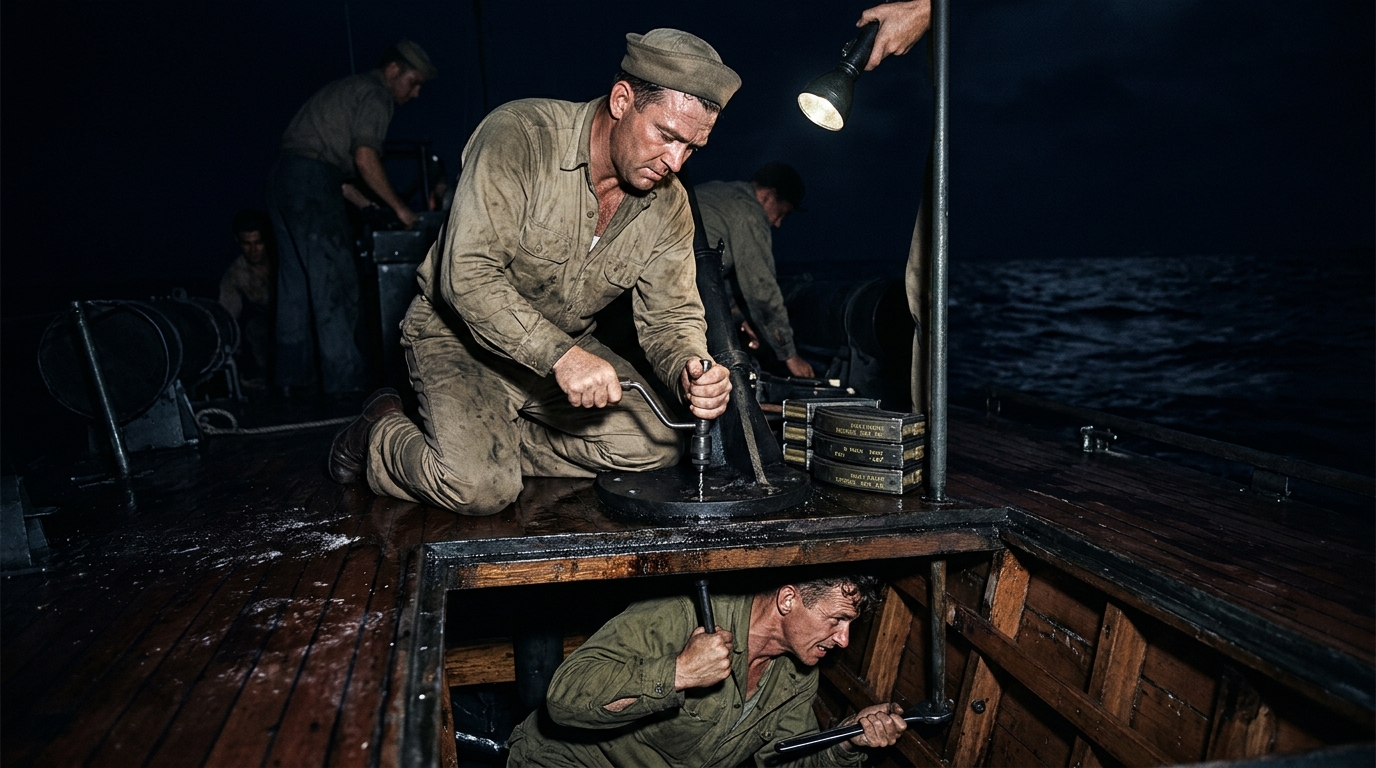
The hand-crank drill bit bit into the three-quarter-inch mahogany plywood deck, throwing up pale yellow wood shavings that smelled faintly of sap and damp rot.
I leaned my weight against the drill frame, my shoulder throbbing in rhythm with every slow rotation as the bit hit the double-layered oak stringer underneath.
Gunner’s Mate Harold Mitchell knelt beside me on the wet deck, holding a grease-slicked bolt between two fingers while watching the shadow of the chart house.
“The oak’s two inches thick right here, Lieutenant,” Mitchell said, his voice barely carrying over the dark slap of Iron Bottom Sound against the hull. “Hand-drilling four holes is going to take thirty minutes a pop. It’s almost midnight.”
“Then keep turning,” I said, handing him the iron crank without slowing my stroke. “If these bolts aren’t cinched down through the frame before zero-one-hundred, we don’t patrol.”
Mitchell took the handle, his knuckles white against the dark metal as he forced the bit through another inch of stubborn hardwood.
Halfway through the second hole, my boot slipped on a stray piece of paper tucked under the chart-room hatch step—a discarded, water-stained naval order stamped in fading red ink that had blown out of Commander Calvert’s office bin.
I picked it up, reading the block letters under the dim glow of my shaded flashlight: SUPPRESSION OF FIELD-MODIFIED AIRCRAFT ORDNANCE – ALL UNITS STAND DOWN ON CANNIBALIZATION.
I shoved the damp paper into my pocket, the cold reality settling in: command didn’t just disapprove of this—they were actively covering up the failure of our torpedoes to protect contract lines.
“We got a break-through on number three,” Mitchell grunted, the drill bit snapping through the underside of the deck frame with a dull crunch.
We lifted the heavy M4 cannon onto the rotating collar, the steel base plate aligning with our four hand-drilled holes.
I dropped the heavy high-tensile steel bolts into place, crawling into the cramped, dark bilge below the forward deck with a heavy iron wrench to secure the nuts from beneath.
Bilge water splashed against my chest, cold and oily, as I jammed my back against the hull ribs and threw my body weight into the wrench.
Above my head, the plywood deck groaned, flexing three-eighths of an inch under the raw mechanical tension of the steel mount.
“She’s cinched,” I called out, crawling back up through the hatch and wiping black bilge oil from my eyes.
Six loaded horseshoe magazines sat stacked on the bare deck beside the gun, forty pounds each, full of thirty-millimeter explosive shells.
“No test fire, Lieutenant?” Mitchell asked, resting his hand on the rough welds of the rotating collar.
“No test fire,” I said, watching the navigation lights of PT-40 cut through the black water ahead of us. “We test it on the first barge that shows up.”
CHAPTER 4: MIDNIGHT ON IRON BOTTOM SOUND
“Lead barge just flashed a signal lantern,” Mitchell called out, his boots wedged tightly against the deck cleats as he manually swung the 280-pound cannon frame. “They think we’re an escort.”
“Keep us on a parallel line,” I yelled down the engine hatch, the rumble of our twin diesels vibrating through the soles of my shoes. “Close the distance to six hundred yards.”
The lead Dhatsu barge realized the mistake a second too late.
A sharp orange arc of tracer fire erupted from their deck machine gun, seven-millimeter rounds stitching a line of white spray thirty yards short of our hull.
“Mitchell, take the shot!”
The Oldsmobile cannon roared, a blinding sheet of white muzzle flash washing over the entire bow deck and blotting out the stars for a split second.
The shockwave hit my chest like a thrown brick, the heavy wooden deck beneath us shuddering violently as the recoil drove the pedestal mount backward against the oak stringers.
High-explosive thirty-seven-millimeter shells cracked through the air at two thousand feet per second, two and a half rounds every second tearing into the lead barge’s steel bow plate.
The first three hits punched clean through the quarter-inch armor plating like wet cardboard, detonating inside the forward troop compartment with a heavy, hollow thud.
The fourth round found their fuel storage—a thirty-foot spout of thick orange flame erupting straight into the night sky as the lead vessel lost steering and veered hard to port, burning down to the waterline.
“Magazine empty!” Mitchell barked, his hands working fast in the dark as he yanked the horseshoe-shaped iron feed frame off the gun casing.
He slammed the second forty-pound magazine onto the receiver, the locking latch clicking home with a solid, metallic smack.
The second Japanese vessel cut its wheel, trying to slip away toward the dark shadow of Cape Esperance, but our helmsman matched their turn degree for degree.
At four hundred yards, Mitchell squeezed the trigger again, the steady, rhythmic thump-thump-thump of automatic cannon fire rattling the chart house windows as the shells walked straight up the second barge’s engine housing.
An ammunition locker on their deck cooked off in a blinding flash that lit up the tired, sweat-slicked faces of our entire deck crew.
The remaining two barges scattered into the darkness, but the water between us was already choked with burning oil and floating timber.
My hands were shaking slightly as I gripped the bridge rail, my ears ringing in the sudden, dead silence that followed the engagement.
The pedestal mount had held, the welds hadn’t snapped, and three armored targets that used to shrug off our fire were now sitting at the bottom of the bay.
Then Mitchell wiped a handful of greasy soot off the cannon breach and looked up at me, his finger pointing down at the base plate.
“Lieutenant,” he said softly, “look at the deck joint.”
CHAPTER 5: THE CRACKING DECK
“The wood’s delaminating,” Mitchell muttered, his voice low as he wiped grease off the M4’s warm receiver. “Another ninety rounds of automatic fire and that pedestal tears clean out of the deck frame.”
Before I could answer, a blinding searchlight beam sliced through the darkness from the Tulagi pierhead, locking PT-48 in a harsh white glare.
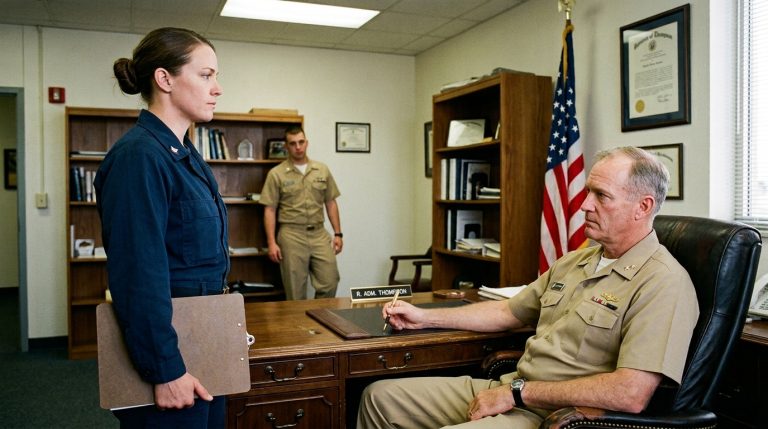
Commander Alan Calvert stood at the end of the wooden dock, his starched khaki uniform spotless despite the tropical humidity, flanked by two armed shore patrol guards.
He didn’t wait for us to tie off the mooring lines before stepping down onto our gunwale, his polished leather shoes squeaking against the wet mahogany.
“Lieutenant Lynch,” Calvert said, his eyes dropping immediately to the scorched 280-pound aircraft cannon mounted on the bow. “What in the hell is this circus act?”
“Two enemy supply barges sunk off Cape Esperance, sir,” I said, rising to my feet and holding my ground. “One disabled.”
“You breached Navy regulations, mutilated government aircraft property at Henderson Field, and bolted an unapproved artillery piece to an Elco hull,” Calvert snapped, stepping closer until I could smell the faint peppermint on his breath. “You broke the deck frame. You compromised an eighty-thousand-dollar naval vessel.”
He reached into his breast pocket and pulled out a folded charge sheet, tapping it against his thumb.
“I’m placing you under administrative arrest for destruction of Navy property,” Calvert continued, his voice cold and even. “You’ll be on a transport to Pearl Harbor by morning to face a general court-martial.”
“We tried three torpedo runs last week, Commander,” Mitchell interjected, stepping forward with his wrench still clutched in his right hand. “Every single one ran right under their five-foot draft.”
“Silence, Sergeant!” Calvert barked, not even glancing at Mitchell. “The Bureau of Ordnance designs our weapons doctrine, not a bunch of field mechanics with cutting torches.”
I reached slowly into my soaked tunic pocket, my fingers wrapping around the wet, crumpled paper I’d found on the chart-room floor hours earlier.
I unfolded the damp sheet and held it out between us—the red-stamped directive explicitly ordering the suppression of field-modified aircraft weapons to protect stateside ordnance contracts.
Calvert’s eyes locked onto the red ink, his jaw tightening as his hand froze in mid-air.
“You knew the torpedoes were useless,” I said, keeping my voice flat and even. “You knew it before we ever left dock, and you suppressed the field mod because Washington didn’t want us fixing their mistakes with scrap metal.”
Calvert didn’t flinch, but his fingers twitched against the edge of his charge sheet as he leaned in close to my ear.
“You think a piece of paper saves you, Lynch?” Calvert whispered, his voice dripping with arrogant authority. “By sunrise, that gun comes off this boat, or you spend the rest of this war in a brig.”
CHAPTER 6: THE AFTERMATH ON THE DOCK
“You think you can black-mail a senior officer with an unfiled paper?” Calvert spat, his voice strained as he snatched the paper from my fingers and shoved it deep into his trousers pocket. “I’ll have shore patrol seize this boat before the sun hits the palm trees.”
“Go ahead,” I said, leaning back against the chart-house door frame and crossing my arms. “Then you can explain to Squadron South Pacific why four boat crews spent eight hours stripping Henderson Field because our official supply line is delivering dud runs.”
Calvert stepped back onto the pier planking, his chest heaving under his stiff khakis as he looked at the two shore patrol guards holding their rifles.
Neither guard moved.
They stood frozen on the dock, staring past Calvert at the scorched thirty-seven-millimeter barrel pointing out over Iron Bottom Sound—and at the three empty horseshoe magazines sitting stacked on our bow deck.
“You’re a line officer, Lynch,” Calvert whispered, his posture stiffening as he tried one last desperate pull on his authority. “You don’t alter fleet architecture. You don’t sign off on unsanctioned modifications.”
“We didn’t alter architecture, Commander,” I replied, pointing down at Chief Frey, who was stepping off a Higgins boat onto the dock ladder with a leather tool roll over his shoulder. “We fixed an engineering oversight so our men stop burning in the channel.”
Frey walked up the pier without asking permission, dropping a thick bronze wheel bushing and four steel backing plates directly at Calvert’s feet.
“Steel backing plate goes under the plywood, Commander,” Frey said, wiping grease off his forehead with a ragged sleeve. “Distributes the recoil load straight across the oak stringers. Takes twenty minutes to bolt in.”
Calvert looked at the steel plates, then at the charge sheet still crumpled in his hand.
He knew the math as well as I did: two barges destroyed, zero American casualties, and a field modification that proved three years of fleet doctrine was dead wrong.
Without another word, Calvert tore the charge sheet down the middle, dropped the pieces onto the wet pier timber, and turned his back on PT-48.
By dawn, the morning sun broke over the palms at Lunga Point, casting a long gray shadow from the thirty-seven-millimeter cannon across the wooden deck.
Mitchell sat on a turned-over grease tub near the bow, methodically wiping down the M4’s receiver with an oily rag, his hands steady and quiet in the cool air.
I picked up the 15/16-inch socket wrench lying beside the hatch, feeling the cold weight of the iron in my palm before setting it neatly inside the tool kit on the bridge.