The Steel Teeth of Normandy: How an Unlikely Jersey Cab Driver Shattered an Unbeatable Defensive Wall
CHAPTER 1: THE KILLING GROUND
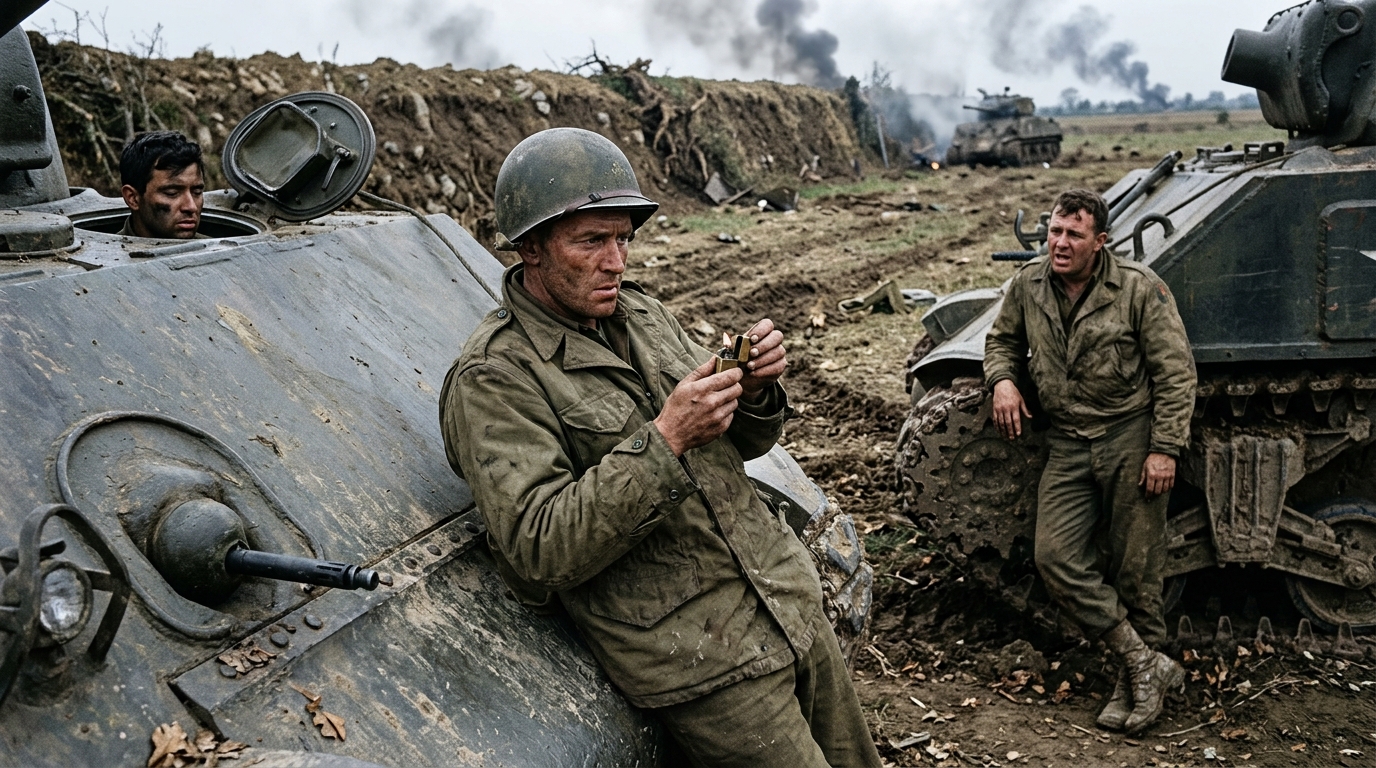
The diesel exhaust from the Sherman thirty yards to the left smelled sour, heavy with unburned fuel and scorched motor oil.
Sergeant Curtis Cullinane kept his back flattened hard against the cold armor plate of his own tank, feeling the heavy vibration of enemy rifle fire snapping off the earthen bank directly above his head. Dirt and dried hawthorn leaves showered down over his helmet with every burst.
“She won’t climb it, Sarge!” De Passo yelled from the driver’s hatch, his face smeared with black bearing grease and sweat. “The belly plate shows every time the nose tips past forty degrees. They’ve got a handheld rocket team sitting right in the ditch on the other side!”
Curtis didn’t answer right away. He reached into his field jacket, pulled out a dented brass Zippo, and flipped the cap open with a sharp, metallic click. He didn’t light it. He just thumbed the cold flint wheel, feeling the rough serrations bite into his thumb while he looked at the wall in front of them.
It was twelve feet high. Twelve feet of packed soil, granite river stones, and oak roots thick as a man’s thigh, woven together over four hundred years of Norman farming.
Thirty yards away, the other Sherman made another desperate engine roar, its tracks throwing up clods of dark dirt as it tried to ride up the embankment. The tank’s nose tilted toward the gray sky, exposing the soft, thin metal of its underside for barely three seconds.
A sharp, whistling crack cut through the trees, followed immediately by a flat, hollow thud.
The tank shivered. White smoke erupted from the engine deck before thick, greasy black flames swept across the open turret hatch. Curtis closed his Zippo with a dull snap and shoved it back into his pocket.
“Get back down in the hull, De Passo,” Curtis said, his voice flat, stripped of speed or panic. “We aren’t climbing that damn thing.”
Captain DeBlanc stumbled down the sunken farm lane ten minutes later, his uniform soaked through with sweat, a paper map dripping wet in his hand. He slammed his hip against the Sherman’s track assembly, gasping for air while artillery from three miles back thundered uselessly against empty open fields.
“Command wants this lane open by noon, Cullinane,” DeBlanc rasped, wiping mud off his jaw with a filthy sleeve. “We’ve got two infantry companies pinned behind this hedgerow getting chewed up by mortars. We have to breach.”
“We go over that bank, Captain, and we burn just like Miller’s rig,” Curtis said, gesturing with a thumb toward the smoking wreckage down the track. “Their anti-tank boys are just waiting for our noses to point at the clouds.”
“Then what do you propose?” DeBlanc barked, his patience completely spent. “We don’t have engineers left in the sector. We have zero smoke shells left in the supply dump, and artillery won’t touch this close to our own line. We’re on our own.”
Curtis walked three paces to the edge of the embankment, stooped down, and plunged his hand directly into the thick, tangled mat of vegetation at the base of the mound. His fingers caught on a knot of taproots solid as iron. He pulled hard until his knuckles turned white, but the dirt didn’t even shift.
“We don’t climb it,” Curtis said, standing up and dusting the black loam from his palms. “We cut the legs right out from under it.”
CHAPTER 2: SCRAP METAL AND CYNICISM
DeBlanc stared at the charred wreck thirty yards down the lane. Smoke rolled off the Sherman’s turret in thick, greasy ribbons, carrying the heavy stink of burnt rubber and oil.
“Cut it?” DeBlanc muttered, his voice cracking from exhaustion. “With what, Curtis? You think we’ve got a specialized demolition corps sitting in our back pocket? The beachhead is a logjam three miles deep.”
Curtis pulled his brass Zippo from his pocket. He didn’t strike the wheel. He just ran his thumb over the cold, cross-hatched metal casing, feeling the small dent near the hinge where it had taken a drop on the transport ship.
“The Germans left thousands of tons of heavy steel sitting on the sand where we walked ashore,” Curtis said. His voice was low, steady, carrying the flat cadence of a man describing a bad engine in a New Jersey garage. “Those beach hedgehogs. Angles, rails, I-beams embedded in concrete. Strong enough to rip the bottom out of a landing craft.”
“That’s scrap metal,” DeBlanc said, stepping around a heap of fallen gravel. “It’s junk sitting in six inches of salt water.”
“It’s high-carbon steel,” Curtis replied, leaning back against the cool armor plate of his hull. “And it’s already there. We get two torch teams down to Omaha, cut those rails into four-foot prongs, and weld them straight to our lower glacis plate. When we hit the bank, the teeth bite the roots before the hull hits the dirt.”
DeBlanc let out a dry, bitter laugh. He wiped his face with the back of his hand, leaving a streak of dark grease across his forehead. “You’re a cab driver from Cranford, Sergeant. You’re not an armorer. You’re not an ordnance officer.”
“An ordnance officer isn’t sitting in this ditch,” Curtis said bluntly. “And the cab drove fine because I knew how to fix the axle when the pothole broke it. We try to climb another bank tomorrow, and you won’t have a company left to command.”
A flight of twin-engine P-38s roared low over the treetops, their engines rattling the leaves off the hawthorn branches above them. Neither man looked up.
DeBlanc pulled his eyes away from the burning tank down the road. He looked at Curtis, then down at the Zippo resting in the sergeant’s palm. The Captain’s shoulders sagged two inches, the rigid posture of West Point doctrine collapsing under the weight of three days of slaughter.
“You’ve got twenty-four hours,” DeBlanc said, his tone turning sharp, defensive. “I can’t give you a squad. I can’t give you a truck. You take De Passo, you take Corporal McDonald, and you find your own transport to the beach.”
“We’ll need the battalion maintenance torch,” Curtis said.
“Take it,” DeBlanc growled, turning his back to head toward the battalion command dugout. “But if you ruin a thirty-ton Sherman with a pile of beach junk, I’ll have your stripes before the sun comes up on the fourteenth.”
Curtis didn’t wait for him to change his mind. He snapped the Zippo lid closed, the metallic click sharp against the quiet roar of distant artillery, and turned to the driver’s hatch.
“De Passo,” Curtis called out. “Get your gloves. We’re going hunting on the beach.”
CHAPTER 3: THE BEACH OF DEAD IRON
The surf hissed fifty yards behind them, dragging gray foam over half-buried landing craft and tangled rolls of concertina wire. Cold salt spray stung the side of Curtis’s face, mixing with the sharp smell of acetylene gas from the portable rig McDonald carried on his shoulder.
“Look at the thickness of these I-beams,” McDonald grunted, dropping the gas tanks onto a flat rock with a wet thud. “This isn’t boiler plate, Sarge. This is heavy structural rail. It’s going to take ten minutes just to slice through one corner.”
“Then we slice faster,” Curtis said. He reached down and ran his gloved hand along the main support girder of a half-sunken hedgehog.
The metal was cold, encrusted with barnacles and wet sand, but beneath the rust, the steel was dense and unyielding. The Germans had designed these girders to stop thirty-ton landing craft dead in their tracks. It was high-tensile material, far tougher than the mild steel plates used on standard field trailers.
De Passo squatted near the surf line, adjusting the regulator valve on the oxygen tank with a small brass wrench. “Beach master’s deputy came by two minutes ago, Sarge. Said we can’t haul this stuff off without a quartermaster release. Said it belongs to the salvage depot now.”
Curtis didn’t turn around. He flipped open his Zippo, sparks flying off the wheel until the yellow flame caught against the wind. He held the flame close to the torch tip to light it, setting the hiss of blue gas into a sharp, piercing whistle.
“Tell the beach master he can come take the torch out of my hand himself,” Curtis said, adjusting the oxygen thumb-screw until the flame turned a bright, inner cone of needle-sharp blue. “And tell him if he wants to trade places with a tank crew in the hedgerows tomorrow morning, I’ll sign his paperwork right now.”
De Passo let out a short snort and went back to holding the spare steel bracing steady.
Curtis leaned into the cut, pressing the blue flame directly against the base of the four-inch angle iron. Showers of bright orange sparks erupted across his boots, crackling against the damp sand. The smell of burning slag and salt water filled the air, thick enough to coat the back of his throat.
As the steel glowed cherry red and melted away under the high-pressure stream, Curtis noticed something odd along the sheared face of an adjacent beam—a piece that had already been broken during the naval bombardment.
The break wasn’t flat. It hadn’t snapped clean along the weld line like cheap iron. The beam had sheared at a sharp forty-five-degree angle, leaving a ragged, jagged tooth edge that had peeled upward under extreme force rather than crushing flat.
Curtis paused for a second, lowering the flame. He wiped his gloved thumb across the jagged edge of the broken girder, feeling the sharp, angled lip that had gouged deep into the wet sand.
“Sarge?” McDonald asked, wiping sweat from his eye with a shoulder. “Torch freezing up?”
“No,” Curtis said, looking from the sheared girder back to the straight, four-foot prongs he had sketched on his paper ration box. “We don’t want straight teeth.”
“What do you mean?” De Passo asked, shifting his grip on the heavy steel rail. “Straight prongs push straight ahead, don’t they?”
“Straight prongs will hit a stone bank and act like a battering ram,” Curtis said, his voice dropping as he stared at the angled break. “The engine will push, the dirt will push back, and the metal will just bend or snap right at the weld. We need an angle that lifts while it cuts.”
“We’ve only got enough gas in these two tanks to cut eight beams, Sarge,” McDonald warned, glancing back toward the road where their borrowed Dodge truck sat idling. “We mess up the cuts now, we don’t get a second try.”
Curtis didn’t argue. He brought the torch back down to the iron, the blue flame biting into the heavy metal as the tide began to lap against his heel.
“Cut them four feet long,” Curtis ordered, his jaw set hard as the sparks rained down around his knees. “And cut the tips at forty-five degrees. Every single one.”
CHAPTER 4: THE WELD AND THE ANOMALY
The electric arc hummed like a nest of furious hornets, casting violent blue shadows across the muddy yard behind the maintenance shed.
Smell of molten iron and scorched primer filled the mask, forcing Curtis to take shallow breaths through his nose. He guided the flux-coated electrode with steady hands, laying down a thick, overlapping bead of filler metal where the steel prong met the lower hull plate.
“Hold that bracing beam higher, McDonald,” Curtis called out through the dark glass visor. “If the angle slips two degrees, the whole tooth points at the sky.”
McDonald grunted, leaning his shoulder hard against a wooden fence post used as a lever beneath the prong. “My arms are going numb, Sarge. This damn girder weighs sixty pounds on its own.”
Curtis cut the current, lifting the mask. The blue glow dissolved into pitch darkness, saved only by the dim red beam of a hooded flashlight De Passo held over the assembly. Smoke curled off the fresh weld, red-hot slag flaking off to reveal a dull, silvery seam.
“Bring the sledge, De Passo,” Curtis said, wiping sweat from his eyebrows with a filthy forearm. “We test the joint before we touch the second prong.”
De Passo stepped forward, swinging a twelve-pound steel mallet in a broad overhead arc.
The hammer head struck the tip of the four-foot prong with a deafening ring that echoed off the metal shed walls. The steel shivered. A hair-line fracture instantly webbed across the upper weld seam, and with a dull clack, the entire prong snapped cleanly off the base plate, tumbling into the mud.
De Passo froze, the sledge hammer resting near his boots. “It sheared right at the root, Sarge. The iron couldn’t take the shock.”
McDonald let out a long, ragged breath, letting his wooden lever drop into the dirt. “We’re out of time. Captain DeBlanc’s driver said the battalion moves out at dawn. If this weld gives way against a hand sledge, a twelve-foot bank will tear the whole front off the tank.”
Curtis knelt in the cold mud, picking up his dented brass Zippo. He flipped the cap open, thumbing the flint until the small yellow flame flickered between his fingers.
He held the light right up to the broken seam. The metal hadn’t failed inside the weld bead itself. The original steel plate on the Sherman’s hull was intact; it was the flat base of the prong that had crystallized and snapped under the straight-on impact.
“It’s not the weld,” Curtis murmured, squinting at the crystalline grain of the broken metal. “It’s the force vector. A flat plate concentrates all the hammer’s shock right on one seam. When the track pushes forward, the root bank acts like a pry bar against the joint.”
“So what do we do?” De Passo asked quietly. “We don’t have time to re-engineer the whole mounting.”
“We don’t make it a flat joint,” Curtis said, closing his lighter with a sharp, decisive snap. “We weld gussets—triangular brace plates—underneath each tooth, angled at forty-five degrees. When the tooth bites the dirt, the force doesn’t snap the weld. It transfers the tank’s downward mass straight into the frame.”
McDonald wiped his forehead, looking down at the scattered pile of beach iron in the dirt. “That’s twice as many welds, Curtis. It’ll take us right up to first light.”
“Then pick up the torch,” Curtis said, pulling his welding mask back over his eyes. “We aren’t going into those hedge lanes with broken teeth.”
CHAPTER 5: THE TRIAL OF DIRT AND ROOTS
Morning fog hung low in the sunken field, thick with the smell of wet grass and exhaust. Fifty yards ahead, the earthen wall rose like a dark, living barrier, its crown massed with thick oak roots and tangled hawthorn.
Captain DeBlanc stood forty paces back near the edge of the tree line, his hands jammed into his field jacket pockets, eyes fixed on the four steel prongs welded to the Sherman’s lower hull. A dozen infantrymen from the 29th sat in the high grass, watching in stony silence.
“You’re sure about the speed, Curtis?” De Passo’s voice crackled through the intercom headset, muffled by the engine’s heavy metallic thrum. “If these welds snap when we hit, we’re going to bury the nose right in the mud.”
“Twenty miles an hour,” Curtis said into his throat mic, his eyes locked on the base of the mound. “Don’t touch the brake, and don’t lift off the gas. If we slow down, we’re just climbing.”
Curtis reached into his collar, pulled out his brass Zippo, and gave the flint wheel one quick flick before dropping it back inside his jacket pocket. The small metal casing felt warm against his chest.
“Engage clutch,” Curtis ordered. “Go.”
The thirty-ton tank lurched forward, tracks tearing up great sheets of wet Norman turf as De Passo poured fuel into the radial engine. The speed indicator needle trembled, climbing past ten, fifteen, then locking at twenty miles an hour.
The hedge wall rushed toward the bow hatch like a rising cliff.
TUNNEL VISION OVERRIDE: Environmental details dissolved into raw momentum and violent vibration. The Sherman hit the dirt bank with a shuddering crash that threw Curtis hard against the steel rim of the hatch ring.
For one terrible half-second, the hull lurched upward at thirty degrees. The engine screamed under sudden, crushing resistance, the tracks spinning uselessly against loosened topsoil.
Then the four-foot angled teeth bit.
Instead of sliding up the face of the mound, the forty-five-degree steel prongs drove straight through the ancient root mat. The upward angle forced the tank’s immense forward mass downward, turning thirty tons of momentum into a massive hydraulic chisel.
A loud, wet crack echoed inside the hull as centuries-old oak roots snapped six feet beneath the surface.
Dirt, rocks, and torn vegetation erupted over the glacis plate, showering through the open turret hatch. The nose dropped back to level ground as the steel teeth sheared completely through the base of the wall, pushing a hundred cubic feet of earth aside like loose sand.
Ten seconds after impact, the Sherman burst through the far side of the hedgerow into the open orchard beyond, leaving a clean, ten-foot-wide breach behind it.
Curtis slammed his hand down on the hull side, his knuckles raw against the painted iron. “Hold position! De Passo, idling speed!”
He turned in the hatch to look back through the gap. The opening was flat, wide, and clear. No exposed belly armor, no trapped tracks, no climbing.
Captain DeBlanc stood at the edge of the breach, looking down at the severed, foot-thick roots protruding from the dirt walls, then up at the Sherman sitting on the far side with its welds intact and its main gun pointed straight down the lane.
DeBlanc stepped through the fresh gap, his boot crunching over shattered stone, and looked up at Curtis in the hatch.
“How many of those beach girders do we have left on the truck?” DeBlanc called out, his voice stripped of every trace of cynicism.
“Enough for four more tanks, Captain,” Curtis said, wiping dirt from his goggles. “If we get more torches, we can do the whole battalion by midnight.”
CHAPTER 6: THE IRON BREAKTHROUGH
The steady clink of hammers against iron ringed out through the orchard as welding crews worked down the line under blue-hooded lamps.
De Passo sat in the mud near the drive sprocket, using an oily rag to wipe thick clods of Norman clay off the forward steel teeth. The prongs were scuffed bare, the green primer completely stripped to dark metal, but the welds were solid. Not a single seam had buckled.
“Quartermaster officer from Division came down ten minutes ago,” McDonald said, leaning his shoulder against the track guard while he wiped grease off his hands. “He was throwing a fit about us cutting up those beach obstacles without a signed property requisition.”
Curtis took a slow sip of the bitter coffee, feeling the heat sink into his chest. “What did Captain DeBlanc tell him?”
“Told him if he wanted the scrap steel back, he could bring a wrench and unbolt it himself,” McDonald said, a slight grin cracking his dirt-streaked face. “Officer walked off real fast when De Passo revved the engine.”
DeBlanc stepped around the front of the Sherman, holding a clipboard with three pages of fresh field orders pinned to the top. He stopped right beside the four steel teeth, kicking the center prong with the toe of his combat boot. The metal gave off a dull, solid thud.
“Division approved the modification across the entire sector,” DeBlanc said, his voice quiet, stripped of the harsh desperation from two days ago. “Every maintenance company on the beachhead is fabricating these cutters tonight. General Bradley’s staff is calling them Rhino tanks.”
Curtis set his tin cup down on the flat steel fender. He reached into his jacket pocket, pulled out his dented brass Zippo, and turned it over twice in his hand.
“They can call them whatever they want,” Curtis said, running his thumb over the small dent in the casing. “Long as the guys inside don’t have to watch another nose point at the sky.”
“We move out for Saint-Lô at 0500,” DeBlanc said, looking Curtis dead in the eye. “You’re taking point for the battalion, Sergeant. Show the rest of the company how to clear a path.”
“Understood, Captain,” Curtis replied.
DeBlanc nodded once, turned on his heel, and walked down the row of idling tanks where arc-welding sparks continued to shower into the twilight, lighting up the dark hedges like summer fireflies.
Curtis stood up on the fender, picked up a grease gun from the tool rack, and bent down toward the front idler housing. He didn’t look at the map board hanging inside the command tent. He didn’t check the sky for plane silhouettes.
He just set the nozzle against the grease fitting, leaned his weight into the lever, and worked the pump until fresh black grease squeezed clean through the bearing seal.