The Frozen Sky: An Everyman’s Miracle Over Bremen
CHAPTER 1: THE COLD ARITHMETIC
Minus forty degrees turns grease to candle wax inside the receiver of a fifty-caliber machine gun.
Alan McGee pressed his gloved thumbs against the butterfly trigger of the twin barrels, feeling the vibration of two Wright Cyclone engines shuddering through the steel housing of the top turret. Below his boots, the plywood floorboards of Snap, Crackle, Pop groaned under the aerodynamic drag of four miles of empty German air. Out through the Plexiglas dome, the sky over Bremen wasn’t blue—it was a bruised, jagged gray stitched together by black blossoms of heavy flak.
“Flak at ten o’clock, high,” the intercom crackled, the pilot’s voice thin and flat, stripped of all emotion by the throat mic. “Keep your eyes up, Alan.”
Alan didn’t answer. He adjusted his grip, his right palm pressing the cold metal of a silver Saint Christopher medal he’d wrapped around the spade grip three missions ago. A black burst detonated fifty yards off the port wing, the concussion slamming into the B-17 like a wooden mallet hitting a hollow crate. The metal skin shrieked. Shrapnel slammed into the waist fuselage with the wet thunk of iron spikes driven into green pine.
Then came the smell—scorched oil, raw gasoline, and the copper tang of melted wiring.
The starboard inner engine didn’t just fail; it tore itself from its mountings in a cloud of thick, roiling soot. The bomber violently yawed to the right, dropping thirty feet in a single stomach-churning plummet.
Alan leaned into the mechanical sight, spinning the turret ring to track a pair of Focke-Wulf 190s diving out of the sun. He squeezed the spade grip. Nothing. The hydraulic line had severed, spitting red fluid across his sheepskin boots.
“Engine three is gone!” the co-pilot yelled over the screaming wind. “We’re losing the tail! Bail out! Bail out—”
The intercom died in a screech of static.
Alan reached down toward the aluminum hook where his chest-pack parachute was supposed to hang. The bracket was empty. The sudden decompression had sheared the storage latch, hurling the canvas pack backward into the roaring furnace of the burning radio room.
A second shell struck the dorsal spine directly behind his head. The air didn’t just rush out—it exploded outward, taking the Plexiglas dome, the aluminum ribs, and the steel turret ring with it. The bomber snapped in half like a dry birch branch.
The world tilted upside down. The screaming noise of four engines vanished, replaced by the deep, hollow roar of the open atmosphere swallowing him whole.
CHAPTER 2: FOUR MILES OF SKY
The air tore at his flight jacket with the force of an iron rake.
Alan didn’t feel his boots leave the metal floorboards of the waist section. One second the B-17’s severed tail section was spinning away like a burning leaf, and the next, there was only gray emptiness, screams of tearing aluminum dying out into the endless roar of the slipstream.
At twelve thousand feet above the target, terminal velocity catches up with a human body in twelve seconds.
He didn’t have a parachute chest pack to pull. He didn’t even have his goggles—the wind had snatched them off his leather helmet, freezing his eyelids shut in a fraction of a second. He forced his eyes open against the needle-sharp frost, his vision reduced to a dark, blur-edges tunnel.
His right hand was clamped so tight around the silver Saint Christopher medal that the broken links of the chain bit straight through his inner sheepskin glove into the meat of his palm.
The cold hit his lungs first. At minus thirty-eight degrees, breathing in was like inhaling crushed glass.
His brain began to fog—hypoxia creeping in with a soft, deceptive warmth around the edges of his neck. He knew the numbers from the altitude chamber lectures back at Maxwell Field. At twenty thousand feet without supplemental oxygen, a man had about three minutes of functional consciousness before his blood turned to gray slop.
He looked down through the haze.
The earth wasn’t rushing up to meet him yet; it was a distant, frozen quilt of green paddocks and gray concrete channels, utterly motionless under the winter overcast. The wind didn’t sound like wind. It sounded like an iron train roaring through a granite tunnel, pounding his eardrums until his nose began to bleed inside his mask.
His body wanted to tumble, arms and legs flailing in the thin air.
He dragged his limbs inward, forcing his knees to lock and his spine to stiffen. Common sense—the simple, stubborn habit of a kid who used to fix broken axles in a Plainfield garage—took over where panic tried to nest. If he tumbled, the centrifugal force would knock him cold before he ever cleared the lower cloud bank.
A ragged piece of insulation from the bomber’s radio room fluttered past his face, matching his speed for three agonizing seconds before diving away into the gray haze below.
His body was a lead weight falling through an ocean of ice. He couldn’t stop the ground. He couldn’t call for help. He couldn’t reach for a rip cord that wasn’t there. All he could do was hold his frame level, keep his lungs working on the thin scraps of oxygen left in his blood, and wait for the air to get dense enough to burn.
The clouds swallowed him at eight thousand feet.
Darkness replaced the light, cold mist slapping his face with the sting of saltwater. His fingers were completely numb now, but his grip on the silver medal didn’t loosen.
Then the cloud layer shattered beneath him.
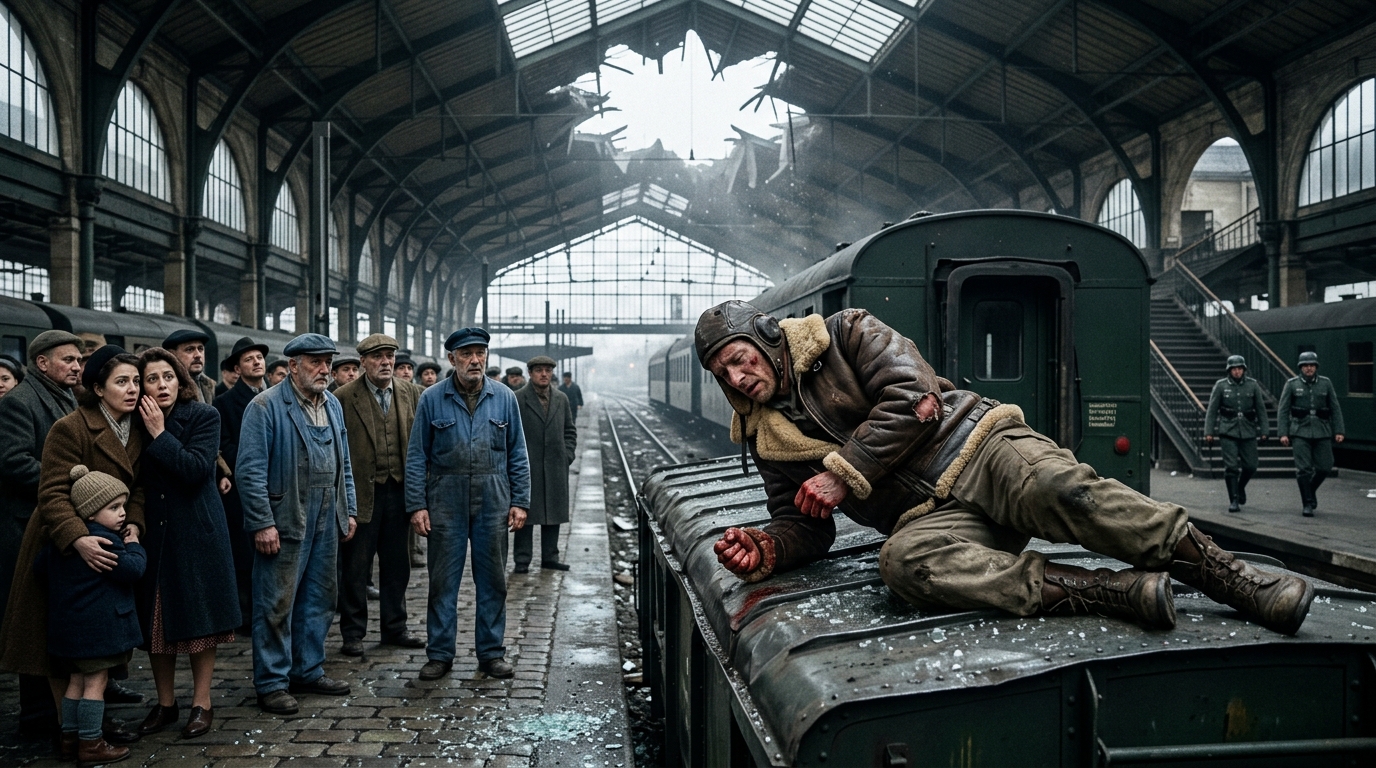
The industrial grid of Bremen rushed up from the fog like a wall of dark iron and red slate, the vaulted glass canopy of the St. Lazar railway station sitting directly in his line of fall.
CHAPTER 3: THE BROKEN CANOPY
Alan tucked his elbows against his ribs, crossed his forearms over his forehead, and clamped his jaw until his back molars creaked.
The first pane of reinforced wire-glass shattered with a sound like a grenade detonating in a tiled shower. The impact slapped his boots skyward, flipping him belly-down into the structural frame. The glass didn’t yield all at once; it buckled in a millisecond cascade, absorbing the initial shock wave of his hundred-twenty-mile-an-hour descent before tearing open under his weight.
Then came the lead framing.
The horizontal structural rib caught his right shoulder with the dull, bone-jarring thud of a sledgehammer hitting wet oak. The heavy iron brace bent downward six inches, groaning under the kinetic load before snapping cleanly at the rivet line. The momentum dragged Alan through the breach, but the angle shifted three degrees—just enough to turn a direct spike into a sliding scrape across the vaulted archway.
A second tier of wired glass took his knees.
The glass exploded into thousands of blunt, frosted diamonds that rained down through the dark rafters of the terminal below. His flight jacket tore along the main seam, sheepskin lining bursting open as the steel framework stripped away his heavy outer layer.
The deceleration hit his chest like a physical wall, forcing every scrap of air from his lungs in a red-tinged spray.
The third layer was an old timber scaffold left by maintenance crews beneath the central skylight. Alan crashed through the cedar planks shoulder-first. The dried wood splintered into kindling, absorbing the remaining momentum in a shower of sawdust and rusty nails before dropping his battered frame twenty feet onto the wooden roof of a parked baggage car.
The car’s tin roof caved inward with a deafening metallic screech.
Alan rolled to a stop against the curved edge of the baggage roof, his knees bent at awkward, impossible angles and his head resting against a cold steel rivet.
Silence hit the terminal like a falling curtain, broken only by the rhythmic pitter-patter of falling glass shards landing on the concrete platform below.
He couldn’t feel his legs. He couldn’t feel his hands. But inside his right palm, squeezed tight between his bloody fingers, the cold silver Saint Christopher medal was still there, pressed flat against his knuckles.
Up above, through the jagged, gaping starburst punched into the station’s vaulted roof, four miles of empty gray sky looked completely still.
Heavy boots began echoing across the cobblestone floor beneath the train car—fast, deliberate, and approaching his position with iron heels clicking against the stone.
CHAPTER 4: AMONG THE RUBBLE
“He’s breathing,” a voice rasped above him—harsh German, clipped at the edges by cold air and absolute disbelief. “Call the field doctor. Now.”
Hands rough as wire brushes grabbed the shredded wool collar of Alan’s flight suit, hauling his upper body onto a canvas stretcher. Every nerve along his ribcage roared in violent protest, the friction of movement tearing at splintered bone beneath his skin.
He didn’t scream. He couldn’t force enough air through his throat to make a sound, his breath catching in ragged, shallow wheezes that tasted of rust and high-altitude ozone.
The field hospital smelled of carbolic acid, wet wool, and cheap coal smoke.
German surgeons worked under two unshaded yellow bulbs, their white aprons already stiff with gray grease and dried plasma. A senior officer with thick silver-rimmed spectacles stepped over the zinc basin, his gloved fingers prodding Alan’s right shoulder where the joint had been crushed flat against the steel roof framing.
“Where is his silk?” the officer demanded, turning to a guard holding Alan’s cut-away harness. “Where is the canopy?”
“No silk, Herr Major,” the guard spat, placing a hand on his holster as if expecting a trap. “The roof took him directly. Four miles, open sky.”
The surgeon froze, his thumb resting against the jagged edge of Alan’s collarbone. He looked from the shredded flight jacket down to Alan’s right hand.
Alan’s fist remained clamped shut, blood dried dark across his knuckles where the silver medal was crushed between his frozen fingers.
The surgeon took a pair of steel forceps and pried the metal disc free, holding the snapped chain up to the dim bulb. The medal swung in a slow, rhythmic circle over Alan’s chest—a tiny circle of cold silver reflecting the stark yellow light.
“He shouldn’t have a heartbeat,” the doctor whispered, his voice dropping all military authority, replaced by the flat, stunned realization of a man staring at broken mathematics. “The internal deceleration alone should have ruptured every organ.”
Alan forced his left eye open, looking past the doctor’s shoulder at the chalked casualty board on the lime-washed wall.
Dozens of entries, neatly lined up in black ink: target coordinates, aircraft types, status codes. Under Bremen – 22 Dec, every other name had a clean red line struck through it.
The doctor leaned down, his breath smelling of stale coffee as he pressed two fingers against Alan’s wrist, feeling the slow, stubborn pulse dragging itself through damaged flesh.
“You dropped through four miles of air without a chute, American,” the surgeon murmured, setting the silver medal on the metal tray beside a pile of extracted shrapnel. “And you expect us to fix you.”
Alan let his head roll sideways on the hard rubber pillow, his sight locking onto the silver medal sitting on the tray.
“Just fix… the hands,” Alan rasped through cracked lips, his voice barely a whisper against the hum of the generator. “I still got work to do.”
CHAPTER 5: THE COLD INTERROGATION
“Four miles,” the intelligence officer said, his voice flat, dry as winter hay. “No silk. No harness. You drop through the roof of St. Lazar, and my medical staff spends three days picking lead framing out of your shoulder.”
Alan sat straight in the straight-backed wooden chair, his right arm bound tight in a stiff, chalky plaster cast that pinned his elbow against his ribs.
His left hand rested on his knee. Nine of his fingers were wrapped in thick yellowed gauze, stiffened by iodine and drying blood.
“Your doctrine demands precision,” von Berndt continued, sliding a thick gray folder across the desk. “High-altitude daylight boxes. Interlocking fields of fire. Beautiful mathematics on paper.”
He opened the folder, revealing carbon-copied briefing logs stamped with the crest of the Eighth Air Force Air Intelligence section—documents salvaged from another downed B-17 three weeks prior.
“Your commanders knew the temperature at twenty-two thousand feet,” von Berndt said, tapping a red-underlined paragraph on the top page. “They knew the human body freezes in under ninety seconds without heated suits. They knew your bail-out gear fails six times out of ten at that altitude.”
Alan looked at the red ink on the paper.
The numbers were laid out in clean, orderly columns: fuel consumption, bomb tonnage, estimated airframe attrition, expected crew loss percentages.
“They sent you up anyway,” the officer spat, leaning forward until his shadow covered the desk. “They knew you wouldn’t survive the jump if your ship took a hit. You were statistical scatter, Sergeant.”
“We had a job to do,” Alan said.
His voice came out low, raspy, but completely steady. He didn’t blink. He didn’t look away from the silver medal sitting between them on the pine grain.
“A job?” von Berndt scoffed, a tight, bitter smile pulling at the corner of his mouth. “You are broken meat sitting in a prisoner camp. Your group commander is already filling out a form letter to your mother in New Jersey, telling her you died over Bremen for a doctrine that doesn’t even work.”
“It works enough,” Alan said, his left hand reaching across the desk.
He didn’t grab the medal like a weapon. He simply pressed his thumb against the cold silver surface, sliding it two inches across the wood toward his side of the desk.
“You’re checking my wrist every two hours to see if I’m still breathing,” Alan said, his eyes locking onto the major’s steady gaze. “Because if a kid from Plainfield can fall four miles through your roof and sit in your chair talking back to you… your math is the thing that’s broken.”
Von Berndt’s hand twitched over the fountain pen, the nib digging a dark spot of blue ink into the corner of the gray folder.
CHAPTER 6: THE QUIET RETURN
Alan dipped the edge of the rag into the metal polish tin, his left hand moving in small, deliberate circles over the silver medal.
His right hand—stiff, scarred across the knuckles, and missing the full range of movement in three fingers—anchored the medal against the bench top. The shoulder didn’t ache anymore unless the weather turned raw and wet, but the joint sat slightly lower than his left, a permanent ridge under his cotton work shirt.
The high command’s calculated casualty projections, the cold arithmetic of the daylight bombing doctrine, and the interrogator’s dry files had all collapsed under the sheer weight of time.
The war had ended. The camp gates had been pushed open by American tanks. The doctrine planners had filed their official postwar reports, writing off thousands of missing airmen as unavoidable operational statistical loss.
None of those charts had accounted for a twenty-two-year-old turret gunner hitting a vaulted glass roof in Bremen and walking away.
A screen door clicked shut at the front of the house, followed by the quiet sound of tires humming along the paved driveway.
Alan wiped the excess polish from the silver disc with a clean strip of flannel, exposing the smooth, rounded edges worn down by years of quiet handling. The snapped chain link had been re-soldered decades ago, a tiny lump of brass solder holding the ring together.
He didn’t talk about the fall at town council meetings or hardware store counters.
When neighbors asked about the stiffness in his right arm or the deep silver line running down his collarbone, he told them he’d had a rough landing in Europe and left it right there.
He didn’t need to explain the physics, the altitude, or the broken mathematics of a four-mile drop to people who thought survival was a matter of clever planning or good luck. He knew the truth was much simpler: the sky opened up, his body endured the friction, and he held his boundary until the earth stopped him.
Alan set the polished medal inside a small wooden cigar box on the shelf above his vise.
He closed the lid, picked up an oil can, and turned toward the lawnmower engine sitting on his workbench, squeezing two drops of oil onto the throttle cable until the spring moved freely in the quiet afternoon air.