The Iron Tin Can: A Gritty Stand on the Burning Horizon of Samar
CHAPTER 1: THE GRAY HORIZON BREACHES
The cold spray off the Laty Gulf hit Commander Ernest Evans square across the jaw, tasting of salt and burning diesel.
At 0640, the morning mist didn’t break—it ruptured. Four miles out, giant shadows rose out of the gray water like iron mountains. Pagoda masts. Crimson spotting flashes. The massive, eighteen-inch barrels of the Yamato clearing the haze, heavy enough to drop a building with a single round.
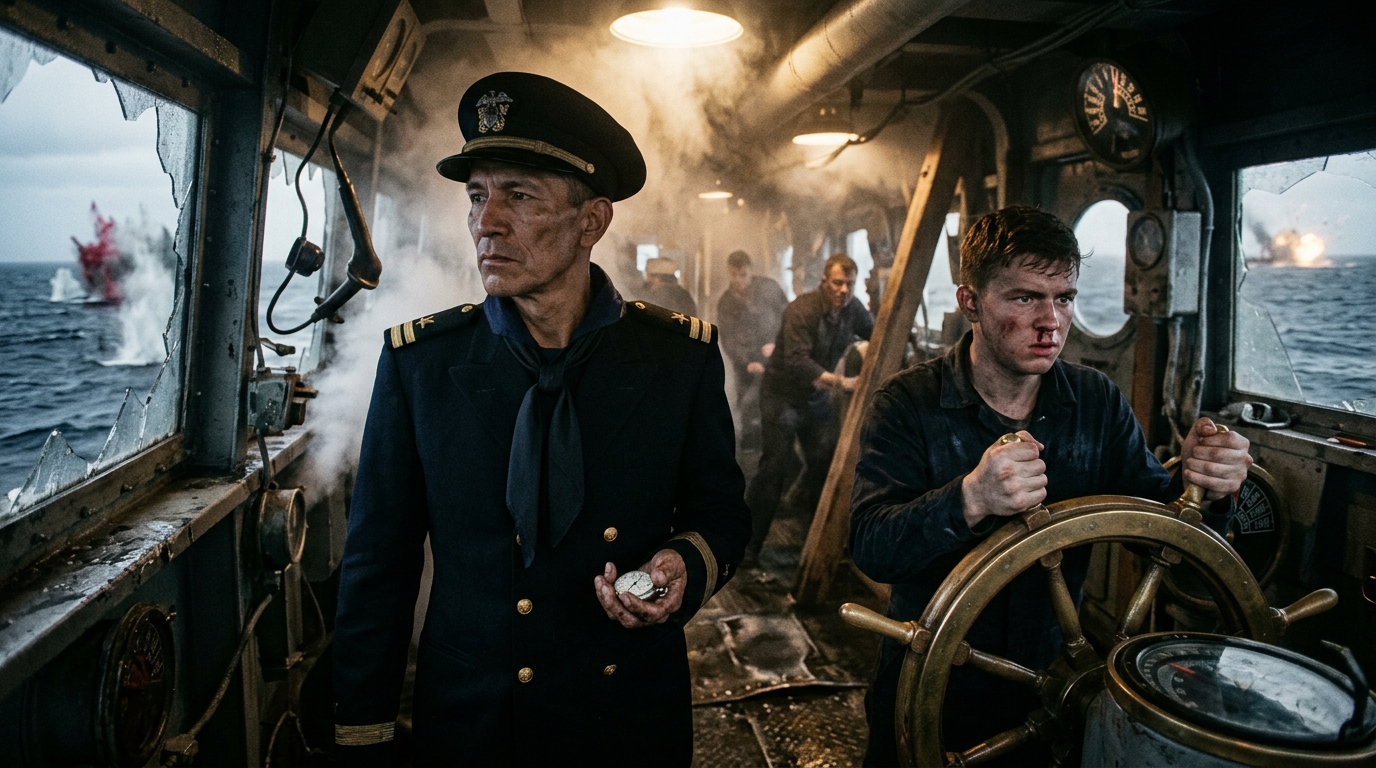
Evans didn’t flinch. He reached into his coat pocket, pulled out a tarnished brass watch with a web of cracked glass over the face, and thumbed the stiff winder. Click. Click. Click.
“Sir,” the young helmsman whispered, his knuckles white on the brass spokes of the wheel. “Those aren’t our ships.”
“No,” Evans said, his voice flat as a dry prairie road. “They aren’t.”
He turned to the open bridge, his boots gripping the slick deck plating. Three hundred and twenty-seven men were staring up at him from the mounts and the fire control platforms, most of them barely old enough to shave, braced against the cold morning wind.
“A large Japanese fleet has been contacted,” Evans announced over the squawk box, his delivery dry, plain, and stripped of drama. “They are fifteen miles away and headed this way. We will engage them at flank speed. Then we will lay smoke. Commence firing.”
The boilers groaned beneath their feet as the USS Johnston surged forward, her 2,200 tons of thin steel shuddering against thirty-five knots of churning ocean.
Five-inch guns roared from the forward turrets, sending tiny fifty-five-pound shells barking into the sky toward battleships that weighed thirty times their size. The rounds fell thousands of yards short, splashing uselessly into the swell, but Evans didn’t care about damage yet. He needed noise. He needed them to look at him.
Towers of colored water—red, yellow, blue—erupted around the Johnston as the giant enemy fleet began ranging their massive guns, framing the small destroyer in geysers of dyed seawater.
Evans didn’t blink. He just tapped the cracked glass of his watch, calculating the distance as the horizon turned to pure fire.
CHAPTER 2: BLIND IN THE CHEMICAL HAZE
“Bridge! Fire control!” The squawk box squealed, choked with static. “Primary torpedo mount is dead! Hydraulic line snapped on the track—it’s jammed dead center!”
Evans didn’t curse. He didn’t slam a fist against the bulkhead. That was for men who had options.
He thumbed the winder on his watch, snapping the brass casing shut with a sharp clack. “Bypass the tubes. Focus all five-inch mounts on the heavy cruiser leading the line.”
“Sir, without torpedoes, we can’t dent their armor—”
“We aren’t trying to sink them, Lieutenant,” Evans cut in, his voice bone-dry. “We’re making them dodge.”
He shoved the engine telegraph all the way to the stop. “Lay chemical smoke. Turn us hard to starboard.”
The Johnston leaned violently as thirty-five knots of churning ocean fought the rudder, throwing the helmsman sideways against the wheel housing. From the stern, chemical generators roared to life, vomiting a wall of blinding, sulfurous white fog that swallowed the ship whole.
Outside, the ocean turned into a war zone of geysers. Fourteen-inch shells from the Japanese battleships slammed into the sea fifty yards off the port side, showering the open bridge in stinging salt spray and red dye.
Evans wiped the salt from his eyes, staring into the wall of smoke his own ship was spinning behind them. “Gunnery, fire on my mark through the blind gap. Rapid fire. Do not stop until the barrels melt.”
The forward five-inch guns barked in unison, the concussive blast rattling the rivets in the steel floor plates under their boots. They couldn’t see the heavy cruiser through the haze, but they didn’t need to. They just needed the Japanese gunners on the other side to hear the lead tearing through their rigging.
Through a brief tear in the chemical smoke, the silhouette of a Japanese heavy cruiser emerged, her broadside guns trained squarely on the fleeing escort carriers behind them.
“She’s ignoring us,” the helmsman yelled, his knuckles white as he fought the wheel. “She’s laying into the carriers!”
“She won’t ignore us for long,” Evans said softly. He grabbed the bridge railing, leaning over the edge as the Johnston burst out of the smoke bank, heading straight for the cruiser’s flank at point-blank range. “Fire!”
CHAPTER 3: TEETH AGAINST ARMOR
The flash of light was blinding, instantly followed by the screech of metal ripping apart on the enemy cruiser’s bridge deck.
Shrapnel rained down across the Johnston’s forecastle like iron hail. Evans didn’t flinch, but a jagged sliver of cold steel sliced across the side of his skull, spraying warm crimson down his collar. He reached up, wiped the stinging blood out of his eye with his sleeve, and never took his gaze off the horizon.
“Keep firing!” Evans roared above the deafening thunder of the deck. “Feed those guns until they glow red!”
A split second later, the sky tore open.
Three fourteen-inch armor-piercing rounds from a trailing Japanese battleship slammed straight into the Johnston’s aft engine room. The shockwave felt like dropping a house onto the deck. The floor plates buckled violently upward, throwing Evans off his feet.
Thick white steam belched from the hatchway below as severed high-pressure lines ruptured, filling the air with the smell of scalding water and scorched oil. The engine telegraph needles fluttered and dropped—from thirty-five knots straight down to seventeen.
“Loss of power to steering!” the helmsman gasped, his arms straining against the dead wheel as blood dripped from his nose onto his shirt collar. “She’s drifting port, Captain! We’re dead in the water!”
“She’s not dead until we stop breathing,” Evans said, pushing himself up off the deck plating.
He didn’t check his wound. He pulled his brass watch from his pocket, noting the cracked glass was now smeared with dark red grease, and tapped the casing sharply against his palm. Tick. Tick. Tick.
“Damage control, report!” he yelled down the voice tube.
“Engine Room One is destroyed, sir!” a breathless voice crackled back through steam static. “Flooding in compartment three! We’re cutting fuel lines manually!”
“Seal the bulkheads and patch what you can,” Evans ordered, his voice terrifyingly calm. “I need twenty knots. Give me twenty knots or we become target practice.”
Down below, men worked in pitch-black, water-filled compartments, hauling heavy timber shores against weeping steel bulkheads while scalding steam hissed off the bulkheads. They didn’t calculate whether they were going to live; they just turned wrenches until their knuckles bled.
The deck shuddered again as the surviving boiler caught fire, the engine humming back to a jagged, straining rhythm. The Johnston crept back up to twenty-four knots, her hull tilting heavily to port as sea water sloshed through her belly.
Evans looked out across the water. The Japanese cruiser column was turning, their massive gun turrets swinging away from the helpless escort carriers to track the battered tin can that refused to die.
“Look at them,” the helmsman whispered, wiping sweat and soot from his brow. “They think we’re a cruiser. They think we’ve got a whole fleet behind us.”
“Let them think it,” Evans said, his fingers tightening on the cracked pocket watch. “They came here expecting a turkey shoot. We’re going to make them think they walked into a slaughterhouse.”
CHAPTER 4: THE SOUND OF TURNING IRON
The heavy thunder of the enemy’s main batteries abruptly ceased.
Across the gray waters of Samar, giant eighteen-inch turrets swung away, their long steel muzzles returning to baseline as thirty-two warships began hauling around in formation, turning their sterns toward the unprotected escort carriers.
“Sir?” the helmsman gasped, wiping soot from his eyes as he stared through the salt-stained windscreen. “They’re… they’re turning around. They’re breaking off!”
Evans didn’t cheer. He didn’t drop his posture. He slowly opened his left hand, looking down at the cracked face of his brass watch.
The glass was spider-webbed, coated in grease and salt, but the second hand kept jumping forward—one stubborn, unhurried tick at a time.
Layer 1 had been the jammed torpedo rack, the terrifying reality that his ship had charged a battle fleet without her primary teeth. But Layer 2—the true core of this battle—had never been about the torpedoes. It was about the mind of the man across the water.
Vice Admiral Kurita, sitting in the armored citadel of the Yamato, had seen a single tin can charge into the teeth of thirty-two warships without a second’s hesitation. He had calculated that no officer in his right mind would throw a light destroyer into guaranteed annihilation unless an overwhelming carrier fleet was waiting just beyond the smoke screen.
The sheer, unhinged audacity of the Johnston had constructed a phantom fleet in the enemy admiral’s mind. The lie was born entirely out of Evans’s refusal to back down.
“Look at them go,” the gunnery officer breathed, leaning heavily against the bulkhead as the tension drained out of his shoulders. “They had us. They could have swept us under in five minutes.”
“They didn’t have us,” Evans said, his voice quiet, carrying the heavy exhaustion of a man who had given every drop of his strength to hold a boundary. “They had numbers. We had work to do.”
The deck beneath them gave a sickening lurch as water finally overwhelmed the forward bulkhead, the bow dipping lower into the swell. Steam hissed out of the deck vents one last time before dying into silence.
“Pass the word,” Evans ordered, his voice steady as he placed the pocket watch back into his coat pocket. “Abandon ship. All hands over the side.”
He didn’t rush. He walked the length of the ruined bridge, ensuring the helmsman cleared the ladder first, before stepping toward the listing railing.
Far across the water, the troop transports at Leyte Gulf remained untouched, their supply lines open, their decks safe. The common-sense duty of a tin can sailor was finished.
Evans rested his hand against the hot, scarred steel of the main mount one last time, feeling the slow, quiet rhythm of the ocean taking the ship home.