The Weight of a Single Knock: How One Widow Stood Firm Against Entitled Greed and Forged an Unshakable Community
CHAPTER 1: THE MIDNIGHT KNOCK
The house groaned under the pressure of the wind, scraping tree branches against the siding like fingernails on a chalkboard. Ruth pulled her knitted robe tighter across her chest and tried to focus on the crossword puzzle resting on her knee. Her teacup sat half-full, the liquid stone-cold and forgotten. At seventy-three, living alone for seven long years since Samuel passed, storms were more than just bad weather. They were heavy reminders of how thin the walls were between quiet safety and sudden chaos.
Then came the pounding. Three hard, desperate thaps against the front door that made the glass rattle in its frame. Ruth’s hand froze halfway to her mouth. Her heart started hammering against her ribs like a trapped bird. Three months prior, a break-in had stripped her home of Samuel’s gold watch and every ounce of security she owned. The police had called her an easy target, a vulnerable population. She kept a Louisville slugger near the entryway for precisely that reason.
“Help!”
The voice cut through the howling gale, rough as sandpaper and thin as a dying radio signal. Ruth inched toward the heavy oak door despite every internal instinct screaming at her to step back. She parted the frost-fuzzed curtain just an inch. A man was hunched against her porch post, snow caked thick on his shoulders and blood dripping steadily from his left arm onto her clean white welcome mat. Across the back of his heavy leather jacket, bold letters cut through the gloom: Hell’s Angels.
She knew the headlines from the week before. Biker brawls, drug raids, and violence up in Casper. But she also remembered the small paragraph on page four about a charity ride raising thousands for the children’s hospital. Two truths sitting side by side. Down on the porch, the injured man used his good arm to drag his fallen motorcycle closer under the eaves, protecting the machine from the driving snow even while bleeding. A careless person didn’t move with that kind of deliberate respect for property.
“Please,” he rasped, his knees buckling slightly as the cold bit deeper into his frame. “I cannot make it much further.”
Samuel used to say that the measure of a person isn’t what they do when things are easy, but what it costs them when things get hard. Ruth reached out, her fingers wrapping around the cold brass deadbolt. It clicked like a gunshot in the silent room. She pulled the door open, letting the freezing gale rush in as the stranger stumbled forward, collapsing against her doorframe.
Up close, he was younger than she expected, maybe forty, with intricate tattoos snaking up his neck. But his eyes were exhausted, a stark storm-cloud gray, and entirely devoid of malice. “Name’s Vincent,” he muttered, swaying on his feet. Ruth reached out instinctively, steadying his broad shoulder with her own frail hands. He smelled of motor oil, cold leather, and the metallic tang of fresh blood.
“I’m Ruth Harper,” she said, her voice holding steady despite the adrenaline spiking in her veins. “You’re hurt.”
She guided him past the entryway toward the warmth of the wood-trimmed kitchen, telling him to sit by the stove while she fetched towels and her old first-aid kit. Vincent slipped his boots off by the door without being asked, taking deliberate care not to track melting snow across her hardwood floors. When she returned with antiseptic and gauze, he sat quietly in Samuel’s old armchair, staring at his hands with the absolute stillness of a man who expected nothing from the world.
She cleaned the gash on his forearm with the gentle efficiency of a retired librarian who had spent decades tending to scraped knees and quiet sorrows. He didn’t flinch when the alcohol hit the raw flesh. “Marines,” he answered quietly when she asked how long ago he served. “Fifteen years.” He worked now at Morrison’s garage downtown, fixing bikes and engines.
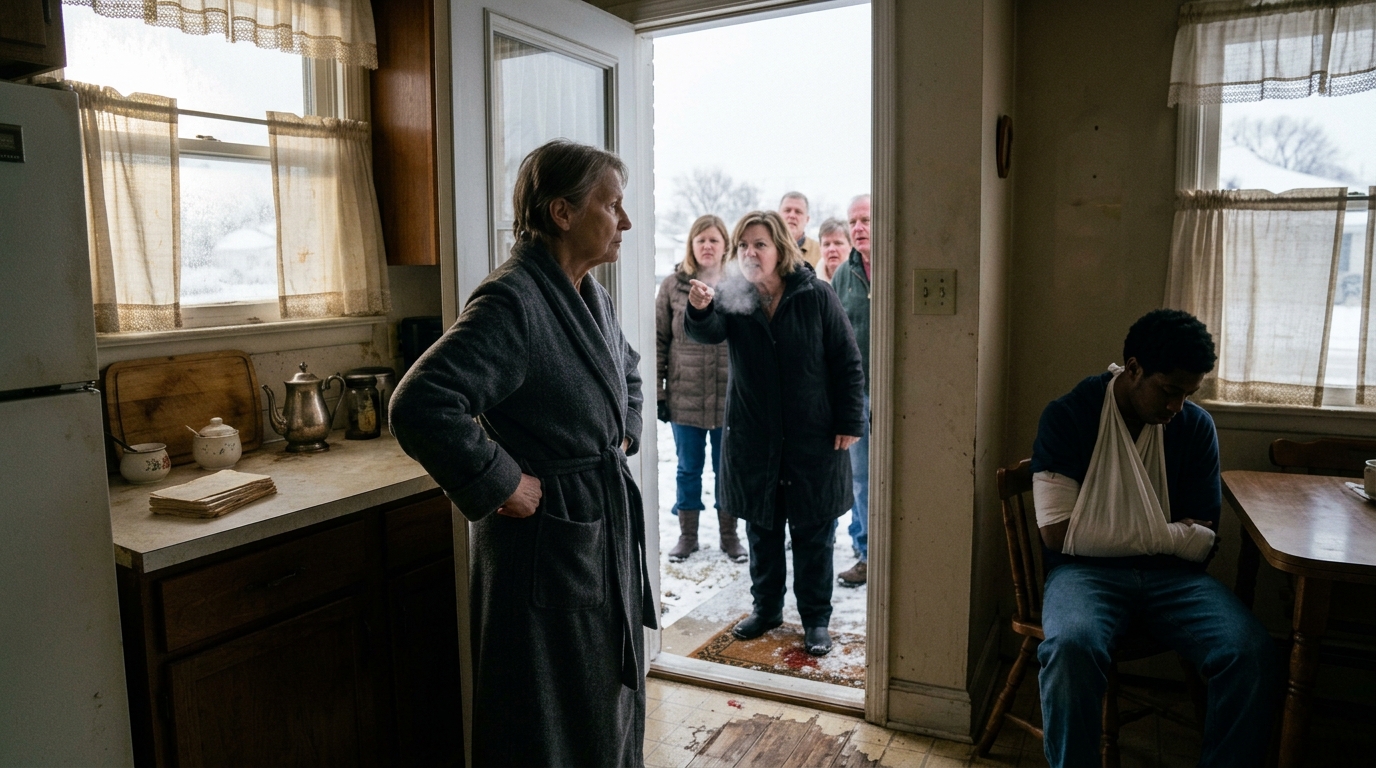
Across the street, through the sliver of space between her kitchen curtains, a harsh porch light cut through the dark. Mrs. Caldwell stood on her porch in the freezing wind, pressed tight to her telephone receiver like a general reporting enemy lines. Her eyes were locked directly on Ruth’s kitchen window, taking in every shadow and movement for morning dissection. Ruth watched her neighbor’s silhouette pinch with absolute, unyielding disapproval.
Vincent noticed her gaze and looked down at his battered hands. “I’ll be gone as soon as the storm lets up,” he said, his voice flat with anticipated rejection. “Don’t want to bring you trouble.”
Ruth pressed a final strip of medical tape down, her thumb smoothing the edge with deliberate firmness. “The couch is better for a separated shoulder,” she said, her tone leaving no room for argument. “You aren’t going anywhere tonight.”
CHAPTER 2: MORNING TRIBULATION
Ruth didn’t reach for the receiver immediately. She watched the red message light pulse against the white plastic base. Across the street, Mrs. Caldwell stood squarely in the center of her frosted lawn like a general inspecting troops. Her phone was pressed hard against her ear, and her free hand pointed an accusatory finger directly at Ruth’s front window. Behind her, three other neighbors hovered on the frosty grass, their faces flushed with the eager electricity of shared outrage.
“They’re talking about both of us,” Vincent said quietly from the doorway.
He didn’t make a move toward his jacket drying by the radiator. He kept his posture small, his injured arm cradled carefully against his ribs, refusing to add any fuel to the fire burning outside. He possessed a grim, self-aware pragmatism that understood the heavy cost of his presence in her home. Ruth cinched the belt of her woolen robe tighter around her waist, ignoring the shrill ring of the telephone until it finally clicked off, leaving only the sound of the wind against the glass.
A sharp rap at the front door replaced the ringing phone. It wasn’t the frantic, desperate pounding of the night before. This knock was measured, polite, and unmistakably official.
Ruth walked down the narrow hallway, her slippers whispering against the hardwood floor. When she pulled the heavy oak door open, Officer Martinez stood on the welcome mat, holding his uniform cap in his hands. He kept his expression neutral, but his eyes darted quickly past her shoulder to take in the leather jacket draped over the chair and Vincent standing calmly in the living room.
“Morning, Mrs. Harper,” Martinez said, his voice dropping into a professional register. “Got a call about a possible disturbance here last night. Everything all right?”
“Everything is fine, Officer,” Ruth replied, her footing solid on the threshold. “A man was caught in the storm, and I gave him shelter. That is the extent of it.”
Before Martinez could answer, a loud huff cut through the cold morning air. Mrs. Caldwell marched across the asphalt and right up to the edge of the porch, her breath pluming in white clouds of indignation.
“She’s harboring a gang member, Officer Martinez!” Mrs. Caldwell announced, her voice pitched to carry all the way down Maple Street. “Everyone in this town knows what those patches mean. You can’t just let criminals take over our neighborhood!”
Vincent didn’t flinch, nor did he step forward to defend himself. He simply stood near the hallway archway, his gray eyes fixed steadily on the floorboards, absorbing the public insult with a heavy, unyielding silence.
Ruth felt a hot spike of anger push through her exhaustion, but she kept her voice entirely level. “Nobody is taking over anything, Helen. He is a local mechanic whose bike failed in the freezing wind.”
Martinez looked between the furious neighbor and the weary librarian, weighing the situation with the quiet exhaustion of a man who knew local politics better than he cared to admit. “Unless somebody witnessed a crime, Mrs. Caldwell, this is a private matter,” the officer said firmly, replacing his cap. “Have a good morning.”
The young officer turned and walked back toward his cruiser, leaving Mrs. Caldwell standing on the walk with her mouth half-open in shock. The small knot of watching neighbors began to shuffle backward, disappointed by the lack of an arrest.
Ruth closed the door against the cold and leaned back against the wood, her hands finally beginning to tremble from the delayed adrenaline. Vincent looked up from the floor, his expression heavy with quiet regret.
“I told you,” he murmured, his voice rough. “The patch brings heat wherever it goes. You don’t need this kind of fight.”
Ruth looked at the battered man standing in her hallway, then out the window at the empty street where her neighbors had retreated to plot their next move. The friction had only just begun.
CHAPTER 3: THE PAPER TRAP
The kitchen was dead silent except for the low hum of the refrigerator. Ruth slipped her thumb beneath the heavy paper flap and slid the thick document out.
Petition for Emergency Guardianship.
The bold text seemed to jump right off the page, cold and clinical. It was filed in the name of her son, Nathan Bennett, claiming she was no longer mentally competent to manage her own affairs. The accusations listed inside read like a malicious checklist compiled by someone who wanted her erased. Poor judgment, vulnerability to criminal elements, and severe cognitive decline.
Every single point was backed by statements gathered from the neighborhood gossip chain. Lisa, her daughter-in-law, had signed her name as a co-petitioner right beneath Nathan’s sharp signature. They weren’t just questioning her choices. They were dismantling her life to get to her assets.
Vincent walked back into the kitchen, his good hand wiping a streak of motor oil from his wrist. He didn’t ask questions. He simply leaned over her shoulder, his eyes scanning the dense legal paragraphs with an immediate, grim understanding.
“This isn’t about safety,” Vincent said, his voice dropping an octave. “This is about access.”
Ruth looked down at the signature line where her son had signed away any pretense of familial loyalty for a quick way out of his debts. She didn’t cry. At seventy-three, grief was a familiar weight, but this wasn’t grief—this was cold, unadulterated friction.
“He thinks I’m an easy target,” Ruth said, her fingers curling around the edge of the paper until the corners crumpled. “He thinks I’ll just fold because the court uses fancy words.”
Vincent pulled out his phone without another word and dialed a number. “I’m calling Thomas. We need someone who knows how to tear these people apart in their own language.”
Within an hour, the kitchen was crowded with men who looked like they belonged on a highway rather than a legal dispute, but their minds were as sharp as tacks. Thomas Morrison, the club president, laid down a legal contact while Jake started mapping out public financial records on his laptop. The trap had been sprung, but they had entirely misjudged who was standing in the center of it.
CHAPTER 4: INSTITUTIONAL WALLS
Dr. Angela Peterson did not look up from her clipboard. Her expression remained professionally flat, stripped of any warmth as she measured Ruth’s composure against a checklist of predetermined biases.
“Can you tell me today’s date, Mrs. Harper?”
The questions weren’t about care; they were designed to isolate. Every standard query about orientation and memory was immediately followed by a pointed pivot toward her personal associations.
“Tell me about your relationship with the motorcycle club members,” Dr. Peterson asked, her pen pausing mid-stroke.
“They are people who helped when a storm knocked my door down,” Ruth replied, her hands resting calmly in her lap. “They are neighbors and mechanics.”
“And you see nothing concerning about men with criminal histories having regular access to your home?”
Ruth felt the invisible walls of the evaluation room tighten. The system wanted her to sound defensive, flustered, or confused. Instead, she kept her voice entirely steady, anchored by the memory of Samuel’s voice and Vincent’s quiet reliability.
“I know honest work when I see it, Doctor,” Ruth said. “I spent forty years helping people find truth in books. I know the difference between a threat and a neighbor.”
The door clicked open mid-session, and Lisa Bennett swept into the common room area just outside during a brief recess, carrying a bouquet of expensive flowers like a prop in a play. Her face was set in a mask of theatrical grief.
“Ruth, this is breaking Nathan’s heart,” Lisa said, settling across from her with calculated grace. “We just want to make arrangements for a safe, secure facility where you don’t have to worry about managing your own money.”
Lisa slid a fresh set of papers across the sticky plastic table—power of attorney documents drafted to hand everything over without a fight.
“All you have to do is sign right here,” Lisa whispered, tapping a manicured fingernail against the dotted line. “Save yourself the embarrassment of a public trial.”
Ruth looked down at the pen resting beside the papers. The easy way out was right there. No more competency hearings, no more staring eyes, no more institutional bleach.
She picked up the pen, held it for a heartbeat, and then set it deliberately down on the table.
“No,” Ruth said quietly.
Lisa’s polished composure cracked instantly, her voice dropping its sweet veneer. “You are making a terrible mistake, and when your criminal friends abandon you, don’t expect us to clean up the mess.”
CHAPTER 5: THE COURTROOM LEDGER
Judge Williams sat behind the high mahogany bench, his expression flat and unreadable as he turned the pages of the emergency petition. Across the aisle, Nathan Bennett avoided his mother’s eyes entirely, shifting nervously in his discount suit. Lisa sat directly behind him, dressed in somber black as though attending a funeral for a plan that was rapidly unraveling.
Sarah Morrison stood up with sharp, unyielding precision. She didn’t waste time with pleasantries or dramatic flourishes. She walked straight to the evidence table and laid out the hard financial records compiled by Jake.
“Your Honor, this petition is not about mental competency,” Sarah stated, her voice carrying cleanly across the quiet courtroom. “It is a desperate attempt by unemployed individuals facing crippling gambling debts and embezzlement investigations to seize control of a seventy-three-year-old widow’s assets.”
Nathan’s attorney, a thin man named Hendrickx, leapt to his feet with an aggressive objection. “Speculation, Your Honor! The respondent is clearly being influenced by outside criminal elements!”
“Sustained on phrasing,” Judge Williams replied, his gaze shifting toward the defense table. “Keep to the financial exhibits, counselor.”
Sarah did precisely that. She called Jake to the stand, who systematically laid out Nathan’s outstanding fifty-three-thousand-dollar bookmaker debts, the failed job history, and Lisa’s ongoing embezzlement investigation. The courtroom grew tense as the stark reality of the petitioner’s motives was dragged into the glaring light.
When Hendrickx cross-examined Ruth, his voice dripped with condescension. “Mrs. Harper, do you really expect this court to believe that associating with motorcycle club members is the sign of a sound mind?”
Ruth looked past the lawyer and met her son’s hollow, panicked stare head-on. Her fingers tightened against the smooth grain of the wooden railing.
“When my son needed help, he looked for a way to steal my home,” Ruth answered, her voice ringing out steady and absolute. “When I needed help, strangers walked out of a storm and offered their hands without asking for a single dime. That is not mental incompetence. That is common sense.”
Hendrickx stammered, scrambling for a counter-argument, but found nothing left to pull from his notes. Judge Williams lowered his reading glasses and stared directly at Nathan with cold, judicial finality.
CHAPTER 6: THE NEW SHAPE OF HOME
The gavel had fallen two hours earlier with the sharp, clean sound of absolute finality. Judge Williams had dismissed the emergency petition outright, slapping Nathan and Lisa with a strict two-year restraining order and exposing their financial exploitation for what it was.
The courtroom had emptied into quiet murmurs, leaving her son to slink out through a side exit without a word. There was no dramatic apology or sudden redemption, only the heavy, grinding collapse of a scheme built on unearned entitlement.
Now, the afternoon sun caught the weathered boards of her porch as Vincent stepped up beside her with a wrench in his hand. He didn’t offer a grand speech. He simply checked the hinge on the screen door, testing the swing twice with the quiet competence of a man who knew how to make broken things whole.
“Kitchen’s stocked for Saturday,” Vincent said, wiping his palms clean on a rag. “Thomas is bringing the paperwork for the new scholarship fund.”
Ruth looked past him toward the vegetable garden Samuel had planted decades ago, now thriving under careful hands. The weight of seven lonely years had dissolved, replaced not by emptiness, but by the steady, unyielding hum of a chosen family.
She turned and walked back inside, picking up her teacup from the wooden table. The storm had passed, the locks held firm, and the house finally felt like home.