Steel Beneath the Waves: The Trial of Armor and Fire in the Burning Pacific
CHAPTER 1: THE WEIGHT OF STEEL
The heavy steel rivet in Miller’s palm was slick with salt spray and hydraulic fluid. He rolled it between his calloused fingers, feeling the rough burr where the sheer-pin had snapped off during morning launch drills.
Above the flight deck, the tropical sky held a heavy, suffocating heat that made the three-inch armor plating burn through the thick soles of his boots.
“Deck’s hot, Chief,” Miller’s assistant, a nineteen-year-old rating named Knox, wiped a sleeve across his soot-stained forehead. “She ain’t breathing like the American ships do. It’s like walking on a cast-iron skillet.”
Miller didn’t look up from the starboard catapult track. His thumb traced a thin, dark line in the steel—a hairline seam weeping a faint film of black industrial grease. “She don’t need to breathe, Knox. She needs to hold.”
“Radar’s clear, but the lookout on the crow’s nest says the clouds are stacking thick to the south,” Knox muttered, his voice cracking slightly as he adjusted his heavy leather deck mitts. “If they come out of the sun, we won’t get ten minutes’ notice.”
“Then we don’t get ten minutes,” Miller said flatly. He pocketed the broken rivet and tapped his boot hard against the seam. “Get the tie-down chains double-cinched on those Sea Hurricanes. If a bomb hits this deck, I want those planes staying where I put them, not sliding into the elevator pit.”
A low rumble vibrated through the hull—not from the engines, but from the heavy armored lift grinding slowly upward from the lower hangar. The elevator platform locked into place with a dull, metallic thud that shook the steel plates under Miller’s feet.
“Chief!” a voice shouted from the island superstructure. A young officer leaned over the bridge railing, his signal slate clutched tight against his chest. “Captain’s orders! Clear the forward park! We’ve got incoming low-altitude contacts—no radar tracking!”
Miller didn’t run. He moved with the deliberate, heavy-footed pace of a man who knew every ton of steel beneath him had a price. He grabbed Knox by the shoulder, spinning the young sailor toward the nearest tie-down station.
“Grab the tension bar,” Miller ordered, his voice dropping into a raspy, quiet command. “We do this by hand.”
Across the flight deck, the silence vanished. The distant, throbbing whine of twin-engine Mitsubishi bombers broke through the cloud cover, low to the water and coming in fast. There were no fighter screens descending from the sky to intercept them. No early warnings from the radar shack.
Just three inches of British armor, two dozen men on an open deck, and the cold, unyielding weight of incoming iron.
CHAPTER 2: SHATTERED CANOPY
The sound didn’t arrive through the air; it traveled through the steel.
It was a dull, metallic groan deep within the hull, followed immediately by the staggering impact of a five-hundred-pound general-purpose bomb striking the forward deck park. The armor plate beneath us took the blow, shoving the force upward through my legs with enough violence to crack my teeth together.
Knox went down on one knee, his hands clawing at the non-skid plating as the sea erupted in a sixty-foot geyser along the port quarter.
“Get up!” I grabbed the collar of his kapok jacket, hauling him to his feet before he could get trampled by the deck crew scrambling for the hose stations. “The plate held! Check the tie-downs!”
A second explosion roared fifty yards off the starboard beam, throwing a thick curtain of saltwater over the island. Through the blinding spray, I looked down at the catapult track where my thumb had been resting seconds before.
The hairline crack was no longer thin.
Under the thermal shock of the blast, the seam had widened into a jagged, finger-width gap, and a dark cloud of scorched hydraulic vapor was hissing out from the hangar space below. The armor hadn’t split from the bomb itself—the metal had sheared clean along a line of pre-war shipyard welds that should have been solid forged plate.
“Chief!” Knox screamed over the deafening whine of twin radial engines making a second strafing pass. “The forward lift is jammed! It’s wedged three inches below the deck line!”
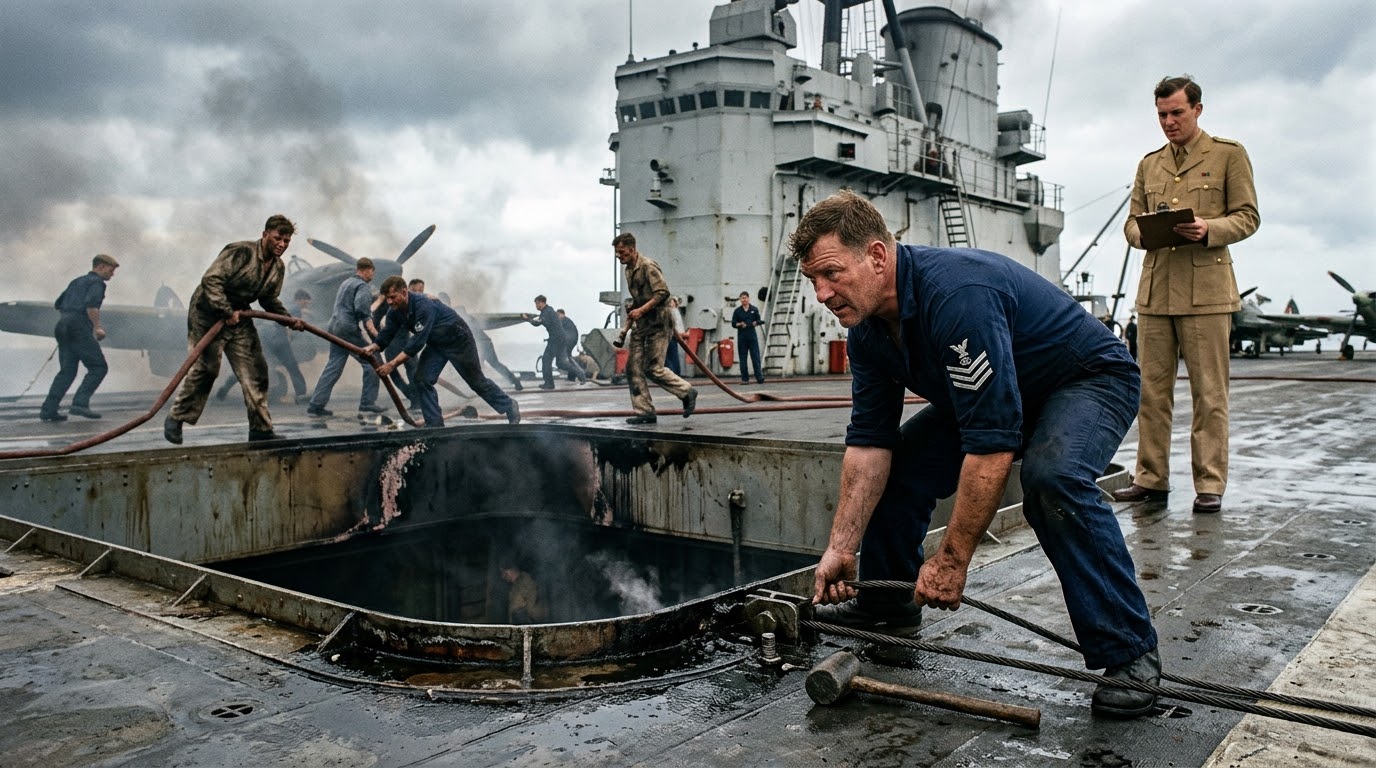
I lunged for the manual override lever near the deck hatch, pulling the heavy brass handle with every ounce of my weight. The mechanical linkage didn’t budge; the housing was completely warped by the buckling steel frame underneath us.
Below the grating, screaming voices cut through the thick haze of burning grease.
Six Sea Hurricanes were staged directly beneath the lift, fully fueled and loaded with fifty-caliber ammunition, trapped in a steel box that was rapidly turning into an oven.
“They can’t get the fire curtains down!” Knox dragged at the latch of the escape trunk, his knuckles bloody where the metal skin had peeled back. “The tracks are pinched shut, Chief!”
I pulled the broken steel rivet out of my pocket and jammed it directly into the warped teeth of the elevator’s emergency release gear, setting a heavy lead mallet against the end.
“Hold the bar, Knox,” I said, my voice dropping into the cold, flat rhythm of a man who knew the steel wouldn’t give us a second chance. “If we don’t shear this pin right now, nobody comes out of that hangar.”
CHAPTER 3: THE PRESSURE BOX
The impact drove a shower of sparks straight into my face, but the broken rivet held fast in the gear teeth.
“Again!” Knox shouted, his hands shaking violently as he pressed his weight against the tension bar to keep the assembly from slipping. “It moved half an inch, Chief!”
Below us, thick white smoke rolled out from the elevator gap, smelling of scorched high-octane fuel and burning rubber. The sound of officers shouting useless orders from the bridge faded behind the immediate, rhythmic clang of iron hitting iron.
I swung the mallet a second time. The shock traveled up my wrists, numbing my fingers, but the sheared pin finally gave way with a sharp crack that echoed down the lift shaft.
The heavy steel elevator dropped four inches with a shuddering crash, settling hard onto the emergency mechanical stops.
“The latch cleared!” Knox reached down, his leather mitts smoking as he hauled back the manual release dog. “She’s disengaged!”
We didn’t wait for the electric winches. I kicked the safety pawl free, grabbing the greasy steel cable with my bare hand to guide the counterweights by hand.
Through the rising haze in the lower hangar bay, the deck crew below scrambled to push the first Sea Hurricane clear of the elevator platform. Their faces were black with soot, eyes wide with the raw instinct of men working inside a sealed iron drum loaded with live ordnance.
“Get those planes forward!” I roared down the hatch, wiping grease across my jaw. “We aren’t lifting another bird until this deck gets cleared!”
A lieutenant in a spotless khaki uniform lunged toward the hatch railing from the island ladder, his brass buttons gleaming through the smoke.
“Chief, what are you doing?” he demanded, his voice thin and high against the roar of the ship’s forced-draft fans. “The Air Officer ordered a full squadron launch immediately! Why isn’t the elevator coming back up?”
I didn’t stop hauling on the guide cable. I looked at the lieutenant, then down at the jagged, buckled seam weeping black grease across the flight deck.
“Because if I bring this lift up before we clear those jammed tracks,” I said, my voice flat and dead cold, “the whole box folds in half—and every man down there burns.”
The lieutenant’s jaw tightened, his fingers twitching toward his clipboard as if a written regulation could straighten three inches of warped British armor. “That is not your call to make, CPO Miller. You’ll answer to the Captain for delaying this launch.”
“The Captain can read the casualty report,” I spat, turning my back on him as Knox braced his boot against the frame to take the next cable load. “Knox, grab the crowbar. We’re levering this last platform clear ourselves.”
CHAPTER 4: COLD IRON REALITY
“You’re relieved of duty, Chief,” the lieutenant stammered, his fingers clawing at his sidearm holster, though he lacked the nerve to unsnap the leather strap. “The Air Officer will have you court-martialed before we drop anchor!”
I didn’t answer him. I drove my boot heel down onto the iron bar one last time.
The warped deck guide snapped with a sharp, echoing pop, and the elevator platform dropped the final six inches, settling perfectly flush with the lower hangar floor.
Below us, Knox and the damage control team shoved the last Sea Hurricane off the platform, rolling it safely forward under the steel fire curtains. The space was clear. The trapped fuel lines and live ordnance were isolated.
The lieutenant opened his mouth to shout again, but the heavy footsteps of the Damage Control Officer cut him off. Major Vance stepped up to the hatch rim, his leather deck jacket smeared with soot and sea salt.
“Shut your mouth, Lieutenant,” Vance said, his voice a low, raspy gravel that carried over the hum of the ventilation blowers. “If Miller hadn’t dropped that lift manually, your precious flight schedule would be sitting on top of a three-thousand-degree furnace.”
The lieutenant’s jaw worked silently, his gaze darting from the major down to the dark, greasy seam splitting the catapult track. “The schedule—”
“The schedule is dead,” Vance snapped, crouching down to run two gloved fingers over the fractured weld. He pulled his hand back, staring at the black industrial grease coating his palm. “Pre-war shipyard work. The plating didn’t fail from the bomb impact, Miller. The seam gave way under the heat.”
“I know,” I said, relaxing my grip on the crowbar until my fingers slowly uncurled from the cold iron. “She’s built like an anvil, Major. But an anvil don’t flex when you hit it hard enough.”
Vance stood up slowly, looking out across the smoke-hazed flight deck toward the distant horizon where the sky was finally clearing. The task force was forming up, two American fleet carriers visible five miles to the west—their wooden decks already swarming with fifty planes preparing for a massive counter-strike.
“They’ll launch eighty birds in twenty minutes,” Knox muttered, wiping his bloodied knuckles on his trousers as he stepped up beside me. “We’ll be lucky if we can patch this deck enough to fly off four.”
“That’s the trade,” I said, reaching into my pocket to pull out the broken rivet. I rolled the scarred steel cylinder across my palm, feeling the cold, rough edge where the pin had sheared clean. “They carry the sky. We take the hit.”
Vance nodded once, a grim, silent acknowledgment, before turning to walk back toward the bridge ladder. The lieutenant stood frozen for a moment longer, his clipboard trembling slightly in the sea breeze, before slinking off into the shadows of the superstructure without another word.
I crouched by the catapult track, took a small steel wedge from my tool pouch, and tapped it firmly into the widened crack with the flat of my palm.
The metal settled with a quiet, solid click. I picked up my mallet, wiped the grease from the handle, and began checking the tie-downs for the next shift.