The Iron Glass Rifle: When Cardboard Armor and Cold Steel Met Invincible War Machines
CHAPTER 1: THE GLASS CANNONS EDGE
The raw wind off the steppe bit through my wool tunic, but I didn’t reach for my coat.
I kept my eyes glued to the optical rangefinder, my thumb tracing the worn, greasy edge of a spent brass primer cap.
Two thousand meters out, three dark shapes crawled through the tall yellow grass like iron beetles.
“Target distance, two-one-zero-zero,” I said, my voice flat against the roar of the Maybach engine below us. “High explosive round loaded, Schmidt?”
“Armor-piercing standard,” Schmidt grunted behind me, slamming the massive breech shut with a dull steel clack. “If we hit ’em with HE at two kilometers, we’ll just peel their paint.”
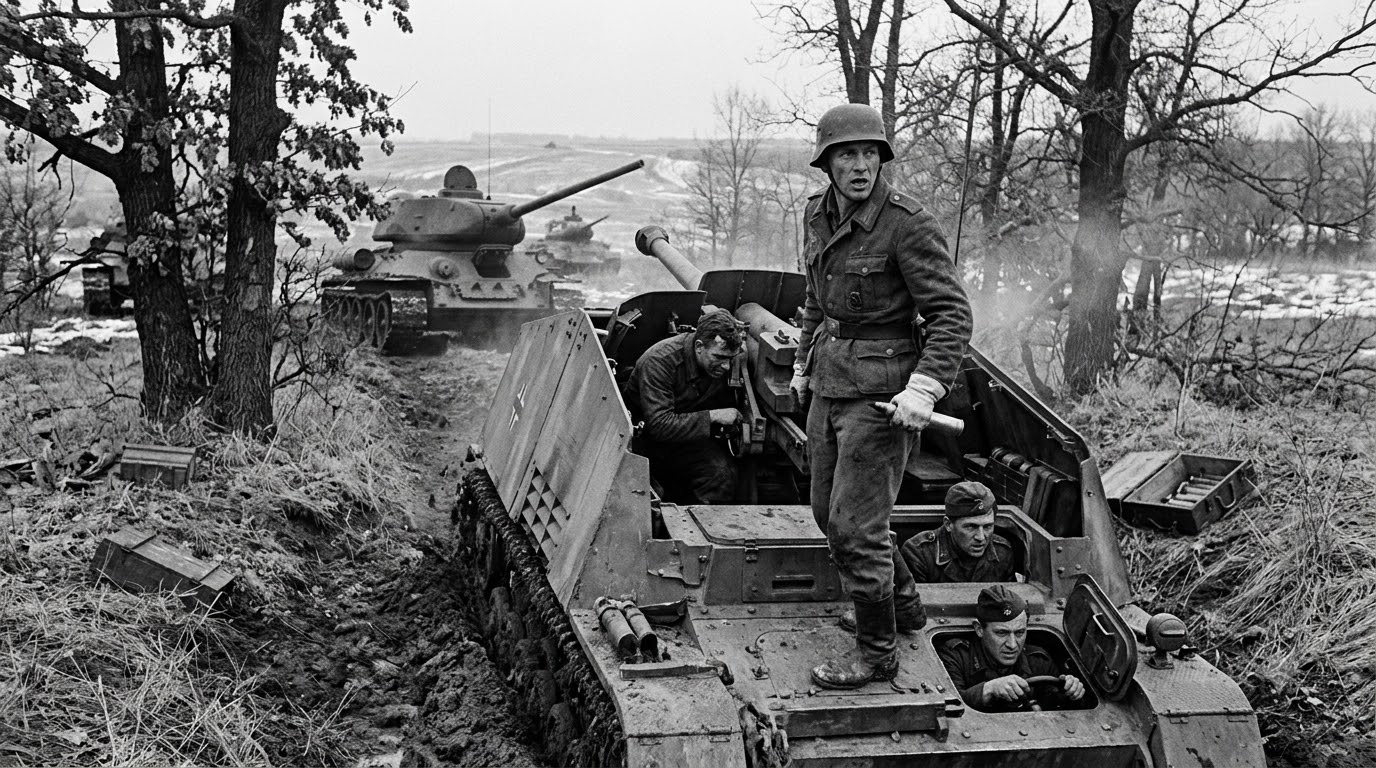
The open-topped steel walls of the Nashhorn offered zero comfort—ten millimeters of rolled sheet metal that wouldn’t stop a heavy machine gun burst, let alone a Soviet 85mm shell.
We were sitting in a high-profile cardboard box mounted on a hybrid chassis, relying entirely on the long, menacing snout of the 88mm PaK 43 to keep death at arm’s length.
“Keep us tucked against the reverse slope, Weber,” I called down to the driver through the open floor hatch.
“Any higher and our silhouette lights up against the skyline like a barn door.”
Weber adjusted the throttle, the engine thrumming as the tracks bit into the frozen earth.
A faint, rhythmic metallic thud vibrated through the floorboards—a tiny, off-beat click that didn’t belong to the transmission or the drive sprocket.
I frowned, tapping my boot against the frame, but there was no time to dissect a loose bolt.
The lead Soviet medium tank drifted straight into the center crosshairs of the optic sight.
“Steady,” I muttered, holding my breath as the brass primer cap turned twice in my fingers. “Let him climb the ridge.”
Schmidt stood rigid beside the gun breach, sweat glistening on his jawline despite the freezing gales whipping across the open compartment.
The Soviet machine crested the mound, its long barrel sweeping left, entirely blind to the thin steel ghost sitting tucked in the distant tree line.
“Fire,” I commanded.
The PaK 43 roared, recoil shoving the massive superstructure back two feet on its suspension as a cloud of gray cordite smoke blasted through the open bay.
Two kilometers away, a instantaneous flash lit the horizon, followed a second later by the delayed, thundering CRACK of detonating steel.
The lead tank’s turret lifted clean off its ring, dropping into the dry grass as a dark plume of black smoke rolled toward the sky.
In the radio headset, static crackled with panicked, distant chatter from the surviving enemy vehicles, their guns turning blindly toward an empty horizon.
“Hit,” Schmidt barked, already clearing the smoking casing with a pair of heavy leather gauntlets. “Clear deck!”
“Track the second one,” I said, leaning back into the rubber eyepiece. “He’s backing down the slope.”
Through the crosshairs, I saw the second tank reverse aggressively, kicking up clods of dirt—not in a blind panic, but in an organized, calculated sweep.
To the east, three more plumes of dust began rising over the hills, far wider than a simple three-vehicle patrol.
My grip tightened on the brass primer cap until the edges bit into my palm.
CHAPTER 2: IRON ON THE HORIZON
“They aren’t retreating,” I called out over the metallic roar of our idling Maybach engine. “That’s a deliberate withdrawal. He’s dragging us into his sweep zone.”
“Loader’s ready,” Schmidt grunted, his boots slipping slightly on the oil-stained diamond-plate deck as he braced another eighty-eight millimeter shell against his hip. “Give me a target, Miller.”
“Hold your fire,” I said, my voice tight. “Look at the dust clouds to the east. That isn’t a three-vehicle patrol—that’s a wide flank.”
Through the optical scope, the landscape looked deceptively serene, just endless rolling yellow grass under a slate-gray sky, but three distinct plumes of pale dirt were rising four miles out.
They weren’t pushing straight at us; they were moving in a wide arc, aiming to cut off our retreat toward the dry creek bed behind us.
“Weber!” I slammed my open palm against the forward bulkhead, the cold steel vibrating through my leather glove. “Ease us back ten yards into the shadow of that oak cluster—now!”
The engine growled as Weber clutched the left track, pivoting the heavy Geschützwagen chassis in a sharp, grinding turn that threw up clods of frozen mud.
The low, rhythmic metallic thud from beneath the deck plate struck again—clack-thud, clack-thud—louder this time, accompanied by a sudden, sickening shudder in the steering linkage.
“Weber, report!” I shouted, dropping down a step into the open compartment. “What was that shift?”
“Drive sprocket’s skipping on the left track!” Weber shouted back from his forward seat, his knuckles white on the steering levers. “The tensioner bracket is sheared! We can run straight, boss, but if I lock that track to make a hard turn again, the whole assembly will throw!”
I swore under my breath, my thumb digging once more into the notch of the brass casing in my pocket.
Without high-command reserves or air support to call on, a cast track out here in the open steppe meant becoming a stationary steel casket for five men.
We couldn’t retreat, and we couldn’t maneuver in a tight circle.
“New plan,” I said, stepping back up to the optics, my heart hammering a cold, steady rhythm against my ribs. “We stay tucked in these trees and let our range do the talking.”
A second Soviet T-34 cleared the crest at eighteen hundred meters, its broad, sloped armor gleaming under the muted sunlight as it turned its turret toward our position.
“Distance, one-eight-zero-zero,” I snapped, setting the reticle directly over the front hull glacis. “Schmidt, armor-piercing!”
“Locked!” Schmidt barked, slamming the breech mechanism home with a sharp, heavy ring.
“Fire!”
The PaK 43 erupted with a concussive shockwave that whipped the canvas tarps off the side railings and sent a cloud of dead leaves swirling into the open cabin.
The shell hit the target square in the lower hull, the kinetic impact so immense that the thirty-ton machine stopped dead in its tracks, its right drive wheel disintegrating into a shower of sparks and black smoke.
Before the smoke cleared from our muzzle, a dark shell whined directly over our open top with a bone-chilling screech, snapping thick oak branches overhead and showering us with bark and twigs.
“They’ve pegged our tree line!” Schmidt yelled, shielding his face as wood splinters rained into the steel box. “That didn’t come from the hill, Miller! That came from the east!”
I swung the optical sight toward the eastern tree line, my blood running cold as the true scale of the trap revealed itself.
Two more armored silhouettes were breaking through the treeline at less than twelve hundred meters, moving fast and firing on the roll—closing the distance before we could adjust our position on a broken track.
CHAPTER 3: THE CLOSEQUARTERS TRAP
“One thousand yards!” Schmidt yelled over the deafening mechanical roar of the approaching engine line. “We can’t traverse fast enough if they cross our arc!”
“Weber, lock the right brake!” I shouted down into the hull hatch, my knuckles going white against the sight casing. “Nudge the front nose three degrees left—just three degrees! Don’t throw that broken track!”
The vehicle lurked sideways with a sickening metal grinding sound, the sheared tensioner bracket shrieking under the strain, but the hull shifted just enough to bring the lead eastern T-34 directly into my crosshairs.
“Distance, nine hundred!” I called out, my voice cutting through the panic like cold wire. “High explosive loaded?”
“Armor-piercing locked!” Schmidt snapped back, his arm muscles bulging as he held the heavy steel breech lever steady against the violent vibrations of the deck. “Shoot now or we’re dead men, Miller!”
“Fire!”
The eighty-eight millimeter cannon slammed backward with a brutal, deafening crack, spraying a jet of hot gray cordite smoke straight over the open superstructure.
Across the open yellow grass, the lead tank didn’t just stop—its front hull plate crumpled under the kinetic shockwave, the sheer velocity of the round detonating its internal ammunition store in a blinding white flash.
“Target destroyed!” Schmidt roared, ducking low as a shower of hot dirt and high-velocity metal fragments rattled off our thin steel gun shield like hail.
“Don’t celebrate!” I barked, pivoting the hand wheel to track the second machine through the dense smoke. “The third one is under nine hundred meters—he’s bypassing the burning hull!”
Through the haze, the final Soviet tank burst forward, its diesel exhaust belching black soot as it charged straight into our dead zone, aiming to crush our cardboard-clad rig at point-blank range before we could reload.
We had zero air support coming, no reserve artillery batteries to smoke the field, and a track that would snap if we tried to turn and run.
“Weber, throw us in reverse!” I yelled, dropping my optical tool and grabbing the traverse lock. “Drive us straight back into the ditch behind the oak tree—let the embankment hide our low hull!”
Weber slammed the gear lever, and the Geschützwagen lurked backward into the shallow ditch, the sudden dip dropping our thin steel compartment three feet below the rising line of sight just as a high-explosive round whizzed inches above our open heads, shattering the main trunk of the oak behind us.
The heavy timber crashed down across our rear deck with a splintering crunch, pinning the engine cover under two tons of dead wood, but keeping us alive in the shadow of the earth.
“Breech clear!” Schmidt gasped, his face smeared with grease and black powder, shoving the final heavy armor-piercing round into the chamber. “He’s coming over the lip right now!”
Above the edge of the dirt embankment, less than two hundred meters away, the towering steel nose of the Soviet heavy tank tipped upward against the gray sky, its long cannon pointing straight down into our open, defenseless position.
CHAPTER 4: THE FINAL BREACH AND AFTERMATH
“He’s dropping his snout to crush us!” Schmidt yelled, bracing his shoulder against the hot shield casing. “We can’t elevate high enough!”
“Weber, dump the clutch forward!” I barked down into the hatch floor. “Force our nose up the back of this ditch!”
Weber slammed the gear lever home, the engine screaming as the rear sprockets dug violently into the loose earth.
The front end of our vehicle surged upward at an angle, tilting the long snout of the PaK 43 directly into the exposed, under-armored belly of the cresting heavy tank.
The opponent tried to depress his main gun to crush our open compartment, his commander screaming orders through his hatch, but his barrel couldn’t tilt low enough before our sight line locked onto his lower hull frame.
“Zero range!” I roared. “Fire!”
The eighty-eight millimeter gun detonated with a concussive blast that shattered our remaining vision glass and blew a crater in the dirt bank.
The heavy armor plate caved inward under two thousand foot-pounds of direct kinetic force, the projectile punching straight through the transmission floor and setting off the internal fuel cells in a muffled, shuddering explosion.
The enemy machine lurked forward three feet, its tracks grinding to a sudden, permanent halt as black smoke billowed from every seam, dead atop the embankment.
The roaring silence that followed was heavy, broken only by the sharp, metallic ping of our hot gun barrel cooling in the freezing steppe air.
Schmidt leaned back against the shell rack, his chest heaving as he wiped a streak of oily black soot from his forehead with a trembling glove.
“Movement on the horizon?” he asked, his voice rasping.
I climbed up onto the steel lip, pulling my optical glasses up onto my cap, and scanned the wide, empty plain.
The remaining dust clouds to the east were receding; the failed multi-axis trap had broken their momentum, leaving three burning wrecks scattered across two kilometers of open grassland.
No artillery support had arrived to bail us out, no armored reserves had swept in to clear the tree line, and our left track tensioner bracket was sheared beyond field repair.
We had survived on pure, uncompromising geometry and cold, pragmatic common sense.
I reached into my wool pocket, my fingers finding the greasy brass primer cap.
I pulled it out, looked at the jagged notch pressed deep into my thumb, and tossed the small piece of brass over the side plate into the cold mud.
Down below, the engine gave a quiet, rhythmic tick as it cooled, and Weber kicked open his forward driver hatch, letting the cold wind clear the smell of burnt powder from the cabin.
I pulled a rag from my belt and slowly began wiping the dust off the optical lens, returning the tool to its clean, quiet state.