The Iron Strain: A Weary Pilot’s Brutal Discovery of the Unstoppable Machine
CHAPTER 1: THE SILVER THREAT
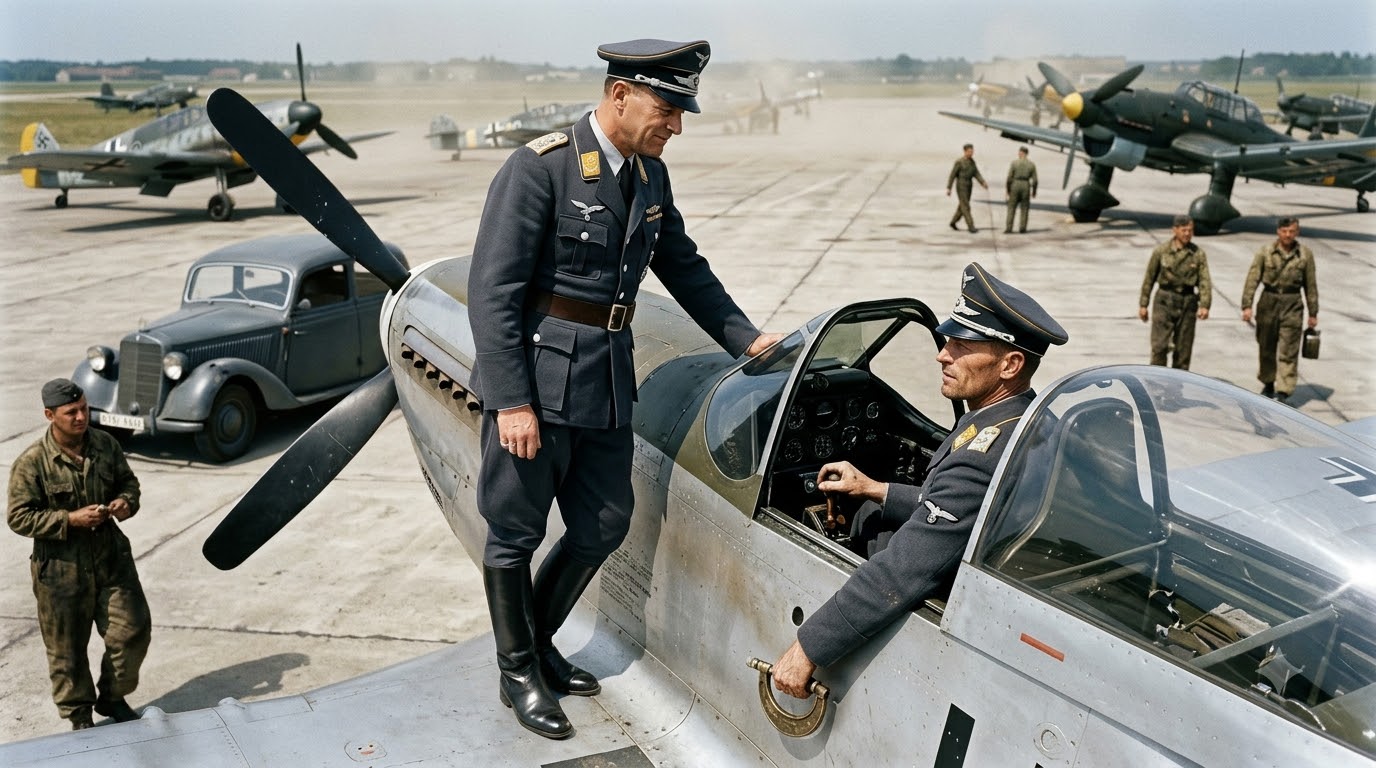
The sun beat down on the tarmac, baking the smell of scorched rubber and aviation fuel into the concrete.
I rolled the scarred brass micrometer between my thumb and forefinger, feeling the deep notch left by a shell fragment over the Pesti oil fields.
Beside me, Inspector General Kuntze smoothed his spotless uniform, his polished leather boots gleaming in the noon heat.
“The Führer’s office expects a full breakdown by sunset, Wolfrum,” Kuntze said, his voice dripping with smooth, desk-bound authority. “Show our boys that this American tin can is nothing more than propaganda.”
I didn’t answer him.
Instead, I stepped up to the silver fuselage of the captured P-51 Mustang, its yellow-painted tail casting a long, sharp shadow over the grass.
My shoulder throbbed—a bitter reminder of the emergency landing near Kamyanka two weeks ago—as I hoisted myself onto the wing.
I pulled back the canopy and slid down into the pilot’s seat, expecting the familiar, snug metal box of my Messerschmitt BF 109.
My elbows hit nothing.
The space was vast, wide, and unnaturally cold, leaving my arms hovering in empty air.
In my 109, my shoulders pressed tight against the side panels, the cannon housing sat wedged firmly between my knees, and every toggle switch rested within a two-inch flick of my wrist.
Here, the control column sat too far forward, the rudder pedals stretched beyond my natural reach, and the massive glass bubble canopy arched high above my head like a greenhouse.
I reached for the throttle quadrant, but my fingers swiped through air before finding the heavy, cold lever.
“Well?” Kuntze called out from the wing root, his manicured hands resting near the cockpit frame. “Does it feel like a flying coffin?”
My thumb dug into the brass ridges of the micrometer in my pocket as I stared at the clean, spacious instrument panel.
“It feels like a room,” I said, my voice flat.
CHAPTER 2: COLD FRICTION
“It’s an oversized glider, Kuntze,” I said, keeping my voice down as I flicked the electric starter switch.
In my old 109, a ground crew would be sweating over an inertia crank right now, straining their backs against a stubborn flywheel in the mud.
Here, the Packard-built Merlin roared to life with a single, clean click.
No hesitation. No heavy cloud of dark soot belching past the exhaust stacks.
Kuntze ducked as the four-bladed propeller cut the humid air, his polished hat almost blowing off in the sudden slipstream.
I leaned over the side of the open canopy, staring down at the engine cowling where the silver panel met the wing root.
There wasn’t a single streak of oil.
After three hundred hours of flight time recorded on its captured log, the metal seams remained bone dry and spotless.
In Russian winters, our mechanics bled from frozen hands just trying to keep DB engines from leaking their own vital fluids across the snow.
This machine didn’t leak; it simply ran with a terrifying, clinical precision.
“Keep it low and pull a hard turn over the treeline!” Kuntze shouted up at me over the engine’s deep thrum, waving a gloved hand toward the eastern sky. “Show the observers from Berlin where its frame buckles!”
I ignored the urge to throw the Mustang into a tight, low-speed banking turn—the exact maneuver where my old Messerschmitt’s automatic wing slats would deploy to save my skin.
That muscle memory was a trap here, and I knew it.
I shoved the throttle forward, feeling the smooth, heavy mechanical resistance as 1,500 horses shoved the airframe straight down the concrete strip.
The acceleration didn’t jerk; it pressed me firmly into the broad leather seat like a giant hand flattening a piece of paper.
The ground blurred, the airfields and yellow-nosed interceptors shrinking into small wooden toys in a matter of seconds.
I pulled back on the stick, expecting the violent shudder of an engine fighting against gravity at high pitch.
The supercharger clicked over automatically with a faint, metallic ping behind the dash, adjusting the air mixture without me touching a single valve.
It didn’t care about the altitude or the thin air.
It just kept climbing, taking more power than a man had any right to ask from a block of steel.
High Command wanted me to find a flaw, a structural weakness I could write down on official letterhead to keep our boys smiling before their next scramble.
I looked back down through the pristine bubble canopy at the tiny speck of Inspector Kuntze standing beside his staff car.
The flaw wasn’t in the plane.
CHAPTER 3: THE BROKEN RATIO
Below my wingtips, the green carpet of the Reich stretched outward in a calm, deceptive haze.
In my Messerschmitt, thirty minutes at this altitude meant keeping one eye glued to the fuel pressure lamp, praying the engine didn’t overheat while counting every drop of high-octane gasoline left in the ventral tank.
I looked at the Mustang’s main fuel gauge, then down at the secondary drop-tank selectors near my left boot.
The needles hadn’t even begun their crawl toward empty.
This machine hadn’t just climbed up to meet us; it was designed to loiter in our sky, waiting for us to exhaust ourselves before descending to strike.
I pushed the stick forward, sending the silver nose plunging down toward the cloud floor in a steep, seventy-degree dive.
Wind roared against the plexiglass, the needle on the airspeed indicator sweeping past 320, then 380, then topping 400 miles per hour.
In a 109, a dive like this was a violent wrestling match—the airframe would begin to shudder violently, the elevator control stiffening until it felt like pulling against a block of solid lead.
The Mustang didn’t vibrate.
Its laminar flow wing sliced through the thick lower air with a eerie, smooth stability, the controls remaining light and responsive under my hands.
There was no buffeting, no loss of control surface authority, no warning groans from the wing roots.
The math clicked into place in my head with the cold, unyielding weight of an anvil dropping through a glass floor.
When their bombers came over Berlin, these fighters wouldn’t be turning back at the border.
They were going to stay over the target, escorting the heavy formations all the way in and all the way back home, forcing our exhausted squadrons into a grinding war of numbers we had already lost.
I pulled the nose back up, leveling off as the airfield tarmac expanded back into view below.
My palm felt damp against the rubber grip, my thumb instinctively searching for the brass micrometer in my pocket to anchor my thoughts.
They wanted me to tell them how to defeat it in the air.
They didn’t realize the war was no longer being fought in the clouds—it was being decided on assembly lines three thousand miles away.
CHAPTER 4: THE INSPECTION TRAP
I unbuckled the harness, swung my legs over the cockpit sill, and dropped down to the concrete.
Inspector Kuntze was already stepping into my path, a leather-bound clipboard clutched tightly in his white-gloved hand.
Behind him, two armed airfield guards stood rigid near the black Mercedes, their eyes shifting nervously between the captured silver fighter and my dirt-streaked jacket.
“I’ve already drafted the technical assessment,” Kuntze said, holding out a fountain pen toward me while tapping the paper with a manicured index finger. “You’ll sign off on severe manifold instability above 20,000 feet and structural wing flex under high g-loads.”
I took off my leather flying cap and wiped the sweat from my forehead, feeling the heavy throb in my wounded shoulder.
“The engine didn’t misfire once,” I said, my thumb slipping into my jacket pocket to grip the brass micrometer. “And the wings hold tighter in a dive than our own airframes.”
Kuntze’s smile thinned into a razor blade.
He didn’t care about flight metrics, and he certainly didn’t care about the truth.
“Listen to me very carefully, Oberleutnant,” he murmured, leaning in close enough for me to smell the stale coffee on his breath. “Berlin does not pay us to write love letters to American factories. The High Command needs our frontline squadrons to believe these planes are flying coffins, or half our rookie pilots will bail out the moment a Mustang escort paints their tail.”
He shoved the clipboard directly against my chest, the wooden edge digging through my leather coat into my collarbone.
“Sign the report, Wolfrum,” Kuntze whispered, his voice sharp with weaponized authority. “Or your next evaluation flight will be in a penal infantry trench on the Vistula line.”
I looked down at the paper, then past his shoulder at the silver Mustang sitting silently on the tarmac, its unblemished engine seals gleaming under the harsh sun.
They wanted a lie to buy a few more weeks of blind obedience, but no ink on a clipboard was going to stop seven hours of enemy fuel range from sweeping our sky clean.
CHAPTER 5: THE SHATTERED MASK
I slowly brought my right hand out of my pocket, setting the scarred brass micrometer flat on top of his evaluation form.
“I measured the wing roots before takeoff,” I said, my voice steady enough to cut right through the hum of the nearby generator. “Zero deflection. I ran the Merlin engine at full throttle for forty minutes at altitude, and there isn’t a single drop of grease on the cowl.”
Kuntze’s face flushed a deep, blotchy red, his jaw working as he tried to find a way to reassert his authority.
“You dare question an official directive from Berlin?” He snatched the micrometer off the clipboard, his manicured fingers trembling slightly as he held the heavy metal tool between us. “You are an aviator, Wolfrum, not an engineer! Your duty is to provide a report that supports the moral discipline of the Reich!”
“My duty is to tell my men what is coming for them,” I replied, taking a step closer until his clipboard was pinned flat between our chests. “You can write whatever fairy tale you want in your office, Inspector, but when nine hundred of these aircraft show up over Berlin next month, my pilots will be the ones dying because you lied about their build.”
The two armed guards behind him shifted their boots on the gravel, exchange a brief, uneasy glance.
Neither of them raised a rifle.
They had seen the silver fighter land without a scratch, and they knew as well as I did what a leaking, worn-out engine sounded like compared to the smooth roar that had just shaken the hangar bay.
Kuntze’s confidence cracked, the arrogant posture dissolving into a bitter, cornered glare as he realized his political threats held no weight against cold iron and engineering facts.
“You will sign this,” Kuntze hissed, snatching the brass tool back toward his body while backing toward his staff car. “Or I will personally ensure your flight status is revoked by midnight!”
“Go ahead and sign it yourself,” I said, turning my back on his pen to face the silver aircraft. “The plane doesn’t care about your signature.”
CHAPTER 6: THE QUIET AFTERMATH
He had taken his unsigned clipboard with him, rushing off to lodge his formal complaints and construct whatever comfortable fiction his superiors demanded in Berlin.
I sat down on the low wooden crate beside my flight gear, picking up a rag to wipe a smudge of engine oil off the micrometer’s notched brass frame.
Outside, the ground crew gathered in small, silent clusters around the yellow-nosed P-51, staring at its broad propeller and pristine aluminum skin.
None of them were reaching for wrenches or running to fetch emergency oil pans.
They simply stood there in the heat, looking at a machine built by an industrial giant that didn’t need to patch its tools together out of scrap and sheer desperation.
The fake flaw narrative Kuntze wanted me to sign wouldn’t save a single pilot when the sky over the Reich filled with those silver wings.
Our dogfight tactics, our sharp turns, and our automatic wing slats were useless against an enemy that could simply fly over our heads for seven hours, waiting for us to run out of fuel.
I slid the brass tool into my inner pocket, feeling its heavy, familiar weight settle against my ribs.
There were no speeches left to give, no grand victories to claim, and no political lies strong enough to turn back the sheer momentum of an unstoppable machine.
I picked up my helmet and walked out into the afternoon quiet, accepting the raw truth of what I had seen.