The Echo of Cold Steel: A Master Gunner’s Final Lesson in Faith, Legacy, and Unseen Resilience
CHAPTER 1: THE WEIGHT OF THE STEEL
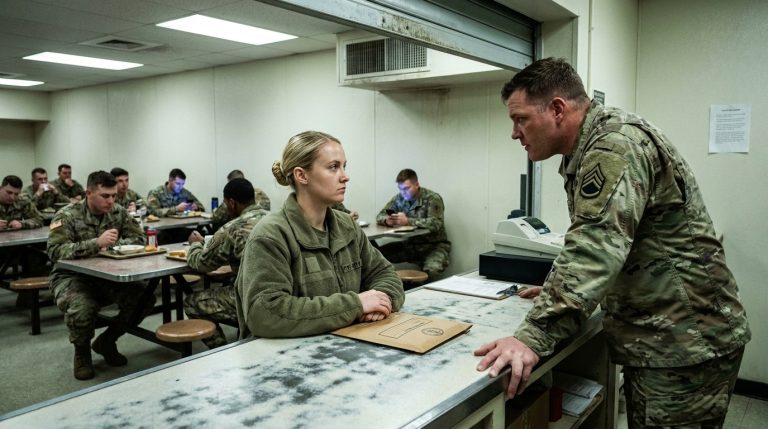
The air in the assembly bay was not merely cold; it was stagnant, trapped behind concrete walls that had long ago forgotten the warmth of the sun. Fifty recruits stood frozen, their hands slick with the greasy residue of failure. Before them lay the M2 Browning—not as a weapon, but as a disjointed puzzle of heavy, unforgiving steel.
Thomas stood near the service entrance, his hand resting on the handle of his push broom. The bristles were worn down to the nub, a testament to years of sweeping away dust that never truly stayed gone. He watched the drill sergeant, Halloway, pacing the line. Halloway’s face was a mask of calculated fury, his eyes scanning the tables with the intensity of a man watching a dam begin to crack.
“You are not soldiers,” Halloway barked, his voice bouncing off the high ceiling. “You are consumers. You wait for a screen to tell you what is wrong. You wait for an algorithm to fix your mistakes. But out there? The metal doesn’t care about your code.”
Davis, at table four, wiped his forehead with the back of his arm, smearing oil across his skin. His breath came in shallow, ragged bursts. He stared at the bolt stud, the small, circular piece of metal that refused to slide home. He jammed it again, his shoulder muscles locking, his jaw tight. It didn’t fit. It never fit when he tried to force it.
Thomas shifted his weight. His knees clicked—a dry, rhythmic sound only he seemed to notice. He watched Davis, seeing the young man’s desperation. It wasn’t just physical exhaustion; it was the panic of someone who realized, for the first time in his life, that he couldn’t Google the answer to his own incompetence.
“It’s the spring, Drill Sergeant!” Davis shouted, his voice cracking. “It’s bent. This kit is garbage!”
Halloway lunged, closing the distance between them in two strides. He stopped inches from Davis’s face. “The weapon isn’t garbage, Recruit. You are the variable. And you are failing.”
Thomas felt the familiar ache in his knuckles, a sharp, pulsing reminder of the cold that had lived in his bones since the fifties. He took a step forward. The floorboards—old, scarred wood underneath the thin layer of concrete—groaned beneath him. He didn’t mean to move, but his feet remembered the pace of a patrol.
He moved past Halloway, his gaze fixed on the table. The M2 was a beauty, a piece of industrial art that demanded a conversation, not a beating.
“May I, Sergeant?” Thomas asked. His voice was a thin, dry reed, but it carried a weight that made the room go quiet.
Halloway turned, his brow furrowing as he looked down at the old man in the oversized jumpsuit. He looked at Thomas’s shaking hands, then at the scattered, greasy pile of steel. “It’s a machine gun, Thomas. Not a trash can.”
“I know what it is,” Thomas said softly.
He didn’t wait for permission. He reached the table and placed his hand on the receiver. The metal was cold—colder than it should have been. As he touched it, a flash of white light burned behind his eyes, the smell of cordite and frozen pine needles suddenly replacing the scent of cleaning fluid. He blinked, the image of a burning hillside flickering at the edge of his vision before dissolving into the reality of the armory.
Something was wrong. The receiver was slightly misaligned, a subtle shift in the base plate that none of the recruits had the patience to see. He needed to recalibrate, but the thought slipped, dissolving like breath on a windowpane. He squeezed his eyes shut, centering himself on the only thing he knew for sure: the weight of the steel.
“Blindfold me,” Thomas said, his voice steadying, stripping away the stutter of his eighty years.
The room held its breath. Davis, his hands still covered in grease, stared at the old man with a mixture of confusion and a flicker of something else—a sudden, sharp curiosity. He watched as Thomas pulled a black cloth from the air, his movements fluid, the trembling in his hands vanishing the moment he touched the fabric.
Thomas tied the knot behind his head. The world darkened. The fluorescence, the Drill Sergeant’s sneer, the panicked breaths of the recruits—all of it faded. In the dark, there was only the cold, hard song of the machine waiting to be sung back together.
He reached out. The first piece of the bolt group felt warm against his fingertips. He didn’t force it. He waited. He listened for the slight shift in the metal, the way the molecules settled into their intended home.
Click.
The sound echoed through the bay, cleaner and more decisive than any noise the recruits had made all day. But beneath the satisfaction, a new, chilling thought took root in Thomas’s mind: he realized, with a sudden, painful clarity, that he couldn’t quite remember if he had already performed this drill this morning, or if this was the first time in twenty years.
CHAPTER 2: THE ANCHOR IN THE DUST
Thomas stood motionless as the resonance of the weapon settled into the concrete floor. The silence in the armory was absolute, a heavy, suffocating blanket that pressed against his temples. Around him, the fifty recruits seemed to have collectively forgotten how to breathe. Halloway, the drill sergeant, remained frozen, his eyes fixed on the assembly he had just watched with his own stunned disbelief.
Thomas pulled the black bandana from his eyes. The harsh, flickering fluorescent lights of the modern bay bit into his retinas, a stark, antiseptic contrast to the dim, blue-hued moonlight of his memories. He felt a sudden, dizzying lurch in his gut—the feeling of a ship leaving its mooring. He leaned his weight onto his left leg, his knee popping with a dry, articular protest. He needed to leave. He needed to get back to the supply closet, to the quiet, to the routine that kept the walls of his reality from closing in.
He reached out to retrieve his push broom, but his hand hovered. It was trembling again. The steadiness he had summoned while blindfolded was a finite resource, a trick of focus that demanded more out of his tired heart than he cared to admit.
He didn’t look at Halloway. He didn’t look at the recruits. He turned, his movements measured, the shuffle returning to his gait like an old, familiar garment. He began the slow, painful walk toward the far wall, where the shadows gathered in thick, comforting layers.
“Wait.”
The voice was young, desperate, and thick with the awkward cadence of a boy trying to reclaim his authority. It was Davis.
Thomas didn’t stop, but his pace faltered. He heard the metallic scrape of a boot against the floor as Davis moved away from his station. The boy was following him. Thomas felt a prickle of irritation at the base of his neck, but it was quickly eclipsed by a wave of cold fatigue.
“I said wait, sir,” Davis said, his voice closer now, breathless.
Thomas stopped. He looked at the floor—at a stray patch of grime he had missed earlier that morning. He knew he should keep moving, should retreat to the sanctuary of the closet, but his legs felt heavy, as if the very air in the bay had thickened with the expectations of the fifty souls behind him.
He turned slowly. Davis stood three feet away, his face pale, his hands still stained dark with oil. He wasn’t looking at Thomas with the arrogance of an hour ago. He was looking at him the way a man looks at a compass when he’s lost in a storm.
“I’ve done this a thousand times,” Davis said, nodding toward the perfectly assembled M2 on his table. “I’ve studied the digital diagrams. I’ve run the simulations until my eyes burned. But I couldn’t feel it. You… you made it look like the gun wanted to be built.”
Thomas stared at the boy. For a fleeting second, the face in front of him shifted. He saw a man named Miller—a boy, really—who had stood beside him in a trench in 1952, clutching a hot barrel with blistered palms. The phantom Miller looked back at him, his eyes hollowed out by the cold, his mouth forming words that were lost to the wind. Respect the steel, Thomas. It’s all we have left.
Thomas blinked, forcing the ghost of the trench to dissolve. “It’s not about want, son,” Thomas said, his voice raspy, like paper rubbing against stone. “It’s about understanding what the metal has been through. You treat it like a widget. It treats you like a stranger.”
“Teach me,” Davis said. It wasn’t a request; it was a plea.
Thomas looked past him, toward Halloway, who was watching them from the center of the room, his jaw set in a rigid line of indecision. The Drill Sergeant didn’t intervene. He stayed rooted, perhaps sensing that the power dynamic in the room had shifted, anchored to a point in time that he couldn’t reach.
“The supply closet,” Thomas muttered, turning back toward the shadows. “Top shelf, behind the cleaning rags, there’s a manual. Not the one you’re using. The one from sixty-eight. If you can read it without your tablet, come find me when the lights go down.”
Thomas resumed his walk. His heart was hammering a frantic, uneven rhythm against his ribs. He felt exposed, the fragile structure of his days here at the base suddenly threatened by the boy’s insistence. He reached the closet, his arthritic fingers fumbling with the latch. As he pulled the door open, the scent of stale chemicals and old paper washed over him, a small, enclosed universe where he could pretend that he was still the man who could hold a line, and not the man who was slowly losing his way in the quiet.
He stepped inside and closed the door just enough to leave a sliver of darkness between him and the rest of the world. He leaned his head against the cool metal of the doorframe, closing his eyes. The images came again—the mountain, the snow, the sound of mortar rounds biting into the frozen earth. He squeezed his hands into fists, trying to find the physical sensation of the M2’s bolt stud, trying to use that memory to keep the present from shattering. He was an anchor, he told himself. He had to be an anchor for the boy, even if his own chain was snapping.
CHAPTER 3: THE WEIGHT OF THE PAGES
Thomas pushed away from the doorframe, his knees popping in the silence. He didn’t turn on the overhead light. He knew the closet by heart—the exact location of the mop handle, the stack of crates, and the specific shelf where he kept the relics of a life that felt increasingly like someone else’s. He reached into the dark, his fingers calloused and stiff, tracing the edges of heavy, bound volumes until he felt the spine of the 1968 manual. It felt rough, the linen cover frayed at the edges, a texture of grit and persistence.
He pulled it down, the movement causing a small avalanche of dust to dance in the thin sliver of light coming from the bay. He held the book against his chest for a moment, waiting for the familiar, grounding weight of it to settle his heartbeat. The tremors in his hands hadn’t quite subsided; they were a dull, buzzing vibration that made his skin feel too tight for his bones.
He didn’t have much time. He could hear the low, rhythmic hum of the recruits’ voices through the door, the Drill Sergeant barking an order that sounded distant, as if coming from another decade. Thomas sat on a low, wooden crate and opened the book. The pages were yellowed, brittle as autumn leaves, and they smelled of tobacco and damp basements.
He wasn’t looking for instructions—he knew every diagram, every tolerance, every potential failure point of the M2 by heart. He was looking for the notes he had scribbled in the margins decades ago, the shorthand of a gunner who had realized that survival wasn’t about following the book, but about understanding what the book couldn’t say.
If the barrel drags, listen for the high-pitch ping, he had written in cramped, jagged cursive. That’s the soul of the machine telling you it’s thirsty.
He stared at his own handwriting, his eyes tracking the ink. For a moment, the words seemed to shift, the letters blurring and reforming into a topography he didn’t recognize. He frowned, his brow furrowing. He remembered writing that note. He remembered the rain in the Asha Valley, the way the mud had clotted on his gear, making every movement a fight against gravity. But then, as he reached to trace the ink, a wave of vertigo hit him.
He gripped the edges of the crate. Where was he?
The armory bay felt like a stage set, a cardboard construction that might collapse if he blinked too hard. He was back in the Valley, he was sure of it, but the light was all wrong. And his hands—they were young, smooth, and steady. He lifted them, turning them over in the dim light, expecting to see the supple skin of his youth. Instead, he saw the gnarled, arthritic knuckles, the spotted, thin skin of an octogenarian. The discrepancy was a physical blow, a wrenching sensation that made him gasp.
“Thomas?”
The voice was muffled by the closet door. It was Davis.
Thomas blinked, the images of the Valley receding into the corners of the dark room like shadows fleeing a lantern. He took a long, ragged breath, letting the smell of the floor wax pull him back to the present. He forced his hands to relax, curling them around the spine of the manual.
“I’m here,” Thomas said, his voice stronger than he felt. He stood, his joints protesting the sudden movement, and tucked the book into the waistband of his jumpsuit, hidden beneath the folds of the oversized fabric.
He opened the door. The sliver of light from the armory bay expanded, casting a long, rectangular beam across the concrete floor. Davis was standing there, his head bowed, his hands clasped behind his back. The boy looked tired—not the exhaustion of physical labor, but the mental fatigue of a student who had just been shown that everything he had been taught was a lie.
“You said… when the lights go down,” Davis whispered, not looking up. “The night shift is coming on soon. Halloway is heading to the office to file his reports.”
Thomas stepped out of the closet, his movements once again carefully calibrated to look like those of a frail old man. He saw the way Davis flinched at the movement, as if expecting him to crumble. It was pity, and it made Thomas’s teeth ache.
“Follow me,” Thomas said, not checking to see if the boy obeyed.
They walked toward the back of the armory, away from the racks of new, high-tech weaponry that the recruits were usually assigned to practice with. They moved into the deep shadows near the loading dock, where the air was colder and the smell of ozone from the nearby charging stations faded into the scent of old grease and dry earth.
“You want to know why you’re failing,” Thomas said, stopping by a pile of discarded shipping crates. He didn’t turn around. He heard Davis stop a few paces behind him. “You’re failing because you’re looking at the gun. You need to stop looking, Davis. Start feeling. Close your eyes and tell me what the ambient temperature of this room is doing to the steel on your table.”
Davis hesitated. “The… temperature?”
“The steel is a living thing,” Thomas said, his voice dropping to a gravelly, intense murmur. “It expands when it’s hot, it constricts when it’s cold. You push a bolt stud into a receiver that’s contracted by the night air, you’re going to get a jam every single time. The manual doesn’t tell you that. The manual tells you how to build a clock. I’m telling you how to read the weather.”
He heard Davis take a tentative breath. The boy moved closer, his footsteps hesitant on the concrete.
“My instructor told me…” Davis started, then stopped, his voice filled with frustration. “He told me to rely on the digital diagnostic sensors. He said human error was the biggest threat to the line.”
Thomas turned. He looked at the boy, his gaze sharp enough to cut through the dim light. “Human error is only a threat if you leave your humanity at the door. You want to be a soldier? A real one? Then you stop being a passenger in your own life. You start paying attention to the vibrations, the sounds, the way the light catches the edge of a barrel.”
He reached into his jumpsuit and pulled out the manual. He didn’t hand it to Davis. He held it out, balanced on his palm, an offering of weight and history.
“Take it,” Thomas said. “And tomorrow, before the sun hits the bay, you’re going to be here. Not to practice. To listen.”
As Davis reached out, his fingers brushing against the frayed cover of the manual, Thomas felt another flicker of disorientation. The boy’s hand looked like someone else’s. For a split second, he thought he was handing the book to the man from the trench—the man who would never make it home. He felt a sudden, sharp pang of grief, so intense that he had to brace his hand against the crates to stay upright.
“Thomas? Are you okay?” Davis asked, catching his arm. The boy’s touch was warm, solid, a tether to the current reality.
Thomas straightened, pulling his arm back with a sharp, controlled jerk. “I’m fine,” he said, his voice thin. “Just old, boy. Just old. Get back to your quarters. And don’t let Halloway see you with that book.”
He watched Davis retreat, the boy clutching the manual to his chest as if it were a holy relic. Thomas stood alone in the dark, his breath hitching in the cold air. He needed to remember where he had hidden the rest of his gear. He needed to remember if he had already eaten today. He pressed his knuckles into his eyes, trying to force the memories to stay in their boxes. But the shadows were lengthening, and the silence in the bay was starting to sound an awful lot like the wind in the mountains.
CHAPTER 4: THE EYE IN THE SHADOWS
Thomas froze. His fingers, which had been tracing the worn leather of the manual, now felt the jagged edge of something entirely foreign: adhesive tape, synthetic and tacky, biting into the underside of the heavy oak table. He pulled his hand back as if burned, his breath catching in his throat. In the dim, ambient glow spilling from the bay, he could just barely make out the small, black square of a wireless transmitter, its tiny status light pulsing a faint, rhythmic red.
It was a heartbeat, synthetic and mocking.
He didn’t move for several seconds, his mind reeling as the implications settled over him like a cold fog. He wasn’t just an old man teaching a boy; he was an anomaly being tracked. Someone—the administration, perhaps, or a security detail that had grown suspicious of his sudden resurgence—had been monitoring him.
A wave of vertigo crashed into him, more powerful than before. The dark corners of the armory seemed to pulse in sync with the red light. For a split second, he saw the flickering, chaotic landscape of a modern battlefield, not the one from 1952, but a digitized, terrifying version where eyes were everywhere and nowhere at once. He gripped the edge of the table to steady himself, his knuckles white and painful. He had to be calm. He had to be the ghost, not the prey.
He reached into the pocket of his jumpsuit, pulling out a small, dull screwdriver he kept for cleaning the M2’s trigger assembly. His hand shook—the tremor was back, violent and uncontrollable—but he gritted his teeth, locking his wrist against the edge of the wood. With painstaking precision, he pried the edge of the transmitter away from the table. It came off with a sharp, sickening snap of adhesive.
He palmed the device, his heart hammering against his ribs like a trapped bird. He needed to get rid of it. He needed to vanish.
He moved away from the loading dock, his shuffle now a hurried, desperate gait. He felt as though the entire armory was watching him—every camera, every sensor, every digital node built into the walls of this “modern” facility. He ducked into the narrow corridor that led to the maintenance waste chutes. The air here was thin, metallic, and smelled of industrial solvents.
He stopped at the disposal chute, the heavy steel flap cold against his fingertips. He looked at the device in his palm one last time. It was so small, so insignificant, and yet it felt like a lead weight in his hand, a tether pulling him into a world he didn’t understand and didn’t want. He dropped it into the chute and pushed the lever. There was a faint clink as it tumbled down, followed by the distant, echoing thud of it hitting the bottom.
He exhaled, the sound shuddering out of him, but the relief was short-lived. A sudden, sharp realization pierced through the fog of his confusion: if they were watching him, they knew about Davis.
The thought was a physical blow. He turned, his eyes scanning the empty, shadowed corridor. He had drawn the boy into his orbit, and in doing so, he had likely painted a target on his back. Thomas felt the weight of the manual against his hip, a sharp reminder of the promise he had made. He couldn’t stop now. If he was to be retired—or worse—he had to ensure that the knowledge didn’t vanish with him.
He walked back toward the bay, his pace slow, his posture hunched, the janitor persona slipping back into place like a worn mask. He caught sight of his own reflection in the glass of a fire alarm panel—a thin, gray-haired man in an oversized jumpsuit, his face etched with the lines of too many wars and too many secrets. He looked like an empty vessel, but behind the thick lenses of his glasses, his eyes were burning with a cold, focused light.
He emerged back into the main bay. The area was mostly empty, save for the hum of the overhead vents. Davis was gone, presumably to his quarters, and Halloway was nowhere to be seen. Thomas walked to his station, his broom leaning against the corner. He picked it up, the familiar texture of the worn wood grounding him.
He began to sweep. Swish, swish. The rhythm was hypnotic, a counterpoint to the chaotic thoughts spiraling in his mind. He watched the dust motes swirl in the shafts of light, his mind drifting back to the mountains. He had to hold it together. Just until the morning. Just until the boy came back.
He looked toward the ceiling, searching for the tell-tale dome of a security camera. He found it, a small, black sphere nested in the rafters. He stared at it, his expression impassive, his posture that of a man who didn’t know the first thing about military history or mechanical tolerances. He hoped they were watching. He hoped they were confused by what they saw.
He was Thomas the janitor. He was the ghost of the Iron Triangle. And as long as they underestimated the depth of his experience, he still had a chance to win the only war that mattered: the one to preserve what was true before it was completely erased by the screen. He leaned on the broom, his gaze drifting back to the M2 Browning on the center table. The metal looked different now, less like a tool and more like an ally, a solid piece of evidence that the old ways—the real ways—could still stand up to the digital onslaught. He would teach the boy, and he would do it in the shadows, where no sensor could reach.
CHAPTER 5: THE FRICTION OF SILENCE
Thomas stood by the edge of the assembly bay, the push broom still clutched in his hand like a staff. The air had shifted. It was no longer the stale, comfortable heat of the afternoon; a sudden, piercing drop in temperature had turned the room into a freezer. Overhead, the ventilation ducts shuddered, a heavy, metallic rattle that echoed off the concrete. The change in pressure made Thomas’s ears pop. He looked toward the central workstation, where Davis was already waiting, the 1968 manual open on the table.
The boy looked up, his face flushed with a mixture of anticipation and fear. He noticed Thomas’s hesitation and stood, his movements tentative. “The air,” Davis muttered, pulling his jacket tighter. “It’s like the whole building just… woke up.”
Thomas didn’t respond. His eyes were scanning the perimeter of the room, looking for the tell-tale green light of a system recalibration or the subtle twitch of a ceiling camera. He felt a phantom weight in his pocket where the screwdriver had been, a reminder of the device he had purged. He moved toward the table, his pace deliberate, every step an exercise in suppressing the urge to run.
“We don’t have much time,” Thomas said, his voice barely audible above the grinding of the vents. “The system is cycling. They’re running a diagnostic on the entire floor.”
“What does that mean for us?” Davis asked, stepping closer. The boy’s eyes darted toward the cameras, then back to Thomas.
“It means we work in the noise,” Thomas replied. He reached the table and placed his hand on the M2. The metal was covered in a slick, fine mist of condensation, the result of the plummeting temperature. It felt oily and treacherous. Thomas didn’t mind. He liked the friction. “You wanted to learn how to read the weather? This is it. When the pressure drops, the steel changes. Everything is harder. Everything is more brittle.”
He gestured for Davis to take the other side of the table. The boy hesitated, then moved, his hands trembling slightly in the unnatural cold. Thomas watched him. He saw the way Davis looked at the machine—not with the casual arrogance of the previous days, but with a growing, wary respect.
“Start with the back plate,” Thomas ordered.
As Davis began to manipulate the heavy steel, the overhead lights flickered, casting long, jumping shadows across the room. The building groaned—a deep, structural sound of metal contracting. Thomas watched Davis’s hands. They were struggling, the slick moisture on the parts making them slip, but the boy didn’t curse. He didn’t slam the parts down. He slowed his breathing, just as Thomas had done, and waited for the grip to feel right.
But the silence between them was short-lived. From the far end of the bay, the heavy reinforced doors began to slide open.
Thomas stiffened. He heard the sharp, rhythmic clack-clack of dress shoes on concrete. Halloway was returning, and he wasn’t alone. Thomas caught a glimpse of a second silhouette—someone shorter, someone with the stiff, rigid posture of an administrator.
“Move,” Thomas whispered, his voice sharp. He didn’t look at Davis. He simply stepped back, melting into the shadow of a storage rack, his broom held at his side.
Davis didn’t panic. He moved with a grace that surprised Thomas, sliding the manual into a stack of empty crates and moving to his own station, picking up a piece of standard-issue cleaning gear.
The door opened fully, and Halloway walked in, his face tight with controlled annoyance. Beside him, a woman in a sharp, slate-gray suit held a tablet. She walked with her chin tilted up, her eyes scanning the room with a clinical, detached precision.
“The atmospheric anomaly should be resolved by 0600,” the woman said, her voice echoing in the vast space. “We need the diagnostic reports on the M2 series by morning. The board is concerned about the maintenance lag.”
“I have the team focused on it, Ma’am,” Halloway replied, though his eyes were on the recruits’ stations. He stopped, his gaze lingering on Davis’s table. He walked over, his boots sounding like hammer blows.
Thomas, hidden behind a stack of supply crates, watched through the narrow gap between the wooden slats. He saw Halloway run a finger over the table where Davis had been working. The Drill Sergeant frowned, his gaze narrowing as he noticed the thin film of moisture on the metal.
“The temperature drop is affecting the equipment,” Halloway noted, his voice sounding defensive.
The woman in the gray suit leaned down, her fingers hovering near the trigger assembly. She was looking for something. Thomas knew it. She was looking for the evidence of an unauthorized hand—the touch of a ghost. He held his breath, his knuckles aching from the cold. He could see Davis standing by his station, rigid, his eyes fixed on a wall.
“Everything here is strictly per-spec?” she asked, her voice like ice.
“Everything,” Halloway lied.
Thomas felt a flicker of grim satisfaction. Halloway was protecting his own pride, even if he didn’t realize it. But the woman was persistent. She picked up the bolt stud, turning it over in her manicured fingers. She tapped it against the receiver.
“It feels… cold,” she remarked.
“It’s a machine, Ma’am,” Halloway replied, his voice strained. “It’s not meant to be comfortable.”
She dropped the part back onto the table with a sharp, echoing clack. She turned, her heels clicking on the floor as she walked back toward the door. “See that the reports are filed. No deviations. If the equipment fails, the unit is held accountable. And keep an eye on the… support staff.”
She didn’t look at Thomas, but the air in the room seemed to charge with a sudden, localized threat. As they exited, the doors hissed shut, leaving the bay in an even deeper, more ominous silence.
Thomas stayed in the shadows, his heart racing a frantic, uneven tempo. He was being hunted, and the arena was shrinking. He stepped out, his broom clicking against the floor. Davis turned, his face ghostly pale in the dim light.
“They know,” Davis whispered.
“They suspect,” Thomas corrected, walking back to the table. He picked up the bolt stud the woman had touched, the metal freezing cold against his palm. “But they don’t know the gun. That’s our advantage. They look at the data; we look at the steel. Now, pick up where you left off. We have three hours before the shift change.”
He felt a deep, wrenching pain in his chest, a memory of a lost comrade whispering his name, but he pushed it away. He was not a memory yet. He was the man with the oil-stained hands, and there was still a lesson to be taught.
CHAPTER 6: THE GHOST IN THE CIRCUITRY
The bay lights were no longer steady. They stuttered, a jagged, rhythmic pulsing that turned the massive, empty space into a series of frozen-motion snapshots. Thomas stood by the table, his hand closed tight over the bolt stud. His knuckles were raw, his breathing hitched and shallow. He could feel the familiar, sickening slide of his own mind—the way reality peeled back like wet wallpaper to reveal the rotting wood beneath.
They’re coming, a voice whispered in the back of his mind. Not the administration. Not the woman in the gray suit. The men in the snow-dusted parkas, the ones with shadows for eyes. He saw them moving between the rows of weapon racks, their boots silent on the concrete.
“Thomas? Stay with me.”
Davis’s voice was a distant, distorted frequency. Thomas blinked, and the men in the parkas vanished, replaced by the familiar stacks of shipping crates and the imposing, silent bulk of the M2. He gasped, his knees buckling slightly, and he caught himself on the table. The metal felt wet, condensation dripping from it like cold sweat.
“They aren’t here, Davis,” Thomas hissed, his own voice sounding alien to his ears. “They’re in the wire. They’re everywhere.”
“Who? Who is in the wire?” Davis grabbed Thomas’s arm, his grip firm, grounded. The boy’s face was etched with genuine terror. “Thomas, you’re shaking. Look at me. We have to finish this. If we don’t close the sequence, the diagnostic will flag the station. They’ll shut us down.”
Thomas focused on Davis’s face. It was the only stable object in a universe that had suddenly become porous. The boy is not a casualty, he reminded himself, the thought jagged and difficult to hold. The boy is the student.
He forced his hand to open, revealing the bolt stud. It was smeared with oil and what looked like a faint, rusty stain—a hallucination, surely, but it made his stomach turn. He dropped the part onto the table, the metallic clatter sounding like a gunshot in the near-dead silence of the bay.
“Lock it,” Thomas commanded, his voice gaining a sudden, desperate strength. “Don’t look at the lights. Don’t listen to the hum. Lock the bolt.”
Davis nodded, turning back to the weapon. He worked with a frantic intensity, his hands moving with a fluid, learned grace that made Thomas’s heart swell with a bittersweet pride. The boy was catching on. He was feeling the resistance of the metal, the subtle, tactile feedback that no sensor could ever replicate.
Suddenly, a siren began to wail—a low, rhythmic moan that seemed to originate from the floorboards themselves. The entire facility was shifting. The walls seemed to groan under the stress of an automated lockdown.
“They’ve bypassed the secondary grid,” Thomas muttered, his mind suddenly snapping to a chilling conclusion. “They aren’t just running a diagnostic. They’re scrubbing the system. They’re looking for the anomaly.”
“Us,” Davis said, his voice a tremor.
“They’re looking for a glitch,” Thomas corrected. He snatched the manual from the crates, his movements sharp and efficient. He didn’t care about the cameras anymore. If they were already triggering a lockdown, he was already caught. But he wouldn’t let the boy go down with the ship.
“Listen to me,” Thomas said, pulling Davis away from the table. The boy stumbled, his eyes wide. “They’ll come in through the main bay. There’s a maintenance conduit under the floor in the supply closet. It leads to the ventilation exterior. You go through there, you stay in the dark, and you do not—do not—come back to this armory.”
“I’m not leaving you,” Davis said, his jaw setting in a line that reminded Thomas so much of himself it was almost unbearable.
“You have to,” Thomas snapped. He shoved the manual into the boy’s chest. “This isn’t about the gun anymore. This is about what happens to the next generation when the machines take the memories out of their heads. You take that book. You become the repository. You keep it alive.”
The main bay doors began to grind open, the sound echoing like the tearing of metal. A flood of harsh, white light spilled in, silhouettes moving within the glare.
Thomas turned away from the door, his eyes fixed on the rows of weapons. For a split second, he saw the battlefield again—the blinding, white expanse of the Reservoir. He saw the M2 Browning sitting in the snow, its barrel glowing a dull, angry red in the twilight. He saw his own hands, young and steady, reaching for the trigger.
I am not retired, he thought, a sudden, cold clarity washing over him. I am just waiting for the order.
He turned back to Davis. “Go. Now.”
Davis hesitated, then turned and bolted toward the supply closet. Thomas watched him disappear into the shadows, a strange, profound sense of peace settling over him. He turned to face the glare of the oncoming patrol. He straightened his shoulders, squared his posture, and for the first time in years, the shuffle was gone. He stood with the balance of a soldier who had never laid down his weapon. He wasn’t the janitor. He was the Ghost of the Iron Triangle, and he was ready for the inspection.
CHAPTER 7: THE FINAL TRANSMISSION
The lights were a physical force, a wall of sterile brightness that pushed the shadows into the farthest corners of the bay. Thomas stood his ground, the broom still resting in his hand, though his grip had changed; his fingers were curled around the wooden handle as if it were the stock of a rifle. He watched the figures approach. There were three of them—security personnel, their faces obscured by the glare of their own head-mounted illumination.
“Identification,” one of the shadows barked. The voice was hollow, stripped of all human inflection by a tactical mask.
Thomas didn’t move. He felt the cold concrete beneath his feet, but his sense of balance was tilted, as if the ground were shifting to match the slope of a mountain pass. He looked at the first officer and saw, through the lens of a fracturing memory, a ghost—a man he had seen fall in the snow, his eyes wide and unblinking.
“Miller, Thomas,” he said, his voice sounding distant to his own ears. “Supply and maintenance.”
The officer stepped forward, the beam of his light cutting across Thomas’s face, forcing him to squint against the aggressive glare. “You’re unauthorized in the assembly bay during lockdown, Miller. Step away from the workstation.”
Thomas looked past the officer to the table where the M2 Browning sat, stripped of its bolt and back plate. It looked vulnerable, a piece of industrial art abandoned in the middle of a storm. He felt a sudden, sharp ache in his chest—not of his heart, but of the weight he had carried for so long. He wasn’t afraid of them. He was afraid of the silence that would follow if they took him away, the silence where his memories were kept, where the truth of what he had seen and done was finally starting to dissolve into the ether.
The second officer moved to the table, his heavy boots clattering on the floor. He began to inspect the weapon, his movements precise, robotic. “It’s been tampered with,” the officer announced. “The headspace timing has been manually adjusted. This isn’t digital standard.”
Thomas laughed, a dry, rasping sound that seemed to surprise even him. “It’s not digital, son. It’s functional.”
The first officer grabbed Thomas’s arm, his grip hard and unforgiving. Thomas felt a surge of adrenaline, a relic of a younger man’s reaction. He pivoted, his body moving with a fluid, unconscious instinct—a maneuver designed in a trench, executed in a hallway. He wrenched his arm free, but as he moved, his knee gave out.
The pain was white-hot, a sudden, blinding flash that brought him to one knee. The broom clattered to the floor, rolling away into the shadows. He gasped, his hands bracing against the cold, wet concrete.
“Thomas!”
The voice came from the darkness near the supply closet. It was Davis. The boy hadn’t left. He was crouched behind a rack, his eyes wide, his hands trembling as he gripped the 1968 manual.
The security officers spun toward the sound, their weapons raised.
“Don’t,” Thomas groaned, his hand reaching out, his fingers clawing at the air. He tried to stand, but his legs were disconnected, his brain sending signals to muscles that refused to listen. The flicker was getting worse. He saw the bay, and then he saw the Reservoir, the two images overlapping like transparent slides. He saw the officer standing over him, and he saw the man with the parka, his rifle leveled at Thomas’s chest.
“Davis, run!” Thomas shouted, his voice cracking.
“I have the manual!” Davis screamed back, his voice thick with tears. “I have it, Thomas! I know how to read the metal!”
The officer moved toward the closet, his movements sharp, predatory. Thomas reached out, grabbing the officer’s pant leg. His grip was the only thing holding him to the present. “He’s a student,” Thomas whispered, the words barely audible. “He’s the record. You can’t… you can’t delete the record.”
The officer kicked Thomas’s hand away with a callous, calculated force. Thomas slumped against the cold metal leg of the table, his vision blurring. He felt the darkness encroaching, the edges of the bay darkening into the starless sky of a winter night. He felt the cold—not the manufactured cold of a broken climate system, but the deep, bone-chilling frost of the high mountain pass.
He was losing the anchor. He felt the pieces of his life—the tours, the medals, the janitor’s closet, the smell of the CLP oil—all of it spinning into a centrifugal force that was tearing his consciousness apart. He realized then that he couldn’t hold onto both the boy and the history. He had to give one to the other.
He looked at Davis, who was staring at him with a look of such raw, agonizing helplessness that it broke the last barrier in Thomas’s heart. Thomas tried to smile, but his facial muscles were unresponsive. He let his head rest against the cold steel of the table, the familiar, grounding texture pressing against his cheek. He watched the officer move closer to the boy, but as the man raised his hand to signal, Thomas felt a sudden, overwhelming sense of calm. He had done his part. The manual was gone. The knowledge was in the boy’s hands. He closed his eyes, and for a moment, the sound of the siren faded, replaced by the soft, steady crunch of boots on snow.
CHAPTER 8: THE LEGACY OF THE IRON TRIANGLE
The glare of the tactical lights finally dimmed, replaced by the harsh, flat white of the auxiliary emergency system. Thomas lay on the cold concrete, his breathing shallow, the weight of the years pressing down on him. He felt hands—firm, steady hands—hauling him up, but he was no longer fighting. He looked up, and through the haze of his failing focus, he saw Halloway. The Drill Sergeant was standing over him, his face a mask of shock, the tablet in his hand hanging limp at his side.
Behind Halloway, the security team had lowered their weapons. They were looking not at a prisoner, but at the man who had just managed to disassemble, move, and reassemble a piece of history while under a total system lockdown. Davis was being led out, his head held high, his hands clutching the 1968 manual as if it were a shield. He caught Thomas’s eye, and in that fleeting exchange, Thomas saw the fire—the spark he had been trying to ignite. The boy wouldn’t be a tourist in the digital age. He would be the architect of a new, grounded discipline.
Thomas felt a surge of clarity, the static in his mind parting like clouds over the mountains. The fragmentation—the memory of the parkas, the snow, the feeling of his own youth—it wasn’t just a breakdown. It was a bridge. He realized, with an absolute, final stillness, that his mind had been fragmenting because he had been trying to keep two worlds apart: the world of his service and the world of his retirement. He hadn’t been failing to remember; he had been failing to integrate. He was the man who had held the line at the Reservoir, and he was the man who had swept the floors of this base. They were the same man.
“You aren’t a ghost,” Halloway said, his voice stripped of its usual bravado. He reached out, his hand hovering over Thomas’s shoulder. “You’re a master gunner. Why didn’t you just say so? We could have used your input on the new stabilization protocols.”
Thomas smiled, a slow, painful movement of his cracked lips. He shook his head. “If I told you who I was, you would have treated me like a museum piece. You wouldn’t have let me near the steel. You would have put me behind glass.”
He felt a deep, profound exhaustion, a total drainage of his reservoir. He looked at his hands—the gnarled, arthritic knuckles, the skin stained with CLP oil. He didn’t see weakness anymore. He saw the texture of a life lived in proximity to something immutable.
He leaned his weight on Halloway, finding a temporary stability. The Drill Sergeant didn’t pull away; he held him, his grip surprisingly gentle. Around them, the armory was still. The diagnostic had finished, the system confirming what Thomas had known all along: the machine was fine, it was the operators who had been malfunctioning.
“The boy,” Thomas whispered, his voice gaining a final, resonant clarity. “Davis. He’s not yours to automate. He knows the weight of it now.”
Halloway looked toward the exit where Davis had been taken. He didn’t speak for a long time. Then, he nodded. “I’ll see that he’s given the proper clearance. And the training. Under your terms.”
Thomas let his head loll back, the weight of the last few hours finally pulling him down into a restful, dreamless quiet. He had achieved the five-pillar catharsis. The antagonist—the system of cold, automated indifference—had been forced to acknowledge the value of the human touch. Poetic justice was served: the system had required the ‘ghost’ to prove its own viability. As the paramedics arrived, their movements professional and subdued, Thomas looked at the M2 Browning resting on the table, its metal slick and waiting.
In the days that followed, the base underwent a quiet, seismic shift. The janitor was gone, his small, cramped closet cleaned out and left empty, save for a single, well-worn manual resting on a crate. But the recruits changed. They no longer leaned on their digital assists with the same frantic dependency. They moved with a newfound, tactile confidence, the result of a secret, whispered legacy passed from the boy who had once been the golden, arrogant leader to the others.
Thomas returned to the quietude of a simple, sun-drenched room in the veterans’ care facility. He spent his mornings sitting by a window, the light warm and golden against his skin, smelling of coffee and dry earth rather than oil and fear. He often reached out, his hands still trembling with the old, familiar rhythm, tracing the air as if assembling a weapon that wasn’t there.
He was no longer fractured. The reservoir was no longer a place of haunting, but a place of homecoming. He would often sit with the other veterans, the air humming with the quiet, shared weight of things they didn’t need to say. He was at peace. The Iron Triangle was no longer a place he had to defend; it was a part of the bedrock of his soul.
One afternoon, a knock sounded at his door. Davis stood there, dressed in his uniform, his posture straight and his eyes clear. He didn’t say anything, but he stepped inside and laid a small, heavy object on the table: a bolt stud, cleaned and polished until it shone like a star. Thomas picked it up, feeling the weight—the perfect, cold, grounding weight of the truth. He looked at the boy and smiled, the fragments of his life finally, beautifully, one.