The Echo of the Wrench: A Journey of Wisdom, Mentorship, and the Soul of Steel
CHAPTER 1: THE STATIC IN THE AIR
The motorpool was a cathedral of concrete and shadows, but this morning, the air felt thin, strained by the presence of a seventy-eight-year-old man in grease-stained coveralls. Lieutenant Davenport didn’t look at Thomas Wilson; he looked at his tablet, where the diagnostic data crawled in rhythmic, binary precision.
“It’s a catastrophic power unit failure, Colonel,” Davenport said, his voice slicing through the humidity like a fresh razor. “Data is unequivocal. We need a three-week window for a full depot swap.”
Behind him, his team of young engineers exchanged quiet, nervous glances. They were the children of the digital gospel, raised on schematics and flawless algorithms. To them, the massive, silent M1 Abrams was not a beast of burden—it was a collection of faulty code.
Thomas Wilson stood motionless. He wasn’t looking at the diagnostic ports or the shimmering screen of the tablet. His eyes, the color of a faded desert horizon, were fixed on the cooling fins of the engine grill. He stood in the silence of the machine, hearing what the computers had failed to record: a subtle, rhythmic ticking, like a heartbeat missing a beat.
Davenport tapped his screen again, his frustration bubbling over. “Sir, I have to insist. This is a civilian liability. My team is prepped for the transport sequence.”
Thomas finally moved. It was a slow, deliberate shift of his center of gravity. He ignored the lieutenant, instead walking the perimeter of the tank with the intimacy of a man touching a grave. His fingers traced the scarred steel of the turret, a deep, rhythmic drag of his skin against the cold metal.
“How did she sound?” Thomas asked, his voice a low, gravelly rasp that seemed to pull the oxygen out of the space between them.
Davenport blinked, genuinely confused. “Sound? The decibel readings were within standard operational parameters until the point of total power loss. The sensors were—”
“I didn’t ask about your sensors,” Thomas interrupted, his gaze locking onto Davenport’s with a stillness that made the younger man flinch. “I asked how she sounded. Did she scream? Did she choke?”
The silence that followed was heavy, laden with the weight of something unspoken. For a fleeting second, the drone of the distant base faded, and the air in the motorpool grew colder, as if the tank itself were exhaling. Then, Davenport let out a sharp, incredulous laugh, his composure cracking just enough to reveal the panic beneath. He stepped forward, closing the distance between himself and the old man, his eyes frantic.
“This is not a poem, Mr. Wilson. This is a 60-ton weapon system. If you cannot provide a technical assessment within the next sixty seconds, you are leaving this base.”
Thomas didn’t answer. He reached into his pocket and pulled out a worn, silver-plated Zippo. With a sharp, rhythmic click-clack, he opened the lid. The sound was bright, metallic, and impossibly loud in the dead air. As he stared at the flame, a flicker of something haunted and ancient crossed his eyes—a memory of sand, of fire, and of a tank that had died in the middle of a war—and for a single, terrified second, the world shifted. Thomas turned his head, his focus sharpening on a seemingly insignificant hydraulic reservoir near the turret ring.
“Something like that,” he whispered, his voice suddenly hollow, as if he were talking to someone miles away.
Davenport sneered, reaching for his radio to call for the MPs, unaware that in the shadows of the motorpool, Sergeant Price was already pulling out his phone, his thumb hovering over the contact that would change everything.
CHAPTER 2: THE WEIGHT OF THE PAST
The Zippo’s lid clicked shut with a finality that seemed to ripple through the motorpool. For a heartbeat, the concrete, the M1 Abrams, and the indignant, youthful face of Lieutenant Davenport vanished.
Thomas Wilson felt the grit of the Iraqi desert between his teeth. The air was not the cool, damp morning of a stateside base, but the thick, suffocating heat of a furnace that didn’t just warm the skin—it baked the soul. He was twenty-five again, crouched in the dark, cramped belly of an Abrams that was, for all intents and purposes, a tomb. The air inside smelled of burnt hydraulic fluid and the ozone sting of dying electronics.
Clack.
The sound of the lighter’s hinge in his present hand echoed the frantic, desperate metallic snaps he had made in the dark, trying to secure that hairline crack in the fuel line while the horizon glowed with the orange fire of incoming rounds. He could feel the blood on his knuckles—not his own, but the rust and jagged edges of the chassis that had claimed his skin as payment for the repair. He remembered the specific, sickening feeling of helplessness when the fire control system went dark, leaving them blind in the middle of a slaughterhouse.
He blinked, the harsh, overcast light of the American morning rushing back to reclaim his vision. The grit of the desert was replaced by the smell of diesel and damp concrete. His heart, however, was still hammering a frantic rhythm against his ribs.
Davenport stood before him, his face a mask of poorly contained rage, his hand gripping his tablet so tightly the plastic casing creaked. The younger man was trembling—not with fear, but with the indignation of someone whose orderly, binary world was being systematically dismantled by an old man who didn’t even have a diagnostic tool.
“You’re stalling, Wilson,” Davenport hissed, his voice dropping into a dangerous, conspiratorial whisper, meant only for Thomas. “This isn’t a theater performance. I have a team, I have a schedule, and I have superiors who don’t care about your ‘feelings’ regarding the machine.”
Thomas didn’t look at him. He didn’t have the energy to explain that the machine didn’t care about the Lieutenant’s schedule, either. He turned his attention back to the tank, running a gnarled, weathered hand along the turret ring. The steel felt like cold, dead skin.
He leaned his forehead against the hull, closing his eyes. He stopped trying to think like a technician and started trying to feel like a tanker. He ignored the hum of the cooling fans, the distant chatter of the soldiers, and the aggressive tap-tap-tap of Davenport’s finger on his tablet. He listened for the internal geometry of the machine.
There.
A faint, irregular vibration. It wasn’t the steady, predictable hum of a healthy engine; it was a rhythmic shudder, a subtle, discordant ‘thrum’ deep within the hydraulic distribution lines near the turret. It was a dying gasp, muffled by the heavy composite armor.
“She’s choking,” Thomas murmured, half to himself.
“What?” Davenport demanded, stepping into Thomas’s personal space.
Thomas opened his eyes. They were clear, calm, and utterly devoid of the heat that radiated from the younger man. “She’s choking, Lieutenant. You’re looking at the data flow, but you’re ignoring the physical resistance. You see the pressure drop as a failure. I see it as a blockage. You’re trying to force the river through a closed gate.”
Davenport let out a sharp, jagged laugh. “A blockage? The diagnostics checked every line, every valve, every sensor. If there were a blockage, the computer would have flagged the pressure spike. You’re talking about archaic mechanics in an age of precision engineering.”
“The computer only knows what you tell it to look for,” Thomas replied, his voice soft, almost pitying. “If you tell a horse to run in a circle, it’ll never know there’s a path straight ahead.”
Thomas moved away from the Lieutenant, walking with a slow, heavy gait toward the hydraulic fluid reservoir at the base of the turret. His knees clicked, a rhythmic, painful reminder of his age, but his hands were steady. He reached down, brushing away a layer of dust that felt like dried silt from another lifetime.
He could see Sergeant Price watching from behind a nearby vehicle—a young man with the same haunted, inquisitive look that Thomas had seen in mirrors for fifty years. The Sergeant wasn’t just watching; he was waiting.
“Step aside, Lieutenant,” Thomas said, not as a request, but as an observation of natural order. “You’ve done your job. You diagnosed the problem. Now, let’s see if we can find the truth.”
Davenport didn’t move. He stood rooted to the spot, the tablet held out like a shield. His eyes searched Thomas’s face for a glimmer of fraud, for the tell-tale sign of a charlatan, but he found only a profound, exhausting patience. The tension between them was no longer about the tank; it was about the collision of two eras, two ways of perceiving reality. The silence deepened, the air around the Abrams growing still, as if the entire motorpool were holding its breath, waiting to see which side of the argument would be shattered first.
CHAPTER 3: THE CALL TO HONOR
Sergeant Price moved with the practiced invisibility of a man who spent his life in the periphery of command. He stepped behind the reinforced rubber flank of a parked Humvee, the vehicle’s desert-tan paint chipped and weathered by years of field maneuvers. The smell of hot asphalt and stagnant motor oil rose to meet him, a familiar, acrid perfume.
He didn’t look back at the M1 Abrams. He didn’t need to. He could feel the eyes of the other mechanics on his back—young, confused, caught between the gravity of their training and the rising tide of something they didn’t yet have the vocabulary to name. Price reached into the cargo pocket of his trousers and pulled out his personal phone. The screen’s glow was a cold, alien light against the gray, overcast sky.
His thumb moved with a muscle memory born of late-night shifts and hushed, reverent stories told in the back corners of VFW halls. He found the contact. Davis, Master Gunner.
The phone rang twice. Each tone was a pulse of anxiety, a heartbeat sounding out across the quieted motorpool. When the line clicked open, the gruff, utilitarian voice on the other end felt like a physical weight.
“Davis, Master Gunner. Make it quick, Sergeant.”
Price kept his voice low, a serrated whisper that barely rose above the distant, idling whine of the base’s generators. “Master Gunner, it’s Price. Third Brigade motorpool. Sir, you aren’t going to believe this.”
There was a pause on the line. A shuffling of papers, the distant clatter of a coffee mug against a desk. “Spit it out, Price. I’m in the middle of a lecture on turbine maintenance.”
Price took a breath, the air tasting of metallic dust. “They brought in an old man. They’re calling him Thomas Wilson. He’s standing right in front of an Abrams that’s been down for thirty-six hours, and there’s a new engineering lieutenant—Davenport—who’s about to have him dragged off the base for trespassing.”
The silence that followed was not the absence of sound; it was the gathering of a storm. It was a silence so heavy, so suddenly charged, that Price felt the hairs on the back of his neck prickle. He could visualize Davis on the other end—the way the man would be freezing in place, the way his eyes would be darkening behind those tired, battle-scarred lids.
“Say that name again,” Davis said. His voice had lost its gruff edge. It was cold. Absolute.
“Thomas Wilson, sir. He’s… he’s got that Zippo. The one from the stories. He’s looking at the hull, sir, and he’s talking about how she sounds.”
Price didn’t hear an answer immediately. Instead, he heard the sharp, sudden slam of a heavy plastic telephone receiver onto a cradle—a sound that carried through the earpiece with the force of a thunderclap.
“Stay there,” Davis growled, the line going dead before the sentence even finished.
Price stood in the shadow of the Humvee, the phone cold in his hand. He hadn’t just made a report; he had shredded the chain of command. He had bypassed the lieutenant, the colonel, and the established protocol of his unit. He had reached back into history and pulled a ghost into the present, and now, he waited for the consequences.
He poked his head around the edge of the Humvee. The scene had shifted, though the players remained the same. Lieutenant Davenport was still posturing, his shoulders hunched in that defensive, aggressive crouch he took when he felt his authority slipping. But Thomas Wilson was different. The old man wasn’t looking at Davenport anymore. He was staring past the tank, toward the main gate, his eyes squinted as if he were trying to read a signal on a distant, fog-covered horizon.
Thomas’s hand, resting on the cold steel of the turret, tightened. He didn’t know about the call. He didn’t know that the gears of a much larger machine were beginning to turn. But he knew the vibration of the ground. He knew the specific tremor of heavy transport vehicles moving with unlawful speed.
“They’re coming, aren’t they?” Price whispered to himself.
He slid his phone back into his pocket, his heart rate spiking as he watched the perimeter guards at the gate shift their stance, their eyes turning toward the rising cloud of dust on the horizon. The atmosphere in the motorpool began to fray. The soldiers who had been whispering now stood in rigid, uneasy clusters. They could feel it—that distinct, electrical tension that preceded a collision of worlds.
Davenport, oblivious, tapped his tablet again. “Mr. Wilson, I’m giving you until the count of ten to vacate this area before I escalate this to physical removal.”
Thomas ignored him. He turned his head slowly, his gaze locking with Price’s from across the concrete. There was no judgment in that look—only a quiet, weary acknowledgment. He knew what Price had done. And in that moment, the gap between the young tanker and the old master vanished, replaced by the invisible, unbreakable tether of the brotherhood of the steel.
“Ten,” Davenport started, his voice a tremor of arrogance.
Thomas didn’t move. He reached into his pocket and clicked the Zippo. Click-clack. The sound was a command.
“Nine,” the Lieutenant continued, unaware that the world he was trying to command was already coming to an end.
Price stepped out from behind the Humvee, his boots scraping against the grit-strewn floor. He didn’t care about the consequences anymore. He wanted to see the look on Davenport’s face when the ghosts finally arrived.
CHAPTER 4: THE ARRIVAL OF THE STORM
The Lieutenant stood frozen, his mouth still shaped around the final syllable of his threat, but the sound had been swallowed by the growl of heavy machinery. Dust plumes, thick and sun-filtered, rose from the main road as a convoy of black command vehicles and sand-colored Humvees descended upon the motorpool like a tactical hammer blow. They didn’t just arrive; they occupied the space, maneuvering with a precision that turned the scattered activity of the motorpool into a rigid, silent tableau.
The lead vehicle screeched to a halt only yards from where Thomas Wilson stood. The air grew heavy, saturated with the smell of scorched rubber and high-grade diesel.
Doors flew open in a rhythmic sequence. The first to step out was a two-star general, Peters, whose presence seemed to exert a physical gravity on the tarmac. His uniform was an impossible contrast to the grease-smeared environment—sharp, starched, and bearing the weight of a decade of command. Beside him moved Master Gunner Davis, his face a map of old battles and older regrets, his eyes scanning the motorpool until they found the lone, weathered figure in the stained coveralls.
Lieutenant Davenport, who had spent the last hour meticulously building his own tower of authority, suddenly looked very small. His tablet, once a symbol of his technical mastery, now dangled uselessly at his side. He tried to straighten his posture, to summon the professional veneer that had always served him, but the man he was confronting—General Peters—didn’t even acknowledge his existence.
The General walked past him as if he were a ghost. The silence in the motorpool was total, broken only by the settling ticks of cooling engines and the distant, rhythmic thrum of the base’s perimeter security.
Peters stopped precisely three feet from Thomas. He brought his hand up in a salute so crisp it sounded like a whip crack against the still morning air. It wasn’t the rote, mandated gesture of a subordinate to a superior; it was a profound, almost religious recognition of history.
“Mr. Wilson,” the General said, his voice carrying the calm, terrifying power of a man who didn’t need to shout to be heard. “It is a distinct honor, sir.”
Thomas, the man who had been a liability only moments ago, simply gave a slow, tired nod. He looked less like a civilian and more like a pillar that had been holding up the roof of the entire Armor Corps, only now revealing himself to those who had forgotten to look up.
Master Gunner Davis didn’t bother with the pleasantries. He stepped forward, his boots heavy on the concrete, and positioned himself directly in front of the paralyzed Lieutenant Davenport. Davis’s face was a study in controlled, dangerous temperature. He didn’t raise his voice, but the sharpness of his tone cut deeper than any outburst.
“Lieutenant,” Davis began, the rank feeling like a lead weight on the air. “You have a degree from MIT. You have a tablet full of data. You have a flowchart that says this man is a nuisance.”
Davis leaned in, his shadow engulfing Davenport. “But you seem to have forgotten how to read the landscape. You see an old man. You see a protocol breach. Let me tell you what I see.”
The entire motorpool leaned in. The mechanics, the young engineers who had followed Davenport’s lead, the guards—everyone was captured by the gravity of the moment.
“I see the ghost of 73 Easting,” Davis said, his voice dropping to a low, gravelly rumble. “I see the man who, thirty years ago, when the world was burning and the comms were dead, crawled into the belly of his own machine under fire and did what the manuals said was impossible. He didn’t have a diagnostic interface. He had a Zippo lighter and a piece of wire. And he did more in ten minutes than you’ve done in your entire career.”
Davenport’s face was bloodless. He looked toward Colonel Miller, but the Colonel was standing at attention, his eyes fixed firmly on the horizon, refusing to intervene. The hierarchy that had bolstered the Lieutenant’s arrogance had inverted, pinning him under the crushing weight of institutional memory.
Thomas watched the exchange with a strange, melancholic softness. He didn’t revel in the humiliation of the younger man. He watched it as one watches a storm clear the air—a necessary, violent process that left behind the scent of wet earth and the potential for new growth. He could see the cracks in Davenport’s facade—the realization that his ‘knowledge’ was merely a shallow pool, while Wilson’s experience was an ocean he hadn’t yet learned how to swim in.
“This man,” Davis continued, his finger jabbing at the air near Davenport’s chest, “is not a liability. He is the reason you are able to sleep soundly in your bed at night. He is the reason your tanks turn on when you turn the key.”
The General remained silent, his gaze fixed on Thomas, waiting. The power shift was complete. The motorpool, which had been the theater of Davenport’s petty tyranny, was now a sanctum for the reclamation of lost wisdom. Thomas finally shifted his weight, his gaze drifting from the General to the M1 Abrams that sat waiting behind them. The machine looked different now—less a dead weight of scrap and more a dormant beast waiting for the right touch to wake it.
The air was still thick, but the friction was changing. It was no longer the abrasive heat of a confrontation; it was the heavy, pregnant silence of an impending restoration.
CHAPTER 5: THE LESSON OF THE STEEL
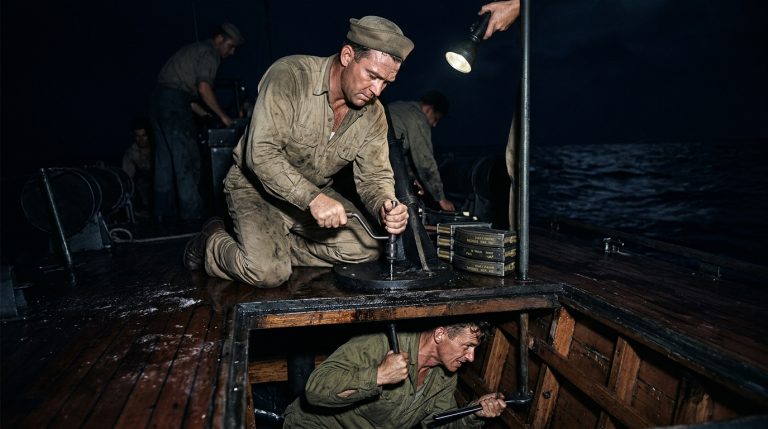
The heavy torque wrench felt like an extension of Thomas Wilson’s own hand. As the cold, oil-slicked steel settled into his grip, the noise of the motorpool—the distant commands, the shuffling of boots, the low-frequency hum of the base—faded into a dull, unimportant background static. He wasn’t in a motorpool in 2026 anymore. For a heartbeat, the transition was total; he was back in the furnace of the desert, where the only thing separating survival from silence was the ability to interpret the language of a machine that was screaming for help.
He didn’t walk toward the engine compartment where Davenport’s team had spent thirty-six hours of frantic, data-driven failure. He walked instead to a small, unassuming access panel near the base of the turret ring. It was a spot that had been ignored by the diagnostic flowcharts, deemed too peripheral to be the cause of a catastrophic power failure.
Davenport, stripped of his bravado but still clinging to his intellectual vanity, trailed behind him. The Lieutenant’s face was drawn, his movements jerky and uncoordinated. He watched with a mixture of dread and genuine confusion as Thomas knelt on the hard concrete. The old man’s knees creaked, a sound as dry as dead leaves, but he ignored the protest of his body. He pressed his ear against the cold, scarred plating of the tank.
“Listen,” Thomas said, his voice barely audible.
Davenport hesitated, then gingerly lowered himself to the ground. The concrete was unforgiving against his expensive uniform. He leaned in, pressing his ear to the steel as instructed. At first, he heard nothing but the wind and the ambient noise of the base. Then, as his ears adjusted, he heard it—a subtle, discordant rhythmic thrumming, like a heartbeat attempting to pump blood through a constricted artery. It was a sound that didn’t exist in any of his digital models.
“That,” Thomas said, his fingers tracing the outline of a small hydraulic reservoir, “is the sound of a machine pleading.”
He raised the torque wrench and struck the metal casing with a single, calculated motion. Thud. The sound was dull, heavy, and definitively hollow. He struck it again, moving his aim by an inch. Thud.
“It’s not the pump,” Thomas explained, his tone shifting into that of a seasoned instructor. “Your diagnostic suite is reading a total pressure loss because the system is starved at the source. You’ve been looking at the effect, Lieutenant. You’ve been chasing the ghosts of the software. You have to look at the anatomy.”
Thomas’s hands, mapped with the scars of a thousand similar repairs, moved to the bolts. He didn’t use a digital torque gauge. He used his intuition, the pressure of his palm, the resistance of the metal. He felt the bolts give way with a tactile satisfaction that only a master craftsman understands.
Davenport watched, his breath caught in his throat. He had spent years learning how to interface with systems through screens, through code, through layers of abstraction. He had never seen a machine dismantled with such primal, unadorned logic. As the access plate was removed, a spray of dark, viscous hydraulic fluid wept from the seal, smelling of burnt earth and spent potential.
Inside, hidden by the shadow of the plating, was a small, circular baffle that had sheared from its mount—a tiny piece of metal, no bigger than a coin, that had effectively throttled the life out of a seventeen-hundred-horsepower turbine.
Davenport stared at the piece of metal, his eyes widening. He looked at his tablet, where the diagnostic logs still insisted on a main power unit replacement. The disparity between the digital reality and the physical truth was a chasm that Davenport had spent his entire career ignoring.
“It’s just a piece of metal,” Davenport whispered.
“It’s a broken heart,” Thomas replied. He reached into his tool kit and pulled out a simple, manual clamp. “In the heat of the fight, you don’t have time to wait for a replacement part from a depot three weeks away. You have to invent the future with what you have in your hand.”
He handed the clamp to Davenport. “Hold this. Not with the tech-bro precision you use on your screen, but with the steady hand of someone who knows that if you let go, the whole world goes dark.”
For the first time since the ordeal began, the Lieutenant didn’t try to lead. He didn’t try to analyze. He took the clamp, his fingers brushing against the oil-darkened skin of the old man, and he held it. He could feel the weight of the machine’s necessity through the steel. He could feel the responsibility of the repair, not as a data point on a report, but as a commitment to the men who would eventually climb into this hull to face the fire.
The tension in the motorpool shifted. The soldiers watching didn’t cheer; they simply stood straighter. The hierarchy of rank, for a moment, had been superseded by the hierarchy of competence. Thomas Wilson was no longer an old man in coveralls; he was the center of a gravity well that was pulling the entire third brigade back toward the earth, back toward the reality of their craft.
Thomas adjusted the temporary line, his movements economical and devoid of any wasted energy. Every action was a lesson, every tool a bridge between the confusion of the digital present and the clarity of the mechanical past. He was teaching the Lieutenant not how to fix a tank, but how to see the world as it actually was—complex, imperfect, and entirely dependent on the steady application of human wisdom.
CHAPTER 6: THE FIRST BREATH
The air around the M1 Abrams felt brittle, stretched to the breaking point by the collective held breath of the entire assembly. Thomas Wilson’s hands, coated in the grime of the repair, moved away from the bypass lines with the slow, deliberate grace of a surgeon finishing a high-stakes procedure. He stepped back, wiping his palms on a rag that was already saturated with dark, tell-tale hydraulic fluid. He didn’t look at the General, nor the humbled Lieutenant; he looked only at the crew chief, a young soldier whose face was a mask of skepticism warring with desperate hope.
“Try her now,” Thomas said, his voice quiet, lacking any of the theatrical flair the Lieutenant had displayed earlier.
The crew chief climbed into the hatch, his movements stiff. The clatter of metal against metal echoed with startling clarity. Thomas felt his own heart rate begin to mirror the rhythm he had diagnosed earlier—the irregular, struggling thrum of a system starved of flow. He stood by the massive road wheels, his feet planted on the concrete, and for a fleeting, terrifying second, the motorpool blurred.
The smell of the base’s diesel vanished, replaced by the choking, sulfurous air of a desert battlefield. The overcast sky of the morning became the blinding, white-hot glare of an Iraqi noon. He was back in his own tank, the heat of the turbine biting at the back of his neck, his knuckles raw and bleeding from the desperate work of the bypass. He could hear the scream of an approaching T72 company, the roar of rounds impacting the ground nearby—a chaotic symphony of destruction.
His eyes widened, the blue of his irises reflecting a fire that didn’t exist in the motorpool. He wasn’t breathing; he was waiting for the ignition—the glorious, life-affirming scream of the turbine catching.
“Sir?”
The voice snapped him back to the present. He blinked, the desert heat receding, leaving behind a cold sweat on his brow. The crew chief was looking down from the turret, waiting for the signal.
Thomas nodded, once, a sharp, decisive gesture.
The ignition sequence began. For a long, grueling second, there was only the high-pitched, mocking whine of the electrics—a sound of electronic impotence. Davenport’s hands clenched into white-knuckled fists at his sides, his eyes fixed on his tablet as if he could force the numbers to change.
Then, it happened.
With a deep, guttural cough that vibrated through the concrete and deep into the marrow of everyone standing nearby, the seventeen-hundred-horsepower turbine caught. It didn’t start—it erupted. A blast of scorching heat flared from the rear grills, sending a shimmering, distorted heat-haze rippling through the air. The Abrams, that massive, monolithic behemoth of depleted uranium and composite armor, shuddered as if it were shaking off a thirty-six-hour sleep. The idle stabilized, shifting from a labored, irregular struggle into a powerful, rhythmic roar that was as steady as a heartbeat.
The effect on the assembled soldiers was instantaneous. A spontaneous, thunderous cheer erupted, rising above the mechanical growl of the tank. It wasn’t the polite applause of a formal event; it was the raw, guttural sound of men who had just witnessed a resurrection.
Thomas stayed where he was, his head bowed slightly. He was listening. Not to the machine’s roar—that was obvious—but to the underlying cadence of the internal components. He was checking for the friction, the whisper of metal on metal that would tell him if his improvisation would hold. The engine was clean. The bypass was working perfectly.
Davenport walked toward the tank, his movements tentative, like a man stepping onto thin ice. He looked at the rear grills, then at the bypassed lines, then at Thomas. The arrogance was gone, replaced by a profound, hollowed-out confusion. He had been so certain that the data was the absolute truth, that the computer’s assessment of a ‘catastrophic failure’ was a permanent, immutable fact. He had built his entire identity around the accuracy of that digital god. And yet, here it was—the machine, roaring, alive, and powerful, fixed by a wrench and a ghost.
“How?” Davenport asked, his voice barely rising above the turbine’s idle. “The diagnostics… the logs… they were categorical.”
Thomas looked at the Lieutenant, his expression softened by a tired empathy. He didn’t offer a lecture on the superiority of human intuition. He simply pointed to the tank.
“Data is just a memory of what happened,” Thomas said. “It doesn’t tell you what’s happening now. You were reading the tombstone, Lieutenant. You have to learn to talk to the person inside the coffin.”
As the tank’s engine pulsed, the air around the motorpool began to settle. The tension that had held the soldiers in a state of crisis was dissipating, replaced by an uneasy, reflective stillness. They weren’t just looking at a tank anymore; they were looking at the limits of their own expertise. The General moved toward the tank, his expression inscrutable, while the Master Gunner kept his gaze fixed on Davenport, as if gauging the final impact of the lesson.
Thomas moved away from the heat, feeling the familiar, aching weight in his knees. He walked toward the edge of the motorpool, needing the distance, needing the air to be cool and free of the turbine’s exhaled fire. He felt the weight of the Zippo in his pocket, the smooth, worn brass a grounding anchor. He had done what he came to do—he had breathed life back into the steel—but the cost was the re-opening of old wounds he hadn’t realized were still bleeding.
CHAPTER 7: THE QUIET RECONSTRUCTION
The motorpool had thinned out. The crowd of soldiers, drawn by the spectacle of the General’s arrival and the legendary repair, had dispersed, leaving behind only the low-frequency drone of the base and the sharp, focused silence of the repair bay. Lieutenant Davenport remained, his posture no longer stiff with defensive pride, but hunched with a strange, contemplative exhaustion.
He was holding a block of sandpaper, his movements mirroring Thomas Wilson’s. His hands, which had spent years navigating the delicate, clean interfaces of touchscreens, were now stained with deep, stubborn lines of industrial grease. He was sanding down the housing for the new baffle, the grit of the metal filings stinging his eyes, the rough edge of the metal biting into his palms.
“You’re pressing too hard,” Thomas said, his voice soft, cutting through the rhythmic scrape. “You’re trying to force the surface to be smooth. You have to let the abrasive do the work. You just have to guide it.”
Davenport slowed his rhythm. He looked at the metal—it was scarred, pitted, and worn, a relic of a machine that had been pushed to its absolute limits. “I spent my entire thesis on predictive failure models,” Davenport murmured, his eyes fixed on the work. “I thought if I knew the math, I could control the outcome. I thought the machine was just a series of probabilities.”
Thomas shifted his weight, his old knees protesting the long hours on the concrete. He reached out and placed a hand on the Lieutenant’s shoulder. It wasn’t the gesture of a superior to a subordinate; it was the steady, grounding grip of a master craftsman acknowledging the first spark of understanding in an apprentice.
“Math is the skeleton, Lieutenant,” Thomas said. “But the soul… the soul is in the friction. It’s in the heat. It’s in the way a machine groans when it’s tired and the way it fights back when it’s hurt. You can’t model that. You have to live it.”
Master Gunner Davis stood a few paces away, his arms crossed over his chest. He was watching them—not with the fury he had shown earlier, but with a guarded, expectant look. He had seen the transformation in Davenport, but he was waiting for the final test. This wasn’t just about repairing a hydraulic reservoir; it was about the survival of the institutional knowledge that Davis had sworn to protect.
“The baffle is ready,” Davenport announced, his voice steady. He held the part out, his hands trembling slightly from the physical exertion.
Thomas inspected the work. It wasn’t perfect—it lacked the clinical precision of a factory-produced component—but it was functional. It was ‘field-ready’ in the most literal sense of the term. He nodded, a slow, thin smile breaking across his weathered face.
“Good. Now, we put it back where it belongs.”
They spent the next three hours in the tight, cramped interior of the chassis. It was an exercise in claustrophobic intimacy. Davenport had to contort his body into spaces that were never designed for a human to occupy, the smell of recycled air and old oil thick enough to taste. He learned the geometry of the machine from the inside out. He learned that every bolt had a story, every connection a specific, subtle tension that had to be respected.
He was learning the vocabulary of the tank.
When the final bolt was torqued, Davenport slid out from the access port, his face streaked with oil and sweat, his muscles screaming in protest. He sat on the floor of the motorpool, his back against the cooling tracks, and looked up at the ceiling of the hangar. He looked like he had been dragged through a war zone, but for the first time in his career, he looked like he was actually there.
“I didn’t know it was this loud,” Davenport said, his voice reflecting a new, quiet awe. “Even when it’s idling… it feels like it’s thinking.”
Thomas sat down beside him, not bothering to hide his own exhaustion. He took the Zippo from his pocket and flicked it open. The flame caught, casting a steady, warm light against the shadowed interior of the hangar.
“Everything thinks,” Thomas said, his eyes distant. “You just have to learn how to listen to the frequency.”
The Master Gunner stepped forward, the sound of his boots echoing like a gavel. He didn’t say a word, but he reached down and offered a hand to the Lieutenant. It was a gesture of inclusion—a bridge built of calloused skin and mutual recognition. Davenport took it, hauling himself up, his movements slow and deliberate. He looked at his hands, blackened with the evidence of his labor, and then at the tank—a machine that was no longer a problem to be solved, but a partner to be understood.
“Tomorrow, 0500,” Davis said, his voice low and devoid of its earlier edge. “We start with the transmission. We’re going to do this until it’s part of your blood, Lieutenant.”
Davenport nodded, a genuine, unforced expression of resolve breaking through his fatigue. He understood now. The machine wasn’t a liability; it was the inheritance. And he was finally ready to start earning his keep.
CHAPTER 8: THE TORCHS WEIGHT
The diner was a sanctuary of linoleum and wood, a place where time seemed to fold in on itself, muffling the roar of the engines and the rigid demands of the barracks. Thomas sat in his usual booth, the vinyl cracked and worn, staring into a cup of black coffee that had gone long cold. He was waiting.
The bell above the door chimed, a bright, cheerful sound that cut through the low murmur of the diner.
Lieutenant Davenport entered. He looked different—not just because of the clean uniform, but because of the way he held himself. The frantic, nervous energy that had once defined him, the desperate need to prove his intellect through data, had been replaced by a grounded, weary ease. He walked over to the booth, a smudge of grease still clinging stubbornly to his jawline, and stopped.
“Mr. Wilson,” Davenport said, his voice quiet, stripped of the reflexive defensiveness that had characterized their first meeting.
Thomas gestured to the empty seat opposite him. “Sit down, son. The coffee’s cold, but the quiet is good.”
Davenport slid into the booth. For a moment, neither of them spoke. The silence wasn’t the heavy, accusatory silence of the motorpool; it was the comfortable, resonant silence of two people who had spent hours in the dark, cramped guts of a machine together. The realization finally settled in Thomas’s mind: the transition was complete. Davenport wasn’t just a technician anymore; he was a bridge.
“I saw the diagnostic report for the training exercise,” Davenport began, his eyes reflecting the soft, muted light of the diner. “The Abrams performed within operational parameters for the entire duration. No warnings. No pressure drops. Nothing.”
Thomas took a sip of the cold coffee, his gaze drifting to the window, where the afternoon sun turned the world into shades of amber. “It’s not because the tank is perfect, Lieutenant. It’s because the crew finally learned how to hear her.”
“I spent six months working under Master Gunner Davis,” Davenport continued, his hands resting on the table. They were hands that had been calloused by sandpaper, stained by oil, and hardened by the labor of genuine, physical repair. “He told me that you didn’t just teach me how to bypass a reservoir. You taught me that the machine isn’t an object. It’s a continuation of the people who maintain it.”
Thomas watched him. He saw the shift—not just in the Lieutenant’s understanding of the armor, but in his understanding of his own place within the legacy. The “Layer 2” realization—that the institutional knowledge wasn’t held in the manuals or the servers, but in the callouses and the intuition of the individuals—was finally taking root. The dying fire of their tradition had been fed, not by a grand, public declaration, but by the quiet, dirty, and essential work of mentorship.
“The Army is built on steel,” Thomas said, his voice thin but clear, “but it’s sustained by the people who know that steel has a spirit. When you stop listening, when you stop feeling the friction, the whole system starts to fray. You didn’t just fix a baffle, Lieutenant. You stopped a gap from widening.”
Davenport looked down at his hands, those same hands that had fumbled with a tablet so clumsily only months ago. They were steady now. “I felt it today,” he confessed. “During the live fire… I could hear the change in the engine frequency before the warning light even flickered. I didn’t need the computer to tell me she was stalling. I could feel it in my own chest.”
Thomas smiled, a slow, deep expression that reached his faded, desert-blue eyes. The torch had been passed. The ghost of 73 Easting, the legend that had haunted his own career, felt lighter, as if the burden of being the only one who remembered how to listen was finally being shared.
The diner grew quiet as the late afternoon sun began to retreat, leaving the booth in shadow. Thomas reached into his coveralls and pulled out the Zippo. He didn’t light it. He just held it, the silver-brass metal cooling under his touch.
“The tank on rack seven,” Thomas asked, his voice a gentle, rhythmic inquiry. “How is she sounding lately? Does she still have that cough?”
Davenport leaned in, his face breaking into a genuine, unforced smile—the smile of a man who had finally found his calling. “She’s running clean, sir. But she still needs a bit of a coaxing on the cold starts. She likes a human touch.”
Thomas nodded, satisfied. He closed his eyes for a moment, letting the warmth of the diner and the simple, profound honesty of the conversation settle around him. He felt an immense, quiet peace. The cycle had been completed, the knowledge secured, and the machine—the great, roaring, metallic beast of their shared history—would continue to run, not because of the binary code, but because of the men who stood in the dirt, hands deep in the grease, listening to the heartbeat of the steel.
The bell above the door chimed as the evening shift began, but for a moment longer, the two of them sat in the quiet, the master and the apprentice, united by the only truth that ever really mattered: that wisdom is earned in the labor, and the greatest act of legacy is to pass the hammer to someone who finally knows how to use it.