The Echo of the Fired Shot: A Testament to the Quiet Strength of Wounded Honor
CHAPTER 1: THE WEIGHT OF THE WOODEN STOCK
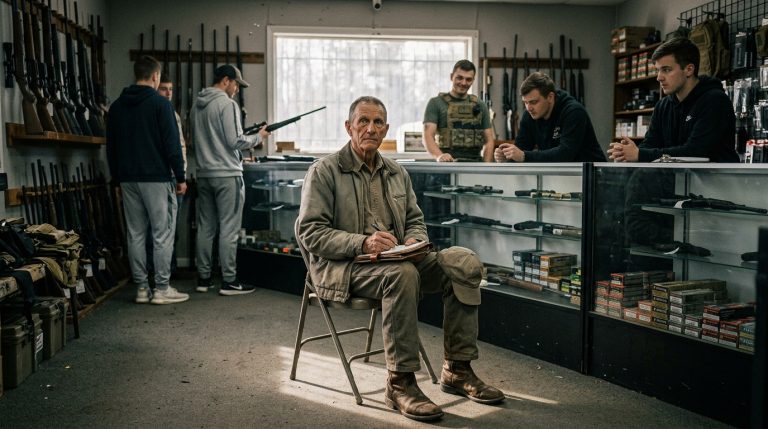
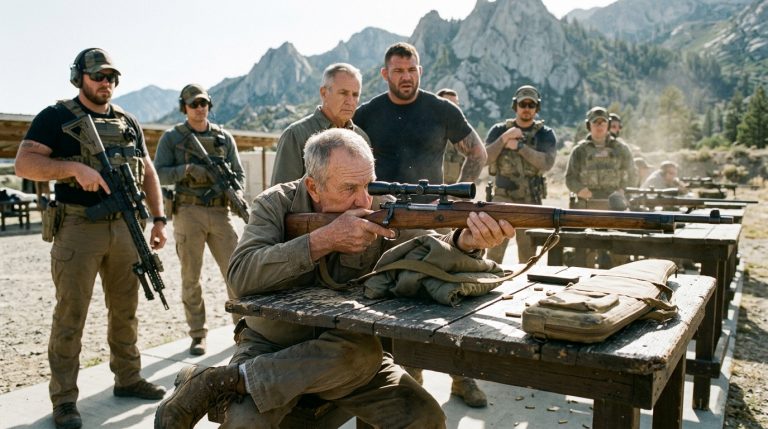
Private Kyle Harper didn’t see a man; he saw an obstacle to the perfection of his afternoon. The sun hung high over the range, baking the dirt until it turned into a fine, grey powder that coated their boots. Elias Walker stood at the edge of the firing line, his back slightly bent, fingers tracing the deep, scarred grain of a rifle that looked like it had been salvaged from a fire.
“Does a young marine have the right to mock an old rifle if he doesn’t know who’s holding it?” Harper’s voice cut through the air, sharp and deliberately loud. He leaned in, his face tight with the arrogance of new, clean uniforms. “Did you dig that thing out of a museum, old man? Or is it just a civil war relic you’re hoping doesn’t fall apart when you pull the trigger?”
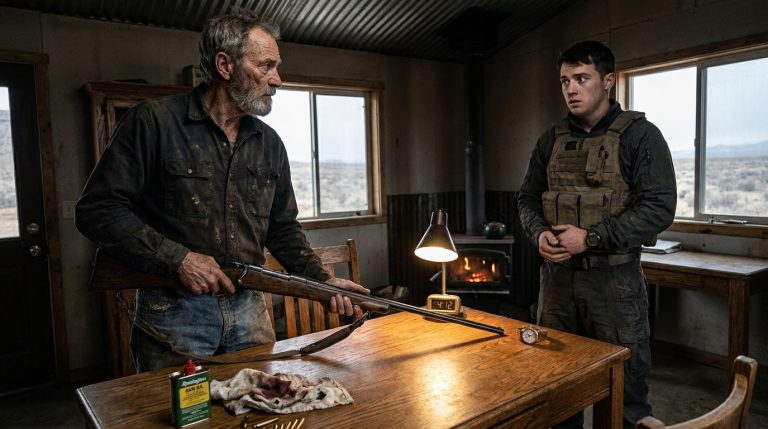
A ripple of laughter surged behind him, a wave of shallow, jittery energy. Elias didn’t flinch. He didn’t turn. He just kept wiping the wooden stock with a piece of cloth so thin it was almost translucent. The wood was dark, almost black, and the metal was dulled to a matte finish that refused to catch the light.
Elias’s movements were rhythmic, a slow, hypnotic flow of preparation that ignored the mounting tension. He pulled the bolt back—a crisp, mechanical sound—and checked the chamber. It was a precise, practiced motion, the kind of movement born from thousands of repetitions in places where a jam meant the difference between breathing and silence.
“I’m talking to you,” Harper said, stepping into the old man’s peripheral vision. His shadow fell over the table, dark and intrusive. “This is a Marine Corps range. We deal in results here, not antique collection.”
Elias slowly straightened, though he didn’t reach his full height. His hands, thick and calloused, rested firmly on the rifle. When he finally turned to look at Harper, his eyes weren’t angry. They were startlingly calm, like a lake after a storm has passed—deep, still, and impossible to read.
“Every job needs to be done right,” Elias murmured. His voice was a dry rasp, barely louder than the settling dust.
“Right?” Harper scoffed, turning to his fellow Marines. “Look at this thing. The wood is cracked, the barrel is pitted. I bet you’d have to pray it doesn’t blow up in your face.”
He reached out, his fingers hovering inches from the rifle’s trigger guard, a gesture of casual disrespect that made the air in the range suddenly, inexplicably heavy. Elias didn’t slap his hand away. He just looked down at the rifle, then back at the horizon, as if he were seeing a coordinate no one else could perceive.
He reached into his pocket and pulled out a single, tarnished shell casing. He set it on the table next to the rifle. It was the only thing on the table besides the weapon—a singular, brass-colored contrast against the worn, grey wood.
“The rifle isn’t the problem,” Elias said, his gaze shifting to a spot just behind Harper’s shoulder. “The problem is the hand that assumes it knows the weight of what it’s holding.”
Harper froze, his smile faltering for a heartbeat, but before he could respond, the wind kicked up, tugging at the range’s flag. Elias leaned over the table, his posture shifting into something suddenly, terrifyingly solid. He looked at the 1,000-yard marker, which sat like a tiny, impossible speck in the distance, and the silence that followed felt like a closing door.
CHAPTER 2: THE CALCULATED SILENCE
The silence on the range was no longer empty; it was pressurized. Harper stood ten feet from Elias, the arrogance that had defined his posture minutes ago now feeling brittle, like sun-bleached plastic. He looked down at his own modern rifle, then back at the old man’s weathered stock, searching for a flaw, a crack, anything to justify the growing unease in his chest.
Elias didn’t look at him. He was looking at the flag near the 1,000-yard marker. A sudden, sharp gust of wind caught the fabric, snapping it violently to the left before just as quickly dying, leaving the air heavy and stagnant. It was a chaotic, unpredictable shift—a stutter in the rhythm of the day. Elias reached out, his hand steady as a root, and adjusted the elevation knob on his ancient sight. It was a fractional movement, almost imperceptible.
Harper’s jaw tightened. “You’re making a production out of a piece of scrap,” he said, his voice forced, trying to reclaim the authority of his rank. “There’s a wind shift, you can see that. That rifle doesn’t have the ballistic support to compensate for a 1,000-yard hold, especially not with that barrel.”
Elias turned his head, his gaze sweeping over Harper with the dispassionate efficiency of someone watching the weather. He wasn’t insulted; he was simply waiting. He stepped back from the table, allowing Harper to look at the rifle if he dared. The wood felt cold, a faded, neutral texture that seemed to soak up the frantic heat of the afternoon.
“The wind is a variable,” Elias said, his voice flat, devoid of the irritation Harper clearly wanted to provoke. “Variables don’t care about the age of the equipment. They only care about the timing of the shot.”
Harper’s friends had stopped whispering. The mockery that had fueled the early hours of the morning had evaporated, replaced by a dull, aching curiosity. One of the younger Marines, a kid with barely a year of service, shifted his weight, his boot crunching loudly in the dirt. Elias’s eyes flickered to the kid—just a momentary glance—and then he looked back at the target line.
The butterfly detour of the wind had done more than just shift the flag; it had shattered the linear progression of Harper’s challenge. The range was quiet, save for the dry rustle of parched grass against the fence. Harper felt the eyes of his squad on him, not in support, but in anticipation. He had backed himself into a corner where his reputation was tied to the performance of a man he had spent the last hour calling a scavenger.
Elias leaned down, his knees popping audibly, a sound that underscored the stark difference between his reality and their perceived peak. He didn’t rush. He didn’t look for the approval of the crowd. He settled into the prone position with a grace that felt ancient, his body aligning with the earth as if he were re-establishing a long-forgotten geometry.
“Are you going to shoot, or are you going to keep lecturing me on physics?” Harper asked, though the bite in his words was gone, replaced by a defensive, hollow edge.
Elias’s fingers checked the bolt one last time. The metal clicked—a clean, sharp sound of intent. He lay motionless, his breathing syncing with the erratic gusts of the wind. He wasn’t fighting the environment; he was letting it pass through him. The faded fabric of his jacket stretched across his shoulder blades, fraying at the seams, a testament to years of endurance that Harper couldn’t begin to quantify.
“I’m waiting,” Elias replied, his voice barely audible over the heat shimmer rising from the ground.
Harper stood rooted to the spot, his own rifle hanging uselessly at his side. He realized then that he had no counter-move. If Elias hit the target, the arrogance of his own position would be exposed; if Elias missed, he had already invited the comparison that he had so desperately tried to avoid. The old man hadn’t just challenged him to a test of marksmanship; he had forced him to look at the fragility of his own status.
Elias didn’t move. He held the rifle, his cheek pressed against the worn wood, his eye finding the target through a sight that Harper couldn’t even name. In that silence, the gap between the two men deepened. It was the gap between those who performed for the score, and those who performed for the act itself. Elias was the ghost of a discipline these Marines had only ever read about in manuals, and for the first time, Harper understood that the old man wasn’t there to prove he was a soldier—he was there to remind them what it cost to be one.
The wind surged again, a final, reckless whip of air, and Elias’s finger tightened. The tension in the range snapped, pulled taut until the air itself seemed to hum, waiting for the crack of the firing pin to shatter the stillness.
CHAPTER 3: THE IMPOSSIBLE SHOT
The sound of the firing pin hitting home did not produce the expected thunder of a round chambering. Instead, it was a dry, hollow snap—a warning. Elias didn’t flinch. He didn’t pull back. His eye remained pressed against the iron sight, his body fused to the earth. To Harper, standing behind him, it sounded like a catastrophic failure. A smirk began to tug at the corner of his mouth, the relief so immense it was almost dizzying.
“See?” Harper whispered, his voice rising with a frantic, vindicated energy. “It’s a piece of junk. It can’t even hold a load.”
Elias didn’t respond. He didn’t move. He simply adjusted his grip, his calloused thumb finding the bolt release with a familiarity that suggested he had performed this exact action in the dark, in the mud, and in the freezing rain for decades. He cycled the action again. Click-clack. The sound was crisp, rhythmic, and intentional. He wasn’t struggling; he was communicating with the steel.
The wind surged once more, a sudden, brutal gust that bent the range flag until the pole groaned. A group of the younger Marines, who had drifted closer out of a morbid curiosity to see the old man fail, instinctively stepped back, bracing against the sudden drop in temperature. Elias adjusted his hold on the stock. The wood was worn smooth, stained with oils that had long since soaked into the grain, giving it the texture of river-smoothed stone.
“The wind is holding steady at five knots from the north-northeast,” Elias said, his voice so quiet it barely rose above the rustle of the dry grass. He wasn’t talking to Harper; he was talking to the rifle. “The elevation is compensated. The drift is accounted for.”
Harper opened his mouth to retort, to tell him that at 1,000 yards, a five-knot gust was enough to throw a shot three feet off target, but the words died in his throat. He looked at Elias’s hands. They weren’t shaking. They weren’t even tense. They were perfectly, unnervingly still. It was the stillness of a predator waiting for a specific, microscopic opening in the chaos.
The heat shimmer on the range rippled, distorting the 1,000-yard marker into a wavering, ghost-like apparition. Elias exhaled. It was a long, slow release of breath that seemed to deflate his entire frame, dropping him into a state of total structural repose. The rifle became an extension of his skeletal system, the steel cooling beneath his touch, absorbing the heat of his skin.
Then, he fired.
There was no stutter, no anticipation—just the deafening, sudden roar of the discharge. The concussion of the shot hit the dirt in front of them, kicking up a fine, choking cloud of grey dust. The sound didn’t dissipate quickly; it seemed to hang in the air, echoing against the distant treeline and the iron-framed shelters of the range.
For a heartbeat, there was nothing. The smell of burnt powder, sharp and biting, filled the stagnant air. Harper clutched his own rifle, his knuckles turning white. He watched the far end of the range, his eyes narrowed, waiting for the tell-tale puff of dirt that would signify a miss, a wide, shameful spray of earth that would prove he had been right all along.
The seconds dragged. Two. Four. Six.
“Hit,” a voice crackled over the range’s radio system, sounding distant and thin, as if the person on the other end had been stunned into a whisper. “Dead center. I don’t know how, but it’s a bullseye.”
The silence that followed was absolute. It wasn’t the silence of anticipation anymore; it was the silence of something foundational being dismantled. The young Marines who had been laughing minutes ago looked at one another, then at Elias, their faces pale. They had been taught that the equipment defined the soldier, that the gear set the ceiling for the capability. They had been taught that the past was dead and that the future belonged to the faster, the newer, and the louder.
Elias sat up, his movements fluid and unhurried. He worked the bolt, ejecting the spent casing. It spun through the air, glinting in the harsh sunlight for a brief moment before hitting the ground with a small, musical ting that rang out in the quiet. He didn’t look at the target. He didn’t look at the crowd. He stood up, his knees cracking again, and began to wipe down the rifle with his thin, fraying cloth.
Harper stared at the spot where the old man had been lying. He felt a cold hollow opening up in his stomach, a realization that he had been playing a game with rules he didn’t understand. He looked down at his own expensive, polymer-stocked rifle, suddenly seeing it for what it was: a machine that required the input of a pilot, and he realized with a sinking heart that he had never truly learned to fly.
Elias finished his work, his motions rhythmic and steady. He looked toward Harper, but he didn’t look at his eyes. He looked at the younger man’s shoulders, noting the way they were slumped, the way the arrogance had leaked out of his posture like air from a punctured tire.
“The shot isn’t the victory,” Elias said, his voice flat, neutral. “The victory is knowing what you’re capable of before you ever pull the trigger.”
He turned away, his back slightly bent, the old rifle slung securely over his shoulder. The Marines parted before him, not out of any order, but out of a sudden, instinctive need to give him space. The path he walked was wide and silent, and for the first time, Harper realized that the old man hadn’t just hit a target—he had hit the exact center of his own sense of self-worth, and he had left it trembling in the dust.
CHAPTER 4: THE RETURN OF THE GHOST
Elias didn’t turn. He heard the footsteps before he saw the man—measured, professional, the heavy gait of someone who had spent their entire life answering to a rank. The crowd of young Marines shifted, their earlier cockiness replaced by a sudden, rigid deference. Elias felt the familiar weight of the air change, the way it stiffens when an officer enters the perimeter.
“Stop.”
The word wasn’t shouted. It was a command that carried the authority of experience. Elias paused, his boots planted firmly in the grey dust of the range. Behind him, Harper had stiffened, his head snapping toward the approaching figure. It was Colonel Reynolds. His uniform was immaculate, his posture a sharp, disciplined line against the hazy backdrop of the firing range. He didn’t look at the recruits; he was looking at Elias’s back, at the way the faded fabric of his jacket sat on his shoulders, at the old, unpolished rifle that now seemed less like a relic and more like a badge of office.
“That can’t be,” Reynolds said, his voice dropping into a register of profound, disbelieving gravity. “It can’t be you.”
Elias stood motionless. The sound of the wind across the range—a low, mournful whistling through the fence wires—suddenly reminded him of a night in a valley he had spent twenty years trying to forget. The rain had been cold, turning the dirt into the same thick, clinging mud that now crusted his boots. He hadn’t been an old man then. He had been a master of his craft, a man who understood that silence was the only armor that didn’t rust.
“Walker.” The Colonel took another step. He was close enough now that Elias could hear the slight rustle of his insignia. “Master Gunnery Sergeant Elias Walker.”
A ripple of genuine, unadulterated shock moved through the ranks of the Marines. Harper looked like he had been struck; the color drained from his face until he looked almost translucent against the sun-scorched earth. He stared at Elias, his mouth opening and closing, the word ‘junk’ now dying in his throat like a swallowed curse.
Elias turned slowly. He didn’t offer a salute. He didn’t need to. He simply looked at Reynolds, his eyes steady, reflecting the same tired resilience that had defined his morning.
“We filed the report,” Reynolds continued, his gaze searching Elias’s face for the man he had once known. “We put your name on the board, Walker. We held the service. We were told you were killed in action.”
Elias bowed his head slightly. The memory of the rain, the sound of rifles firing in the dark, and the weight of the rifle—the same rifle—pressed against his chest. “So did I,” Elias said, his voice barely a whisper, yet it carried across the range with a clarity that seemed to freeze the very air.
A dry, sharp swallow echoed from the crowd. The “White Knight.” The name flickered into the minds of the older range instructors present, men who had heard the legends of a hillside held for three nights in a driving storm with no reinforcements and no expectation of survival. The myth, which had always been relegated to the category of ‘improbable history,’ was suddenly standing in the dirt, wearing a frayed jacket and carrying a piece of steel that had survived the impossible.
Reynolds turned his head, his gaze sweeping over the squad of recruits with a cold, piercing intensity. “Do you know who you are standing in front of?”
No one answered. The silence was heavy, a suffocating blanket of realization. They had been laughing at the very thing that represented the foundation of their entire existence. They had been mocking the cost of their own safety.
“He was once called ‘White Knight’ Walker,” Reynolds said, his voice hardening, pulling the legend out into the light where it could no longer be ignored. “Because he held a hillside for three nights while the rest of his unit was pinned. No reinforcements. No backup. Just him and that rifle. The same rifle you just called junk.”
Harper took a step back, his foot slipping in the dust. He looked at Elias’s hands—the thick, scarred, sunworn hands that had held the weight of a platoon’s survival. He had thought he was measuring the man by the efficiency of his marksmanship, not realizing he was witnessing the endurance of a man who had already outlived his own legend.
Elias closed his eyes for a heartbeat. The smell of ozone from the firing range mixed with the phantom scent of the damp, cold hillside. It was all still there, buried just beneath the surface of the present, a texture of time that never truly faded. “No need to tell it, Colonel,” Elias said, his voice low, final. “It’s over.”
“No,” Reynolds replied, his posture not wavering, his respect evident in the way he stood before the veteran. “It was never called by its right name.”
The tension in the range wasn’t resolving; it was coalescing. The decoy secret—the idea that Elias was just an aging, eccentric ghost—had shattered. In its place was something much harder to bear: the reality of the price paid by those who had already walked through the fire. Harper stood paralyzed, the shell of his own arrogance having been completely stripped away, leaving him exposed in the quiet, merciless light of a truth he was nowhere near prepared to understand.
CHAPTER 5: THE BURDEN OF GRACE
Harper stood in the center of the range, the ground beneath his boots feeling suddenly treacherous. The air, which had been thick with the heat of the afternoon just moments ago, now felt thin and cold. He looked at Elias—really looked at him—and saw not the old man who swept the floors, but the man who had occupied a space in the unit’s history that Harper had only ever seen in faded, framed photographs in the mess hall.
“Sir, I…” Harper began, his voice splintering. He took a half-step forward, his movements jerky, uncoordinated. “I cross the line. I didn’t know. If I had known, I would have—”
“If you had known,” Elias interrupted, his voice low, steady, and entirely devoid of malice, “you would have acted differently because you thought I was someone worthy of your time. That’s not respect, son. That’s just a calculation.”
Colonel Reynolds didn’t step in to soften the blow. He stood with his hands behind his back, his expression unreadable, a silent observer to the dismantling of a young man’s arrogance. He watched as Harper’s face worked through a range of emotions—confusion, defensive pride, and finally, a profound, gut-wrenching shame.
Elias reached into his pocket. His movements were slow, deliberate, as if he were pulling out something precious. He drew out a single shell casing. It was oxidized, darkened by age and exposure, a small piece of history that had been handled, ignored, and eventually forgotten. He held it out, his fingers rough and calloused, steady as the earth itself.
“Keep it,” Elias said.
Harper stared at the casing, his hand trembling as he reached out to take it. The metal was cool, solid, and impossibly heavy. It felt like an anchor. “What for, sir?”
“To remember,” Elias replied, his gaze drifting to the far end of the range, where the 1,000-yard marker stood silent and defiant. “To remember that a word can miss its mark just as easily as a bullet, and that a silence—if you have the courage to hold it—can strike truer than any accusation.”
The Colonel turned his head to the crowd of recruits. They were watching, their expressions a mix of awe and terror. “Did you hear that?”
“Yes, sir,” several voices chimed in. It wasn’t the rhythmic, rehearsed snap of a unit on parade; it was a fractured, earnest response from men who were trying to process the fact that their world had just shifted on its axis.
Elias turned, his back slightly bent, the old rifle slung over his shoulder like a heavy, comforting weight. He didn’t wait for a dismissal. He didn’t ask for forgiveness. He simply began to walk away, his pace unchanged, his rhythm undisturbed by the emotional debris he had left in his wake.
“Sir, I’m ready to accept discipline,” Harper called out, his voice desperate, clinging to the only language he knew—the language of command and consequence. “I need to know how to fix this.”
Elias stopped. He didn’t turn around, but he slowed his gait, the fabric of his jacket catching the light as the sun began its long descent. “You don’t fix it with discipline, Harper. You fix it with the next move you make. You fix it by how you treat the next man who stands on this range, regardless of the uniform he’s wearing, or the rifle he’s carrying.”
He continued walking, leaving the firing line, leaving the range, and leaving the ghost of the ‘White Knight’ behind in the dust. Harper stood alone, his hand clenched tightly around the brass casing. He looked at the Colonel, but Reynolds wasn’t watching him anymore. He was watching the old man grow smaller against the vast, empty expanse of the range, a solitary figure moving through a world that was only just beginning to understand what he had carried for them in silence.
The range, usually a place of noise and frantic, desperate measurement, went silent. No one moved to reset the targets. No one reached for their gear. For the first time, the Marines weren’t thinking about their score. They were thinking about the distance between who they were and the standard that had just walked out the gate.
CHAPTER 6: THE LINGERING RIPPLE
The sun dipped low, bruising the horizon with shades of deep violet and burnt orange. On the firing range, the shadows stretched long and thin, like fingers reaching across the packed, grey earth. Elias walked, his gait steady, the rhythm of his boots against the ground the only sound in a world that had suddenly learned how to listen. Behind him, the range was still. The frantic, competitive energy that had defined the morning was gone, replaced by a deliberateness—a new kind of discipline that didn’t need to be shouted.
He reached the edge of the range, where the paved lot met the dust. He stopped and turned, just for a second. In the distance, he saw Harper. The young man stood still, his posture no longer rigid with artificial confidence, but grounded, heavy with the weight of the casing he still held in his palm. He wasn’t looking at the target; he was looking at his own hands, studying them as if he were seeing them for the first time.
Elias turned away, his duty concluded. He didn’t need to see the rest. The lesson wasn’t about him; it was about the space he left behind.
In the days that followed, the change was subtle, woven into the very fabric of the base’s daily life. There were no grand declarations, no new policies posted to the notice boards, and no ceremonies to mark the shift. But the way the Marines spoke—the way they held their weapons, the way they checked their sectors—had been permanently reordered. When a recruit misfired or a trainee let their frustration show, there was no mocking laughter, no sharp, cynical retort. Instead, there was a quiet, almost practiced patience. A glance. A nod. A steady hand on a shoulder.
Elias returned to his routine with the same unadorned precision. He swept the floors of the supply room, logged the ammunition counts, and moved through the quiet corridors of the barracks as if he were a part of the architecture itself. He never sought recognition. He never looked for the Colonel to ask for a status update. He simply lived, a quiet, fading texture in a world that was becoming increasingly loud.
One afternoon, toward the end of the week, he found himself back near the range. The air was cool, smelling of damp earth and the metallic tang of cooling steel. He walked to the edge of the fence, his hand resting on the weathered wood of the railing. Harper was there, supervising a fresh group of recruits. He saw Elias and stopped, his face softening in a way that wasn’t quite a smile, but something far more permanent—a recognition.
Harper walked over, his steps measured. He didn’t speak immediately; he just stood beside the old man, looking out over the 1,000-yard line. The wind was gusting, just as it had that day, but the recruits were compensating, their movements slow, controlled, and devoid of ego.
“It’s better,” Harper said, his voice quiet. He opened his hand, showing the shell casing. It caught the waning light, a dull, tarnished gold. “The range feels… different. It feels like it holds something now.”
Elias looked at the casing, then at Harper. The younger man’s eyes were clear, the frantic, defensive edge replaced by a steady, pragmatic focus. He had stopped looking for shortcuts; he had started looking for the truth in the work.
“The range has always held it,” Elias said, his voice a low rasp. “You just had to stop shouting long enough to hear it.”
He reached out, his hand—thick, scarred, and strong—briefly resting on Harper’s shoulder. It was a gesture of immense weight, a transfer of something that couldn’t be quantified in performance reports or medal counts. It was the transfer of the silence, the inheritance of the ‘White Knight’s’ endurance.
“Don’t carry the casing because it’s mine,” Elias added, his eyes tracing the horizon. “Carry it because it’s yours. Because you chose to pick it up and look at it.”
Elias turned and walked away, his figure growing smaller against the backdrop of the darkening base. He didn’t look back again. He walked past the parking lot, past the barracks, and toward the tree line where the base gave way to the wild, unkempt beauty of the hills.
Back on the range, Harper stood for a long time. He turned the casing over in his fingers, the edges worn, the surface scratched by time. He finally put it into his pocket, his grip firm and relaxed. He turned back to the line, where a recruit was struggling with his bolt. Harper walked over, not to correct him, but to show him. He moved with a slow, deliberate grace, his voice low and instructive.
The story didn’t end with a parade or a plaque. It ended in the quiet, mundane repetition of the work. The legacy of the hillside, the three nights of rain, the cold, impossible shots—they didn’t live in a file or a museum. They lived in the way a man chose to stand, the way he chose to listen, and the way he understood that honor wasn’t something you claimed; it was something you cultivated in the long, silent stretches between the shots.
As the stars began to pin themselves against the velvet dark, the base grew quiet. The lights hummed, the wind whispered, and somewhere, in a small, unremarkable room, an old man sat down to rest, his hands folded, his breathing steady, the heavy burden of his history finally, quietly, at peace.