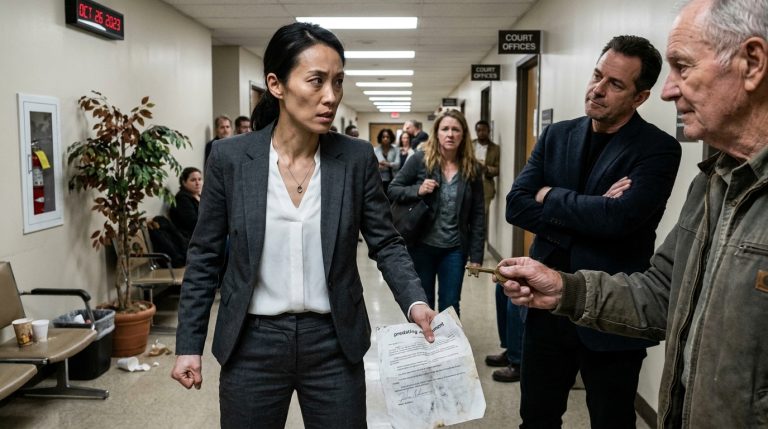
A Bridge Across the Wire: Finding Quiet Redemption in the Echo of a Forgotten Trident
CHAPTER 1: The Weight of the Stitch
The morning air in the facility was thick, saturated with the smell of nylon dust and stale coffee—a smell that had been the anchor of Glenn’s life for five decades. He held his breath, his needle hovering a fraction of an inch above the nylon. Two and a quarter. It was a measurement that felt like a betrayal of everything he knew, but in this room, he followed the new manual, not the instinct that had kept men alive in the dark years.
“I said, I want a two-inch margin, not two and a quarter. Are you even listening?”
The voice was thin, vibrating with the sharp, unearned cadence of a young man who had only ever seen the world through the glass of an academy training manual. Glenn didn’t move. He kept his focus on the needle, his pulse steady, a rhythmic thumping against his wrist that matched the slow, deliberate tick of the wall clock. He felt the heat radiating from Lieutenant Davies, a stifling, humid pressure that threatened to undo his focus.
Glenn reached for his thermos. It was old, the metal dented and worn, its surface textured by a lifetime of hard labor. He took a slow, methodical sip. The coffee was bitter, scalding, and perfect.
“I’m talking to you, old man,” the voice spat, closer now, invading the private, silent cathedral of his workspace.
Glenn placed the thermos down with a soft, practiced thud. He finally looked up. He didn’t see a soldier; he saw a boy wearing a suit that didn’t fit. He saw the frantic, searching eyes of someone who hadn’t yet learned that the most dangerous things in this world were the ones that made no sound at all.
“The manual dictates the margin, Lieutenant,” Glenn said. His voice was a rasp, like sandpaper on dry wood. It was the first time he had spoken in hours, and the sound felt heavy in the confined space. “But if you prefer the two-inch, I can adjust it. It’s a risk, but it’s your command.”
Davies leaned in, his face turning an angry, blotchy crimson. He reached out and snatched the logbook from the table. As his hand swept across the surface, his sleeve caught the lip of the thermos. The cup tipped, a dark tide of coffee surging toward the pristine orange expanse of the parachute.
Glenn’s hand moved—not with the speed of a young man, but with the efficiency of a machine that had been running for seventy-three years. He caught the thermos mid-fall. Not a single drop touched the nylon. But as he straightened, a flicker of movement caught his eye.
The lieutenant had stopped mid-rant, his gaze fixed on something just above the collar of Glenn’s shirt. He squinted, his lip curling into a smirk that didn’t reach his eyes.
“What is that?” Davies asked, his voice dripping with a new, cruel curiosity. He pointed a manicured finger at the ink visible at the nape of Glenn’s neck. “Did you lose a bet in a dive bar, or is that just the mark of someone who’s stayed past their welcome?”
Glenn felt the coldness of the memory hit him—not a sting, but a numbing frost that traveled down his spine. It was a trident. A mark he hadn’t thought about in years, a symbol of a promise made in a torpedo room that had long since rusted into history. The silence in the room stretched, taut as a suspension cord. For the first time all morning, Glenn’s hand, the one holding the rag, began to tremble—just a fraction.
He didn’t look at the lieutenant. He looked at the orange canopy and saw, for a fleeting, terrifying second, the faces of men who hadn’t made it home.
CHAPTER 2: The Ripple of Silence
The air in the rigging facility had turned heavy, stagnant, as if the oxygen itself had been replaced by the weight of things unsaid. Glenn’s hand, the one clutching the cleaning rag, did not stop shaking; the movement was small, rhythmic, a subconscious tremor that he had spent decades suppressing. He stared at the orange nylon, but he wasn’t seeing the weave of the fabric anymore. He was seeing the condensation dripping down the steel hull of the torpedo room, the cold sweat on Marcus’s forehead as the guitar-string needle pierced his own skin, and the suffocating pressure of being five hundred feet beneath the Atlantic, held together by nothing but a shared, unspoken oath.
“Well?” Lieutenant Davies’s voice cracked through the reverie like a whip. He was still standing there, his hand reaching out, his fingers hovering inches from Glenn’s identity badge. His face was flushed with the erratic, performative rage of a man who needed the world to acknowledge his authority because he didn’t quite believe in it himself. “I asked you a question. Or are you deaf as well as incompetent?”
Glenn slowly withdrew his hand from the table and tucked both into his pockets, clinching his fists to still the tremor. He didn’t look at the lieutenant; he looked past him, at the junior enlisted sailors who had frozen in place. They were watching, their expressions a mixture of terrified curiosity and profound discomfort. He could see the way they held their breath, the way their shoulders were hunched, their bodies already bracing for an explosion that hadn’t happened yet.
“It’s an old mark, Lieutenant,” Glenn said, his voice flat, devoid of the defensiveness the boy clearly craved. “It doesn’t signify anything you’d find in a service record.”
“Don’t give me that,” Davies snapped, his gaze darting to the logbook he’d tossed earlier. He seemed energized by his own malice, a man intoxicated by the discovery of a target. He picked up the logbook again, his thumb flicking through the pages with a dismissive, violent energy. “You’re an employee of this command. Everything about you is subject to review. If you’ve got something to hide—something that disqualifies you from being in the proximity of Tier 1 equipment—then you’re a liability.”
He took another step into Glenn’s space, his chest puffed out, his uniform crisp and white, contrasting sharply with the grease-stained, worn fabric of Glenn’s work shirt. “I’m going to be reviewing all your packs. Every. Single. One. If I find so much as a thread out of place, I’ll have your contract terminated and your access to this base revoked by sunset.”
Glenn watched him, his eyes tracing the jagged, nervous movement of the lieutenant’s jaw. He felt the familiar, dull ache of an old injury in his shoulder, a physical reminder of a jump gone wrong in a landscape that no longer appeared on any map. He understood the boy’s fear; it was the fear of a vacuum. Davies was terrified that if he stopped shouting, if he stopped finding “errors” to correct, the silence of the room would reveal that he didn’t actually know what he was doing.
The other riggers, the ones who had worked with Glenn for years, were staring at the floor. Senior Chief Romano was standing three stations away, his jaw clamped shut, his hands balled into white-knuckled fists. He caught Glenn’s eye for a micro-second—a warning, a plea for restraint. Glenn gave a nearly imperceptible nod. He had spent his life dealing with men who thought the world was built on paperwork and protocol. He knew that the only way to survive the fire was to let it burn itself out.
“As you wish, Lieutenant,” Glenn replied, his voice barely a whisper in the echoing hall. “The logs are on the rack. The packs are numbered. You’ll find everything exactly as it should be.”
Davies let out a sharp, ugly bark of a laugh. He looked around the room, clearly expecting a chorus of agreement or at least a show of fear from the others. When none came, he threw the logbook onto the packing table with enough force that it skidded, knocking the coffee thermos over once more. The dark, black liquid began to pool, a slow-moving, obsidian stain creeping toward the edge of the table.
This time, Glenn didn’t move to catch it. He watched the coffee drip off the edge of the table and onto the polished, grey concrete floor. It looked like ink. It looked like the mixture of ash and alcohol he had used to mark his neck forty years ago.
“You’re done for today,” Davies announced, his voice rising again, desperate to reclaim the momentum. “Get out of my sight. I’m going to go through every entry in this book. And when I find the discrepancy—and believe me, I will—don’t expect any mercy.”
He turned on his heel, his military posture rigid, and marched toward the back office. The sound of his boots on the concrete was the only thing filling the void.
Glenn stayed at his table. He didn’t pick up the thermos. He didn’t wipe up the spill. He stood perfectly still, watching the coffee soak into the concrete, his mind drifting back to that torpedo room. He could hear the hum of the turbines, feel the oppressive, heavy silence of the deep
CHAPTER 2: The Echo of the Needle
The tremble in Glenn’s hand was a traitor. He pressed his palm flat against the cool, unforgiving surface of the packing table, trying to ground himself, but the vibration persisted. It wasn’t the palsy of age—he knew the difference—but the ghost-recoil of a memory that had been buried under decades of coffee-stained silence.
Lieutenant Davies was still standing there, his face a map of confused arrogance. He was waiting for a reaction, a defense, a breakdown. He wanted the old man to apologize, to hide the mark, to show weakness. Davies didn’t understand that he wasn’t looking at a relic; he was looking at a dormant fault line.
“I asked you a question, Patterson,” Davies prompted, his voice tight with the irritation of someone who felt his authority slipping, even though he had never truly held it. “Is that some kind of gang ink? You’re on a government installation, and I’m beginning to think your security clearance needs a very thorough, very public audit.”
Glenn took a slow, deep breath, the air in the facility tasting of ozone and dust. He didn’t look at the Lieutenant. He looked at the orange nylon, and suddenly, the fluorescent lights of the rigging room flickered and dimmed. He wasn’t in a Navy facility anymore; he was back in the cramped, freezing belly of a sub, the metal walls sweating with condensation. The air was thick with the scent of recycled oxygen, diesel, and the sharp, metallic tang of blood and pen ink.
Steady, a voice whispered in the back of his mind. It was Marcus.
Marcus had held the guitar-string needle, his eyes bright with a feverish, desperate light. They were kids, barely twenty, about to be launched into a mission that didn’t technically exist. The ink was a mixture of lampblack and cheap, stolen bourbon. It burned like a live wire, but it was a holy fire. It marked them as the first of something, a secret pact that defied the crushing weight of the Atlantic outside.
“It’s a record, Lieutenant,” Glenn finally said. His voice was steady now, the tremor in his hand quelled by the sheer force of a lifetime of suppressed discipline. He looked up, his eyes locking onto Davies’s own. The young man recoiled slightly, unsettled by the raw, bottomless calm in the old man’s gaze. “A record of a time when the work mattered more than the paperwork.”
Davies blinked, the smirk faltering. He reached out again, his hand hovering toward the ink, a gesture of petty desecration. “I don’t care about your stories, old man. I care about protocol. And currently, you are in violation of…”
“Senior Chief!”
The voice boomed from the back of the room, cutting through the lieutenant’s bluster like a knife. It was Romano. He hadn’t left his post, but he had moved, his gait unhurried, his hands hanging loose at his sides in a way that suggested they were ready for anything. He walked up to the workstation, his eyes darting to the logbook, then to the coffee stain, and finally to the Lieutenant.
Romano stood between them. He was a mountain of a man, his presence a deliberate, immovable barrier. He didn’t look at Davies; he looked at Glenn.
“The Captain is going to want to see those manifests for the Q3 insertion, Glenn,” Romano said, his tone casual, almost conversational. It was a lifeline. “I’ve got the files in the back. Why don’t you let the Lieutenant handle the final inspection of this chute? He’s clearly got the eye for detail today.”
It was a test. Romano was throwing a gauntlet at the Lieutenant’s feet, betting on the boy’s lack of practical experience to unravel him. Glenn looked at the parachute. He knew every stitch, every tension point, every potential failure. Letting Davies touch it was like letting a child hold a live sparkler in a room filled with gasoline.
“The Lieutenant is certainly free to inspect,” Glenn said, stepping back, his movements economical. He wiped his hands on his rag, the fabric feeling rough against his skin. “But the log stitch is a delicate thing. It requires a certain… understanding of physics. Wouldn’t want you to find a ‘thread out of place’ that isn’t there.”
Davies sensed the trap, but his pride wouldn’t let him back away. He stepped up to the table, looking down at the nylon with an expression of intense, performative scrutiny. He was trying to act the part, but his hands were slightly clumsy, unpracticed in the tactile language of the trade.
Glenn turned away, his back to the Lieutenant. He walked toward the back office where Romano waited. The room seemed to shrink, the voices of the other riggers dropping to a nervous whisper. As he walked, the phantom sensation of the needle returned to his neck, a sharp, rhythmic prickling. He had spent his life keeping these men safe, ensuring they came back to the world they left behind. He was a guardian, an anchor. And right now, the weight of that responsibility felt heavier than the deepest trench in the ocean.
He reached the door, Romano closing it behind them with a sharp, final click.
“He’s dancing on a landmine, Glenn,” Romano murmured, his voice low and devoid of its earlier casual tone. “He’s going to trigger something. And I don’t think he’s ready for what’s beneath the surface.”
Glenn leaned against the wall, the cool metal pressing into his back. He looked at the clutter of the supply office, his mind calculating the risks. He had shielded the truth for decades. He had kept his identity, his history, and his mission locked behind a mask of an old, simple rigger. If Davies kept digging, if he kept pushing against the surface of this life, he wouldn’t just find a story. He would find the ledger.
And the ledger wasn’t just a record of work. It was a map of lives—a trail of anonymous financial support, of silent burials, of families kept afloat by a man who had no business being a savior.
“Let him dig, Mike,” Glenn said, his voice barely a breath. “But keep your eyes on the manifest logs. If he gets to the Q3 files, he’ll find the signatures. And those signatures… they lead to doors he doesn’t know how to open.”
The room was quiet, the hum of the facility outside distant and fading. For the first time, Glenn felt the vulnerability of his position. He was not just a rigger; he was a silent steward of a legacy that the Navy had tried to erase. And the boy outside, with his shiny uniform and his hollow arrogance, was holding a match, looking for something to burn.
CHAPTER 3: The Commanders Intervention
The supply office was a cramped, utilitarian tomb of gray metal shelving and boxes of spare cordage, smelling faintly of machine oil and dust. Romano stood by the door, his hand still resting on the latch, listening to the muffled, frantic movements of Lieutenant Davies on the other side. Outside, the rigging floor had descended into a controlled chaos. Sailors were shouting, equipment was being shoved aside, and the sharp, rhythmic snap of parachutes being secured echoed through the facility.
Then, the klaxon began—a long, piercing wail that vibrated in Glenn’s teeth. It wasn’t just a drill; it was the sharp, jagged sound of a base-wide mobilization alarm.
“That’s not a standard safety check,” Romano muttered, his brow furrowing as he pulled his communication radio from his belt. He adjusted the frequency, the static hissing like dry leaves. “The Lieutenant didn’t call this. He doesn’t have the clearance.”
Glenn didn’t move. He kept his back against the cool steel wall, his eyes fixed on a dusty box of webbing on the middle shelf. He felt a sudden, sharp clarity, a shift in the internal pressure of his mind. If Davies was trying to make a name for himself, he had just chosen the worst possible moment to do it. The Lieutenant was pushing, but he was pushing into a vacuum, unaware of the structural integrity of the command he was trying to bend.
“He’s making a power play,” Glenn said quietly. His voice didn’t waver. “He wants to isolate this room. He wants to drag me out in front of the entire rigging staff during a mobilization. It’s the only way he can ‘prove’ his authority is absolute.”
Romano turned to him, his expression grim. “We can’t stay in here, Glenn. If the inspection team comes through during a drill and finds us locked in an office while that kid is running riot out there, it’s going to look like we’re hiding something.”
Glenn pushed himself off the wall. The tremor in his hands had vanished, replaced by the cold, precise focus of a man who had navigated through worse than an arrogant lieutenant. He grabbed a heavy, weathered canvas bag from the floor—his personal tool kit—and slung the strap over his shoulder.
“We don’t hide,” Glenn said. “We work. That’s what we’re here for. If he wants to inspect the floor, let him inspect. But I’m not letting him touch the Q3 manifests.”
He stepped toward the door, his movements fluid and unhurried. He opened the office door to a scene of frantic activity. Lieutenant Davies was standing on a packing table, shouting at a group of young enlisted men, his face flushed, his movements erratic. The mobilization alarm continued to wail, a persistent, aggressive hum that made the air feel thin.
Davies caught sight of them immediately. His eyes widened, a flicker of something—was it panic?—crossing his face before he masked it with a sneer. He jumped down from the table, his boots hitting the concrete with a heavy, deliberate thud.
“Patterson!” Davies yelled, his voice strained to be heard over the alarm. “I ordered you out of the facility! Why are you still here?”
Glenn kept walking. He didn’t break stride. He felt the weight of the tool bag against his side, a solid, grounded counterpoint to the Lieutenant’s frantic flailing. “I’m here to secure the gear, Lieutenant,” Glenn replied, his voice calm, cutting through the noise with a quiet, authoritative gravity. “That’s what this drill is for. Securing the assets.”
Davies stepped into his path, forcing Glenn to stop. The Lieutenant was breathing hard, a thin sheen of sweat on his forehead. He looked like a man who had realized too late that he had bitten off more than he could chew. “I told you to leave. You’re dismissed, Patterson. Get to the gate.”
Glenn stood his ground. He didn’t look at the Lieutenant; he looked at the men behind him, the young sailors who were watching the exchange with wide, wary eyes. They looked confused, their loyalties caught between the officer’s rank and the silent, immovable reality of the old man in front of them.
“The assets aren’t secured, Lieutenant,” Glenn said, his voice low, measured. “You’ve left the chute on Station Four open. If this were a real mobilization, we’d be failing the inspection before we even started. Is that the standard you want to set for your team?”
Davies spun around, his face turning an even darker shade of crimson as he saw the open chute. He had been so focused on the confrontation that he had neglected the work itself. He stammered, his mouth working, but no words came out.
At that exact moment, the heavy blast doors at the far end of the hangar creaked open. The ambient noise of the facility dropped to a sudden, expectant hush. Captain Reynolds walked in, accompanied by Master Chief Thorne. They didn’t move quickly; they moved with a heavy, tectonic purpose that seemed to pull the air out of the room. The Captain’s eyes swept the floor, ignoring the chaos, ignoring the sailors, and locked directly onto the station where Davies stood, frozen, his hand still pointing at Glenn.
Romano stepped up beside Glenn, his presence a silent shield. The Captain’s gaze shifted to them, then to the mess of paperwork and open parachutes Davies had managed to create in his wake.
“Lieutenant,” the Captain’s voice was a low growl, audible even as the last echoes of the alarm faded into silence. “I believe I asked for a progress report on the rigging readiness. What I’m seeing instead is a scene of utter incompetence.”
Davies didn’t move. He couldn’t. He looked at the Captain, then back at Glenn, his mouth opening and closing like a fish pulled from the deep. The “power play” had vanished, leaving only the stark, cold reality of his own failure.
Glenn remained still, his face an unreadable mask. He had seen this before—the moment when the fire consumed the one who lit it. He didn’t feel triumph; he felt only the heavy, familiar weight of a promise that had to be kept.
CHAPTER 4: The Ledger of Shadows
The Captain’s arrival had not brought the explosion Glenn expected; instead, it had brought an icy, surgical silence. Captain Reynolds stood in the center of the rigging floor, his uniform stark against the cluttered, industrial backdrop. He didn’t scream. He didn’t threaten. He simply stood there, his eyes tracking Lieutenant Davies with the patient, terrifying intensity of a predator assessing a kill.
“Master Chief Patterson,” Reynolds said, finally breaking the silence. He didn’t look at Glenn as he spoke, his gaze remaining fixed on the lieutenant, who seemed to be shrinking into the floor. “I trust the packing standards are being upheld?”
Glenn inclined his head, his posture as solid as the concrete beneath them. “The standards remain, Captain. Always.”
Reynolds nodded, once, a sharp movement. “Good. Master Chief Thorne, see that the lieutenant is removed from this facility. I believe he has an extensive review of the administrative protocols to conduct in my office. Permanently.”
The command was final. Master Chief Thorne stepped forward, a man whose presence was as heavy as the bulkhead of a ship. He didn’t speak to Davies; he simply gripped the younger man’s arm, his fingers like iron bands. Davies didn’t resist. He looked at Glenn one last time—not with anger, but with a vacant, shattered confusion—before Thorne led him toward the exit.
As the doors hissed shut behind them, the tension in the room didn’t dissipate; it shifted. The sailors returned to their stations, but their movements were muted, careful. They watched Glenn now with a new kind of reverence, the kind reserved for someone who had walked through fire without singeing a hair.
Romano walked over, his face still tight. “He’s going to get the audit, Glenn. The Captain isn’t doing this for show. He’s going to open the books on this entire department to ensure the transition is ‘clean.’ That includes the contractor files.”
Glenn felt the cold knot return to his stomach. The financial ledgers. They were tucked away in a locker that had belonged to him for five years, buried beneath layers of mundane inventory reports and outdated manuals. If an administrative audit team came through, they wouldn’t just find the logs of parachute stitches; they would find the paper trail of the silent support he had been sending to the families of his fallen brothers.
“I need to move them,” Glenn said, his voice low, a secret spoken only to the rhythmic hum of the facility.
“You can’t,” Romano warned, his eyes darting to the overhead security cameras. “The Captain’s staff is already moving through the perimeter offices. They’re locking down access to the personnel files.”
Glenn didn’t respond. He turned and walked toward the rows of lockers that lined the far wall, his steps measured and deliberate. He needed a distraction, something to pull the auditors away from his station long enough for him to clear the locker. He reached his unit—a rusted, gray-painted metal door—and pulled out his key.
He swung the door open, the hinges giving a soft, protesting groan. Inside, it was a tableau of a life lived in service: a spare pair of work boots, a thermos, a thick, dog-eared copy of a manual from the early eighties, and, tucked into a false back panel he had installed himself, the ledgers.
As he reached for the panel, his fingers brushed against something cold and plastic. He pulled it out. It was a security key card, white and unmarked, with a heavy, magnetic stripe. It didn’t belong to him. He had never seen it before.
He frowned, turning the card over in his fingers. It had no identification, no badge number, no clearance level indicated. But it felt heavy, high-density. Why would someone leave a high-level access card in his locker?
Before he could process the discrepancy, the muffled sound of footsteps approached. Two young ensigns, their faces flushed with the zeal of the freshly empowered, were walking down the aisle, clutching clipboards. They were checking lockers.
Glenn acted on instinct, the kind that had been forged in the deep, cold water of the Atlantic. He shoved the ledgers back, but instead of trying to hide the card, he tucked it into the pocket of his shirt, just beneath the collar, exactly where the trident tattoo sat on his neck.
“Master Chief Patterson?” one of the ensigns called out, his voice cracking slightly. “We’re conducting a routine audit of the contractor workstations. We’ll need to inspect your locker.”
Glenn turned, his back blocking the open door of the locker, his posture relaxed, even slightly slumped, the picture of an aging man caught in the middle of a mundane day.
“Always happy to cooperate with an audit, Ensign,” Glenn said, his tone accommodating, almost apologetic. He stepped aside, revealing the contents of his locker. “Just boots and coffee, I’m afraid. Not much of a life for an auditor to look through.”
The ensign stepped forward, peering into the cramped space. He moved the boots aside, shuffled the manuals, and poked at the back panel. Glenn held his breath, his heart rate remaining steady, a steady rhythm against his ribs. He felt the plastic of the key card against his skin, a sharp, cold presence.
The ensign paused. He looked at the back panel, his eyes narrowing. “This panel… it looks a bit loose, Master Chief.”
Glenn didn’t flinch. “Old lockers, Ensign. They don’t make them like they used to. I’ve been meaning to fix it for a year, just never got around to the repair work.”
The ensign hesitated. He reached out to pull on the panel, but then, in the distance, the klaxon sounded again—a short, frantic burst, signaling a sudden, emergency override in the server room. The ensigns looked at each other, their clipboards twitching in their hands.
“Override on the security net,” the ensign said, his priorities shifting instantly. “We’re needed at the control center.”
They turned and left without a second look, their boots echoing down the aisle. Glenn stayed there, watching them disappear around the corner. He reached up and touched his collar, the key card still hidden there. It wasn’t just a key; it was a mistake—or a gift—left for him by someone who knew exactly what was hidden in the back of his locker.
The air in the room felt different. The “audit” wasn’t just an administrative chore. Someone was playing a deeper game, and they had just invited him to join.
CHAPTER 5: The Confrontation of Grace
The rigging facility was no longer a sanctuary; it had become an observation deck. As Glenn walked toward his station, the presence of the audit team—a collection of gray-suited administrators and junior officers with sterile, unblinking stares—transformed the familiar aisles into a gauntlet. Every glance felt like a measurement. Every whisper of a radio transmission sounded like a countdown.
Glenn kept his head down, his movements practiced and economical. He needed to get to the office, to the private, secondary storage closet where he kept the duplicate logs that truly mattered—the ones that didn’t just track parachute tension, but the flow of funds to the families of the fallen.
He passed the main packing floor, his eyes scanning for Romano. The Senior Chief was currently being interrogated near the blast doors by a tall, angular officer with a clipboard. Romano caught Glenn’s eye for a fleeting second—a warning. Don’t go near the office.
Glenn bypassed the office corridor entirely, turning sharply into the maintenance hallway. His mind, usually a calm, steady instrument of precision, was now operating on a knife’s edge. The key card in his shirt pocket felt like a brand. He didn’t know who had left it, but the very fact that it existed meant someone had breached his perimeter. Someone knew about the ledger.
The hallway was lined with rows of lockers and utility panels, the air smelling of industrial cleaner and ozone. He reached a service hatch near the rear of the facility, a narrow passage he had used during his earliest days on the base to avoid the eyes of visiting dignitaries. He slid the hatch open, the metal groaning under his touch, and squeezed into the cramped, dark space behind the bulkheads.
He wasn’t alone.
The space was filled with the low-frequency hum of a server stack. In the dim light, he saw a shadow move. He froze, his hand instinctively going to his belt, finding only his rigging shears.
“Master Chief,” a voice whispered. It was soft, hesitant, and entirely familiar.
Glenn squinted into the darkness. A young man, barely out of his teens, wearing the uniform of a supply-tech, stood huddled against a cable bundle. It was the same tech who had been tasked with the base-wide inventory audit—the man who had been under the Lieutenant’s command before the purge.
“You’re the one who was in my locker,” Glenn said, his voice a low, gravel-grinding whisper.
The boy shivered, his eyes wide and terrified. “I… I wasn’t supposed to find them. The ledgers. I was just supposed to do the standard inventory check on the locker bank, and the panel was loose. I didn’t mean to look, but I saw the names.”
Glenn moved closer, the narrow space forcing them into uncomfortable proximity. “The names,” he repeated, the words feeling like shards of glass in his throat.
“The families,” the boy whispered. “I saw the wire transfers. I saw the names of the men who didn’t come back from the North Atlantic mission. I knew the history, Master Chief. My father… he was one of them.”
Glenn felt the air vanish from the hatch. He reached out and grabbed the boy’s collar, the move impulsive and desperate. “Your father? Your father was Marcus?”
The boy nodded, a tear tracking a clean path through the grime on his cheek. “He talked about the trident. He talked about the promise. Everyone thinks this base is just about the tech, the gear, the high-altitude training. But I’ve been watching you for months. You aren’t just packing chutes. You’re keeping them together.”
Glenn released him, his hand falling to his side. The boy was shaking, his fear now replaced by an overwhelming, agonizing devotion.
“The audit team, they aren’t here for the gear,” the boy continued, his voice rising slightly, breathless. “They’re being directed by someone in the logistics command. They want the records. They want to prove that someone has been embezzling, that there’s a ‘ghost’ account fueling the base. If they find your ledger, they won’t just revoke your access. They’ll erase the whole history. They’ll mark the families as beneficiaries of illicit funding, and they’ll ruin them.”
Glenn leaned his head against the cold metal casing of the server stack. He felt the weight of the trident on his neck, the phantom sting of the needle. He had spent years ensuring that the truth—the real truth—remained buried. He had treated the ledger as his burden alone, a silent penance for the men he hadn’t saved.
“I need that ledger,” Glenn said, his voice devoid of emotion, a cold, tactical directive. “If they find it, it’s over.”
“I have it,” the boy said, pulling a thin, black-bound book from his utility vest. “I pulled it during the drill when the servers were down. I knew this was coming.”
He handed it to Glenn. The book was warm, a solid, heavy thing that held the weight of decades of promises. As Glenn took it, he heard a sound from the hallway—the heavy, rhythmic thud of combat boots.
“They’re coming,” the boy whispered, his eyes darting to the service hatch. “I heard them talking. They’re closing in on this sector.”
Glenn looked at the boy, then at the ledger, then at the narrow opening. He was the one who had survived. He was the one who had kept the promise.
“Stay here,” Glenn commanded, his voice firm, leaving no room for argument. “If they ask, you were doing a routine inventory check on the server heat. You haven’t seen me.”
“Master Chief, they’ll know—”
“They won’t know anything,” Glenn said, already moving toward the back of the hatch, toward the labyrinth of maintenance tunnels that ran beneath the entire base.
He didn’t look back. He moved with a speed that defied his age, his mind already mapping the route to the external incinerator, the only place where a secret this heavy could be turned into ash. But as he crawled into the dark, the sense of being watched—a persistent, skin-crawling prickle—intensified. It wasn’t just the auditors. Someone else was in the tunnels.
He gripped the ledger tighter, his knuckles white in the gloom. He was being hunted, and for the first time in his life, the target wasn’t a mission objective. It was the truth of the trident itself.
CHAPTER 6: The Unspoken Understanding
The maintenance tunnel was a throat of rusted corrugated steel, barely wide enough to navigate. Glenn moved with a predatory, silent grace, his breath kept shallow, his ears straining against the low-frequency thrum of the base’s climate control system. Behind him, the sound of heavy-booted pursuit was distinct now—rhythmic, systematic, and far too close. He clutched the ledger to his chest, the edges biting into his palms.
He reached a junction where the tunnel split into a web of conduits. According to the old schematics—the ones he had memorized forty years ago when this base was nothing more than an experimental outpost—there was a service ladder here that led up into the communications hub. It was the only way to bypass the security checkpoint at the end of the corridor.
He hoisted himself up, his muscles burning with a fatigue he hadn’t felt since the service days. Each movement was a testament to the Kintsugi logic of his life: cracks repaired, stress points reinforced, the whole structure held together by the stubborn refusal to break. He reached the grate and pressed his ear against it. Silence, save for the faint, clinical clicking of a mechanical keyboard.
He pushed the grate open, the hinges resisting with a high-pitched, metallic shriek that sounded like a gunshot in the sterile air of the comms hub. He didn’t hesitate. He vaulted over the threshold, landing in a crouch behind a stack of shipping crates.
The room was vast, bathed in the blue-tinged glow of monitors. At the center desk sat an officer—a man Glenn recognized from the administrative office. He wasn’t auditing files. He was monitoring a live feed of the security tunnels.
“They’re moving through Sector Four,” the officer muttered into a headset, his voice clinical, detached. “Intercept at the northern exit. Do not let the contractor reach the incinerator.”
Glenn felt the cold realization sink in. This wasn’t just an audit. The Lieutenant hadn’t been acting on personal vendetta; he had been a bludgeon used by someone in the Logistics Command who had been tracking the ‘ghost’ accounts for months. They weren’t looking for embezzlement—they were looking for the legacy of the trident. They wanted to prove that a Tier 1 unit—one that technically never existed—had been operating off the books, using base assets to secure their own private war.
Glenn didn’t wait for the interceptors. He moved. He rose from behind the crates, his presence a sudden, jarring anomaly in the blue-tinted room.
The officer spun around, his hand reaching for the silent alarm on his desk. Glenn was faster. He crossed the distance in three long, silent strides, his hand clamping over the officer’s wrist. It wasn’t an act of violence, but a show of absolute, immovable force.
“Don’t,” Glenn whispered. The word was soft, but it carried the weight of a thirty-year career in the shadows. He looked into the officer’s eyes and saw the flash of recognition—not of his rank, but of the trident on his neck, an ancient, terrifying symbol of a world the officer had only read about in redacted files.
“You’re… you’re Patterson,” the officer stammered, his bravado dissolving into a genuine, primal fear.
“I am the man who makes sure the gear works,” Glenn said, his voice dropping to a gravelly, resonant tone. “And I am the man who makes sure that history doesn’t get rewritten by boys with clipboards.”
He didn’t hurt him. He simply reached over and pulled the man’s security badge from his belt—the high-clearance card that could override the incinerator’s locks.
“The audit is over,” Glenn said. “Go tell your superiors that the ghost in the machine is gone.”
He stepped back, letting go of the officer’s wrist. The man remained frozen, his gaze locked on the trident. Glenn didn’t stay to see what he would do. He turned and walked out the door, his gait unhurried, his posture as steady as the tide.
He emerged into the hallway, the base’s security forces appearing at the far end, their weapons drawn. He didn’t run. He walked toward the incinerator bay, a man in a worn work shirt, clutching a ledger that held the weight of a thousand secrets. He knew they wouldn’t shoot. Not here. Not in front of the cameras. They were administrators, not warriors. They were afraid of the light, and they were terrified of what would happen if they tried to stop a man who had already died for his country once before.
He reached the heavy, reinforced door of the incinerator and swiped the card. The locks disengaged with a solid, satisfying thud. He stepped into the heat, the roar of the furnace a welcoming, cleansing fire.
He tossed the ledger into the flames. He watched as the names, the dates, and the financial history of the families he had protected for years curled and blackened, turning into nothing more than soot and memory.
The sacrifice was complete. The evidence was gone. And as the heat pressed against his face, he realized that he wasn’t afraid of the repercussions. The promise wasn’t written in a book; it was written in the resilience of those he had helped. He had ensured they were safe, and that was all that had ever mattered.
He turned back to face the security team, his expression calm, his eyes reflecting the dying embers of the fire. The storm was over, and for the first time in his life, the silence wasn’t a burden. It was peace.
CHAPTER 7: The Final Truth
The roar of the furnace subsided into a low, dying moan, leaving the room in a silence so profound it felt heavy. Glenn stood before the reinforced door, his shadow stretched long and thin across the concrete floor by the waning light of the flames. The security team—a half-dozen men in tactical vests—stood motionless at the threshold, their weapons lowered. They weren’t looking at him anymore. They were looking at the charred, swirling flakes of ash dancing in the draft, the only remaining evidence of the records that had held the base’s history together.
Captain Reynolds stepped through the line of security, his expression unreadable. He walked past the incinerator controls, his gaze sweeping the bay, before settling on Glenn. He didn’t order him to the ground. He didn’t move to cuff him. He simply stood there, a man burdened by the weight of a truth he had suspected for years but never dared to confirm.
“You burned it,” Reynolds said, his voice quiet, stripped of the commanding roar he used for his officers. “Thirty years of records. The identities. The accounts. The truth of the unit that didn’t exist.”
Glenn reached up and touched his collar, his fingers tracing the faint, faded ink of the trident. “They weren’t records, Captain. They were promises. And a promise doesn’t need a paper trail to be kept.”
“You have no idea what you’ve done,” Reynolds said, moving closer. “The audit team, the Logistics Command—they aren’t just looking for fraud. They’re looking for leverage. By destroying the ledger, you haven’t just removed the evidence; you’ve made yourself the only living repository of the truth they want to use to blackmail the families of those men.”
Glenn turned to face him, his eyes clear and steady. “Let them try. They want leverage? They’ll find that a man who has already let go of everything is the hardest thing in the world to break.”
A sharp, metallic clatter echoed from the hallway. Master Chief Thorne entered, holding a tablet. He looked at the Captain, then at Glenn, his expression grim. “The administrative team is demanding an immediate handover of all personnel files. They’ve cited the ‘destruction of classified material’ as grounds for a full-scale intervention.”
Reynolds looked at Glenn, a fleeting moment of understanding passing between them—two men who had spent their lives serving a country that often demanded the impossible. “They are coming, Glenn. Not just for the files. They are coming for you. They’ll try to frame you for the mismanagement of the funds. They’ll try to make you the scapegoat for the entire unit’s existence.”
Glenn didn’t flinch. He walked over to the workbench, picked up his tool kit, and began packing his gear with the same surgeon’s precision he had used for decades. “I’m not a goat, Captain. And I’m certainly not a scapegoat. I’m just a rigger. I fix things that are broken.”
“And what happens when you’re gone?” Thorne asked, his voice rough. “When the audit team realizes you’re the only one who knows the truth?”
Glenn paused. He looked at the incinerator, the last flickers of orange light fading into gray ash. He thought of the young tech in the tunnels, the son of Marcus, who now knew the truth of his father’s legacy. He thought of the families, no longer dependent on the ghost accounts, but standing on the foundation he had helped them build.
“I won’t be gone,” Glenn said. He walked toward the exit, passing the security team. They parted instinctively, clearing a path, their gazes dropping as he walked by. He didn’t look back at the Captain. He didn’t need to. He had done his work. He had fulfilled his promise.
He walked out into the cool, night air of the base, the silence of the airfield surrounding him. He could see the silhouettes of the planes on the tarmac, the vast, open sky above. He had lived his life in the shadows, a quiet professional protecting a legacy that had long since become a part of the wind.
He didn’t know where he would go next. He didn’t care. For the first time in his life, the weight in his chest was gone. The ledger was ash, the secrets were buried, and the men he had served—the men whose names were etched into his heart—were finally at rest. He kept walking, his stride steady, a phantom moving through a world that would never truly understand the debt it owed him. He was a rigger, a guardian, a brother, and as he disappeared into the darkness of the airfield, he knew he had finally come home.
CHAPTER 8: The Legacy of the Trident
The walk from the airfield to the perimeter gate was longer than it should have been. Every step was a deliberate shedding of the man he had been for forty years—the contractor, the ghost, the guardian. The air was crisp, tasting of salt and dry grass, a sharp departure from the sterile, ozone-heavy atmosphere of the rigging facility. As he reached the gate, the guard—a young man who looked no older than the tech he’d left in the tunnels—stepped out of the booth, his eyes lingering on the trident ink at the nape of Glenn’s neck. He didn’t ask for a badge. He didn’t ask for a permit. He simply stepped aside and opened the gate.
Glenn kept walking. He didn’t look back at the sprawling expanse of the base, the concrete monoliths that had been his life’s work.
Two weeks later, the world was quiet. He found himself in a small coffee shop in a town three states away, a place where the mountains met the plains and the horizon was wide enough to hold a man’s history. The shop was warm, smelling of roasted beans and rain-dampened wool. He sat by the window, a newspaper folded in his lap, watching the traffic crawl down the main street. He felt, for the first time in his life, the absence of an immediate mission. There were no parachutes to pack, no ledgers to hide, no fallen brothers to account for.
The bell above the door jangled, a cheerful, metallic sound that cut through the low murmur of the room. A man walked in, moving with a familiar, squared-away gait. It was Davies.
He looked different. The arrogance had been stripped away, leaving behind a raw, human uncertainty. He wore civilian clothes—a simple jacket and jeans—and he looked like a man who had spent a long time walking through a fire that had scorched the edges of his soul. He scanned the room, spotted Glenn, and hesitated. He walked over slowly, his expression one of fragile humility.
“Sir,” Davies began. His voice was steady, but there was a tremor in his hand as he pulled out the chair opposite Glenn. “I didn’t think I’d find you.”
Glenn looked at him. He didn’t see the lieutenant anymore. He saw a man who had been broken and, in that breaking, had found the space to start over. He gestured to the empty seat.
“I’m not a Master Chief anymore, son,” Glenn said, his voice soft, the rasp of his years smoothed by the quiet. “Just Glenn.”
Davies sat. He didn’t apologize immediately. He looked at the window, at the gray, sweeping clouds moving over the mountains. “The audit was… illuminating,” he said after a long silence. “They tried to find the ghosts. They found nothing but a group of families who had been given a chance to live. They didn’t know what to do with that. It didn’t fit the narrative they had prepared.”
Glenn nodded. He had known the ledger was a decoy. The real truth wasn’t in the numbers; it was in the resilience of the lives he had supported. “And you?” Glenn asked. “What did you find?”
Davies looked at his hands, the fingers that had once been so quick to judge. “I found that the ‘bleeding edge’ is a lie, Glenn. The real work is the stuff that nobody sees. I’m out. I’m moving to the coast. I’m going to teach, maybe work with the search and rescue teams.”
“A good choice,” Glenn said. He reached into his pocket and pulled out a small, worn object—a rigging tool, the metal smoothed by decades of use. He placed it on the table between them. “That tool has seen more than most men. It’s seen the inside of a torpedo room and the height of the atmosphere. It’s a good weight to carry.”
Davies looked at the tool, his eyes glistening. He didn’t touch it. He just looked at it with a profound, quiet respect. “Why did you do it, Glenn? All those years, hiding in plain sight, taking the abuse, acting like a relic?”
Glenn watched a drop of rain trace a path down the windowpane. He thought of the trident, the sting of the needle, and the promise Marcus had made in the dark. He thought of the boy in the tunnels, the next generation already taking up the mantle of care.
“We are only as strong as the people we leave behind,” Glenn said. “I didn’t do it for the unit. I did it for the promise. A promise isn’t a duty. It’s an act of love.”
They sat in silence for a long time, the quiet of the shop a soft, comfortable blanket. There was no need for talk of missions or war or the heavy, iron-clad history of the Teams. The truth was simple: he had been a guardian, and he had been successful. The legacy wasn’t the trident or the war stories; it was the people who were still walking, still living, and still striving because he had been there to hold the line.
As Davies stood to leave, he looked at Glenn one last time. There was no salute, no rigid formality. Just a simple, human connection. “Thank you, Glenn.”
“Take care of yourself, son,” Glenn replied.
He watched Davies walk out into the rain, his stride light, his shoulders finally square. Glenn picked up the newspaper, but he didn’t read. He watched the mountains, the vast, enduring peaks that had seen it all and held their peace. He was finally, truly free. He reached out and touched his neck, the skin smooth where the ink had once been, and smiled. The promise was kept. The cycle was complete. And for the first time in his life, the silence was enough.