A Freight of Buried Steel and Silence: The Long, Cold Road to a Final Reckoning
CHAPTER 1: THE HISS OF AIR BRAKES
The diner was a study in fatigue and bad lighting. My coffee was a dark, stagnant pool in a ceramic mug, and the fluorescent light above my booth flickered with a low-frequency buzz that felt like a needle pressed against my temple. I didn’t want trouble. I wanted the three hours of sleep I was owed before the next haul.
Then the girl started to cry.
It wasn’t a soft, cinematic weeping. It was a jagged, ugly sound that tore through the ambient hum of the Rusty Skillet. I looked over the rim of my cup. The old man, Elias, was staring at the floorboards, his back stiff as a structural beam. A young man in a tailored suit—too expensive for a hole-in-the-wall near an I-95 off-ramp—stood over them, dangled a pair of dog tags like a prize, and sneered.
“Look at him, sweetheart,” the kid said, his voice dripping with the kind of entitlement that usually ends in an insurance claim. “He’s a nobody. Just a janitor with a delusions of grandeur.”
Elias didn’t move. He held a small, battered wooden box against his chest with a grip that made his knuckles turn white. I watched the tendons in his forearms. They weren’t shaking from old age. They were vibrating from the effort of holding back a response that would have shattered the kid’s jaw.
The kid reached out—a mistake. He flicked the wooden box.
The latch gave way, and the contents tumbled onto the grease-stained linoleum. It wasn’t the gold he was expecting. It was a silver star, tarnished and biting into the floor, and a folded piece of paper with a government seal that didn’t belong in a diner. I saw the kid’s eyes catch the glint of the seal. He wasn’t just mocking an old man anymore; he was processing the weight of a secret he wasn’t supposed to see.
He stepped on the medal, grinding it into the dirt. “Stolen valor, Pops? Or just trash?”
I pushed my cup away. The ceramic hit the table with a dull thud. I stood up, feeling the center of gravity shift in my legs, the familiar weight of the road still ghosting through my muscles. I didn’t care about the medal, and I didn’t care about the old man’s war stories. But I saw the way the kid’s hand twitched toward his inner jacket pocket—a reach for a phone, or a weapon, or something else entirely.
I walked toward them, my boots heavy and rhythmic.
“Step back,” I said, my voice low. It wasn’t a request. It was the sound of air brakes releasing—a heavy, mechanical finality.
The kid turned, his shark-smile faltering as he measured my 6’4″ frame against the cramped, narrow aisle of the booth. But when his gaze dropped to my belt, his expression changed. He didn’t see a trucker. He saw someone who had spent his life in the dark, and for a split second, he looked genuinely afraid.
Then, behind the counter, the kitchen door swung open, and I saw a second man emerge from the shadows of the prep station, watching the interaction with a cold, analytical precision that felt entirely out of place for a diner cook. He wasn’t looking at the argument. He was looking at the wooden box on the floor.
The air in the room didn’t just get colder. It thinned. And I realized that the fight wasn’t about a bully and an old man; it was about the box, and the fact that we were all being watched by someone who had been waiting for this exact collision.
CHAPTER 2: THE MIRRORS EDGE
The kitchen door didn’t just swing open; it breathed. The man who stepped out wasn’t wearing an apron. He was wearing a dark, nondescript windbreaker, and his hands were tucked into his pockets with a casual, practiced ease that had nothing to do with flipping burgers. He wasn’t looking at the spilled contents of the box. He was looking at the way the light hit the government seal on the paper—a seal that shouldn’t have been in a rest-stop diner in rural Virginia.
The kid, Brad, sensed the shift. He straightened, his shark-smile losing its luster as he realized he wasn’t the only predator in the room. He glanced toward the kitchen, then back at me. I kept my hand on the tire thumper concealed behind my thigh, the cold steel biting into my palm.
“Problem, gentlemen?” I asked. My voice felt like gravel grinding against iron.
The man from the kitchen stepped into the pool of yellow light. He had eyes that were flat, unblinking—the kind of gaze you see in men who spend their lives watching monitors or counting heartbeats. “No problem,” he said, his voice smooth, devoid of any local accent. “Just an interested bystander.”
Elias was still on his knees, his hands trembling as he reached for the silver star medal. He didn’t look at me. He didn’t look at the kid. He was focused entirely on the paper. I saw his fingers hesitate, hovering just a millimeter above the document. He wasn’t afraid of the kid anymore. He was afraid of what that paper represented if the wrong eyes—the eyes now standing in the middle of the aisle—got a look at it.
“Leave it,” I muttered to the old man, keeping my gaze locked on the man in the windbreaker.
The kid, Brad, misinterpreted the tension. He thought he was in control. He kicked the wooden box further away, the wood groaning as it slid across the floor. “You heard the man, Pops. Leave the trash. We’re done here.”
I didn’t move. My perspective shifted; the flickering neon light above the booth strobed, casting long, fractured shadows that made the man from the kitchen seem to blink in and out of existence. For a second, I thought he was reaching for a piece of kitchen cutlery, but the motion was wrong. It was a draw, practiced and fluid. The air in the diner felt thick, pressurized, like the cabin of a plane losing altitude. I saw a micro-expression on his face—a twitch of his jaw—that told me he was calculating the distance between me, the girl, and the exit.
“Move,” I said to the kid. I didn’t yell. I used the command tone I’d learned in the motor pool, the one that makes people move out of the way of a reversing trailer.
Brad blinked, his bravado clashing with the sudden, icy reality of the room. He looked at his buddies, who were now standing up, their faces flushed with a mixture of alcohol-fueled aggression and genuine, rising panic. They realized, perhaps too late, that this wasn’t just a diner booth anymore. It was an arena.
I stepped forward, my boots clicking against the linoleum. I didn’t touch the kid. I just crowded his space, forcing him to take a half-step back. The man from the kitchen mirrored my movement, his hand still buried in his pocket. He was watching the box, not me. That was the tell. The document wasn’t just paper; it was leverage.
“The lady is leaving,” I said, glancing at Sarah. She was frozen, her eyes wide, staring at the silver star medal. “And she’s taking her father with her.”
“Is she?” the man in the windbreaker asked. He took another step forward. The floorboards creaked under his weight—light, efficient, silent.
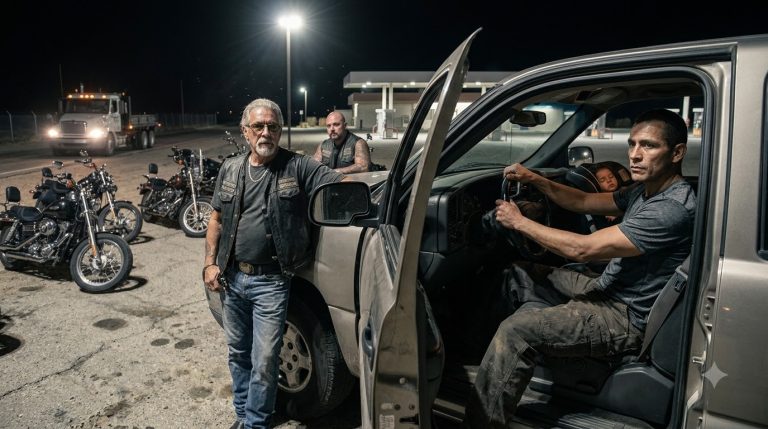
I shifted my weight, bracing for the impact. My knuckles ached with the anticipation of the fight. The flickering neon light caught the reflection in the front window—the rain-slicked parking lot, the dark silhouette of my Peterbuilt, and the black SUV idling in the shadows near the gas pumps. They weren’t just here to eat. They were here for an extraction.
The silence stretched, agonizingly thin, until the waitress—a woman who had spent thirty years serving bad coffee—finally broke it. “I’m calling the cops,” she whispered from behind the counter, her hand hovering over the landline.
The man in the windbreaker finally looked at her. He didn’t smile. He just exhaled, a sound of profound disappointment. “Don’t bother,” he said.
I knew then that the door was closing. Not just the diner door, but the escape route. I reached down, grabbed the edge of the booth table, and with a sudden, violent heave, flipped it onto its side. It provided the cover I needed.
“Get them to the rig,” I shouted to Sarah, my voice cutting through the rising tide of violence.
The world went kinetic. The kid, Brad, lunged. The man in the windbreaker drew. I didn’t wait to see what he was holding. I swung the tire thumper with everything I had.
CHAPTER 3: THE CONCRETE ANVIL
The hickory shaft of the tire thumper collided with Brad’s upraised forearm with a dull, solid crack. The kid shrieked, the momentum spinning him backward into his two companions, their expensive loafers losing traction on the grease-slicked linoleum. To my left, the man from the kitchen completed his draw. The weapon was small, matte-black, and entirely devoid of civilian markings. Before his wrist could lock into a firing stance, the flipped laminate table took the brunt of his movement. The heavy particle-board edge struck his hip, throwing his first shot wide. The report wasn’t a roar; it was a sharp, compressed cough that shattered a row of hanging coffee mugs behind the counter into glittering ceramic teeth.
“Out! Now!” I roared, my boots already churning the floorboards as I grabbed the collar of Elias’s vintage suit jacket.
The old man didn’t freeze. With a speed that contradicted his rusted posture, his left hand swept across the floor, scooping up the tarnished Silver Star and the loose sheets of paper. For a fraction of a second, as my hand braced against his shoulder, my eyes locked onto the margin of the top document. It wasn’t standard legal text. Stamped in fading, water-damaged crimson ink across the top header was a sequence of alphanumeric characters—a military tactical grid reference from an era before satellite navigation. The discrepancy registered like a burr in my mind, but there was no time to process the friction.
Sarah was already moving ahead of us, her fingers digging into the brass handle of the diner’s double doors. She threw her weight against the glass, and the cold, unyielding wall of the Virginia storm hit us like a physical blow.
The rain was a blinding sheet of gray, illuminated only by the harsh yellow halogen perimeter lights of the rest stop. My Peterbilt sat twenty yards away, a massive, dark silhouette against the woodline, its flatbed trailer loaded with eighty thousand pounds of structural steel steeling itself against the downpour. Behind us, the diner doors slammed open again. The man in the windbreaker emerged into the rain, his silhouette sharp and angular under the halogens, his weapon leveled with terrifyingly calm intent.
“Get up into the cab!” I shoved Sarah toward the driver-side chrome steps, then turned to hoist Elias. The old man climbed with a surprising, sinewy strength, his fingers locking onto the grab handle like iron clamps.
I scrambled up behind them, pulling the heavy fiberglass door shut just as a localized thwack echoed against the metal paneling beneath my feet. A clean, round puncture opened in the lower utility step, the edges of the aluminum peeled back like winter fruit.
I dropped into the air-ride seat, my left hand jamming the heavy key into the ignition while my right slammed down on the yellow and red air-valve knobs. The starter whined—a agonizing two-second drag against the cold oil—before the sixteen-liter diesel engine erupted into life with a subterranean roar that shook the entire frame of the rig. The air gauges slowly climbed, their needles glowing red against the dark dashboard.
“Buckle down,” I grunted, hitting the wiper switch. The heavy blades began their frantic, useless sweep across the windshield, cutting through the torrent just enough to reveal three distinct pairs of high beams swinging out from the dark perimeter of the fuel islands.
The black SUV was leading, its front bumper already angling toward the exit ramp to box us against the concrete guardrail. Behind it, two modified diesel pickups rumbled, their oversized tires throwing up twin roostertails of muddy water.
“They’re shifting into a wedge,” Elias said from the passenger seat. The tremor was entirely gone from his voice. It was flat, measured, the tone of a man who spent his youth calculating intercept angles on a grease board. “They don’t want to stop the truck, Jack. They want the steer axle. If they blow the front left tire against that concrete barrier, the weight of the steel beams will do the rest.”
I didn’t answer. I slammed the clutch to the floor, shoved the long-throw gear shift into low-third, and hammered the throttle. The turbocharger spooled up with a high-pitched scream that cut through the diesel rumble. Eighty thousand pounds of American steel groaned as the tires bit into the slick asphalt, the sheer mass of the vehicle resisting the sudden demands of momentum.
We cleared the parking lot apron just as the black SUV surged alongside my left flank. Through the blurred glass of my mirror, I could see Brad in the passenger seat, his face twisted into something manic and wet with rain, his hands clawing at the window frame. He wasn’t holding a club anymore. The glint of a barrel showed through the downpour.
“Hold on back there!” I called out to Sarah, who had curled herself into the narrow mattress of the sleeper berth.
The highway on-ramp was a narrow, unlit throat of concrete flanked by a vertical rock wall on the right and a drop-off median on the left. The truck was gaining speed, the speedometer needle creeping past forty as I skipped gears, the transmission clicking with mechanical precision. But the SUV was faster. It edged forward, its front fender overlapping with my front wheel assembly, attempting to squeeze the massive chrome snout of the Peterbilt into the crumbling shoulder.
“He’s committing to the squeeze,” Elias muttered, his hand bracing against the dashboard, his eyes fixed on the narrowing gap ahead where the two lanes of the interstate merged into a single construction bottleneck. “Two hundred yards until the concrete narrows, Jack. If he stays there, we lose the mirror and the lane.”
My perspective tightened down to the four inches of space between my heavy-duty lug nuts and the thin, expensive sheet metal of the SUV’s passenger door. I didn’t swerve. To pull right was to invite the mud to swallow my steering. Instead, I let my fingers relax slightly on the leather-wrapped rim of the wheel, feeling the feedback of the road, waiting for the exact micro-second when the front axle balanced against the grade.
“Not on my road,” I whispered.
I gave the wheel a single, sharp twitch to the left—a controlled four-inch lean that put the massive weight of the truck’s structural frame directly into the path of the intruder.
CHAPTER 4: THE BULLET IN THE DOOR
The sound of the collision was a high-frequency scream of tearing metal, a cacophony that drowned out the steady, metronomic slap of the windshield wipers. The SUV’s side panel, painted a sleek, corporate black, folded inward like a soda can under the relentless pressure of my truck’s lug nuts. I didn’t ease off. I kept the throttle buried, the engine roaring in a low-frequency register that I felt in my marrow, forcing the SUV to slide against the concrete barrier.
“They’re losing their line!” Elias yelled over the roar, his eyes fixed on the side mirror. He was leaning forward, his posture rigid, his hands gripping the dashboard in a way that looked less like fear and more like a tactical hold. “The SUV driver’s panicking. He’s going to jerk the wheel.”
Just as he spoke, the SUV’s front wheels locked, smoking against the asphalt. The vehicle fishtailed, its rear end clipping the concrete jersey barrier with a dull thump that jolted the truck’s trailer. The SUV spun, its momentum lost, and slid backward, falling behind the trailer as we surged into the single-lane construction zone.
But we weren’t clear. The two diesel pickups were still there, flanking the trailer, their engines whine-pitching as they struggled to maintain pace on the narrow shoulder. They were hunting for the airlines. I saw one of the drivers pull alongside the trailer, a man with a heavy jaw and a face obscured by a ball cap, reaching out of the window with something that glinted—a heavy, serrated blade meant for cutting brake lines.
“Flank right,” I growled, more to myself than to Elias. I downshifted, the engine braking causing the truck to shudder. The pickup on my right, expecting me to accelerate through the bottleneck, found itself suddenly alongside my drive tires.
I didn’t ram him. I simply drifted the massive rig a foot to the right, closing the gap until the pickup’s side mirror tapped against the trailer’s frame. The driver flinched, his steering jerky, and he was forced to brake or lose his fender. He fell back, disappearing into the spray of my rear tires.
The rhythm of the wipers—thwack-hiss, thwack-hiss—suddenly shifted for me. My mind jumped, unbidden, back to the humid, suffocating heat of 1969. I wasn’t in a Peterbilt; I was back in the belly of a transport craft, the sound of the blades overhead syncopating with the same desperate, rhythmic urgency. The metallic tang of the diner, the smell of burnt coffee and grease, vanished, replaced by the copper scent of cordite and wet, red earth. I saw a ghost of a grid reference—that same red-inked stamp from the paper—on the back of a flare-carton I’d held fifty years ago.
The phantom thought hit with the force of a physical blow. The document in Elias’s box wasn’t just a legal complaint. It was a casualty list. A list that the Senator’s father had suppressed to hide a catastrophic tactical failure.
“Jack!”
Elias’s voice pulled me back into the rain-slicked present. I snapped my focus back to the road, realizing I’d drifted inches toward the orange construction barrels. I yanked the wheel, the heavy steering fighting me, and straightened the rig just as the narrow bridge deck appeared ahead.
“They’re coming again,” Elias said, his voice quiet. He didn’t look back at the mirrors. He reached into his coat and produced a small, silver-framed photograph, tucking it into his pocket, his movements deliberate. “The SUV is back on the road. They’re reckless now, Jack. They aren’t trying to capture us anymore; they’re trying to silence the evidence.”
I glanced at the door panel. A new dent had formed, a shallow crater where a bullet had struck the reinforced steel earlier. It was a reminder of how thin the line was between being a hero and being a statistic. I looked at the dashboard, then down at the floorboard where Sarah was huddled, her face pale but her eyes fierce. She wasn’t just a victim; she was a witness.
“We’re two miles from the state line,” I said, my voice rasping. My jaw ached where the goon had struck me back at the construction site, but the adrenaline had burnt off, leaving behind a cold, sharp clarity. “If they haven’t stopped us by the time we cross, they know they’ve lost their jurisdiction.”
“They don’t care about jurisdiction,” Elias replied. He turned to me, his eyes dark with a memory I didn’t want to touch. “They care about the box. If they can’t take it, they’ll burn the truck with us inside. You need to prepare for a hard stop, not a flight.”
I looked ahead. The road was straight, a long, dark ribbon of asphalt cutting through the damp, midnight forest. The high beams of the SUV crested a hill behind us, bathing the interior of my cab in an aggressive, blinding white light. It was a pursuit of pure, unadulterated ego.
I checked the fuel gauge. Low. I checked the engine temp. Holding steady, but the stress on the hoses from the repeated braking was starting to show; a thin wisp of steam curled up from the edge of the hood.
“Stay low,” I told Elias. I didn’t let off the throttle. I watched the dash-cam light—a tiny, flickering green LED on the rearview mirror. It was the one thing they couldn’t bribe or break. It was the witness they couldn’t bury.
As the SUV closed the gap, I saw Brad stand up in the passenger seat, his arm fully extended. He wasn’t aiming for the tires anymore. He was aiming for the cabin. The flash of the muzzle was a strobe light against the dark, and the ping of a bullet against the grill sounded like a funeral bell.
I didn’t flinch. I kept the wheel steady, my foot pressed into the floor. The road ahead wasn’t just asphalt; it was a path to a truth that had been rotting in the dark for five decades, and I was the one delivering it to the light.
CHAPTER 5: THE GRAVEL STAGING AREA
The air-line coupling at the rear of the tractor exploded with a sound like a gunshot. The sudden, violent loss of pneumatic pressure screamed through the cab, the red warning light on the dash blooming to life like an angry, unblinking eye. The trailer brakes—designed to lock instantly upon a catastrophic loss of pressure—seized.
The Peterbilt shuddered, the massive weight of the steel beams behind me acting as a gargantuan anchor. We didn’t just stop; we bucked, the tires skidding and tearing deep, ragged furrows into the rain-soaked gravel of the construction staging area I had banked on for evasion. The rig groaned, the chassis twisting under the sudden, violent deceleration, and we came to a dead halt with the trailer jackknifed across the access road, effectively blocking the path but leaving us exposed to the dark, widening mouth of the highway.
“Jack!” Sarah’s voice from the sleeper birth was a thin, terrified thread of sound. “What happened?”
“Stay down!” I didn’t wait for her to respond. I was already moving, my hand finding the tire thumper beneath the seat. The silence that followed the hiss of the air-lines was more terrifying than the pursuit; it was the silence of a trap waiting to be sprung.
Elias didn’t look at me. He was already leaning against the passenger door, his eyes scanning the staging area. The yard was littered with the hulking, skeletal shapes of construction machinery—an excavator with its boom lowered like a praying mantis, stacks of rebar that shimmered like silver wire under the rain, and the brooding, mud-caked mass of a bulldozer.
“They’ll be here in seconds,” Elias said. His voice was devoid of the panic that should have been there. It was the voice of a man who had been here before, who knew the cadence of an ambush. “The SUV is close. The pickups will fan out to flank the perimeter.”
I shoved the door open and stepped out into the freezing deluge. The mud was ankle-deep, clinging to my boots like sludge. The air was a chaotic mix of diesel fumes and the sharp, metallic ozone of the electrical failure. My heart was a frantic, irregular drum in my chest, but my hands—my hands were still, steady as the steel I hauled.
A pair of headlights cut through the darkness, swinging wildly into the gravel yard. The black SUV hit the uneven ground and bounced, its suspension protesting, before sliding to a stop twenty feet away. Brad climbed out, his movements stiff, his broken wrist cradled against his chest, but his good hand held the pistol with a shaky, desperate authority.
“End of the road, trucker!” he screamed, his voice raw, distorted by the wind and rain. He didn’t come alone. Two figures emerged from the gloom behind him—the men from the diner, their faces hidden by the hoods of their jackets, moving with the heavy, aggressive tread of men who knew they had the advantage.
I didn’t answer him. I kept my posture low, using the massive, mud-splattered tire of the tractor as a shield. I glanced toward the trailer. If I could reach the manual release valve, I might be able to bleed the pressure further and crawl the rig just enough to force them into a more confined engagement. But the air-line was a mess of tangled, weeping rubber.
“Elias, stay in the cab,” I barked, not looking back.
“I’m not a passenger, Jack,” Elias replied. The door clicked open, and the old man stepped out. He wasn’t holding the tire iron this time. He was holding the wooden box. He moved with a strange, liquid grace, bypassing the cover of the truck entirely and stepping into the open, his eyes locked on the man leading the charge.
“Brad,” Elias said, his voice carrying over the storm. It wasn’t loud, but it had a weight, a gravity that caused the advancing men to falter for the briefest of seconds. “That paper you want? It’s not a record of a hero. It’s a record of a lie. You’re killing for a ghost that doesn’t exist.”
Brad didn’t care about the history. He raised the gun, his thumb working the slide. “Shut up! You’re just a janitor. You don’t know anything about real power.”
I didn’t let him finish the sentence. I lunged from behind the tire, the hickory stick arcing in a blurred, punishing motion. The first man, caught off guard by the sudden aggression of a man he thought was pinned down, didn’t even have time to raise his hands. I caught him in the temple, the impact echoing like a hammer strike on a beam. He went down into the mud, lifeless as a discarded suit.
But the second man was already on me. He moved with a professional, bruising intensity, closing the distance and slamming a forearm into my throat. The breath left my lungs in a sharp, painful hiss, and the world tilted. We hit the gravel, the sharp stones biting into my skin, the taste of cold mud and gasoline filling my mouth.
I clawed for footing, my fingers slipping on the wet surface, the man’s weight pinning my shoulder. Somewhere in the distance, I heard the sharp, dry crack of a pistol shot, followed by a scream that wasn’t mine. I didn’t dare look. I pulled my knee up, driving it into his gut with everything I had left, the friction of the struggle, the cold, and the exhaustion threatening to turn the world to gray.
This was the escalation. The point of no return. We weren’t just fighting for the truth anymore; we were fighting for the next breath.
CHAPTER 6: THE BROKEN WRIST
My lungs burned. The intake of air felt like swallowing shards of glass and freezing rain. I twisted beneath the man pinning me, the gravel digging into the soft skin of my neck, and brought my elbow up in a violent, upward strike. It caught him square in the ribs—a wet, sickening crunch—and he collapsed, wheezing, his grip on my shoulder breaking.
I scrambled up, my legs feeling like leaden weights. The yard was a nightmare of shadows and strobe-lit chaos. Rain slicked everything: the yellow construction machinery, the polished steel of my truck’s fuel tank, and the dark, glistening mud where we fought. I swung the hickory stick, not with precision now, but with the raw, desperate force of a man running on fumes.
Elias was a dozen feet away, his back to the front tire of the truck. He was breathing heavily, but his stance hadn’t wavered. He held the wooden box in one hand and had somehow disarmed the second attacker—the one with the chain—leaving the man sprawled in the mud, nursing a shattered forearm. But Brad was still there. He was backing away toward the SUV, his eyes wide and vacant, the gun trembling in his hand. He wasn’t looking at me; he was looking at the box in Elias’s hand, his fixation on the secret becoming his only remaining reality.
“Give it to me!” Brad shrieked, his voice cracking. He didn’t fire. He looked like he’d forgotten how to pull the trigger. He was a child holding a heavy, dangerous toy, terrified that if he dropped it, his entire world would vanish.
“It’s not what you think, boy,” Elias said. He didn’t raise his voice. He stepped forward, his boots moving through the muck with a calm, predatory rhythm. “You think this makes you powerful? You think this is the key to the castle? It’s just paper. Dead men’s names, written by a coward to hide his own failure.”
I started to move, intending to flank Brad, but my tunnel vision flared. The pounding in my ears matched the rhythmic thrum of the rain against the truck’s roof. I missed the movement entirely. From the shadows between the bulldozer and the stack of rebar, a third man—the one I’d thought I’d taken out with the stick—re-emerged. He didn’t come for me. He lunged for Elias.
“Elias, look out!” I yelled, my voice tearing.
Elias reacted with the efficiency of a machine. He didn’t turn. He simply tilted his body, a micro-adjustment that allowed the attacker’s heavy, swinging fist to whistle through the empty air where his face had been. With the same movement, Elias drove his elbow backward, burying it into the man’s solar plexus. The attacker buckled, gasping, but he grabbed Elias’s coat, dragging the old man down into the mud.
The box flew from Elias’s hand, spiraling through the air.
Time slowed. I watched the battered wooden lid hit the gravel, the force of the impact forcing the latch to snap finally and completely. The contents spilled out—not just the medal and the photos, but a stack of documents, their edges already curling and darkening from the rain. I saw the red-inked grid references, and beneath them, a signature—one that made my blood run cold. It wasn’t the signature of a clerk. It was the signature of the Senator’s father, the man the nation hailed as a hero of the conflict.
Brad saw it too. He lunged for the papers, his gun forgotten in the mud. He was faster than he had any right to be, his desperation acting like a fuel. He scooped up the primary document, clutching it to his chest as if it were a shield.
“I have it,” Brad whispered, a terrifying, manic laugh bubbling up from his throat. “I have it. You can’t kill me now. I’m the one who knows.”
“You don’t know anything,” I said, stepping between him and the truck. I was exhausted, my ribs throbbing with every breath, my knuckles torn and bleeding, but I felt a strange, cold calm settle over me. “All you have is a piece of paper that proves your family was built on a foundation of blood.”
Brad looked up at me, his eyes bloodshot, his face a mask of ruined arrogance. He didn’t look like a district attorney’s son anymore. He looked like a man who realized, finally, that he had no exit. He raised the gun, but his hand was shaking so violently that he couldn’t keep the barrel level.
“We leave now,” I said, glancing at Elias, who was rising from the mud with a grim, hard-won resilience. “Sarah is in the truck. We are finishing this run.”
“You’re not going anywhere,” Brad hissed, but he took a step back. He was looking at the papers, then at the gun, then at the approaching sirens that were beginning to wail in the distance—a low, mournful sound that signaled the end of the game.
The escalate wasn’t over. The sirens weren’t our salvation; they were the arrival of the next obstacle. We were at the precipice. I looked at the broken wrist Brad was holding, at the ruined suit, at the papers fluttering in the wind. We were in the middle of a war zone that didn’t appear on any map, and the truth, for the first time, was tangible. It was in our hands, and it was going to cost us everything to hold onto it until dawn.
CHAPTER 7: THE TRUTH IN THE STATIC
The siren’s wail had changed. The pitch was deeper, more rhythmic—a tactical heavy-duty strobe. It wasn’t the police. My hands, caked in a mix of mud, gasoline, and sweat, gripped the hickory stick so tightly the wood groaned. I watched Brad, whose face was a ruin of shattered confidence and flickering, frantic madness. He was cradling the wet, ruined papers as if they were holy relics, ignoring the blood dripping from his broken wrist onto the asphalt.
“You don’t get it, trucker,” Brad sneered, his teeth bared in a grimace. “My father didn’t build this to last. He built this so we would never have to be the ones explaining the costs. This isn’t evidence. It’s an insurance policy.”
He gestured with the gun—weakly, but enough—toward the road. Two heavy, matte-black armored vans were cresting the hill, their high beams cutting through the rain like searchlights. They didn’t have the markings of any law enforcement agency I recognized. They were clean, industrial, and silent.
“Elias,” I said, not taking my eyes off Brad. “Get in the cab. Close the door.”
“I’m not leaving you, Jack,” Elias replied, his voice calm, standing beside me in the freezing rain. He reached out and grabbed the edge of the trailer’s frame, pulling himself up. “If those men reach that truck, they’ll shred the dash-cam, they’ll destroy the cabin, and they’ll ensure that none of us leave this yard alive.”
The pickups began to move again, their engines revving in a discordant, mechanical chorus. Brad’s friends, having recovered from the initial shock of the fight, were fanning out, forming a semicircle. The net was closing.
I looked at the Peterbilt—my home, my tool, my only leverage. The air lines were severed, the tires were groaning under the pressure of the uneven gravel, and the cab was riddled with bullet holes. It was a dying beast. I realized then that my mission wasn’t to drive it out; it was to use it as the ultimate obstacle.
“Sarah!” I shouted toward the sleeper berth. “Unlock the dash-cam unit. Extract the drive. If I don’t give you the signal, you run for the treeline. Don’t look back.”
The armored vans slowed, their tires crunching over the gravel. They stopped twenty yards out, doors swinging open in synchronized, military precision. Men in tactical vests, their faces masked, stepped out. They weren’t looking for a fight; they were looking for a clean-up.
Brad stood up, his face lighting up with a sudden, wretched relief. “Over here! Bring the transport!”
I saw the dynamic shift. Brad wasn’t a master-mind; he was a liability, and the men in the tactical gear knew it. They weren’t coming for him; they were coming for the papers he was holding.
“Elias,” I whispered, the cold rain blurring my vision. “What was the grid reference on that document?”
Elias leaned in, his voice a ghost of a sound against the roar of the downpour. “It was the extraction point for a unit that was supposed to be evacuated after the sector fell. They were left there for three days, Jack. Because the Senator’s father pulled the air support to cover a logistical error. I was the one on the radio. I heard them die.”
The truth hit me harder than any punch. It wasn’t a clerical error. It was a cold-blooded calculation.
I looked at the dash-cam LED, still pulsing its tiny, defiant green light. The men in the gear were closing in, their weapons raised in a low-ready posture. Brad reached out to them, holding the papers, expecting a welcome. The lead man in the tactical vest didn’t take the papers. He raised his suppressed rifle and pointed it at Brad’s chest.
“Move,” I commanded, shoving Elias toward the rear of the trailer, toward the gap between the construction barrels I’d used to enter. “When I give the signal, you run. Don’t stop for the truck, don’t stop for the boxes. Run for the treeline.”
“What about you?”
I looked at the hickory stick, then at the massive, heavy-duty air-release valve on the side of the trailer. If I opened that valve, the last vestige of air pressure would dump, and the trailer would pin itself to the gravel, an immovable mountain of steel.
“I’m going to make sure they’re too busy with me to notice where you went,” I said.
I didn’t wait for his protest. I sprinted toward the trailer, the mud sliding beneath my feet, my muscles screaming in protest. I hit the release valve. The sound was like a thunderclap—a massive, sudden release of air that echoed through the staging area, startling the tactical team and causing the lead man to hesitate.
I vaulted onto the flatbed, using the stack of steel beams as a ramp, and stood on the highest point, silhouetted against the dark, stormy sky. I was the target. I was the distraction. And I was the only thing standing between the truth and the dark.
CHAPTER 8: THE GRANITE ECHO
The tactical team had stopped dead. They were trained to execute, not to interrogate, and the sight of a lone man standing atop a mountain of steel, refusing to bow, had paralyzed their momentum. I didn’t hold the hickory stick up as a weapon anymore; I held it as a witness.
The leader of the tactical team, a man whose face remained hidden behind a ballistic visor, lowered his rifle. He looked at the dash-cam unit still pulsing its green light, then at the man—Brad—who was weeping in the mud, clutching a handful of rain-sodden, incriminating history. Brad was no longer the threat. The threat was the reality that he had brought with him.
“The unit is live,” I said, my voice echoing off the surrounding construction equipment. It was the first time I’d spoken since the valve blew. “The state police are three miles out. They aren’t coming to help you. They’re coming to secure the scene. If you raise those weapons, you aren’t just following orders; you’re complicit in a cover-up that has been rotting for half a century.”
The leader turned his head, his gaze shifting from me to Elias, who stood defiantly in the mud near the tractor tire. Elias didn’t look like a clerk, and he didn’t look like a victim. He looked like the man he was at twenty: the only one left to give the order when the sky fell.
The leader stepped toward Brad. He didn’t ask for the papers; he simply reached down, tore them from Brad’s broken, trembling grasp, and held them up to the light of the armored van’s floodlights. He scanned the grid references, the list of names, and the signature at the bottom. The silence in the staging area was so absolute that I could hear the rain dripping off the edge of the trailer.
Then, the leader did something unexpected. He tossed the papers onto the gravel, between himself and me, and turned his back on the Senator’s son.
“Secure the perimeter,” the leader ordered his men, his voice tinny through the radio. “And keep the local authorities back until we’ve established a federal buffer. This isn’t a civil disturbance. This is a matter of national record.”
Brad began to scream, a high-pitched, hysterical sound of total collapse, but the tactical team didn’t care. They dragged him toward the armored van, his boots trailing long, deep grooves in the mud—a final, pathetic mark of his family’s entitlement being dragged into the dirt.
As the armored vans pulled away, leaving the staging area bathed in the cold, blue light of the morning, I finally felt the toll. I dropped the hickory stick. It hit the gravel with a sound that felt like the final period at the end of a long, brutal sentence. My ribs screamed in protest as I slid down the side of the trailer, my legs giving out, and hit the mud.
Elias walked over, his movements slow, the stiffness returning to his joints. He sat down beside me, his back against the cold steel of the truck. He reached into his pocket and pulled out the Silver Star medal, turning it over in his hand.
“They won’t be able to bury this one,” Elias said, his voice soft. “Not with the dash-cam, not with the team on record, and not with the Senator’s son in custody. It’s over, Jack.”
“It’s not over,” I replied, staring at the horizon where the first hint of gray light was beginning to bleed into the sky. “But it’s finished.”
We sat there for a long time as the state troopers finally arrived, their red and blue lights washing over the mud and the debris of our struggle. I watched as they approached, their cautious, professional movements a stark contrast to the violence of the night. I didn’t reach for the tire thumper. I just closed my eyes and listened to the cooling engine of the Peterbilt—a long, tired tick-tick-tick of metal contracting, a heartbeat settling back into a slow, rhythmic peace.
Later, I walked with Sarah to the front of the rig. She didn’t say a word. She just reached out and took my hand, her grip surprisingly strong, her eyes fixed on the man who had been her father—the man who was now walking toward the police captain with his head held high, his dignity reclaimed from the rust and the rain.
I leaned against the grill of my truck. The mirror was gone, the door was dented, and the trailer would need a complete overhaul before I could haul again. But as the sun finally broke over the tree line, illuminating the mist that clung to the highway, I felt a strange, quiet weightlessness.
I reached out and placed my hand on the cold, chrome hood ornament. It was bent, scratched, and covered in the dust of the road, but it was still there. I had a long, slow drive ahead of me—a drive to fix what was broken, to replace what was lost, and to finally get that sandwich that didn’t taste like sawdust. I walked to the driver’s side, pulled the door open, and climbed back into the cab. The smell of diesel and rain was still there, but for the first time in my life, it didn’t smell like a cage. It smelled like the road. And I knew the way.