A Ghost Beneath the Waves: The Final Descent of the Steel Phantom into the Crushing Deep
CHAPTER 1: THE ZERO DEPTH
The transition was violent, a sharp shift from the rhythmic churning of the Vigilant’s propellers to a terrifying, absolute silence. Jedadiah Croft hung in the void, a single, pressurized dot of warmth in an ocean that wanted him dead. The depth gauge on his wrist—a relic of analog needles and brass gears—twitched, the needle hovering on the threshold of what human physiology, augmented or otherwise, was ever meant to endure.
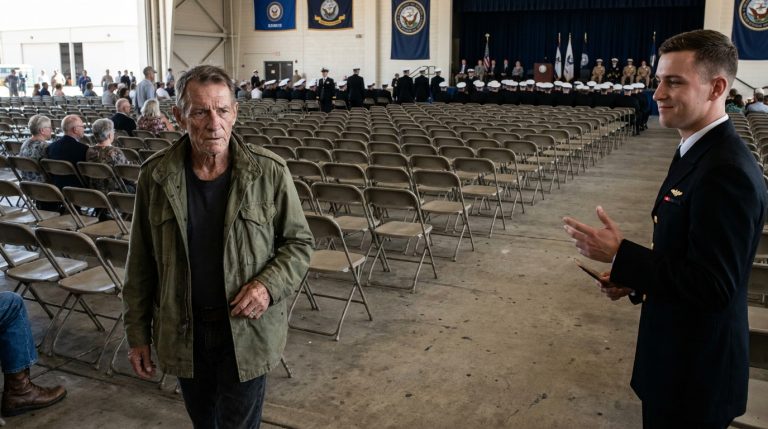
He did not look up. Looking up only invited the phantom of the surface world, the world of politics and admirals and young men in polished shoes who thought they knew the weight of a uniform. Down here, the weight was literal. It pressed against his chest, a heavy, velvet-black blanket that sought any microscopic flaw in his suit’s integrity.
He checked his intake valve. His fingers, gnarled and steady, moved with an efficiency that bypassed thought. He reached for the secondary oxygen feed to verify the seal, and his hand stopped. He froze, the muscles in his back coiled like tempered steel. The port was empty. The backup line—the redundant lifeline he had personally installed before he even boarded the Vigilant—wasn’t just disconnected. It was gone.
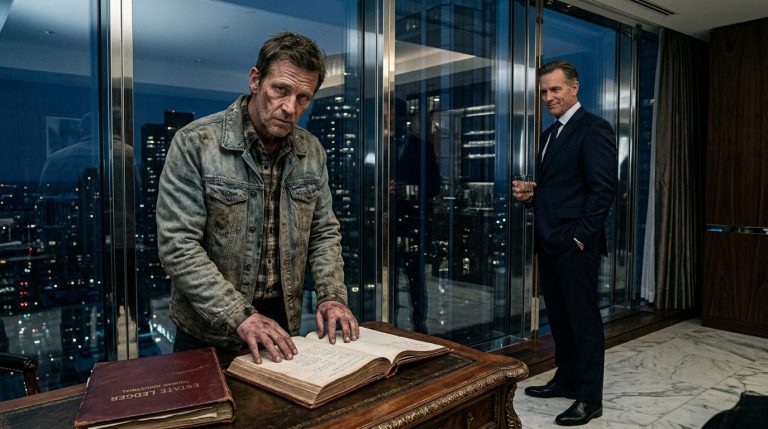
He didn’t panic. Panic was a waste of oxygen, a luxury of the terrestrial world. Instead, he felt a cold, jagged spike of awareness. He had been checked over by the Admiral’s specialists. He had been “prepared” by a team whose movements he had trusted with the blind naivety of a veteran. But this—this was a calculation. Someone had intended for him to reach the Nebraska with exactly enough air to perform the repair, and not a single breath more for the return trip.
Jedadiah adjusted his buoyancy, his eyes scanning the absolute dark ahead. A low, rhythmic ping resonated through his suit, vibrating against his ribs. It wasn’t the sound of the Nebraska’s distress beacon. It was a modulated, synthetic pulse. A call-and-response protocol used by deep-sea interceptors.
He wasn’t just here to save a sub. He was being hunted, and the bait was currently screaming for help in a tin can three hundred feet below him. As he descended, the water began to swirl with an unnatural, bioluminescent flicker—not from jellyfish, but from the wake of something massive and silent approaching from the starboard side.
He reached the first deck of the Nebraska. The hull was scarred, the metal groaning under the immense weight of the deep. Jedadiah moved his hand toward the emergency valve, his heart rate steady at fifty beats per minute. But as his fingers brushed the cold steel, he stopped again. Pressed into the frame of the valve was a small, plasticized chip—a signature. It was a piece of technology that didn’t exist in the US Navy’s inventory.
He realized then, with a calm that bordered on the transcendent, that the valve hadn’t jammed. It had been locked from the outside.
CHAPTER 2: THE ANATOMY OF A LIES
The valve was not merely stuck; it was a testament to design, a piece of industrial art crafted by engineers who understood the specific, brutal physics of the Atlantic floor. Jedadiah’s gloved fingertips traced the locking mechanism. There was no corrosion, no salt-crust, no wear-and-tear of a decade-long neglect. The metal was clean, the tolerances tight. Someone had greased this with high-grade synthetic lubricant recently, and then engaged a locking pin that was clearly not part of the standard Nebraska schematics.
He pulled his hand back, the movement restricted by the heavy, pressurized rubber of his suit. His breathing sounded like a gale force wind inside his helmet, each intake of oxygen carrying a sharp, metallic tang. He needed to focus. The Nebraska was a tomb, but she was a tomb that was currently screaming for help.
He tapped the side of his helmet, activating the external hydro-mic. “This is Croft,” he rasped, his voice sounding distant even to his own ears. “The valve assembly has been tampered with. There is a foreign locking pin installed. I need to bypass the external housing to reach the manual torque-spindle.”
There was no immediate response from the Vigilant. Instead, a burst of static crackled in his ear, followed by a rhythmic, high-pitched chirping—a coded handshake. Admiral Jennings was on the line, but he wasn’t speaking. He was waiting.
“Do you hear me?” Jedadiah asked, his tone shifting into the cold, clinical rhythm of a man who didn’t care for protocols. “If I force the housing without the override code, the pressure differential will shear the stem. The sub loses internal integrity. I lose my life. I need the bypass frequency.”
Still, silence. Jedadiah looked toward the sonar-array of the submarine, a hulking shadow against the abyssal darkness. He felt a sudden, sharp vertigo—a V-4 distortion creeping into his peripheral vision. Was it the depth, or was it the realization that he was being observed? He moved his head, and the light from his suit-mounted lamp caught the edge of a secondary hull panel. It was unscrewed.
A flash of memory—the cold, sterile hallways of the Phantom project training facility—hit him with the force of a physical blow. They had taught him that the only way to beat a trap was to dismantle the bait. He reached into his tool-kit and pulled out a modified hydraulic wrench, a heavy piece of iron he had scavenged from a wreck years ago.
He didn’t wait for the Admiral’s permission. He began to unbolt the secondary housing, his movements slow, deliberate, and entirely devoid of wasted energy. He felt the cold of the water through the suit—a deep, marrow-chilling bite that spoke of the immense pressure outside. Every turn of the wrench required a massive expenditure of caloric energy. His heart rate, disciplined as it was, began to climb.
He wasn’t fighting the ocean anymore. He was fighting the Vigilant.
He heard it then—a vibration that traveled through the hull of the submarine, a rhythmic drumming. It was too fast for whale song, too irregular for current. It was the cavitation of a propeller, a large one, closing in at a high rate of speed. He turned his head, his vision blurring. A silhouette loomed in the distance, a dark, sleek form that wasn’t the Vigilant. It was an interceptor, its signature masked, its purpose unmistakable.
They weren’t here for the Nebraska. They were here for him.
Jedadiah set his feet, planting his boots into the soft, silty mud of the seabed. He locked the wrench onto the valve assembly and took a breath. The oxygen supply on his chest unit hissed, warning of a drop in pressure. He smiled, a jagged, humorless line beneath his mask. If they wanted the Steel Phantom, they were going to have to do more than just watch him die.
He applied pressure, the torque screaming in protest as the rusted iron of his tools met the high-tensile steel of the submarine. The valve didn’t budge, but the locking pin groaned. He pushed harder, his muscles burning, his very soul focused on the single goal of movement.
“I’m opening her up, Admiral,” he whispered into the dead air. “Whether you’re listening or not.”
With a final, desperate shove, he felt the pin shear off. The valve turned, a quarter-inch, then a full rotation. A plume of freezing, pressurized water burst from the gasket, knocking him backward into the silt. But beneath the roar of the rushing water, he heard it: the slow, mechanical wheeze of a ballast tank finally, mercifully, venting its air.
The Nebraska was alive. But as the submarine began its groaning, slow-motion rise from the grave, the interceptor sub shifted its bow toward him, its torpedo tubes locking on with a high-pitched, electronic whine. He had saved the crew, but he had just marked himself as the final target in a game he hadn’t agreed to play.
CHAPTER 3: THE WEIGHT OF THE ABYSS
The whine of the interceptor’s targeting system was a thin, jagged needle scratching against the interior of Jedadiah’s helmet. It wasn’t the sound of an automated guidance lock—it was too rhythmic, too deliberate. Someone was piloting that sub with a precision that bordered on the sadistic, dancing just outside the effective range of the Nebraska’s hull-mounted sonar.
Jedadiah didn’t move. To move was to expend heat and oxygen, and he had precious little of either. He kept his gloved hand pressed against the vibrating steel of the submarine’s hull. The Nebraska was beginning to groan—a deep, metallic shriek of ballast tanks fighting the crushing weight of the water. She was rising, but she was sluggish, wounded by the same forces that had held her pinned.
He checked his wrist-mounted gauge. The oxygen scrubbers were cycling, but the sound was labored. He was down to his reserve—the very reserve he had suspected was being manipulated. If he tried to swim for the Vigilant now, he would be a silhouette against the mid-depth light, an easy target for whoever was sitting in the dark, waiting for him to break cover.
He needed to become part of the environment. He pulled his body close to the submarine’s rear hydroplane, tucking himself into the shadows cast by the structure. He closed his eyes, slowing his heartbeat, a technique he hadn’t practiced in over twenty years. The cold of the deep began to seep through the suit’s insulation, numbing his fingertips, but he welcomed it. It kept him sharp.
The interceptor’s sonar pinged again—a sharp, percussive thud that rattled his teeth. It wasn’t looking for the submarine; it was looking for him. The interceptor had no interest in the Nebraska anymore; it was tracking the acoustic signature of his suit’s rebreather.
He reached into his utility belt, his fingers finding the small, lead-lined compartment. He pulled out a pressurized acoustic decoy—a device he’d kept buried in his kit since the Cold War. It was an antique by modern standards, a simple gas-expulsion unit that mimicked the heartbeat of a diver. He didn’t activate it yet. He needed the interceptor to commit to a sweep first.
As the interceptor drifted closer, the water around Jedadiah began to churn with the turbulence of its massive propeller. He caught a glimpse of its bow—sleek, featureless, devoid of any national markings. It was a black shape in the obsidian water, a silent predator that had been waiting for the Nebraska’s failure to force the Phantom out of the ether.
He realized then that he had been wrong. They didn’t want to capture him. They wanted him to witness the death of the sub, to know that even a legend couldn’t save his own. He felt the cold iron of the submarine’s rudder beneath his palms. He wasn’t just an asset; he was a liability that needed to be cleaned up.
The interceptor stopped its advance. It hovered, barely fifty yards away, its searchlights cutting a blinding, narrow beam through the particulate-heavy water. The light swept over the spot where Jedadiah had been seconds earlier. He had pushed himself into the narrow gap between the rudder and the main hull, holding his breath until his lungs burned with the effort.
He shifted his weight, his boot scraping against a protruding bolt. The sound was microscopic, but in the stillness of the abyss, it felt like a gunshot. The light snapped toward him, the beam narrowing, probing the gap with predatory hunger.
He didn’t wait. He triggered the decoy.
A puff of pressurized air erupted from the unit, sending a cloud of bubbles and acoustic resonance shooting away from the sub at a forty-five-degree angle. The interceptor’s lights immediately tracked the movement. The sub lurched, its bow-thrusters kicking in as it gave chase, eager to eliminate the phantom signature.
Jedadiah didn’t follow the decoy. He stayed pinned to the Nebraska. As the interceptor accelerated away, the turbulence of its passing shook the submarine violently. Jedadiah braced himself, his muscles screaming under the strain. The sub was gaining altitude, moving toward the upper strata where the water was warmer and the pressure manageable.
He looked at the valve assembly he had just repaired. It was holding, but the structural stress of the rapid ascent was starting to spiderweb the surrounding plating. He moved his hand, tracing the cooling metal. He had done his part. The crew of the Nebraska was beginning to cycle their emergency systems.
He was alone, five thousand feet below the surface, with a damaged suit and a dwindling air supply. And as he watched the interceptor disappear into the distance, he saw a second light flickering in the depths—a rescue team, or perhaps the final executioners. He checked his wrist-dial again. The needle wasn’t just dropping; it was spinning, indicating a catastrophic failure in the suit’s pressure-management system.
He had minutes. Maybe less. He pushed off the hull, his movements fluid despite the exhaustion. He began to swim, not toward the surface, but toward the deep-water trench that lay just beyond the sub’s path—the only place on the ocean floor where he could lose his pursuers, even if it meant risking the one thing he had fought so hard to protect: his own life.
CHAPTER 4: THE SILENT SIGNAL
Jedadiah clung to the exterior of the Nebraska, his body pressed against the cold, unyielding skin of the submarine like a barnacle. He was five thousand feet down, and the silence was heavy, a suffocating weight that pressed against his mask. Above him, the sub continued its ascent, a massive, groaning whale shaking off its chains. The turbulence was beginning to die down as they reached the edge of the thermal layer, but the danger hadn’t passed. It had simply shifted into the shadows.
He didn’t look back toward the interceptor’s last known vector. He turned his attention to the site of his repair. He had shorn the locking pin, but the casing remained partially pried open, revealing the internal spindle he had manipulated. His headlamp, dialed to a tight, focused beam, illuminated the dark, grease-slicked interior of the assembly.
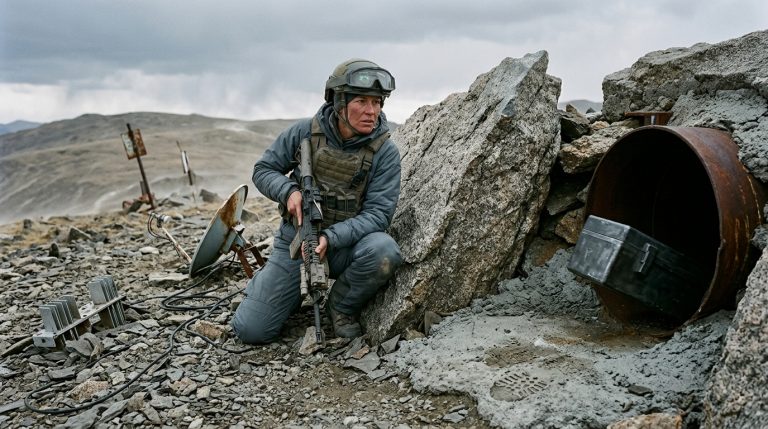
Something didn’t fit. The emergency valve was a mechanical system, pure and simple. Yet, wedged into the hydraulic housing, tucked neatly between two pressure-equalization lines, was a small, blackened object. It was a secondary transceiver—not a standard piece of maritime electronics, but a compact, solid-state unit wrapped in high-density foam.
Jedadiah reached for it, his gloved fingers moving with the agonizing slowness of an old man whose joints were being punished by the depth. He pried it loose with his knife, the metal scraping against the casing with a sound that seemed to vibrate directly through his jawbone. He held the object up. It was a signal repeater. It hadn’t been there to lock the valve; it had been there to broadcast the Nebraska’s location to whoever was hunting him.
The epiphany didn’t come as a surprise; it came as a cold, familiar ache in his chest. They weren’t just trying to kill the Nebraska to flush him out. They were using the Nebraska as a relay station, a way to anchor his presence in the deep while the interceptor moved in for the kill. The entire mission had been a logistical setup, a pre-calculated assassination disguised as a rescue operation.
He looked at the transceiver, his thumb tracing the embossed serial number. He had seen this marking once before, in the back of a black-book file at a desk he hadn’t sat at in twenty years. It belonged to the Ghost-Protocol—a splinter group of Naval intelligence that had been officially disbanded, yet here it was, humming with the faint, electronic heartbeat of an active network.
His oxygen alarm chirped—a sharp, staccato burst of sound that shattered his focus. He was at twelve percent capacity. He had enough air to reach the surface if he abandoned the sub now, but the transceiver was still active, still pulsing a low-frequency signal that would act as a beacon for the interceptor until it was crushed.
He looked at the unit, then at the sub’s retreating shadow. If he left it, the interceptor would track the Nebraska all the way to the surface, and once the submarine surfaced, it would be vulnerable to whatever surface-to-sea weapons the Ghost-Protocol had waiting in the dark.
He didn’t hesitate. He took the transceiver and wedged it into his own suit’s exterior tool-harness, shielding it with his lead-lined kit. If he was going to be the beacon, he was going to make sure the signal was pointed in the wrong direction.
He kicked off the hull, his movements jerky, the exhaustion of the last hour finally catching up to him. He felt the cold begin to penetrate his core—a sharp, biting sensation that signaled the failure of his suit’s heating coils. He had no choice but to dive deeper. If he stayed near the sub, he would lead the hunters to the crew. If he pushed down into the trench, he might be able to lose them in the complex, high-pressure geology of the sea floor.
He began to sink. The water grew colder, the light from his headlamp fading as the abyss reclaimed him. His breath came in shallow, labored gasps, each one tasting more of copper than air. The silence of the ocean was absolute, a void that seemed to welcome him back.
He was tired. The mission was supposed to be a simple fix, a nod to the past, but the past didn’t stay buried in the deep. It rose, cold and vengeful, and now it was waiting for him in the crushing dark. He closed his eyes for a split second, picturing the deck of the Serenity, the sun-warmed wood and the smell of salt and old rope. It felt like a dream from a different life.
He opened his eyes and looked down into the black. There was a faint, bioluminescent glow rising to meet him—a school of deep-sea squid, or perhaps a swarm of drones waiting in the trench. He didn’t check. He just kept sinking, his hand hovering over the transceiver in his harness, waiting for the moment he could turn this trap into a tomb for his pursuers.
CHAPTER 5: THE PRICE OF SURVIVAL
The trench was a jagged tear in the ocean floor, a place where the sunlight did not reach and the pressure was a constant, crushing presence. Jedadiah settled into the darkness, his descent slowing as he tucked himself against the lee side of a massive rock formation. The water here was freezing, a black liquid that seemed to want to steal the remaining warmth from his body.
He didn’t have the luxury of settling in. His wrist-dial was blinking a steady, rhythmic red—a warning that his internal suit pressure was struggling to compensate for the external environment. He reached for the repair kit strapped to his thigh, his movements stiff. The cold had numbed his fingers, making the intricate task of swapping the oxygen-scrubber cartridge feel like trying to perform surgery with frozen iron bars.
As he worked, a sudden, intrusive memory bloomed in the back of his mind—a psychological phantom of the Ghost-Protocol training days. He remembered the smell of ozone and the sterile, white walls of the testing tanks where they had first taught him to breathe the experimental mixture. He could hear the voice of his old handler, a man who had sold his soul to the highest bidder long before the Cold War ever truly ended. ‘You aren’t a man, Jedadiah. You’re a tool. And tools are meant to be disposed of when they stop serving the purpose.’
He shook his head, the motion rattling his helmet. He couldn’t afford to be haunted. Not now. He clicked the new cartridge into place and waited for the hiss of equalization. The system groaned, the old copper pipes within the suit vibrating as the pressure normalized. It held. For now.
He didn’t just sit there. He checked the transceiver he had stashed. It was still active, but it was getting warmer. He noticed a faint, rhythmic pulsing of light through the foam padding—a signal frequency, transmitting his exact location to the interceptor he had outmaneuvered. He wasn’t just sitting; he was broadcasting.
He looked toward the surface. A faint, dancing luminescence was visible far above—the lights of the Vigilant, or perhaps something else entirely. He could try to ascend, to gamble on the chance that he could reach the Vigilant before the interceptor closed the gap. But that would mean leading the enemy straight to the Nebraska, which was now surfacing and broadcasting its own SOS signal.
He pushed off the rock, his suit’s thrusters firing with a sputtering, irregular puff of air. He had to draw them away. He had to be the decoy.
He navigated the complex geology of the trench, moving through narrow fissures and around jagged spires of basalt. His lamp beam cut through the darkness, revealing clouds of silt and the strange, haunting shapes of deep-sea life that seemed entirely unbothered by his presence. He was a ghost in their world, a relic of a time when men were built to survive the unlivable.
He spotted a deep-water venting chimney, a towering structure of minerals that spewed superheated, mineral-rich water into the freezing depths. It was a perfect piece of defensive architecture. If he could position himself behind the vent, the thermal interference would mask his acoustic signature. He could force the interceptor to close the distance, to come into his domain rather than hunting him from afar.
He reached the chimney and pressed himself into the shadow of the venting plume. The water here was turbulent, swirling with intense currents that threatened to tear his suit from his frame. He braced his feet against the chimney wall, his hands reaching for his remaining tools.
He wasn’t just surviving. He was setting a trap. He took the transceiver, wrapped it in a piece of metallic-coated insulation he had scavenged from his repair kit, and wedged it deep into a crevice within the vent. Then, he moved away, drifting into the darkness of the trench, waiting.
Minutes passed. The silence returned, deeper and more predatory than before. Then, the water began to vibrate. The interceptor was closing in. It was coming for the signal. Jedadiah pulled his blade, his eyes locked on the dark aperture of the vent. He wasn’t the prey anymore. He was the shadow waiting in the dark.
CHAPTER 6: THE FRACTURED DEPTH
The seafloor didn’t just vibrate; it groaned, a deep, tectonic protest that echoed through the bones of the trench. Jedadiah was already moving before the chimney fully gave way, his thrusters burning through the last of his secondary reserves. Above him, the towering structure of basalt and minerals fractured, a thousand tons of jagged, superheated rock shearing away and plummeting into the abyss. The plume, once a steady stream, exploded into a chaotic cloud of scalding, mineral-rich shrapnel.
He wasn’t fast enough. A massive slab of basalt struck the seabed inches from his boots, the shockwave tossing his body like a piece of driftwood in a hurricane. He spun, his vision swimming as his suit’s outer hull chimed with the impact of smaller debris. He felt a sharp, stinging cold against his left shoulder—a breach. The pressure was already beginning to fight its way inside, a thin, needle-like stream of freezing water forcing through the fabric.
He clamped his hand over the tear, his gauntlet slick with the oil-like condensation of the suit’s interior. He was blind, trapped in a swirling, opaque fog of silt and steam, and somewhere in that darkness, the interceptor was navigating the chaos with sonar-guided intent.
He didn’t have time for repairs. He had time only for motion.
Jedadiah pushed himself horizontal, dragging his body through the swirling debris. The water here was hot, shimmering with the mineral discharge, distorting his view of the trench walls. He heard the metallic ping-ping-ping of the interceptor’s sonar—a relentless, methodical sound that was getting louder, closer. They were coming through the plume, ignoring the collapsing hazards of the trench. They were willing to risk their hull integrity to end him.
He saw a narrow aperture in the trench wall, a lava tube that led deep into the subterranean crust. It was tight—barely enough room for a man in a standard suit, let alone a reinforced deep-sea rig—but it was his only chance. He jammed himself into the opening, the rock walls scraping against his oxygen tanks with a screech that set his teeth on edge.
He forced his way forward, his movements hampered by the leaking suit and the ever-present weight of the deep. He was losing air. His helmet’s heads-up display began to flicker, the numbers scrolling past in a blur of crimson warnings. Pressure Critical. Integrity Compromised. Oxygen Level: 4%.
He reached a wider chamber within the tube and collapsed, his chest heaving. The silence here was different—it was the absolute, crushing silence of the earth itself. He pulled his hands away from his shoulder and saw the jagged, torn edge of the suit. He didn’t have a patch. He didn’t have a spare. He had his own gnarled hands and a piece of discarded wire from his tool-kit.
He began to stitch the tear, his movements erratic and desperate. He looped the wire through the rubberized fabric, pulling it tight until his knuckles were white. The leak slowed to a trickle, then stopped. He was still bleeding air, but it would hold. For a while.
He looked back toward the aperture. The interceptor’s floodlights were washing the trench floor in a harsh, clinical white, searching the debris of the collapsed chimney. They were looking for a body. They were looking for the Steel Phantom.
Jedadiah leaned his head back against the cold, damp stone, his breath rattling in his throat. He had the transceiver in his harness, still shielded, still ticking. He pulled it out. The foam padding was shredded, but the unit itself was undamaged. He had a choice. He could destroy it, bury it here in the dark, and hope the interceptor would lose the signal and retreat, or he could use it.
He looked at the signal light. It was pulsing at a higher frequency now—an authorization burst. The interceptor wasn’t just hunting him; it was signaling the Admiral. The interceptor was reporting his kill.
The realization hit him with the weight of the entire ocean. They weren’t just killing him to remove a threat; they were killing him to complete a process. They needed the record to show the Phantom was dead so they could move on to the next phase of their, whatever that was.
He tapped the transceiver, his fingers trembling. He couldn’t kill the interceptor, not with a broken suit and a handful of rusted tools. But he could lead them to the surface. He could lead them back to the Vigilant.
He activated the transceiver’s high-gain mode. The light turned a steady, blinding blue. He held it out, away from his body, and began to move toward the surface, climbing the steep, treacherous walls of the trench. He wouldn’t hide. He would drag the interceptor into the open, right into the path of the Vigilant’s sensors. He would force the Admiral to watch the kill.
He climbed, his muscles burning with the effort of every inch. The water pressure increased, his suit groaning under the strain, but he didn’t stop. He was the bait, and he was taking the trap with him.
CHAPTER 7: THE KINETIC VOW
The water around him was no longer just fluid; it was a pressurized lattice of sound, vibration, and malice. The interceptor was close—so close that Jedadiah could feel the rhythmic thump of its propeller-wash against his suit, a steady, staccato heartbeat that told him exactly where the predator was lurking. He was climbing, his body angled toward the distant, faint shimmer of the surface, but the interceptor was cutting him off, herding him into a narrow corridor of abyssal rock.
He glanced at his heads-up display. The oxygen was a flickering, dying ember—less than three minutes of breathable air remained. His suit’s structural integrity was a patchwork of wire and desperate hope, the cold of the ocean floor already beginning to crystallize on his inner visor. But he didn’t care about the cold. He cared about the signal.
He held the transceiver out, letting it trail behind him on a tether of nylon cord. He had modified the signal, pushing it into a broad-spectrum burst that would saturate every receiver in a ten-mile radius, including the Vigilant. If the Admiral was still listening, if the crew of the cutter had any sense of duty left, they would see him. They would see the Phantom, and they would see the interceptor that was trying to erase him.
The interceptor surged forward, its lights flaring to a blinding, high-intensity white that erased the shadows of the trench. It was a beautiful, lethal machine—sleek, black, and perfectly engineered for the silence of the deep. It made no sound other than the subtle displacement of water, a ghost in the machine.
Jedadiah didn’t try to outrun it. He turned.
He dropped his arms, letting his buoyancy compensation fail, and fell backward into the current. The interceptor, caught off-guard by the sudden reversal, banked hard to avoid a collision. In that split second, the acoustic-dampening field—a faint, iridescent ripple in the water around the interceptor—flickered.
It was a mistake. A flaw in their proprietary tech. Jedadiah saw the shimmer, the momentary disruption of the water density, and he didn’t hesitate. He jammed his thruster into maximum output, ignoring the scream of the turbine as it sucked in seawater and grit. He rammed his suit directly into the wake of the interceptor, using the vessel’s own displaced energy to slingshot himself toward the surface.
He didn’t get far before a wall of pressurized water slammed into him. The interceptor had fired its bow-thrusters, a concentrated blast designed to knock a target off-course. The force of it spun Jedadiah, his suit’s external lights shattering against a nearby rock face. He drifted, uncontrolled, into the darkness of a secondary crevice.
His oxygen scrubbers sputtered and died. The silence that followed was absolute, a heavy, velvet void. He felt his heart hammering against his ribs, a frantic, bird-like flutter. He had one last trick. He reached for the transceiver, but his fingers were frozen, stiff and unresponsive. He curled his hand into a fist, forcing the mechanical action of his suit’s glove to do what his body could not.
He triggered the final command: a full-power overload.
The transceiver in his harness flared, a brilliant, blinding blue spark that ionized the water in a three-foot radius. The feedback loop surged through the tether, through the harness, and struck the interceptor’s proximity sensors with the force of an EMP.
The interceptor went dark. Its lights vanished, its propulsion died, and it drifted, dead in the water, only feet away from his position.
Jedadiah didn’t wait to see if it would restart. He kicked, his legs moving with a heavy, leaden lethargy. He was dying, the cold and the lack of oxygen making his vision swim with shimmering, golden spots. But he kept kicking. He looked up, past the darkness, past the interceptor, toward the light that was slowly beginning to resolve into the silhouette of a cutter hull.
He was nearly there. He was going to make them look at him. He was going to make them witness the end of the Steel Phantom, not as a casualty, but as a ghost that had finally decided to haunt them.
CHAPTER 8: THE GHOST IN THE MACHINE
The final ascent was not a swim; it was a surrender to the mechanics of the suit, a frantic, gear-grinding fight against the inevitable. Jedadiah’s hands were no longer his own; they were frozen appendages locked to the controls. Above him, the water lightened from an impenetrable obsidian to a bruised, electric purple. He didn’t look for the surface; he looked for the hull of the Vigilant.
He broke the surface with a violent, lung-shattering gasp. The air was cold, biting, and tasted of diesel and salt. The sky above was a canvas of storm-clouds, indifferent to the man who had just returned from the end of the world. He drifted, his buoyancy partially intact, while the sea heaved around him. The Vigilant loomed nearby, its floodlights cutting through the mist like searchlights in a prison yard.
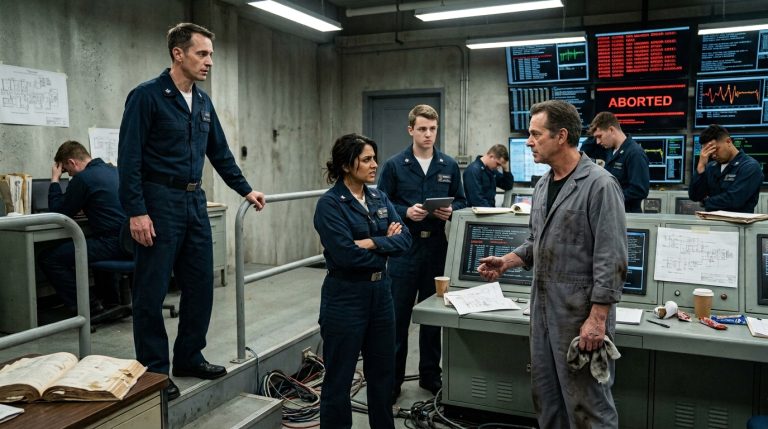
Admiral Jennings stood on the bridge, his face a mask of iron. Beside him, Lieutenant Kalin held a sidearm, his knuckles white. The Admiral didn’t speak. He didn’t need to. The interceptor, battered and trailing debris, surfaced a few hundred yards away. The Ghost-Protocol had failed, but they had succeeded in their final objective: they had brought the Phantom into the light.
Jedadiah reached for his harness and pulled out the transceiver. He held it up, a piece of blackened, useless tech in the morning sun. He didn’t wait for them to board him. He unbuckled his helmet, the seals hissing as the pressure difference finally equalized. The cold air rushed in, searing his lungs, but he felt a strange, detached calm.
“The signal is gone, Admiral,” Jedadiah said, his voice a gravelly rasp that carried the weight of the deep. “I decrypted the loop. You weren’t tracking me. You were tracking yourselves.”
Jennings stiffened. The Admiral stepped toward the railing, his voice sharp and brittle. “You were an asset, Croft. You served your purpose. The Nebraska is safe, and the record will show a tragic, accidental failure. You were meant to stay down there.”
“I was never the tool,” Jedadiah replied, his gaze locking onto the Admiral’s. “I was the test. You wanted to see if the Phantom could still perform at depth, so you could decide whether to authorize the next generation of the program. Well, you have your data. And you have your end.”
Jedadiah signaled with his hand—a slow, deliberate motion. Across the water, the interceptor’s hatch blew—not from a malfunction, but from a manual override Jedadiah had rigged with the transceiver’s final pulse. The interceptor began to tilt, water pouring into its open hull. It wasn’t a sinking; it was a broadcast. He had triggered the ship’s internal mission logs to transmit to the civilian maritime emergency band—a frequency that was now being picked up by every news station from New York to London.
The Admiral’s face drained of color. He stepped back, the mask of command slipping for the first time. The Vigilant’s crew stood in stunned silence, watching as the interceptor’s secret, unauthorized cargo of surveillance and sabotage data flooded the open airwaves.
Jedadiah watched the chaos on the bridge of the Vigilant. The Poetic Justice was a quiet thing, a slow, inevitable dismantling of a lie. The Admiral had been defeated not by a weapon, but by the very information he had tried to keep buried.
As the interceptor began its final, sliding descent into the cold, gray Atlantic, Jedadiah turned his focus back to his boat, the Serenity, which had drifted nearby. He reached into his pocket and pulled out the small, broken compass he had carried for years—the one that never pointed North. He looked at it, the needle spinning lazily in the wind. He realized he didn’t need it to point anywhere anymore.
He climbed the ladder to the deck of his boat, his limbs heavy but free. He picked up the fishing rod he had abandoned hours ago. The line was still tangled, the hook still bare. With a slow, deliberate motion, he began to work the knots out of the nylon, his fingers moving with a grace he hadn’t felt in a lifetime.
The Vigilant moved to intercept him, but the Admiral stopped them. He saw the transmission logs streaming onto his monitors—the logs that proved his involvement, the logs that would cost him his career, his legacy, and his freedom. He stood alone on the bridge, a broken man in a pressed uniform, watching as the old fisherman sat on his wooden bench, methodically cleaning his gear in the rising dawn.
The world was quiet now. The storm had passed, leaving behind a sky of pale, washed-out blue. Jedadiah finished with the line, cast his hook into the water, and sat back. He was a relic, a ghost, but for the first time in thirty years, the silence didn’t feel like a weight. It felt like peace. He had done his duty—not to the navy, not to the flag, but to the truth that lay in the crushing dark.
The sun broke the horizon, painting the waves in shades of gold. Jedadiah closed his eyes, the smell of the sea finally masking the metallic taste of his final descent. He had fixed the sub. He had saved the crew. And in the end, he had brought the shadows back into the light. He wasn’t a weapon anymore. He was just a man, finally home.