Calloused Hands And Heavy Iron: How An Old Mechanic Stood Her Ground Against Greed
CHAPTER 1: Ashes And Cold Iron
The glass crunched under her boots like thin ice. Margaret stood at the edge of the black square where the heavy oak workbench used to be.
The air still tasted of melted copper and wet ash. A single charred rafter groaned in the mid-morning heat, shifting two inches before settling back into the rubble.
Her fingers closed around the brass key in her pocket. The metal was cold against her palm, grounding her against the smell of burnt motor oil.
She didn’t blink when a charred piece of corrugated tin slid off the pile and hit the concrete with a flat, hollow ring. Out on the two-lane highway, a gravel truck blew past, kicking up dust that settled over the ruined roof beams.
Carl Havers wanted a clean slate. He wanted the dirt cleared and the boundaries redrawn by men who sat in air-conditioned offices three counties away.
Margaret walked the perimeter of the foundation. Her rubber-soled slippers offered no protection against the jagged edges of steel, but she didn’t rush her steps.
Every stride was deliberate, measured against sixty years of sweeping this exact floor. A crow dropped onto the twisted skeleton of the fuel hoist, tilted its head, and kicked off into the grey sky.
She turned her back on the wreckage and walked toward the house without looking at the highway. The front screen door hung slightly crooked on its lower hinge from the heat of the fire.
Inside, the kitchen was dead silent except for the steady drip of the kitchen faucet over the sink. Margaret filled a chipped ceramic mug with cold tap water and set it on the oilcloth table.
She pulled out a yellow legal pad and a short wooden pencil with a worn eraser. Her hand was steady as she wrote down the exact time the fire engines had cleared the gate at 4:00 AM.
She didn’t write about grief or ruin. She wrote down the license plate numbers of the utility trucks parked down the shoulder three days prior.
The front gate creaked, but she didn’t look up from the paper. The gravel driveway crunched under the weight of an approaching engine, slow and heavy, stopping right at the edge of the porch steps.
CHAPTER 2: The Suit On The Porch
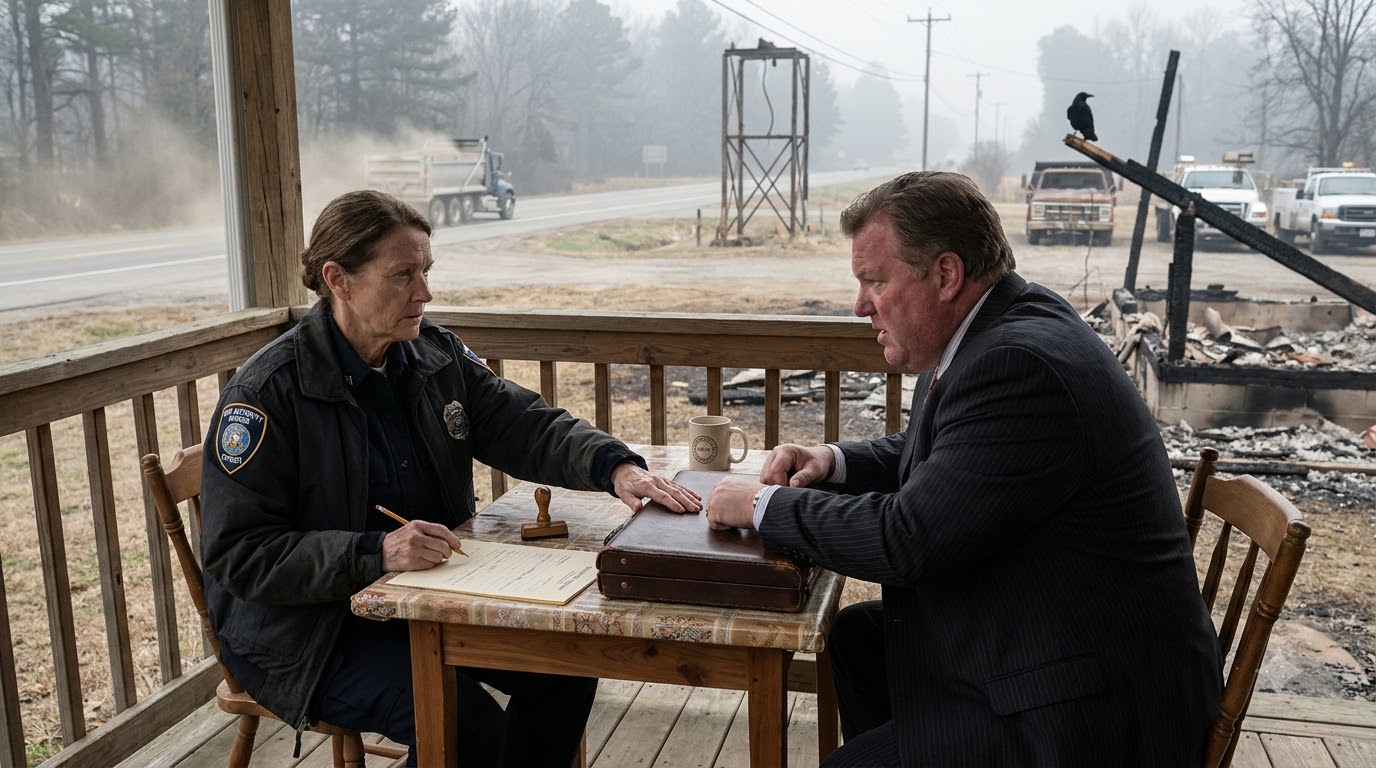
Carl Havers didn’t wait for an invitation. He stepped past the warped screen door, his heavy frame filling the narrow entryway with the sharp scent of expensive cologne and damp asphalt.
His tailor-pressed suit looked entirely out of place against the weathered timber of the porch floorboards. He laid a heavy leather briefcase flat on the small cedar table beside the empty coffee mug.
“Mrs. Doyle,” Havers said, pitching his voice to sound reasonable. “I told you yesterday we can settle this before it gets complicated.”
Margaret kept her pencil poised above the yellow legal pad. She did not look up at his face. Her gaze remained locked on the small brass zipper of his briefcase.
“You’re standing on private property,” she said. Her voice was flat, carrying the dry weight of sixty years spent talking over lathes and idling engines.
Havers chuckled, a dry sound that lacked any real humor. He tapped a fat finger against the brass lock of his case.
“Property lines are a funny thing when the county clerk misplaces a folio,” he said. “I’m offering you a clean exit. One hundred ten thousand. Cash. You take it and you’re gone by Friday.”
Margaret let the pencil drop against the wood. The quiet click echoed in the close space of the porch.
She reached out and picked up the cold ceramic mug, turning it half an inch to line up the handle with the edge of the legal pad.
“The shop is gone,” she said.
“And the tax assessment is coming due,” Havers added, leaning in closer. “Forty-one thousand. You can’t service that debt on a pension, Margaret. Be practical.”
The micro-mystery hung in the air between them, sharp and cold. On the bottom corner of the leather briefcase, a small embossed notary stamp caught the morning sun—issued out of a municipal office three counties away, stamped on a deed that hadn’t been filed locally.
Margaret saw the seal. She didn’t point it out. She simply committed the mismatch to memory, filing it away beside the license plate numbers she had written down at dawn.
“I’ve spent forty-six years looking at this ridge,” Margaret said quietly. “My father planted that orchard. My husband built the porch you’re standing on.”
“Sentiment doesn’t pave highways,” Havers snapped, his patience wearing thin as the forced smile cracked. “You either sign the quitclaim form today, or the county brings the demolition crew back out to clear what’s left of your scrap heap.”
He unzipped the briefcase with a sharp, metallic rasp and slid a single sheet of cream-colored paper across the table.
Margaret looked at the signature line at the bottom of the page. The ink was fresh.
CHAPTER 3: The Rotary Dial
Carl Havers jerked his hand back as if the paper had bitten him, his heavy jaw tightening beneath his starched collar.
“You’re making a mistake you won’t survive by Friday,” Havers spat, snatching up his briefcase and turning sharply on his heel.
The screen door slammed against the cedar post with a dry rattle, echoing into the empty gravel driveway. Margaret didn’t watch him climb back into the black SUV.
She picked up the yellow pencil, her fingers steady, and turned the page to a blank sheet. The kitchen clock ticked against the wall, loud and flat in the stillness.
She walked to the wall phone, her slippers dragging slightly against the linoleum. The black plastic receiver was cold beneath her palm as she lifted it from the cradle.
She didn’t call the county courthouse. She didn’t call the number for the state fire marshal that Deputy Wesley had left on the counter two nights ago.
Instead, she punched in a ten-digit sequence from memory, her thumb pressing down each button with slow, deliberate pressure. The line clicked twice before a heavy, gravel-rough voice answered on the other end.
“Yeah,” the deep voice rumbled. “Who’s this?”
“Mr. Cass,” Margaret said, her voice steady against the hum of the open wire. “This is Margaret Doyle.”
A sharp intake of breath crackled through the speaker, followed immediately by the sound of heavy boots shifting over loose gravel on the other end of the line.
“Ma’am,” Cass said, his tone instantly shifting from casual to razor-sharp. “Where are you?”
“I’m on my porch,” Margaret said, looking out through the grease-smudged kitchen window at the black square of ash where her shop used to be. “And they just came back.”
Silence stretched across the line, heavy and dense with unspoken intent.
“Don’t sign anything,” Cass said, the words dropping like lead weights. “Don’t open the gate for anyone. We’re rolling out now.”
CHAPTER 4: The Iron Convoy
Margaret set the black handset back onto its cradle with a dry, hollow clack.
The first low rumble shook the windowpanes before she even reached the front screen door.
She walked out onto the splintered wood of the porch, her hand brushing the brass key in her pocket.
Down the stretch of two-lane highway, a wall of dust rose against the morning sun as heavy chrome caught the light.
Big Cass killed his engine at the head of the driveway, the heavy machine sliding three inches in the loose gravel before dying to a ragged tick.
He swung his boot over the saddle and stood up to his full height, his leather vest dark with road dust and miles of hard riding.
Behind him, the road filled from shoulder to shoulder with machines, stretching back past the ridge until the sound became a continuous iron roar.
Not a single man shouted. They parked in tight, orderly rows across the gravel and spilled out into the open space where the burned shop timbers still smelled of charcoal.
Cass walked up the wooden steps, his heavy boots sounding like mallets against the floorboards.
“Morning, ma’am,” Cass said, pulling off his heavy gloves and stuffing them into his back pocket. “You look like you’ve had a long week.”
“Longer than you think, Mr. Cass,” Margaret answered, stepping aside to let him clear the narrow doorway.
Behind them, a flatbed truck ground its gears and backed through the open gate, loaded down with fresh lumber and steel beams stacked eight feet high.
Diane Castanos stepped down from the passenger seat of a black sedan that had slipped in behind the convoy, carrying a leather briefcase heavy with state records.
She walked straight up to the porch, her eyes fixed on Margaret with the sharp, calculated focus of a woman who had spent decades tearing apart corporate title fraud.
“Show me the papers they dropped off,” Diane said, dropping the briefcase onto the cedar table with a flat thud.
CHAPTER 5: The Federal CounterMove
Diane Castanos didn’t waste a second on pleasantries. She slid a certified title search dating back to 1948 across the scarred wood of the table.
“The survey Havers filed with the county is a complete fabrication,” Diane said, her voice dropping into a flat, professional register. “The notary seal on the transfer deed belongs to an office three counties away that was closed down two years ago.”
Margaret looked down at the paper. The mismatched notary stamp she had noticed earlier on the corporate briefcase matched the forgery stamp line for line.
“He thought an old woman alone wouldn’t check the record room,” Margaret said, her fingers resting lightly on the edge of the legal pad.
“He miscalculated,” Diane replied, pulling a federal complaint form from the stack. “We filed a racketeering and fraud injunction in U.S. District Court this morning, backed by an emergency restraining order.”
Footsteps crunched heavily on the gravel drive.
Carl Havers stepped past the parked motorcycles, flanked by a nervous-looking county official and a local property assessor holding a clipboard.
“You’re operating an unpermitted construction site without a commercial zoning variance, Mrs. Doyle,” Havers shouted, stopping twenty feet from the porch steps with his face mottled red. “The county marshal is right behind me to clear this lot out by sundown.”
Diane stood up slowly, blocking his view of Margaret. She didn’t raise her voice, but every word cut through the crisp air like cold steel.
“You might want to check who signed the federal injunction, Mr. Havers,” Diane said, holding up a blue-backed document bearing a federal magistrate’s signature. “Step five hundred feet past this property line, or the U.S. Marshals will enforce the contempt order before your car engine cools.”
Havers froze, his mouth opening and closing as his eyes darted from Diane to the sea of leather-vested men standing silently around the perimeter.
CHAPTER 6: The Rusted Threshold
Havers didn’t look back once as he climbed into the black SUV. The doors slammed shut, and the vehicle tore out of the driveway, kicking up a spray of loose stones against the highway shoulder.
Diane rolled the blue-backed paperwork back into her leather briefcase with a crisp, final snap of the brass latches.
Around the perimeter, the engines of a hundred machines idled down in a synchronized wave of low iron thrumming.
By sundown, the contractor’s crew had bolted down the last sheet of green trim on the new shop’s front wall.
It stood twice as large as the old one, smelling of fresh pine and clean machine oil, built straight and true over the blackened square of the past.
Margaret walked through the wide double doors alone as the evening light dipped below the ridge.
Big Cass leaned against the frame of the back office door, his heavy vest resting over his arm.
“Everything’s square, ma’am,” Cass said quietly, watching her hand brush the smooth edge of the new workbench. “Nobody’s coming back.”
Margaret reached into her apron pocket and pulled out the small brass key from Frank’s old toolbox.
She walked over to the center nail driven into the timber support right above the middle vise.
She hung the key on the iron point. It swung once, twice, and then settled completely still against the raw pine.
“Thank you, Mr. Cass,” Margaret said, turning to face him.
“Just paying what we owed,” Cass nodded, turning toward the open doorway where the last of the riders were kicking their starters to life.
Margaret stood by the workbench as the roar of the convoy faded away down the long stretch of highway until the gravel lot was entirely quiet again.
She reached into her pocket, pulled out her red cotton shop rag, and wiped down a speck of sawdust from the clean surface.
She walked over to the electric kettle in the corner, plugged it in, and waited for the water to heat.
Outside, the evening air was cool and steady, carrying the scent of dust and open fields across the valley.
She sat down on the wooden stool, wrapped both hands around her warm ceramic mug, and looked out the spotless window at the road.