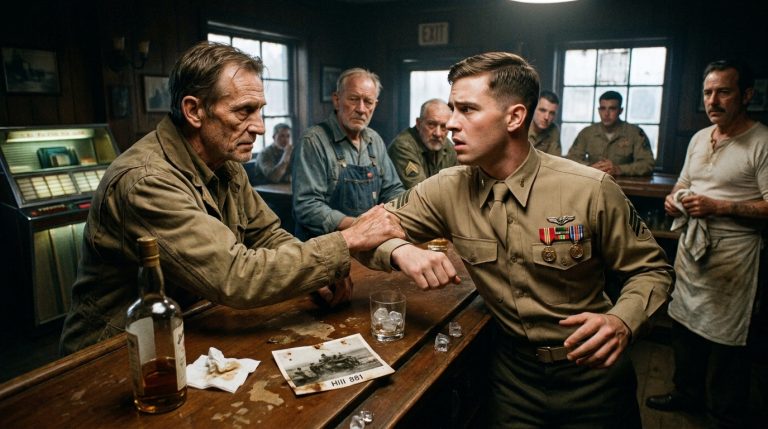
The Brass and the Bone: A Long-Shadowed Ledger of the 75th Ranger Regiment’s Forgotten Truth
CHAPTER 1: THE JANITORS LEDGER
The banquet hall smelled of floor wax and the lingering, stale ghost of last night’s diesel fumes from the motor pool. Joseph didn’t mind the smell; it was cleaner than the air in the Ashau Valley, which had tasted exclusively of wet iron and rot.
He moved with a steady, grinding rhythm, his boots finding the familiar traction on the polished linoleum. Most people saw the janitor—a hunched frame, a mop that seemed to pull him rather than the other way around. They didn’t see the way he mapped the room. His eyes, clear and cold as winter gravel, caught the misalignment of the head table. Three millimeters to the left. The chair meant for the General was slightly off-center.
He adjusted it. It was a reflex, not a job.
Joseph paused by the regimental honor wall. His gnarled fingers, mapped with the scars of a different life, traced the brass nameplate of Specialist Greg. The metal was dull, oxidized by the humidity that crawled off the local bayou. He pulled a rag from his back pocket. It was gray, stained with years of labor, but it was soft. He began to buff the brass, the friction creating a steady, low-frequency hum that vibrated up his arm.
Thump.
A rhythmic clicking came from his pocket. He ignored it, his concentration locked on the reflection in the brass—not his own face, but the distorted, shimmering image of the hall behind him.
He saw the door to the service entrance creak open. Captain Hayes stood there, silhouetted by the harsh fluorescent light of the hallway. Hayes didn’t look at the hall; he looked at the floor, at the scuff marks Joseph had missed, and then at Joseph himself. The Captain’s face was a study in practiced irritation, the kind of look that usually preceded a lecture on efficiency.
Joseph didn’t stop polishing. The brass was starting to glow, a dull, warm gold pushing through the tarnish.
“Is this some kind of joke?” Hayes’s voice cut through the air, sharp and abrasive. “Someone get this relic out of my banquet hall before the General arrives.”
Joseph didn’t flinch. He leaned into the rag, pressing down until his knuckles turned the color of parchment. The metal didn’t need to be perfect for the Captain; it needed to be perfect for the names. He knew exactly how heavy a name felt when it stopped being spoken aloud.
He felt the weight of the replica medal in his inner coat pocket—a heavy, cold lump of metal that he had carried for thirty years. It wasn’t the original; the original was buried in a place where the dirt still tasted of cordite. But this one, this heavy, forged thing, had enough weight to remind him that he was still here.
“Did you hear me, old-timer?” Hayes took a step closer, his polished boots clicking a sharp, impatient staccato against the floor.
Joseph took a breath, the air whistling slightly in his chest. He turned, the mop handle resting against his hip like a rifle stock. He looked at the Captain, not with the eyes of a subordinate, but with the flat, assessing gaze of a man who had seen exactly how far a human being could be stretched before they snapped.
The metallic clicking in his pocket skipped a beat, then fell silent. Joseph looked at the brass plate, then back to the Captain, and said nothing. The silence between them was heavy, rusting at the edges.
CHAPTER 2: THE BANQUET HALL
The silence in the banquet hall was not empty; it was a physical weight, thick with the smell of floor wax and the underlying, sharp tang of ozone that always seemed to precede a storm. Captain Hayes remained in Joseph’s personal space, his chest heaving with a rhythmic, agitated motion. He was still waiting for a reaction, for the old man to tremble, to drop the mop, to offer some pathetic excuse that would justify the Captain’s self-righteous indignation.
Joseph did not blink. He kept his grip on the mop handle, his calloused palms finding the worn wood smooth, grounding. He was counting the beats of Hayes’s pulse; he could see it at the base of the Captain’s neck, a rapid, frantic tempo. It was the heart rate of a man who played at war, not one who had lived in its teeth.
“You heard me,” Hayes repeated, his voice dropping into a register he likely imagined was menacing. “The MPs are a call away. I suggest you take your cart and vacate this hall. We have high-ranking dignitaries arriving in less than four hours. They don’t need to see the custodial staff lingering like furniture.”
Joseph looked past Hayes, his eyes sweeping the perimeter of the room. The chairs were perfect, the symmetry restored, the honor wall gleaming under the overhead lights. He didn’t care about the MPs, and he certainly didn’t care about the Captain’s performance. His concern was the maintenance of the environment. A banquet hall for heroes required a specific kind of quiet, a stillness that Hayes was currently contaminating with his noise.
“The wax is still wet,” Joseph said, his voice a low, gravelly rasp that seemed to catch on the dusty air. “Foot traffic will ruin the shine before the evening starts.”
Hayes recoiled as if he had been slapped. He wasn’t used to being ignored or addressed with such mundane, pragmatic detachment. He took a step toward the mop cart, his polished boots—those pristine, useless things—skidding slightly on the freshly treated floor. “I don’t give a damn about the floor,” he hissed. “I care about the standards of this regiment. You are a relic, and you are cluttering up a space that belongs to men who actually contributed something to this country.”
Joseph finally shifted his stance. He moved the mop with an agonizingly slow, calculated grace, sliding the damp fibers across a scuff mark Hayes had just made. He felt the phantom ache in his left knee, a souvenir from 1968, but he didn’t favor it. He maintained his posture, square and heavy.
“Every man who has his name on that wall contributed everything,” Joseph replied. His tone wasn’t defensive. It was a statement of fact, as clinical as a ballistics report. “I’m just making sure the polish holds.”
Hayes let out a sharp, incredulous laugh that echoed off the high rafters of the banquet hall. He looked toward the service door, where a pair of junior lieutenants were hovering, their faces illuminated by the pale, artificial light of the hallway. They were watching, eager for a show, for the Captain to finally crush the old man’s dignity.
“Fine,” Hayes said, his grin returning, sharp and predatory. “Stay, then. Work. Be the furniture. But when the General walks in, you’d better be invisible. If I see you standing around when the real heroes arrive, I will see to it that you never step foot on this base again. Do you understand me, old man?”
Joseph dipped the mop into the bucket, the water swirling with a dark, murky sediment. “I understand,” he said quietly.
Hayes didn’t linger. He straightened his uniform, smoothed his lapels with a nervous, twitching motion, and marched toward the exit, his subordinates scrambling to clear his path. The heavy double doors swung shut, the metallic thud ringing through the hall like a closing vault.
Joseph was alone again. He returned to the mop, his movements falling back into the steady, meditative cycle. He knew the Captain’s type. He had seen a hundred of them in the field—officers who treated the world as a stage and their rank as a costume. They were dangerous only because they were unaware of their own limitations.
He moved to the corner of the room, behind a large decorative pillar, and reached into his inner coat pocket. He pulled out the heavy, cold replica of the Medal of Honor. It was a solid weight in his hand, a physical anchor. He felt the raised metal of the star, the cold sting of it against his skin. It wasn’t the original; the original was a ghost, a legend that belonged to a version of him that had died in the Ashau Valley. But this replica, forged in secret and kept in the dark, held the gravity of the truth.
He looked at it for a long, silent moment. The clicking from his pocket returned—a soft, mechanical ticking that he tuned out as easily as he tuned out the wind. He wasn’t a janitor, and he wasn’t a hero. He was a caretaker of things that other people had forgotten how to value.
He placed the medal back into his pocket, his expression unchanging. He still had four hours before the dinner. There were table settings to align, linens to check for wrinkles, and shadows to clear from the corners of the room. He walked toward the head table, his boots silent, his presence fading into the background, becoming exactly what the Captain wanted: a piece of furniture that was beginning to feel a great deal like a bomb.
CHAPTER 3: THE INVITATION
Joseph continued his work, his movements mechanical and precise. He moved from the head table to the guest seating, the cart wheels squeaking a soft, rhythmic protest against the floor wax. Each motion was deliberate, an exercise in economy. He wasn’t just arranging chairs; he was establishing a perimeter.
As he reached the back row—the section where the rank-and-file, the grunts, and the forgotten would inevitably end up—he paused. The smell of the floor wax, a chemical, sharp sweetness, suddenly shifted. A phantom draft drifted through the service door, carrying the scent of damp earth and charcoal. It was an impossible smell in a climate-controlled banquet hall, yet for a split second, Joseph wasn’t standing on polished linoleum. He was standing in a monsoon-drenched valley, the mud sucking at his boots, the air so thick with water it felt like breathing silt. The memory wasn’t a choice; it was a physical blow, a sudden, sharp ache in his knee that brought him to a halt.
He steadied himself against the back of a chair. The sensation of the damp, uneven ground vanished as quickly as it had arrived, replaced by the cool, solid reality of the hall. Joseph exhaled, a low, rasping sound. He didn’t look for the source of the hallucination. He knew it wasn’t the room; it was the proximity of the evening’s event. The approaching dinner was a catalyst.
He reached into his pocket, his hand hovering over the cold, hard outline of the forged Medal of Honor. He had crafted the replica himself, years ago, in a machine shop that had since been torn down to make room for a highway. It was a tool, not a prize. He needed it to ensure that when the time came, the focus wouldn’t be on the truth of his service—which was a locked file—but on the visibility of the symbol. If they wanted a caricature of a hero, he would give them one so perfect it would force them to look at their own hands and realize they were empty.
A soft, hesitant footfall sounded from the entrance. Joseph didn’t turn. He knew the gait—irregular, heavy on the left side, the walk of someone who hadn’t yet learned to carry their own weight in a uniform. It was the young Private, Davis.
“Sergeant Major?”
The voice was thin, barely a whisper. Joseph turned slowly, his face a mask of calm, weathered stone. Davis was standing near the door, his eyes darting toward the head table, then back to the mop cart. The boy looked terrified, not of Joseph, but of the space the old man occupied.
“The place settings for the staff,” Joseph said, his voice level. “You’ve misaligned the napkins at the third table. The weave of the fabric should point toward the center, not the side.”
Davis blinked, his focus shifting to the table. He moved toward it with a stiff, awkward agility. “I… yes, sir. I’ll fix it.” He reached for the napkin, his fingers trembling. “Captain Hayes was here earlier. He said some things. I just… I wanted you to know that not everyone agrees with him.”
Joseph watched the boy work. Davis was earnest, a trait that was usually fatal in a place like this. He was trying to bridge a gap he didn’t even understand.
“Agreement isn’t a requirement for duty, Private,” Joseph replied. He pushed his cart forward, the wheels grinding, a sound like iron on stone. “You are here to set the tables. Focus on the geometry of the task. The rest is just noise.”
“But it’s not just noise, is it?” Davis looked up, his young face pale. “I saw your hands earlier. When you were polishing the nameplate. You were doing it like it was a field-strip. I’ve seen the records, sir. I’ve read the archives, even the ones that are supposed to be redacted.”
Joseph stopped. The hall seemed to tilt, just for a heartbeat. He looked at the boy—not at the uniform, but at the light in his eyes. It was a dangerous, searching kind of light.
“Archives are often wrong, Private,” Joseph said, his voice dropping into a register that made the air feel thinner. “They record the event, never the cost. If you’re looking for a story, you’re in the wrong building.”
“I’m not looking for a story,” Davis whispered, stepping closer. “I’m looking for why someone like you, with your history, would spend ten years cleaning floors for officers who don’t even know your name.”
Joseph turned back to his cart. He took hold of the bucket, the handle biting into his calloused palm. “I’m not cleaning for the officers,” he said, the words heavy and final. “I’m cleaning for the ghosts. They deserve a clear reflection.”
He began to push the cart toward the kitchen, the squeak of the wheel marking a relentless, steady time. He didn’t look back to see if Davis followed. He knew the boy was standing there, caught in the middle of a realization he wasn’t ready to hold. The tension in the hall was no longer just the Captain’s arrogance; it was now the weight of an unasked question, hovering in the air like dust caught in a beam of light.
CHAPTER 4: THE WEIGHT OF THE SUIT
The journey from the kitchen to the utility closet was a series of narrow, low-lit corridors that smelled of stale electricity and industrial cleaner. Joseph pushed the cart with a steady, grinding efficiency, his mind replaying the Private’s questions. The boy was a variable he hadn’t accounted for—a soft, impressionable element in a calculation that required absolute rigidity. He reached the closet, the door groaning on its hinges, and stepped into the small, cramped space that housed his supplies.
He flipped the light switch. The yellow bulb flickered, struggling against the gloom, and cast long, erratic shadows across the shelves of cleaning agents and spare rags. As Joseph began to sort his inventory, his boot caught on something metallic near the base of the shelving. He paused, his gaze dropping to the floor.
It was a cufflink. Not the standard-issue plastic buttons the enlisted men wore, but a heavy, gold-plated piece of jewelry, ornate and distinctly out of place in a room where the most valuable item was a gallon of industrial-strength degreaser. He knelt, the familiar protest of his knee echoing in the tight space, and picked it up. The metal felt cold, heavy with a specific, polished arrogance.
He didn’t need to see the engraving to know whose it was. He had seen Hayes adjusting his sleeves earlier that morning, the sunlight catching that very gold. But what it was doing here, in the darkest corner of the utility closet, suggested a narrative Joseph hadn’t authorized.
His eyes scanned the floor. A faint, jagged scratch marred the polished concrete, and a smudge of oil—dark, viscous, and smelling of high-grade machine grease—was smeared against the doorframe. Someone had been here. Someone had been hurried, perhaps dragged, or perhaps just careless in a moment of panicked agitation. Joseph closed his eyes for a second, forcing his senses to expand. The scent of ozone from earlier was sharper here, mixed with a faint, cloying trace of something like expensive cologne.
The “furniture” was starting to move.
He slid the cufflink into his pocket, his hand brushing against the cold, hard weight of the replica medal. If Hayes was careless enough to lose a piece of his identity in the utility closet, he was arrogant enough to be sloppy with his larger plans. Joseph didn’t move to report it. He didn’t move to question it. He simply added the detail to his mental ledger. The banquet hall was no longer just a place for polishing brass; it was a theater, and the script was being rewritten by players who were already losing their footing.
Joseph finished his sorting, his movements slowing as he prepared the suit he had hidden behind the cleaning supplies. It was an old charcoal-gray garment, the fabric frayed at the cuffs and thin at the elbows. He pulled it out, the cloth feeling dry and brittle in his hands. It was the only armor he had left. He wouldn’t wear it until the final hour, but he needed to ensure it was ready. He laid it out across the mop bucket, smoothed the lapels, and checked the collar.
He spent the next hour in a meticulous state of preparation. He checked the stitching of the suit, the cleanliness of the white shirt, and the integrity of the pale blue, star-spangled ribbon he had kept tucked away in a velvet pouch. Each action was an extension of his duty. He wasn’t preparing for a dinner; he was preparing for a final accounting.
The sound of boots in the hallway broke his concentration. A heavy, rhythmic tread, much more disciplined than Hayes’s restless pacing. Joseph froze, his ears tracking the movement. Two people, stopping right outside the closet door.
“The old man has the service entrance key,” a voice rumbled—not Hayes, but someone deeper, more authoritative. “Make sure he doesn’t use it to access the restricted records. The Captain is already on edge about the dinner. If the Janitor knows where the files are stored, we have a bigger problem than just a PR stunt.”
“He’s a ghost, sir,” a younger voice replied. “He doesn’t know anything. He’s been here for years, and he hasn’t even looked at a document file.”
“Keep watching him,” the authoritative voice snapped. “He’s an anomaly. And in this regiment, anomalies get erased.”
Joseph stood perfectly still, his breath shallow, his hand resting on the handle of the mop. The voices faded as the footsteps continued down the corridor. He didn’t feel fear. He felt the cold, hard clarity of a man who had finally been recognized as a threat. The game was no longer a prank, and the Captain was no longer the only one playing. The walls he had polished, the halls he had walked, and the nameplates he had kept shining—they were all part of a structure he now had to navigate with surgical precision.
He waited until the silence returned, thick and absolute. He picked up the suit, folded it once, and placed it back into the darkness of the locker. He would need more than just a mop and a rag to survive the night. He would need to be exactly the ghost they feared.
CHAPTER 5: THE ARRIVAL
Joseph stepped out of the utility closet, his boots silent against the linoleum. The hallway, which only moments ago felt like a familiar artery of the base, now possessed a predatory stillness. The overhead fluorescent lights flickered with an intermittent, buzzing hum—a sound that reminded him of a faulty radio connection from a decade he’d tried to bury. He gripped the mop handle, his knuckles white, and began the long, calculated trek toward the banquet hall.
He moved with the economy of a man who knew that every step was a liability. He was no longer just the janitor; he was a target. The realization didn’t quicken his heart; it sharpened his focus. He could hear the distant, muffled echoes of the banquet hall coming to life—the clatter of silverware, the booming, artificial laughter of officers practicing their charisma, and the rhythmic percussion of heavy footsteps.
As he turned the corner near the administrative wing, the light above him surged, then died, plunging the corridor into a bruised, gray twilight. He stopped. His eyes adjusted, tracing the geometry of the darkness. Behind him, he heard a sound—the distinct, metallic click of a door latch. It wasn’t the sound of an opening; it was the sound of a locking mechanism engaging, followed by the soft, deliberate scrape of a leather sole on tile.
He didn’t turn around. He leaned forward, his weight balanced on the balls of his feet, his senses filtering the ambient noise for the signature of a pursuit. There was a pause, a breath drawn somewhere in the gloom, and then the silence returned, heavier than before. Was he being followed, or was the base itself beginning to tighten its grip, shifting its architecture to box him in?
He continued walking, his movements precise, his path avoiding the pools of deepest shadow. He felt the cold, hard lump of the forged medal in his pocket, a talisman that felt increasingly like a live grenade. He had to reach the banquet hall. The dinner was the pivot point. If he could navigate the next two hours without compromising the illusion, he would be in a position to force the truth into the light. But the “erasure” threat had changed the physics of the evening. He was no longer an observer; he was a participant in a game where the rules were written in redacted ink.
The corridor opened into the main foyer. The banquet hall doors were just ahead, ornate, polished oak structures that felt like the gates to a different reality. Through the wood, he could hear Hayes’s voice, raised and jovial, punctuated by the tinkling of crystal.
He felt a sudden, sharp jolt of vertigo. The scent of ozone returned, stronger now, mixing with the smell of floor wax to create an olfactory profile that tasted like the metallic tang of an incoming mortar strike. He stumbled, his hand catching the handle of a service trolley to stay upright. For a split second, the tiled floor of the foyer seemed to dissolve into the wet, sucking mud of the Ashau Valley. He saw the faces of his team—not as ghosts, but as living, breathing men waiting for a signal he had yet to give.
“Steady,” he whispered to himself, the word a rasping anchor.
He stood up straight, his spine popping with a dry, brittle sound. He pushed the cart, the squeaky wheel protesting, and reached the heavy oak doors. He didn’t look back at the hallway. He didn’t look for the shadow that had been tracking him. He knew that if he turned now, he would see nothing but empty air, and that emptiness was far more dangerous than any soldier.
He pushed the door open. The roar of the banquet hall hit him like a physical wall—the heat, the collective volume of dozens of voices, the scent of roasting meat and high-end bourbon. He was inside the cage. The lights were blindingly bright, the chandelier crystals refracting the room into a million sharp, stinging points.
Hayes was standing at the head table, holding a glass aloft, his gaze raking the room with the satisfaction of a man who thought he had secured his legacy. He saw Joseph. For a brief, flickering moment, the Captain’s face betrayed a look of genuine, predatory triumph. He looked as if he was about to signal the MPs.
Joseph didn’t hesitate. He walked toward the back, his head down, his posture stooped—the perfect janitor, the perfect shadow. He reached the utility station at the far wall, where he was meant to wait. He set his mop aside and reached into his inner pocket, his fingers finding the cool, smooth surface of the medal one last time. He wasn’t afraid. He was waiting.
CHAPTER 6: THE CONFRONTATION
The sound was less like an accident and more like a fracture in reality. A tray of champagne flutes cascaded from a server’s grip, hitting the marble with a violent, rhythmic detonation of glass. Shards sprayed across the floor, catching the overhead lights and scattering them into a thousand jagged, blinding flickers. Joseph shifted instinctively, his body coiling to avoid the spray of debris. In the chaos of the room, he moved with a fluid, unnatural grace, ducking behind a heavy velvet curtain just as the clatter reached its crescendo.
When he emerged, he found himself not in the safe, darkened perimeter of the utility station, but exposed in the wide, open expanse of the center aisle. And he was not alone.
Captain Hayes was already moving. He had descended from the head table with the speed of a man who had been waiting for the exact moment of chaos to strike. He didn’t look at the spilled champagne. He looked straight at Joseph, his expression a twisted synthesis of rage and exhilaration. Hayes knew. Or perhaps he simply hated. In the predatory calculus of the banquet hall, the distinction didn’t matter.
“You,” Hayes barked, his voice cutting through the fading echoes of the broken glass. He didn’t use the title ‘Janitor.’ He didn’t use any title at all. He pointed a rigid finger at Joseph’s chest—directly over the spot where the forged medal rested in the inner pocket. “You couldn’t help yourself, could you? You had to stay, to watch the spectacle. To see what real men look like.”
The room went silent. The laughter died, replaced by the collective intake of breath from a dozen tables. The servers froze. The General, seated at the center, turned his head slowly, his eyes narrowing into granite chips.
Joseph stood his ground. He didn’t retreat. He didn’t offer the apology Hayes was fishing for. He simply stood, his hands hanging naturally at his sides, his shoulders squared. He felt the cold, hard weight of the replica medal pressing against his heart. It was a fake—a piece of machined metal forged in a forgotten shop—but in the sterile, air-conditioned air of the hall, it felt heavier than any bullet.
“I came to finish the work, Captain,” Joseph said, his voice low, raspy, and dangerously steady. “The nameplates on the wall still needed a final buff. Brass tarnishes quickly when the air is thick with pretense.”
Hayes stopped a few feet away, his face turning a mottled, furious red. The sheer audacity of the old man’s calm was a friction that seemed to be grinding Hayes’s control down to the bone. “You’re a disgrace,” Hayes whispered, loud enough for the nearest tables to hear. “You are a stain on this room. You are wearing a lie, and you think because you scrubbed a few floors, you’ve earned the right to exist in the same air as these soldiers?”
He reached out, his hand snapping forward to grab the lapel of Joseph’s worn coveralls.
Joseph didn’t flinch. He let the contact happen. As Hayes pulled him in, Joseph leaned into the motion, not with resistance, but with a sudden, overwhelming, and absolute stillness. He looked directly into Hayes’s eyes—eyes that were currently flooded with the terror of a man who realized, too late, that he had grabbed something he couldn’t put down.
“The brass doesn’t care who cleans it,” Joseph murmured, his tone as cold as the Ashau Valley in mid-winter. “The names are already carved. Whether you see them or not, whether you understand them or not, they are there. You think this is a uniform? You think this is a rank? You’re playing with silhouettes, Captain. You’re fighting a shadow, and you’re losing your balance.”
Hayes stumbled back, his fingers slipping from the heavy fabric as if he’d touched a live wire. He looked around the room, expecting support, expecting the laughter to return. But the room was watching with a terrible, growing intensity. The junior lieutenants were silent. Private Davis, standing near the back, had moved from the shadows, his face pale and fixed on the medal in Joseph’s pocket.
The air in the room seemed to have been sucked out by a vacuum. The tension wasn’t just atmospheric anymore; it was structural. The floor felt less like polished stone and more like the shifting, treacherous terrain of a memory. Joseph felt the ghost citation in his mind—the details of the operation that didn’t exist, the lives he had carried, the men he had buried, the truth he had kept clean for forty years.
He didn’t need the medal to be real. He just needed the Captain to believe it was.
“You want to know what this is?” Joseph asked, his voice rising just enough to carry to the head table. He reached into his pocket. He didn’t pull out the medal. He pulled out the cufflink he had found in the utility closet—the gold-plated, ornate piece Hayes had lost earlier. He held it up, catching the light. It glinted, a small, bright spark of evidence. “You dropped this in the closet, Captain. Along with your composure.”
The color drained from Hayes’s face. The room seemed to tilt. The Captain’s eyes locked onto the cufflink, and for a terrifying, singular moment, he realized that the janitor had been where he shouldn’t have been, and seen what he shouldn’t have seen. The game wasn’t just about the medal anymore. It was about the silence. And the silence was beginning to crack.
CHAPTER 7: THE INTERVENTION
The cufflink spun on the polished marble, a tiny golden eye watching the room. Captain Hayes stared at it, his chest heaving, the vein in his temple pulsing with a rhythmic, erratic beat. He looked as if he had been struck. For a moment, the bravado that had fueled his entire evening—the performance of the alpha officer—collapsed, leaving him looking exposed and remarkably small.
The silence in the room was absolute. It was a vacuum, pulling at the ears. Then, the sound of measured, rhythmic footsteps began to cut through the tension. General Wallace was moving. He hadn’t been watching the banquet; he had been watching Joseph. The General’s gait was slow, deliberate—the walk of a man who spent his life measuring distances.
“Captain,” the General’s voice boomed, deep and resonant, a sound that seemed to vibrate through the very floorboards. It wasn’t loud, but it possessed a weight that commanded total obedience.
Hayes turned, his face pale. “Sir, this… this man is a disruption. He was trespassing in restricted areas. He’s—”
“He is standing,” the General interrupted, his gaze not on Hayes, but on Joseph. The General stopped ten feet away, his granite-like eyes scanning the old man. He didn’t look at the coveralls. He didn’t look at the mop cart. He looked at the shape of Joseph’s shoulders, the way he carried his weight, and the calm, unwavering focus in his eyes.
The General’s hand, scarred and heavy, rose. He drew himself up to his full, imposing height and executed a salute—sharp, perfect, and profoundly respectful. It was a salute that didn’t belong to the room, or the hierarchy, or the dinner. It was a salute of absolute, unconditional recognition.
“Sergeant Major Chen,” the General said. The name hit the air like a gavel.
The room convulsed. The sound of a hundred heartbeats seemed to synchronize. The name echoed, a dormant memory in the regiment’s history. A few of the older veterans at the front tables stood up, their chairs clattering, their eyes widening in sudden, sharp realization. The name had been sealed in a classified file for nearly four decades. To see the man attached to it—the man everyone had dismissed as a relic—was to watch the foundation of the regiment’s history suddenly and violently shift.
Hayes staggered back. “Sergeant Major?” he whispered, his voice cracking. “Sir, there must be a mistake. He’s… he’s the janitor.”
“He is the reason we are all here,” the General said, his voice dropping to a low, dangerous rumble. He turned his head slowly to look at Hayes, his gaze landing with the force of a physical blow. “You invited a hero to be a punchline. You attempted to assault a man who holds a Medal of Honor that has been classified since the Ashau Valley operation in 1968. Do you have any idea what that implies, Captain?”
Hayes was trembling now. The cufflink on the floor looked less like a lost item and more like a symbol of his own unraveling. “I didn’t know,” he gasped, his gaze darting toward the exits as if looking for a way out of his own life.
Joseph stood perfectly still. The phantom scent of the valley—the humid, suffocating rot of the Ashau mud—was gone. He felt only the cool, sterile air of the hall, the weight of the replica medal in his pocket, and the sudden, heavy burden of the truth being dragged into the light. He wasn’t a janitor anymore. He was a piece of evidence, a living piece of history that refused to stay buried.
“I didn’t ask for the recognition,” Joseph said, his voice cutting through the General’s authority. He looked at the General, his eyes clear, cold, and entirely unafraid. “I asked for the right to serve in silence. You broke that, General. Not him,” he gestured to Hayes. “You. By keeping the files sealed so long that the men you sent home were forgotten by the very regiment they saved.”
The General paused, his expression flicking toward a rare, fleeting moment of vulnerability. The weight of the truth—the Ghost Citation—was hanging between them, a tangible, burning thing. Joseph wasn’t just a survivor; he was the primary witness to a history the military had spent decades trying to sanitize.
“The truth is a heavy thing to carry, Sergeant Major,” the General said, his voice softening just enough to be heard only by those in the immediate radius.
“It’s heavier when you’re forced to hold it alone,” Joseph replied. He reached into his pocket and pulled out the forged medal. He didn’t hold it like a trophy. He held it out, showing the General the craftsmanship of a man who had been forced to forge his own proof of existence. “You want to know why I had this made? Because the official version of my life was a lie. And I couldn’t bear to let the memory of those men fade while I was the only one left to remember them.”
The General looked at the medal, then at Joseph’s hands, and finally back to the Captain. The room was deathly quiet. Hayes had slumped against the head table, his head in his hands, the humiliation finally complete. The story was out. The ghost had stepped out of the utility closet, and there was no way to push him back in.
CHAPTER 8: THE FINAL LEDGER
The banquet hall, once a theater of noise and pretense, had become a cathedral of absolute, ringing silence. Captain Hayes remained crumpled against the head table, his hands pressed over his face, the picture of a man whose reality had been dismantled by a single name. The General continued to hold Joseph’s gaze, his own eyes wet with the kind of recognition that only exists between those who have left pieces of themselves on distant, nameless battlefields.
Joseph felt the weight of the forged medal in his hand, its sharp, metallic edges biting into his skin. The artifice of it was gone. It had served its purpose as a bridge, a way to drag the truth across the chasm Hayes had opened. He felt a sudden, profound exhaustion—not the fatigue of the long shifts or the scrubbing of floors, but the deep, marrow-aching weariness of a man who had finally finished a race he hadn’t known he was running.
“The operation was never meant to be recorded,” Joseph said, his voice quiet but resonant, filling the space like water filling a dry well. He didn’t look at the crowd; he looked at the General. “You know that. I know that. We were ‘ghosts’ in the Ashau Valley, sent to hold a line that the high command refused to acknowledge existed. Eight men didn’t come back. Their names aren’t on this wall, General. I’ve checked every year. Their names aren’t anywhere.”
The General’s jaw tightened. “The files were classified for the sake of the alliance, Sergeant Major. You know the cost of the politics involved.”
“The cost was theirs,” Joseph said. He stepped forward, the floorboards creaking under his weight—a grounding, rhythmic sound. He walked to the Honor Wall, the brass plaque he had been polishing earlier that morning. He pulled a fresh, clean rag from his pocket and began to buff the brass, his movements slow, deliberate, and final. “I didn’t stay here to expose you, General. I stayed here because when the silence became too loud, I needed to make sure that the few names that were known were clean. I needed to ensure that someone, somewhere, was still seeing them.”
He stepped away from the wall. The name of Specialist Greg caught the light, gleaming with a sharp, defiant luster. Joseph turned to Hayes, who had finally looked up, his face hollowed out by the sheer magnitude of his error. Joseph walked over to the Captain, his gait steady, his presence devoid of malice. He reached out and placed the forged medal on the table in front of Hayes. It clattered against the fine china, a hollow, sobering sound.
“You wanted to see what a hero looked like,” Joseph said, his voice devoid of judgment. “You wanted to find a ghost to mock so you could feel more alive. But you forgot the most important thing, Captain. You can’t build a legacy on someone else’s shadow. The only thing you’ll ever earn is what you build with your own hands.”
Hayes didn’t speak. He reached out, his hand hovering over the medal, and then pulled back as if burned. He stood up, unsteady, and turned toward the General. There were no words of defense, no excuses. The Captain’s career, his prestige, and his status had been stripped away by the simple, quiet weight of a janitor who refused to be forgotten. He walked out of the hall, his head bowed, his gait dragging, the sound of his exit swallowed by the cavernous, unmoving silence of the room.
The General stayed. He watched the Captain leave, then turned back to Joseph. “What now, Sergeant Major?”
Joseph looked at his mop cart, then at the rows of soldiers, their faces transformed by the weight of the moment. They were looking at him not with the dismissive indifference they had shown hours ago, but with a profound, terrifying awe.
“Now?” Joseph picked up his mop cart. He felt a strange, light, expansive feeling in his chest—a feeling of air returning to a collapsed lung. “Now, I finish the work. The floor still needs to be mopped. The brass still needs to be polished. And I suspect that after tonight, there will be a lot of people needing to remember the names of the men they were supposed to have kept in mind.”
He began to push the cart toward the service exit. He stopped at the entrance, his hand on the door, and looked back. Private Davis was standing by the Honor Wall, his eyes fixed on the gleaming brass. He wasn’t looking at the General, or the room; he was looking at the nameplate. He reached out, his fingers hovering over the name ‘Greg,’ and finally, tentatively, touched it.
Joseph smiled—a faint, sad, but entirely whole movement of his lips. He pushed the door open, the cool, evening air rushing in to meet him, carrying the scent of dry earth and the promise of a quiet, undisturbed night. He walked out into the dark, his back straight, his shoulders square. The ghosts were still there, but for the first time in forty years, they were no longer walking alone. He had repaired the reflection. He had cleared the name. And in the steady, rhythmic grind of his wheels against the concrete, he found the only peace a soldier ever truly earns: the peace of knowing the job was done, and the record was finally, irrevocably true.