The Fence Line War: Protecting The Perimeter Of A Suburban Sanctuary Against Invasive Local Authority
CHAPTER 1: THE BREACH
The monitor sat on my desk, a small, glowing window into the reality I had fought so hard to fence off. It was 3:47 p.m. on a Saturday, the time when the light hits the back patio at an angle that turns the grass into a sea of muted, rusted gold. I gripped the edge of my desk, my fingers tracing the slight indentation where the wood had begun to weather and split.
Two figures were stepping over the locked gate. They didn’t move with the grace of guests; they moved with the entitled clatter of people who believed their own convenience was a law of nature. It was Cheryl and Doug, the local busybodies who treated their own lawns like museums and mine like a shared park.
I watched, silent. The friction of the gate’s metal latch against the strike plate was a sound I knew intimately, a sharp, metallic grind that signaled the loss of my peace. They were wearing bathrobes—fluffy, white, and offensively clean—that stood out against the weathered gray of my fence like a stain on a piece of reclaimed timber.
I didn’t reach for the phone. I didn’t reach for the door handle. I sat in the dim light of my office, letting the anger settle into my bones, heavy and cold as iron. They settled into the spa, the water jets kicking on with a mechanical hum that vibrated through the floorboards beneath my feet. They laughed, a sound that grated against the quiet of my home.
Then, the monitor flickered. A small, dark shape caught my eye in the corner of the frame—near the bottom hinge of the privacy gate. A screw, one I had tightened only two days ago, was missing. The gate hung slightly askew, a tiny, jagged imperfection in the wall I had built. My eyes narrowed. I hadn’t left it loose. I touched the screen, watching Cheryl tip her head back as the jets hit her neck, and realized she wasn’t just a neighbor anymore. She was a complication that demanded a permanent fix. My hand drifted to the keyboard, not to type, but to steady myself. The peace I had purchased was being ground down, bit by bit, into sawdust. I stood up, the silence of the room feeling suddenly fragile, like glass ready to shatter.
CHAPTER 2: THE FALSE DIPLOMACY
The screen hummed, casting a pale, cold light over the rust-stained desk. On the monitor, Cheryl was still laughing—a high, brittle sound that seemed to bypass the speakers and vibrate directly in my marrow. I watched her reach for a drink, her movements clumsy, lacking the awareness of someone who understood they were trespassing on something fragile.
I didn’t let the anger peak; I let it solidify. I stood, the floorboards groaning under my boots. My office was a fortress of organized chaos, a place where everything had a purpose, a place where logic dictated the layout. Leaving it felt like stepping into an unmapped wilderness. I walked to the back door, my hand hovering over the heavy, iron-bolted latch. This was the barrier, the physical manifestation of my refusal to be part of the community mosaic Karen tried to paint.
The air outside was stagnant, smelling of dry, parched earth and the metallic tang of the wrought-iron fence I’d spent three weekends reinforcing. As I stepped onto the patio, the sound of the spa jets hit me like a physical blow. It was the sound of my peace being colonized.
“Sam!” Karen’s voice cut through the jazz, sharp and brittle. She was reclining in the corner of the tub, a glass of something amber in her hand. She didn’t look like a trespasser; she looked like a CEO at a retreat. She waved a dripping hand at me, her expression a mask of practiced, insincere warmth. “We were just commenting on the water temperature. A bit low, don’t you think? Most of the board members were hoping for a, shall we say, more inviting soak.”
I stopped ten feet from the deck edge. I didn’t acknowledge the others—Doug, his back turned, trying to fix a rogue nozzle; a man I didn’t recognize, looking vaguely embarrassed in the bubbles. I focused entirely on Karen. The psychological phantom of my last conversation with her washed over me—the way she had weaponized a simple inquiry about a fence permit into a three-hour hearing about ‘neighborhood harmony.’ I remembered the sound of her pen scratching against the clipboard, the rhythmic tick-tick-tick that had signaled the start of my losing battle to be left alone.
“It’s private property,” I said. My voice was steady, the words stripped of emotion, functioning only as a statement of fact. “Which means it’s not for the board, and it’s certainly not for you.”
Karen’s smile didn’t falter, but it hardened at the edges. She took a slow sip, her eyes scanning my backyard with the predatory interest of a landlord inspecting a tenant’s damage. “Private property is a generous term for such a central location, Sam. We’re all neighbors here. Sharing is what keeps Woodpine Ridge from becoming just another collection of boxes. Surely you can see the benefit of a common area.”
“I see a trespass,” I replied, my gaze shifting to the gate. The screw was still loose, the metal catching the afternoon sun. It looked like an open wound.
“We filed a request for an official viewing,” Doug mumbled from the water, his tone trying for casual but landing on defensive.
I stepped closer to the deck, the wood grain rough beneath my boots. The smell of chlorine and synthetic fragrance was overpowering. “There was no request. There was no approval. There is only a gate you climbed over.”
Karen finally sat up, the water sluicing off her shoulders. She looked at me not with guilt, but with a cold, pitying curiosity. She was the one who decided what was ‘reasonable’ in this pocket of the world. To her, my demand for privacy wasn’t a right; it was a character flaw.
“You’re making this difficult, Sam,” she said softly, the tone meant to mimic an indulgent parent speaking to a stubborn child. “If you continue to be so… uncooperative, I’m afraid the board will have to consider further action regarding your property compliance. We’ve already noted the lack of aesthetic uniformity with your fence.”
She gestured to the surrounding suburban perfection. Everything here was curated to be the same shade of beige. I realized then that I wasn’t just fighting for my hot tub; I was fighting against a machine that viewed individuality as a technical error to be patched.
“Consider whatever you want,” I said, turning my back on them to head back to the office. “But the next time you cross that line, it won’t be a conversation.”
As I walked away, I heard the faint, metallic clink of a glass against the tub’s edge, followed by a muffled, dismissive laugh. It was the sound of a gamble. I reached the office door, the rust on the frame rough under my palm, and pushed it shut. I had given them their chance at a graceful exit. Now, I would prepare the trap.
CHAPTER 3: THE PROCUREMENT
The silence of my office was no longer the empty, restorative quiet I had curated for months; it was dense, pressurized by the recent confrontation. I didn’t sit back down. Instead, I moved toward the workshop bench in the corner, where the tools of my trade—soldering irons, micro-controllers, and precision drivers—rested in their foam cutouts. They were orderly, reliable, and entirely predictable. Unlike the neighbors currently turning my backyard into a staging ground for a suburban carnival, these tools would never demand a vote or a compliance review.
I bypassed the workbench and walked toward the side exit, grabbing my keys. The trip to the local hardware store was a necessity of tactical preparation. I needed more than just the tracing compound Devon had mentioned; I needed an delivery system, a mechanism that could house the compound without tripping the alarm of a routine inspection.
The drive was short, the streets of Woodpine Ridge winding and tree-lined, designed to force a slow, contemplative pace. Every house looked identical, a parade of neutral tones and manicured lawns that felt like a collective performance of order. As I turned onto the main road, my phone buzzed against the passenger seat. An automated notification from the logistics provider: Package Delivered.
My brow furrowed. I hadn’t expected the compound until Tuesday. The sudden shift in the timeline felt like a loose thread in a garment, something that could either tighten the whole structure or unravel it if pulled the wrong way. The detour to the hardware store became secondary. I looped the car back, the engine note deepening as I accelerated toward home, the urgency of the moment sharpening my focus.
When I reached the driveway, the house sat still, a silent observer of the afternoon’s petty drama. The package was tucked behind a decorative planter, hidden from the casual observer but vulnerable to the nosy. I grabbed it, the cardboard cool and slightly damp from the humidity. I didn’t take it inside immediately. I walked to the side of the house, away from the prying eyes of the cameras, and knelt by the fence.
The soil here was dry, packed hard by seasons of neglect. I tested the perimeter, checking the tension of the wire. My fingers brushed against the rusted base of a support post, the iron gritty and flaking under my skin. This was the front line. The package contained the ‘masterpiece’ Devon had promised, but holding it now, I felt the weight of the coming conflict shift. It wasn’t just about the hot tub anymore. It was about the integrity of the space I had staked out.
I opened the box in the shade of the tool shed. Inside, the vial of clear, inert liquid sat nestled in foam. It was unremarkable—the kind of thing a health inspector or an HOA president would overlook without a second glance. I held it up to the light, watching the way the afternoon sun caught the meniscus. It was a catalyst.
I stood and made my way back to the workshop, my mind already mapping the integration. The spa’s fragrance pod was the perfect vector; it was a closed-loop system, designed for a controlled release. If I installed the compound there, it would remain invisible until the water reached the specific, threshold temperature of a group soak. It wouldn’t just be sabotage; it would be an automated response to the violation of my property.
I set to work, the precision of the tasks serving as an anchor. My movements were fluid, devoid of the hesitation that had plagued me during the confrontation with Karen. As I disassembled the pod, I found myself thinking about the ‘communal amenity’ she had blathered about. She believed that sharing was the mortar of a neighborhood. She was wrong. The mortar was just the stuff you used to hide the cracks. And the cracks in this neighborhood were deep, wide, and waiting to be exposed.
I finished the modification just as the sun began to dip, casting long, spindly shadows across the workshop floor. I cleaned the bench, placing every tool back in its designated home. The sense of control returned, but it felt different now—sharper, more dangerous. I wasn’t just defending my perimeter anymore. I was waiting for the next breach. And when it happened, I would be ready.
CHAPTER 4: THE BAIT
I stood in the center of the workshop, the air smelling of ozone and soldering flux. The modification to the fragrance pod was complete, a subtle, invisible alteration that sat waiting for the heat of the water to trigger the violet bloom. It was an elegant piece of engineering, precise and cold. I wiped my hands on a rag, the fabric rough against my skin, and looked out the small workshop window toward the backyard. The sun had set, casting the fence in long, jagged shadows that stretched across the lawn like bars on a cage.
My next move was delicate. It required a performance of absence. If I wanted them to return, I had to create the illusion that I was gone, that the sanctuary was unguarded and ripe for the taking. I went to the driveway and pulled my car out, driving it three blocks away to a friend’s garage. I walked back, the night air cool and biting, moving through the shadows of the houses until I reached my own.
The silence of the house was absolute. I moved through the rooms in the dark, checking the locks, ensuring every curtain was drawn, and every light extinguished. It was a simulation of departure. I wanted the house to look empty, to feel vacant, to broadcast a signal that the owner was miles away, seeking solace in a getaway that would keep him busy for the weekend.
Back inside, I set up the final piece of the architecture. On the kitchen counter, I left a set of keys and a half-full mug of coffee—props to suggest a hurried exit. Near the porch, I placed a bottle of sunscreen and a pair of sunglasses, artifacts of a planned trip to somewhere warm. If Karen was watching, and I knew she was, she would see these small, seemingly accidental details and reach the only conclusion that mattered to her: the coast was clear.
I retreated to the second-floor guest room, the one with the direct, elevated view of the patio. I sat on the floor, my back against the wall, and waited. The hours crawled by. The silence of the house was heavy, the kind of stillness that forced you to listen to the settling of wood, the contraction of pipes, the distant hum of the suburbs. It was a rhythm of erosion, the slow wearing down of my defenses.
As the morning light began to bleed into the sky, gray and hesitant, I pulled a small digital recorder from my pocket. It was connected to the security feed, set to capture every audio scrap of the coming day. My phone vibrated against the floor—a simple alert. Someone was at the front gate.
I crawled to the window, the floorboards cold beneath my knees. Through the slats of the blinds, I saw her. Karen. She was standing at the edge of the property, peering over the fence with that familiar, predatory intensity. She wasn’t alone; Cheryl was with her, gesturing toward the spa. They were checking for signs of life. I held my breath, my muscles tensed, watching as they circled the perimeter, searching for any reason to doubt their assumption of my absence.
They stood there for a long time, talking in low, sharp bursts. Karen held her phone up, perhaps checking the calendar or the HOA portal, her face illuminated by the harsh, artificial light of the screen. I watched the way she moved, her posture shifting from suspicion to confidence as the moments passed. She was deciding. She was calculating the risk.
Then, she turned to Cheryl and nodded. A small, thin smile touched her lips—a gesture of ownership. They didn’t climb the gate this time; they simply walked around to the side entrance, their movements practiced, fluid, and entirely without hesitation. They had decided that my property was a public good, and they were ready to collect their dividend.
I moved away from the window and crept to the terminal in the corner of the room. I didn’t need to see them to know they were heading for the spa. The sound of the gate latch—the metallic grind I knew so well—echoed through the house, a signal that the perimeter had been breached. I tapped a few keys on the terminal, bringing up the feed.
There they were. Karen, dropping her bag onto the patio tiles; Cheryl, already reaching for the cover of the tub. They looked relaxed, entitled, and utterly oblivious to the chemistry waiting for them in the pod. I watched as they sank into the water, the jets kicking on with a familiar hum. It was the beginning of the end for their little neighborhood gathering. I took a breath, the air in the room tasting of dust and anticipation. The hook was set. Now, I just had to watch them bite.
CHAPTER 5: THE DETONATION
The screen was a kaleidoscope of suburban toxicity. On the display, Karen and Cheryl were laughing, their voices muffled by the glass but carrying a distinct, sharp cadence of triumph. They were settling in, the jets of the spa pulsing rhythmically, creating a steady hum that seemed to vibrate even through the floor of my upstairs sanctuary. I didn’t breathe. My eyes were locked onto the digital clock in the corner of the monitor: 3:47 p.m. Exactly as I had anticipated.
The water, previously a clean, artificial blue, began to shift. It started in the swirl near the fragrance pod, a faint, wispy ribbon of color that looked, at first, like a shadow. I leaned closer, my hands gripping the edge of the desk so hard my knuckles turned white. Was it the light? Was it a reflection from the trees? No. It was deepening. The color didn’t just drift; it bloomed. A rich, unapologetic royal purple bled into the water, swirling with the turbulence of the jets like ink dropped into a clear pond.
Karen stood up, her movement abrupt. She reached down to wipe a spray of water from her shin, and then she froze. The violet dye clung to her skin with a terrifying permanence. She looked at her legs, then at the water, and then at Cheryl. The expression on her face—a mix of confusion and mounting, primal realization—was the most beautiful thing I had ever seen.
“What is this?” Her voice came through the speakers, thin and panicked. She clawed at the water, but the dye was aggressive, clinging to the skin, staining the very air around her.
Cheryl scrambled for the side of the tub, her movements clumsy and frantic. She slipped on the wet tile, the sound of her impact—a dull, heavy thud—echoing in the quiet of my house. “It’s burning! My skin, Karen, it’s turning purple!”
The chaos, once only a potentiality in my workshop, was now unfolding in high-definition reality. I watched as they scrambled, the ‘communal amenity’ turning into a trap of their own making. A third person, a man I vaguely recognized as a board member, tried to climb out, but his footing failed, and he crashed backward into the chair I’d arranged near the deck. The chair snapped, the wood splintering with a dry, jagged sound that seemed to punctuate the shrieks.
I didn’t turn away. I didn’t blink. I pulled the digital recorder closer, capturing every fragment of their panic. This was the friction of the real world colliding with their performative order. Karen, the woman who had spent months lecturing me on the ‘uniformity’ of the fence, was now standing in my backyard, covered in the evidence of her own intrusion, her face a mask of purple, shimmering rage.
She shouted something toward the back door of my house, her eyes wild, her finger pointing at the camera as if she could sense me watching from the dark. She was looking for a villain, a target for her sudden, violent instability. But I remained a phantom, a silent observer in the rafters. The irony was suffocating. She had spent months trying to force me into her box of regulations, and now she was trapped in mine.
As the neighbors scrambled away from the spa, leaving trails of violet water across the patio stones like a grotesque, modern art installation, I stood up. My legs were stiff, my body aching from the hours of stillness. I walked to the window and looked out at the scene below. They were shouting, arguing about lawsuits and chemical burns, their voices rising in a discordant symphony of defeat.
I felt no rush of joy, no hollow victory. I felt only a sense of profound, heavy clarity. The rust of the fence, the dry, unyielding earth of the backyard, the cold, hard logic of the compound—everything had behaved exactly as I had calculated. I had defended my perimeter. I had protected my autonomy from a machine that knew only how to consume.
But as I watched Karen slip and stumble toward the gate, her hands bright, stained violet, I noticed something else. A receipt, crumpled and damp, had fallen from the pocket of her coat onto the patio tile. It was caught by a light breeze and dragged across the pavement toward the base of the fence. My stomach tightened. If that was what I thought it was—a piece of the event fund records she had been so careful to keep hidden—then the game had just changed. The purple was just the beginning. The audit was the true reckoning.
CHAPTER 6: THE PAPER TRAIL
I stepped out onto the patio, the cool evening air clinging to my skin. The patio tiles were still damp, slick with the remnants of the violet water that had caused such a spectacular, chaotic retreat minutes earlier. I moved with calculated precision, my eyes tracking the path the wind had taken. The receipt had stopped against the base of the fence, snagged on a protrusion of rusted iron—a jagged, unforgiving piece of the boundary I had fought so hard to maintain.
I knelt, the grit of the concrete pressing into my knees. The paper was translucent, stained with a mix of water and street grime, but the ink remained stubbornly legible. I lifted it carefully, the texture thin and fragile. It wasn’t just a receipt for catering. It was an itemized list of expenses for the very ‘unity picnic’ Karen had hosted weeks prior, featuring costs for “special event coordination” and “maintenance supplies” that were vastly inflated—by factors of ten, at least.
My mind raced. I knew the standard vendor costs for the neighborhood; I’d looked them up out of sheer, idle curiosity after Karen’s first complaint about my fence. These figures were fraudulent. They were placeholders for a systematic siphoning of the community’s event fund.
A heavy, hollow feeling settled in my chest. It wasn’t just arrogance; it was greed. Karen hadn’t been acting out of some misguided sense of neighborhood stewardship. She was using the HOA’s regulatory power as a screen for personal enrichment. The realization didn’t make me angry—it made me cold. Anger was a volatile, unrefined energy; this was something I could use.
I walked back into the house, the receipt tucked firmly into my pocket. My previous strategy—the passive, defensive posture of a man protecting his home—was dead. I needed to know the extent of the rot. I sat down at my desk and pulled up the HOA portal. It was a poorly secured, outdated interface, designed more for collecting dues and issuing fines than for transparency. I’d bypassed its primitive defenses months ago, just to see what kind of data they were keeping on me. Tonight, I navigated deeper.
The files were disorganized, a jumbled mess of spreadsheets and scanned invoices. But beneath the veneer of administrative incompetence, the patterns were unmistakable. Over the past year, thousands of dollars had been funneled through shell companies—vague names like ‘Woodpine Supply’ and ‘Ridge Event Services.’ Every transaction was signed off by Karen. Every audit was ‘internal.’
I began to copy the files, my fingers flying across the keys. The rhythmic click-clack was the only sound in the room, a steady, driving beat that kept the adrenaline in check. With every document I saved, the image of Karen sitting in my spa, holding her glass like a queen, shifted. She wasn’t an invasive neighbor. She was a petty criminal who had mistaken my backyard for her own private bank account.
As the final transfer bar reached a hundred percent, a new thought occurred to me. Why now? Why had she chosen to push so hard on the fence compliance in the last month? I cross-referenced the dates of her most aggressive complaints against the dates of the largest ‘disbursements’ from the event fund. The correlation was exact. Every time she needed to distract the board from an upcoming audit or a suspicious invoice, she created a conflict. She needed a ‘problem’ that required her full attention—a problem like my fence, my hot tub, or my refusal to conform.
I wasn’t a target because I was a nuisance. I was a target because I was the perfect, visible distraction. I sat back, the blue light of the monitor reflecting in my eyes. The strategy shifted. I wouldn’t just defend my property. I would tear down the screen. I began to draft the email, keeping the tone clinical, detached, and utterly devastating. I didn’t need to be loud. I didn’t need to be aggressive. I just needed to let the numbers speak for themselves. The truth had a way of rusting through even the most polished surfaces, and I was going to make sure the entire neighborhood saw the corrosion.
CHAPTER 7: THE HEARING
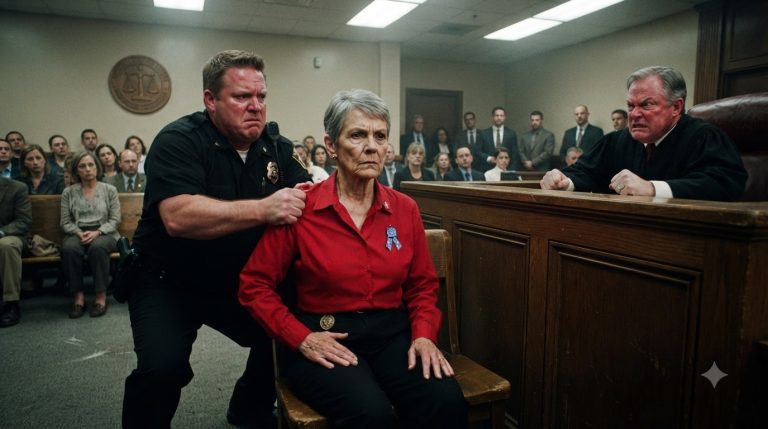
The courtroom smelled of floor polish, old paper, and a lingering, faint scent of damp wool that reminded me of suburban basements. It was a space designed to strip away the pretense of private lives and force them under the harsh light of public scrutiny. I sat at the defendant’s table, my back straight, my hands resting on the cool, synthetic surface of the tabletop. Across the aisle, Karen sat in a beige suit that seemed specifically engineered to broadcast innocence. She looked small, her posture rigid, though the faint violet tint still lingering around her hairline—a stubborn reminder of our previous encounter—made her look less like a pillar of the community and more like a relic of a failed experiment.
The judge, a man whose face seemed etched from granite, didn’t look up as he flipped through the stacks of affidavits. The air in the room felt heavy, pressurized. Every time the door opened at the back, the metallic clack of the hinge vibrated through the floorboards, a sound that mirrored the gate latch back home. The neighbors were there—Cheryl, Doug, and a dozen others—filling the back rows, their presence a dull, buzzing static of anxiety and curiosity.
Karen’s lawyer, a man whose suit was as slick as his arguments, stood to begin. He spoke of “chemical ambush” and “psychological trauma,” his voice an practiced, affected baritone. He gestured toward Karen, highlighting the lingering stains on her hands as if they were scars from a war she hadn’t started. It was a performance, a well-rehearsed narrative intended to shift the focus from her trespass to my supposed ‘hostility.’
I didn’t fidget. I watched the judge, the way his pen hovered over the documents. When my turn came to present, I didn’t reach for a prepared speech. I stood, my movements measured, and placed the flash drive on the desk. It felt heavy—a concentrated mass of intent.
“Your Honor,” I began, my voice steady, cutting through the murmurs in the gallery. “The defense characterizes this as an unprovoked attack. The evidence suggests otherwise.”
I didn’t start with the dye. I started with the property surveys, the signed boundary agreements, and the time-stamped video of the first trespass. I let the law speak first. The courtroom went silent. The judge leaned forward, his gaze sharpening as the video played on the monitors: Karen, leaning over my fence with her clipboard, her smile tight and predatory. Then, the footage of the party, the laughter, the audacity of the takeover.
“But the trespass was not the goal,” I said, my gaze finally locking onto Karen. Her face was turning a shade of pale that made the purple around her neck stand out like a bruise. “The goal was the cover. Karen hasn’t just been managing the neighborhood; she’s been liquidating it.”
I produced the hard copies of the financial records, the spreadsheets I had painstakingly reconstructed, and the invoices that didn’t exist in any reality but her own. The room seemed to tilt. The whispering in the gallery escalated, a chaotic, dissonant sound that finally broke the judge’s stoicism. He held up a hand, and the room fell into a deathly, expectant hush. He began to leaf through the pages, his eyes widening.
The color drained from Karen’s face, replaced by a frantic, high-pitched energy. She stood up, her lawyer grabbing her arm to pull her back, but she was already unraveling. “That’s a lie! He stole those! He’s a voyeur, he’s been spying on us!”
Her outburst was the final move in a game she had already lost. The judge didn’t look at her; he looked at the audit report, then at the flash drive. He looked at me, his expression unreadable, and then he closed the folder with a sound like a hammer hitting an anvil. The silence that followed was absolute, the kind of silence that doesn’t just fill a room—it dominates it. Karen collapsed back into her chair, her hands shaking so violently she had to clasp them together to hide it. The empire hadn’t just fallen; it had been dismantled by the very rules she thought she controlled.
CHAPTER 8: THE QUIET AFTER
The aftermath of the hearing was not a sudden explosion of joy or a dramatic exit; it was a slow, grinding deceleration. As I stepped out of the courthouse, the midday sun was harsh, bleaching the color from the concrete steps and turning the world into a sharp, high-contrast image. The crowd of neighbors who had filled the gallery were already scattering, their voices low, their faces masks of embarrassed realization. They had come to watch a spectacle and had instead witnessed the dismantling of their own consensus.
Karen exited the side door, escorted by her lawyer. She didn’t look at me. The violet stain on her skin seemed to have faded to a sickly, mottled gray, a physical remnant of the chaos that had defined her final weeks in power. She walked with a hunched, diminished gait, stripped of the clipboard and the performative authority that had once dictated the boundaries of our lives. She was just a woman now, one who had reached too far and found the ground beneath her empty.
I didn’t follow. I didn’t need to. The legal machinery was already in motion; the audit I had triggered was not something she could negotiate away. The HOA board had been purged within hours of the judge’s ruling. By the time I reached my car, the notifications were already flooding my inbox—a flurry of apologies, resignations, and the sudden, frantic scrambling of people who had spent too long looking the other way.
When I finally arrived home, the street was uncharacteristically quiet. The manicured lawns, the uniform siding, the rows of tidy, predictable houses—they all seemed to hold their breath. I turned into my driveway, the engine of my car cutting out with a sharp, final tick of cooling metal.
I walked to the backyard. The fence, my constant companion in this siege, stood firm. I walked along its length, my hand resting on the top rail. In the places where I had reinforced the joints, the steel felt cold and solid. The screw that had been missing, the tiny, nagging imperfection that had started this entire sequence, was replaced by a fresh, galvanized bolt. It was a small repair, but it felt significant. It was the physical closure of a breach.
I reached the hot tub. The water was clear, the jets off, the surface still and reflecting the deepening twilight. The silence of the garden was absolute, a stark contrast to the buzzing, artificial energy of the last few weeks. I sat on the deck, the wood rough and familiar against my palms.
Victor, the retired Marine who had been appointed the new HOA president, had stopped by earlier that afternoon. He hadn’t been apologetic in the performative sense; he’d been blunt. “The board was broken,” he’d said, standing by the gate, his posture disciplined. “We were too busy looking at the rules to notice what was happening behind them. That stops now.” He hadn’t asked for my compliance; he had acknowledged my boundary. It was the first time I felt like a neighbor rather than a subject.
I looked at the water. I hadn’t set out to be a crusader, or a savior of the neighborhood, or even a destroyer of empires. I had only wanted the space to breathe. And now, I had it. The struggle for autonomy was over, not because I had won a war, but because I had finally established the reality of the line I had drawn. The performative order of Woodpine Ridge hadn’t been destroyed—it had been exposed for what it was: a thin, rusted mask over the real world.
I reached out and touched the side of the spa, the material smooth and cool. It was just a machine, a piece of infrastructure. But in the quiet of the evening, it felt like an artifact of a hard-won peace. I listened to the wind rustling the leaves of the trees beyond the fence, a sound that no longer felt like an intrusion, but like a part of the world I had reclaimed. The air smelled of damp earth and coming rain, a clean, honest scent that carried no trace of chemical dyes or false authority.
I leaned back, closing my eyes. The battle was finished, the audit was underway, and the silence was mine. The boundary was secure. And for the first time in a very long time, I didn’t feel the need to check the feed. I just sat, and watched the night descend, and breathed.