The Granite Border: A Veteran’s Measured War Against the Suburban Tyrant in the Meadowlands
CHAPTER 1: THE ULTIMATUM
The smell of basil was sharp, almost medicinal, in the heat of the morning, but it was quickly swallowed by the cloying, synthetic perfume trailing off the woman in the powder-blue tracksuit. Karen didn’t just stand on my land; she occupied it, her posture radiating the kind of brittle authority that only comes from a life spent policing color swatches and mailbox heights.
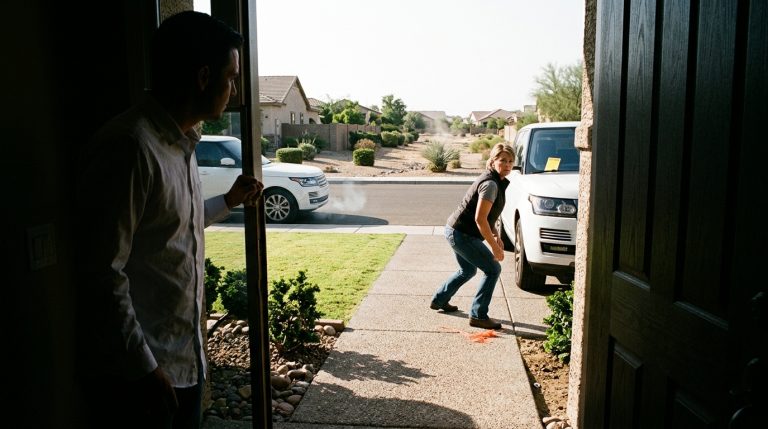
Her SUV sat half on the grass, a smudge of black on the vibrant green of my property. The engine was off now, but the heat radiating from the hood shimmered in the air, distorting the view of the quiet subdivision beyond my fence.
“Twenty-four hours, Miller,” she said, her voice a saccharine veneer over a core of pure granite. “That’s the grace period. Tear it down, or we make sure you’re liquidated by the end of the fiscal week.”
I didn’t answer. I focused on the way her knuckles were white against the steering wheel of her life, or rather, the way she clutched her handbag, her fingers drumming a frantic, uneven rhythm. She was vibrating with a hidden, high-frequency panic that had nothing to do with my tomatoes. It was the frantic energy of someone whose books didn’t balance.
I looked down at the heirloom tomato in my palm—a marbled, heavy thing of red and gold. I began to polish it on my shirt, my movements rhythmic, disciplined, a soldier cleaning his sidearm before a skirmish.
“The deed is dated 1952, Karen,” I said, my voice low. It wasn’t a shout. It didn’t need to be. “The HOA was incorporated in 1988. I don’t report to ghosts, and I certainly don’t report to you.”
Her face flushed, the color creeping up her neck in a jagged, unhealthy line. She took a step forward, her sneakers—perfectly white, entirely out of place on my soil—sinking slightly into the dirt. She looked at the stand, the reclaimed barnwood, and the baskets of produce, her eyes narrowing as if she were mentally tallying the cost of every board and nail, looking for a way to turn it into a liability.
“You think this is a game?” she hissed, leaning in close enough that I could smell the stale coffee on her breath, hidden beneath the floral mask. “You’re an anchor. You’re dragging down the value of every home in the Meadowlands. We have bylaws. We have the leverage.”
She reached into her tracksuit pocket and pulled out a folded slip of paper, thrusting it toward me. My fingers, calloused from years of hauling crates and repairing irrigation lines, closed around the paper. It was thick, cream-colored, and smelled faintly of the same cloying perfume.
I didn’t open it. I knew what was inside. Another ultimatum. Another set of bold-faced demands. But as I looked at her, I noticed a detail that didn’t fit the picture of a neighborhood queen. The cuff of her tracksuit was frayed. Just slightly. A microscopic tear that she had clearly tried to hide with a hasty, amateur stitch.
The queen of the Meadowlands was cutting corners.
“I’ll consider your offer,” I said, my voice devoid of emotion.
She stared at me, her mouth parting, caught off-guard by the lack of fear. She expected a scream, a debate, or a plea. She didn’t know how to handle a target that refused to acknowledge the weapon. She spun on her heel, her movements sharp, jagged, and stomped back to the SUV. The gravel crunched under her feet—a harsh, dry sound like breaking bone.
As she peeled away, spitting gravel onto my strawberries, I didn’t reach for the phone to call for help. I stepped into the shadows of the barn, placed the tomato on the counter, and picked up the letter. I opened it with a letter opener Clara had kept by the door for a decade. The metal was cool against my skin.
As I unfolded the page, I realized the typeface was slightly misaligned in the bottom margin—a printer error common with machines that are failing. She wasn’t just broke; she was desperate. And desperation, I knew, was a tactical error I could exploit.
I looked toward the back of the farmhouse, where the files were kept, and felt the familiar, cold shift in my pulse. The war hadn’t started today. It had started the moment she stepped onto the grass, and now, I had the first piece of the puzzle.
I turned to go inside, but my foot caught on something near the threshold. A small, silver charm bracelet—clasp broken—lay in the dust, half-buried. It wasn’t mine. It certainly wasn’t Clara’s. I picked it up, the cold metal biting into my palm. It was delicate, expensive, and completely out of place in the dirt. My heart skipped. The HOA president didn’t wear silver; she wore gold.
Who had been standing here before she arrived?
CHAPTER 2: THE UNKNOWN OBSERVER
The silver bracelet felt like a piece of ice in my calloused palm. I stood perfectly still on the threshold of my farmhouse, the early morning air thickening with a humidity that clung to my skin like a second layer of clothing. My eyes scanned the perimeter of the property—the long, swaying lines of the cornstalks, the gravel path leading toward the distant, darkened shape of the Meadowlands subdivision, and the dense treeline where the creek cut through the bedrock.
There was no movement. Not a bird, not a breeze. Just the heavy, expectant silence of a stage waiting for the first line of dialogue.
I didn’t turn back to the house. I walked out into the center of the gravel drive, my boots crunching with a sound that felt deafening in the stillness. I held the bracelet up to the rising light. It was high-quality, the silver cool and smooth, with a small, intricate heart charm that had been sheared off the clasp. It hadn’t been dropped weeks ago. It was clean of rust, lacking the fine layer of dust that even a single day of summer wind would deposit.
It had been dropped within the last hour.
A ghost of a memory flitted through my mind—Clara, years ago, sitting on this very porch, her fingers tracing a similar chain before she laughed about the fragility of beautiful things. The weight of the memory hit me in the gut, a sharp, physical ache that I immediately clamped down on. I didn’t have time for the ghost. I needed the predator.
I turned toward the tree line, my hand instinctively going to the heavy, iron latch of the gate. My military training clicked in: observe, assess, triangulate. If someone had been standing here while Karen performed her pathetic, shrill theater, they would have needed a vantage point that offered both cover and a clear line of sight.
I moved with the slow, deliberate pace of a man walking a perimeter, avoiding the crunch of the gravel where possible, keeping to the grass. The sun began to bleed over the horizon, turning the sky a bruised, angry purple. As I reached the edge of the wood, I saw it—a slight depression in the tall fescue, a flattened patch of grass that shouldn’t have been there.
Someone had been kneeling.
I crouched, the movement fluid, my knees popping in the quiet. I ran my fingers over the grass. It was damp with dew, but the pattern was clear: two distinct points of pressure, indicating a long wait. They hadn’t just passed through; they had been observing.
My jaw tightened. Karen was many things—a tyrant, a petty bureaucrat, a woman with a crumbling facade—but she wasn’t a spy. She didn’t have the patience to sit in the fescue at three in the morning, and she certainly didn’t have the discipline to wait until the exact moment of the confrontation to drop a piece of high-end jewelry.
This meant the board was not as united as she wanted the world to believe. Or, more dangerously, someone else was using the HOA’s conflict as a smokescreen for their own agenda.
I looked at the house. My office, with its stacks of records and the quiet, comforting smell of tobacco, suddenly felt less like a sanctuary and more like a target. I stood up and headed back, not toward the front door, but toward the side entrance near the tool shed. I needed to document this.
Inside the dim, quiet office, I pulled my logbook from the desk drawer. The smell of old paper and tobacco was a balm to my nerves, steadying the rhythm of my pulse. I wrote the date, the time, and the description of the bracelet with clinical precision. I placed the item inside a clear plastic bag—an evidence-gathering tactic I’d learned decades ago.
As I taped the bag to the back of the logbook, my gaze shifted to the pile of HOA bylaws I had been studying. The print was dense, full of the same hollow, authoritative language. Article 7, Section 3. I flipped through the pages, looking for something I might have missed in my initial read.
I found it on page 42, buried in the addendum regarding “Community Safety and Surveillance.” It wasn’t a standard clause. It was a recent amendment, typed in a slightly different font. The Board reserves the right to employ third-party security monitors to ensure the protection of neighborhood property values.
Third-party monitors. That meant a security firm. And security firms didn’t drop silver bracelets; they left footprints, radio signals, or tactical gear.
A sudden, sharp metallic thud echoed from the porch.
I didn’t freeze. I blew out the candle on my desk, plunging the room into shadow, and moved to the corner near the window. I pulled the heavy curtain back just a fraction of an inch, my heart beating a steady, rhythmic pulse in my ears.
A black sedan, headlights off, was idling at the edge of my gravel drive. A figure stepped out—not a tow truck driver, not a neighbor, but someone in a dark, tactical-style jacket, their face obscured by a brimmed cap. They were walking toward the barnwood stand, their gait measured, purposeful.
They weren’t here to talk. They were here to retrieve whatever had been dropped, or perhaps, to see if I’d found it.
I reached into the bottom drawer of the desk, pulling out a heavy, industrial-grade flashlight. I didn’t have a weapon, and I didn’t want one. I had leverage. I had the high ground of my own land. I stepped away from the window and headed toward the back door, my boots hitting the hardwood floor with a deliberate, confident weight.
The war had escalated from administrative intimidation to physical surveillance. Karen was a distraction, a loud, obnoxious alarm bell meant to keep me looking at the front gate while something else moved in the shadows.
I slipped out the back, moving through the dark, cool air of the pre-dawn. I stayed low, using the cover of the garden shed to approach the stand from the side. The figure in the jacket was near the display baskets, their hands moving with practiced speed, searching the gravel where I’d stood only minutes before.
“Looking for something?” I asked, my voice cutting through the silence like a blade.
The figure spun around, and I hit the flashlight button. A blinding beam of white light flooded the area, pinning the intruder in a halo of unforgiving brightness. They shielded their eyes, their breath hitching in a sharp, controlled gasp. It wasn’t a stranger.
It was Gerald, the HOA treasurer.
He stood there, blinking, his expensive watch catching the light—a small, gleaming piece of gold that felt like an insult in the dirt. He looked less like a corporate officer and more like a man who had seen the bottom of the well and found nothing but mud.
“Jack,” he stammered, his hand going to his chest. “I… I think I left my keys.”
I didn’t lower the light. I stepped forward, the weight of the moment pressing down on the air between us. The treasurer of the Meadowlands, the man who preached about aesthetic harmony, was trembling.
“You didn’t drop your keys, Gerald,” I said, my voice cold, hard, and utterly final. “You dropped a piece of someone else’s life. Tell me why you’re really here, or I call the sheriff and let him ask you while he’s searching your car.”
He looked at the light, then at me, his eyes wide with a terror that had nothing to do with the law. He looked at the barn, then back at the road, his composure shattering like glass.
“She doesn’t know, Jack,” he whispered, his voice trembling so violently the words were barely audible. “She thinks she’s in control. But we’re not just broke. We’re empty. And she’s not the one driving this car anymore.”
CHAPTER 3: THE ACCOUNTANTS SHADOW
Gerald didn’t move. He stood under the harsh, unblinking glare of my industrial flashlight, his chest heaving as if he’d just run a mile. The gold watch on his wrist caught the light, a gaudy, expensive thing that seemed absurdly out of place against the backdrop of my worn, earth-stained barnwood. He wasn’t a soldier, and he certainly wasn’t a predator; he was a man who had realized too late that the walls he’d helped build were starting to lean inward.
“Start from the beginning,” I said, keeping the light steady, focusing it just below his eyes so I could watch the way his pupils dilated. “And if you lie, Gerald, I’m not calling the sheriff. I’m calling the county tax assessor. We’ll see how well your personal finances hold up under a real audit.”
He flinched. The name of the tax assessor seemed to hit him harder than the threat of jail. He reached out to steady himself against one of the support beams of the stand, his fingers trembling so violently that the wood vibrated.
“It’s not just the fines,” he rasped, staring at his shoes. “The HOA isn’t a government, Jack. It’s a bank account. A very, very poorly managed one. We… we took loans. Bridge loans, short-term high-interest stuff, to fund the pool expansion and the new landscaping last year. We assumed the property values would keep skyrocketing, that we could just refinance our way out of the debt.”
I kept the light fixed on his face. “And when the market leveled off?”
“The debt stayed,” he said, his voice dropping to a hollow murmur. “Interest rates climbed. We started looking for other ways to generate revenue. Fines. Not for compliance—for survival. Karen was the one who pushed it. She became obsessed with the ‘integrity of the community.’ It was her code for squeezing every drop of liquid cash out of anyone who fell outside the lines.”
He looked up then, his eyes wide and bloodshot in the beam of the light. “She’s not just looking for a win, Jack. She’s terrified. If this gets out—if the residents find out we’ve been leveraging their homes to pay for landscaping and pool filters—the insurance bond will be pulled. We’ll be personally liable for millions.”
The narrative clicked into place. The “aesthetic harmony” wasn’t a standard; it was a desperate, scorched-earth strategy to keep the HOA from declaring bankruptcy. Karen wasn’t just a bully; she was an embezzler drowning in a rising tide of her own making.
“And the bracelet?” I asked, lowering the light just enough to let him breathe.
“She gave it to me,” Gerald said, his voice thick with self-loathing. “She told me to plant it near your property, to suggest that someone had been snooping around, maybe even a thief, to create a sense of insecurity in the neighborhood. She wanted to push through a new security contract. A security firm she hand-picked. It was another kickback, Jack. Everything is a kickback.”
The sheer, mundane greed of it was almost worse than the malice I had imagined. I turned the light away, letting the darkness of the farm swallow us both. The silence stretched, filled only by the distant, rhythmic chirping of crickets and the rustle of the wind through the corn.
“You’re not going to fix this, Gerald,” I said, my voice low and steady. “You’re going to help me end it.”
“If I help you, I’m finished,” he countered, a flash of desperation crossing his face. “She’ll know.”
“She already knows,” I replied. “She sent you here to do her dirty work. If you go back and tell her you failed, what do you think she’ll do? She needs a scapegoat, Gerald. Someone who held the checkbook. Someone who signed the loan documents. Look at yourself. You’re already wearing the uniform of the guilty.”
He looked down at his clothes—the expensive, slightly-too-tight suit jacket, the polished shoes ruined by my gravel. He looked like exactly what he was: a man waiting for the axe to fall.
“What do you want?” he whispered.
“I want the records,” I said. “All of them. The original loan agreements, the board meeting minutes that never made it onto the public website, and the list of everyone who received a kickback on the mailbox contract. If I’m going to burn this kingdom down, I want to make sure I don’t leave any foundations for her to rebuild on.”
Gerald stood silent for a long moment, the only sound the frantic clicking of his watchband against the wood. “I have them on an encrypted drive. I kept them as insurance.”
“Bring them here tomorrow night,” I said. “Three a.m. No phones. No cars. Walk through the woods.”
He nodded, a jerky, nervous movement, and turned to leave. He paused, his hand on the gate, and looked back at me. “She’s planning something else, Jack. She said that if you didn’t leave by the end of the week, she’d take a ‘physical approach.’ I don’t know what that means, but she wasn’t joking.”
“Neither am I,” I said.
He slipped away into the darkness, his silhouette vanishing into the trees. I stood alone in the shadow of my barnwood stand, the silver bracelet still burning a hole in my pocket. The “physical approach.” It wasn’t a threat; it was a confession. Karen was running out of paper, so she was turning to steel.
I walked back toward the farmhouse, but I didn’t enter. I stood on the porch, looking out at the expanse of the Meadowlands—the endless, uniform rooftops, the silent streets, the rows of identical homes. They looked fragile, somehow, in the moonlight. As if a single strong gust of truth could level them all.
I went into the office, the smell of tobacco settling around me like an old friend. I pulled the map of the neighborhood from the desk and began marking the locations—the pool, the new landscaping, the perimeter where the security guards would likely be positioned. If Karen wanted a physical confrontation, she’d have one. But she was playing a game of intimidation on a field I had spent twenty-five years learning how to dominate.
I sat at my desk and pulled out a clean sheet of paper. I didn’t write a letter. I didn’t make a list of demands. I just drew a single, clean line dividing my land from theirs.
The war was no longer about a vegetable stand. It was about the architecture of their control, and tonight, I had found the keystone. I could see it now—the way the board had moved, the way they had spent, the way they had hidden. It was a masterpiece of corruption, and like every masterpiece, it relied on the viewer standing at the correct distance.
I reached for the letter opener Clara had left me. I gripped it tight, the metal cold and biting against my palm. I wasn’t waiting for the morning. I had a phone call to make to Dave, and I had a defensive perimeter to reinforce. If they wanted to get physical, I would show them what happens when you try to bulldoze a piece of land that has already survived a war.
The phone rang three times before Dave picked up. “It’s three-thirty in the morning, Jack,” he groaned.
“Wake up, Dave,” I said, my voice as calm as a frozen lake. “I have the treasurer. I have the motive. And I think I know where they’re hiding the bodies.”
CHAPTER 4: THE PERIMETER OF SECRETS
The transition from the intense, focused heat of my office into the pre-dawn chill was like stepping into a different world. The stars were beginning to fade, replaced by a gray, bruised light that bled over the rooftops of the Meadowlands. I walked toward the edge of my property, the crunch of the gravel under my boots feeling unnervingly loud.
I was heading for the Henderson cottage. If Gerald was the treasurer of the HOA’s rot, Henderson was the historian of its decline. I needed the context that lived in his head—the stories of the families who had been pushed out, the “unapproved” fences, the sudden, quiet departures of people who had once been fixtures of the community.
The air smelled of dew and damp earth, a stark contrast to the cloying, perfumed artificiality of Karen’s influence. As I reached the property line, I saw a light flicker in Henderson’s window. He was a creature of early habits, a man who measured his days by the slow, deliberate work of his garden.
I stepped through the gap in the hedge that separated our lands, my eyes scanning the darkness for any sign of Gerald’s “third-party monitors.” I found none, but the feeling of being watched was a persistent, irritating itch at the base of my neck. I moved with the same low-profile discipline I’d used on patrol, keeping to the shadows of the hedges, my breathing steady, my mind cataloging the geography of the perimeter.
Henderson opened his door before I even knocked. He was wearing a faded flannel robe, his face etched with the weariness of a man who had seen too many winters.
“You’re early, Jack,” he said, holding the door wide. “Or maybe I’m just getting old.”
“Things are moving faster than we expected,” I replied, stepping into the warmth of the cottage. It was a space that felt like a sanctuary, cluttered with books, maps, and the faint, comforting scent of pipe tobacco and woodsmoke.
“Sit,” he said, gesturing toward a small, circular table covered in topographical maps of the township.
I didn’t sit. I walked to the maps, my eyes tracing the lines of the Meadowlands. “Gerald talked. He confirmed the debt, the kickbacks, and the fact that Karen is terrified of an audit. She’s leveraging the homes, Henderson. She’s gambling with the equity of every family in this neighborhood to cover a massive, looming deficit.”
Henderson let out a long, shuddering sigh and leaned back against the counter. “I suspected as much. You don’t get that aggressive unless you’re protecting a skeleton. But there’s something else, Jack. Something you haven’t seen.”
He reached beneath the table and pulled out a battered metal box. He unlocked it with a key he wore on a chain around his neck. Inside were folders, their edges frayed, filled with documents that looked like they had been salvaged from a landfill.
“These are the original planning documents for the Meadowlands,” he said, sliding a blueprint toward me. “Look at the zoning.”
I leaned in, the light of the kitchen lamp casting sharp, deep shadows across the page. The zoning wasn’t just R1 residential. There were annotations—handwritten, in red ink—that specified a series of underground easements, utility conduits, and storm drainage systems that ran directly beneath the area where the new pool and community center had been built.
“So?” I asked, my brow furrowing.
“So,” Henderson said, his voice dropping to a gravelly whisper. “Those systems were supposed to be maintained by the township. But the HOA board took over the maintenance contract five years ago, promising to save the community money. Look at the maintenance records.”
I flipped through the pages. The maintenance, supposedly performed annually, was non-existent. There were invoices for millions of dollars in repairs that had never happened. The money had been siphoned off, funneled through the same shell corporations Gerald had hinted at, leaving the foundation of the community center sitting on a bed of hollow, collapsing pipes.
The financial deficit wasn’t just a matter of poor planning. It was a ticking time bomb. One heavy storm, one significant shift in the water table, and the “community center” would literally sink into the earth, taking the board’s liability—and the entire neighborhood’s property value—down with it.
“She’s not just protecting her status,” I realized, the weight of the revelation settling into my bones. “She’s waiting for the collapse. She’s stripping the assets, lining her pockets, and letting the infrastructure rot so she can bail out before the first crack appears in the foundation.”
“Exactly,” Henderson said, his eyes hard and bright. “She’s the captain of a sinking ship, Jack. And she’s planning to be on the only lifeboat.”
I stared at the blueprints, the reality of the situation coalescing into a clear, brutal picture. This wasn’t just a petty power struggle over a vegetable stand. It was a criminal enterprise masked by the suburban dream. Karen wasn’t fighting for her reputation; she was fighting to keep the truth from surfacing until she had liquidated every cent of the community’s equity.
“I need these,” I said, my voice barely audible. “If I go to the district attorney with these blueprints and the financial records Gerald is bringing me, we don’t just win. We end her, permanently.”
“She knows about these, Jack,” Henderson said, his voice grave. “She’s been trying to buy my cottage for months. Not for the land, but for the box. She’s searched my place twice. She doesn’t stop.”
I looked at the old man, then at the box. I felt the sharp, cold edge of resolve sharpen within me. “She won’t get them. And she won’t get my farm.”
I stepped out of the cottage, the metal box tucked securely under my arm. The sky was beginning to turn a pale, metallic gray, the first hint of morning light filtering through the trees. The perimeter of the Meadowlands, once a boundary of frustration, now felt like a front line.
I moved back toward my property, my senses dialed to an extreme, unnatural clarity. I heard the distant, muffled sound of an engine starting in the subdivision—a soft, low growl that didn’t belong to the morning birds. I stopped, dropping into the shadow of a low-hanging pine, and watched the road.
A black sedan, headlights off, glided slowly toward my driveway. It was the same car I’d seen earlier, but this time, it was moving with a different kind of intent. It slowed to a crawl in front of the farm, then stopped.
I held my breath, the metal box feeling impossibly heavy, the edge of the blueprints biting into my ribs. The driver’s door opened, and a figure stepped out, their silhouette framed by the dim, gray dawn. It wasn’t Gerald. It wasn’t Karen.
It was a man in a dark, tactical jacket, his face partially obscured by a cap. He stood there for a long moment, staring directly at the barnwood stand, his posture predatory, his movements calculated. He checked his watch, then turned his gaze toward the farmhouse.
He was waiting. He was the “physical approach” Karen had promised.
I didn’t move. I waited for the man to commit, to move into the open, to provide me with the opportunity I needed to force the situation. I realized then that I wasn’t just fighting an HOA. I was being hunted by a system that couldn’t afford to be seen.
I gripped the edge of the metal box, the cold metal grounding me, and stepped out of the shadows. If they wanted the perimeter, they could have it. But they were going to have to walk through the fire to get it.
CHAPTER 5: THE COLLISION IN THE RAIN
The man didn’t move. He stood like a statue carved from the gray morning, his posture rigid, his gaze locked onto the farmhouse. He hadn’t seen me yet; I was still partially obscured by the shadow of the low-hanging pine. But the tension in his shoulders—that subtle, microscopic shift of weight to the balls of his feet—told me he was on the edge of action.
Then, the sky opened up.
It wasn’t a gradual drizzle. It was a sudden, violent release of pressure, a deluge of cold, stinging rain that hammered against the dry earth and turned the gravel of my drive into a slick, treacherous slurry. The man’s focus snapped, his head jerking up to shield his face, his tactical jacket turning dark as it soaked through. In that split second of distraction, I moved.
I didn’t run. I drifted. I stayed low, keeping the bulk of the garden shed between us, my boots making no sound against the sodden grass. I needed to know who he was, and more importantly, what he was carrying. He reached into his jacket—not for a weapon, but for a radio.
“Base, I’ve got a perimeter breach,” he hissed, his voice barely audible over the roar of the rain. “The target is mobile. I’m moving to intercept.”
I reached the corner of the shed, my hand finding the heavy, iron handle of a rusted garden spade. It wasn’t elegant, but it had weight and reach. As the man took his first step toward the farmhouse, I swung out, not to strike, but to block his path.
I jammed the edge of the spade into the gravel, the steel ringing out against a hidden stone. He spun, his hand flying to his belt, but he slipped. The wet gravel gave way under his boots, and he tumbled into the slurry, his momentum carrying him hard into the side of the shed.
“Identify yourself,” I commanded, my voice booming over the wind, the flashlight beam cutting through the rain like a white lance.
He scrambled to regain his footing, his face illuminated by the harsh, strobe-like effect of the storm. He wasn’t a cop. He wasn’t a security guard. He was a man with the cold, hollow eyes of someone who worked in debt collection—not the legal kind, but the kind that preferred darkness and wet concrete.
He reached for a holster, but I kicked the spade forward, pinning his hand against the side of the shed. He grunted, a guttural sound of frustration, and swung a heavy, gloved fist toward my ribs. I pivoted, the wet ground threatening to slide out from under me, and caught his wrist. We locked together, a struggle of weight and leverage in the freezing downpour.
He was strong—lean, fast, and driven by a professional, clinical coldness. He didn’t swear; he didn’t shout. He just kept pressing, his movements designed to neutralize, not to fight. We danced in the mud, the rain washing the grit into our eyes, the only sound the ragged intake of our breath and the wet thud of boots on the ground.
“You’re making a mistake, Miller,” he grunted, twisting his wrist, trying to create distance. “The HOA has the paperwork. We’re just the cleaning crew.”
“You’re trespassing,” I retorted, shoving him backward into the rain-slicked side of the barn. “And you’re about to find out exactly what happens to cleaning crews that try to scrub a sanctuary.”
He surged forward, an elbow catching me in the shoulder, sending a shockwave of pain through my arm. I stumbled, my boot finding purchase on a slick patch of mud, and I went down. He was on me in an instant, a knee driving into my chest, his hands reaching for the metal box I still held in my left arm.
I didn’t give it up. I rolled, dragging him with me into the deepest part of the mud, the box pinned between my body and the earth. I used the terrain, the slick, sliding surface, to tilt his weight off-balance. I drove my shoulder into his side, a raw, kinetic burst of force, and flipped him over.
He hit the ground hard, the air knocked out of him in a sharp, wet gasp. I didn’t wait for him to recover. I pinned him with my forearm, the flashlight clattering to the ground, its beam spinning crazily across the wet gravel.
“Who sent you?” I demanded, my face inches from his. “Was it Karen? Or was it the people pulling her strings?”
He gasped, a cold, mocking smile touching his lips despite the mud and the rain. “You think it’s just her? You think you’ve uncovered a conspiracy? You’re just a variable in a ledger, Miller. A line item that’s been marked for deletion.”
He lunged, a sudden, desperate move, grabbing the edge of my jacket and pulling me off balance. We rolled again, this time hitting the fence line, the wood groaning under the force of our impact. He kicked, catching me in the stomach, and scrambled backward, his tactical jacket gleaming with slick, black water.
I stood up, panting, the metal box clutched to my chest like a shield. My side burned, and my lungs felt like they were filled with cold fire. He stood ten feet away, watching me, his eyes dark and unreadable. He realized he had miscalculated. He had come for a farmer, and he had found a soldier.
“This isn’t over,” he said, his voice stripped of its earlier arrogance. He took a step backward, his hand moving to his radio. “Base, extraction needed. The site is compromised. We’re moving to phase two.”
He turned and bolted, not toward his car, but into the dense, dark treeline near the creek. I started to pursue, but the weight of the metal box—the weight of the community’s future—held me back. If I left it, I risked losing the only proof I had. If I followed him, I risked losing the target.
I stayed.
I watched his shadow dissolve into the trees, the rain blurring the outline of his form until he was nothing more than a memory of a threat. I stood there, shivering, the mud and the blood and the cold rain mixing into a bitter cocktail on my skin.
I picked up the flashlight. Its lens was cracked, but the beam still held. I turned back toward the farmhouse, the metal box secure. I had the records. I had the treasurer’s testimony. And now, I had proof that the “board” was backed by people who didn’t play by the rules of the HOA.
The rain began to taper off, the storm moving east, leaving behind a world that felt stripped, cleaned, and dangerous. I walked into the house, the door clicking shut behind me with a finality that resonated in the quiet. I walked to the office and laid the metal box on the desk.
I opened it, the blueprints and the financial statements laid out before me. I looked at the names, the dates, and the offshore accounts linked to the “maintenance contracts.”
It was all there. The entire architecture of the decay.
The telephone on the desk rang. I didn’t reach for it immediately. I let it ring once, twice, three times, listening to the sound pierce the silence of the room. I picked up the receiver, my voice steady, my mind calculating the final moves of the game.
“Dave,” I said. “We have everything. And we have a witness who’s ready to talk.”
CHAPTER 6: THE ARCHITECTURE OF COLLAPSE
The office was filled with the rhythmic, heavy sound of my own breathing. Dave’s voice had been a low, jagged wire of professional intensity, confirming that the files I had provided were not just sufficient, but explosive. We had the smoking gun: the shell corporations, the falsified invoices, and the deliberate neglect of the drainage infrastructure. But Dave had added a warning that stopped the blood in my veins.
“They know something is missing, Jack. They aren’t just sending scouts anymore. The HOA legal team is filing a temporary restraining order against you for ‘harassment.’ It’s a classic pre-emptive strike to freeze you out of the county records before we can file the motion for the injunction. You have twelve hours before that order is served.”
I hung up the phone and looked at the map on my desk. The Meadowlands subdivision lay beneath the ink like a disease, its uniform lines concealing a hollow, rotting center. I wasn’t just fighting for my land anymore; I was fighting to prevent a literal catastrophe. If the drainage systems failed as Henderson had predicted, the collapse would be catastrophic for everyone—the families, the children, even the people who had blindly followed Karen’s lead.
I grabbed my jacket and stepped out onto the porch. The storm had passed, leaving behind a sky of bruised, liquid iron. The air was cold, sharp, and tasted of ozone. I needed to move, not to run, but to position myself. If Karen was going to use the law to lock me out, I had to ensure the truth was already in the hands of the people who could not be bought.
I started the truck, the engine turning over with a steady, reassuring growl that cut through the silence of the damp morning. I wasn’t heading to the courthouse. I was heading to the Northwood County Food Bank.
Maria needed to know. The community needed to know.
The drive was quiet. The roads were slick, the trees drooping under the weight of the residual rain. I watched the houses of the Meadowlands pass by—the perfectly manicured lawns, the pristine mailboxes, the carefully curated facade of suburban peace. I saw a group of kids at a bus stop, their bright raincoats flashes of primary color against the desaturated backdrop of the neighborhood. They were safe, for now. They didn’t know that the very ground they walked on was being hollowed out by the people they trusted.
I pulled into the parking lot of the food bank. The warehouse was already humming with the early morning activity of volunteers. I stepped out of the truck, the cold air biting at my lungs, and saw Maria standing near the loading dock, reviewing a clipboard.
She looked up, her expression turning from professional focus to genuine concern as she saw me. “Jack? It’s awfully early for a delivery.”
“I’m not here to deliver,” I said, my voice low. I beckoned her toward the small, cluttered office near the back.
We entered, the scent of canned goods and stale coffee filling the room. I laid the blueprints and the financial records out on her desk. She didn’t ask questions. She looked at the documents, her sharp, experienced eyes tracing the red-ink annotations Henderson had made. As she read, the color drained from her face.
“These are the drainage plans,” she said, her voice barely a whisper. “These are the structural integrity reports.”
“The money for the maintenance has been siphoned off for years,” I explained, the words feeling heavy in the air. “The board is looking at a catastrophic failure of the infrastructure under the community center. Karen is liquidating the assets, Maria. She’s planning to vanish before the ground gives way.”
Maria looked up at me, her gaze steady. “And you think if the residents knew…?”
“If they knew, they’d demand an audit,” I said. “They’d freeze the accounts. They’d stop her. But they won’t believe me. To them, I’m the ‘rogue operator’ who caused a nuisance. I need someone they trust. Someone who has nothing to gain from this conflict.”
Maria stood, her hand resting on the blueprints. She was a woman of faith and service, a person who lived for the community’s well-being. “I’m not a whistleblower, Jack. I’m a service provider.”
“This is the ultimate service,” I pressed, my tone hard, relentless. “If you don’t do this, you’re not just watching the neighborhood collapse. You’re watching the families who depend on you lose everything.”
She turned toward the window, watching the volunteers move crates of food. The weight of the decision was evident in the slumped lines of her shoulders. She had been the heart of the community for twenty years. She knew every family, every struggle, every secret. She knew that truth, once spoken, could never be taken back.
“They’ll try to destroy me, too,” she said, finally turning to face me.
“I won’t let them,” I promised, the weight of my military years backing the statement. “I have the legal team, I have the evidence, and I have the support of the families who are already waking up. You just have to hold the line for twenty-four hours.”
She took a deep, steadying breath. “My office has a meeting with the local news team at ten this morning for a segment on our fall food drive. If I walk into that meeting with these papers…”
“Then you change the narrative,” I said. “Permanently.”
I left the food bank ten minutes later, the blueprints and the records safely in Maria’s hands. I felt a strange, hollow lightness in my chest—the exhaustion of a mission that was finally approaching its climax. I drove back toward the farm, my mind already working on the next tactical steps.
But as I rounded the final bend toward my property, I saw the roadblock. Two black SUVs were positioned across the entrance to my driveway. Men in dark suits, their silhouettes rigid against the morning mist, were standing near the open trunks, watching the road.
I didn’t slow down. I accelerated, the engine roaring as the truck surged forward. They weren’t cops. They were the “cleaning crew.”
I didn’t turn back. I kept the pedal to the floor, my eyes locked on the space between the two vehicles. I knew what they wanted—the box, the blueprints, the silence. They were going to get exactly what they deserved. I braced myself for the impact, my hands locked onto the steering wheel, the tactical resolve of a soldier taking the final objective burning through the fog in my brain.
The war was no longer about the boundary of my property. It was about the integrity of the ground beneath their feet. And as I closed the distance, I knew that the collapse was no longer a question of if, but when.
CHAPTER 7: THE BREAKING POINT
I didn’t lift my foot from the accelerator. The truck surged forward, the tires fighting for traction against the wet, churning mud of the driveway. The two men stood their ground, their faces impassive behind the windshields of their expensive SUVs. They weren’t moving. They were betting that I, a man who had built his life on order and discipline, wouldn’t cross the threshold into true, irreversible chaos.
They were wrong.
I saw the driver of the lead vehicle—a man with a sharp, angular jaw and eyes that lacked any vestige of human empathy—reach for his door handle. I didn’t give him the time. I cranked the wheel to the left, the truck’s heavy chassis lurching, and swerved into the soft, rain-soaked grass of the lawn instead of the gravel path. The mud sprayed up like a geyser against their doors, blinding them.
The truck tilted, the suspension screaming, as I bypassed their blockade entirely. I cleared the gap with a bone-jarring thud, the heavy metal of my front bumper grazing the rear quarter panel of the nearest SUV. I didn’t look back to check the damage. I punched the throttle, the engine roaring as I tore onto the main road, the vehicle fishtailing before I regained control.
My heart was a piston, driving the blood through my veins with a rhythm that felt like a march. They would follow—I knew that—but they were stuck in the mud of my own making. I had the records. I had the momentum.
I drove toward the town square, the familiar landmarks—the post office, the hardware store, the quiet, unsuspecting streets—flashing past in a blur of gray. My destination wasn’t home, and it wasn’t the law office. It was the place where the community held its pulse: the Town Hall. The morning council meeting was already in session, and the room would be packed with the very people who were being bled dry.
As I pulled into the parking lot, I saw the black SUVs closing in from the rearview mirror, their lights flashing like predatory eyes. I jumped out of the truck, the metal box clutched to my chest, and ran.
The doors to the council chamber were heavy, oak-paneled things that felt like a barrier between two worlds. I pushed them open, the sound of the meeting—the monotonous drone of administrative reports—shattering as I stepped onto the floor.
Karen was at the podium, her back to me, her voice a smooth, practiced melody of reassurance. “Our financial health is robust,” she was saying, gesturing to a slide deck that showed nothing but empty growth. “The Meadowlands is, and will remain, the premier residential experience in the county.”
“It’s a lie!” I shouted, the sound echoing off the high ceilings.
The room froze. A hundred faces turned toward the back. Karen spun around, her face pale, her composure fracturing for the first time in public. Her eyes darted toward the side entrance, where I knew the security teams would be entering any second.
I walked toward the stage, my boots heavy on the hardwood. I didn’t care about the gasps, the murmurs, or the security guards beginning to move from the shadows. I reached the podium and slammed the metal box down. The sound was like a gunshot, ringing through the chamber.
“The community center is sitting on a bed of rotted, collapsing pipes,” I said, my voice cutting through the panic. “The funds for maintenance have been siphoned into shell corporations owned by your own board members. You aren’t living in a community. You’re living in a sinking asset that’s being stripped for parts.”
I opened the box, the blueprints and the financial records spilling out, a cascade of cold, hard truth across the polished wood of the stage. “Check the county records. Check the maintenance invoices. Check the accounts.”
Karen reached for the papers, her hands shaking, her face a mask of frantic, sweating desperation. “He’s deranged! He’s been harassing us for weeks, threatening the board, creating chaos!”
“I’m not the one with the offshore accounts, Karen,” I said, leaning in, my voice so low only she could hear. “I’m not the one who signed the loans. And I’m certainly not the one who’s going to be in handcuffs when the ground finally gives way.”
The doors to the chamber burst open. The two men from the black SUVs stepped inside, their faces flushed with rage, their hands moving toward their coats. They were expecting to drag me out, to silence the noise, to keep the lid on the box for just a few more hours.
But they were too late.
The room was already in motion. People were standing, the murmur of confusion shifting into a low, angry roar. A woman in the front row—someone I recognized from the vegetable stand—stood up, her voice rising above the din. “Let him speak! I want to see those invoices!”
The men hesitated, their tactical training colliding with the reality of a hundred angry residents, most of whom had their phones out, recording every second. They were in a public building, in broad daylight, surrounded by witnesses. They knew they couldn’t force the situation without creating a PR nightmare that would destroy their client instantly.
They stopped. They didn’t retreat, but they held their ground, frozen by the sudden, overwhelming loss of their tactical advantage.
Karen looked at the men, then at the room, then at me. Her mask had finally fallen, revealing the true, hollowed-out horror of her situation. She was trapped, not by a man, but by the weight of her own deceptions. She turned to the audience, her voice attempting to find its strength, but failing, cracking into a thin, pathetic whine.
“This… this is an unprecedented breach of protocol,” she stammered, her eyes darting back and forth. “This meeting is adjourned.”
“The meeting isn’t over,” I said, turning to the room, my voice steady, command-trained. “The meeting has just begun.”
I looked out at the faces of the people I had fought for—the tired parents, the elderly homeowners, the families who had put their entire lives into these houses. I saw not fear, but a dawning, terrible clarity. I saw the anger that precedes a reckoning.
I reached for the phone in my pocket. Dave was on the other end, his voice a steady hum of preparation. “We’re here, Jack. The state police are five minutes away with the warrants. Hold the floor.”
I looked at Karen. She looked like a ghost, a hollow shell of the authority she had once wielded. I knew then that the collapse was already happening—not in the pipes beneath the ground, but in the mind of the woman who had tried to build her world on a lie.
The room began to boil over. People were moving toward the podium, toward the records, their faces hard with the demand for answers. The men in the suits slowly backed out of the room, their mission failed, their leverage broken.
The silence of the Meadowlands was dead, replaced by the chaotic, beautiful noise of a community waking up. And as I stood there, the weight of the last few weeks falling away, I realized that I had finally, truly, brought them home.
CHAPTER 8: THE PRICE OF HARMONY
The roar of the council chamber didn’t cease; it shifted frequency. It became a low, vibrating hum of realization as the double doors behind me hit the walls with a dry, heavy hollow thud. The state police did not rush. They moved with the same clinical, rhythmic discipline that I had lived by for a quarter of a century. Blue and gray uniforms cut through the civilian crowd like a wedge of cold iron, their leather holsters creaking slightly in the sudden, sharp silence that followed them.
Karen didn’t look at the officers. Her eyes remained locked on the papers scattered across the cedar podium—the red-ink annotations, the shell corporation names, the infrastructure failure logs. Her skin looked gray under the fluorescent tubes, the texture of her face resembling damp parchment. The gold pen she held between her fingers didn’t just tremble; it snapped with a clean, plastic click against the edge of the microphone.
Dave stepped forward from the wake of the state troopers, his briefcase held firmly against his flank like a shield. He didn’t offer a dramatic speech. He laid three separate white sheets of paper on top of her ruins.
“The state attorney general has issued an emergency freeze on all accounts associated with the Meadowlands Homeowners Association, Miss Peterson,” Dave said, his tone lacking any heat, carrying only the flat weight of an inescapable judgment. “A concurrent warrant has been executed at your personal residence. The state police are already retrieving the secondary digital ledger from your home office.”
Karen’s hands dropped onto the cedar surface, her fingers spreading out as if she were trying to hold down a structure that was physically dissolving beneath her. She looked up at the crowd, her lips parting, searching for a single face that would look back at her with something other than cold curiosity or simmering rage. She found none. Gerald was already sitting three rows down, his head buried in his hands, his gold watch catching the light like a marker left on a casualty.
“This is an aggregate calculation error,” she whispered into the open microphone, her voice carrying a dry, hollow rattle through the sound system. “The infrastructure was a localized problem. We were… we were stabilizing the valuations. If the community looks unkept, everything drops. The numbers have to look right on paper.”
“The ground doesn’t read paper, Karen,” I said. My voice didn’t rise above a conversational level, but it filled the space between us with the weight of the ten acres she had tried to take. “The pipes beneath the foundation are hollowed out. You spent the money meant for the concrete on a mask, and now the mask is stuck to the rot.”
She took a sharp, gasping breath—the visceral counter-move of a creature that realizes the perimeter is fully closed. She reached across the podium, her fingernails clawing at the original blueprints, attempting to shred the physical evidence with a frantic, unpolished violence. A trooper stepped forward, his gloved hand coming down on her wrist with a gentle, immovable pressure.
“Miss Peterson,” the officer said, his voice flat and professional. “Please step away from the documents.”
She deflated. The rigid, granite posture that had defined her tracksuit kingdom disappeared, leaving only a disheveled woman in an oversized blazer that didn’t fit her shoulders. She was led out through the side entrance, her heels making a dragging, irregular sound on the hardwood, a stark contrast to the clean, rhythmic stride of the troopers guiding her.
The room didn’t erupt into cheers. The silence that settled over the council chamber was heavy, analytical, and cold. The residents looked down at the papers, then at each other. They were safe from her, but they were now left with the stark, physical reality of the work that lay ahead.
The denouement did not begin with a celebration; it began with a tool.
Three days later, the sun rose over the farm with a pale, washed texture that felt clean of the humidity from the previous week. I sat on the bottom step of the barnwood stand, the scent of fresh earth and crushed mint leaf filling the air. In my lap lay the wooden display basket that Karen’s SUV had clipped during her first, arrogant intrusion. The white oak slat was splintered, its edge jagged and sharp.
I didn’t use a machine. I used Clara’s old drawknife, the iron blade dulling slightly but still holding enough of a true edge to shave the wood. I pulled the blade toward my chest, the uniform curls of white oak falling onto the gravel with a dry, rhythmic shrrp, shrrp. Each stroke was deliberate, a slow calibration of force that removed the damage until the wood beneath showed its clean, original grain.
A shadow fell across the gravel. I didn’t jump. I looked up to see Tom Sterling standing at the edge of the drive, his hands tucked into his work jeans. He looked tired, but the frantic, defensive posture he had carried during the HOA meetings was gone.
“The state receivership went through this morning, Jack,” Tom said, stepping onto the grass. “They’re bypassing the old board entirely. The county is taking over the utility easements. They’re digging up the community center road tomorrow to reinforce the main conduit.”
I nodded, my fingers tracing the newly smoothed edge of the basket slat. “It’s going to be a long winter for the neighborhood, Tom.”
“Yeah,” he said, looking out over the rows of my cornstalks, his eyes lingering on the creek line where the water was running clear and uninterrupted. “But the ground is solid. That’s what matters. People are talking to each other now. Real conversations, not just violation notices left on windshields.”
He reached into his pocket and pulled out a small, green paper bag filled with seed pods from his own garden—heirloom varieties his father had kept. He laid them on the wooden counter of the stand, next to a basket of my early tomatoes.
“We thought you might want to try these next spring,” he said quietly. “A different strain of goldens. They hold up better against the late frost.”
“Thank you, Tom,” I said.
He turned and walked back toward the subdivision, his stride unhurried, his silhouette blending into the morning light that was now hitting the rooftops of the Meadowlands. The houses didn’t look like an encroaching army anymore; they looked like houses. Just buildings filled with people who had learned the hard way that you cannot build a home on a foundation of hollow compliance.
I picked up the repaired basket, the new wood showing pale against the weathered grain of the old barnwood. I set it back on the top shelf, exactly where Clara had always kept it, aligned with the edge of the counter. The wood was clean, the edges were smooth, and the border was intact.
I stepped out into the open field, the morning sun warming the back of my neck. The silence of the farm was no longer a defensive posture. It was just peace.