A Ghost in the Gravel: The Quiet Precision of the Sniper Who Dismantled a Garrison Tyrant
CHAPTER 1: The Weight of Dust
The midday heat in Djibouti didn’t just sit on the skin; it colonized the lungs. Sadie felt every ounce of the triple-digit temperature, a heavy, suffocating blanket that pressed down on her exhausted frame. She was three weeks deep into the Shabelle River Valley, and the metallic tang of dried blood still clung to her gear like a second, unwanted skin.
She wasn’t Sadie Jarrett right now. She was a ghost, an echo of a kinetic event that had left a hundred insurgents dead in the brush. Her primary weapon, the HK416, felt like an extension of her own nervous system, yet it hung heavy, unstrapped, a relic of a war she was desperately trying to exit for the sanctuary of a shower and a cot.
Then came the voice.
It was sharp, brittle, and carried the hallmark arrogance of someone who had never heard a bullet whistle past his ear. “Hey you in the filthy rig, halt.”
Sadie didn’t turn. The ringing in her ears, a parting gift from a mortar blast three days prior, turned the world into a muted, distorted tunnel. She took another step, the crunch of gravel under her combat boots sounding like grinding bone.
“I didn’t dismiss you.”
The interruption hit her like a physical blow. She stopped, her muscles screaming in protest as she pivoted. Major Roman Harrison stood ten feet away. He was a creature of pressed starch and polished leather, his boots gleaming with a predatory, artificial luster that felt entirely alien to the cratered landscape she had just crawled out of.
He looked her up and down, his lip curling as if he’d discovered something rotting under a floorboard. “Do you know how to salute an officer, or did they not teach you that in whatever third-rate supply unit you crawled out of?”
“I’m returning from an operation, Major,” Sadie rasped. The words were dry, sandpaper-thin. “I’m not in uniform. Excuse me.”
She turned to leave, but Harrison moved with a rapid, reflexive stride, cutting off her exit. The courtyard went deathly silent. A few sailors nearby froze, their eyes darting between the mud-caked phantom and the officer who clearly didn’t realize he was poking a live wire.
Harrison’s eyes dropped to the fine, powdery dust that had risen from the gravel when Sadie turned. He looked at the toe of his pristine boot, then back at her with a sick, slow smile.
“You want to learn about standards?” he whispered, the sound cutting through the heavy air. “Get on your knees. Clean it off.”
Sadie stared at him. She didn’t feel rage. She felt a distant, cold amusement—a byproduct of the total clarity that comes only when you’ve spent weeks staring at death. She saw the tremble in his hands, the soft skin of his neck, the complete absence of combat callus. He was a man playing soldier in a sandbox.
She reached into a pouch and pulled out the frayed microfiber cloth, the small piece of fabric she used to nurse her scope back to clarity after a long hunt. She felt the heavy weight of the knife on her hip, the blade biting into her skin, and for a fleeting second, she calculated the trajectory of a move that would end this encounter in a heartbeat.
Instead, she sank to her knees.
The gravel dug into her skin, but she didn’t flinch. She began to wipe the dust from his boot, her movements precise, rhythmic, and utterly devoid of spirit. As the cloth moved, a low, rhythmic hum began to rise from the horizon—the unmistakable roar of a dozen heavy diesel engines converging on the gate.
Something had shifted in the air. The Major was busy gloating, but Sadie, her head bowed in the dust, knew exactly what was coming.
CHAPTER 2: The Sound of Steel
The gravel shifted under her knees, a small, biting protest against her weight. Sadie didn’t move. She kept the frayed microfiber cloth pressed to the toe of Harrison’s leather boot, her fingers steady as stone. The major’s shadow loomed over her, a dark, jagged shape against the blinding white of the Djibouti midday sun. He was still gloating, his voice a droning, thin sound that barely registered against the static in her brain.
Then, the world changed.
It started as a vibration in her marrow. The ground, which had been a solid, unyielding anchor, began to tremble. It was the specific, low-frequency hum of heavy machinery pushed beyond its design limits—pneumatic brakes hissing, engines straining, the sheer tonnage of armored steel grinding against the asphalt of the compound.
Sadie’s grip on the cloth didn’t waver, but her focus sharpened. The scent of hot diesel and copper-tinged dust pushed through the stale air. She knew that sound. It was the frantic, desperate cadence of an extraction convoy, the kind that only returned when the world had tried to swallow its occupants whole.
The Major’s smug monologue faltered. He stiffened, his head snapping toward the front gates.
“What is that?” he muttered, the authority in his voice replaced by a sudden, jagged uncertainty. He took a half-step away, his boots scuffing the gravel—a sound that, only seconds ago, would have commanded her total attention. Now, it was background noise.
The gates parted. Four JLTVs rolled in, followed by two MRAPs, their paint scorched and their glass webbed with white fractures. They looked like creatures dragged from the belly of a nightmare. They didn’t move like base vehicles; they moved like survivors.
As the vehicles hissed to a halt, the mental fog that had kept Sadie tethered to the ground began to lift, replaced by a cold, searing clarity. The Shabelle River Valley flooded her senses—the damp, suffocating heat of the brush, the way the light died in the eyes of the enemy, the relentless, mechanical act of placing her finger on the trigger. The psychological phantom of the valley was so strong she could almost taste the swamp water on her tongue.
The doors swung open. The men poured out.
They were colossal, bearded, and coated in the grit of a three-week hell. Captain Mitchell Adams was the first to hit the ground. Sadie saw him clearly, even from her position in the dust. His uniform was shredded, a field bandage wrapped around his bicep soaked through with a fresh, dark bloom of blood. He didn’t look like an officer in a garrison courtyard. He looked like a man who had stared into an abyss and refused to blink.
Adams barked a command, but the sound was swallowed by the sudden, suffocating silence that descended on the courtyard. The Marines stopped dead. Their gear hit the ground with a dull thud, but their eyes were elsewhere.
They were fixed on her.
Sadie remained on her knees, the microfiber cloth still clutched in her hand. She felt the Major’s presence beside her—the sudden, frantic shift in his center of gravity as he realized the dynamic of the room had inverted. He was no longer the hunter; he was an obstruction in the path of a tidal wave.
“Captain!” Harrison barked, his voice cracking, trying to reclaim the space. “I don’t recall ordering your unit to form up in my courtyard! Have your men stand down and—”
Sadie didn’t look at the Major. She looked at Adams. She saw the moment the Captain’s expression transitioned from exhaustion to a white-hot, singular intensity. She saw the way his hand twitched toward his rifle, not in aggression, but in a reflexive need to guard the one thing that had brought them home.
The air in the courtyard wasn’t just quiet anymore; it was heavy, pressurized by a hundred men who were only alive because of the phantom currently kneeling at the feet of a man who didn’t know her name.
Sadie slowly unclipped the retention strap of her HK416. The click was tiny, but in the silence of the compound, it sounded like a bolt-action rifle firing. She didn’t rise yet. She let the tension stretch, let the Major feel the jagged edges of his own stupidity as the reality of his situation began to dawn on him. She could feel the gaze of the Raiders—not as a burden, but as a weight she had carried for three weeks in the valley.
She wasn’t a contractor. She wasn’t a vagrant. She was the reason they were breathing.
She watched Adams take his first step toward the Major. It wasn’t a march; it was a predator closing a gap. Behind him, the hundred Marines moved, not with a command, but with a singular, terrifying unity. The ground shook again, a rhythm of boots hitting concrete that spoke a language Harrison clearly didn’t speak.
Sadie looked down at the frayed cloth in her hand, then at the Major’s polished boot. The Major took a step back, his face losing its color, turning the shade of ash. He was finally seeing it—the reflection he had demanded, and the terrifying truth of who was standing behind it.
She stood up. The movement was fluid, effortless, and entirely indifferent to the Major’s presence. She didn’t look at him; she looked through him, her eyes searching the faces of the Raiders until she found the young corporal who had been dragged from the kill zone. He was standing there, chest heaving, his eyes locked on her with a raw, desperate reverence.
The Major started to stammer, his words spilling out like shattered glass, but Sadie didn’t hear a word. The courtyard was hers now.
CHAPTER 3: The Silent Insurrection
Major Harrison’s breath hitched, a ragged, uneven sound that seemed loud in the suffocating stillness of the courtyard. He looked at Captain Adams, then toward the wall of Marines, his eyes darting like a trapped animal. He was looking for an exit, a justification, or perhaps a junior officer to throw under the bus—but Miller and Davis had vanished. They had seen the tide turn and had peeled away into the shadows of the mess hall, leaving him to drown alone.
Sadie didn’t blink. She watched him, her gaze as steady as a crosshair. She felt the weight of the HK416 against her chest, a familiar, grounding presence. She didn’t need to speak. In her world, words were secondary to presence, and right now, her presence was absolute.
“You are dealing with a disciplinary issue,” Adams repeated. The Captain’s voice was lower now, a dangerous, gravelly rasp that vibrated in the air. He didn’t look at Harrison; his eyes remained fixed on Sadie, a silent acknowledgment of the three weeks they had spent in the valley—the nights they had huddled together while she dismantled the enemy, the way she had become their sole lifeline.
Harrison swallowed hard, his throat working. He tried to puff out his chest, to regain the rigid posture of a man who believed in the primacy of his own rank, but it was a pathetic, crumbling facade. “This… this individual was walking through the base in non-regulation gear,” he stuttered, his voice climbing an octave. “I am simply enforcing… the rules.”
“Shut your mouth, Major,” Adams snapped. The command was sharp, a sudden whip-crack that made the few remaining onlookers flinch. It wasn’t the insubordination of a petulant soldier; it was the cold, practiced tone of a combat commander who had just returned from the end of the world. “You will not speak another word.”
Sadie watched the Major’s face cycle through shades of shock, indignity, and finally, a cold, creeping terror. Harrison began to hyperventilate. He was discovering, in real-time, that the institutional armor he wore—the pressed uniform, the oak leaf, the base protocols—was made of paper. Out here, in the dust of the compound, none of it existed.
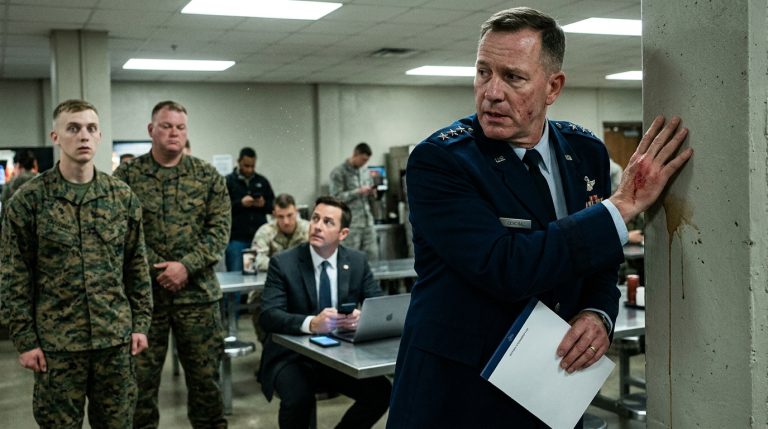
The silence that followed was total. It was a vacuum, drawing all the air out of the courtyard. Then, the heavy, rhythmic thud of a boot hitting the gravel signaled the arrival of General Davies Horton. He emerged from the shadows of the Joint Operations Command Center, his three silver stars catching the unforgiving desert sun. He walked with a heavy, deliberate stride, flanked by security detail that looked as lethal as the men behind Adams.
Every sailor and clerk in the vicinity snapped to attention, but the General ignored them. His eyes were locked on Harrison, his face a mask of furious, concentrated stillness. He walked to the center of the standoff, his boots crunching in the same gravel where Sadie had been forced to kneel only moments before.
“Major,” the General said, his voice quiet, which was somehow worse than a shout. “I’ve been watching you for ten minutes.”
Harrison’s salute was a trembling, frantic thing. “General, sir! I—I can explain—”
“Drop your hand, Roman,” the General commanded, his tone dripping with iron. “Before I have someone break it.”
Harrison’s arm fell to his side, his fingers twitching. He looked desperate, his eyes searching the surrounding faces for a shred of empathy, but he found none. The Marines were granite. The General was a storm front. And Sadie… Sadie was the calm, center point of a vortex he had created himself.
“I watched you stop an operator returning from a Tier 1 kinetic deployment,” the General continued, stepping into Harrison’s personal space. The Major shrank back, his polished boots losing their luster in the grime. “I watched you degrade her. And I watched you force a superior officer to kneel in the dirt to stroke your pathetic, garrison-bred ego.”
The General paused, his gaze sweeping over the assembled Raiders. “She has no insignia because she doesn’t exist on paper, you absolute fool. While you were sitting in your air-conditioned office, Lieutenant Commander Jennett was alone, fifty miles behind enemy lines, keeping two hundred fighters from overrunning Captain Adams’ position.”
The revelation rippled through the onlookers. A whisper started, low and disbelieving. The ‘undisciplined contractor’ was a commander. A ghost. The woman who had been kneeling in the dirt was the very reason the base—and the men standing before them—still existed.
Harrison’s eyes went wide, his mouth agape. He looked at Sadie, really looked at her for the first time, searching for the person he had tried to humiliate. He saw the layers of dried blood, the matted hair, the pale, icy blue eyes that looked back at him with a profound, terrifying detachment.
“General, please… my career…” Harrison whimpered.
“Your career is dead,” the General said, his voice an icy, final verdict. “You are relieved of your duties at Camp Lemonnier. Surrender your sidearm and your badge to the MPs. You will be confined to your quarters until transport arrives tomorrow.”
The Major stood frozen, a small, graying man in a pristine uniform that suddenly looked like a costume. He turned, looking for Miller or Davis, but the space where they had been standing was empty. He was alone.
Sadie watched him go, his walk now a stumbling, frantic retreat toward the barracks. She felt no satisfaction, only a profound, hollow exhaustion. The theater of the Major was over, but the weight remained. She stood in the center of the courtyard, surrounded by the men she had brought home, and for the first time in three weeks, she felt the silence. It wasn’t the silence of the hunt. It was just the silence of the desert.
CHAPTER 4: The Final Echo
The barracks door closed behind the Major with a final, muted thud that sounded less like a departure and more like a period at the end of a long, jagged sentence. Sadie stood in the center of the courtyard, the heat of the Djibouti sun beginning to bake the remaining adrenaline out of her joints.
The crowd was already beginning to dissolve. The sailors and clerks, having witnessed the impossible, were retreating into their daily routines, their eyes fixed firmly on the ground, as if the reality of what they had seen was too bright to look at directly.
“Commander,” General Horton’s voice cut through the thinning air, soft now, devoid of the earlier command-level roar. He stood beside Captain Adams, both men watching her with a focus that felt heavy—not with expectation, but with the quiet, weary recognition of two men who knew exactly what it cost to stay alive in the valley.
Sadie looked at them. The walls she had built around her psyche, the ones that allowed her to function as a phantom, felt brittle now. They had survived the Major’s ego, but the exhaustion was a living thing, crawling into her muscles and settling into the marrow of her bones.
“I want you inside, Sadie,” the General said, his voice dropping to a personal note. “Medical is waiting. And then, I want the full debrief—not for the records, but for the truth.”
“Yes, sir,” she replied. Her voice was barely a rasp, the dry remnants of a throat that had spent weeks shouting orders over the crack of gunfire.
She turned. Her walk toward the special operations compound was not the predatory gait of the Wraith; it was the slow, methodical pace of someone who had carried an impossible burden and had finally been allowed to set it down. She felt every inch of the path, the crunch of the gravel under her boots, the slight pull of the shrapnel wound on her shoulder.
She reached the heavy steel door of the compound. Beside it sat a small, battered wooden bench, weathered by years of sun and salt. She paused, the weight of the rifle on her chest suddenly feeling like a leaden anchor. She unslung it—a slow, careful motion—and set it down. It was a tool, a perfect, lethal instrument, but here, in the quiet of the compound, it looked out of place.
She sat on the bench. For the first time in three weeks, she didn’t have to scan for movement. She didn’t have to calculate the range to the horizon or the windage of a potential threat.
Captain Adams approached, his stride measured. He stopped a few feet away, his own rifle slung comfortably across his back. He didn’t speak for a long time. He just stood there, looking out at the shimmering heat haze rising from the runway.
“The corporal,” Adams said finally, his voice thick. “He’s asking for you. He knows, Sadie. They all know.”
“They don’t need to know,” Sadie said, leaning her head back against the cool, shaded concrete of the wall. She closed her eyes. The image of the Major’s polished boots—the target of her forced labor—flashed into her mind, followed immediately by the memory of the young corporal’s weeping salute.
“They need to know that someone was watching the ridge,” Adams countered gently. “They need to know that someone cared enough to stay when the odds went to zero.”
“I stayed because I had a job,” she said, but the words felt hollow even to her.
“You stayed because you were the only one who could,” Adams corrected. He reached into his pocket and pulled out a small, frayed piece of cord, a remnants of the gear she had used to camouflage her position in the brush. He placed it on the bench beside her. “You left this behind.”
She didn’t pick it up. She looked at it—a tiny, tangled thread of reality in a world of complex, classified ghosts. She felt the heavy, lingering presence of the valley, the memory of the insurgents falling in the dark, the responsibility of every life that hadn’t been extinguished because she had been there.
The truth was a cold, hard thing, but sitting there in the shade, she realized it wasn’t a burden anymore. It was a foundation. She was the one who had held the line. And she had done it not for the rank on her shoulder—which didn’t exist—but for the men whose breathing she could hear, muffled and steady, from the nearby barracks.
“Go to the infirmary, Commander,” Adams said, his voice a quiet salute. “Sleep. The world will still be broken when you wake up, but we’ll be here.”
Sadie nodded. She stood up, her joints popping, the effort a dull ache that she welcomed. She picked up her rifle, the steel cold against her palm, and felt the familiar weight of it—not as a weapon, but as a commitment.
She walked through the doors. The air inside was cool, filtered, and smelled of antiseptic and safety. As the heavy door swung shut, the sound of the base—the distant roar of engines, the hum of the cooling units—faded away, replaced by the quiet, steady rhythm of her own heart.
She wasn’t a ghost. She was a woman who had walked through hell and carried the keys to the exit in her own hands. She would sleep now. And when she woke, she would be ready for whatever came next, not because she was a phantom, but because she was real.