The Sinking Shoreline: How Patience, Precision, and a Controlled Valve Dismantled a Public Illusion
CHAPTER 1: THE BRASS VALVE
The iron wheel bit into the palm of my hand through the thin wool of my glove, cold and unyielding. Outside the windowless concrete shed, the early morning air smelled of damp silt and rotting reeds, the kind of heavy, stagnant odor that clung to the lowlands before the sun burned through the mist.
It was 6:07 a.m. exactly, the digital glow of the dashboard clock in my truck reflecting faintly against the rusted latch of the door.
I turned the valve one full rotation to the left. The internal gears caught with a heavy, subterranean thud that vibrated up through the soles of my boots, a dull pulse traveling three hundred yards down the concrete spillway toward the main gate at Harrow Lake. Somewhere beneath the surface, a massive steel plate lifted by a fraction of an inch, just enough to let the current slip past.
Four hours. That was all the time it would take for the math to do its work.
I pulled my binoculars from the passenger seat, the strap catching on the frayed collar of my jacket, and stepped out onto the porch. The world was still gray and silent, the surface of the water flat and unmoving under a heavy ceiling of clouds. Across the basin, the wooden pilings of the newly constructed municipal boat launch stood tall and defiant against the pale horizon, fresh white lumber gleaming in the dim light like teeth in a skull.
Vivian Marsh would be awake by now. She would be standing in front of a full-length mirror in her rented lakeside townhouse, smoothing the lapels of a cream-colored blazer, rehearsing the speech she had spent eighteen months perfecting for the cameras. She had her ribbon-cutting scheduled for precisely 10:07 a.m., timed down to the minute to catch the morning news broadcast and the arrival of the county commissioners.
She believed she had conquered this shoreline. She believed the three hundred and forty thousand dollars of county grants and local donations she had poured into the concrete, the sod, and the picnic tables had transformed my private property into a monument bearing her name.
My fingers traced the knurled metal rim of the binoculars as I adjusted the focus wheel. The lens sharpened on the newly installed flagpole at the edge of the park, snapping the braided nylon rope into crisp relief against the gray sky.
A single, high-pitched metallic click echoed from the interior of the pump house behind me—a loose toggle switch rattling in the draft. I didn’t turn around. My eyes stayed locked on the water’s edge, watching the exact point where the dark surface met the jagged line of slate stones.
The water line was holding steady for now, flat and glassy. But beneath that deceptive calm, the pressure was already shifting, and the first imperceptible drop had begun.
CHAPTER 2: THE RIBBONS AND THE GATHERING CROWD
The lens of the binoculars clicked slightly against the bridge of my nose as I kept the focus locked on the western boundary of the park. Three hundred yards away, across the damp depression of the dry lakebed margins, a pair of county workers in high-visibility orange vests were unrolling a long spool of crimson ribbon across the main entrance archway.
They moved with the easy, unhurried cadence of men who believed they were anchoring a permanent monument. Every staple driven into the freshly planed cedar posts felt less like construction and more like a stake driven into sand, though they didn’t know it yet.
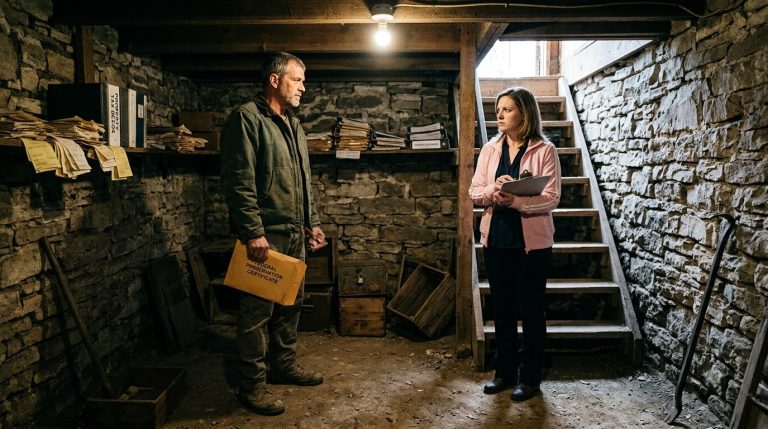
My right hand left the rubberized grip of the binoculars to reach into the breast pocket of my shirt, brushing against the smooth, stiff edges of a manila envelope. Inside lay the certified copies of the 1991 land registry, stamped, signed, and countersigned by Leonard K’s office two winters ago when the first rumors of the Ridge Rest HOA expansion began to circulate through the township zoning board. The county had accepted Vivian Marsh’s application without a second look at the original plat maps, dazzled by the promise of private donations and a federally backed tourism grant. They had trusted the sheen of fresh paint and the smoothness of a corporate presentation.
A low rumble vibrated through the floorboards of the porch as a delivery van turned onto the asphalt lane leading down to the lake lot, its tires hissing against the damp morning dew.
I lowered the binoculars, letting them hang against my chest by the worn nylon strap, and walked back inside the dim interior of the house. The kitchen was cold, smelling faintly of stale black coffee from the pot I’d brewed before dawn. On the laminate counter sat a stack of spiral-bound notebooks, nineteen years of them, their covers warped by humidity and labeled with neat, black-inked dates in my own hand: 1997-1998, 1999-2000, 2001-2002.
Every single entry detailed the precise cubic feet of water managed through the low-level sluice gates, the seasonal variances, the high-water marks, and, most crucially, the exact legal boundaries of the deeded shoreline that extended twenty feet past the current mudline.
The telephone on the wall remained silent, but the mental image of Vivian Marsh was sharp in my mind. Right now, she would be reviewing the VIP guest list, checking off the names of the district commissioner, the local press photographers, and the board members who had rubber-stamped her project without verifying the survey markers. She was surrounded by the intoxicating momentum of her own creation, completely insulated by the belief that money and public relations could rewrite property law.
I picked up a ceramic mug, turned it over in my hand, and set it down without filling it. There was no room for distraction now. The valve at the dam had been open for just under an hour. The water level would have dropped by perhaps half an inch across the broad, shallow basin of the northern cove—barely noticeable to a casual observer standing on the grass, but entirely unmistakable to anyone looking at the concrete pylons of the boat ramp.
My boots crunched softly against the linoleum as I returned to the front window. The delivery van had parked near the pavilion, and a group of volunteers were unloading folding chairs, stacking them in neat aluminum rows beneath the crisp white canopy of the main tent.
The air outside was beginning to clear as the heavy cloud cover stretched thin, allowing pale shafts of sunlight to spear down through the pines and strike the surface of the water. For a fleeting second, the lake looked peaceful, mirrors of silver and gray reflecting the quiet morning. But the drop was ongoing, steady and relentless, governed entirely by gravity and the precise mathematics of the iron gate I had turned with my own hands three miles up the valley.
Let them staple their ribbons. Let them practice their speeches about community enrichment and public access. The foundation they were standing on wasn’t concrete; it was an illusion built over a paper trail that had been waiting nineteen years for this exact hour.
CHAPTER 3: THE FIRST INCH OF EXPOSED MUD
The kitchen counter felt cold beneath my palms as I stood motionless, listening to the muffled hum of the refrigerator motor. Outside, the morning was settling into its routine, but the rhythm of the valley had changed. Somewhere three miles up-gradient, the water was slipping past the iron seat of the dam at a calculated, unyielding volume.
A sudden, sharp fragment of memory cut through the silence—the summer of 2014, when the drought had stripped Harrow Lake down to its limestone ribs, exposing rusted automobile frames and old property stakes that people had spent decades pretending weren’t there. Water had a way of keeping secrets until it decided not to, and right now, gravity was acting as its accomplice.
I turned away from the counter, my boots clicking rhythmically against the linoleum, and walked back to the front window. The delivery van across the cove had departed, leaving behind a neat grid of aluminum folding chairs under the white canopy. The ribbon-cutting ceremony was drawing closer.
My gaze drifted down to the water’s edge where the slate-gray ripples lapped against the bank. Even from three hundred yards away, the change was no longer a matter of calculation; it was visible. A narrow ribbon of dark, damp silt—barely an inch wide when I first looked—had widened into a distinct, glistening border of exposed earth. The water was pulling back, shrinking away from the newly driven wooden pilings of the municipal boat launch with a quiet, indifferent finality.
If Vivian Marsh had looked down from the podium right now, she might have seen it. But she wouldn’t be looking down. People like her, high on the momentum of public grants and ribbon-cutting schedules, never looked at the ground until they tripped over it.
I reached out and picked up a heavy red pen from the desk, tapping its plastic cap against the edge of a map spread flat across the table. The map was an original county survey from 1991, its paper yellowed and brittle at the folds, marked with precise red ink annotations that Leonard K’s office had verified twice. The easement granted a narrow right of passage—a footpath for walkers and a strip for a line-cast, nothing more. It explicitly forbade grading, permanent construction, or commercial development. Yet, over the last eighteen months, Vivian’s contractors had bulldozed the bank, poured three concrete pads, and erected a permanent timber pavilion entirely within the restricted zone.
They had assumed nobody was watching. Or worse, they had assumed that a quiet property owner living at the edge of the basin would be too intimidated by a county-backed project to push back.
A sharp rap at the front door broke the stillness of the room.
I didn’t flinch. I didn’t turn around immediately. I set the red pen down with deliberate slowness, making sure it didn’t roll off the edge of the map, and let my eyes linger on the horizon. The sun had finally broken clear of the ridge, casting long, sharp shadows across the dry, pale patch of earth widening by the minute along the northern cove.
The knock came again, heavier this time, carrying the hollow, impatient cadence of someone who was used to doors opening the moment they touched them.
My boots found the floorboards as I walked across the living room, the fabric of my jacket brushing against the doorframe. I didn’t unlock it yet. I kept my hand resting flat on the cold brass knob, feeling the faint tremor of the wood as another vehicle rumbled down the dirt road outside, carrying the first wave of guests toward the grand opening.
CHAPTER 4: THE 47PAGE COMPLAINT ENTERS THE CROWD
The heavy brass knob felt like cold stone beneath my palm. Outside, the wind caught the edge of the screen door, causing it to rattle sharply against its frame before settling back into stillness. I didn’t turn the handle. Instead, I let my thumb trace the raised manufacturing imprint on the metal, feeling the steady, unrelenting thrum of a vehicle engine idling down the lane.
Whoever stood on the other side of that timber threshold wasn’t Vivian Marsh—she was currently three hundred yards away, stepping up to a podium draped in crimson ribbon under the bright morning glare. This was likely a local courier or a zoning official sent to deliver a late notice, unaware that the game they thought they were managing had already shifted past redemption.
I released the knob, letting my hand drop to my side, and turned away from the door. Let them knock. The silence inside the house was absolute, broken only by the rhythmic ticking of the wall clock in the kitchen.
My boots moved with deliberate, unhurried steps across the braided rug toward the rear window facing the northern cove. The landscape outside had crossed an invisible threshold while my attention was briefly diverted. The narrow band of damp silt I had watched form an hour ago had expanded into a wide, pale scar of exposed lakebed. The water was actively pulling back now, receding from the wooden pylons of the new municipal boat ramp with visible, kinetic momentum. The dock, designed to float flush against a deep-water shelf, was beginning to tilt awkwardly, its metal brackets groaning under the strain of unsupported weight.
Across the basin, the grand opening ceremony had reached its climax. Through the binoculars, I could see the flash of camera bulbs reflecting off the cream-colored lapels of Vivian Marsh’s blazer. She stood smiling at the center of the stage, her hands raised slightly to quiet the applause of the three hundred people packed beneath the white canopy.
She held the ceremonial silver scissors aloft, the metal catching the sunlight in a blinding arc. To the crowd, to the county commissioners seated in the front row, and to the local news crew broadcasting the feed live, it was a triumph of civic planning.
They couldn’t see the mudline dropping. They couldn’t hear the quiet, heavy slide of water draining away from the pilings.
A sudden movement near the edge of the gathered crowd caught my lens. A man in a dark gray windbreaker, carrying a thick, legal-sized binder beneath his arm, was pushing his way past the rows of folding chairs. He didn’t look like a local resident coming for the free refreshments. He walked with the heavy, unyielding stride of a process server who had a 47-page civil complaint burning a hole in his pocket.
My fingers tightened around the rubberized housing of the binoculars as I watched him approach the base of the podium. The timing was exact. The water level had dropped precisely eighteen inches—enough to compromise the boat ramp, enough to throw the picnic tables into the drying mud, and enough to strip every legal defense Vivian Marsh thought she possessed right out from under her feet.
She lowered the scissors, turning to face the applause, just as the man in the gray windbreaker reached the foot of the stage and extended a heavy, manila-encased document toward her hand.
CHAPTER 5: THE CAMERAS CATCH THE RECEDING WATER
The flashbulbs didn’t pop with a sound; they registered only as blinding white punctures against the gray backdrop of the lake, silent explosions of light caught by the lenses of three separate local news cameras. From three hundred yards away, through the gritted glass of my binoculars, I watched the exact moment Vivian Marsh’s fingers froze an inch above the silver ceremonial scissors.
The man in the gray windbreaker didn’t speak. In the stillness of the amphitheater, where the applause had died down into a confused, ragged murmuring, his posture was a physical anchor of absolute authority. He pressed the heavy, 47-page civil complaint forward until the stiff manila edge brushed against the cream-colored fabric of her blazer sleeve.
A collective shift rippled through the front row of folding chairs. The district commissioner, who had been leaning forward with a practiced, politician’s smile frozen on his face, blinked heavily and turned his head toward the water’s edge.
That was where the real story was happening.
The lake didn’t recede with a dramatic roar; it pulled back with a quiet, sickening slurp of suction against the drying silt. The water level had dropped a full two feet since dawn, dragging the shoreline down past the engineered grading of the new municipal boat ramp. The concrete pad, meant to meet the surface at a smooth, functional angle, now hung suspended over eighteen inches of pale, cracked mud, looking less like a public amenity and more like a ruined skeleton exposed by an unseasonable tide.
Near the picnic area, one of the heavy cedar tables had begun to slide, its legs catching awkwardly in the thickening mire as the ground beneath it lost its hydrostatic support. A woman in a floral sun dress, holding a paper cup of coffee, pointed a trembling finger toward the receding waterline, her voice carrying a sharp note of alarm that cut cleanly through the damp morning air.
Vivian’s hand dropped away from the scissors. The silver blades clicked together once, hollow and sharp, before she let them slip from her fingers back onto the velvet-lined presentation tray. Her gaze jerked away from the process server, away from the cameras flashing in rapid, mechanical succession, and locked onto the exposed lakebed.
The color drained from her face so completely that even from this distance, the sharp contrast against her blazer was undeniable. She had spent eighteen months architecting a public narrative—press releases, social media campaigns, ribbon-cuttings, and grant applications—all built on the foundational lie that the lake belonged to the public and that the 1991 easement gave her carte blanche to build whatever she pleased. She had treated property lines as minor suggestions and legal oversight as a nuisance to be managed by public relations.
Now, with the water actively draining away to reveal the raw, indisputable boundaries of the deeded shoreline, the physical reality of the land was tearing her illusion apart in real time.
The cameraman nearest the stage shifted his position, pivoting his heavy rig away from the podium to capture the sinking boat ramp and the panic spreading among the families who had crowded down to the water’s edge. The red recording light on top of the lens burned a steady, accusing crimson.
I lowered the binoculars slightly, resting the cold metal against my chest as I watched Vivian turn slowly toward the county commissioner, her lips moving in words too distant to hear, though the desperate panic in her posture needed no translation. The trap hadn’t been sprung with a shout or a slammed door; it had opened with the slow, inevitable gravity of a valve turning three miles up the valley, letting the truth drain out into the light.
CHAPTER 6: THE RESIGNATION AND THE QUIET SHORE
The red recording light on the news camera remained steady, a tiny, accusing ember against the bright midday glare. From three hundred yards away, through the crosshairs of my binoculars, I watched the immediate, violent compression of Vivian Marsh’s world. The process server stood like an immovable monument, his hand still extended with the 47-page complaint pressed against the cream fabric of her sleeve.
She didn’t take the papers at first. Her fingers twitched at her sides, curling into tight, white-knuckled fists against the folds of her skirt. Around her, the well-rehearsed harmony of the grand opening completely fractured. The county commissioner had stepped back three paces, his face flushing a mottled, angry crimson as he muttered something into the collar of his shirt, distancing himself from the platform as fast as his polished loafers could carry him.
The crowd of three hundred people had broken apart into restless, murmuring clusters, their eyes darting between the podium and the stark, ugly reality of the exposed lakebed. The boat ramp now hung completely isolated in mid-air over two feet of cracked, gray silt, and the picnic tables leaned at absurd, drunken angles in the mud.
Vivian finally reached out, her fingers trembling as they brushed the stiff edge of the manila cover. She didn’t read it. She didn’t need to. The figures printed in bold black ink across page twelve—detailing the exact parameters of the 1991 easement, the explicit prohibition against permanent commercial grading, and the nineteen-year record of water level operations controlled from a concrete valve three miles up the valley—were already casting their long shadow over everything she had built.
I lowered the binoculars, the strap sliding smoothly against the worn fabric of my jacket, and turned away from the front window.
The silence inside my house felt entirely different now. It wasn’t the tense, coiled anticipation of the early morning hours, but the deep, settled quiet of a ledger finally balanced. On the kitchen counter, the stack of nineteen spiral-bound notebooks sat in an unmoving row, their dark covers catching the pale light filtering through the glass. Beside them lay the original 1991 survey map, marked with the red ink lines that Leonard K’s office had sworn would hold when the time was right.
I walked over to the counter and picked up a clean cloth, wiping down a small smudge of dust near the edge of the laminate. There was no need to watch the rest of it unfold, but the sequence of events was as predictable as the physics of the valley itself.
By Sunday evening, the local news segment detailing the scandal had crossed three hundred and forty thousand views online, transforming a suburban ribbon-cutting into a public indictment of bureaucratic overreach. Vivian Marsh didn’t fight the complaint in court; she didn’t have the legal footing to survive a contest against nineteen years of meticulous documentation and a clear, unyielding prohibition clause. She submitted her quiet resignation to the municipal board before the sun set on the weekend, leaving behind a scramble of corporate lawyers and a county administration desperately trying to distance themselves from the unauthorized grant funds.
The criminal defense attorneys moved in by Monday morning, and the attorney general’s office initiated a formal inquiry into how a public grant had been funneled into a private commercial development built entirely on restricted land. The Ridge Rest HOA board dissolved into frantic infighting, pointing fingers at one another as the cost of the structural removal estimates began to mount.
I walked out onto the front porch, letting the screen door click softly shut behind me. The air was crisp, carrying the clean, sharp scent of damp earth and pine resin.
Across the basin, the grand opening banner had already been pulled down from the timber pavilion, leaving only two loose ends of red ribbon fluttering desolately in the breeze against the gray cedar posts. The water level had stabilized, held in check once more by the locked valve up the valley, but the shoreline bore the permanent, raw scar of the receding tide—a reminder that no amount of public relations or corporate optimism can rewrite the laws of the land when the truth is finally allowed to drain into the open.
I reached down, adjusting the heavy brass buckle of my work boots, and then pulled a small pocketknife from my trousers, its steel blade catching the afternoon sun. Sitting on the corner of the wooden porch railing was the weathered oak sign I had taken down two summers ago when the first surveyors had crossed my boundary line without permission.
The wood was dry and splintered at the edges, scarred by years of weather and neglect. Using the tip of the blade, I carefully tightened the loose brass screw holding the upper corner of the mounting bracket in place, turning it until the metal bit firmly back into the grain.
The repair was small, almost insignificant against the scale of the valley, but it held steady under the pressure of my thumb. I stood up, brushed a thin film of sawdust from my palm, and carried the sign back toward the front door, stepping into the quiet warmth of the house as the shadows lengthened across the floorboards.