A Symphony of Steel and Soul: The Unlikely Restoration of a Widow’s Heart and Home
CHAPTER 1: THE FIRST RIPPER
The screen door rattled, a thin, desperate sound against the fury of the Arizona monsoon. Margaret Pearson didn’t look through the peephole. She didn’t have to. The sound of the wind, a low, predatory whistle through the ponderosa pines, told her all she needed to know. The sky was a bruising purple, heavy with the weight of impending collapse.
She unlatched the door and pulled it open, the wind nearly tearing it from her grip. Thirty figures stood on her porch, their leather vests slick with rain, their helmets held like offerings. Vincent, the leader, stood at the front, the scar above his eye pale against his soaked skin.
“Ma’am,” he shouted over the thunder. “We’re caught. We didn’t calculate the speed of this front.”
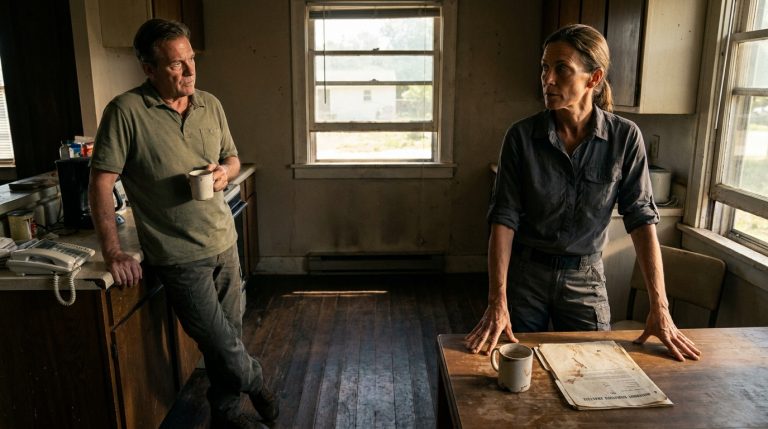
Margaret stood back, her slight frame silhouetted against the dim, yellow light of her kitchen. The air inside smelled of dust and old tea—a stark contrast to the ozone and hot, wet asphalt outside. “Don’t just stand there letting the damp get into your bones,” she said, her voice cutting through the gale. “There’s a carport around back for the bikes. Bring them in, then get inside. The coffee’s hot.”
She watched them move—not with the jagged, chaotic motion the town feared, but with a silent, synchronized efficiency. They moved like men who had spent decades anticipating disaster. As the first few stepped over her threshold, they did something she hadn’t expected: they paused, stripping off their sodden boots, arranging them in a perfect, unspoken line on the porch, their movements reverent, as if they were stepping into a cathedral rather than a rotted-out house.
The kitchen, usually a sanctuary of silence, was suddenly crowded with the heat of thirty men. They were giants in her small, cramped world, their presence physical, heavy, and undeniably foreign. Margaret navigated the space with the steady, practiced grace of someone who had spent years balancing on crumbling ground.
She turned to the stove, her fingers brushing the worn dial. She had two pounds of beef, a few boxes of pasta, and the silence of the town outside, which she knew would be watching, waiting for her to stumble.
“I’m Margaret,” she said, not turning around. “And I don’t care who you are or what they say about you. In this house, you’re guests. And guests eat.”
Behind her, a ripple of movement stopped. A young man, barely out of his twenties, stared at the frayed edges of her tablecloth, his expression shifting from guardedness to something softer, more fragile. Vincent stepped forward, his eyes tracking the way Margaret’s hand trembled slightly as she gripped the handle of the pot. He looked at the ceiling, where a fresh water stain had blossomed, dark and ominous. He didn’t say a word, but the way he looked at the wall—the calculation in his gaze—was the first note of a deeper, hidden rhythm.
Then, from the darkness outside, the wind stopped its whistling and shifted to a roar. The roof above them groaned, a deep, structural protest against the weight of the rain. The entire house seemed to tilt, a single, sharp shift in the floorboards sending a cascade of dust from the ceiling.
Margaret stood still, staring at the ceiling. “It’s been doing that for years,” she murmured, though it sounded like a lie even to her.
Vincent moved toward her, his hand hovering near the wall as if he wanted to brace the structure himself. “It’s not just the rain, Margaret,” he said, his voice low and devoid of the toughness he’d worn on the road. “That foundation is shifting. You shouldn’t be standing here.”
“I’ve nowhere else to go,” she replied, turning to face him.
The kitchen went dead silent, save for the rhythmic, aggressive thrum of the rain against the roof. It was then that the first piece of the ceiling plaster broke free, falling to the floor between them with a sharp, shattering crack.
CHAPTER 2: KITCHEN CALCULUS
The dust hung in the air, a fine, ghostly powder that caught the dim light of the kitchen fixture. Margaret didn’t flinch. She watched the gray shards of her ceiling settle into the meat sauce, a small tragedy that felt, in the moment, like a final capitulation. She felt the eyes of the thirty men on her back—thirty pairs of eyes, all seeing exactly what the town had spent years pretending wasn’t there.
Vincent didn’t move toward the mess. He stayed where he was, his gaze fixed on the hole in the ceiling, then dropping to the floor where the joists were exposed, dark with rot. He looked at the other men, his expression unreadable, and then he looked back at Margaret.
“You’ve been living under this?” he asked. His voice wasn’t condescending; it was heavy with a quiet, dangerous kind of realization.
Margaret reached out and pulled the pot off the burner, shielding the remaining sauce with a stained tea towel. She kept her back to him, her knuckles white. “It’s held for a long time. It’ll hold a bit longer.”
“It’s not holding, Margaret,” Russell said from the doorway. He had moved with a fluid, predator’s grace, his boots making no sound on the worn wood. He knelt by the threshold of the kitchen, his fingers probing the wood of the floorboards. “This house is breathing its last. If the monsoon hits any harder, the roof won’t just leak—it’ll fold.”
Margaret turned, her expression guarded. She felt the intrusion of their gaze, the way they were dissecting the anatomy of her survival. She wanted to chase them out, to keep the shame of her house private, but the sheer, crushing reality of the rain outside forced her to stay rooted.
“I didn’t ask for a structural report,” she said, her voice thin. “I asked if you wanted coffee.”
Vincent looked at her for a long second, his eyes softening at the edges. He stepped into the workspace, dwarfing her, yet somehow managing to make himself smaller, less imposing. He took the pot from her hands and set it on the cold counter. “We’re going to need more than coffee, Margaret. If we’re staying the night—and we are, because nobody’s getting out of this driveway until this front passes—we’re going to need to stabilize this kitchen.”
He didn’t wait for her permission. He nodded to the men gathered in the living room. “Forge, get the emergency kit from the lead bike. Keep it covered with the tarp. The rest of you, clear the living room. Move the furniture to the center; we need to brace the joists before the next surge.”
It was an invasion, but not the kind Margaret had spent fifteen years fearing. It was an invasion of order. The bikers moved with a frantic, silent efficiency. Within moments, her living room—the room where she had sat alone for so many lonely winters—became a staging area. They worked with tools she hadn’t seen in decades: high-tension steel brackets, industrial tape, and structural supports they pulled from their saddlebags.
Margaret stood in the corner, clutching her apron, watching as they worked on her floorboards. They didn’t talk to her; they didn’t offer empty platitudes. They treated her home like a damaged machine, their hands moving with the precision of surgeons.
She watched a young rider, his arms covered in tattoos that depicted battles she didn’t recognize, carefully place a support beam under the sagging threshold. He looked up, caught her watching, and offered a shy, fleeting nod. It was a gesture of profound respect, devoid of pity.
Why? The question burned in her throat. She had given them a few cups of coffee and a roof that barely kept the rain out. She wasn’t a hero; she was a widow with a failing life.
She walked over to the kitchen counter, where Russell was now working. He had moved the debris aside and was examining the plumbing, his face illuminated by a small LED light he’d pulled from his vest.
“It’s not just the roof,” Russell said, not looking up. “The plumbing is weeping into the foundation. It’s been happening for a long time, hasn’t it?”
Margaret looked at the faucet, then down at the water-logged wood beneath the sink. “Everything breaks eventually, Mr. Carver. Most people just patch it and hope for the best.”
“Most people don’t let it go until the structure turns against them,” he countered, though his tone was devoid of judgment. He reached into his vest, pulled out a small wrench, and tightened a nut with a sharp, metallic click.
Outside, a fresh crack of thunder shook the house, the vibration running through the floorboards like a physical shock. The entire structure shivered. For a second, the light flickered, and Margaret felt the familiar, cold finger of panic. But then, the house held. The braces they’d installed groaned, a metallic, screeching protest that sounded like steel biting into wood, but it held.
Margaret looked at the ceiling, then at the men around her. For the first time in years, the silence of her home wasn’t empty; it was heavy with the presence of people who were actively, physically tethering her house to the earth. She realized then that they weren’t just fixing her home; they were acknowledging the reality of her struggle, and in that acknowledgement, the shame that had been her constant companion began to fray.
Vincent walked back into the kitchen, his hair wet, his face set in a mask of grim determination. He looked at the stove, then back at the pantry. “We’re going to be here until dawn,” he said to her, his voice quiet. “Is there enough to feed everyone a second round? We can stretch it if you’ve got flour or dry goods.”
“There’s flour,” she said, her voice finding its footing. “And I have some canned beans in the cellar.”
“We’ll manage,” he said. He looked at her, his expression suddenly intense. “You don’t have to look at us like we’re strangers, Margaret. We know what this house costs you.”
Margaret turned away, her heart hammering against her ribs. She didn’t want them to know. She didn’t want anyone to know the full cost of the last fifteen years. She moved to the cellar door, her steps sure for the first time in a long time.
CHAPTER 3: THE FIRST RIPPLE
Margaret’s hand rested on the cool, stone wall of the cellar stairs, her knuckles white. She could hear the muffled, rhythmic thud of the bikers working in the kitchen above—the sounds of hammers and drills, the low, steady murmur of men who weren’t just guests, but a construction crew in exile. She grabbed a jar of peaches and a heavy tin of dried beans, her movements mechanical.
The basement was a place of ghosts, filled with Harold’s old contractor tools, now covered in a fine layer of dust, and boxes of memories she hadn’t touched since the day Rebecca left. She pushed past a stack of crates, her eyes catching the reflection of a streetlight through the small, ground-level window. Outside, the rain had slowed to a rhythmic, steady drizzle, but the streets of Williams were not empty.
She saw the silhouette of a truck—Patricia Walsh’s sedan—idling near the corner of her driveway. It had been there for twenty minutes.
Margaret stood still, the weight of the beans pulling at her arm. Patricia wasn’t just watching; she was waiting. In the small, suffocating ecosystem of their neighborhood, a gathering like this wasn’t an event—it was a contagion. Margaret felt the cold air seeping through the cracked foundation, a chill that had nothing to do with the storm. She knew that by morning, the town’s version of this night would be far removed from reality. It would become a story of siege, of men in leather waiting for the moment to turn the town against itself.
She climbed back up the stairs, the door creaking as she pushed it open. The kitchen felt impossibly small now, the warmth of the men trapped against the raw, damp smell of the exposed joists.
Vincent was by the sink, his back to her, scrubbing a stain off the counter with a cloth. He stopped when he saw her, his eyes scanning her face. He saw the tension in her jaw, the way she looked toward the window.
“They’re still out there,” he said. It wasn’t a question.
Margaret set the beans on the counter and began to open them, her movements deliberate. “They don’t like what they don’t understand, Vincent. And they don’t understand you.”
“They don’t have to,” he replied, his voice a low, steady rumble. He picked up a plate, his fingers calloused and steady. “But I didn’t think they’d be sitting in their cars watching. That’s a new level of hospitality.”
“It’s fear,” Margaret said, finally looking at him. “Fear is a very effective fuel. It’s what kept me quiet for fifteen years.”
A younger biker, the one with the ink-stained arms, leaned against the doorframe, nursing a cup of coffee. “We aren’t going to be here long, Margaret. The storm will break by dawn, and we’ll be gone. They don’t need to worry about us.”
Margaret looked at him—at the genuine confusion in his eyes. He didn’t understand the fragility of their position. “You don’t get it. Once you leave, I have to stay. I have to live with the stories they tell, with the way they’ll cross the street when they see me. You’re giving me a roof, but you’re making my world feel a whole lot smaller.”
The kitchen fell silent. The work had slowed; even Russell, who had been focused on the wiring, stood up straight. He looked at Margaret, his gaze sharp, assessing.
“We didn’t come here to hurt you, Margaret,” Russell said.
“I know that,” she replied. “But the town doesn’t care about my safety. They care about their comfort. And you’ve interrupted it.”
Vincent stepped closer, his presence commanding the cramped space. He reached out and, with a touch so light it surprised her, adjusted the sleeve of her cardigan. “Then we make it worth it. We don’t just stay in the shadows and leave at dawn. We show them exactly why we’re here.”
Margaret felt a shiver run down her spine. “How?”
“We finish the work,” Vincent said. His voice was calm, but there was a flicker of something behind his eyes—a determination that felt as solid as stone. “We don’t leave just because the sun comes up. We stay until this house is solid. We make them look at the work, and we make them look at the fact that it was done for a neighbor, not a stranger.”
“That will only make them angrier,” Margaret cautioned, though she felt a strange, budding warmth in her chest.
“Let them be angry,” Russell said, his voice hard. “They’ve had fifteen years to fix this place. If they want to be angry that we’re doing the job for them, let them have the anger. We’ll take the house.”
Margaret looked at the jar of peaches in her hand, then at the men gathered in her kitchen—men who were, by the town’s definition, monsters. She thought of the cold, judgmental eyes of her neighbors, and for the first time in fifteen years, she felt a flicker of defiance. She wasn’t just a widow waiting for her walls to cave in. She was a woman who had dared to open her door, and she was discovering that perhaps the walls weren’t the only thing that needed reinforcing.
“There’s more coffee in the pot,” she said, turning back to the stove.
Vincent smiled, a slow, grim curve of his mouth. “Then we’ll drink it.”
Outside, the idling engine of the sedan shifted. Patricia Walsh wasn’t leaving. She was calling someone. The static of a radio hissed through the damp night air, a sharp, intrusive sound that cut through the silence of the woods. The tension in the kitchen heightened; the men shifted, their posture changing from that of a construction crew to that of a unit waiting for an order. They weren’t just fixing a house anymore. They were settling in for a siege, and Margaret, standing at the center of it all, realized with a jolt of clarity that she had crossed a line she could never pull back from.
CHAPTER 4: THE MOBILIZATION
The kitchen was no longer just a room for fixing faucets; it had transformed into a command center. While Russell continued to patch the drywall with the focused, rhythmic movements of a man sealing a wound, Vincent stood by the window, staring out at the rain-slicked road. His phone, a black slab of heavy plastic, was tucked against his ear. He spoke in a low, sharp cadence that Margaret only half-caught—words like “permit,” “lumber,” and “logistics.”
Margaret moved around them, her hands busy with chores that felt increasingly obsolete. She swept the floor of the dust the bikers had tracked in, finding a strange comfort in the menial task. Each time she passed Vincent, she felt the gravity of his presence. He wasn’t just talking to friends; he was calling in favors that spanned state lines, pulling on the threads of a network that most of the world never even knew existed.
“Margaret,” Vincent said, catching her eye as she passed. He stepped away from the window, his movements tight, controlled. “We’ve got supplies coming from Flagstaff. Two trucks. They’ll be here by morning, provided the roads don’t wash out completely.”
“Trucks?” Margaret felt the familiar prickle of alarm. “Vincent, you’re talking about construction. People don’t just drive trucks of lumber through Williams on a whim. The Sheriff—”
“The Sheriff is currently sitting in his cruiser down the road, waiting to see what we do next,” Vincent interrupted, his voice calm. “He’s watching us. He’s looking for a reason to categorize this as an incident. We’re going to give him nothing but a series of legal, permitted repairs.”
He leaned against the counter, his eyes tracing the line of the ceiling. “We’ve got the permits. I’ve been on the phone with the county office since the storm hit. They’re surprised, but they’re not going to block structural safety repairs, not when there’s a paper trail a mile long.”
Margaret looked at him, startled. “You had time to do that? In the middle of a monsoon?”
“I’ve spent thirty years learning how to navigate the walls people build against us,” Vincent said simply. He walked over to the kitchen table, where a notebook lay open. It was covered in neat, cramped writing—a list of materials, names, and timelines. It looked like a military mission plan, but it was headed with her address.
For the first time, Margaret realized the depth of the “debt” they felt. It wasn’t just a favor; it was a crusade. And as she looked at the list, she realized that this wasn’t just about fixing her roof. It was about proving something to a town that had written them off, and in doing so, they were dragging her into a light she hadn’t stepped into for years.
“They’re going to be here, aren’t they?” she whispered. “All of them.”
“We’ve got people coming from all over the Southwest,” Russell added, standing up and wiping his grease-stained hands on a rag. “Not just for the house. We’re setting up a perimeter. Nothing gets in or out without being logged. We aren’t going to let anyone claim we’re a threat. We’re here to work, and we’re going to be the most visible, quiet, efficient workers this town has ever seen.”
Margaret sat down at the table, her legs feeling heavy. The room felt crowded, not just with the physical bodies of the men, but with the weight of what was coming. She thought of Patricia Walsh in her sedan, thought of the Sheriff watching from the shadows, and realized that her house was about to become the epicenter of a collision between two worlds.
“I don’t know how to thank you,” she said, the words feeling inadequate.
“Don’t,” Vincent said, pulling a chair out and sitting across from her. He looked exhausted, the lines around his eyes etched deep by the strain of the night. “This isn’t about gratitude. It’s about the fact that you’re the only person who treated us like we were human. That’s a rare currency in this world, Margaret. We spend it where we find it.”
He reached out and tapped the notebook. “By the time the sun hits that peak,” he said, gesturing toward the window where the first, gray light of dawn was beginning to touch the distant mountains, “this house is going to belong to a professional crew. You’re going to be the foreman, whether you like it or not. We’re going to show them that a home is worth more than a reputation.”
Margaret leaned forward, her hand brushing the paper. The ink was still fresh. She looked at the list—hammer, nails, cedar, insulation, paint—and felt a strange, terrifying surge of hope. She had spent fifteen years hiding from the world, and now, the world was coming to her doorstep. Not to tear her down, but to build her up, whether the town liked it or not.
She stood up, her back straightening, a physical shift in her posture that caught Vincent’s attention. “If we’re going to do this,” she said, her voice steady and clear, “then we do it right. I know how to manage a budget. I know how to keep a crew focused. And I know every single weak point in this house better than anyone.”
Vincent smiled, and this time, the exhaustion in his eyes was replaced by a sharp, approving spark. “Then I guess we’ve got a project, foreman.”
Outside, the first engine of the morning began to turn over—the low, guttural growl of a bike that had been waiting for the signal. It was joined by another, and then another. The sound rippled through the valley, not as a threat, but as a beginning. Margaret walked to the kitchen window and pushed it open. The air was cool, smelling of rain and fresh pine, and for the first time in fifteen years, she didn’t look for the shadows. She looked at the road, waiting for the trucks to arrive.
CHAPTER 5: THE DELUGE
The morning light was flat and unforgiving, washing out the colors of the desert and turning the dust of Margaret’s driveway into a hazy, swirling fog. The convoy was not a group of motorcycles, but a procession of heavy flatbeds, their engines idling with a low, menacing roar that seemed to vibrate the very foundations of her house.
Margaret stood on the porch, her hands clasped tightly in front of her. She felt like a trespasser in her own yard. Across the street, the town of Williams was beginning to stir, but it was a hesitant, fearful wakefulness. Windows were cracked open just a fraction, and silhouettes moved behind blinds. The news had spread—the “invasion” was no longer a rumor; it was happening, right in the middle of a town that preferred its secrets kept behind neatly painted picket fences.
Vincent was already at the edge of the property, his boots kicking up the dust as he guided the first flatbed into position. He was authoritative, his movements broad and precise, completely unbothered by the fact that he was currently the most scrutinized man in the county. Beside him, Sheriff Murphy’s cruiser was parked at a sharp angle at the end of the street, its lights off, its presence a dark, looming question mark.
As the first load of cedar beams was offloaded, the sound of the crane—a sharp, mechanical clanking—echoed off the canyon walls. It was the sound of a construction site, but to the neighbors, it sounded like the preparation for an ambush.
Margaret felt the weight of the air, thick and cloying with the smell of diesel and sweat. A memory surfaced, unbidden: Harold, forty years ago, standing exactly where Vincent was now, directing a crew to frame their first house. She remembered the sound of his laughter, the way he would wipe his brow and look at her, his eyes full of that same, quiet pride. The grief hit her then, sharp and sudden, a physical blow to her chest. She had spent fifteen years burying that memory under a mountain of bills and isolation, but here it was, resurrected in the center of a standoff.
She stepped off the porch, her feet hitting the dirt with a firmness that surprised her. She walked toward the trucks, toward the men who were busy unloading lumber and tools.
“Margaret, you shouldn’t be out here,” Russell said, pausing as he moved a stack of galvanized pipe. “It’s going to get messy.”
“I’m the foreman, aren’t I?” she asked, her voice steady. She took the clipboard Vincent held out, her hand not trembling in the slightest.
Just then, a sleek, silver car rounded the corner and skidded to a halt near the Sheriff’s cruiser. Patricia Walsh stepped out, her expression a mix of indignation and fear. She was followed by a handful of other residents, their faces taut with the same, nervous urgency.
“Stop this!” Patricia shouted, her voice thin against the mechanical drone of the trucks. “You have no right to turn this street into a staging ground! We’ve called the state police, and they’re on their way.”
Vincent didn’t even look up from his work. He signaled to one of the drivers to back the second truck into the yard, the reverse alarm a shrill, piercing sound that cut through the shouting.
“We have the permits, ma’am,” Vincent said, his voice level, almost bored. He didn’t raise his tone, yet it carried across the yard with chilling clarity. “The work is legal, the property owner has authorized it, and the county has signed off on every single structural beam. Unless you have a specific legal objection to the building codes, I suggest you step back. This is a private construction site.”
“Private?” Patricia gestured wildly toward the line of bikes and the growing sea of leather-clad men who were appearing from the trucks, their tools in hand, their eyes fixed solely on the house. “You’re an army, not a crew! Look at them! They don’t look like contractors!”
“They are members of the club,” Vincent said, finally looking at her. His gaze was cold, empty of any malice, yet entirely uncompromising. “And every single one of them is a skilled laborer. We’re here to do a job. We aren’t here for you.”
The tension spiked. A few of the townspeople took a step forward, their faces flushing. Sheriff Murphy stepped out of his cruiser, his hand resting on the belt at his waist, his eyes moving between the bikers and the angry neighbors. The atmosphere was brittle, ready to shatter.
Margaret stepped into the gap. She moved between Vincent and Patricia, her posture straight, her gaze meeting the eyes of her neighbors one by one. She saw the fear in them, but she also saw the ugly, reflexive judgment that had defined her existence for years.
“Patricia,” Margaret said, her voice cutting through the noise like a blade. “I didn’t invite you here.”
“Margaret, we’re trying to protect you!” Patricia hissed, her eyes wide. “They’re using you, don’t you see? They’re going to take this house, they’re going to—”
“They are fixing the house that you all watched rot,” Margaret said. She looked at the Sheriff, then back to the group of people who had been her neighbors for three decades. “For fifteen years, I have asked for nothing. I’ve survived, I’ve kept my head down, and I’ve watched this town turn its back on anyone who couldn’t pay the price of admission. You didn’t come to my door when the roof started leaking. You didn’t come when the electricity failed. You’re here now because you’re uncomfortable, not because you’re concerned.”
The silence that followed was heavy, punctuated only by the distant, rhythmic tap of a hammer starting on the porch.
“The work continues,” Vincent said, his voice low.
The men went back to their labor. The townspeople stood frozen, caught in the friction between their fear and the undeniable, cold truth of what Margaret had said. They weren’t protecting her; they were protecting their own peace of mind, and the sight of her, standing there with the clipboard, standing with the “monsters” they feared, was something they didn’t know how to handle.
As the first beam was raised into place, a massive, structural piece of cedar that anchored the new roof, Margaret felt a strange, quiet thrill. She wasn’t hiding anymore. She was part of the machine, part of the work, and as the house began to groan under the weight of the repair, she knew there was no going back to the way things were.
CHAPTER 6: THE CONSTRUCTION
The house had become a living thing, breathing in rhythm with the drills and the saws. Margaret moved through the hallway, her boots crunching on the grit that now coated every surface, a fine, powdery snow of sawdust. The air was thick, tasting of pine and the sharp, chemical tang of fresh sealant. Outside, the world of Williams seemed distant, a muffled, hostile static beyond the heavy perimeter the bikers had established.
She found Vincent near the stairs, his face smeared with grease, his eyes focused on a blueprint he’d spread across a makeshift table. He didn’t look up as she approached.
“The Sheriff is back,” Margaret said, her voice barely audible over the high-pitched whine of a circular saw in the kitchen.
“I know,” Vincent replied. He didn’t break his concentration. “He’s watching the perimeter. He’s looking for a slip-up, a violation, anything to give him cause to shut us down.”
“Why do you let him?”
Vincent looked up then, his gaze heavy. “Because it’s the game, Margaret. If we give him nothing, he can do nothing. And every hour he sits in that cruiser is another hour we put into this roof.”
Margaret turned her gaze toward the living room, where two younger riders were carefully re-staining the original floorboards. They were working with a precision that bordered on the obsessive. It was a strange sight—the men the town feared, kneeling on the floor, their hands gentle as they worked the grain of the wood. It was an act of grace that felt dangerously out of place, an anomaly in a world that demanded they remain the shadows they were painted as.
A shadow fell across the doorway. Russell stepped in, his expression uncharacteristically tight. He pulled Margaret aside, away from the noise of the saw.
“We’ve got a problem,” he said, his voice a low, urgent murmur. “The town council just issued an emergency stop-work order. They’re claiming the structural integrity of the house is too compromised to be saved and that our activities are endangering the neighboring properties. They’re bringing in a city inspector in less than an hour.”
Margaret felt the blood drain from her face. “A stop-work order? But the permits…”
“They’re using the ’emergency’ clause,” Russell said. “They don’t care about the permits. They want us out. If they stop the work now, they’ll declare the house a public hazard and force a demolition order by end of day tomorrow.”
Margaret leaned against the wall, the wood still humming with the vibration of the work being done elsewhere in the house. “They’re going to tear it down? They’re going to tear it down because they’d rather have an empty lot than have you here?”
“They’re going to tear it down because they’re terrified of what happens if we succeed,” Russell said, his eyes hard. “If we finish this house, the story changes. The narrative that we’re a threat vanishes, and it’s replaced by the reality that we’re just… men. They can’t have that.”
Margaret looked around her house—at the sturdy new studs, the reinforced joists, the promise of a future she had long since abandoned. The fear she had felt for fifteen years flared up, but beneath it, she felt something new. A cold, hard resolve.
“They’re coming in an hour?”
“Less,” Russell confirmed.
“Then we don’t stop,” Margaret said. Her voice didn’t waver. “If they want to serve an order, they can serve it to a house that’s already standing solid. Russell, how much of the roof can you finish before the inspector arrives?”
Russell hesitated, then a slow, grim grin spread across his face. “If we pull everyone from the kitchen and focus entirely on the roof? We can get the main support rafters locked down. It won’t be finished, but it’ll be structurally sound. It’ll make the demolition order an act of sabotage, not safety.”
“Then do it,” Margaret commanded.
She watched as he turned and barked an order to the men in the kitchen. The tempo of the house shifted instantly. The whine of the saws ceased, replaced by the heavy, rhythmic thud of mallets and the rapid-fire drilling of rafters into the ridge board. They moved with a fluidity that was almost terrifying—not a crew, but an engine.
Margaret walked to the window, watching the street. The Sheriff’s cruiser was still there, and now, a second vehicle had pulled up—a white sedan with the seal of the city on the door. The inspector.
She felt the house shudder as the main support beam was hammered home. It was a sound of defiance. She realized then that this was never just about a house. It was about the fact that she had finally stopped being a silent participant in her own demise. She was the one who had opened the door, and she was the one who would hold it open, even if the town decided to pull the walls down around her.
She checked her watch. Forty minutes. She turned back to the work, her hand finding a hammer left on the table. She didn’t know how to frame a roof, but she knew how to stand her ground. And for the first time in her life, she wasn’t standing alone.
CHAPTER 7: THE SILENT DEPARTURE
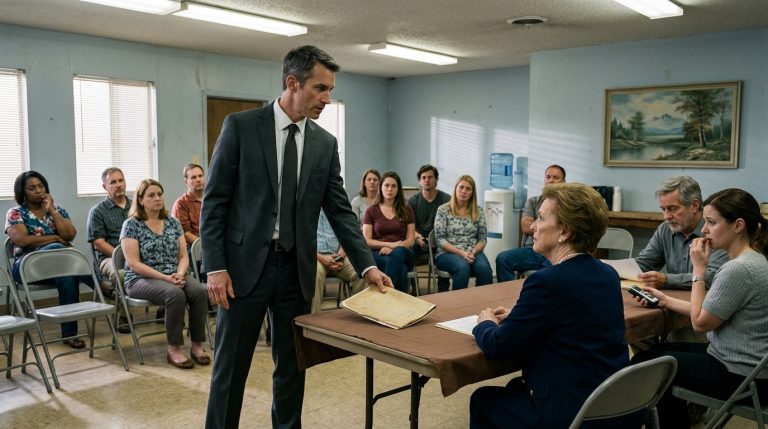
The inspector was a man of precise movements and even more precise biases. He wore a crisp, ironed shirt that looked entirely out of place against the backdrop of mud and sawdust, and he held his clipboard as if it were a talisman meant to ward off the reality of the construction site. He stood on the bottom step, looking up at the roofline with an expression of practiced clinical disdain.
Margaret didn’t move. She stood on the porch, her boots planted firmly on the new, solid cedar boards. Beside her, Vincent remained as still as a statue, his arms folded across his chest. The silence was absolute. Behind them, the house was a hive of activity, but every worker—every single one of the eight hundred men who were now part of the landscape—had frozen at the inspector’s arrival.
“Mrs. Pearson,” the inspector said, his voice clipped. “I’m here to conduct an emergency safety assessment. I’ve been informed by the city council that there is unauthorized, high-risk work being conducted on a condemned structure.”
He moved to step onto the porch, but Vincent didn’t budge. He merely tilted his head, a gesture that was at once casual and entirely immovable. The inspector stopped.
“The work is authorized,” Margaret said, her voice sounding louder than she expected in the stillness. She held up the clipboard, the pages filled with the meticulous notes Vincent had helped her assemble. “These are the permits, inspector. The county office approved the structural repairs at 06:00 this morning.”
The inspector glanced at the clipboard but didn’t reach for it. He kept his eyes fixed on the house, his gaze lingering on the newly installed rafters. “The structural integrity of this building is beyond repair. I’m marking this as a public hazard. You are ordered to cease all activity immediately and vacate the premises.”
“Look at the rafters,” Vincent said, his voice surprisingly soft. He pointed to the structural work that had been finished only moments before. “Those are load-bearing, double-thickness cedar. They’re anchored to the foundation with seismic-grade steel. That’s not a hazard. That’s a reinforcement.”
“I don’t need a lecture on construction from… individuals like you,” the inspector sneered, his eyes darting to Vincent’s vest. “I see a house that should have been leveled years ago, and I see a bunch of outsiders interfering with local property codes. This is a demolition order, not a renovation.”
Margaret felt the anger rise in her throat, a hot, searing flame that tasted of fifteen years of humiliation. She stepped forward, ignoring the way the inspector flinched.
“You see a hazard because that’s what you were told to see,” she said. “You didn’t come here to inspect a house. You came here to fulfill a political mandate. But look closer, inspector. Really look.”
She gestured to the house—the way the windows were flush with the frames, the way the roofline was now dead-level, the way the whole structure hummed with the solid, grounded energy of a building that had been brought back to life. She saw the inspector’s eyes widen, just for a fraction of a second. He saw the craftsmanship. He saw the sheer, unyielding quality of the labor. For a moment, the mask slipped.
“It doesn’t matter,” he muttered, though his voice had lost its edge. “The town council has made its decision. The order stands.”
“Then the town council is wrong,” Margaret said. She looked back toward the street. The residents were still there, huddled near the Sheriff’s cruiser, their faces tight with expectation. She realized then that the inspector didn’t matter. The stop-work order didn’t matter. What mattered was the fact that the house was standing, and it was stronger than it had been since Harold’s final day.
Vincent reached out and gently took the clipboard from Margaret. He didn’t argue. He didn’t threaten. He simply held the papers out to the inspector. “Take them. Review them. If you want to shut us down, you’ll have to do it through a judge. Until then, the work continues.”
The inspector looked at the clipboard, then at the wall of men behind them—a quiet, watchful presence that filled the yard. He realized he was alone in a space that had been reclaimed. He took the clipboard, his fingers brushing Vincent’s hand, and for a moment, the two men locked eyes. It was a silent acknowledgment: the game had changed.
“We’ll see about that,” the inspector said, turning and walking back toward his car.
As the car pulled away, the silence was shattered by the restart of the work. The hammers began again, a rhythmic, driving beat that seemed to pulse through the very earth. Margaret stood on the porch, watching the inspector disappear down the road. She knew the fight wasn’t over—there would be lawyers, there would be court dates—but she also knew that the house would stay standing.
The sun began to dip below the horizon, casting long, golden shadows across the new wood. Vincent moved to stand beside her. “He’ll be back,” he said.
“Let him come,” Margaret replied. She looked at her hands, stained with the dust of her own home. She felt a profound, quiet peace settle over her, a feeling of being finally, truly present in her own life. “We aren’t going anywhere.”
The men continued to work, their silhouettes moving against the dying light, a silent, disciplined force that had brought more than just wood and nails to her doorstep. They had brought the truth of what a community could be when it stopped being afraid. And as Margaret watched the final nails being driven, she knew that whatever happened next, she was no longer just the widow in the crumbling house on the edge of town. She was the woman who had dared to open her door, and in doing so, she had found that even the most broken things could be made whole again.
CHAPTER 8: THE HARVEST
The mobilization had ended as abruptly as it had begun. The trucks were gone, their rhythmic rumble replaced by the soft, late-afternoon chorus of birds nesting in the ponderosa pines. Margaret remained on the porch, her gaze tracking the dust that was finally beginning to settle on the road. The town of Williams was quiet, the aggressive watchfulness of the last three days having dissolved into a bewildered, lingering uncertainty. Patricia Walsh’s sedan was gone, the Sheriff’s cruiser had vacated its post, and the house stood—transformed.
It was no longer the sagging, weeping ruin that had defined her existence for a decade and a half. It was solid. The white paint was crisp against the darkening sky, the porch steps firm beneath her weight, and the roofline sharp and unwavering.
Vincent stepped out from the interior, his hands dusted with the fine white powder of new drywall. He stopped beside her, his presence no longer the commanding weight of a commander, but the quiet, weary satisfaction of a man who had completed a promise. He didn’t say anything, merely looking out at the mountains, his face caught in the dying, honey-colored light.
“It’s finished,” she said, the words feeling heavy with a sudden, overwhelming gratitude.
“The work is,” Vincent agreed, his voice rough. “Now, the rest is up to you.”
He reached into his vest, pulling out a final, small packet of documents. He placed them on the porch railing near her hand. It was the deed, the permits, and the receipts—a neat, organized stack of evidence that the house was now, legally and structurally, a home.
“They won’t come back,” Vincent said, nodding toward the road. “Not after this. The story has changed, Margaret. You didn’t just rebuild a structure; you rebuilt the narrative. This town will have to live with the fact that while they were watching from their windows, we were out here doing the work they refused to do.”
Margaret took the documents, her fingers tracing the edges. She realized then that the true revelation wasn’t the strength of the house, but the vulnerability of the town itself. Their prejudice had been a shield against their own inaction, a brittle comfort that had shattered the moment someone actually stood up and cared.
She turned to Vincent, and for the first time, she saw the man behind the patches, the individual behind the club hierarchy. “Thank you, Vincent.”
He nodded, a brief, sharp motion, and then he turned to descend the steps. The other men had already assembled, their bikes waiting in a silent, orderly line. There were no speeches, no dramatic farewells. They understood the finality of the act; they had paid the debt, and in doing so, they had redeemed a part of themselves that the world had long since discarded.
Margaret watched them go. One by one, the engines flared to life—a sound that was now familiar, almost welcoming. As Vincent mounted his bike, he paused, looking back at the house, and then at her. He touched his hand to his heart, a gesture that was small, fleeting, and entirely sincere. And then, he was gone, the entire convoy drifting down Route 66 like a river of steel, until the last red taillight vanished around the bend.
The silence that followed was profound. It wasn’t the empty, oppressive silence of her past, but a breathing, living quiet.
Margaret walked back inside. She touched the walls, the cool, smooth texture of fresh paint, the solid strength of the framing. She stopped by the framed photo of Harold, which had been cleaned and polished to a shine, and saw the reflection of her own face in the glass—older, yes, but no longer haunted.
The front door clicked shut, not with the crooked, rattling scrape it had made for years, but with a firm, solid latch. She was home.
She walked to the kitchen, where a single, small bouquet of wildflowers—gathered from the side of the road by one of the men—sat in a jar on the counter. She picked them up, the scent of the wild, mountain air filling the room. Her daughter’s voice echoed in her mind from their earlier, tearful phone call—the tentative, hesitant hope that they might actually see each other by Christmas.
She wasn’t a hero. She was a woman who had dared to be kind, and in the ripple of that single, small act, the world had reshaped itself around her. She sat down at her kitchen table, a place that was now sturdy enough to hold the weight of her life, and began to write. Not a report, not a list, but a letter. A beginning.
Outside, the first stars appeared, bright and cold above the peaks, but inside, the light was warm. The house stood solid, the foundations were deep, and for the first time in fifteen years, Margaret Pearson felt the quiet, enduring grace of a life that was truly her own. The debt was paid, the past was laid to rest, and as the night deepened, she sat in the stillness, listening to the house breathe, waiting for the future to arrive.