The Weight of Iron and Stone: How a Single Line on a Forgotten Deed Broke a Tyrant’s Grip
CHAPTER 1: THE GRAVEL PATH
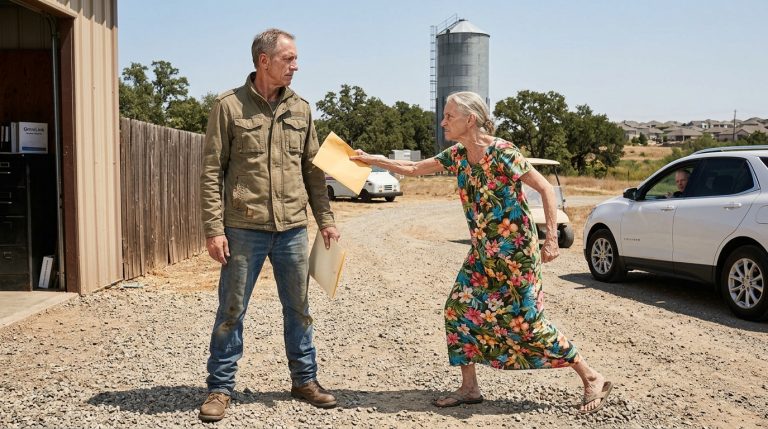
The hammer felt heavy in my hand, its steel head cold against my palm. I let it hang low by my thigh, my eyes fixed on the woman standing at the edge of my lawn with a clipboard clutched to her chest like a rusted breastplate. Her floral print dress strained against a frame built on a lifetime of suburban indulgence, and her sausage-like finger jabbed repeatedly at the long, shell-winding gravel driveway I had graded with my own sweat for the better part of a decade.
“This isn’t a request, Mr. Miller,” she said, her voice grating like dry gravel under a heavy tire. “This is a formal notification of community integration.”
Ten acres of rolling timber and quiet isolation, bought as an escape hatch after twenty years of combat engineering, suddenly felt like a shrinking perimeter. Behind her stood a nervous shadow of a man in an oversized golf shirt, studying a patch of dandelions with the frantic focus of a man trying to defuse an unexploded ordnance. He wanted the earth to open up and swallow him; I wanted the silence back.
“You’re telling me,” I said, my voice dropping into the low, flat register I used when a briefing had gone sideways, “that you, the president of a homeowners association I don’t belong to, are commandeering my private road?”
Her smile was a thin, cruel slash across powdered skin. “Language like commandeering is so unnecessarily hostile. We’re all neighbors here. The developer has determined this is the most cost-effective access route, and the HOA board has approved it. You’ll be compensated, of course. We’ll be waiving your first year’s mandatory road maintenance fee.”
The sheer audacity of it tasted like ash. A mandatory fee for the privilege of letting strangers grind their luxury sedans into my dirt. A wave of cold, calculated anger rose behind my ribs—the exact same sensation I used to get when checking a perimeter fortripwires. This wasn’t a clerical error or a neighborhood misunderstanding. It was an intrusion, deliberate and institutionalized.
She spun on her heel with the clumsy grace of a barge, her crony scurrying behind her like a stray dog caught in the headlights, and climbed into an oversized SUV that kicked up a cloud of dust before disappearing down the county road.
I turned back toward the house, the quiet evening shadows stretching long across the clearing, but the calm was gone, replaced by an uneasy hum in the air—and as I glanced down at the base of the porch post where the old property marker iron stake used to sit flush with the earth, I noticed it was missing.
CHAPTER 2: THE FIREPROOF SAFE AND THE PAPER TRAIL
The metal rim of the hole was clean, the surrounding sod neatly compressed as if pulled straight up with a pair of locking pliers rather than kicked loose by accident. Nobody loses an iron survey stake by mistake. They dig it out because it tells a story they don’t want anyone else to read.
I crouched there in the gathering dusk, my thumb brushing the loose dirt. Behind me, the house was dark, save for the pale amber glow of the kitchen window where Sarah was likely finishing up with Leo. I didn’t want to bring this inside yet. Not until I knew the shape of the trap.
I stood up, the joints in my knees popping slightly against the silence, and wiped my hand on the thigh of my work pants. The hammer still rested on the porch step where I had dropped it, its wooden handle catching the last weak sliver of sunlight slipping through the pines. The message was clear enough without words. Karen and her board weren’t just sending letters anymore; they were clearing the field markers so they could redraw the boundary lines to fit their convenience.
I walked inside, letting the screen door shut with a muffled click that didn’t rattle the frame. The kitchen smelled of baked chicken and green beans. Sarah looked up from the counter, her eyes tracing the line of my jaw before settling on my hands.
“Everything alright outside, Jack?” she asked, her voice carrying that quiet, guarded hesitation she’d picked up over the last two years as the HOA’s paper war escalated.
“Fine,” I said, keeping my voice flat. “Just checking a post.”
I didn’t tell her about the missing stake. No use front-loading a panic until I had something concrete to push back with. Instead, I kissed the top of her head as I passed, murmured something about needing to check some old records for a tractor part, and headed straight down the basement stairs.
The basement was cool and smelled of concrete and dry cedar. In the far corner, tucked beneath the heavy wooden workbench where I stored my reloading gear and spare parts, sat the heavy-duty fireproof safe. I dropped to one knee, spun the dial past the numbers with practiced rhythm—three turns left to seventy-four, two turns right to twelve, one turn left to forty-five—and felt the internal tumblers throw back with a heavy, muffled thud.
I pulled the steel door open and reached past the emergency cash box and our passports, my fingers finding the thick, fire-resistant accordion file labeled PROPERTY: 10 ACRES – ORIGINAL DEED & SURVEY.
The file was heavy, swollen with stiff legal paper, blue-line prints, and certified county stamps that smelled faintly of old ink and sealing wax. I carried it back upstairs, bypassing the kitchen entirely, and laid it out across the dark walnut dining room table.
The overhead pendant lamp threw a sharp, circle of light across the paper sea. I unclasped the elastic band holding the file shut and tipped the contents onto the wood. Deeds, title insurance policies, tax receipts, and the big, crisp blueprint from when Sarah and I first closed on the place seven years ago.
I sat down, pulled the desk lamp closer, and opened the master survey plat.
My eyes tracked the boundaries. A neat, rectangular parcel with one notched corner where the old county road met the property line. From that intersection, a thirty-foot-wide white ribbon cut straight north through a thick stand of oak trees, terminating right at the foundation of our house. The private driveway.
According to the paperwork, the ingress-egress easement was absolute. It belonged to this parcel. But easements of necessity—the legal loophole developers loved to use when they botched their civil engineering—allowed landlocked parcels to claim access across private land if no other route existed. That was the legal weapon Dewey, Cheatham, and Howe were threatening to pull out of their briefcase. They were going to argue that Willow Creek Estates Phase 4 had no other way out, making my driveway a public necessity by default.
“Not if you never owned the road to begin with,” I muttered to myself, echoing the thought that had been burning in my mind since Karen stood on my lawn.
To break their argument, I had to prove two things. First, that the developer knew damn well there was an alternative route planned on their own original master plats from the nineties. Second, that my driveway wasn’t just an easement carved out of their land—it was a separate, pre-existing historical entity that predated their subdivision entirely.
I reached deeper into the accordion file, past the documents from our purchase, digging down to the historical chain of title records the title company had handed over during closing as a stack of dusty photocopies.
The documents grew yellower, the font shifting from modern typed text to old typewriter script, and further back still, to curling, hand-signed cursive from the nineteen-fifties.
My thumb caught on the edge of an old deed transfer from 1958, when the original thousand-acre agricultural tract was first broken up into smaller parcels. The paper was thin, almost translucent, crackling slightly as I smoothed it flat under my palm.
I grabbed a yellow legal pad and a mechanical pencil, leaning in close under the light. If I was going to beat them, I couldn’t rely on outrage. I had to build a logistical timeline, map every survey marker, and trace every parcel split back to the source.
The house upstairs grew quiet. A floorboard creaked overhead as Sarah walked Leo back to his room. Outside, the wind picked up, brushing pine needles against the side of the house like dry paper fingers. I didn’t look up. I kept tracing the legal descriptions, word by word, hunting for the single loose thread that would unravel their entire corporate kingdom.
CHAPTER 3: THE DUSTY ARCHIVES OF THE COUNTY RECORDS OFFICE
The mechanical pencil lead snapped with a sharp, metallic ping against the pulp of the legal pad. I didn’t curse. I just reached into the cardboard box at my elbow, pulled out a fresh pencil, and kept writing.
The clock on the kitchen wall ticked past eleven. Upstairs, the house had settled entirely into that deep, heavy quiet that only rural nights can produce. But down here, surrounded by the physical weight of deeds, liens, and surveyor’s notes, my mind was running like a cold-soaked diesel engine trying to turn over on a sub-zero morning.
The missing iron boundary stake from the edge of my lawn kept flickering at the edge of my thoughts. It was a tactical indicator. Someone had crossed the perimeter not to steal timber or scout livestock, but to alter the physical reference points of the land itself. If you pull the stakes, you remove the physical proof of where one man’s dirt ends and another’s begins. It was a petty, aggressive move, born of an arrogance that assumed paper trails could be manipulated just as easily as physical markers.
I closed the 1958 document, stacking it squarely atop the modern title policy. I had enough fragments to know the structure of their bluff, but fragments wouldn’t hold up if Dewey, Cheatham, and Howe filed an injunction in county court. I needed the primary source documents—the raw, unedited plats from the county archives before the digital scans had even been processed.
The county records office didn’t open until eight in the morning. That gave me six hours until sunrise, and zero hours of sleep worth logging.
When the first thin, gray light began to bleed through the eastern tree line, silhouetting the bare oak branches against a washed-out sky, I was already pulling my boots on by the back door. I left a short note for Sarah on the kitchen counter—Running into town for parts, back by noon—keeping it light enough to mask the hard edge in my chest.
The drive into town took twenty minutes down winding county blacktops slickened by morning condensation. The county courthouse stood at the center of the old square, a square-block monolith of soot-stained limestone and tall, narrow windows that looked like they hadn’t been washed since the Eisenhower administration.
Inside, the air smelled exactly like every municipal archive on earth: a dense, suffocating blend of decaying cellulose, floor wax, and damp plaster. The fluorescent tubes overhead hummed with a low, erratic buzz that vibrated right behind the bridge of my nose.
The front counter was empty except for a heavy brass bell and a plastic sign reading BRB. I leaned against the scarred mahogany wood, my fingers tapping a steady rhythm against the edge. A moment later, a door behind the partition swung open, and a woman with graying hair pinned up in a loose bun stepped out, her wire-rimmed glasses perched precariously on the very tip of her nose.
“If you’re looking for marriage licenses, room two-b is down the hall,” she said, her voice dry as autumn leaves. Then she looked closer, adjusting her glasses up the bridge of her nose. “Wait. You’re the one who called about the old Willow Creek acreage last week.”
“Jack Miller,” I said, offering a tight, polite nod. “I need access to the pre-development parcel maps from nineteen-ninety-eight, and whatever subdivision plats are filed under book twelve.”
She didn’t move immediately. Instead, she studied my face with the practiced, calculating gaze of someone who had spent thirty years watching neighbors tear each other apart over five feet of scrub brush. A slow, knowing smirk touched the corners of her mouth.
“Willow Creek,” she murmured, leaning her forearms against the counter. “Marge told me about you. Said you’ve got the HOA president’s knickers in a permanent twist. You’re looking for the original tract division before the developers laid out their phase four, aren’t you?”
“I’m looking for anything that shows who owns the dirt under my tires,” I replied evenly.
She turned without another word, her rubber-soled shoes squeaking against the linoleum floor as she disappeared into the maze of steel shelving behind the partition. A minute later, she returned carrying a heavy, gray cardboard banker’s box that looked like it weighed fifty pounds. She thumped it down onto the counter with a heavy cloud of dust that caught the weak morning sunlight pouring through the high windows.
“Everything from the original nineteen-ninety-eight incorporation and the subsequent phase filings is in here,” she said, tapping the lid. “Including the surveyor’s field notes that the developer tried to seal thirty years ago when they realized their initial grading cut across a protected watershed. Take your time, soldier. Nobody else is coming in here today.”
I pulled the box toward me, feeling the rough, fibrous cardboard under my palms. The paper inside wasn’t just a collection of legal briefs; it was a map of human greed, shortcuts, and administrative oversight waiting to be dismantled piece by piece.
I unlatched the cardboard flap, reached inside, and pulled out the topmost rolled blue-line print, letting the heavy paper unroll across the counter with a sharp, crackling snap.
CHAPTER 4: THE 1950S PLAT MAP AND THE BOMBSHELL CLAUSE
The blueprint settled onto the wood with a heavy, dry whisper, its edges curling upward against the restraining weight of my calloused thumbs.
Across the counter, the clerk watched over the rim of her wire-rimmed glasses, her fingers steepled beneath her chin. She didn’t say a word, recognizing the focused, deliberate stillness of a man who had spent decades reading terrain maps before moving infantry across a grid.
“Nineteen-ninety-eight initial plat,” I said, my voice barely carrying over the hum of the overhead lights. My finger traced the thick black border lines defining the original agricultural tract before the developer carved it into uniform, cookie-cutter segments. “Phase one and two went in along the southern boundary. They used the main highway corridor like they were supposed to.”
“They did,” the clerk agreed, leaning in slightly. “Until the excavation costs on the northern ridge went over budget. That’s when the engineering firm started looking for a shortcut to push phase three and four through.”
I tracked my finger north, past the neat squares of beige colonials, up toward the dense patch of mature oak trees marking the edge of my own land. The lines on the blue-print grew fainter here, rendered in hand-inked annotations that looked older than the primary print.
That was when I noticed it. A small, triangular patch of cross-hatching where the temporary construction route crossed the southeastern border of my ten acres. It wasn’t just a border touch; it was an intentional, deep bite into the corner of my property line. For over a decade, their heavy machinery had been rolling across dirt that belonged on my side of the survey pins.
My jaw tightened. That explained the missing boundary stake from the previous evening. Someone on the board—or the developer’s side—had known this map existed. They knew that if I pulled these records, their entire “easement of necessity” argument would instantly collapse under the weight of an unacknowledged, long-standing trespass violation.
“They didn’t just want my driveway,” I murmured, staring at the intersecting ink lines. “They needed it to cover up the fact that they’ve been illegally using my back corner as a haul road for twelve years.”
“And if you don’t raise a flag, nobody looks,” the clerk said softly, reaching under the counter to pull out a yellow highlighter. “But you’re looking. And the county archive doesn’t un-print history just because a developer hires a high-priced law firm from the city.”
She slid a heavy glass magnifying loupe across the counter toward me. I picked it up, feeling its cold brass rim, and lowered it over the dense block of text printed in the lower right-hand corner of the original 1958 master deed reference.
The ink was old, slightly faded to a dark plum color, but the legal description remained painfully clear. I read the words once, then twice, letting the technical phrasing settle into my mind like coordinates on a target grid.
Save and excepting a strip of land thirty feet in width for the purpose of a roadway, running from the county road north along the westernmost boundary line…
It wasn’t an easement granted to the surrounding land; it was an explicit carve-out withheld from it. The road had never belonged to the massive farm that eventually became Willow Creek Estates. It had been legally severed from that parcel before the first bulldozer ever broke ground in the valley.
I set the magnifying glass down on the counter. The metal clinked against the mahogany with a sharp, final sound. The defensive wall was solid, but a good engineer doesn’t just sit in a bunker; he prepares the counter-offensive.
“I need certified copies of everything in this box,” I said, looking up at the clerk. “Every single page, stamped and signed by the county auditor.”
She smiled, a thin, approving grin, and reached for her rubber stamp. “Consider it done, soldier. Let’s see how much their corporate lawyers charge to argue with a fifty-year-old ink stamp.”
CHAPTER 5: THE ENCOUNTER AT 112 WILLOW WAY WITH ARTHUR ABERNATHY
I tucked the thick bundle of stamped records into my canvas mailbag, zipped it shut with a sharp, metallic hiss, and walked out of the county records office into the glare of midday. The air outside was dry, tasting faintly of exhaust and sun-baked asphalt.
The documents were secure, but a stack of paper sitting in a canvas bag wouldn’t do a damn bit of good if it stayed locked in my basement. Karen and her board operated in the open, rallying homeowners with manufactured panic and loud proclamations in community spaces. To break that cycle, I needed an insider who understood the board’s mechanics better than Karen ever would—someone who had spent a career reading the fine print of corporate bylaws and municipal ordinances.
I drove straight from the courthouse toward the tidy, suburban grid of Willow Creek Estates. The transition from my rolling ten-acre timber buffer to the neighborhood’s cookie-colonials felt like stepping across a tactical boundary line. Every lawn was a uniform shade of emerald green; every driveway looked as though it had been swept with a broom that very morning.
It didn’t take long to find 112 Willow Way. A tasteful, beige-brick colonial distinguished from its identical neighbors only by a small, elegant stone bird bath sitting near a neatly trimmed hedge of boxwoods.
I cut the engine, the truck’s diesel purr dying down into a soft, cooling tick under the hood. I grabbed the canvas bag, stepped out onto the paved sidewalk, and walked up the front path.
Before my knuckles even brushed the brass knocker, the heavy wooden door swung open. A man in his late seventies stood in the entryway, wearing a tweed jacket with leather patches at the elbows and a pair of sharp, intelligent eyes that sized me up in a single, fluid sweep. He didn’t look surprised; if anything, he looked like a man who had been waiting for a specific report to land on his desk for two years.
“Mr. Miller,” Arthur Abernathy said, his voice dry and steady. “I wondered when the defiant landowner was going to make his way past the subdivision sign. Come in. The coffee’s still hot.”
I stepped across the threshold, the rich smell of roasted beans and old paper washing over me. The interior of the house was a stark contrast to the sterile perfection outside—walls lined with dark mahogany bookshelves overflowing with law volumes, tactical maps, and worn leather binders.
We sat down in a pair of wingback chairs flanking a polished coffee table. Arthur didn’t waste time on pleasantries. He poured two mugs from a ceramic French press, slid one across to me, and leaned back, steepling his fingers.
“Word travels fast in a place where everyone’s windows face each other,” Arthur said, a dry smile touching the corners of his mouth. “Karen has been calling emergency executive sessions all morning. She’s claiming you’re planning to barricade the road and cut off their emergency services by the end of the week.”
“She knows damn well I’m not running a blockade,” I said, taking a slow sip of the dark, bitter coffee. “I’m running an audit.”
I unzipped the canvas bag and slid the top certified copy across the polished wood between us. It was the original 1958 deed extract, the one with the highlighted clause—Save and excepting a strip of land thirty feet in width for the purpose of a roadway…
Arthur adjusted his reading glasses, leaned forward under the warm amber glow of a desk lamp, and began to read. For a long minute, the only sound in the room was the heavy tick of a grandfather clock in the hallway. Then, a low, appreciative whistle escaped his lips.
“Good lord,” he murmured, looking up over the rim of his glasses. “You didn’t just find a crack in their armor, Jack. You found the main structural load-bearing pillar.”
“They claim an easement of necessity,” I said, keeping my tone flat and controlled. “Because their phase four expansion has no alternative high-volume access route.”
“They can claim whatever they want to pacify the homeowners at the next meeting,” Arthur replied, tapping a finger against the paper. “But a court of law requires a clean chain of title. And this document proves their developer bought a landlocked parcel and deliberately ignored it for decades, assuming nobody would ever check the dust in the county basement.”
He leaned back, his eyes narrowing with a sharp, tactical focus. “If you send this to their regular legal counsel, Karen will spin it. She’ll tell the neighborhood you’re a predatory outsider trying to extort them. We need to weaponize this information correctly. We need to let her walk right into the trap of her own making.”
I looked at the old lawyer, seeing the quiet, unyielding resolve in his eyes. The perimeter was set. The logistics were locked. All that remained was waiting for the enemy to make their next move.
CHAPTER 6: GATHERING THE DOSSIER OF DISCONTENT IN SECRET
The coffee in my mug had grown lukewarm, but I didn’t drink it. My fingers remained laced around the ceramic, feeling its solid, unyielding weight while my eyes tracked the notes Arthur was scribbling onto a clean legal pad.
“If we move too fast, Karen will simply dig in and rally the board to authorize an emergency litigation fund before anyone can inspect the books,” Arthur muttered, his pen scratching a steady, rhythmic line across the paper. “We need a wider perimeter. We need the people who have already felt the flat side of her blade.”
“They’re already out there,” I said, leaning back into the worn leather of the wingback chair. “The young couple with the basketball hoop, the elderly widow on Elm Street facing liens over her rose garden. They aren’t looking for a war, Arthur. They’re looking for an exit strategy from a neighborhood that feels more like an occupied zone.”
Arthur stopped writing, looking up over his glasses with a sharp, pragmatic gleam in his eye. “Then we don’t give them a battle cry. We give them a platform. Over the next week, while you maintain your perimeter here on the acreage, I’ll quietly reach out to three key homeowners. People the board trusts, who are quietly at their breaking point. We collect their written grievances—every arbitrary fine, every threat of foreclosure over a non-compliant mailbox or unapproved paint swatch.”
“Keep it off the digital message boards,” I warned, my military instincts kicking in. “Karen monitors those channels like a hawk. If she smells an internal alignment forming, she’ll lock down communication.”
“Encrypted text messages and face-to-face meetings over coffee in town,” Arthur agreed, tapping his pen against the pad. “Low signature. High impact. And while we build the civilian dossier from the inside, you secure the external logistics.”
“Top Rodriguez and the boys from the old unit are on standby,” I said quietly. “They don’t need to cross the property line unless things go sideways. But having a few experienced heads ready to bear witness if the board tries a strong-arm maneuver keeps the rules honest.”
Arthur offered a dry, thin smile, folding the legal pad closed with a crisp slap. “A quiet coalition built on procedural law and documented overreach. Karen thinks she’s running an empire, Jack, but empires built on petty fines and stolen boundaries always collapse the moment someone refuses to pay the toll.”
I stood up, leaving the lukewarm coffee untouched, and zipped the canvas bag containing the certified county records. The sun had dipped lower through Arthur’s study window, casting long, desaturated shadows across the mahogany floorboards. The blueprint for the counter-offensive was drawn. All that remained was executing the steps without a single miscalculation.
CHAPTER 7: DELIVERING THE ITEMIZED INVOICE AND LEGAL COUNTERNOTICE
The printer on the sideboard hummed, spitting out the final page of text with a rhythmic, mechanical clatter. I reached down, pulled the warm paper free, and aligned it squarely against the stack of certified documents sitting on the walnut table.
Arthur had spent the last forty-eight hours helping me refine the language, balancing cold legal precision with undeniable historical fact. We weren’t just issuing a refusal; we were handing Karen an itemized structural reckoning.
The letter was structured like an engineering brief. It opened with the clean, unimpeachable boundaries of the nineteen-fifty-eight deed, quoting the save-and-excepting clause verbatim to establish that the thirty-foot gravel road had never belonged to the original agricultural tract that became Willow Creek Estates. From there, it transitioned directly into the tactical core of our counter-offensive: the twelve-year history of unauthorized heavy equipment use along the southeastern property clipping.
We didn’t estimate the damages. We calculated them using standard commercial land-use rates for heavy transport corridors in the county, compounding the total over twelve years of continuous trespass. The final figure—two hundred forty-seven thousand, five hundred eighty-three dollars and fourteen cents—stared up from the center of the page in crisp, bold type.
It was a financial grenade designed to blow up the board’s fragile budget before they could even file their first injunction.
I slid the multipage document into a heavy manila envelope, sealed the adhesive flap with the flat of my thumb, and pressed a certified mail label across the seam. Beside it lay the secondary proposal: two distinct paths for the HOA. Option A required them to pay the backdated invoice in full, cease all traffic across the private road permanently, and face the county environmental hurdles of building an alternative route from scratch. Option B offered a strictly regulated commercial lease agreement at fifteen thousand dollars a month, backed by a five-million-dollar liability policy and complete architectural autonomy for every homeowner trapped under their covenants.
The terms were exorbitant, deliberate, and entirely non-negotiable. They were built to force Karen into a corner where her only option was to reject reason in favor of outrage.
I picked up my jacket from the back of the chair, pulled it on against the evening chill, and walked out to the truck. The gravel road crunched beneath my boots, dark and solid under the canopy of oaks. Twenty minutes later, I stood inside the local post office, handing the heavy, barcode-tracked envelope across the counter to the postal clerk.
“Certified mail, return receipt requested,” I said, sliding my driver’s license across for verification.
The clerk scanned the barcode, the machine letting out a sharp, digital chirp. “That’s going straight to the Willow Creek administrative office, isn’t it?” she asked, her eyes flicking up to meet mine with a knowing glint.
“It is,” I said.
“They’re not going to like that envelope very much, Mr. Miller.”
“That,” I replied, turning toward the door as the heavy latch clicked shut behind me, “is entirely the point.”
CHAPTER 8: THE EMERGENCY CLUBHOUSE MEETING AND THE ASSEMBLED VETERANS
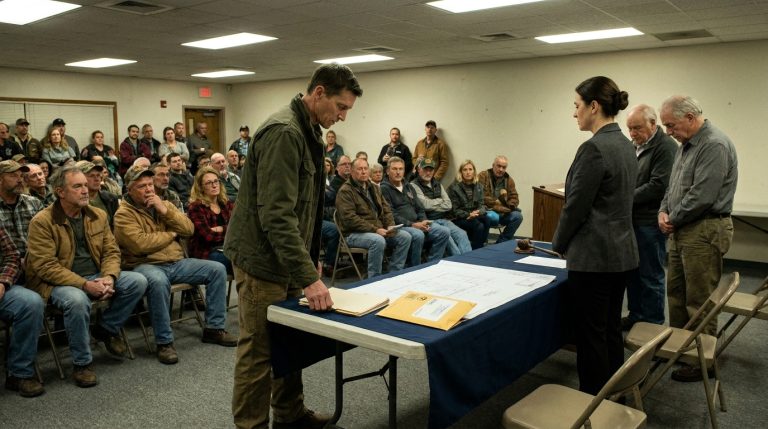
The air inside the Willow Creek community clubhouse hummed with an electric, volatile tension that could be felt before I even stepped past the double glass doors. Every parking stall in the lot was crammed with sedans and SUVs, their bumpers nearly touching in the scramble for space.
Inside, the room was packed to absolute capacity. Homeowners lined the side walls, standing shoulder-to-shoulder beneath the recessed ceiling lights. At the front, flanked by her nervous-looking proxy and the association treasurer, sat Karen. She wore a power suit the color of a fresh stoplight, her fingers gripping a microphone with a white-knuckled rigidity that betrayed the rehearsed smile plastered across her face.
I didn’t take a seat in the middle rows. Accompanied by Arthur Abernathy, who walked with the measured stride of an old trial lawyer heading into cross-examination, I moved down the center aisle toward the front row. Right behind us marched Top Rodriguez and five other veterans from my old combat engineering unit, men built like masonry blocks, wearing their dark VFW jackets. They didn’t speak. They didn’t loom or threaten. They simply filled the empty space in the third row, bringing an absolute, unshakeable gravity into a room that had spent two years running on suburban hysteria.
Karen tapped the microphone, the feedback wailing a sharp, metallic screech through the speakers that made the front rows wince.
“We have called this emergency session,” Karen announced, her voice trembling just enough to reveal the panic beneath the lacquer, “to address an unprecedented act of aggression from an outside property owner. Mr. Miller has chosen to launch a predatory assault on our community, demanding extortionate sums and threatening our very access.”
Murmurs rippled through the packed room like wind across dry grass. Heads turned toward the front row. I kept my face flat, my eyes fixed forward, letting the silence do the heavy lifting.
“He is demanding nearly a quarter of a million dollars,” Karen continued, her voice rising toward a theatrical crescendo, “and a monthly tribute just so we can drive to our own homes. The board has consulted our legal counsel, and we refuse to bow to blackmail. Therefore, we are proposing an immediate special assessment of five hundred dollars per household to fund our emergency litigation defense!”
The room erupted. Shouts bounced off the drywall. A man near the back stood up, his face red with frustration. “Five hundred dollars? Why are we paying for a legal battle over a road the developer should have secured in the first place?”
Karen slammed her hand down on the folding table, her face darkening. “Because the developer’s corporation is dissolved! The burden falls to us as a unified community to protect our property values!”
Arthur Abernathy stood up slowly. His joints didn’t creak; his posture was straight, his tweed jacket settling perfectly across his shoulders. He didn’t yell. He simply spoke with the quiet, authoritative resonance of a man who had spent forty years dismantling bad arguments in federal court.
“Karen,” Arthur said, cutting through the rising noise like a razor. “Before this community votes on a special assessment to fund a personal crusade, I believe the homeowners have a right to hear from the property owner directly—and to examine the actual documents your board has tried to keep locked away.”
Karen’s expression tightened into a hard, vicious line. “Mr. Miller is not a member of this association, Arthur. He has no standing here.”
“Under our own association bylaws,” Arthur replied smoothly, pulling a printed copy of the governance charter from his pocket, “any individual targeted by proposed board action has an absolute right to address the floor. Furthermore, as a dues-paying member in good standing, I yield my speaking time to him.”
The crowd murmured its immediate agreement. The mood in the room had shifted; the collective panic was turning into something much colder and more dangerous for the woman at the podium.
Karen realized she had lost control of the floor. With a look of venomous contempt, she sneered, “Fine. Let the outsider speak. Let’s hear what lies he’s prepared to spin to justify stealing your road.”
I stood up, buttoned my jacket, and walked past the front row toward the projector screen set up beside the podium. The perimeter was drawn. The evidence was in the bag. It was time to show them what was written underneath the polished veneer of Willow Creek Estates.
CHAPTER 9: PROJECTING THE TRUTH ACROSS THE BOARDROOM WALL
I didn’t step up to the podium. I walked directly past Karen, my boots striking the linoleum floor with a steady, deliberate cadence that carried across the hushed room, and reached over to flip on the projector switch.
A sharp, rectangular block of white light slammed onto the projection screen behind the board’s table, illuminating the room in a pale, sterile glow. With a few clicks of the connected laptop, the first document filled the screen—a crisp, high-resolution scan of the 1998 Willow Creek master development plan.
The murmurs in the crowd died down instantly. Every eye shifted from Karen’s rigid, crimson-suited figure to the glowing blue lines stretching across the wall.
“This,” I said, my voice low, steady, and unhurried, “is the original master plan filed when your subdivision was first approved over twenty years ago. Look closely at the southern boundary. This was the designated, platted grand entrance connecting directly to the main highway.”
I used the laser pointer to trace a clean, tree-lined corridor looping away from the residential blocks.
“For phases one and two, this is the route the developers used,” I continued, letting the facts hang in the quiet space of the room. “But when they broke ground on phase three and four, construction costs on the northern ridge spiked. Instead of building what was promised on the blueprint, the developer looked for a shortcut.”
I clicked to the next slide. The image shifted to the survey map of my acreage, highlighting the temporary haul route that clipped the far southeastern corner of my property line. The red boundary lines cut a jagged, unapproved scar through the timber.
“For twelve years,” I said, turning my head slightly to look directly at the pale, tight-jawed faces of the board members seated at the long table, “heavy construction traffic, grading equipment, and contractor fleets have been rolling across dirt that does not belong to your subdivision. That isn’t an accident. That is an unacknowledged, twelve-year trespass.”
A sharp intake of breath rippled through the middle rows. Heads snapped toward the treasurer, whose eyes darted nervously toward Karen.
“He’s altering the documents,” Karen shrieked suddenly, her voice cracking as she half-rose from her chair, grabbing the edge of the table with white knuckles. “That’s a fabricated map! Don’t listen to him—he’s trying to manufacture a pretext to lock us out of our homes!”
Nobody moved. Nobody murmured in agreement. The theater of her outrage had collided with the hard, blue-line reality of public records, and the friction was tearing her narrative apart.
I didn’t shout back. I simply clicked to the final slide—the translucent, yellowed extract of the 1958 deed from the county archives, complete with the auditor’s raised seal and original ink stamp.
“Your president told you this evening that I am trying to steal your road,” I said, stepping back so the entire room could read the text glowing in white and gray behind me. “The truth, recorded at the county courthouse sixty years before a single one of these houses was built, is that this road was never part of your parcel to begin with. The foundational deed explicitly states: Save and excepting a strip of land thirty feet in width for the purpose of a roadway. Your subdivision was built around my driveway, not on it.”
The silence in the room was absolute. You could hear the low, rhythmic whir of the projector’s cooling fan spinning against the casing.
Arthur Abernathy stood up near the front row, his voice carrying effortlessly across the quiet hall. “I have personally reviewed the certified copies of these records, ladies and gentlemen. The board didn’t just fail to do a title search—they attempted to pass off a developer’s engineering shortcut as a legal right, and now they want you to fund a five-hundred-dollar special assessment to cover up their own negligence.”
The dam broke.
Shouts of disbelief and fury erupted from the homeowners who had spent two years paying fines for unapproved garden gnomes and non-compliant paint colors, only to discover they were being asked to bankroll a fraudulent lawsuit.
Karen stood frozen at the head of the table, her red power suit suddenly looking less like armor and more like a uniform of defeat as the community she had ruled through petty tyranny turned its collective back on her.
CHAPTER 10: THE TOW TRUCK CONFRONTATION BY THE WORKSHOP
Two days after the clubhouse mutiny, the air on the ten-acre homestead was too quiet. The kind of quiet that precedes a drop in barometric pressure.
I was in the open-sided timber workshop attached to the barn, my boots planted on the concrete floor, holding an electric angle grinder steady against the edge of a steel grading blade. Sparks showered outward in a tight, brilliant orange fan, smelling sharply of hot iron and friction. Outside, the midday sun beat down on the long, packed-gravel drive, turning the dust to powder.
Then the sound cut through the whine of the motor—a deep, heavy-throated diesel rumble that didn’t belong to a neighbor’s car or a delivery van.
I cut the power switch. The grinder’s wheel whined down, its metallic screech fading into silence, leaving only the sound of heavy air brakes hissing against asphalt out by the county road turnoff.
I set the tool down on the workbench, wiped my palms on my shop rag, and walked out into the clearing.
Framed against the backdrop of tall oak trees sat an industrial-sized commercial tow truck, its dual rear wheels chewing up the edge of my grass as it maneuvered backward into the clearing next to the barn. And standing right beside the driver’s side door, directing the heavy rig with sharp, imperious stabs of her hand, was Karen.
She wasn’t wearing her red power suit today. She wore a heavy beige trench coat despite the heat, her face pinched into a mask of frantic, vindictive desperation.
And parked right where she was pointing, resting comfortably on the gravel and grass well within my property lines, was my restored 1968 Ford F-100 truck. The old machine I had spent five years pulling apart and putting back together bolt by bolt.
I didn’t slow down as I walked toward them. My boots crunched hard into the gravel. “What in hell do you think you’re doing?”
The tow truck driver, a burly man in a grease-stained jumpsuit, stopped unhooking his heavy steel rigging chains and glanced between us, his brow furrowing in deep hesitation.
Karen spun around, her eyes wide and glittering with a terrifying level of self-righteous fury. “I am enforcing community integration regulations, Mr. Miller! This is a final notice of violation for an inoperable, unlicensed vehicle stored in public view. According to association bylaws, the board has authorized me to have it removed and impounded at the owner’s expense!”
“You have no authority here,” I roared, the calm discipline finally cracking under the weight of her sheer, delusional audacity. “This is not your subdivision. That is my private land, and that is my private vehicle.”
“Your private land is subject to the aesthetic covenants of the access corridor!” she shrieked back, her voice climbing into a harsh, brittle screech. “Now move aside before I have you charged with obstruction of a municipal-adjacent order!”
The driver dropped the chain, holding his hands up defensively. “Ma’am, look—I need to see a signed sheriff’s impound order or a valid county writ before I hook up to any vehicle on private property. I’m not touching it without proper paperwork.”
“I am the authority here!” Karen screamed, her face flushing a dark, mottled purple. “I am the president of the board! Hook it up right now!”
I pulled my phone from my pocket, my thumb swiping straight to the keypad without a second wasted. I didn’t argue with her. You don’t argue with a person who has lost all contact with reality; you lock the perimeter.
“Sheriff’s department,” I said into the receiver as the call connected. “I need to report an active criminal trespass and an attempted vehicle seizure at 1550 County Road 6. The perpetrator is on site and refusing to leave.”
Karen watched me make the call, her chest heaving beneath the trench coat, her mind trapped in a loop where she still believed her title as HOA president gave her sovereign immunity over the laws of the state. It was the final, desperate twitch of a cornered beast refusing to accept that the cage had already locked shut.
CHAPTER 11: DEPUTY MILLER THE DEED AND THE FINAL EJECTION
The deputy stepped out of his cruiser with a calm, deliberate slowness that belonged to a man who had seen a hundred neighborhood disputes explode over four feet of disputed fence line. He was tall, his broad-brimmed campaign hat tilted slightly back as he surveyed the scene: the massive industrial tow truck idling on the gravel, my old Ford F-100 sitting safely on the grass, and Karen vibrating with a frantic, unhinged energy beside her trench coat.
“Morning, folks,” Deputy Miller said, his voice level and entirely devoid of panic. He walked up slowly, resting a thumb near his duty belt. “Dispatch mentioned an active trespass call at this address. Who’s in charge here?”
Karen seized the moment, lunging forward with her paperwork outstretched like a shield. “Officer, thank goodness you’re arrived. I am the president of the Willow Creek Homeowners Association. This individual is obstructing a legally mandated community enforcement action. I have issued a final notice of violation for an abandoned, unlicensed vehicle, and we are exercising our right to impound it.”
The deputy didn’t take the paper immediately. Instead, he looked past her at the sprawling timber line, the wide gravel sweep of the driveway, and then back down at Karen’s face.
“Ma’am,” the deputy said quietly, “is this specific parcel part of the Willow Creek subdivision plat?”
“It’s adjacent, and our governing covenants cover the shared access corridor!” she snapped, her voice climbing in pitch. “The association maintains jurisdiction over all traffic visibility and aesthetic standards affecting our community’s property values!”
I didn’t shout. I reached into my jacket pocket, pulled out the certified copy of the 1958 deed extract with the auditor’s seal and the highlighted boundary text, and handed it across to the deputy.
“Jack Miller, officer,” I said evenly. “This is my property, my workshop, and my vehicle. That woman is trespassing, and she attempted to direct a commercial towing service to steal my property off my land.”
Deputy Miller took the document. He unfolded the heavy, stiff paper under the morning sun, his eyes tracking the old typewriter script and the margins marked by the county recorder’s office. He read the save-and-excepting clause twice, his expression hardening as the legal reality locked into place.
He looked up from the page, his gaze sliding slowly from Karen to the tow truck driver, who was leaning against his cabin with his arms crossed and his hands tucked safely in his pockets.
“Ma’am,” Deputy Miller said, his tone dropping into a cold, professional register. “according to this official county record filed decades before your subdivision was ever surveyed, not only is this gentleman’s property entirely outside your association’s jurisdiction, but the roadway you drove in on is his private property.”
Karen’s jaw dropped. The words seemed to bounce off her as if she were speaking a foreign language. “That… that’s impossible. The developer’s transition agreements—”
“Your developer’s agreements don’t override recorded state property law,” the deputy interrupted, his voice absolute. “You are standing on private land without authorization. You have no legal standing to issue violations, and you certainly have no authority to tow vehicles here. I am going to ask you and this towing service to pack up your equipment and leave the premises immediately.”
“I am the president of this board!” Karen shrieked, her face twisting into a mask of pure, desperate fury as her final pillar of authority crumbled into dust. “You can’t do this! Arrest him! Arrest him for obstruction!”
“Ma’am,” Deputy Miller said, his hand resting firmly on his belt as he stepped closer. “If you do not get back in your vehicle and leave this property right now, I will place you under arrest for criminal trespass.”
The threat hung in the heavy summer air like a drawn blade.
The tow truck driver didn’t wait for another syllable. He climbed back into his cab with a heavy thud of his boots, slammed the door, and threw the rig into reverse, kicking up a cloud of gravel as he turned his massive dual-axle wheels around and bolted down the drive.
Karen stood frozen for three long seconds, her mouth opening and closing soundlessly, before a strangled, broken sob escaped her throat. She spun on her heel, marched stiffly back to her SUV parked behind the cruiser, and slammed the door hard enough to rattle the glass.
Deputy Miller watched her tires spin loose gravel as she sped down the winding drive behind the tow truck. He folded the copy of the deed, handed it back to me with a respectful nod, and tipped the brim of his hat.
“Looks like you’ve got the perimeter secure, Mr. Miller,” he said. “Have a good day.”
He turned back to his cruiser, put it in drive, and escorted them off the property. I stood by the edge of my workshop, the morning sun warming the steel of my truck’s fender, watching the dust settle into the quiet pines.
CHAPTER 12: THE RESURFACED ROAD AND THE QUIET MORNING PORCH
The dust kicked up by the cruiser settled slowly back onto the packed earth, leaving the air clean and smelling faintly of sun-warmed pine and dry gravel. I stood motionless beside my restored Ford F-100, watching the empty turnoff where the county blacktop met the edge of our timber line. The perimeter was clear. The threat had collapsed under the weight of its own bad math.
Two weeks after Karen and her board resigned in disgrace ahead of the recall vote, the physical landscape of the valley began to heal. Arthur Abernathy had been elected president of the interim homeowners association by a landslide, and his first official act wasn’t to issue a memo or levy a fine—it was to walk up my driveway without a briefcase, seeking a permanent foundation.
We sat at the same wooden dining table where I had unrolled the original records weeks before.
“We need a permanent solution, Jack,” Arthur had said, leaning back with a mug of coffee in his hand. “Your initial demand of fifteen thousand a month was a fair wake-up call, but it’s not something the community can sustain long-term. We want to do this right.”
I didn’t want to choke the neighborhood, and I certainly had no interest in turning my driveway into a tollbooth. My fight had never been against the families with basketball hoops or the elderly widow tending her roses; it had been against an artificial tyranny built on inflated authority.
We drafted a clean, equitable resolution. The HOA paid a modest, one-off settlement of fifty thousand dollars—not as a penalty, but placed directly into a jointly managed trust fund dedicated exclusively to the grading, drainage, and snow removal of the road in perpetuity. In exchange, I granted a formal, restricted residential easement. Commercial vehicles and heavy construction traffic were strictly barred from cutting across the property, and the association’s bylaws were permanently stripped of their architectural overreach. The petty committees dictating paint colors, garden layouts, and play equipment were dissolved forever.
The first project funded by the new trust was already complete. My old friend Top Rodriguez had brought his heavy grading equipment up from the county seat, laying down a deep, perfectly sloped bed of crushed stone and packing it tight with a steamroller.
Now, stepping back onto the porch, I set my mug of coffee down on the freshly stained cedar railing. The gravel drive below looked immaculate—dark gray, solid, and smooth, catching the early morning sunlight as it filtered through the high canopy of oak trees.
Sarah stepped out onto the porch behind me, her bare feet making a soft scuff against the wood planking. She wrapped her arms around my waist, resting her cheek against my shoulder, looking out at the open expanse of our ten acres.
“It’s quiet again,” she whispered, her voice carrying a profound, settling relief.
“It’s more than quiet,” I said, reaching down to trace the smooth edge of the newly repaired porch railing. “It’s secure.”
Down in the yard, Leo’s laughter echoed from the wooden treehouse he and I had built together, ringing clear and bright through the timber. Out on the main access road, a neighbor in a sedan drove past, offering a friendly, unhurried wave through the windshield before turning toward town. I raised a hand in return, watching them go without a flicker of tension in my chest.
Karen and her husband had sold their beige colonial at a steep loss days after the board dissolved, packing their belongings into a moving truck and vanishing into the anonymous sprawl of the city, unable to bear the weight of a community that no longer looked at them with fear. They were gone, leaving behind only the quiet proof that paper tigers cannot stand against unyielding truth.
I picked up my coffee, taking a slow sip as the morning breeze rustled the pine needles overhead. The war was over. The land was our own, anchored in iron, stone, and the quiet dignity of a single line written seventy years ago on a piece of paper that nobody had bothered to read until the ground beneath them began to give way.