A Hundred Years of Stone Against the Erosion of Power, Property, and Petty Tyranny
CHAPTER 1: THE FIRST NOTICE AND THE COLD CALCULATION
The clippers stayed in my hand, the metal jaws locked around a thick, woody stem that didn’t want to yield.
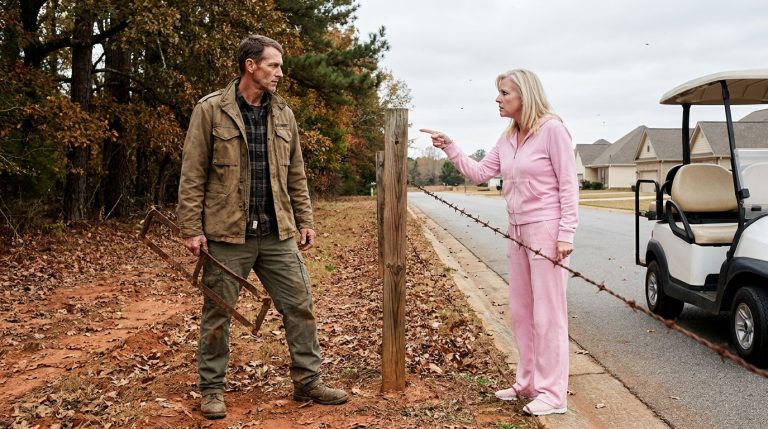
Across the property line, the pink tracksuit stood like a neon flare against the muted grays of the November subdivision. Karen didn’t blink as she delivered the ultimatum, her voice carrying that sharp, metallic grating edge common to people who spent their entire lives managing committees and weaponizing minor bylaws. Behind her, the hydraulic arms of the loader hissed, coughing a small cloud of blue exhaust into the crisp air.
My pulse didn’t spike. Twenty years of moving through terrain where mistakes carried immediate, permanent consequences had trained the panic out of my nervous system long ago. When the ground is trying to kill you, a woman with a laminated rulebook and a rented piece of heavy machinery is just a tactical variable to be measured and neutralized.
I released the rose stem, letting the severed branch drop into the mulch.
“You’ve had your warnings, Mr. Caldwell,” she said, stepping half an inch past the concrete edge onto my grass, testing the boundary like a dog probing an electric fence. “The board voted last Tuesday. The aesthetic code of Sterling Ridge is absolute. That pile of unapproved rocks comes down before noon.”
The rocks she referred to formed a four-foot bulwark of dry-stacked granite and fieldstone, weathered by a century of rain and frost. It held back the slope of the hill with quiet, arrogant geometry.
“Karen,” I said, keeping my voice low enough that she had to strain to catch it over the engine’s rumble. “Look up at the Garcias’ back patio.”
She blinked, momentarily thrown off by the refusal to argue. “What?”
“Look at the slope of their lawn,” I repeated, my eyes fixed on the rusted hydraulic cylinder of the loader. “Then think about what happens to thirty tons of wet shale when the basal restraint is removed with a front-end bucket.”
Her smirk tightened, hardening into a bright, stubborn enamel. “The association’s legal counsel reviewed the guidelines. A fence is a fence.”
“It’s not a fence,” I said, turning my back on her to pick up my bucket of pruning tools. “It’s gravity.”
I walked toward the house without looking back, but I could feel the microscopic shift in the air behind me—the sudden, uneasy hesitation of the equipment operator as he cut the engine’s rev, letting the machine settle into a sullen, quiet rumble.
CHAPTER 2: THE ARCHIVES AND THE BLUEPRINT OF THE HILL
The garden shears rested cold against my thigh as I stepped back across the property line, the damp lawn yielding softly beneath my boots. The skid steer’s exhaust thinned out, dissolving into the crisp morning fog, but the heavy odor of diesel and burnt oil lingered in the air like an unwashed stain. Across the asphalt, Karen’s pink tracksuit vanished behind the heavy oak door of her SUV, the latch clicking shut with a dry, final sound. She was not defeated; she was retreating into her command center.
I turned and walked toward the back porch, my movements unhurried, though every muscle in my back was braced for a shout or a slammed door.
Inside the kitchen, the air was warm and smelled faintly of roasted chicory. Sarah sat at the wooden table, her fingers wrapped around a ceramic mug that had long since cooled. She didn’t look up as I entered, her eyes fixed on the small patch of sunlight stretching across the linoleum.
“She won’t stop at a rented tractor,” Sarah said, her voice flat, carrying the accumulated weight of a hundred small suburban grievances that had slowly curdled into something sharper. “That woman takes code violations like personal insults.”
“She’s playing a predictable script,” I said, setting the pruning shears on the counter. “People who build their entire identity around a laminated rulebook don’t know how to pivot when the rules stop working in their favor. But she has the board’s rubber stamp. That means the next move isn’t on the lawn.”
I pulled out a chair opposite her and sat down, the old pine groaning under my weight. The smell of wet shale and crushed leaves clung to my jacket, a sharp reminder of the grade outside. It triggered a sudden, unbidden memory of a dry riverbed in Kandahar—the way the banks looked stable until the heavy rains hit the upper ridges, washing out the entire infrastructure because someone had cut corners on the basal footings twenty years prior. Physics didn’t care about municipal ordinances. Gravity operated on a strict, unyielding ledger.
“I need to go down to the county records office,” I said, leaning forward. “The paperwork on this lot goes back to the late seventies, long before Sterling Ridge graded the upper hill. If the developer tied the upper tiers into this retaining wall, there has to be an engineering note tucked away in the master grading permits.”
“You think they cut corners?” Sarah looked up, her gaze sharpening.
“Developers always cut corners where they think no one is looking,” I said, standing up and reaching for my car keys on the counter. “They build the houses on the prestige of the view and leave the structural math to whoever owns the bottom lot. If Karen wants a legal war, we aren’t going to fight her with neighborhood petitions. We’ll fight her with structural engineering.”
The drive down to the county municipal building was a short, straight stretch of two-lane asphalt that cut through the commercial sprawl of the valley before climbing back into the older, brick-paved heart of the county seat. The air inside the archives room smelled of old paper, vinegar-tinged microfilm, and decades of fluorescent hum.
The clerk, a bored middle-aged man with a pencil tucked behind his ear, pointed me toward the microfiche machines in the back corner like a prison guard directing an inmate to the yard.
I spent three hours feeding reels into the rusted metal gate of the reader, the amber light burning my eyes as page after page of subdivision maps, zoning variances, and deed covenants flickered past. Sterling Ridge had been built in phases—Phase One in 1978, carving out the terraced hillside where the Garcias and a dozen other families now lived behind manicured lawns.
I spun the manual crank faster, the film blurring into gray streaks until I hit the sub-folder labeled Phase One Geotechnical and Grading Addendum.
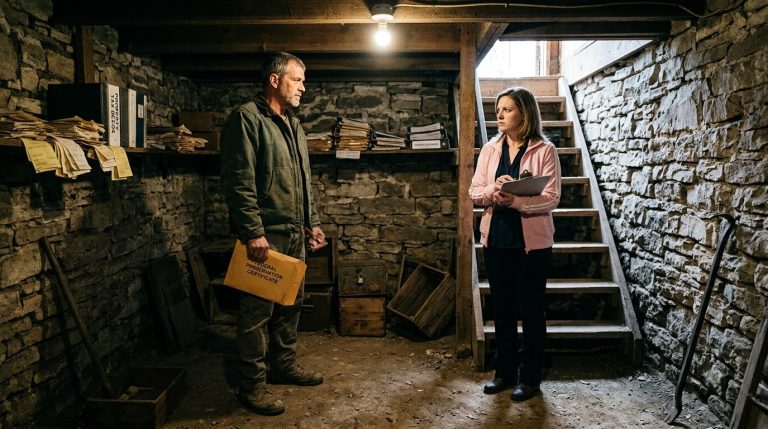
There it was. A faded, sepia-toned blueprint of Lot 1A—my property—dated October 1978. In the bottom corner, penned in the neat, precise hand of a county inspector, was a handwritten marginal note circled in red ink: Existing dry-stacked stone wall designated as primary basal retaining structure for lower grade tier. Do not alter or excavate. Structural integrity critical for slope stability of Tiers 1 through 3.
I stared at the screen until the amber glow seemed to burn into my retina.
Tiers one through three. That wasn’t just my front yard. That was thirty-two homes sitting on the steep, sloping shelf directly above me. Karen wasn’t just trying to enforce an aesthetic code; she was actively trying to pull the pin on a localized landslide that would take out half the upper ridge.
I didn’t print the file immediately. I sat back in the metal chair, the cold vinyl sticking to my lower back, and let the silence of the archive room settle over me. The trap wasn’t something I had to build from scratch. The developers had laid it forty years ago, and Karen was walking straight toward it with a rented skid steer and a smile.
My phone buzzed in my pocket—a text from Marcus, the contract lawyer I’d consulted after the mailbox incident.
How’s the weather on the ridge?
I pulled out my phone and tapped out a single reply, keeping my thumb steady over the screen.
The foundation is cracked. Send me the liability template for critical municipal infrastructure.
I stood up, ejected the microfilm reel, and slid it back into its paper sleeve. The air in the archives suddenly felt too thin, too quiet, like the breathless second before a mortar round drops. The real work had just begun, and the next move wasn’t mine to make—it was waiting for Karen’s next escalation.
CHAPTER 3: THE KANGAROO COURT AND THE FIRST PUBLIC FRACTURE
The parking lot of the Sterling Ridge Community Clubhouse was already packed when I pulled my truck into an empty slot near the side entrance. It was Thursday evening, the designated night for the quarterly homeowner association assembly, but the usual sparse gathering of residents paying annual dues had been swollen by anticipation. Word of the impending code enforcement hearing for 121 Sterling Drive had circulated through the informal network of backyard fences and group chats.
I sat for a moment with my hands resting on the steering wheel, watching the headlamps sweep across the brick facade. The heavy manila folder sat on the passenger seat, containing not just Marcus’s drafted cease-and-desist letter, but the photocopied blueprint from 1978 and the engineer’s marginal note circled in red ink.
The air inside the double glass doors of the clubhouse hit me with the stale scent of commercial carpet cleaner, bad coffee, and institutional panic. Karen had spared no expense setting the stage. At the far end of the multi-purpose room, a long folding table draped in dark blue fabric served as the dais. Flanked by her two perpetual board cronies—quiet faces who nodded at everything she said—Karen sat upright, her posture rigid inside a tailored charcoal blazer that had replaced the morning’s pink tracksuit, though her expression remained just as unyielding.
As I walked down the center aisle, the low murmur of neighborhood conversation died down instantly, replaced by the collective intake of breath from thirty pairs of lungs.
I didn’t take a seat in the folding chairs facing the dais. Instead, I stood near the back wall, keeping my hands free and my weight balanced evenly on both feet, scanning the room like an engineer evaluating a perimeter before a briefing. A few rows up, Carlos Garcia sat rigid, his forearms resting on his knees, staring straight ahead with a look of tight, unsettled concentration. Beside him, old Mrs. Miller kept her eyes fixed firmly on her lap.
Karen tapped a silver gavel against the wooden block once, the sharp crack echoing off the drop-ceiling panels.
“We have several routine matters to conclude,” Karen began, her voice carrying that practiced, theatrical resonance designed to project absolute control. “However, tonight’s special session requires our immediate attention regarding an ongoing, willful violation of our community standards at 121 Sterling Drive.”
She didn’t waste time on pleasantries. She launched directly into a ten-minute indictment, projecting slides onto a pull-down screen that showed my front yard, the weathered stone wall, and close-ups of fieldstone blocks she claimed violated the neighborhood’s uniform fencing covenants. She spoke of compliance, property values, and the sacred trust of the board with the fervor of a high priestess defending an altar.
“Mr. Caldwell has been given every opportunity to conform,” Karen concluded, her lips tightening into a triumphant, thin line as she clicked off the projector. “The architectural committee has voted unanimously to authorize immediate removal of the non-compliant structure at the homeowner’s expense. Mr. Caldwell, do you have anything to say before the board ratifies this enforcement action?”
The room turned in unison, all eyes pivoting toward the back of the hall where I stood.
I didn’t rush. I walked slowly down the center aisle, my boots clicking rhythmically against the commercial linoleum, until I reached the front row, stopping just short of the dais. I pulled the manila folder from under my arm and placed it flat on the wooden podium.
“Good evening,” I said, my voice steady, pitched low enough that the back row had to lean forward to catch it. “I’d like to correct the record on several points. First, the structure in question is not a fence. It is a dry-stacked stone retaining wall built forty years before this subdivision was incorporated.”
Karen’s smile didn’t waver, though a microscopic twitch marred the corner of her left eye. “Semantics, Mr. Caldwell. The code applies to all boundaries.”
“It’s not semantics; it’s engineering,” I replied, opening the folder to reveal a crisp, high-resolution copy of the 1978 grading plan. I turned it toward the board members, letting the red circle of the engineer’s note catch the overhead light. “Second, this wall holds back four hundred tons of earth supporting the upper tiers of this hill. According to the original master drainage and grading permits on file with the county archives, removing it will trigger an immediate structural failure of the slope beneath Tiers One through Three.”
A sharp murmur rippled through the middle rows of the audience.
Carlos Garcia stiffened in his seat, his head snapping around to look at me, then up toward the ceiling as if he could already feel the foundation of his home shifting beneath him.
“That is a baseless scare tactic,” Karen snapped, her voice rising an octave, losing its smooth cadence as she struck the gavel down twice. “The board’s architectural guidelines supersede old paperwork. We have legal indemnification.”
“You have a liability trap,” I said, my voice dropping into that flat, unyielding register I used when briefing unit commanders. I slid a second document across the table—Marcus’s formal legal notice, stamped with the certified mail receipt from three days prior. “My attorney has already filed notice with the county planning commission and your insurance carrier. Any attempt to alter that wall tomorrow morning will be documented, recorded, and prosecuted as willful endangerment of public safety.”
Karen stood up half an inch out of her chair, her face flushing a deep, mottled crimson that clashed violently with the charcoal blazer. “You cannot speak to this board that way! We are the authority here!”
“You’re a committee managing cosmetic shrubbery,” I said quietly, letting the words hang in the heavy air of the room. “You are completely out of your depth.”
The silence that followed was absolute. The two board members flanking Karen looked down at their hands simultaneously, suddenly intensely interested in the grain of the folding table. The illusion of unassailable power had fractured right down the middle, and the first real weight of consequence had settled over the room.
CHAPTER 4: THE GEOTECHNICAL AUDIT AND THE TRAPS FINAL TEETH
The fluorescent hum of the clubhouse meeting room seemed to drop an octave as the assembly dissolved into a chaotic swirl of whispered arguments and sudden, anxious movements. Karen did not wait to gavel the session closed. She swept her papers into a leather portfolio with jerky, uncoordinated motions, her face mottled with a dull, furious purple, and marched through the side exit without a backward glance.
I didn’t rush to leave either. I stood at the podium, methodically sliding the blueprint and Marcus’s legal notices back into the manila folder, feeling the gaze of half the room pressing against my shoulders.
As the crowd thinned toward the double doors, a heavy shadow fell across the wooden floor. I looked up. Carlos Garcia was standing a few feet away, his hands shoved deep into the pockets of his jacket, his expression tight and pale under the harsh overhead lights.
“Is it true?” Carlos asked, his voice low, stripped of any neighborly pleasantry. He didn’t wait for an invitation to step closer. “That wall… if it goes, what happens to the slope beneath our backyard?”
“The developer’s own engineering notes from 1978 designate it as the primary basal restraint for the lower tier,” I said evenly, meeting his gaze without flinching. “If someone puts a front-end loader against it and shears off the key stones, the clay shelf above it loses its anchor. It won’t happen overnight, but the first heavy autumn rain will take the grade right down into my driveway.”
Carlos swallowed hard, his Adam’s apple bobbing sharply against his collar. He looked toward the side door where Karen had vanished, then back at me. A slow, bitter realization hardened the lines around his mouth. “She didn’t check the permits. She just saw an old stone wall and decided it ruined the uniform look of her brochure.”
“She saw an obstacle to her authority,” I replied, snapping the clasp of my folder shut. “And she assumed nobody would check the math.”
The next morning, the physical reality of that math arrived in a van marked Albright Geotechnical Engineering.
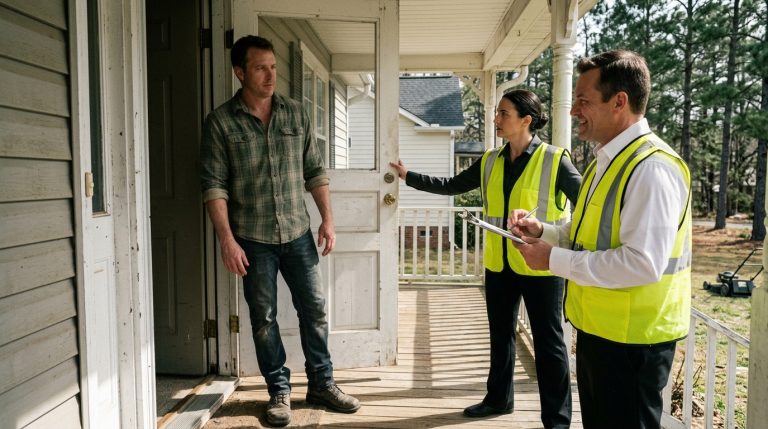
Dr. Albright was a tall, severe woman in her late fifties with steel-gray hair tied back in a tight bun and a clipboard permanently clamped under her arm. She didn’t waste time on small talk. She spent four hours walking the perimeter of my property, her boots crunching over the frost-killed grass, driving steel pins into the soil, and deploying a portable ground-penetrating radar unit that hummed a low, rhythmic pulse against the earth.
I stood by the edge of the stone wall, watching her trace the mortarless joints of the granite blocks. A sharp, unbidden unease flickered through my chest as I noticed a fresh hairline fracture running diagonally across a concrete pier near the western corner—a subtle sign of micro-settling that hadn’t been there during my morning check two days ago. Karen’s stunt with the skid steer had already stressed the foundation.
“Mr. Caldwell,” Dr. Albright called out, her voice cutting sharply through the crisp morning air as she straightened up from her equipment. She tapped her clipboard with a pen. “Your wall isn’t just structurally sound; it’s under active, localized stress. Whoever bumped that western anchor with heavy machinery last week fractured the seating mortar of the corner key. If there’s another attempt to alter this structure before we reinforce the toe, the entire upper tier is going to start sliding.”
“How long do we have before it becomes critical?” I asked, keeping my tone strictly transactional.
“Days, not weeks, if the weather turns,” she said flatly, pulling a certified notification form from her binder and handing it to me. “I’m issuing an immediate structural emergency classification. This document goes straight to the county building inspector and your municipal risk assessor today. It shifts the legal status from a private neighborhood dispute to a public safety hazard.”
I took the paper, feeling the crisp weight of the official seal. The trap was no longer just waiting to be sprung; the tension in the wire was pulling so tight that any further pressure from the board would snap it entirely.
My phone vibrated in my pocket. I pulled it out. A text from Marcus:
Just received notice from the HOA’s legal counsel. They’re demanding an emergency injunction against your ‘unauthorized structure’ for Tuesday morning.
A cold, precise focus settled over me. Karen wasn’t backing down; her ego was driving her straight toward the cliff.
“Let them file,” I muttered to myself, slipping the phone back into my pocket as I watched Dr. Albright pack her radar unit into its aluminum case. “Tuesday morning is going to be very crowded.”
CHAPTER 5: THE SECOND CONFRONTATION AND THE ARRIVAL OF THE CITY ENGINEER
The morning of Tuesday, October 12th dawned with a sharp, cloudless clarity that felt entirely wrong for the confrontation it framed. The air smelled of frost-burned grass and diesel exhaust before the sun had even fully crested the ridge behind the upper tier of houses.
I did not wait outside in the cold. I stood by the kitchen window, a mug of black coffee cooling in my hand, watching the live feed from the security cameras mounted above the garage. At exactly 7:53 a.m., the familiar flatbed truck rumbled around the corner of Sterling Drive, carrying a replacement skid steer loader operated by a weathered, older man who wore the weary posture of someone accustomed to municipal disputes.
A minute later, Karen’s white SUV pulled up across the asphalt. She stepped out with the practiced air of a general reviewing an engagement, her pink tracksuit zipped tight against the autumn chill, a smug, immovable certainty etched across her features. She expected a repeat of the first encounter—a brief shouting match followed by the steady bite of heavy metal into stone.
I set the mug down on the counter, picked up the waterproof portfolio containing Dr. Albright’s certified engineering assessment and the 1978 blueprints, and walked out the front door.
The gravel crunched sharply under my boots as I crossed the lawn. Karen was already standing on the public sidewalk just beyond my property line, her arms crossed over her chest, directing the contractor toward the western corner of the wall.
“Well, Mr. Caldwell,” Karen called out, her voice carrying across the quiet street with a metallic ring. “Your emergency delaying tactics are over. The injunction was denied, the board’s mandate stands, and that eyesore comes down right now.”
I did not look at her. I ignored her completely, stepping past her line of sight to approach the driver’s side of the flatbed where the contractor stood unstrapping the machine’s safety locks.
“Good morning,” I said, my voice low and steady. “My name is Jack Caldwell. I own this property. Before you drop that bucket, I am legally required to hand you this packet regarding the structural stability of the terrain and your company’s liability.”
The man stopped, a heavy metal ratchet strap dangling from his gloved hand. He looked at my face, measured the absolute calm in my posture, and then took the heavy plastic sleeve I offered him.
Karen stormed forward, her face flushing a dark, mottled red. “Don’t listen to him! He’s just a homeowner trying to obstruct community policy! The HOA has indemnified you, and you have a signed work order!”
The contractor held up a single, weathered hand, silencing her without shifting his gaze from the first page of Dr. Albright’s report. I watched the professional skepticism on his face slowly dissolve, replaced first by confusion and then by a cold, dawning realization as his eyes tracked over the high-resolution copy of the 1978 geotechnical marginal note circled in red ink.
He flipped to the second page, scanned the municipal seal of the emergency classification, and then looked up from the paper. He didn’t look at me. He looked past us, up the steep incline of the hill toward the tiers of houses sitting precariously on the slope.
“Are you out of your mind, lady?” the contractor growled, turning his glare onto Karen. “Did you know this was a basal retaining wall?”
Karen sputtered, stepping back half a step. “It’s a non-compliant stone border! The board voted! You have a contract!”
“My contract doesn’t cover triggering a massive slope failure and getting my business sued out of existence,” the contractor snapped back, shoving the portfolio back into my chest before pivoting sharply toward his cab. “I’m not touching this property.”
Before Karen could scream another order, a black city-owned sedan pulled up abruptly to the curb behind her SUV. The door clicked open, and Mr. Davies, the city engineer I had alerted two days prior, stepped out onto the pavement holding a digital tablet.
“What seems to be the problem here?” Davies asked, his voice carrying an effortless municipal authority that cut straight through Karen’s panic.
Karen whirled around, her hands trembling slightly as she pointed a finger at the sedan. “I am the HOA president, and this is a sanctioned code enforcement action! This man is refusing to remove an illegal structure!”
Mr. Davies did not even look at her. His eyes were fixed on the granite blocks of the wall, then on the fresh hairline fracture near the corner, and finally on the digital architectural maps loading on his tablet screen.
“Ms. Henderson,” Davies said, his tone flat and chillingly official. “According to the master structural engineering records filed with the city, that wall is the primary load-bearing anchor for thirty homes on the upper ridge. Your remedial action was not a code enforcement—it was an act of gross structural negligence.”
The word hung in the cold morning air, sucking all remaining defiance out of Karen’s posture. Across the street, front doors began to open. Carlos Garcia stepped out onto his porch, his eyes fixed on the scene with a cold, terrifying clarity, while down the block, other neighbors drifted toward the sidewalk, finally stepping out from behind the curtained silence of their homes to witness the collapse of an empire built on paper and fear.
CHAPTER 6: THE FALL OF THE STERLING RIDGE BOARD AND THE QUIET HORIZON
The retreat was neither grand nor dramatic; it was the slow, hollow deflation of a structure built entirely on empty authority. Karen did not argue with the city engineer, nor did she cast another glance at the heavy granite blocks of the wall. She turned on her heel, her pink tracksuit rustling sharply against the crisp autumn air, and walked back to her white SUV with jerky, uneven strides. The door slammed shut with a flat, final thud, and the vehicle reversed down the lane, tires crunching over the loose gravel before disappearing around the corner of Sterling Drive.
She left behind a neighborhood that had quietly woken up from a multi-year sleep.
Mr. Davies remained by the curb for several minutes, his fingers tapping methodically against the screen of his tablet as he logged the official stop-work order and transmitted the risk assessment to the municipal planning commission. Around us, the front doors that had remained bolted for seasons began to open. Carlos Garcia descended his front steps, his expression tight and deliberate, while old Mrs. Miller and a dozen other residents drifted toward the sidewalk, their previous hesitation burned away by the proximity of what could have been a catastrophic collapse.
“You caught it in time, Jack,” Davies said, looking up from his screen and offering a brief, respectful nod. “The city will issue a formal binding injunction protecting the foundation line by tomorrow morning. The HOA’s insurance carrier is already pulling files on the board’s liability.”
“Thank you, Davies,” I said, keeping my hands steady in my pockets.
As the city sedan pulled away, Carlos stopped beside me, staring up at the steep, grassy slope that led to his backyard. His breath plumed white in the cold air. “My kids play right over there,” he said quietly, his voice carrying an undercurrent of raw disbelief. “She was willing to shear the footing of the entire hill just to win a petty dispute over a set of rules she wrote herself.”
“People who mistake compliance for power usually don’t look past the surface,” I replied, turning my gaze back toward the granite wall.
The aftermath moved with the unyielding momentum of an institutional avalanche. Marcus, working in tandem with the corporate litigators from the HOA’s insurance carrier, dismantled the board’s legal standing within forty-eight hours. Confronted with the documented proof of willful misconduct and the imminent threat of multi-million-dollar structural liabilities, the insurance provider issued an ultimatum: either the board resigned immediately, or the community’s master policy would be canceled for gross negligence.
The emergency homeowners meeting held the following week at the local high school auditorium did not feature speeches or debates. Karen’s two board cronies stood up, mumbled hasty resignations into the microphone, and stepped down into the silence of an unforgiving crowd. When Karen took the podium to read a brief, flat statement of resignation, she did not look out at the room. She looked down at her papers, her voice stripped of its old theatrical resonance, before walking out of the auditorium through a side exit while the room remained entirely silent.
The legal settlement arrived four weeks later. The Sterling Ridge HOA paid every cent of my legal and engineering fees, issued a formal, mail-in apology to every household, and signed a binding court consent decree permanently designating the dry-stacked stone wall as critical municipal infrastructure, placing its future maintenance under the direct oversight of an independent structural engineer funded by community reserves.
The transformation of the neighborhood was swift. The following month, Carlos Garcia was elected as the new board president. His first official act was to strip the architectural guidelines of their punitive clauses, replacing them with transparent, common-sense standards that valued safety and community over cosmetic uniformity.
On a bright, cool Saturday afternoon in late November, the smell of charcoal smoke drifted across my front lawn. The Garcias and the Millers had organized a neighborhood potluck—a wall celebration to mark the permanent end of the old regime. Children ran back and forth across the grass, occasionally treating the flat, weathered top of the stone wall like a balance beam. A few months prior, that sight would have triggered an instinctive need to intervene; now, it simply anchored the deep, steady rhythm of a neighborhood that had finally found its footing.
I stood by the edge of the property line, flipping a burger on the grill, while Sarah walked up beside me and leaned her head gently against my shoulder.
“You really won, Jack,” she murmured, watching the sunlight catch the rugged edges of the granite.
I looked down at the wall—at the interlocking fieldstones, the deep earthen backing, and the quiet strength that had weathered both a century of frost and a modern tyrant’s ego. It had been built to last, and in the end, it had held everything together.
“We didn’t just win,” I said softly, handing her a plate and watching the smoke rise into the clear autumn sky. “We just gave the foundation a chance to breathe.”