The Deed of War: A Veteran’s Tactical Deconstruction of Suburban Tyranny
CHAPTER 1: THE PERIMETER THREAT
The electric hum of the golf cart cut through the October quiet three seconds before the tires crunched onto the gravel.
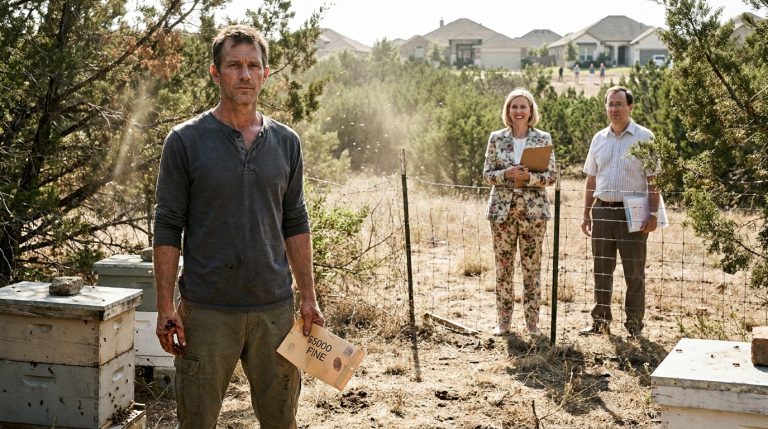
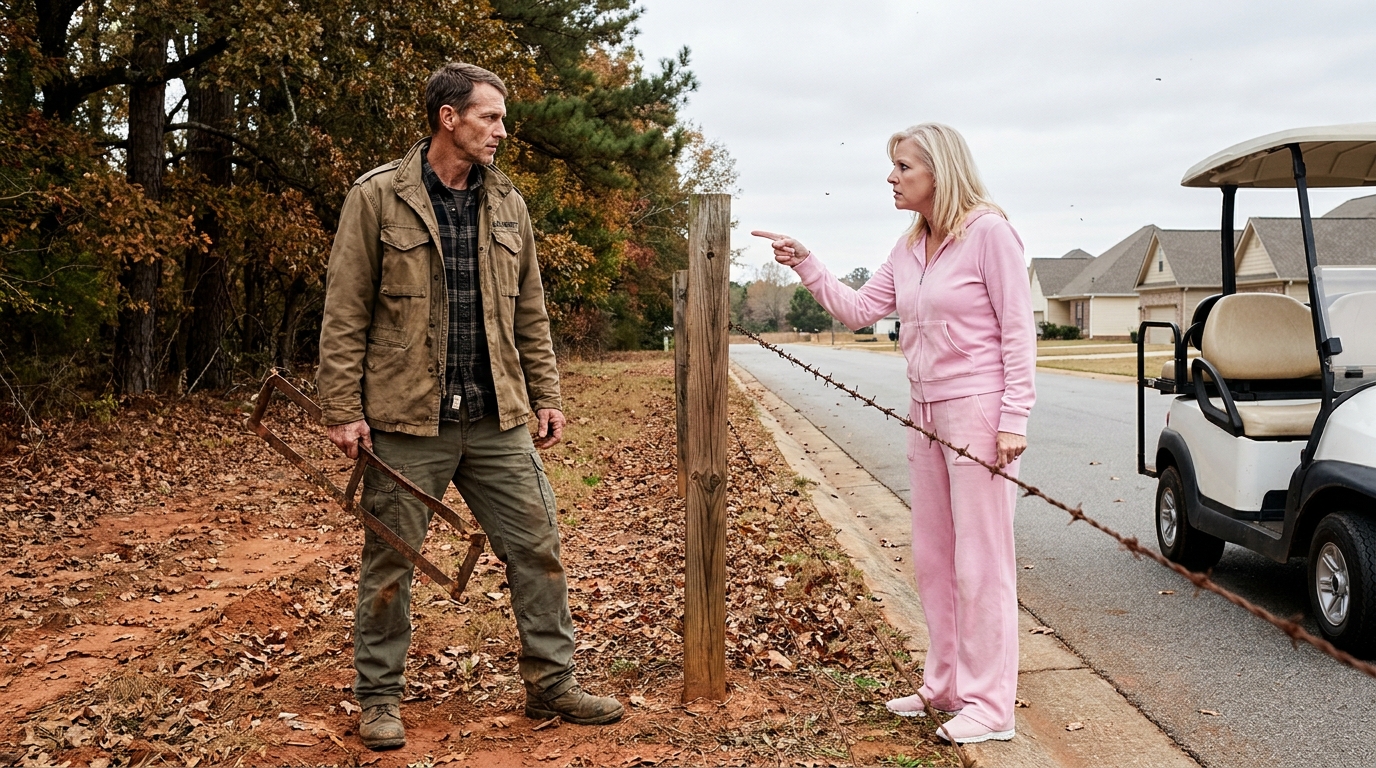
I didn’t turn around immediately. I kept my left hand clamped around the rusted barbwire strand, pulling it taut against the cedar post, my thumb rolling the notched brass 7.62 casing I kept in my pocket. The wire groaned under the tension of the fence stretcher.
“Your grandfather’s legacy is a public nuisance, Mr. Miller,” the voice rasped. “And I will see it dismantled piece by piece if I have to.”
I set the fence tool down on the red dirt. I turned slowly, letting my eyes take in the intruder.
Karen Thorne. President of the Oakridge Estates Homeowners Association. Blonde hair frozen in rigid hairspray, pastel tracksuit pristine, sitting behind the wheel of a custom white golf cart. Her vehicle sat three inches inside the asphalt community road—her kingdom. Her manicured index finger jabbed across the invisible line toward my hundred acres of timber and brush.
“You’re standing on dry grass, Thorne,” I said. My voice didn’t carry heat. Twenty years in the Army Corps of Engineers teaches you to save your breath for heavy lifting. “And your cart is idling on county right-of-way.”
“Don’t play technicalities with me, Jack,” she snapped, stepping out of the vehicle. Her heels clicked on the pavement. “Word gets around. You’re leasing the north ridge to bow hunters this season. Armed men. On our border.”
“My land,” I said. “My veterans. Five guys I served with. They harvest clean, they pack out their trash, and they don’t ask your permission.”
“This development backs directly onto those woods!” Her lip curled, revealing teeth white enough to blind. “We have children here. Property values to protect. You think because your granddad logged this dirt a hundred years ago you’re exempt from community standards?”
“I don’t think,” I said, stepping up to the fence wire. “I know. Check your plat maps. Oakridge Estates Phase 1 stops at my eastern survey line. You have zero jurisdiction here.”
“Jurisdiction is defined by impact,” she said, leaning forward. Her perfume hit the autumn air like sweet poison. “I have a board, Mr. Miller. I have legal retainers. I will bury you in nuisance suits, code violations, and municipal injunctions before your friends ever string a bow. I’ll make this dirt cost you more than it’s worth.”
I looked down at her polished shoes, then back up into her pale blue eyes. Beneath the calculated fury, her right eyelid twitched twice—a micro-expression of hesitation. She was waiting for me to raise my voice. She wanted an angry farmer shouting at a lady so she could call the sheriff.
I gave her nothing. I let the silence drag until the wind rustling the dry oak leaves was the only sound between us.
“Try it,” I said quietly.
Her eyes narrowed. She waited three seconds for a longer answer that never came, then turned on her heel and climbed back into the cart. The electric motor whined as she reversed, spun the wheel, and drove back toward the row of beige McMansions towering over the tree line.
I reached into my pocket, my thumb running over the notched brass casing. I didn’t feel angry. Cold calculation replaced the spike of adrenaline.
She wanted a war of attrition. She thought she was dealing with a bitter local holding onto dirt. She didn’t know she was poking a man who spent two decades studying topography, deeds, and structural vulnerabilities.
I picked up my pliers, clinched the staple into the cedar post, and headed back toward the cabin.
The perimeter was marked. The salvo was coming.
CHAPTER 2: BUREAUCRATIC SALVO
The paper didn’t feel like a threat. It felt too expensive for that.
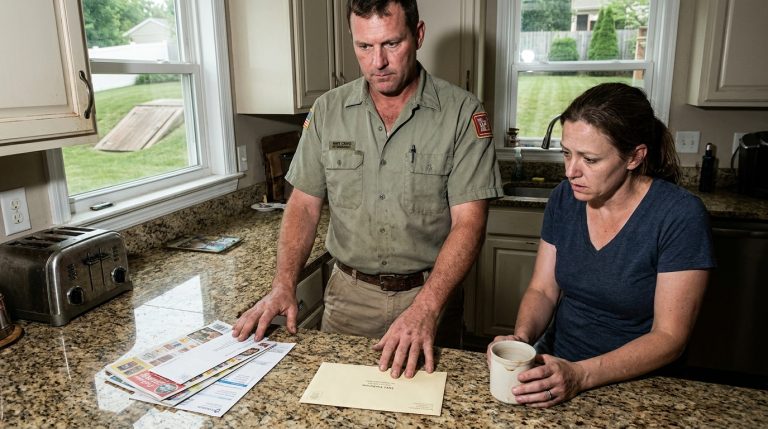
I stood on the edge of the porch, the cold October breeze biting through my flannel, holding the cream-colored envelope. The Oakridge Estates HOA crest was stamped in raised gold leaf on the flap. I slid my thumbnail under the seal, splitting the fiber with a dry, sharp pop.
Inside sat three pages of heavy cardstock and a pre-printed red slip.
NOTICE OF FORMAL COVENANT VIOLATION, the bold header read. Parcel ID Tag: ORE-04A-SUB.
I scanned the body text. Pursuant to Bylaw 12-B (Commercial Enterprise Prohibition) and Article 4 (Aesthetic Integrity), you are hereby ordered to immediately cease all commercial, recreational, or third-party leasing activities on the parcel designated under community oversight. Failure to comply within 72 hours will result in a baseline fine of $500.00, accruing at $100.00 per diem, attached as a cloud upon property title.
I turned the page over. Attached to the back was a computer-generated tax map. A red line had been drawn around my hundred acres in fine-tip marker. Someone had manually written SUB-DISTRICT B across my timberland.
My thumb went to the notched 7.62 casing in my pocket, rolling the brass against my thigh.
There it was. The beachhead. She hadn’t just filed a complaint; she had assigned my ancestral land an administrative tag—ORE-04A-SUB—trying to pull my deed into her system through sheer procedural fiction. If you don’t reject an administrative classification within a statutory window, municipal courts treat your silence as implied consent.
I walked inside, shutting the heavy oak door against the wind.
I laid the letter on the kitchen table, right next to the original land patent framed under glass—a faded document dated 1888, signed in black iron-gall ink.
Patent 1888 didn’t mention bylaws. It didn’t mention lawn height or approved shades of mailbox paint. It granted one hundred and twenty acres to my great-grandfather from the United States General Land Office.
Karen Thorne was trying to rewrite a hundred and thirty-eight years of county history with a laser printer and a gold foil stamp.
I didn’t call a lawyer. Not yet. Lawyers cost three hundred dollars an hour to file motions that buy you thirty days of waiting. In military intelligence, before you counter an offensive, you survey the ground truth. You go to the terrain map that can’t be edited by a neighborhood board.
I grabbed my truck keys, picked up the violation notice, and drove into town.
The Madison County Records Building smelled of old binding glue, wet dust, and the metallic hum of fluorescent lights fading out.
Marge sat behind the high oak counter, a pair of reading glasses dangling from a beaded chain around her neck. She had been the Register of Deeds since my grandfather was turning soil in the south pasture.
“Jack,” she said, her voice like gravel turning in a cement mixer. “You look like you’re hunting something.”
“Need the vault keys, Marge,” I said, sliding the cream envelope across the wood. “Specifically, Parcel 4A and the master plat for Oakridge Estates Phase 1.”
Marge picked up Karen’s notice, squinted at the gold crest, and let out a short, wet snort. “Karen Thorne again? She sent two paralegals down here last spring trying to access our tax maps. Thought if she changed the boundary overlays on the county website, it made it real.”
“Did she?”
“Told ’em to get out before I called the bailiff,” Marge grunted, reaching under the counter for a heavy brass ring of keys. “Table four in the back. Pull book thirty-two.”
The vault was cold. Row after row of leather-bound ledgers stacked ten feet high, housing every boundary line drawn in this county since the territory was surveyed.
I unrolled the master plat map for Oakridge Estates across the metal table. The paper was stiff, smelling of ammonia and cyanotype ink. I traced the black surveyor lines with my forefinger.
Phase 1 was laid out in clean, sterile grids: cul-de-sacs, ninety-degree turns, hundred-foot lots. Then came the eastern boundary line—a bold, double-hatched line running north to south.
Right on the other side of that hatched line lay my hundred acres, marked clearly as Parcel 4A (Unincorporated / Excluded).
There was a surveyor’s note inked directly into the margin, dated twenty years ago when the developer first broke ground: Parcel 4A is explicitly excluded from the covenants, restrictions, and jurisdictional boundary of Oakridge Estates Development. Access restricted to private easement.
Karen’s violation notice was legally dead on arrival. It was a bluff wrapped in expensive cardstock.
I pulled out my phone and took a clear, high-resolution photo of the surveyor’s note, making sure the county registrar seal in the corner was sharp.
Then my eyes drifted down the edge of the plat map.
Just south of my border, wedged right between the edge of my timber line and the primary entrance to Oakridge Estates, sat a five-acre green rectangle. On Karen’s notice, it was labeled as Community Park – Founders Green.
I looked closer at the county plat. The rectangle wasn’t labeled Founders Green. It was tagged under a different administrative code: Parcel 5B.
Below the parcel tag, in fine, faded cursive, was a note I hadn’t noticed before: Subject to Special Restrictive Covenant / See Deed Book 412, Page 88.
My finger stopped on Parcel 5B.
“Marge,” I called out, my voice echoing in the concrete vault. “Pull Deed Book 412.”
CHAPTER 3: THE REVERSIONARY CLAUSE
Marge’s heavy footsteps echoed against the bare concrete floors as she walked back into the deeper shadows of the vault.
I stayed motionless over Table Four, my hands flat on the metal surface beside the sprawling cyanotype map. The cold from the steel seeped through my palm, up my wrist, grounding me while the air in the room grew thin and dry.
“Book 412,” Marge grunted, coming back into view with a heavy leather-bound volume cradled in both arms. She set it down with a dull, heavy thud that puffed a tiny cloud of dry paper dust into the air between us. “Deed transfers from the mid-nineties. Pages are fragile, Jack. Don’t go tearing around in there like a dog in the weeds.”
“I’ll go slow,” I said.
She nodded once, adjusted her glasses chain, and retreated back to her desk at the front counter.
I turned the thick cover. The heavy rag-paper pages groaned along their bindings. I flipped past residential land divisions, municipal right-of-way grants, and power line easements until the top of page eighty-eight came into view.
DEED OF GIFT & SPECIAL CONVEYANCE.
The grantor’s name was printed in sharp, bold typewriter ink: John Arthur Miller.
My grandfather.
I drew a quiet breath, my thumb sliding over the coarse edge of the page. The document was dated twenty-one years ago. I traced the legal description down the page. Parcel 5B, carved cleanly out of the southeastern quadrant of our family’s original claim under Patent 1888. Five acres of prime, level oak ridge right along the paved access road.
I remembered the summer he signed it. I was home on leave before my second deployment, sitting on the back porch while he worked on a tractor carburetor. He’d mentioned donating five acres so the county could put in swings for the kids moving into the new houses nearby. He had shrugged it off as neighborly quiet work. He’d never mentioned the specifics.
I read down to the core conditions.
ITEM I: RESTRICTION OF USE.
The conveyed real property designated herein as Parcel 5B shall be held, maintained, and operated in perpetuity exclusively as a public park, accessible without fee, restriction, or discrimination to all residents, visitors, and citizens of Madison County.
I leaned closer, my eyes locking onto the next block of text.
ITEM II: PROHIBITION OF EXCLUSIONARY CONTROL.
Neither Madison County, nor any private corporate entity, homeowners association, or adjacent property development shall execute proprietary jurisdiction, install restrictive barriers, enforce private rules, or otherwise alter the unrestricted public status of Parcel 5B.
Karen Thorne’s gilded sign—Founders Green: A Private Park for the Residents of Oakridge Estates—was a direct, brazen violation of Item II. The HOA had taken a public county asset donated by my family and branded it as their own exclusive amenity. They had used it as a selling point to drive up home values while warning off anyone who didn’t hold an Oakridge keycard.
That was Layer 1. A clear case of public land usurpation.
Then my eyes dropped to the final paragraph on the page, set in slightly smaller, densely packed font.
ITEM III: REVERSIONARY COVENANT.
In the event that Madison County or its assignees fail to enforce Item I or Item II, or permit any private entity to exercise exclusionary dominion over Parcel 5B, all right, title, and interest in said property shall immediately terminate. Full legal title to Parcel 5B shall, by operation of law, automatically revert to the Grantor or his surviving legal heirs.
I read the paragraph three times.
The Reversionary Covenant. It wasn’t just a restriction; it was a built-in killswitch.
My grandfather hadn’t just given land away blindly. He had anticipated that someday a corporate developer or a petty board might try to fence off his gift. He had planted a legal landmine right under the soil of that five-acre park, waiting for someone careless enough to step on it.
Karen Thorne thought she was holding a five-hundred-dollar fine over my head to stop my veteran friends from hunting deer on my private woods. She had no idea that her own association was sitting on a stolen five-acre park that I now had the explicit legal right to seize back from under their feet.
I pulled out my phone, lined up the camera lens directly above page eighty-eight, and snapped three high-resolution photographs of the document, ensuring my grandfather’s signature and the registrar’s official seal were sharp and clear in the light.
I closed Book 412 with a quiet, firm slap.
I walked back out to the front counter. Marge was working a crossword puzzle with a wooden pencil.
“Find what you were looking for, Jack?” she asked without looking up.
“More than I expected,” I said, handing the brass ring of keys back across the wood. “Marge, who’s the sharpest real estate attorney in town these days? Someone who doesn’t mind poking a hornets’ nest.”
Marge paused her pencil, looking over the rim of her glasses with a slow, knowing smirk. “Sarah Jenkins. Moved her office into the old bank building on Main last winter. Sharp as a razor, and she doesn’t take kickbacks from the developers.”
“Thanks, Marge,” I said.
I stepped out of the records building and into the bright, cold autumn air. I pulled out my phone, looked up the address for the old bank building on Main Street, and started walking down the sidewalk. My thumb rolled the brass 7.62 casing in my pocket, no longer suppressing cold fury, but calculating the exact trajectory of the round I was about to chamber.
CHAPTER 4: THE WEAPONIZED LETTER
The wind on Main Street carried the smell of dry oak leaves and exhaust. My boots hit the cracked concrete in a steady, heavy cadence as I covered the three blocks to the old bank building.
I pushed through the heavy brass-rimmed glass doors. The lobby was high-ceilinged, renovated with clean oak paneling and modern black iron fixtures. Behind a frosted glass desk sat Sarah Jenkins. She didn’t look like a local attorney who spent her afternoons drafting simple wills. She was in her mid-thirties, wearing a tailored charcoal blazer, her dark hair pulled back in a tight, efficient knot.
She looked up from a stack of legal briefs, her sharp gray eyes taking in my work jacket, my muddy work boots, and the thick manila envelope tucked under my arm.
“Mr. Miller,” she said, her voice dry and precise. “Marge at the records office called ahead. She said you were coming down here to break something.”
“Not break,” I said, setting the envelope flat on her desk. “Reclaim.”
I sat in the leather chair across from her. I didn’t waste time on pleasantries. I pulled out the three documents and laid them out side-by-side like a hand of cards: the cream-colored HOA violation notice with its absurd fine, the high-resolution photo of the county plat map showing Parcel 4A excluded from Oakridge Estates, and the copy of Deed Book 412, page eighty-eight.
Sarah didn’t touch the papers at first. She picked up a silver pen, tapped the cap twice against her knuckles, then pulled the violation notice closer.
“Karen Thorne,” Sarah murmured, a faint, dangerous smile touching the corner of her mouth. “She sent this same templated nonsense to a family on Crestview last month over a wooden swing set. They paid the fine out of fear.”
“Read the plat map first,” I said.
She slid the printout over. Her eyes scanned the double-hatched boundary line and the surveyor’s note. “They tagged your parcel ORE-04A-SUB to create an administrative fiction. It’s a classic scare tactic. Legally, it’s garbage. They have as much authority over your timberland as they do over the county courthouse.”
“Now read the deed,” I said, tapping the copy of Deed Book 412.
Sarah picked up the page. Her eyes moved quickly down the first paragraph, tracking the legal description of Parcel 5B. Then she reached Item II: Prohibition of Exclusionary Control. Her pen stopped tapping.
When she hit Item III: Reversionary Covenant, her posture shifted. She straightened her back, leaning into the desk light. She read the paragraph once, slid her finger along the text, and read it a second time.
“Your grandfather,” she said softly, looking up at me, “was an absolute strategist.”
“He knew who he was dealing with twenty years ago,” I replied.
“This isn’t a defensive document, Mr. Miller,” Sarah said, her voice dropping into a low, predatory register. “This is a tactical warhead. Karen Thorne put up a carved cedar sign claiming ‘Founders Green’ as a private park for Oakridge Estates residents. She’s been using HOA funds to patrol it, chase off non-resident children, and list it as a private community asset in their sales brochures. That is a direct, documented breach of Item II.”
“Which triggers Item III,” I said.
“Which means,” Sarah completed the thought, “the five acres don’t belong to Madison County anymore, and they certainly don’t belong to Oakridge Estates. The title automatically reverts to you. The moment we file a notice of re-entry and quiet title, their prized neighborhood centerpiece becomes your private dirt.”
I leaned forward, placing my hands flat on her desk. “I don’t want to tie the park up in land court for five years, Sarah. I want Karen Thorne stripped of her illusion of authority. I want her board to understand exactly what she built their neighborhood on.”
“Then we don’t file the lawsuit today,” Sarah said, pulling a blank yellow notepad toward her. “We write a letter. A certified, signature-required demand letter addressed directly to Karen Thorne and every individual member of the HOA board of directors.”
“Lay out the terms,” I said.
“Paragraph one,” Sarah said, her pen flying across the paper with a scratchy, methodical rhythm. “We declare their violation notice against Parcel 4A null, void, and fraudulent, warning them that any attempt to attach a lien will trigger an immediate countersuit for slander of title and harassment.”
“Paragraph two,” I added.
“Paragraph two,” Sarah continued, her eyes sharp. “We cite Deed Book 412, Page 88. We inform the board, in cold legal terms, that their private enforcement over Parcel 5B constitutes an ongoing material breach of the original deed of gift, activating the Reversionary Covenant.”
“And the ultimatum?”
“Thirty days,” Sarah said, capping her pen with a sharp snap. “They have thirty days to perform three non-negotiable actions. First, physically dismantle and remove the ‘Private Park’ sign at Founders Green. Second, issue a written retraction and clarification to every homeowner in Oakridge Estates, acknowledging that the park is public county property. Third, post a permanent sign at the entrance stating the land is open to all citizens of Madison County without restriction.”
“And if Karen refuses?”
“If she refuses,” Sarah smiled, a sharp, cold expression, “we file the reversion of title. We take the park back, and she can explain to three hundred homeowners why her personal grudge cost them their neighborhood playground. I’ll draft it now. It goes out by certified mail before five o’clock.”
I stood up, pulling a checkbook from my jacket pocket to pay her retainer. The cost was real—two weeks of fence-building income gone in a stroke of a pen—but the ground was set.
“Send it,” I said. “Let’s see how long her confidence lasts when the paper carries my grandfather’s signature instead of hers.”
CHAPTER 5: THE AMBUSH SUBVERTED
The heavy door of the Oakridge Estates clubhouse swung shut behind me, sealing out the damp night wind.
Inside, eighty folding chairs sat in tight, rigid rows over polished gray vinyl flooring. The room smelled of fresh paint, industrial floor wax, and cheap urn coffee. Every seat was occupied. Men in quarter-zip fleeces and women in winter coats leaned together, whispering behind manicured hands.
At the front of the hall stood Karen Thorne behind a metal podium. She wore a tailored burgundy blazer, her blonde helmet of hair immaculate under the fluorescent tubes. Beside her, a laptop sat plugged into a portable digital projector, its blue standby light burning against the blank white wall behind her.
I walked down the side aisle, my heavy leather work jacket creaking with every step. Beside me, Sarah Jenkins carried a slim black briefcase in her right hand and a compact digital projector under her left arm.
The whispers dropped off like a falling stone. Heads turned. Eyes locked onto my chest, then dropped to Sarah’s briefcase.
Karen tapped the microphone twice. A sharp, high-pitched squeal echoed off the metal rafters.
“This is an emergency executive meeting of the Oakridge Estates Homeowners Association,” Karen announced, her voice pitched high and tight. “I must remind all non-resident guests that this hall is private property. Uncertified visitors have no standing to address the board.”
“I’m not here to address the board, Karen,” Sarah said calmly, unhooking her briefcase latch with a clean clack. “I’m here to represent Jack Miller regarding the formal certified notice your directors received three days ago.”
“That letter was a frivolous attempt to intimidate this community!” Karen snapped, her right knuckle white against the edge of the podium. Her eyelid gave that familiar, involuntary twitch—twice, rapid. “You are attempting to cloud our title to Founders Green. You are threatening the safety and property values of every family in this room!”
A low murmur of agreement rose from the front rows. A middle-aged man in a navy vest stood up, glaring back at me. “We paid for that park in our HOA dues! You can’t just walk in here and claim our neighborhood playground!”
I didn’t answer him. I kept my eyes fixed on Karen’s hands. She was trembling—not with anger, but with the cold realization that her board members were sitting in the front row, watching her every move.
Sarah set her portable projector on the rear refreshment table, plugged in a short power cord, and flipped the switch. A sharp beam of white light cut through the room, washing over Karen’s podium and striking the wall directly above her head.
“Madame President,” Sarah said, her voice cutting through the rising noise like a cold blade. “Before you call for a vote to fund a legal defense using community reserves, your homeowners have a right to examine the foundational record.”
“Turn that off!” Karen shouted, stepping out from behind the podium. “This is my meeting!”
Sarah hit the advance key on her laptop.
The first image hit the wall in stark, three-foot-high resolution: a photograph of the carved cedar sign at the entrance of the park. FOUNDERS GREEN: A PRIVATE PARK FOR THE RESIDENTS OF OAKRIDGE ESTATES.
“This is the sign your board installed two years ago,” Sarah stated quietly. “And this is the record under which that dirt was conveyed.”
Sarah hit the key again.
The slide shifted. The cyanotype plat map filled the wall. The bold double-hatched line separating my timberland from the development glowed in the light. Right beside it, the red highlight centered on Parcel 5B.
“Item I of Deed Book 412, Page 88,” Sarah read aloud, her voice ringing off the concrete walls. “Conveyed by John Arthur Miller to Madison County in 1995. ‘To be held, maintained, and operated in perpetuity exclusively as a public park, accessible without fee, restriction, or discrimination to all residents of Madison County.'”
The room went dead silent. The man in the navy vest slowly sat back down.
“Your president told you this park was private HOA property,” I said, stepping into the light of the projector beam. My voice was low, carrying the weight of twenty years of command. “She used your dues to build a wall around land my grandfather gave to every kid in this county. She told you I was coming to take your playground. The truth is, she’s the one who broke the deal.”
Sarah clicked the remote one last time.
The final slide expanded across the drywall. The text was short, dense, and highlighted in glaring yellow: ITEM III: REVERSIONARY COVENANT. In the event of exclusionary control, all right, title, and interest shall automatically revert to the Grantor or his surviving legal heirs.
Karen’s face drained of color. She looked back at the wall, then down at her board members.
The treasurer—a tall man with thin wire glasses—stood up from the first row. He didn’t look at Karen. He looked directly at the projected slide, his mouth slightly open.
“Karen,” the treasurer said, his voice flat and hollow. “Is this document real?”
“It’s… it’s a technicality!” Karen stammered, her hands grasping wildly at the air. “Our founding developer signed off on the park usage! We have an administrative tag—”
“Did you know about the reversionary clause when you sent that notice to Mr. Miller?” the treasurer interrupted, stepping closer to the podium. “Did you know we didn’t own the dirt?”
Karen didn’t answer. She opened her mouth, closed it, and took one slow step backward, her heel catching on the projector cord plugged into her laptop.
The room erupted.
Homeowners rose from their chairs, shouting over one another. Three board members crowded around the podium, demanding to see the physical copy of the deed in Sarah’s hands. The unified front Karen had spent three years building dissolved into open, chaotic hostility in less than four minutes.
I turned around, zipped my jacket, and walked toward the exit doors. Sarah packed her projector with calm, deliberate movements, slipping the power cable into her briefcase.
Karen Thorne stood alone against the white wall, illuminated only by the glaring yellow text of my grandfather’s covenant—a ruler stripped of her kingdom, watching her own people tear down the gates.
CHAPTER 6: TOTAL SURRENDER
The heavy glass doors of the clubhouse clicked shut behind us, cutting the indoor shouting down to a muffled hum.
The night air hit my face like cold water. Sarah walked alongside me, her heels making a clean, rhythmic knock against the damp asphalt. She didn’t look back once. She slid her briefcase into her left hand, her face completely unreadable under the amber parking lot lights.
“They won’t recover from that,” she said quietly as we reached my truck. “The treasurer was already taking notes on the deed citation. By morning, the board will vote to remove her.”
“I don’t care about her title,” I said, opening my truck door. “I just want the sign off the park.”
“It’ll be down by noon tomorrow, Mr. Miller,” Sarah said, offering a concise nod. “I’ll make sure the certified dismissal of their claim against Parcel 4A arrives at my office before the week is out.”
The morning sun broke low and sharp through the eastern pines, casting long, thin shadows across my driveway.
I stood by the fence line with a pair of heavy iron fencing pliers in my hand, replacing a worn staple on the cedar post where Karen had stopped her golf cart a week ago. The cold metal felt solid against my palm.
The quiet electric whir of a golf cart came down the paved road.
I didn’t reach for my pocket. I kept my hand on the post and turned to face the street.
It wasn’t Karen Thorne.
It was the HOA treasurer. He wore a heavy green work jacket over a button-down shirt. He pulled the cart to a stop five feet back from my survey line, his hands resting on the plastic steering wheel. He looked tired. The tight, guarded posture he had held in the front row of the clubhouse was gone.
“Mr. Miller,” he said, his voice quiet against the morning breeze.
“Treasurer,” I replied.
He looked over at the five-acre woods where the park sat. “The board met at 7:00 AM. Karen resigned. Effective immediately.”
I didn’t answer. I let the silence sit between us, steady and cold.
“We hired a crew,” he continued, gesturing down the road toward the park entrance. “The carved cedar sign is already down. We’re filing a formal notice with the county recorder acknowledging that Parcel 5B is a public county park under the terms of your grandfather’s deed. We’re also expunging the administrative tag on Parcel 4A.”
He pulled a white envelope from his coat pocket and stepped out of the cart, stopping two inches shy of the boundary line. He held it out.
“This is the official board statement,” he said. “Formal withdrawal of all claims, signed by all four remaining directors. We… we apologize for the trouble.”
I reached across the wire and took the envelope. “Tell the neighborhood the park is open. Same as it’s been since 1995.”
He nodded once, a brief micro-action of relief relaxing his shoulders, turned back to his cart, and drove away without another word.
By mid-afternoon, the wind had died down.
I walked down the dirt track toward the southern edge of my property, where the timber gave way to the five acres of Parcel 5B.
The carved cedar sign that claimed Founders Green for Oakridge Estates was gone. In its place stood two bare wooden posts waiting for the county’s metal crew. A group of three local kids from down the county road were already tossing a football across the open grass near the oak grove.
I walked up to the edge of the park where the old boundary stone sat buried in the sod—a heavy block of granite marked with the original land survey code under Patent 1888.
I sat on the rough stone, pulling the notched 7.62 casing out of my pocket. I held it up to the pale autumn light, running my thumb over the worn rim, then slipped it back into my pocket for good.
My grandfather hadn’t built a wall around his life. He had built a perimeter based on clear lines, quiet endurance, and a refusal to give an inch to petty men with clipboards.
The timber behind me rustled in the wind. The fence was tight. The land was clear. The legacy was intact.