The Subterranean Ledger: How an Engineering Mind and a Sub-Grade Fortress Dismantled Suburban Tyranny
CHAPTER 1: THE CEDAR DOOR
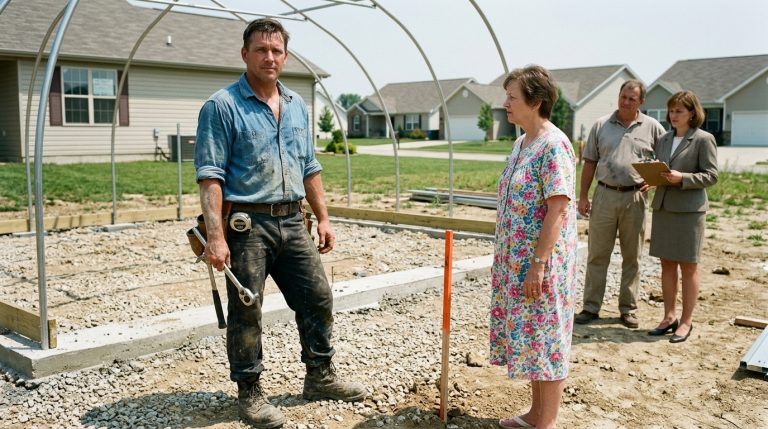
The morning air smelled of wet sod and cut grass, heavy with the humidity that clung to the lowlands of Oak Ridge before the summer sun could burn it away. Mark Henderson stood motionless at the edge of the patio, his boots planted firmly on the flagstones, watching the floral print of Karen Miller’s muumuu retreat toward the sidewalk. Her arms remained locked across her chest, that fleshy battering ram of a stance she used to preface every edict delivered to the covenant.
His hand rested on the top rail of the cedar door set into the gentle rise of the backyard turf. The wood was cool against his palm, sanded smooth and sealed with marine-grade polyurethane, built to repel moisture and time alike. Behind it lay twelve feet of reinforced concrete block and the quiet, earthen sanctuary where Laura’s jars of preserved tomatoes sat catching the dim light of a single overhead bulb.
The threat had not been subtle. Concrete by Friday. At his expense.
Mark did not shout. Twenty years in the Army Corps of Engineers had trained out the reflex for empty noise. When a dam showed a hairline fracture, you did not scream at the water; you measured the seepage, calculated the hydrostatic pressure, and mapped the stress points. Karen was a stress point, localized and predictable. She operated on the assumption that volume equaled authority and that a laminated rulebook from a local printer constituted federal law.
He turned away from the yard, his boots clicking hollowly on the flagstone as he walked back toward the house. The kitchen was quiet. Laura sat at the island, her fingers wrapped around a ceramic mug, her eyes fixed on the small stack of mail by the toaster. On top sat the crisp, white envelope bearing the Oak Ridge Homeowners Association logo—the thick, self-important bond paper that always felt heavier than it actually was.
“She was at the property line again,” Laura said, her voice low, carrying the tired cadence of a woman who simply wanted to grow her carrots in peace.
“I know,” Mark said, pulling out a chair opposite her. He did not touch the envelope yet. He looked at the faint smudge of dark soil under her thumbnail—evidence of the hours she had spent since dawn weeding the beds near the trellis. That soil was rich, dense, and chemically neutral, perfectly graded to drain away from the foundation he had spent three months pouring by hand.
“She mentioned the township,” Laura continued, looking up now, her gaze sharp. ” Said she’d already spoken to the municipal office. Mark, did we miss a filing? Did the county zoning board flag something after the fact?”
“No,” Mark said. His voice was flat, level, carrying the exact cadence he used when briefing a district commander on site safety compliance. “The county permit was pulled, reviewed by Dave at the municipal desk, stamped, and paid for in full three weeks before the first bucket of gravel was hauled in. The setback is twenty-two feet from the western property line. The local code requires twelve. We aren’t just legal; we exceed every structural threshold for lateral soil pressure in this county.”
He reached out, his calloused fingertips sliding under the flap of the HOA envelope without tearing it, lifting it to inspect the return address typography. It was printed on an inkjet printer, not a professional press—a small detail, but indicative of a rushed, reactionary mobilization.
“Then what is this?” Laura asked, nodding toward the paper.
Mark pulled the letter free, unfolding it with deliberate slowness. The words leaped out before he even processed the legalistic boilerplate: Notice of Violation, Article 14.7, Unapproved Structures and Alterations.
His eyes stopped dead on the citation. Article 14.7 governed above-ground outbuildings, tool sheds, gazebos, and detached play structures requiring architectural review committee clearance. It said nothing about subterranean spaces because a subterranean space, by definition, did not alter the exterior architectural profile of the lot.
A cold, sharp clarity settled behind his ribs. Karen hadn’t consulted a lawyer. If she had, a lawyer would have caught the jurisdiction gap immediately. She had skimmed the index, found the scariest-looking code number with the word Structures in it, and applied it like a blunt instrument.
He laid the letter flat on the granite countertop, smoothing the crease with the side of his thumb.
“She didn’t check the zoning maps, Laura,” Mark said softly, his eyes narrowing as he stared past the kitchen window toward the faint, green-shrouded rise of the root cellar door. “And she didn’t read past the table of contents.”
“She’s going to fine us,” Laura murmured, her shoulders tightening. “You know how she is with the board. They just rubber-stamp whatever she puts on the agenda.”
“Let her fine us,” Mark replied, his voice dropping into a register that was entirely devoid of warmth. He stood up, walking toward the hallway door that led to his home office—the small, orderly room where his drafting table, his engineering handbooks, and three decades of project logs were kept. “Let her log every dollar she thinks she’s owed. Every single piece of paper she sends us is just another nail in a coffin she’s building for herself.”
He paused at the threshold, turning his head slightly as a faint, metallic scrape echoed from the alley behind the fence—a sound so minor it would have gone unnoticed by anyone else. It was the sound of a heavy-duty municipal padlock clicking shut on a utility box, or perhaps the precise, heavy tread of someone measuring distances with a metal tape along the easement line.
Mark did not look out the window. Instead, he stepped into the office, flicked on the brass desk lamp, and pulled a heavy green binder from the shelf—the one labeled Structural Calculations & Municipal Compliance.
He opened it to page one, picked up a red grading pencil, and began to write.
CHAPTER 2: THE BLUEPRINT ARCHIVE
The brass lamp threw a tight, amber circle across the drafting table, illuminating the precise grid lines of the subterranean elevations. Outside, the evening shadows lengthened across the lawn, stretching long and slate-gray against the eastern fence line. Mark did not look up when the back door clicked shut, signaling Laura’s return from the garden toolshed. He already knew her rhythm—two short steps, a momentary pause as she wiped her gloves against her apron, and the soft sigh that always preceded a conversation she didn’t really want to have.
The kitchen floorboards creaked as she approached the open study door. She stopped at the threshold, her shoulder leaning against the white-painted frame, holding a small ceramic trowel in her right hand like a talisman.
“The township clerk’s office closes at five,” Laura said, her voice carrying an undercurrent of careful restraint. “If she actually filed a formal grievance with municipal planning instead of just playing president with her inkjet printer, wouldn’t they have called us by now?”
Mark capped his red pencil with a sharp, metallic click. He didn’t turn around immediately; instead, his eyes tracked the fine carbon lines of the rebar schedule he had drawn three months ago.
“They would have,” Mark said, his voice level, steadying the air in the small room. “Provided there was an actual violation to log. But Karen operates on administrative inertia. She relies on the assumption that people see an official seal or a bold-faced code citation and fold before they ever check the index. She’s an amateur playing a professional game, Laura. That’s her vulnerability.”
“She’s persistent, Mark. And she has the board in her pocket.”
“The board is a rubber stamp until it faces personal liability,” Mark murmured, finally turning his chair to face her. The amber light caught the hard angles of his jaw and the faint lines around his eyes—the physical markers of two decades spent overseeing heavy civil engineering projects where a single miscalculated load rating could bring down a bridge span. “A board of directors only maintains its loyalty to a tyrant as long as the tyrant’s crusade is free. The moment they realize the corporate liability insurance doesn’t cover personal bad-faith harassment, their loyalty evaporates.”
He stood up, his joints making a faint, dry pop as he stretched his shoulders. The memory of his grandfather flickered briefly across his mind—the old man standing in the cool, damp dark of a Vermont root cellar back in nineteen-eighty-four, explaining how you don’t fight a flood by building a higher wall in front of the rushing water; you dig a diversion channel and let the current defeat its own momentum. Karen was rushing forward with a head full of steam and zero structural reinforcement.
“What are you going to do?” Laura asked, her gaze dropping to the heavy green binder open on the desk.
“Nothing yet,” Mark said, walking over to the filing cabinet tucked into the corner of the room. He pulled the bottom drawer open with a smooth, oiled glide. “We let her send the second letter. The one where she escalates the fine from one hundred dollars to two hundred and fifty. Every time she doubles down without legal backing, she deepens her exposure.”
He reached into the back of the drawer and pulled out a thin manila folder containing the county public records request forms he had picked up a month prior during his initial zoning check. He didn’t bring them out to show her; he kept them flat against his thigh, out of sight.
“Where are you going?” she asked, noticing the shift in his posture.
“Nowhere,” Mark said quietly, his eyes fixed on the hallway window that looked out toward the distant community park and the gleaming white timbers of the newly erected neighborhood gazebo near the pond. “I’m just checking our perimeter.”
He walked past her into the hallway, the cool linoleum under his socks offering a sharp contrast to the heated tension of the house. He didn’t step outside into the fading twilight. Instead, he stopped by the front window, drawing the sheer curtain back half an inch with two fingers.
Across the street, parked diagonally under the amber glow of the municipal streetlamp, sat Gary’s oversized silver SUV. The engine was off, but the driver’s side window was rolled down an inch, and a faint plume of blue cigarette smoke curled lazily out into the damp night air. Gary wasn’t just driving home from work; he was stationed there, a sentinel for an HOA president who was already losing her grip on reality without even knowing it.
Mark let the curtain drop back into place. His reflection in the double-paned glass looked back at him—unblinking, gray-eyed, and entirely composed.
The first phase of the war was over. The paperwork had been filed, the perimeter secured, and the enemy was currently locking herself inside a fortress built entirely of paper and bluff.
He turned away from the glass and walked back toward the study, his mind already calculating the precise day the certified mail receipt for the second escalation letter would hit their box, and how soon after that he would pay a quiet, undocumented visit to the county records office to look at the blueprints for a certain community gazebo.
CHAPTER 3: THE SMEAR CAMPAIGN AND THE BARBECUE
The sunlight hit the manicured turf of the front yard with a harsh, unyielding glare, turning the emerald blades into flat planes of green paint. Mark didn’t look across the asphalt toward the municipal streetlamp where Gary’s SUV had idled hours before. He kept his pace measured, his boots striking the concrete walkway with a flat, rhythmic thud that demanded no attention yet commanded the space it occupied.
The immediate neighborhood had changed over the last forty-eight hours—not in its physical geography, but in its acoustics. The usual ambient noise of lawnmowers and children shouting down the cul-de-sac had grown tight, compressed by a localized atmospheric pressure that only an active HOA vendetta could generate. When Mark reached the curb to retrieve the afternoon mail, he noticed Mrs. Gable—Brenda from three houses down—pausing mid-stride by her hydrangea bushes, her hand hovering over a stray leaf as if she had been caught rehearsing a motion.
She didn’t wave. Her eyes flicked toward Mark’s porch, darted back to her flowerbed, and then retreated behind her screen door with a soft, metallic click.
Karen’s whispered network had begun to take root. The initial notice of violation had spawned an invisible curriculum of caution among the residents who preferred anonymity over friction.
Mark pulled the latch of the metal mailbox down. Inside lay the usual collection of slick grocery flyers, a local utility bill, and one envelope that stood out like a raw nerve: a square, cream-colored cardstock bearing the return address of the Oak Ridge Homeowners Association. No inkjet printing this time; this was an embossed seal, executed with the cold, self-important formality of an administration preparing for an audit it never expected to fail.
He didn’t open it on the curb. He tucked it against the utility bill, closed the box with a sharp snap, and turned back toward his property line.
By six o’clock that evening, the dining room table had been cleared of its blueprinted grid lines and replaced with the quiet mechanics of hospitality. Laura had spent the afternoon prepping three racks of ribs and a heavy iron skillet of cornbread, her movements efficient and deliberate. She wasn’t fighting a war; she was holding a dinner party. That was the distinction Karen failed to grasp. An HOA president operated on vertical edicts from above, while a community operated on lateral human friction—the shared smell of charcoal smoke, the passing of plates across a cedar fence, and the casual, unscripted exchange of facts that completely dismantled manufactured panic.
Tom and Maria arrived precisely at six-thirty, their expressions a careful blend of neighborly warmth and quiet curiosity. Tom, whose career in commercial real estate gave him an instinctive eye for property lines and structural integrity, didn’t wait for an invitation to look at the backyard.
“I heard about the second letter,” Tom said, setting a cooler of craft beer down by the flagstone patio. He wiped his palms on his jeans, his gaze drifting naturally toward the gentle, grass-covered swell of the root cellar door tucked between the lilac bushes. “Gary was at the mail kiosks this morning telling anyone who would listen that the board is preparing to slap a formal lien on your title for non-compliance.”
Mark unscrewed the cap of a bottled water, the plastic crackling sharply in the cool evening air. “Gary wouldn’t know a lien from a lease agreement unless Karen printed it out for him in large-format font,” Mark said evenly. “He signs whatever she hands him because he likes the sound of his own title as treasurer.”
“It’s more than just Gary,” Maria interjected, stepping out onto the patio with a bowl of potato salad. Her face was tight with suppressed annoyance. “I was at the community pool yesterday. Karen was holding court by the shallow end, telling people that your underground structure was actively compromising the drainage basin for the entire western slope. She said it was a subterranean sinkhole waiting to swallow the foundations of the houses on either side of you.”
Laura paused by the sliding glass door, a tray of ceramic plates balanced in her hands. Her eyes flicked toward Mark, a brief flicker of anxiety tightening her mouth.
Mark didn’t blink. He reached down, picked up a heavy steel mason’s square from the patio table where he had left it earlier, and turned it over in his hands, letting the cold metal catch the fading sunlight.
“Drainage basins require a continuous hydraulic gradient,” Mark said, his voice dropping into the steady, unhurried cadence of a structural briefing. “If our foundation were compromising the slope, the subterranean water table would be backing up into our eastern footer within six hours of a heavy rain. We had two inches of downpour on Tuesday night. The perimeter drain ran clear into the municipal storm sewer by midnight. Not a single drop of pooling against the retaining blocks.”
He set the steel square down with a definitive clack against the stone.
“She’s projecting, Tom,” Mark added, looking directly at the real estate agent. “She needs the narrative of a catastrophe to justify the fines. If the root cellar is safe, legal, and stable, then her entire enforcement mechanism collapses. And if her enforcement mechanism collapses, people start asking questions about where the community dues actually went last spring.”
Tom went completely still. A slow, knowing smile crept across his weathered face as he processed the implications of Mark’s wording. He picked up his beer bottle, turned it once by the neck, and looked out across the lawn toward the distant silhouette of the neighborhood gazebo near the retention pond.
“Last spring,” Tom repeated softly, testing the weight of the phrase. “You mean the gazebo project? The one that went thirty percent under budget on paper and took half the time to frame?”
“That’s the one,” Mark said quietly.
Before Tom could press further, the sound of a screen door latching down the fence line drew their attention. Brenda—the quiet neighbor who had visited days earlier—stood hesitantly at the edge of the property line, clutching a small glass pie dish wrapped in a checkered napkin. She looked back toward her own house as if checking to see if an invisible line had been crossed, then took a breath and stepped across the grass toward them.
“I didn’t mean to interrupt,” Brenda said, her voice small, almost apologetic. “I just… I baked a rhubarb crisp. And I wanted to drop it off before it got cold.”
Laura’s face instantly softened. She stepped forward, her hands open and welcoming, taking the dish with genuine grace. “You didn’t interrupt at all, Brenda. We were just talking about dinner. Please, stay. There’s more than enough food.”
Brenda hesitated, her eyes flickering toward Mark. There was no fear in her expression now—only the quiet, stubborn resolution of someone who had looked behind the curtain of an HOA tyrant’s bluff and found nothing holding it up except hot air and cheap cardstock.
“I heard about the meeting Karen is trying to call,” Brenda said quietly, her fingers nervously pleating the edge of her apron. “The special assembly at the clubhouse next week. She’s bringing someone from the county out. A building inspector. She’s telling everyone he’s going to condemn the cellar on the spot.”
Mark walked over to the patio table, picked up the thick, cream-colored envelope from the HOA, and turned it over in his fingers. He didn’t open it. He didn’t need to.
“Let her bring whoever she wants,” Mark said, his voice carrying an absolute, unshakeable weight that settled over the patio like a lead weight. “When you invite an outside authority into a dispute, you lose control of what they look at. And right now, there are a lot of public records in this town that haven’t been looked at closely enough.”
CHAPTER 4: THE ACCOUNTANTS ARCHIVE AND THE LEGAL COUNTERSTRIKE
The cream-colored cardstock parted cleanly under the edge of Mark’s thumb, releasing the faint, dry scent of high-grade wood pulp. He didn’t sit down immediately. He stood beside the drafting table, letting the overhead brass light fall across the embossed seal of the Oak Ridge Homeowners Association.
Notice of Administrative Escalation.
The fine had jumped from one hundred dollars to two hundred and fifty. Below the figure, typed in a sharp, self-important font, was a demand for immediate compliance or face an emergency lien registration filed directly with the county clerk by Friday afternoon. Karen’s signature at the bottom was a sprawling, aggressive loop of blue ink that gouged slightly into the paper fibers, revealing the frantic pressure of the hand that held the pen.
The study door clicked softly, and George Gable stepped into the room. The retired accountant didn’t wait for an invitation; he carried a heavy, worn manila folder tucked securely under his arm, its edges frayed from years of careful categorization. He looked at the cream-colored letter in Mark’s hand, a quiet, knowing grimace touching the corners of his mouth.
“The two-hundred-and-fifty-dollar bracket,” George said softly, stepping closer to inspect the page without touching it. “I remember that phase. That’s the panic tier. When the initial threat fails to produce a submission, she doubles the penalty to force an emotional reaction before you have time to consult a municipal code book.”
Mark laid the letter flat against the mahogany desktop next to his red grading pencil. “She’s accelerating her timeline because the board is beginning to fracture behind closed doors,” Mark said, his voice flat and controlled. “Tom heard from a reliable source that Gary and Cynthia are sweating the personal liability angle. If they realize the board’s insurance doesn’t cover bad-faith enforcement of non-existent bylaws, Karen’s monolithic control is going to crack.”
“It’s already cracked,” George replied, opening his worn manila folder with a crisp, dry rustle of paper. He slid a photocopied document across the desk toward Mark. “Three years ago, when she tried to fine me over the decorative stone border around my rose garden, she used this exact template. Same formatting, same aggressive verbiage, same non-existent statutory reference.”
Mark’s eyes scanned the page, his engineer’s mind instantly recognizing the pattern. It wasn’t just a similar letter; it was a recycled administrative template with the names and dates swapped out. Karen wasn’t running a legal governance body; she was operating a boilerplate intimidation machine, relying on neighborly exhaustion to avoid judicial scrutiny.
“She missed a crucial detail in her legal template this time,” Mark noted, tapping a finger against the bottom margin of the HOA notice. “She cited Article 14.7 as a blanket authority for property remediation. But Article 14.7 explicitly limits its scope to above-ground structures requiring architectural clearance. A subterranean excavation falls under municipal civil engineering jurisdiction, not local covenant management.”
“Which brings us to Sarah,” George said, a faint, dry smile touching his lips. “The young litigator down the street. She’s finished drafting the formal response from her firm.”
Mark nodded, reaching into the middle drawer of his desk to pull out a crisp, legal-backed document delivered by courier twenty minutes prior. It was a formal Cease and Desist notice addressed not just to Karen Miller, but individually to every sitting member of the Oak Ridge HOA board of directors. It explicitly outlined the doctrine of fiduciary breach, detailed the pattern of selective harassment cataloged in George’s archives, and demanded the immediate retraction of all fines against the Henderson property under threat of personal civil litigation.
“This is the wedge,” Mark said, holding the legal brief up to the light to inspect the firm’s embossed watermark. “Once Cynthia and Gary receive this at their home addresses with their own names listed as individually liable defendants, they won’t care about Karen’s garden projects or her community standing. They’ll want their names off the liability line.”
“And while they’re scrambling to contain the fallout in their executive sessions,” George added, his eyes narrowing with quiet satisfaction, “what’s our next move on the offensive front?”
Mark walked over to the corner filing cabinet, unlocking the top drawer with a steady twist of a small brass key. He pulled out a thick, banker’s box overflowing with public records request forms, photocopied architectural blueprints, and municipal invoices—the complete dossier he had spent the last three nights compiling regarding the community gazebo near the retention pond.
“We don’t wait for them to come to us,” Mark said, setting the heavy box of public records down on the drafting table with a solid, echoing thud. “Karen invited an outside authority to inspect our property. It’s only fair that we return the favor for hers.”
He reached into the box and pulled out the winning contractor’s bid for the neighborhood gazebo project, pointing a calloused finger directly at the bottom-line figures and the glaring absence of an electrical safety sign-off. The paper felt cold against his palm—the precise texture of an oversight waiting to be exposed.
CHAPTER 5: THE PUBLIC RECORDS VAULT AND THE MISSING SIGNATURE
The heavy corrugated cardboard parted with a sharp, tearing rasp that seemed uncomfortably loud in the quiet study. Mark didn’t hesitate. He pulled back the flaps, releasing the dry, chemical smell of archival paper and ozone-bleached toner—the unmistakable scent of municipal bureaucracy stored too long in windowless basement rooms.
George Gable leaned forward, resting his palms on the edge of the desk. The amber light from the banker’s lamp caught the sharp angles of his silver-trimmed glasses as he watched Mark lift the first stack of manila folders.
“The county planning files for the Oak Ridge common area gazebo,” Mark said, his voice dropping into its lowest, most analytical register. He laid the stack flat against the mahogany. “Approved April of last year. Total budget allocation: forty-two thousand dollars. Designed as the centerpiece of Karen’s presidential legacy.”
“And structurally vulnerable,” George added quietly, his accountant’s eyes already scanning the itemized index sheets on top of the pile. “Otherwise you wouldn’t have spent three nights cross-referencing these invoices against state contractor registries.”
Mark didn’t answer immediately. He pulled a yellow legal pad from the drawer, laid a sharp-tipped mechanical pencil beside it, and began pulling individual folders from the box. He worked with the practiced efficiency of a man conducting a forensic audit on a failing bridge design. Every document had a weight, a sequence, and a paper trail. If a footer was poured four feet deep as required by local freeze-line codes, there would be a concrete delivery ticket matching the cubic-yard displacement. If an electrical line was run underground to feed the overhead lantern, there would be an inspection sign-off from a licensed municipal electrician.
The first discrepancy appeared on invoice number four-thousand-two-hundred-eighty-one.
Mark tapped the paper with the blunt end of his mechanical pencil. “Look at the concrete volume,” he said, his voice cold and flat. “The architectural blueprints specified four structural piers sunk four feet deep to anchor the timber frame below the local frost line. That volume requires approximately six point four cubic yards of ready-mix concrete.”
George leaned closer, his finger tracing the printed line items. “The delivery ticket from the regional supplier,” George murmured, reading the numbers aloud. “Four point two cubic yards. That’s a deficit of over two yards.”
“Which means the piers weren’t sunk four feet,” Mark stated, his eyes narrowing as he mentally calculated the soil load capacity. “They were cut off at roughly two and a half feet to save on material costs and labor time. It’s a clean, quiet shortcut that passes a casual visual inspection on day one, but after two freeze-and-thaw cycles, lateral soil pressure will begin to crack the foundation footings.”
Before George could reply, a sudden, piercing slash of white light cut across the study window, painting the bookshelf and the green walls in a harsh, kinetic glare. Outside in the street, the heavy engine of an oversized SUV rumbled to a low, aggressive idle before the headlights flickered off, plunging the cul-de-sac back into deep shadow. Gary’s vehicle had returned, parked directly across from their driveway like a mechanical sentinel keeping watch over a battlefield.
Neither man looked out the window. In a war of paperwork, external intimidation was just noise—a crude psychological tactic deployed by people who knew they were losing control of the actual mechanics.
Mark turned the page, sliding the electrical subcontractor’s estimate out from beneath the structural receipts. His fingers brushed the edge of the paper, feeling the thin, cheap grain of interior-grade stock.
“That’s minor compared to this,” Mark whispered, his gaze locking onto the itemized material list.
George peered over the desk, his brow furrowing. “Standard Romex wiring? For an outdoor public structure?”
“Interior-grade thermoplastic insulation,” Mark confirmed, his jaw tightening into a hard, unforgiving line. “Designed exclusively for dry residential framing behind drywall. It has no moisture barrier, no armored shielding, and no underground conduit rating. When they buried it six inches under the damp soil leading out to the gazebo post, they created a ticking time bomb. The first time the ground saturates during a heavy summer storm, that insulation degrades. The soil becomes an active conductor. Anyone touching that wooden post under the wrong atmospheric conditions…”
He didn’t need to finish the sentence. The physical reality of the hazard hung in the air between them, sharp and undeniable. Karen hadn’t just cut corners to save her pet project under budget; she had built an electrocution hazard in the middle of a public park where children played every afternoon.
Mark flipped to the very back of the folder, his thumb riffling through the final pages, looking for the mandatory certification stamp.
The space where the final municipal electrical inspection report was supposed to be stapled was completely, conspicuously blank. There was an application request form stamped Received, but no sign-off, no inspector’s badge number, and no completion certificate. The project had been energized illegally, bypassing final safety sign-offs entirely to ensure the ribbon-cutting ceremony happened on schedule.
Mark picked up his red grading pencil, hovered it over the blank space for three slow heartbeats, and then set it down with absolute, deliberate precision.
“She skipped the final inspection,” Mark said, his voice entirely devoid of triumph, carrying only the cold weight of absolute certainty. “She pushed the project through, turned on the power, and pretended the paperwork was complete.”
George straightened up, exhaling a long, measured breath that rattled slightly in his chest. He looked at Mark with a new, profound level of respect—not just as a neighbor defending his property, but as an engineer who had systematically dismantled an adversary’s entire empire using nothing more than public records and basic math.
“The special clubhouse assembly is scheduled for next Tuesday,” George said quietly, his hand resting on the edge of the manila folder. “Karen is bringing Inspector Evans out to condemn your root cellar in front of the entire community.”
“Let her,” Mark said, his gray eyes reflecting the amber light of the desk lamp with unblinking clarity. “She’s bringing the county safety inspector right into a neighborhood where the only uninspected, condemned structure is the one she signed off on with her own name.”
CHAPTER 6: THE EMERGENCY BOARDROOM FRACTURES
The acoustic ceiling tiles of the Oak Ridge community clubhouse conference room absorbed sound too efficiently, turning every hurried whisper into a dry, abrasive scrape of friction. Outside executive doors, the evening air had turned the color of wet slate, throwing long, distorted shadows across the asphalt parking lot where Gary’s oversized SUV sat diagonally across two marked spaces.
Inside, the long mahogany-veneer table was crowded with four sitting board members and a secretary whose pen had remained suspended over her shorthand pad for the last ten minutes.
Karen sat at the head of the table, her floral-print caftan vivid against the neutral beige of the walls, her fingers locked tightly around a polished silver fountain pen. She wasn’t looking at the agenda. Her eyes were fixed on the opposite end of the room where the duplicate copies of Sarah’s formal legal cease-and-desist letter lay scattered across the polished wood like dropped ordnance.
“We are not amending the fine schedule,” Karen said, her voice dropping into a register of sharp, metallic authority that lacked its usual theatrical resonance. “The Henderson property is in flagrant violation of covenant section fourteen point seven. If we back down now because of a threatening letter from an ambulance-chasing litigator three doors down, we surrender every structural standard this community has spent a decade enforcing.”
Cynthia, the board secretary, shifted uncomfortably in her faux-leather executive chair. She didn’t look at Karen. Her gaze was locked on the second paragraph of the legal brief—the specific section highlighted in yellow ink by her own hand.
“Karen, it’s not just a threatening letter,” Cynthia said, her voice tight, dry, and trembling slightly with nervous exhaustion. “My name is on this document. Individually. As a named defendant.”
“Standard intimidation tactics,” Karen snapped, waving her silver pen dismissively through the air. “They always name the board members. It’s boilerplate legal theater designed to induce panic among people who don’t understand how neighborhood covenants work. Our insurance covers corporate governance.”
“Does our insurance cover bad-faith harassment?”
The voice came from halfway down the table, flat and unyielding. Gary, the treasurer, hadn’t looked up from his phone screen for twenty minutes, but when he finally raised his head, the skin around his eyes was gray with stress. He pushed his chair back an inch, the metal legs scraping harshly against the commercial carpet tiles.
“I talked to my brother-in-law this afternoon,” Gary continued, his tone hardening. “He’s a senior partner at a civil defense firm in the city. I read him the exact wording of Sarah’s brief regarding fiduciary breach and selective enforcement. You know what he told me, Karen? He told me that if a board president initiates punitive fines without statutory backing while ignoring prior precedent, the corporate liability policy voids its personal indemnity clause. That means if Henderson files a civil suit, our personal assets—our bank accounts, our homes—are exposed.”
The silence that followed was absolute. Even the low hum of the ceiling-mounted ventilation unit seemed to drop an octave.
Karen’s face flushed a deep, mottled crimson that clashed violently with the bright purple fabric of her dress. She slammed the fountain pen down against the table, the nib snapping against the wood with a sharp crack.
“You are cowards,” Karen hissed, leaning forward until her forearms pressed heavily against the tabletop, her chest heaving with suppressed fury. “Both of you. I built this community’s standards from the ground up. I fought for the architectural review process, I secured the landscaping contracts, and I personally oversaw the construction of our central community assets, including the gazebo by the pond. And now you’re ready to fold because a retired engineer dug a muddy hole in his backyard and hired a rookie lawyer to write a scary letter?”
“A hole that’s fully permitted by the county,” Cynthia whispered, her voice dropping to a defensive murmur as she pulled her notepad closer to her chest. “Mark Henderson showed Brenda the municipal sign-offs last week. He has an engineered grading plan that exceeds every municipal drainage code in the district. If we force a public confrontation at next Tuesday’s assembly with Inspector Evans, and the county backs his permits, we aren’t just losing an argument—we’re exposing the association to a massive public relations disaster.”
“Evans won’t back him,” Karen said through clenched teeth, though the absolute conviction in her tone had begun to fray at the edges. “Evans is a professional. He’ll take one look at an unapproved underground excavation and see it for what it is: a liability hazard. That is why I called the special assembly. That is why the county inspector is coming out to condemn the structure on-site. When the community sees an official county placard nailed to his cedar door, this entire rebellion will dissolve overnight.”
She looked around the table, her eyes darting from face to face, searching for the unquestioning loyalty she had commanded for three consecutive terms. But she found only averted gazes and rigid postures. Gary stood up completely, tucking his phone into his jacket pocket with a definitive snap of his wrist.
“I’m moving that we formally rescind the fine notices against the Henderson property,” Gary said, looking directly at Cynthia. “And I’m moving that we cancel the special assembly before the county inspector gets dragged into a private civil war that we started without legal clearance.”
“Seconded,” Cynthia murmured instantly, sliding her paperwork into her leather portfolio and standing up without waiting for a vote.
Karen sat frozen at the head of the long table, her hands flat against the mahogany veneer, her mouth slightly open as the institutional authority she had wielded like a scepter for years slipped through her fingers in less than five minutes. The boardroom doors swung open with a soft pneumatic hiss, and the remaining board members filed out into the hallway, leaving her alone in the sterile, beige silence of her own administrative defeat.
Yet, even as the quorum collapsed around her, Karen’s mind refused to accept the geometry of her failure. Her fingers twitched toward her smartphone. If the board wouldn’t back her, and if the formal administrative process was stalling out under the weight of legal threats, there was still one option left. She would make it personal. She would bring the fight directly to their doorsteps before Tuesday night arrived, using every tool, every whisper, and every desperate measure she had left to reclaim the narrative.
CHAPTER 7: THE CLUBHOUSE CONFRONTATION AND THE GAZEBO INSPECTION
The folding metal chairs arranged across the linoleum floor of the Oak Ridge clubhouse rattled as fifty residents shifted in unison, their murmurs forming a low, collective static that filled the high-ceilinged room. The air smelled of artificial pine cleaner and recycled heat. At the front of the hall, standing behind a modular wooden podium, Karen wore a vibrant purple caftan that caught the harsh glare of the overhead troffers, her face set in an expression of tight, unyielding triumph.
Beside her, seated on a metal folding chair with a gray clipboard resting against his knee, sat David Evans, the senior county building inspector. His grey mustache was neatly trimmed, and his county-logo polo shirt bore the faint creases of someone who had spent his afternoon checking blueprints rather than attending suburban turf wars.
Mark walked down the center aisle with a measured, deliberate stride. He carried a single, slim leather portfolio tucked beneath his left arm. Beside him walked Laura, her hand linked firmly through his elbow, her posture upright and calm. In the second row, George Gable and Tom offered subtle, grounded nods.
Karen raised both hands, her palms facing down in a theatrical gesture designed to command silence.
“Thank you all for coming to this special community assembly,” Karen announced, her voice projecting with practiced, ringing authority over the microphone. “We are here tonight to address an urgent matter of public safety and covenant compliance concerning an unapproved subterranean structure located at one-twelve Oak Drive.”
A murmur rippled through the front rows. Several of Karen’s loyalists turned to gawk at Mark as he took a seat midway down the center aisle.
“For weeks,” Karen continued, her voice swelling with dramatic cadence, “the board has attempted to resolve this severe zoning violation through administrative channels. But the homeowner has chosen obstruction and legal threats over compliance. Fortunately, we have secured the expert assessment of the county safety authority. Mr. Evans is here tonight to provide his official evaluation and to confirm whether this excavation constitutes an imminent hazard to our neighborhood stability.”
She stepped back from the podium with a dramatic flourish, gesturing toward the county inspector as if presenting a verdict already written.
Inspector Evans stood up, picking up his clipboard and clicking his ballpoint pen with a dry, mechanical click. He walked up to the podium, adjusting the microphone stem down an inch to match his height.
“Good evening,” Evans said, his voice flat, professional, and entirely devoid of theatrical flair. “I was asked by the association president to conduct an immediate on-site safety assessment of a subterranean structure on Oak Drive. Before I present my findings regarding that property, I need to address a secondary filing handed to my office earlier this afternoon by Mr. Henderson’s legal counsel—a public records audit concerning the Oak Ridge community gazebo.”
Karen’s head snapped toward the inspector, her smile faltering by a fraction of a millimeter. “Mr. Evans, that is not on the agenda for tonight’s assembly.”
“Standards review supersedes association agendas, ma’am,” Evans replied evenly, not looking at her. He flipped open his clipboard to a set of municipal attachments bearing red-inked margins. “Earlier today, at two p.m., I reviewed the engineering logs and contractor invoices for the community gazebo project completed last spring. I subsequently visited the site prior to arriving here this evening.”
The room grew so quiet that the hum of the overhead projector blower sounded like a jet engine.
“First,” Evans continued, his eyes scanning the crowd, “the architectural blueprints required structural foundation piers sunk to a depth of four feet below the local frost line. Field excavation revealed the actual concrete depth to be barely two and a half feet. That is a structural compromise.”
A collective intake of breath swept through the middle rows.
“Second,” Evans raised his voice slightly, cutting off Karen as she opened her mouth to interrupt. “The electrical feed running from the main breaker box to the overhead lantern utilized interior-grade Romex wire—unrated for moisture, unshielded by underground conduit, and buried six inches beneath damp soil. There is no record in the county archives of a final electrical inspection ever being requested, conducted, or passed for that structure.”
Evans reached down to his belt, unhooking a bright red laminated placard with block-lettered black text. He held it up so the entire room could see it.
“As of six-fifteen p.m. today,” Evans stated coldly, “the Oak Ridge community gazebo is officially condemned as an active electrocution and structural hazard. The power to the structure has been severed, and it is ordered for immediate demolition at association expense.”
The silence in the room shattered instantly. Voices erupted from all sides—shocked parents demanding explanations, neighbors turning to stare accusingly at the front table, and Gary sliding down his metal chair with his head in his hands.
Karen’s face drained of every trace of color, leaving her skin a stark, ghostly white against her purple caftan. She grabbed the edges of the wooden podium, her knuckles turning yellow under the pressure.
“That—that is entirely irrelevant,” Karen shrieked, her voice cracking into a high-pitched, desperate frequency that pierced the microphone feedback loop. “We are here to discuss his bunker! His illegal subterranean hazard! Mr. Evans, tell them about the root cellar! Tell them it’s a sinkhole!”
Inspector Evans turned his gaze slowly from the crowd back toward Karen, his expression hardening into absolute professional disdain.
“As for Mr. Henderson’s root cellar,” Evans said clearly into the mic, pausing for dramatic weight. “I inspected the interior structure immediately prior to this meeting. The concrete block work is exemplary. The waterproofing membranes exceed municipal standards. The ventilation is fully compliant. On paper and in practice, it is one of the most soundly engineered private projects in this district. The county has issued its final sign-off, and any further interference from this board will be treated as targeted civil harassment.”
Mark remained seated in the center aisle, his posture motionless, his hands resting quietly on his knees. He didn’t smile. He didn’t gloat. He simply watched the precise, mathematical collapse of a tyrant’s empire, knowing that every single stress point had finally given way under the weight of its own internal flaws.
CHAPTER 8: THE CONDEMNED LEDGER AND THE FINAL SILENCE
The afternoon sun hung low over the western ridgeline of Oak Ridge, casting long, sharp amber beams across the manicured lawns that seemed to highlight every blade of grass with uncompromising clarity. Mark stood on his back flagstone patio, his hands resting lightly on the cold, smooth timber of the cedar door set into the rise of the turf. He didn’t open it immediately. He simply watched the dust motes drift lazily through the shaft of light falling across the hinges.
In the distance, across the community green near the retention pond, the low rumble of heavy machinery broke the stillness. A municipal flatbed truck idled by the edge of the park, its amber strobe lights flashing in slow, rhythmic pulses against the fading light. A pair of demolition contractors, equipped with heavy-duty pry bars and reciprocating saws, were systematically dismantling the remaining timber framework of the condemned gazebo. Each sharp screech of tearing wood and every heavy thud of timber hitting the turf carried across the open green—a clean, mechanical accounting of structural collapse.
The community had not rioted, nor had it erupted into open factional warfare. It had simply dissolved its illusions. Three days after the special assembly, George Gable had assumed the interim presidency by unanimous electronic vote, his first official act being the formal dissolution of Karen’s punitive fine schedule and the retraction of every administrative warning issued during her tenure. Gary and Cynthia had tendered their resignations from the board before the ink on Sarah’s legal brief could even dry, retreating quietly behind closed doors and drawn blinds.
Karen had put her house on the market within forty-eight hours of the assembly. The moving van had arrived on a gray Thursday morning—a small, unmarked truck that loaded her belongings without ceremony or a single neighbor coming out to wave goodbye. She could not bear to remain in a place where her authority had been unmasked not by an act of rebellion, but by the simple, unyielding application of engineering truth and public record.
The front door of the house slid open behind Mark, the soft click of the latch preceding the familiar, comforting footsteps of Laura stepping out onto the patio. She carried two small ceramic mugs of black coffee, steam curling into the crisp evening air. She stopped beside him, handing him one of the mugs before resting her shoulder gently against his arm.
“They’re taking down the main support posts now,” Laura said softly, her voice carrying a quiet note of resolution as she watched the distant amber lights flash across the park.
“Good,” Mark said, taking a slow sip of the coffee. The heat was sharp against his tongue, grounding him in the physical reality of the present moment. “A structure built on shortcuts doesn’t survive a change in the weather. It was bound to fail the moment someone checked the foundation depth.”
He turned his gaze from the distant demolition site down toward his own property line. The soil above the root cellar was settling naturally, the fresh sod knitting seamlessly into the surrounding turf until the gentle swell looked as though it had been carved into the hillside twenty years ago. There was no sign of the battle that had been fought across its surface—no paperwork, no threats, no petty tyrants standing on the flagstones with folded arms.
Mark set his coffee mug down on the low stone wall beside the patio, stepped forward, and pulled the heavy iron latch of the cedar door. It swung open smoothly, oiled to perfection, releasing the cool, earthen scent of limestone, damp concrete, and sweet preserved fruit.
He descended the three poured concrete steps into the subterranean sanctuary, the dim light from the overhead fixture illuminating the clean, white-painted block walls. Neatly organized along the sturdy wooden shelves stood dozens of glass Mason jars filled with the rich, jewel-toned bounty of Laura’s garden—deep red tomatoes, golden peaches, and amber pickles catching the light in orderly rows. Every block had been mortared by hand; every rebar grid had been calculated down to the last pound of lateral load capacity. Nothing had been left to chance, and nothing had been built on a bluff.
Mark reached out, his calloused fingertips brushing against the cool glass of a peach jar, adjusting its placement on the shelf by a fraction of an inch until it sat dead-center on the grain. It was a small, silent motion of maintenance—the quiet labor of keeping a world intact.
When he climbed back up the steps into the fading twilight, Laura was waiting by the open doorway, her eyes bright and steady, free of the fatigue that had weighed on her for months.
The air was cooling rapidly as dusk settled over Oak Ridge, bringing with it the sharp, clean scent of dry earth and approaching autumn. The war of paper and intimidation was over, replaced by the quiet, steady rhythm of daily life restored to its rightful balance. Mark closed the heavy cedar door behind him, dropped the latch into its iron bracket with a solid, satisfying click, and walked back toward the house with his wife, knowing that the foundation beneath their feet was built to last.