The Weight of Silence: A Legacy of Honor Found Beneath the Dust of Forgotten History
CHAPTER 1: THE WEIGHT OF THE SUNRISE
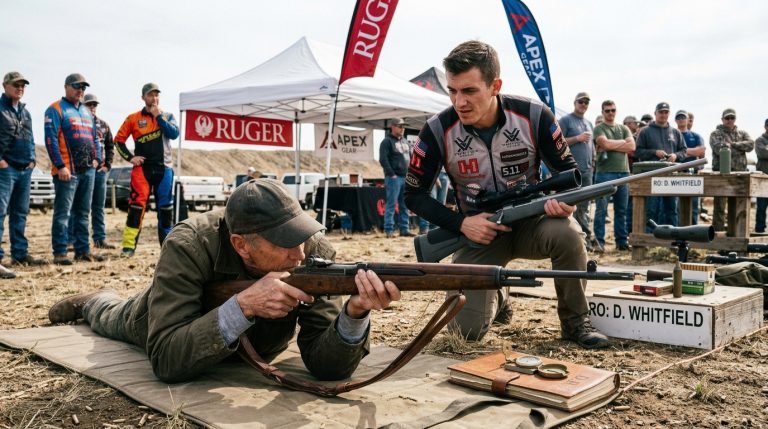
The air inside the Embassy Suites ballroom tasted of stale coffee and the thin, sharp scent of industrial carpet cleaner, a sensory assault that made the house in Grand Island feel a world away. Walter Hendricks stood at the edge of the folding table, his knuckles white against the rough wool of the blanket. He felt the gaze of the young man behind the table—Trevor Nash—who looked at Walter’s worn coat and saw only a man who had wandered into the wrong room, a relic of a time before digital metrics and tactical trends.
“What have you got for us today, sir?” Trevor asked. The question was polite, but it lacked texture; it was the voice of a man who looked at the world and saw only its surface.
Walter didn’t rush. He had driven ninety-two miles for this moment, passing through the early morning thaw of a Nebraska spring, his heart beating in sync with the rhythm of a promise he had made in a hospital room in 1990. “It was my grandfather’s,” Walter said, his voice a low scrape of sound in the hum of the room. He felt the heavy, cold presence of the iron within the blanket. It was more than a weapon; it was a physical weight, a piece of 1927 held in place by the fraying threads of the past.
Trevor reached for the bundle with the casual, careless speed of someone who had never had to carry a secret. Walter’s hand twitched, a reflexive guard, but he pulled back. He watched as Trevor unwrapped the wool, his movements hurried, eyes already scanning for rust or modern markings. When the cloth fell away, the room seemed to tilt. The wood of the stock was worn smooth in two perfect ovals—the memory of a thumb, a hand, a grip held in the heat of a Nicaraguan summer.
“Thompson style,” Trevor murmured, his voice shifting into a practiced, airy register. “Likely a parts gun. You know what those are, sir? Just a mishmash of reproduction parts, really.”
Walter felt the familiar, dull ache in his chest—the ache of being unseen. Beside him, another appraiser named Cole picked up the brittle, yellowed manual that had tumbled from the blanket, flipping through it with a thumb that lacked any reverence for the paper’s age.
“Classic,” Cole laughed, glancing at the stamp on the inside cover without even registering the ink. “Grandpa’s fairy tales, right?”
Walter looked at them, then at the weapon, and realized the chasm was wider than he had feared. He wasn’t just here for an appraisal; he was here to see if the world still knew how to hold a truth. He watched as Trevor gripped the barrel, holding the weight of his grandfather’s courage with the clumsy disregard of a tourist. He leaned in, his voice steadying, and asked, “Is there someone else here who could look at it?”
It was then, in the silence that followed, that a man from the far end of the room—a man with gray hair and a quiet, deliberate stride—set down his coffee cup. He stood, and the way he moved through the room told Walter that he was not coming over for a joke.
CHAPTER 2: THE CALIBRATION OF VALUE
Harold Weaver did not rush. He moved with a measured, rhythmic cadence that suggested a man who had long ago mastered the art of observation. He didn’t look at Trevor or Cole. He looked only at the bundle, his eyes narrowing slightly as if calculating the weight of the wool against the history it concealed. When he finally reached the table, the air in the ballroom seemed to grow thinner, the ambient noise of the crowd receding into a muffled, distant drone.
“Step away from the table, please,” Harold said. His voice was a calm, low-frequency command, stripped of any aggression, yet carrying the kind of gravity that forced an immediate, involuntary obedience.
Trevor hesitated. For a flicker of a second, the defensive armor of his YouTube-honed confidence showed a crack. He looked at Cole, who was still holding the brittle manual, and then back to Harold. The shift was subtle—the way Trevor’s shoulders dropped, the way his jaw tightened—but it was there. He retreated a half-step, creating space between himself and the black-cloth-draped table.
Walter watched Harold’s hands. As the man reached into his back pocket to retrieve a pair of white cotton gloves, a memory sparked in Walter’s mind with the clarity of a physical touch. He was nine years old again, standing on the back porch in Kearney, watching Thomas Hendricks pull a soft, linen cloth from a wooden box. The same deliberate care, the same reverence for the object’s soul. The sight of Harold’s gloved fingers smoothing the wool blanket back, revealing the worn, dark-blued steel beneath, felt like a phantom pressure on Walter’s own skin.
Harold’s fingers moved across the receiver with a practiced, almost surgical lightness. He didn’t treat the firearm as a product to be appraised; he treated it as a record to be read. As he turned the piece over, the fluorescent light caught the dull, pitted surface, highlighting the imperfections that the younger men had labeled as “abuse.” To Harold, these were not marks of neglect; they were the scars of geography and time.
“The manual,” Harold said, his eyes never leaving the metal. “Carefully, face up.”
Cole placed the yellowed paper on the table as if it were burning his fingers. He looked cowed, the grin fully evaporated from his face, replaced by a pale, twitchy alertness. He had spent the morning labeling everything in the room based on its market viability, but now, faced with an object that defied his simplistic taxonomy, he looked lost.
Walter felt his breath hitch. He had spent decades believing this weight was his alone to carry. He had kept it in the dark, beneath tax returns and Christmas cards, precisely because he had assumed the world had lost the capacity to recognize it. He looked at Harold’s face—the concentration, the slight tightening of the eyes as he checked the serial number—and felt the first real, terrifying possibility that the promise he had made in 1990 was about to be fulfilled in a way he had never dared to imagine.
Harold didn’t speak. He rotated the Thompson, studying the Cutts Compensator, then leaned in to examine the specific vertical grip. He was silent for a long time, the kind of silence that usually preceded a verdict. Trevor, standing a few feet away, began to shift his weight from foot to foot, his throat working as if he were trying to swallow down a sudden, bitter realization.
“Walter,” Harold said, finally turning his gaze from the steel to the man. The use of his first name—not ‘sir,’ but Walter—hit him with an unexpected force. “May I please have permission to examine this?”
Walter felt a vibration in his hands, a residual tremor from the long drive, but his voice was firm. “Yes, you may.”
As Harold picked up the weapon, holding it with the precise, muzzle-down grip that Thomas Hendricks had taught him sixty-five years ago, the ballroom seemed to shrink until there was only the table, the steel, and the two men. Trevor watched, his eyes fixed on Harold’s hands, and Walter saw the moment the young man realized he had been looking at a masterpiece through the lens of a pawn broker. The color drained from Trevor’s face, not in shame, but in the sudden, jarring recognition of his own smallness. The atmosphere was no longer transactional; the air had thickened with the heavy, unvarnished truth of history.
CHAPTER 3: THE CATHARSIS OF MEMORY
The silence that filled the ballroom was absolute, a heavy, suffocating pressure that seemed to flatten the very air. Walter Hendricks stood motionless, his fingers still tracing the rough, grey wool of the blanket he had set aside. He watched Harold Weaver, who had not yet turned back to the room. Harold was standing with the Thompson, his back to the crowd, his posture suggesting a man who was communing with an old, solemn friend. Every line of Harold’s body was a testament to the fact that this was not merely an appraisal; it was a reckoning.
Trevor Nash was the first to break the stillness, though not with words. He took an involuntary step back, as if the weapon on the table had suddenly grown in size, becoming something too massive and complex for the small, curated world of his YouTube channel. His face, usually set in the easy, practiced smile of a man who dealt in tactical accessories and superficial opinions, was now etched with a raw, ugly uncertainty. He looked at Cole, who remained slumped in the folding chair, face buried in his hands, and Trevor seemed to realize, for the first time, that the joke he had been part of was no longer funny. It was, quite simply, an indictment.
Walter felt the shift in his own chest. For years, he had imagined this confrontation. He had played it out in the quiet hours of his routine in Grand Island, preparing for the moment he would finally place the burden of the Thompson into someone else’s hands. He had expected dismissal, or perhaps a mild curiosity. He had not prepared for this—the way the room had stopped breathing, the way the history he had protected in the dark was now casting such a long shadow in the light.
“Sir,” Harold said, his voice quiet, drawing the attention of the small crowd that had begun to gather. “May I have your permission to share the reality of this piece?”
Walter nodded, unable to speak, his throat thick with the accumulation of decades.
Harold turned. He addressed the small assembly—the woman in the green jacket who was still filming, the older men in Carhartt jackets who had watched him approach—with the same steady, disciplined tone he had used with the Bureau. He spoke of 1927. He spoke of the Republic of Nicaragua, of the heat, of the mud, and of the Marines who had been the first to carry the Thompson into the crucible of an insurgency. He spoke of Captain Gilbert Hatfield and the Battle of Ocotal. Every word was a hammer strike, building the truth piece by piece, turning a supposed “parts gun” into a vessel of combat history.
As Harold described the 15-hour siege, the dive bombers, and the desperate, close-quarters defense at the northeast perimeter, Walter felt the years peel away. He was not an old man in an Embassy Suites ballroom anymore; he was a young boy on a back porch in Kearney, hearing the stories from his grandfather, Thomas Hendricks. He heard the echo of the gunfire in Harold’s tone, the smell of cordite and dry dust.
When Harold reached the part about the Navy Cross, and the serial number matching the diary in the Marine Corps archives, the room seemed to tilt. Trevor looked as if he were being physically unmade. He stood with his hands hanging limp at his sides, his earlier arrogance replaced by a profound, hollow shame. He looked at Walter, trying to find some anchor, some way to bridge the chasm he had created with his casual, careless words.
Walter met his gaze. He saw the flicker of panic in Trevor’s eyes—the realization that he had spent his career polishing the surface of things, never once bothering to look beneath, never once respecting the cost of the things he labeled as products.
“My grandfather,” Walter said, his voice finally finding its strength, cutting through the hum of the fluorescents, “would have done exactly what you did if he hadn’t been taught better.”
Trevor flinched, the words striking him with more force than a blow. He opened his mouth, his lips trembling, but no sound came out. The distance between the man who measured worth in followers and the man who measured it in memory was insurmountable. Walter saw it all—the vanity, the ignorance, and the sudden, searing arrival of clarity. He felt no anger, only a quiet, weary pity. He had lived long enough to know that the worst kind of blindness is the one that thinks it sees perfectly.
Harold continued to speak, detailing the registration, the provenance, and the signed manual from General Thompson. With every revelation, the crowd grew closer, the woman in the green jacket leaned in, and the sterile, commercial atmosphere of the hotel ballroom was irrevocably shattered. The truth was out, stripped of its camouflage. For Walter, the secret no longer belonged to the back of his closet. It belonged to the world, and in that, he felt a strange, terrifying lightness, as if he had finally set down a weight he had carried so long he had forgotten what it was like to stand upright.
CHAPTER 4: THE BRIDGE ACROSS TIME
The National Museum of the Marine Corps was a place of echoes, a vast, soaring structure that seemed to hold the breath of every Marine who had ever served. Walter walked through the quiet, dim galleries with Ethan trailing close behind him. The boy was sixteen now, his stride purposeful, his eyes scanning the displays with an intensity that made Walter’s heart ache with a quiet, profound pride. They moved past the artifacts of other wars, but it was the interwar gallery that drew them, like a compass needle finding north.
When they reached the corner where the display case stood, Walter stopped. The Thompson was there, resting on a velvet mount, preserved in the sterile, low-light environment of the museum. It looked different here—less like the weight he had carried for thirty-six years and more like a testament. The plaque beside it, inscribed with the details of the Ocotal defense and the provenance of the Hendricks family, seemed to hum with a quiet authority.
Ethan stared at the weapon for a long time. The reflection of the gallery lights played across the glass, but the boy didn’t seem to notice. He was looking at the wood of the stock, at the same worn patches where his great-great-grandfather’s thumb had rested nearly a century ago.
“It’s not just a gun, is it, Grandpa?” Ethan asked, his voice low.
“No,” Walter replied, the word feeling light, stripped of the heavy secrecy that had once defined it. “It’s a story. It’s what he carried so he could come home.”
Walter watched Ethan’s face. He saw the shift from boyish curiosity to a mature, sober understanding. The “decoy” of his own life—the routine, the silence, the perceived simplicity of a retired rail worker—had been replaced by the realization that he was part of a lineage. He reached out, his hand trembling slightly, and pressed his palm against the glass. He wasn’t touching the steel, but he was touching the truth.
The payoff of the journey, he realized, wasn’t the museum or the recognition. It was this: the connection that had been blocked by thirty-six years of silence was now flowing unimpeded. The antagonist of his own narrative—the fear of being forgotten, the pressure to maintain the secret—had been defeated not by force, but by the simple, courageous act of telling the truth.
They spent an hour there, in the quiet of the gallery. Walter explained the details he had kept hidden for so long—the weight of the weapon, the way his grandfather spoke of the Marines in his platoon, the specific, terrifying reality of the morning of July 16th. He did not withhold the details anymore. He gave them to Ethan as one gives a map to a traveler. He saw the boy absorb it, every word a stone being placed in the foundation of his own identity.
As they finally turned to leave, the museum air felt different. It was no longer the heavy air of the past; it was the sharp, clean air of the future. Walter felt a sense of peace that settled deep in his bones, a “Cool Down” after a lifetime of exertion. He looked at the shop on the way out, where a small, replica emblem of the Second Marine Regiment sat on a shelf. He bought two, pinning one to his own lapel and handing the other to Ethan.
The act of symbolic closure was complete. He had taken an object that had caused him decades of quiet isolation and transformed it into a legacy. There was no more “predator-prey” dynamic in his mind, no more fear of judgment from men like the appraiser in Omaha. That life, the life of a man hiding a secret in the dark of a closet, was gone.
They walked out into the Virginia sunshine, the museum a towering silhouette behind them. Ethan stopped on the path, looking back at the building one last time, then turned to his grandfather. He reached out and took Walter’s hand—not with the tremor of age, but with the firm, steady grip of a man who now understood exactly what he was holding.
“Tell me again, Grandpa,” Ethan said, his voice clear and steady. “Tell me about the morning the planes came.”
Walter smiled. The sun was warm on his face, the weight in his chest was gone, and for the first time in his life, he knew that the story would continue long after he was gone. He began to speak, and as they walked toward the parking lot, the past and the present walked with them, finally, perfectly, as one.