The Iron Foundation: How a Retired Engineer Dismantled a Suburban Tyrant’s Corrupt Empire
CHAPTER 1: THE PERIMETER DECLARATION
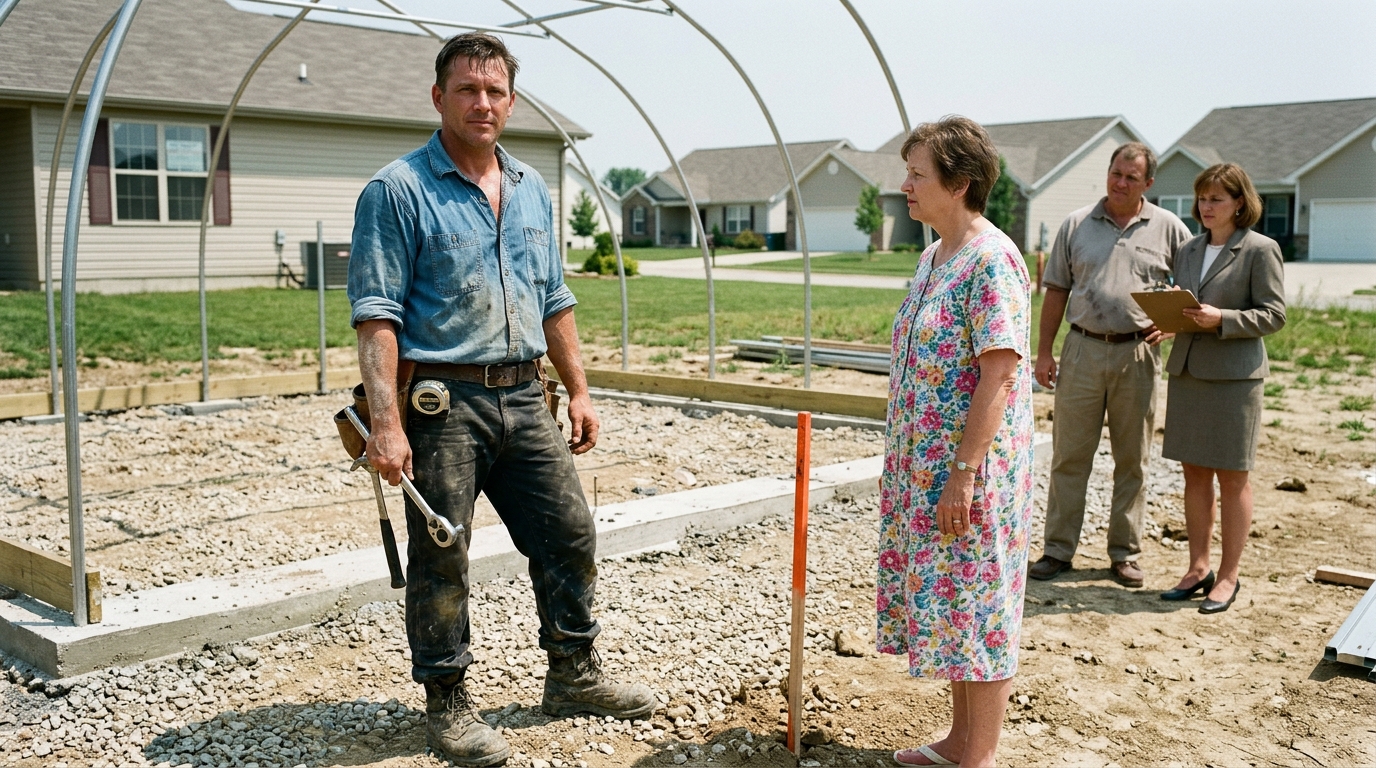
The crunch of cheap leather soles on dry gravel broke the rhythm of my ratchet wrench.
Three feet past my property line, the grass was clipped to exactly two inches. On my side, six galvanized steel arches rose from fresh concrete footings, cured forty-eight hours ago. A two-inch variance in the soil line meant someone was standing where they didn’t belong.
I didn’t drop the torque wrench. I gripped the cold rubber handle, let the steel weight settle in my palm, and turned around.
“That pile of junk is a violation, Mr. Davis.”
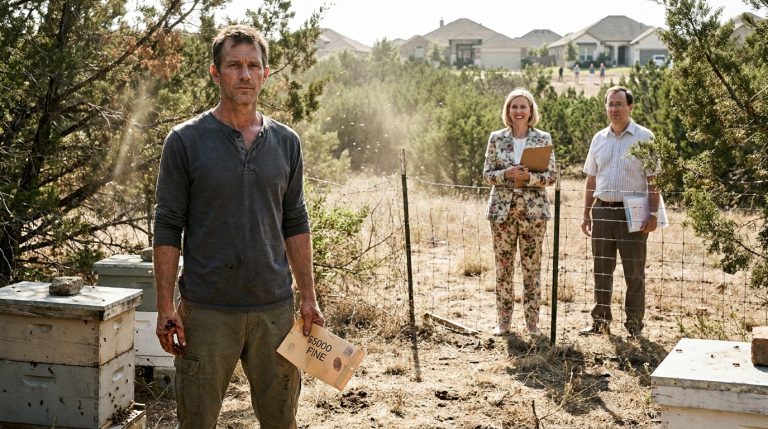
Karen Miller stood on the edge of the survey stake. Her floral mumu fluttered in the humid breeze, but her stance was rigid, rooted in eight years of unchallenged authority. Flanking her were Bob and Linda, two board cronies holding clipboard checklists like infantry shields.
“As of this moment, you are fined $5,000 for an abandoned structure,” Karen said. Her voice carried that flat, syrupy authority reserved for public servants who think their badges are real. “You have seventy-two hours to remove it. Or we will.”
I looked past her left shoulder. High in her second-story master window, a pair of dark curtains twitched. A long camera lens reflected the afternoon sun for a fraction of a second before pulling back into the shade.
A physical discrepancy. Surveillance wasn’t in the bylaws.
“Abandoned?” My voice stayed low, flat, engineered. “The concrete was poured Tuesday. The steel frame was delivered yesterday at 14:00 hours. The county permit is taped to my front glass.”
“It’s an unfinished eyesore,” she snapped, stepping an inch closer to my survey line. “It violates the aesthetic harmony of Serenity Meadows. Bylaw 17.4. The board voted this morning. The fine stands.”
Bob shifted his weight, his eyes darting to the heavy torque wrench in my right hand. He knew what steel could do. Karen didn’t. She only knew compliance.
“Show me the vote minutes,” I said.
“We don’t owe you minutes, Mr. Davis. We owe you notice. Seventy-two hours.” She turned on her heel, her cronies falling into step behind her like ducklings behind a fox.
I didn’t watch them walk away. I turned back to the greenhouse frame, tapped the torque wrench once against the steel rib—ping—and calculated the leverage required to tear down an empire.
CHAPTER 2: PAPER SHIELD HIDDEN EYES
The vibration in the torque wrench died against my calloused palm. Up on the second story of 412 Elmhurst, the heavy beige drape settled back against the glass.
I didn’t give her the satisfaction of looking up twice. I wiped the wrench with an oil-rag, set it on the workbench beside my blueprint casing, and walked into the house.
Elena sat at the kitchen table, surrounded by misting bottles and small plastic pots containing Phalaenopsis cuttings. Her left thumb was rubbing the pale skin of her right wrist—a rhythmic, unconscious micro-action she only did when the joint pain spiked.
“She was at the property line,” Elena said. Her voice was too steady, carefully stripped of tremor. “I heard her.”
“She brought Bob and Linda,” I said, setting the torque wrench on the counter. “It’s a performance. She needs an audience to establish authority.”
“Mark, we can’t afford a five-thousand-dollar fine. The medical bills from last month’s treatment—”
“We aren’t paying five thousand dollars.” I pulled out a chair, sat opposite her, and took her hand, feeling the slight heat radiating from her inflamed joint. “The county permit in our window is sealed by the building department. Local covenants cannot override state-recognized structural zoning unless specifically detailed in the master deed. I read the master deed before we signed the mortgage.”
She looked at me, her brown eyes searching my face for the hairline cracks she knew I hid. “You’re treating this like a deployment.”
“I’m treating this like an engineering problem. You fix the foundation before you build the wall.”
The mail carrier arrived at 09:15 the following morning.
I was at the end of the driveway before the engine idling in the street cut off. The envelope was thick, heavy-stock cream paper, sealed with a formal gold adhesive stamp bearing the Serenity Meadows crest. Certified mail. Return receipt requested.
I signed the green card, handed the pen back to the carrier, and sliced the top edge open with my pocketknife right there by the curb.
Notice of Administrative Fine & Retroactive Penalty Assessment.
The text was a masterclass in aggressive, subjective posturing. It cited Bylaw 17.4—the “Aesthetic and Harmonious Community Standards” clause. But Karen had added a new line item. Because I had failed to cease construction immediately upon her verbal notice, a secondary penalty of $200 per day was being assessed, retroactively applied to the start of the foundation pour.
Total current balance: $6,400.
Appended to the back of the notice were three high-resolution printouts. Zoomed-in shots of my backyard. One showed the open concrete footings; another showed the steel frame; the third showed Elena standing near the patio door in her housecoat, her face turned away from the glass.
The angle was unmistakable. Thirty-five degrees elevation, shot from a high-powered lens positioned at the second-story window of 412 Elmhurst.
I didn’t feel my heart rate spike. Years of structural field assessment in active zones train your circulatory system to cool down when the threat materializes.
I carried the letter into my home office, pulled out a fresh yellow legal pad, and opened my laptop to the state’s public business registry.
If you want to pull down a structure, you don’t hit the thickest beam. You find the dry rot near the base.
I spent four hours going through the public records of the Serenity Meadows Homeowners Association. Every non-profit corporation registered in the state must file annual corporate disclosures. I downloaded eight years of tax returns, board meeting minutes, and vendor expenditure ledgers.
The pattern emerged within forty-five minutes.
Board turnover was non-existent. Karen Miller had served as president for eight consecutive years. Bob Jenkins held the treasurer seat; Linda Vance held secretary. They re-elected each other during sparsely attended annual meetings held on Tuesday mornings at 10:00 AM—a time specifically chosen when ninety percent of working residents couldn’t attend.
Then I cross-referenced the vendor payouts.
Under operating expenses, one line item swallowed nearly sixty percent of the entire community’s annual maintenance budget: $58,400 a year for groundskeeping, common area lawn management, and perimeter tree trimming. The checks were made out to an entity registered as Greenscape Solutions LLC.
I queried the state business registry for Greenscape Solutions LLC.
The registered agent was Gary Miller. Corporate address: a residential PO Box three miles away. Gary Miller was Karen’s younger brother.
I stared at the screen while my cold coffee sat untouched in my mug.
It wasn’t just petty suburban tyranny. It was a closed loop. The vague aesthetic bylaws weren’t designed to keep the neighborhood looking pristine; they were designed to create leverage, generate fines, and intimidate residents into paying into an operating account that fed her family’s shell company.
I picked up my pen and began drafting the formal response.
I didn’t use emotional language. I used standard legal formatting, citing County Permit #734-B, State Corporate Code Section 14-8, and the HOA’s own Bylaw 8.2—a clause Karen had conveniently omitted, which stated that any outbuilding operating under an active municipal building permit was exempt from subjective architectural committee review.
At the bottom of the page, I added a single, calculated paragraph:
Furthermore, be advised that the photographic evidence attached to your notice confirms unauthorized visual surveillance originating from your private residence targeting my personal property and family members. This material has been archived. Cease surveillance immediately, or formal legal action regarding invasion of privacy will be initiated.
I folded the letter, sealed it in a formal envelope, and addressed it to the HOA Board of Directors.
When I walked out to my car to drive to the post office, I stopped by the greenhouse frame. I picked up a piece of chalk and drew a crisp, white line across the concrete foundation where the main water line would hook into the climate control system.
The line was straight, uncompromising, and permanent.
CHAPTER 3: THE COUNCIL OF WAR
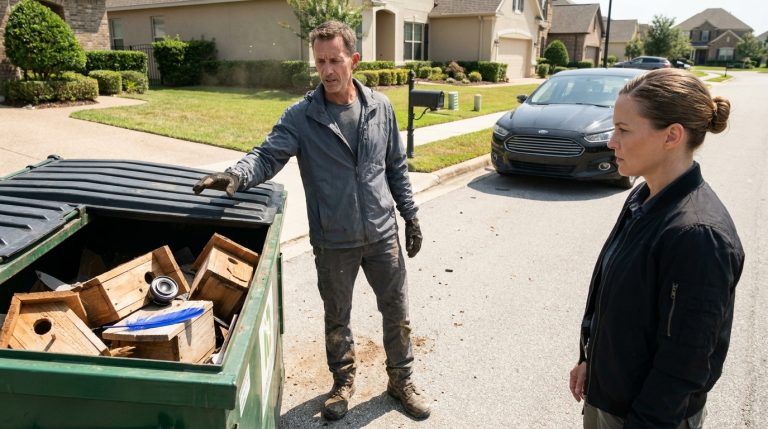
The chalk dust stayed on my thumb as I walked down the driveway. Over at 412 Elmhurst, a battered commercial pickup truck—white door panel painted with Greenscape Solutions LLC— sat idling on the curb. A man in grease-stained work boots tossed a single bag of mulch onto Karen’s front walkway, entered the cab, and drove off without touching the rest of the overgrown lawn.
Fifty-eight thousand dollars a year for six bags of mulch and a wave.
I didn’t call a public meeting. Public meetings give bullies time to prepare a script. Instead, I fired up the back-patio smoker, laid six racks of ribs across the iron grate, and let the hickory smoke drift across the wooden fence line toward Tom’s yard.
Tom was thirty-two, a lieutenant with the county fire department. Strong shoulders, heavy jaw, and eyes that constantly scanned doorways—a habit born from entering burning structures. By 17:30, he was standing at the edge of my patio, holding two cold aluminum cans.
” Smells like a peace offering, Mark,” Tom said. He didn’t smile. His right hand flexed repeatedly around the rim of his beer can.
“It’s dinner,” I said, setting down the iron tongs. “Sit.”
Within twenty minutes, the patio held six people. I didn’t invite the loud ones. I invited the ones who paid their dues on time and kept their heads down.
The Patels sat on the low stone wall. Mrs. Gable, seventy-two, sat stiffly on the edge of a teak chair, her delicate hands folded over a vinyl handbag that contained every notice Karen had sent her since her husband died two winters ago. Next to her sat David, a thirty-eight-year-old corporate attorney who lived four houses down and rarely cut his own grass because he worked eighty-hour weeks downtown.
I didn’t offer a speech. I laid a manila folder on the iron table.
“Three days ago, Karen Miller issued a $5,000 fine against my greenhouse,” I said, my voice barely carrying past the barbecue smoke. “Yesterday, she retroactively increased it to $6,400, citing Bylaw 17.4.”
Tom let out a sharp, bitter sound. “The aesthetic harmony clause. She used that to force me to take down my kid’s portable basketball hoop last August. Said if I didn’t pay the $1,000 penalty, she’d put a lien on my deed. My wife was eight months pregnant. We couldn’t risk a cloud on the title.”
“It wasn’t a penalty, Tom,” I said. “It was an extraction.”
I opened the folder and slid three sheets of paper across the metal table.
The first was a copy of the state business filing for Greenscape Solutions LLC. The second was the annual HOA expenditure ledger I’d pulled from the secretary of state’s database. The third was a photograph I’d taken twenty minutes earlier of the Greenscape truck dropping a single bag of mulch.
David picked up the filings first. His eyes, trained on corporate filings, moved across the lines in five seconds flat. He stopped at the name of the registered agent.
“Gary Miller,” David said softly. His thumb began tapping against the armrest—a rhythmic, analytical micro-action. “Her brother.”
“Sixty percent of our annual operating assessment goes to that PO box,” I said. “Five thousand dollars a month for work that isn’t being performed. When the operating account runs low because of vendor payouts, she uses Bylaw 17.4 to generate secondary revenue from residents who won’t fight back.”
Mrs. Gable reached out with a trembling hand, her knuckles swollen with arthritis, and touched the printed ledger. “My Japanese maple,” she whispered. Her voice carried no anger—just the flat, heavy weight of an old grief. “She fined me four hundred dollars and forced me to hire a contractor to pull it out. She said the root system violated neighborhood character. The contractor she recommended… it was Greenscape.”
“She forced you to pay her brother to kill your husband’s memorial tree,” Tom said, his face flushing dark red under his tan. He stood up from his chair, his chair legs scraping violently against the concrete. “We take this to the police.”
“Not yet,” David interjected, setting the papers down flat. “The police won’t touch a civil HOA dispute without a formal forensic audit or a criminal referral from a regulatory body. Right now, it looks like bad business judgment, not legally proven fraud.”
“Then what do we do?” Tom demanded, looking between David and me. “Let her keep taking six thousand bucks from Mark? Let her bully Mrs. Gable?”
“We open a second front,” I said. I pulled a blue-bound booklet from my folder—the master HOA bylaws. “Section 12.3. Any group of homeowners representing ten percent of total voting interest can force a special inspection of all community physical assets and operational records within fourteen business days.”
David looked at me, a sharp spark of professional respect lighting up his eyes. “You aren’t just contesting your fine.”
“The fine is noise,” I said, picking up the iron tongs and turning the ribs over the coals. The fat dripped onto the heat diffuser, popping with a sharp hiss. “Tomorrow morning, David drafts a formal demand under Section 12.3. We demand full inspection access to every vendor contract, maintenance log, and safety certificate for the largest shared asset in this development.”
Tom frowned. “The landscaping?”
“The community pool,” I said.
David paused, his thumb halting mid-tap. “Why the pool?”
“Because lawn care is subjective,” I said, looking out toward the tall perimeter fence that separated my yard from the central recreation area. “Water safety isn’t. A bad lawn costs money. A non-compliant commercial pool shuts down under county authority. And when a county inspector steps onto private property, Karen Miller doesn’t get to vote.”
The patio went quiet, save for the crackle of hickory wood in the pit. Mrs. Gable reached into her handbag, pulled out a fountain pen, and set it beside my blue booklet.
“Tell me where to sign, Mark,” she said.
CHAPTER 4: THE INSPECTION STRIKE
The ink from Mrs. Gable’s pen was still damp on the petition sheet when I folded the document into my coat pocket.
Forty-eight hours later, the county health department’s enforcement vehicle pulled up along the chain-link enclosure of the Serenity Meadows central recreation complex.
I stood fifty feet away near my garage door, holding a torque wrench and a rag, watching the scene unfold. Through the diamond wire mesh, the pool water looked deceptively clear—a brilliant turquoise sheet reflecting the high afternoon sun. But clear water in a neglected commercial system is usually an illusion produced by over-chlorination to mask bad filtration.
Chief Inspector Evans stepped out of the county SUV holding a aluminum clip-board. He wore steel-toed boots and a heavy dark blue field jacket. He didn’t knock on the clubhouse door; he walked directly to the gated entrance, reached for the latch, and pulled.
The gate swung open without resistance. The magnetic self-closing arm hung loose, its hydraulic seal ruptured and leaking black fluid onto the concrete.
“That’s infraction one,” I murmured under my breath.
Karen Miller emerged from the side patio door of her residence, her floral dress billowing as she hurried across the turf. Her two board cronies, Bob and Linda, trailed ten paces behind. Bob’s face was chalky, his lower lip drawn back over his teeth—an involuntary micro-action that signaled blind panic.
“Can I help you?” Karen’s voice cracked across the open lawn, syrupy authority stretched thin over raw agitation. “This is private residential property. The pool is currently closed for routine maintenance.”
Inspector Evans didn’t slow his stride. “I’m executing county enforcement order P7843 Inspection Warrant, issued under public safety protocol.” He held up a tri-fold document bearing a red municipal stamp. “Anonymous complaint filed regarding life-safety non-compliance. I have full statutory authority to inspect commercial and semi-public recreational facilities.”
“We have a private contractor!” Karen snapped, stepping directly into his path near the shallow end. She jabbed a finger toward Bob. “Mr. Jenkins handles our maintenance. Everything is logged.”
“Then Mr. Jenkins can open the pump house,” Evans said flatly.
Bob fumbled with a brass key ring. His hands shook so violently the keys clinked against the rusted padlock thrice before fitting the keyway. When the door swung open, a cloud of acrid, white chemical vapor rolled across the concrete.
Evans took one step back, his eyes narrowing. “Class One chemical hazard. Liquid chlorine stored within two feet of muriatic acid in an unventilated enclosure. One leak creates mustard gas.” He unclipped a red tag from his binder. “Immediate operational shutdown.”
“Now wait a minute—” Bob started.
“We aren’t done,” Evans cut him off. He walked to the deep end, knelt on the concrete, and looked down through six feet of water toward the main drain grate.
The atmosphere shifted instantly. Layer 1—Karen’s petty aesthetic fines and extortion scheme—shattered right there on the concrete apron, revealing the lethal reality underneath.
The drain cover at the bottom was flat, stamped plastic with wide parallel slits—an obsolete 1990s fitting cracked down the center.
Evans stood up slowly. His jaw muscles locked tight enough to turn his cheeks white. “That is a single-suction, flat drain cover.”
“It functions fine—” Karen began.
“It is a direct violation of federal law under the Virginia Graham Baker Act,” Evans barked, his voice dropping into a register that made even the teenagers near the tennis courts freeze. “That drain creates seven hundred pounds of direct vacuum pressure. A child sitting on that grate gets trapped underwater until their lungs collapse.”
Karen’s face lost every drop of color. She looked toward Bob, but Bob had already retreated three steps back, his eyes fixed on the pavement.
“I issued a written remediation order on this exact drain cover three years ago,” Evans said, his voice dropping to a icy, lethal whisper. “You signed the receipt, Mrs. Miller. You certified in writing that the anti-vortex dome had been installed and billed to this association.”
He pulled a thick ledger pad from his coat. The press of his pen was loud enough to hear from the fence line.
“Willful non-compliance with a critical life-safety directive,” Evans declared. “Effective immediately, this facility is condemned under municipal authority. The base fine for willful failure to remediate an anti-vortex drain is $75,000. Chemical storage violation: $5,000. Barrier access failure: $5,000. Total assessment: $85,000, payable by the corporate entity within thirty calendar days.”
“Eighty-five thousand?” Karen’s voice rose to an agonized shriek. “Our annual operating fund doesn’t have eighty-five thousand dollars!”
“Then I suggest you review your vendor ledgers, Mrs. Miller,” Evans said, slapping the orange condemnation sign onto the entry gate and locking it with a county chain. “Because if a child had touched that drain this weekend, you wouldn’t be facing a fine. You’d be sitting in a county holding cell.”
Evans turned and walked back to his vehicle without another word.
Karen stood alone on the concrete, her hands clutching her floral dress, staring at the orange tag fluttering against the wire mesh. She didn’t look at Bob. She didn’t look at Linda.
When she finally turned her head, her eyes locked onto me standing fifty feet away by my garage, the heavy steel torque wrench resting across my forearm.
The war was no longer about a greenhouse. The core truth was out, leaking like acid into the foundation of her empire.
CHAPTER 5: THE MIDDLE SCHOOL TRIBUNAL
The orange tag flapped once against the chain link, a sharp plastic snap that cut through the humid silence. Karen’s glare burned across fifty feet of turf, but I didn’t return her gaze. I lowered the torque wrench, turned on my heel, and walked into my workshop to prepare the notice of emergency assembly.
Seventy-two hours later, at 19:00 on a humid Thursday, the doors of the Oakridge Middle School gymnasium groaned open on heavy hydraulic hinges.
The room smelled of floor wax, old basketball rubber, and cold duct air. Over one hundred and eighty residents filled the metal folding chairs, their voices rising in a tight, resonant hum that bounced off the brick walls.
Karen sat at a long folding table set up on the hardwood apron below the scoreboard. To her left sat Bob; to her right, Linda. On the desk between them rested three pristine manila folders and a silver gavel Karen had brought from her home office. Her fingers twitched around the wooden handle—a sharp, restless micro-action that belied her stone-faced posture.
David stood beside me at the front microphone, adjusting a digital projector mounted on a steel tripod.
“She tried to issue an emergency injunction this morning,” David whispered, his thumb resting against his lapel. “Claimed the meeting was an illegal assembly under Section 4 of the covenants.”
“Section 4 requires twenty days’ notice for policy changes,” I said quietly, watching Tom guide Mrs. Gable to a seat in the second row. “Section 12.3 allows forty-eight hours for asset insolvency. We aren’t changing policy, David. We’re auditing a disaster.”
Karen slammed the gavel onto the rubber pad. Thwack.
“This assembly is irregular,” she announced into the gooseneck microphone. Her voice boomed through the overhead speakers, brittle and loud. “The board has not sanctioned this meeting. The ongoing issues regarding municipal health citations are currently under legal review by association counsel.”
“Your association counsel resigned at 14:00 hours today, Mrs. Miller,” David said smoothly, taking one step toward the podium. He pulled a single-page fax from his leather briefcase. “When he reviewed the P7843 Inspection Warrant issued by the county health department, he formally withdrew representation to avoid personal professional liability.”
A sharp murmur rippled through the fourth row.
Karen’s knuckles turned chalk-white against the gavel handle. “Sit down, Mr. Vance. You are out of order.”
I tapped the laptop spacebar.
The projector bulb flared, painting a twelve-foot glare across the pull-down white screen above the gymnasium stage.
The first slide wasn’t a list of complaints. It was a high-resolution scan of corporate tax filings for Greenscape Solutions LLC, side-by-side with the HOA bank disbursements for the last thirty-six months.
“Fifty-eight thousand dollars a year,” I said, my voice carrying cleanly across the hardwood without the microphone. “Transferred directly from our reserve account to an entity owned entirely by Gary Miller—Karen Miller’s brother. For lawns that receive one bag of mulch per quarter.”
“That is a legitimate commercial contract!” Karen shouted, standing up so fast her metal chair scraped violently against the floorboards. “Approved by a quorum of this board!”
“A quorum consisting of you, your treasurer who operates the pool company, and your secretary,” Tom called out from the second row, standing up to face the crowd. “My kid’s basketball hoop was a thousand-dollar fine because it looked bad. But you paid your brother sixty grand for dead grass!”
“Order!” Karen struck the gavel twice, but the sound was drowned by a sudden wave of angry voices rising from the center bleachers.
I hit the spacebar again.
The image shifted. On the screen appeared the official report from Inspector Evans, highlighting three specific line items in bold red boxes: the liquid chlorine hazard, the non-compliant single-suction drain, and the eighty-five-thousand-dollar penalty levied against the corporate entity of Serenity Meadows.
“The board received three separate written notices regarding the Virginia Graham Baker Act over the past thirty-six months,” I said, stepping into the blue light of the projector. “Each time, the board certified to the county that the anti-vortex drain had been installed. Each time, funds were drawn from the capital fund to pay Crystal Clear Pool Services—owned by Treasurer Bob Jenkins.”
Bob flinched as if struck, his chin dropping toward his collar.
“The drain cover was never purchased,” I continued, letting the silence settle over the room like iron weight. “The money was dispersed. The hazard remained. And last Friday, if Chief Inspector Evans had not locked that gate, any child in this room could have been drawn into that pipe with seven hundred pounds of hydraulic pressure.”
Mrs. Gable stood up slowly in the front row, her hands trembling as she pointed a thin finger at the head table. “You lied to us,” she said, her frail voice cutting through the hum with surprising force. “You took my husband’s tree, and you put our children in danger for money.”
“This is slander!” Karen’s voice cracked. She reached for her papers, her hands scrambling across the smooth surface of the table. “Bob, call the sheriff. Have these people cleared from the school!”
David stepped up to the main microphone. “The sheriff is already outside, Mrs. Miller. Not to clear the gym. They are waiting for the results of the recall vote so they can secure the association’s financial servers at the clubhouse.”
David held up a stack of white paper cards. “Under Section 12.5, a two-thirds majority of present homeowners can remove any board member for cause without prior judicial review. I move to recall Karen Miller, Bob Jenkins, and Linda Vance immediately.”
“Seconded!” Tom shouted from the floor.
“All those in favor,” David called out, “raise your hand.”
A forest of arms rose across the bleachers, dense and unbroken. Out of one hundred and eighty-four residents present, every single hand went up—save for three at the front table.
Karen stood behind her chair, her mouth slightly open, staring at the sea of raised palms. The authority that had governed three hundred homes for eight years didn’t crumble with a dramatic speech; it simply evaporated under the weight of eighty-five thousand dollars in cold, unassailable documentation.
“The motion passes unanimously,” David said, setting the cards down. “The board is dissolved.”
Karen didn’t speak. She slowly picked up her silver gavel, slipped it into her handbag, and walked down the side aisle toward the double exit doors. No one cheered. No one shouted. The crowd simply parted, leaving a five-foot wide gap of polished hardwood for her to walk through alone.
I watched the heavy doors swing shut behind her, then turned back to the projector screen to load the transition audit documents.
CHAPTER 6: STRUCTURAL CLEARANCE
The metallic thump of the school doors settling into their brass latches was the last sound Karen Miller left behind in that gymnasium.
Eight weeks later, the morning air in Serenity Meadows smelled of wet turf and ozone from an early rain, entirely stripped of the heavy chlorine fumes that used to hang over the central fence.
I stood inside the completed greenhouse frame. All twenty-four clear polycarbonate sheets were locked into their aluminum tracks, sealed with industrial rubber gaskets that kept the interior at a steady seventy-two degrees. Along the southern wall, automated misting nozzles hissed softly every fifteen minutes, coating the thick green leaves of Elena’s Phalaenopsis collection with fine water droplets.
My right hand held the torque wrench—not as a defensive weapon against trespassers, but to give the final quarter-turn to the hinge bolt on the automated roof vent.
Outside the glass, a white county fleet sedan was parked along the curb at 412 Elmhurst.
Inspector Evans stood on the driveway apron alongside two investigators from the State Attorney General’s Consumer Protection Division. David stood with them, a thick black binder tucked under his arm.
Through the clear polycarbonate wall, I watched Karen step out onto her front porch. She wore plain gray slacks and a dark coat, her shoulders curved forward. The floral mumus were gone. Her brother’s truck was nowhere in sight; Greenscape Solutions LLC had been dissolved three weeks prior under court order, its asset accounts frozen to satisfy the primary restitution judgment.
“She tried one last maneuver through her personal attorney on Tuesday,” David said, stepping through the sliding door of the greenhouse. He let the door glide shut behind him, the rubber seal catching with a satisfying, airtight thunk. “Claimed the board members were protected by corporate indemnification clauses in the original master deed.”
I wiped the torque wrench with an oiled rag and set it in the top drawer of my steel toolbox. “Indemnification covers good-faith operational errors. It doesn’t cover criminal fraud or signing false compliance affidavits on a municipal health warrant.”
“Exactly.” David tapped the binder. “When the prosecutor showed her attorney the paper trail—the invoices Bob Jenkins submitted for the non-existent drain cover under the Virginia Graham Baker Act, cross-referenced with the checks routed straight into her brother’s account—the defense folded. She signed the consent decree this morning.”
I looked out at the street. A commercial moving van pulled up behind the county sedan. A red and white For Sale sign already stood near her curb, its wooden stake driven deep into the turf where she used to stand inspecting neighbors’ grass height.
“The $85,000 county health fine?” I asked.
“Re-assessed directly to Karen, Bob, and her brother personally under the corporate veil exception,” David replied. “The HOA operating account didn’t lose a single cent. In fact, the court-ordered restitution wiped out every illegal administrative penalty her board ever levied against residents. Every dollar Mrs. Gable paid, every cent from Tom’s basketball hoop fine, and your $6,400 assessment—all expunged from the county land records.”
Elena walked into the greenhouse carrying a small brass watering can. Her left thumb was still, resting comfortably against the handle without the tight, rhythmic pressure she used to exert when her joints flared from stress. She stopped beside a blooming white orchid, her fingers gently brushing the underside of a petal.
“It’s quiet outside, Mark,” she said softly.
“It’s compliant,” I said, leaning back against the steel workbench. “To the actual law.”
Across the street, the moving crew began loading wrapped furniture into the back of the van. Karen Miller got into the passenger side of her attorney’s car without looking back at the neighborhood she had spent eight years ruling through fear and fraudulent paper.
Tom walked past my driveway holding a tackle box, his two sons running ahead of him toward the newly certified, fully compliant community pool. He caught my eye through the glass, gave a sharp two-finger salute, and kept walking. Down the sidewalk, Mrs. Gable was dropping fresh mulch around a young dogwood sapling she had planted in her front yard that morning—no permits required, no threat of extortion, no hidden eyes behind a second-story curtain.
I picked up the torque wrench, laid it flat inside its velvet-lined case, and snapped the brass latches shut.
The structure was built. The foundation was solid. The perimeter was clean.