The Cold Calculus of Retribution: How a Retired Logistician Dismantled a Suburban Empire Using Paper and Proof
CHAPTER 1: THE CEDAR SHARD
The lid of the green dumpster didn’t lift; it resisted, sticking against the humid afternoon air before giving way with a hollow, plastic groan.
Jack Miller did not blink. His fingers, calloused from decades of handling manifests and cargo weights, gripped the reinforced rim. Behind him, the gravel of the driveway crunched under a sharp, rhythmic pivot—Karen’s sensible loafers announcing a victory she expected him to acknowledge.
“Section four, subsection B,” she recited, her voice dropping into that smooth, practiced cadence of administrative finality. “Unapproved structures. You were sent a notice, Mr. Miller.”
Jack ignored her. His gaze dropped past the edge of the rim into the shadowed cavity below.
It was a systematic demolition. Ten precision-engineered boxes, built to the exact specifications of the National Audubon Society, lay crushed beneath a heap of mundane household refuse. But it wasn’t the shattered plywood or the twisted aluminum brackets that locked his focus. It was a micro-detail half-buried beneath a greasy paper bag: a single, intact camera lens housing, no larger than a dime, catching the sparse light filtering through the plastic lid. It bore a scratched serial number he had logged into his spreadsheet forty-eight hours prior.
Beside it lay a streak of brilliant cobalt blue. A feather.
The biological cost of the executive order.
“The dumpster is municipal property,” Karen continued, her tone sharpening as the silence stretched thin between them. A shadow fell across the sun-bleached asphalt as she stepped closer, wielding her clipboard like a standard-issue shield. “If you wish to salvage your debris, you have until trash collection hour tomorrow morning. After that, it goes to the county landfill.”
Jack let the heavy plastic lid drop. The impact was flat, heavy, and final, causing her to flinch back a fraction of an inch—a microscopic tell of physical unease that his tactical training cataloged and filed away.
He turned slowly, his face washed of expression, wiping any trace of the white-hot current surging through his chest into a calculated, dead-eyed calm. He reached into his pocket, his thumb finding the familiar rectangular edge of his phone. The screen was dark, but the recording indicator was already active, pulsing silently in the upper corner.
“Karen,” Jack said, his voice dropping an octave, flattening into the register he used when coordinating supply lines through hostile sectors where a single misspoken syllable could compromise an entire convoy. “Every single one of those units was a registered data collection node for a federally protected migratory research initiative. You haven’t just discarded property. You have interfered with a multi-agency wildlife study under the jurisdiction of the federal government.”
Her smug, bulldog posture didn’t break, but the skin around her eyes tightened. A fractional hesitation—the first real crack in her armor.
“We have bylaws,” she insisted, though the volume had dropped. “The architectural committee—”
“The committee received the certified packet eight months ago,” Jack cut across her, his words measured, rhythmic, and absolute. He pulled the phone clear of his pocket, holding it level between them, the lens aimed squarely at the bridge of her nose. “And signed for it on a green postal card that is currently locked in a fireproof safe inside my office. You didn’t miss the paperwork, Karen. You bypassed it.”
He didn’t wait for her retort. He didn’t watch her retreat down the manicured asphalt toward her own impeccably compliant fortress. Instead, he turned back to the garage, stepping past the threshold into the cool, shadowed interior where his heavy-duty work gloves hung by the workbench, waiting for an engagement he now knew was inevitable.
CHAPTER 2: THE ARCHIVE OF OFFENSES
The transition from the sunlit driveway into the cool, shadowed concrete of the garage felt like dropping ten degrees into a bunker.
Jack did not pause to wipe his boots. The rubber soles of his shoes struck the concrete floor with a flat, dull slap that echoed off the bare studs of the unfinished wall. His left hand still held the phone, the glass screen warm against his palm, its internal battery draining slowly as the background recording loop continued to capture the low hum of the neighborhood traffic outside.
He didn’t turn on the overhead fluorescent lights at first. He preferred the dim amber glow filtering through the high clerestory windows—a pale, rectangular wash that illuminated the dust motes hanging motionless in the stagnant air.
On the workbench sat the heavy-duty canvas tarp he had unfolded moments ago. Resting upon it was the debris field: ten distinct fragments of cedar, a collection of crushed solar panels no larger than a deck of cards, and the twisted, silver-threaded remains of mounting brackets designed to withstand seventy-mile-per-hour crosswinds.
Jack stepped forward, pulling a pair of reinforced cowhide work gloves from their iron nail by the side door. The leather was stiff, smelling faintly of linseed oil and old sweat. He worked his fingers into them one by one, the heavy leather joints flexing with a stiff, mechanical resistance that required a conscious squeeze of his fists.
This was the logistics phase. In supply chain management, you did not lament a wrecked shipment or curse the driver who ran the truck off an embankment; you accounted for the manifest, calculated the loss ratio, and immediately initiated the chain of custody documentation.
He reached down, his gloved fingers wrapping around the largest remaining structural element of Unit Seven—the baseplate that had once cradled the multi-year study’s primary data logger. The wood was splintered cleanly across the grain, exposing a pale, yellow interior that hadn’t yet weathered to the gray of the outdoor elements. That was the physical proof of recent intervention. The cut was fresh. The fiber was damp.
With measured, deliberate movements, Jack began the sorting process.
He did not rush. Every piece of metal went into a clear, heavy-gauge plastic evidence bag he kept stocked for equipment maintenance. Every shard of wood was aligned by its original coordinate designation—North wall, East corner, Ground stake.
As he worked, his mind stripped away the superficial layers of the dispute. Karen’s appearance on his lawn hadn’t been an impromptu patrol. People armed with clipboards and pre-printed section citations do not wander aimlessly down a suburban cul-de-sac looking for violations; they execute an assigned sweep. Which meant there was a paper trail, a preceding directive, or an internal board communication that had authorized the dispatch of her brother-in-law’s landscaping crew to clear what she deemed an “unapproved structure.”
A subtle metallic clink broke the steady rhythm of his sorting.
Jack paused, his gloved hand hovering two inches above the blue tarp.
Half-concealed beneath a curled strip of roofing shingle lay a stray component that hadn’t belonged to any of his ten constructed units. It was a small, black plastic adjustment screw, threaded with a metric pitch commonly used on commercial-grade hedge trimmer attachments or heavy-duty leaf blower housings—not the standard wood screws he had meticulously selected from his own hardware inventory.
He pinched the screw between his thumb and forefinger, lifting it toward the dim amber light of the window.
It was clean. No rust on the threads. No dirt from his yard. It had fallen from the machinery used during the sweep, dropped during the hasty, uncoordinated loading of the green dumpster.
It was a physical discrepancy. A microscopic piece of foreign material left behind by an overconfident opponent who believed her jurisdiction extended past the property line and down to the atomic details of the soil.
Jack slid the black screw into his shirt pocket, feeling the small, hard plastic edge press flat against his chest.
He finished sorting the remaining debris, sealing the last plastic bag with a sharp zip, and stood up from the workbench. His knees gave a faint, familiar pop—the silent tax of thirty years carrying weight across uneven terrain.
He stripped off the heavy leather gloves, tossing them onto the wooden surface with a solid thud, and walked out of the garage, leaving the door cracked precisely six inches to vent the smell of broken pine.
The house inside was silent. The air conditioning hummed a low, steady baseline through the floor vents, maintaining a sterile seventy-two degrees that felt entirely disconnected from the humid battlefield taking shape fifty feet beyond the front porch.
Jack walked down the narrow hallway toward his office, his boots clicking softly on the hardwood floor. He pushed the solid oak door open, stepping into a room organized with absolute, ruthless geometry.
On the left wall, his framed retirement certificate hung precisely level, the glass reflecting the pale afternoon light without a single fingerprint marring its surface. Below it sat the shadow box containing his service medals, their ribbons faded uniformly by the passage of years. On the opposite wall hung the massive topographical map of North American migratory flyways, crisscrossed with colored marker lines charting the seasonal paths of the very birds he was currently trying to protect.
He walked straight to the heavy steel filing cabinet tucked into the corner. His hand found the key hanging on a magnetic hook behind the door frame—a key he never left in the lock.
He unlocked the bottom drawer, pulled it open with a smooth, oiled glide, and withdrew the thick, three-ring binder labeled with a strip of white label-maker tape: Project Bluebird.
He carried it to the center of the spartan oak desk, laid it flat, and flipped open the heavy cardboard cover.
The first page was pristine. The official letterhead of the Audubon Society stared back at him in crisp black ink, inviting him to participate as a primary field observer for the regional recovery initiative. Behind it lay the architectural blueprints, stamped and approved by a municipal engineer four years prior, establishing the legal foundation of the property’s protected status.
And tucked immediately behind the blueprints was the section he needed: the HOA correspondence file.
He didn’t just want to prove she was wrong. He wanted to map the exact chronology of her descent from a petty neighborhood bureaucrat into an active participant in the destruction of federal research assets.
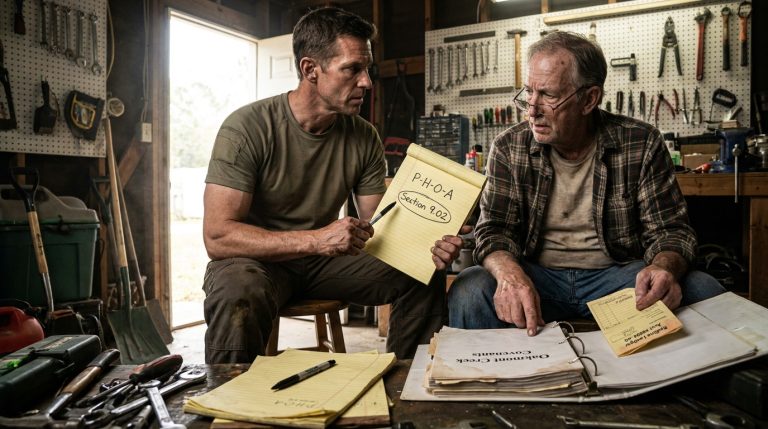
Jack pulled a yellow legal pad from the desk organizer, picked up a heavy brass-weighted pen, and wrote a single line across the top margin: Selective Enforcement & Precedent.
Below it, he began a bulleted list, starting with the exact dimensions of the cedar used in Unit Seven, moving down through the timestamp of the digital recording on his phone, and ending with the small, black metric screw currently resting in his shirt pocket.
He worked in absolute silence, his pen moving with steady, unhurried strokes, building a missile out of paper and ink.
CHAPTER 3: THE FEDERAL INTRUSION
The brass-weighted pen did not leave his hand until the final period was anchored at the bottom of the yellow legal pad.
Jack stood up from the oak desk, his joints making a dry, audible snap in the quiet room. He folded the top sheet of the pad along its perforation, the paper tearing with a clean, sharp hiss, and carried it across the hardwood floor toward the dual-monitor workstation setup against the north wall.
The screens flared to life with a quiet hum, casting a pale, bluish glare across the sharp angles of his face.
He didn’t open a browser window to vent his frustration on social forums; he opened a secure email client, his fingers moving across the mechanical keyboard with the methodical precision of a radio operator keying in grid coordinates. The draft window was already populated with the designation Site 734 – Regional Migratory Study Asset Loss.
Into the attachment field, he dragged the eighty-seven geotagged photographs he had compiled from the tarp in the garage—each image stamped with precise coordinate data, metadata verifying the time of capture, and high-resolution macros of the splintered federal tags. Beside them, he attached a scanned, high-contrast PDF of the certified mail return receipt bearing Karen’s sloppy, hurried scrawl from eight months prior.
His index finger hovered over the enter key for a fraction of a second, feeling the light tactile resistance of the switch.
Then he pressed it. Send.
The transmission bar flashed green for a fraction of a second before vanishing, locking the payload into the servers of Dr. Aris Thorne at the Audubon Society’s national headquarters.
There was no immediate feedback. In logistics, the waiting period between sending an order and receiving confirmation was the test of system integrity. Jack leaned back in his ergonomic chair, the leather creaking under his weight, and stared at the blinking cursor on the monitor. He didn’t have to wait long for the macro-environment to react.
Forty-eight hours of absolute silence followed—a classic administrative blockade designed to test the resolve of the complainant, forcing the lower tier to blink first and overreach. Jack used the vacuum to fortify his perimeter. He did not step outside. He monitored the street through the narrow side slats of the wooden blinds, watching the sterile passage of neighborhood life fold in on itself.
Then, on the third morning, the email reply arrived.
It didn’t come from a standard civilian domain. The metadata header displayed a secure government routing suffix.
Jack clicked the message open. The text was stark, stripped of bureaucratic pleasantries, written by a woman whose prose functioned like a scalpel. Dr. Thorne had not just forwarded the file; he had routed it directly to the regional enforcement division of the United States Fish and Wildlife Service.
Mr. Miller, the message began. This office has received your documentation regarding Site 734. The destruction of active or prepared nesting frameworks within a registered migratory corridor constitutes a potential criminal violation under the Migratory Bird Treaty Act of 1918. Special Agent Riley has been assigned to your sector.
Jack’s eyes traced the final sentence twice. The vocabulary was clean, heavy, and absolute. Federal jurisdiction did not recognize subdivision covenants, executive board meetings, or backyard aesthetic standards.
Before the digital echo of the email could fade, a sharp, metallic rapping echoed from the front porch.
It wasn’t the tentative knock of a neighbor delivering a pamphlet or the aggressive pound of an HOA president wielding a clipboard. It was a double-tap—heavy, authoritative, and metered.
Jack rose from the desk without a sound, walked down the narrow corridor, and turned the deadbolt.
She stood on the concrete porch step framed by the harsh midday glare. Special Agent Riley did not look like a cinematic law enforcement officer; she wore a slate-gray windbreaker over a plain collared shirt, her hair pulled back into a severe, utilitarian knot that missed nothing. Her dark Ford sedan sat idling at the curb, its engine silent, absorbing the ambient heat of the street.
“Mr. Miller?” she asked, her voice flat, dry, and entirely devoid of performance.
“Agent Riley,” Jack replied, stepping back to clear the threshold. “Come in. The evidence is secured in the garage.”
She didn’t enter the house immediately. Instead, her sharp, analytical gaze swept past him down the hallway before locking onto his eyes. “Lead the way, Mr. Miller. Let’s see what’s left of the site.”
Jack turned and walked toward the side door, his boots hitting the concrete floor as they crossed into the dim, amber-lit garage where the blue tarp and the plastic evidence bags waited like silent witnesses on the workbench.
CHAPTER 4: THE SMEAR CAMPAIGN AND THE FIRST WHISPER
The concrete floor of the garage felt cool beneath the thin rubber soles of Jack’s boots as he led Special Agent Riley past the workbench.
The blue tarp lay stretched across the center of the space like an operational map, its surface mapped with the sorted debris of the ten destroyed structures. Riley did not touch anything immediately. She stopped two paces short, her slate-gray windbreaker rustling slightly as she planted her boots and stared down at the ruined cedar frames, the twisted aluminum brackets, and the shattered solar micro-modules arranged with military precision.
“You organized this,” she noted, her voice carrying a dry, professional detachment that lacked any trace of condescension.
“In logistics, you don’t inventory a loss by staring at the wreckage,” Jack replied, his voice level. “You isolate the components, verify serial numbers, and establish a baseline before filing the report.”
Riley crouched down, her movements economical and precise. She gloved her hands with a pair of thin nitrile membranes pulled from her pocket, then reached out to lift a fragment of the roof structure from Unit Seven. Her gloved thumb traced the edge of the stamped aluminum federal tag screwed directly into the grain. The metal was bent at a sharp, unnatural angle, bearing the distinct imprint of a heavy-handed pry bar or the jaw of an industrial waste compactor.
“This tag is registered under the Department of Interior’s avian migratory monitoring database,” Riley said, her eyes narrowing as she studied the micro-stamping. “Section 703 of Title Sixteen. You didn’t just lose backyard fixtures, Mr. Miller. These units were classified as active field collection nodes for a multi-year regional study.”
“I have the Audubon correspondence and the engineering blueprints filed in my office,” Jack said. “Along with the certified mail return receipt signed by the current HOA president eight months prior.”
Riley looked up, her expression tightening into a sharp, evaluative line. “She signed for them?”
“And filed a destruction order anyway.”
The agent stood slowly, slipping off the nitrile gloves and tossing them into a small disposal pouch. “That shifts the administrative boundary from a civil dispute over aesthetic covenants into willful, premeditated interference with federal research assets. The bureau takes a very dim view of municipal overreach masquerading as local governance.”
She spent the next forty minutes walking through the perimeter, photographing the destroyed site from every conceivable vector, and cataloging the physical evidence into her own secure inventory bags. When she finally walked back to her idling dark Ford sedan at the curb, the afternoon sun had shifted, casting long, sharp shadows across the manicured asphalt of the cul-de-sac.
“Expect a formal follow-up from the U.S. Attorney’s office within the week,” Riley said through the rolled-down window before putting the car into gear. “Keep this site quarantined. Do not alter the tarp.”
The sedan pulled away without kicking up gravel, its tires whispering silently over the asphalt.
Jack stood on the front step watching the tail lights vanish around the corner. The silence of the neighborhood returned—a superficial, sterile quiet that felt increasingly fragile. He turned back inside, locking the front door with a heavy, mechanical click.
The real counter-offensive, however, was about to encounter resistance from an unexpected quarter.
Two mornings later, the monthly edition of the Creekwood Commons Community Chronicle was slotted into his metal mailbox. Jack retrieved it with a pair of gloved fingers, carrying the glossy folded paper into the kitchen like an unexploded shell.
On the front page, beneath an aggressively cheerful blue logo, sat an unsigned editorial column penned in the unmistakable passive-aggressive cadence of the former HOA president. The headline read: Protecting Our Community’s Aesthetic and Property Values.
The text did not name him directly, but every sentence was a finely tuned missile designed to isolate him from the neighborhood. It spoke of disruptive residents who refused to abide by shared standards, who imported unapproved clutter under the guise of personal hobbies, and who sought to drag down the collective equity of fifty families for the sake of individual ego. It was a classic insulation tactic—paint the target as an outsider, rally the compliant majority, and manufacture a consensus before the legal filings could drop.
Jack set the newsletter flat on the kitchen island. The paper was smooth, its ink glossy and unblemished.
An intrusive memory flared behind his eyes—Elepror standing near this exact kitchen window four years ago, holding a cup of black coffee while watching a pair of bluebirds darting toward the greenbelt. They only stay where they trust the silence, Jack, she had said, her voice soft against the morning hum of the refrigerator. People like Karen… they don’t understand silence. They only understand volume.
Jack’s jaw tightened. The memory didn’t soften him; it hardened his resolve into cold, unyielding geometry.
He walked out the front door and down the sidewalk toward the community mailboxes, his phone in his pocket recording the audio loop. He needed to test the perimeter. He needed to find out if the narrative of the newsletter had successfully poisoned the wells, or if the cracks in Karen’s manufactured consensus were already starting to spiderweb outward.
He didn’t have to wait long.
Near the cluster of gray steel mailboxes, Mrs. Gable—an eighty-year-old widow living two doors down—was struggling with the latch of her small box, her hands trembling slightly against the metal door. As Jack approached to offer a steadying hand, she glanced around with darting, frightened eyes, as if expecting an administrative patrol to materialize from the boxwood hedges.
“Mr. Miller,” she whispered, her voice barely carrying over the distant hum of a lawnmower. She clutched a bundle of envelopes tightly against her chest. “I read that… that dreadful article in the paper.”
Jack paused, his posture neutral, his eyes locked on hers. “It’s a deflection, Mrs. Gable.”
“It’s wicked,” she corrected, her voice dropping lower, acquiring a sudden, sharp edge of suppressed fury that had nothing to do with birds and everything to do with old grievances. “Just like what she did to my rose garden last year. All because of a three-inch wire border she called an unapproved fence.”
Jack felt a subtle shift in the air pressure around them—the first microscopic fracture in the enemy’s front line. He pulled out his phone, his thumb tapping the screen to unlock a new, empty folder.
“Tell me about the roses,” Jack said quietly.
CHAPTER 5: THE CLUBHOUSE RECKONING
The double doors of the Creekwood Commons community clubhouse did not swing open; they yielded under a firm, measured push that rattled the glass panes in their aluminum frames.
Jack did not step aside to let the evening crowd surge past him. He walked through the threshold with Marcus flanking his left shoulder, their dark suits cutting a sharp, uncompromising line through the murmuring sea of residents who filled the foyer. Behind them, a small, disciplined contingent of neighbors—Mrs. Gable clutching her handbag like an operational dossier, and Mr. Patel with his jaw set in a hard, flat line—moved in close formation.
The room inside was thick with the scent of commercial floor wax and trapped body heat. Nearly fifty residents occupied the folding chairs, turning the municipal meeting into an impromptu assembly of grievances. At the long folding table stationed at the far end of the room, Karen sat directly in the center, flanked by three silent, mannequin-like board members.
She did not wait for the scheduled start time. Her hand came down hard on the wooden podium, a gavel strike that cracked through the dense air with unnecessary, sharp force.
“Order,” Karen commanded, her voice pitched high, vibrating with a tightly coiled panic she tried to mask beneath administrative severity. “This special session is called to address unauthorized disruptions and reaffirm our shared community standards.”
She launched into her prepared speech, her eyes sweeping across the rows of folding chairs with practiced intimidation. She painted a picture of a peaceful neighborhood under siege from an outside actor—a lone, litigious resident who refused basic accountability and sought to dismantle the equity of fifty families.
Jack remained standing near the back row, his expression fixed in a cold, neutral mask. He did not interrupt. In tactical engagements, you never fire on an adversary while they are actively overextending their supply lines. You let them exhaust their ammunition.
“This board has a fiduciary duty to protect your property values,” Karen declared, her voice rising toward a crescendo as she pointed a manicured finger in his direction. “And we will not be intimidated by frivolous legal threats or government overreach brought on by those who wish to harm our peaceful community. Now, perhaps Mr. Miller would like to explain why he has decided to sue all of his neighbors.”
A low, collective murmur rippled through the rows of folding chairs. The trap was sprung, or so she believed.
Jack stepped out from the aisle, his boots striking the polished linoleum with a heavy, deliberate cadence that cut through the room’s chatter. He didn’t head for the front table. Instead, he walked straight to the small AV podium stationed near the projector screen, pulled a slim laptop from his leather folio, and plugged the HDMI cable into its port.
The wall behind the board lit up in a blinding, rectangular wash of stark white light.
“I am not here to explain a lawsuit,” Jack said, his voice level, amplified cleanly by the lapel microphone without a trace of emotional tremor. “I am here to present physical evidence.”
With a single keystroke, the first slide materialized on the wall: a crystal-clear, high-resolution scan of the architectural improvement request form he had submitted eight months prior.
“This is the project specification sheet,” Jack stated, his eyes locking onto the rigid, bloodless face of the board president. “And this second slide—” he tapped the enter key, bringing up the scanned image of the green postal receipt bearing a hurried, sprawling signature “—is the proof of delivery, signed by Ms. Karen herself on October seventeenth, confirming the board received my complete plans.”
A sharp intake of breath swept through the front rows. The three board members flanking Karen shifted instantly, their heads turning in unison to stare down at her with sudden, raw disbelief.
“I received no rejection within the statutory thirty-day window,” Jack continued, his tone rhythmic and unyielding. “Under Section eight, subsection C of the HOA bylaws, silence constitutes automatic approval.”
He advanced the slide again. The white wall flickered, then displayed the stark, brutal photograph of the shattered cedar birdhouses dumped unceremoniously into the green municipal bin.
“This is what was pulled from the wreckage on April twenty-second,” Jack said, the words dropping into the dead silence of the room like lead weights. “Followed by a $150 cleanup invoice billed to my address by Karen’s own family-operated contracting service.”
The dam broke.
Before Karen could raise her gavel or sputter a defense, Mrs. Gable stood up from her folding chair. The elderly woman walked unsteadily down the center aisle, her hands trembling, but her voice—when she reached the microphone—carried a quiet, devastating clarity that pierced every corner of the hall as she recounted the brutal execution of her husband’s memorial rose garden.
Then Mr. Patel rose, his voice resonating with a father’s cold fury as he detailed the banishment of his son’s basketball hoop.
One by one, the silent hostages of the subdivision found their voice, transforming the boardroom into an irreversible tribunal. Karen slammed her gavel down twice, shouting into a dead microphone as the room turned its back on her completely, leaving her marooned at the center table in a widening ring of absolute isolation.
CHAPTER 6: THE BOARDROOM FRACTURE
The heavy oak door of the auxiliary conference room did not slam shut; it clicked into its latch with a sharp, pneumatic hiss that signaled an air-tight seal against the rest of the building.
Jack was not present inside the room, but the shockwave of his presentation had crossed the threshold twenty minutes prior. At the center of the mahogany table, Karen stood over a ledger of reserve accounts, her knuckles pressing white against the dark wood surface. Her breath came in short, shallow intervals, the bulldog-like posture reduced to a rigid, trembling defiance.
“We authorize fifty thousand immediately,” Karen commanded, her voice dropping into a low, compressed register. She looked across the table at David Chen, the meek accountant who held the association’s checkbook. “The legal firm downtown knows how to bury these filings in procedural delays. We retain them tonight, or we lose control of the entire corporate structure.”
David did not look down at his ledger. His glasses caught the harsh fluorescent glare overhead, reflecting two bright, unblinking rectangles of white light. He kept his hands flat on the table, equidistant from the checkbook binder.
“I cannot authorize that expenditure, Karen,” David said. His voice lacked its usual defensive quiver; it was thin, steady, and entirely absolute.
Karen’s head snapped up, her eyes widening with a sudden, dangerous intensity. “What did you just say to me?”
“I said no,” David repeated, his fingers sliding the leather-bound checkbook two inches further away from her reach. “Our insurance carrier issued an administrative review notice three hours ago. They have explicitly indicated coverage denial due to the nature of the allegations. Draining our reserve funds to finance a defense against willful, premeditated misconduct is a breach of fiduciary duty. It is legally reckless.”
The other two board members seated along the flanks shifted simultaneously, their chairs groaning against the commercial carpet. They didn’t look at Karen. They stared straight ahead at the polished mahogany grain, realizing with sudden, cold clarity that the financial shield they had taken for granted was about to dissolve.
“This is about protecting the association,” Karen hissed, leaning forward until her forearms rested flat on the wood, her face darkening with a rush of blood. “If we don’t fight back now, every unapproved structure, every piece of garbage left on a lawn will become permanent law.”
“No,” David replied, standing up slowly from his chair to match her height. He pushed his glasses up the bridge of his nose with a single, deliberate finger. “This is about protecting you. The federal investigation is locked onto the decision to destroy those nests. The civil suit names you personally for your pattern of harassment. The association’s funds are for the community infrastructure, not your private litigation.”
The silence that followed was dense, sharp, and suffocating.
Karen’s control snapped like an over-tensioned cable. With a guttural sound of pure, unadulterated fury, she lunged across the corner of the table, her hand clawing for the edge of the financial ledger.
“Give me that binder!” she screamed, all administrative pretense instantly incinerated by panic.
David jerked the ledger back just in time, but the momentum sent a stack of loose quarterly statements sliding across the polished surface. Susan, the board secretary, stepped physically between them, her hands raised in a defensive barrier as Karen swung wildly, her fingers catching only air and a loose plastic pen holder that clattered against the wall.
The struggle lasted less than five seconds—a brief, ugly micro-scuffle of sliding chairs and desperate, uncoordinated motion—before Karen realized she was completely isolated. The other two board members had pressed themselves back against their chairs, their faces drained of color, staring at her as if she were a stranger who had broken into the building.
Karen stopped, her chest heaving, her fingers curling into tight fists at her sides. She looked from David’s steady gaze to Susan’s rigid posture, then down at her own empty hands resting on the bare mahogany.
“You’re all cowards,” she spat, her voice cracking on the final syllable. She grabbed her leather handbag off the back of her chair, spun on her heel, and marched toward the door.
The pneumatic latch gave way with a sharp snap, and the door swung wide, framing her exit into the dim, empty hallway outside.
Inside the conference room, the air felt suddenly lighter, stripped of the heavy atmospheric pressure that had governed Creekwood Commons for five years. David exhaled slowly, letting his shoulders drop an inch, and reached across the table to pick up the phone.
“Mr. Miller?” David said into the receiver once the connection went through to the number Marcus had provided. “This is David Chen. The board is ready to open a formal channel for negotiation. Tell us what you need to begin dismantling the rest of this.”
CHAPTER 7: THE DISCOVERY SUBPOENA AND THE SMOKING GUN
The leather swivel chair in Marcus’s downtown office offered no comfort, but Jack did not lean back.
He sat upright on the front edge of the cushion, his boots planted firmly against the low-pile commercial carpet, watching the amber status light of the high-speed document scanner pulse in steady, rhythmic intervals. Across the glass surface of the conference table, three heavy cardboard boxes sat open, their interiors packed with dense stacks of printed email threads, server logs, and digital exports dragged straight from the administrative archives of Creekwood Commons.
The subpoena dragnet had yielded results faster than even a military intelligence drop.
Marcus pulled a single printed sheet from the top of the middle stack, his thumb flicking across the bottom edge where the digital metadata was watermarked in stark, monospace type. He didn’t smile; trial attorneys of his caliber did not celebrate a won motion until the opposing counsel had exhausted every avenue of appeal. But the rigid set of his jaw told the entire story.
“She didn’t just bypass the protocol, Jack,” Marcus said, his voice low and level as he slid the paper across the mahogany grain. “She cataloged her own malice.”
Jack reached out, his gloved thumb—still habituated from handling evidence in the garage—resting against the heavy cardstock. His eyes scanned the header block. It was an internal email chain dated six days prior to the demolition of Unit Seven. The sender was Karen. The recipients were the silent, compliant members of the former executive board.
The text was crisp, unambiguous, and drenched in unmitigated arrogance:
Don’t bother responding to his submission, the digital ink declared. He’s just some retired soldier who thinks his medals mean he can do whatever he wants. We need to make an example of him before every yahoo in the neighborhood starts putting junk in their yards. Let him put them up, then we’ll take them down and bill him for it. That will teach him about our rules.
Jack traced the lines with his eyes twice. There was no ambiguity here, no room for judicial reinterpretation or creative legal spin. It was premeditation rendered in high-contrast pixels—a signed confession written under the bright neon lights of executive impunity.
“This is the linchpin,” Marcus noted, tapping his pen against the corner of the table. “The insurance carrier pulled their policy coverage twenty minutes after I faxed them this page. They classified her actions as willful and malicious tort liability, which means the corporate shield protecting her personal assets is completely vaporized. She is entirely on her own.”
Jack stood up from the chair, the paper still clutched in his hand. The weight of the document felt substantial—not heavy like lead, but dense like a ledger balanced to the exact decimal point.
“What about the federal docket?” Jack asked.
“Agent Riley’s office received the complete data export this morning,” Marcus replied, leaning back and folding his arms. “The U.S. Attorney’s office is drafting the formal complaint based on the Migratory Bird Treaty Act violations. Ten destroyed nesting units, documented federal tracking tags, plus an explicit written instruction to destroy the evidence. They aren’t looking at civil fines anymore. They’re looking at a federal injunction that will strip her of any remaining legal standing in the county.”
Jack walked to the tall office window, looking down twelve stories toward the gray concrete canyons of the city below. The traffic moved in structured, predictable lanes—lanes governed by laws that did not bend to personal whims or neighborhood tyranny.
The legal trap had snapped shut with absolute, crushing precision. Karen had spent five years building her miniature empire out of paper rules, passive-aggressive newsletters, and manufactured fear. Now, she was about to be buried under an avalanche of her own documentation, driven by the very system she had assumed she could weaponize against others.
“She’s trying to retain independent counsel,” Jack said, his voice flat as he watched a dark sedan pull away from the curb below. “According to David, she’s shopping around downtown for a litigator willing to take her case on contingency.”
Marcus offered a dry, humorless chuckle. “On contingency? With a hundred-thousand-dollar federal liability and seventeen families joined in a class-action tort? No lawyer in this state will touch her file without a five-figure retainer paid upfront in cash. And since her insurance won’t cover a dime of her defense, she’s going to have to liquidate her own fortress to pay for it.”
Jack turned away from the window, folding the printed email thread carefully and sliding it into the breast pocket of his jacket. The physical texture of the paper against his chest felt cool and solid.
“Then let her liquidate,” Jack said. “The perimeter is secured. It’s time to close the operation.”
CHAPTER 8: THE OUSTER THE SETTLEMENT AND THE FINAL NOD
The air of the following spring carried a crisp, washed clarity that felt entirely detached from the heavy institutional dust of Marcus’s conference room.
Jack stood in his backyard, his boots planted firmly against the soft turf of the lawn, the afternoon sunlight warm and unyielding against his shoulders. The settlement funds disbursed by the interim board had cleared the escrow account three days prior, but the true currency of the transition wasn’t financial. It was structural.
Twenty new birdhouses—an expanded, fortified deployment designed in strict accordance with the Audubon Society’s technical specifications—lined the perimeter of the greenbelt.
A sharp, metallic click echoed across the grass as Mr. Patel, standing atop a sturdy aluminum ladder, sank the final stainless-steel mounting screw into a cedar post. Below him, his ten-year-old son handed up tools with an expression of intense, professional gravity.
“A little to the left, Dad,” the boy instructed, squinting through the glare. “It has to face southeast, exactly like Mr. Miller mapped it.”
Ten feet away, Mrs. Gable knelt in the rich earth near the edge of the property line, her gloved hands carefully firming moist soil around a vibrant cluster of pink rose bushes. The new board under David Chen’s leadership hadn’t just approved her garden; they had formally designated it the first community pollinator plot, protected under the newly rewritten association covenants. A soft, contented hum escaped her lips—a sound of quiet restoration that had been suppressed for years.
Dr. Aris Thorne stepped up beside Jack, wiping his hands on a clean shop rag and nodding toward the immaculate line of nesting boxes.
“Your documentation turned into an academic benchmark at our regional headquarters, Jack,” Thorne said, a wide, appreciative grin breaking across his face. “The regional legal division is publishing your file as a procedural blueprint. They’re calling it the Creekwood Protocol—a standard textbook guide for citizen scientists dealing with hostile local governance.”
Jack didn’t smile; he kept his eyes fixed on the mounting post where the cedar grain caught the light. “Adversity only yields results if the perimeter is held, Dr. Thorne.”
A sudden, sharp flash of brilliant cobalt blue caught the edge of his vision.
A male Eastern bluebird, bold and unhesitating, glided down from the overhead branch of an oak tree to land gracefully on the perch of the very box Mr. Patel had just secured. The bird tilted its head, inspected the opening with a quick, darting motion, and let out a series of clear, warbling notes. A moment later, its mate landed softly beside it, carrying a strand of dry grass in its beak.
The system was active again. The biological loop was closed.
Later that afternoon, a low, heavy rumble vibrated down the asphalt of the cul-de-sac.
Jack turned slowly from the porch railing as a large, dust-covered moving truck rumbled past the community mailboxes and air-braked to a dead stop directly in front of the house across the street.
The engine idled with a deep, diesel thrum. Two movers in faded blue overalls stepped out from the cab, swung open the cargo bay doors, and began hauling stackable cardboard cartons down the metal ramp.
Then Karen emerged from the front door.
She looked smaller. The rigid, bulldog-like posture that had once dominated executive meetings and neighborhood patrols was entirely gone, replaced by a slow, mechanical aimlessness. Her shoulders slumped beneath a plain gray cardigan, and her eyes remained fixed on the concrete path as she directed the movers in a flat, monotonous voice. Without her insurance shield, stripped of her position, and forced to liquidate her property to settle the class-action judgments levied by seventeen families, she had been reduced to a spectator in her own eviction.
As one of the movers carried a stack of plastic storage bins down the walkway, Karen glanced up.
Her gaze swept across the manicured lawn, crossed the asphalt of the street, and locked directly onto Jack standing motionless on his front porch.
For two seconds, the entire neighborhood seemed to contract around that single line of sight. There was no triumph in her expression, no lingering spark of defiance or administrative fury. There was only an immense, hollow landscape of absolute loss.
Jack did not look away, nor did he smile. He lifted his right hand from the railing and gave a slow, deliberate nod.
It wasn’t a gesture of forgiveness. It was an acknowledgment of closure—the final calculation of a ledger balanced to the exact decimal point, proving that tyranny, no matter how entrenched, ultimately collapses under the unyielding weight of the truth.
Karen flinched slightly at the motion, turned her back without a word, and hurried back into the dim interior of the house as the front door clicked shut behind her.
Jack turned back toward the yard. The moving truck’s engine revbed, its tires hissing softly as it pulled away down the street, leaving behind an open, unobstructed view of the greenbelt stretching toward the horizon.
He walked down the porch steps, his boots striking the concrete path with a steady, unhurried rhythm, stepping into the warm afternoon sun to join the neighborhood as the bluebirds sang above them.