The Long Echo: A Master Sergeant’s Quiet Return to the Line of Fire and Memory
CHAPTER 1: The Weight of the F150
The air at the Mosquite Valley Shooting Expo tasted of dry earth and spent propellant, a scent that crawled into the back of Walter’s throat and stayed there. Around him, the world was a blur of neon sponsor logos, high-end optic glare, and the frantic, nervous energy of men who measured their worth in gear. Walter sat in his 1996 Ford F-150, the vinyl seat cracking under his weight, watching the younger shooters move. They marched with the confidence of men who had never known the silence of a jungle at night.
He felt the tremor in his right hand—a light, rhythmic fluttering of the knuckles. It was a traitorous thing, this age. It reminded him that while his mind remained fixed in the sweltering green of 1969, his body was slowly turning to dust. He gripped the steering wheel, squeezing until the tremor forced itself into submission. He wasn’t here to compete. He was here to see if he could still hit a target without needing the fancy, light-gathering glass the others relied on.
Caleb Morrow sat in the passenger seat, his leg bouncing—a nervous habit that hadn’t left him since he’d returned from Helmand. Caleb looked out the window, his eyes tracing the line of the firing range with a quiet, practiced intensity.
“They don’t know what they’re doing, Walt,” Caleb murmured, his voice barely audible over the distant crack of rifles. “They’re just playing with numbers.”
Walter didn’t answer. He reached over, tapping the thermos of coffee on the bench seat. He poured a cup, the steam rising to fog his glasses. He wiped them clean with the hem of his faded Carhartt jacket. The fabric was thin, worn down at the cuffs from years of chores and quiet repairs. It was a texture he understood: things that had endured.
“It’s not about the gear, Caleb,” Walter said, his voice as dry as the valley wind. “It’s about whether you’re listening to the wind before it starts to blow.”
He stepped out of the truck, the heat hitting him like a physical weight. His knee clicked, a sharp, familiar pain, but he ignored it. He looked toward the firing line. Bryce Callaway was there, shouting at a sponsor rep about a trigger pull. The man was a blur of expensive synthetic fabrics and nervous sweat.
Walter felt a phantom ache in his chest—a sudden, piercing memory of Daniel Bowen, reading Steinbeck by the light of a dying fire, oblivious to the threat hovering just beyond the perimeter. That memory, that sharp, jagged piece of the past, suddenly made the expo grounds feel thin, artificial. If he stepped up there, he wouldn’t be shooting at paper and steel. He’d be shooting to see if he could still hold the line for the ones who didn’t make it home.
He adjusted his plain cap, pulling the brim low. He began to walk, his stride measured, slow, and devastatingly certain. The crowd didn’t notice him yet, but as he passed the first row of folding chairs, the atmosphere shifted. People didn’t see a master sergeant; they saw an old man in a frayed coat.
But as Walter caught the scent of the oiled steel from the borrow rack, the world narrowed down to three plates at 400 yards. The tremor in his hand vanished entirely. He stopped, his gaze locking onto the center plate. The decoy secret—that he was here to reclaim his past—began to feel heavy. He realized then that if he hit those plates, he wouldn’t just be proving himself. He would be committing to a final, public act that he wasn’t sure he was ready to survive.
He reached the edge of the range, his heart rate steadying into a pace he hadn’t maintained since the Delta. He raised his hand, the motion fluid, and for the first time all day, he wasn’t just a shadow in the crowd. He was a threat to their understanding of the world.
“I’d like to try,” he said.
CHAPTER 2: The Bench: The Anatomy of a ColdSight Adjustment
The distance between the crowd and the firing bench was less than twenty paces, but for Walter, it felt like traversing a bridge he hadn’t crossed in half a century. Each step required a deliberate calculation. His knee, a joint made of steel and stubborn scar tissue, reminded him with every downward push that he was an old man playing a young man’s game. But as his hand brushed the cool, oiled walnut of the M14 on the borrow rack, the physical feedback changed. The tremor, that treacherous, fluttering pulse in his right hand, ebbed away into the rhythm of his breathing.
Marcus Hennessy stood by, his gaze fixed on Walter with a mixture of professional curiosity and sudden, dawning recognition. He didn’t offer to carry the rifle; he stepped aside, granting Walter the space that a master takes by right of competence.
“This one, then,” Walter said, his voice quiet but resonant against the ambient static of the expo.
He picked up the rifle. The weight was familiar—seven pounds of balanced, functional history. He checked the action, his thumb sliding over the safety with an economy of motion that made the nearby spectators go still. Bryce Callaway remained frozen in his peripheral vision, arms crossed, his posture radiating a mix of skepticism and the kind of defensive irritation that comes from feeling one’s own reality beginning to tilt.
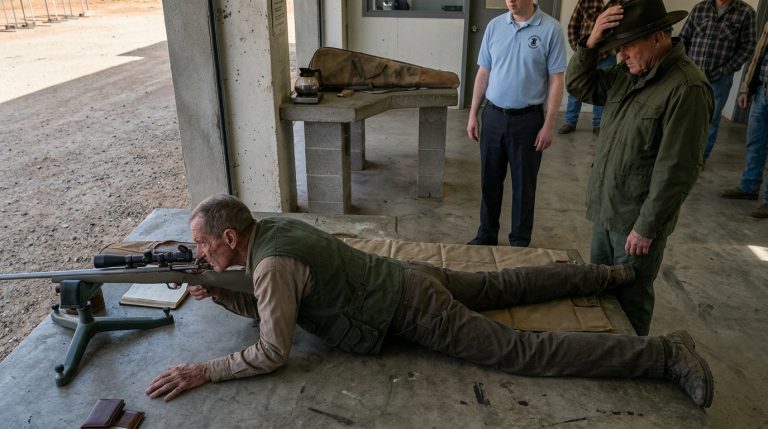
Walter walked to the bench, the gravel crunching under his boots. He refused the foam shooting mat that Marcus offered with a slight, almost imperceptible shake of his head. Instead, he folded his Carhartt jacket, laying it carefully on the concrete surface to create a foundation. He set his cap beside it. The white of his hair seemed to catch the harsh afternoon light, highlighting the lines etched into his skin—maps of terrain no one else in this valley had ever seen.
He settled into the prone position. It was a movement of practiced grace, slow but devoid of wasted effort. He didn’t just lie down; he anchored himself. His body became a tripod, his breathing immediately syncing with the cadence of the ambient wind. He pushed his cheek against the walnut stock, his eye finding the iron sights.
There was a discrepancy. A micro-mystery.
As he aligned the front sight post within the rear aperture, he felt it—a slight, unnatural friction in the elevation drum. It wasn’t wear-and-tear. It was a deliberate, subtle alteration, as if someone had tweaked the mechanical tolerance of the sight just enough to throw off a shooter who relied on standardized dope.
He didn’t pull back. He didn’t complain to Marcus. Instead, he adjusted his hold. He compensated for the mechanical ghost by shifting his shoulder pressure, locking the rifle into a position that defied the sight’s flaw. He realized then that the rifle wasn’t just borrowed; it had been handled by someone who knew how to plant a trap for the unwary. It was a small, stinging realization—that even here, in the quiet shade of an expo, there were people who looked at a tool and saw only a way to deceive.
Walter’s pulse remained at an even sixty beats per minute. He watched the shimmer of heat over the 400-yard line, the way the light distorted the edges of the steel plates. He wasn’t thinking about the $20,000, or the cameras, or the way Bryce was leaning forward, mouth slightly open. He was thinking about Daniel Bowen. He was thinking about how, at Snoopy’s Nose, you didn’t have time to complain about a faulty sight. You just killed the wind and pulled the trigger.
“Sir,” Marcus said, his voice lowered, professional. “Just so we’re clear on the rules. Three plates. Left, center, right. 400 yards. One shot per. Sixty seconds.”
Walter didn’t look up from the sights. “Understood.”
He was aware of the heat rising from the pavement, the scent of the dry earth baking in the October sun, and the subtle, persistent pain in his lower back—a reminder of a life spent in the dirt. He felt the cold iron against his finger, the texture of the trigger guard, the reality of the weight. He was a man out of time, yet in this micro-second, he was the only person on the range who was exactly where he belonged.
He inhaled, a long, controlled draw of air that expanded his diaphragm, and held it. The world tightened. The tremor was gone. The error in the sight was neutralized by his own stubborn anatomy. He was ready.
CHAPTER 3: The Three Shots: The Suspension of Time and the Resurfacing of the Delta
The world shrunk to the radius of the rear aperture. Outside that small circle of steel, nothing existed—not the heat, not the whispering audience, not the skepticism of Bryce Callaway, not even the phantom ache in his knee. Walter’s world was a 400-yard line of sight, and the only thing that mattered was the whisper of the wind against the grain of his own resolve.
He didn’t pull the trigger; he let it happen. It was a distinction that separated the mechanics from the marksmen. At 3:47:09 p.m., the sear broke. The recoil was a familiar, sharp nudge against his shoulder, a physical greeting from a rifle that spoke a language he had learned before most of the people standing behind him were born.
Left.
The sound of the plate ringing didn’t reach him for a full second, a delay that felt like a lifetime of anticipation. When the ping finally chimed through the dry air, it was soft, musical, and utterly definitive. It wasn’t the sound of a competition win; it was the sound of a check-mark in a ledger that had been open for decades.
He didn’t wait for the applause, because there wasn’t any. He didn’t wait for the spotter’s confirmation, because he didn’t need it. His eye remained pressed to the stock, his body a monument of controlled stillness. The “center” plate, a dark speck dancing in the heat shimmer, seemed to grow larger as his vision sharpened.
Center.
He cycled the action. The mechanical sound of the M14—the heavy, rhythmic clack-clack of the bolt—was the loudest thing in the valley. It was a sound that triggered something deep within the reptilian brain. Suddenly, the gravel of the range floor wasn’t gravel anymore. It was the damp, heavy mud of the Mekong Delta. The smell of the sun-baked dust changed, replaced for a heartbeat by the cloying, sweet stench of rotting vegetation and ozone.
He saw Daniel Bowen. Not the Sergeant Major who would arrive later, but the kid. The skinny boy with the Steinbeck paperback, looking at him with eyes that were too old for his face. Daniel was crouched behind a downed palm, his rifle jammed, his breath coming in ragged, panicked hitches.
Hold it together, Daniel, the memory whispered in Walter’s mind. Don’t look at the jungle. Look at the sight. Just the sight.
The present crashed back in with the force of a physical blow. The center plate was there. The drift was negligible. He inhaled, the air burning his lungs, and broke the second shot at 3:47:23 p.m.
The ping was cleaner this time, more resonant. He felt a bead of sweat roll down his temple, but he didn’t blink. He shifted his weight, his knee screaming in protest as he adjusted his prone angle to compensate for the slight incline of the bench.
He was tired. The tremor in his hand was waiting for him, lingering just at the edges of his consciousness, a patient predator waiting for the moment he lost focus. He knew his body was failing. He could feel the systemic wear, the slow, terminal thinning of his reserves. This wasn’t just a challenge; it was a final audit. If he missed, it would be the end of the narrative he had spent fifty years building—the idea that a man’s utility was not tied to his expiration date, but to his attention.
Right.
He spoke the word aloud, a command to the rifle, to the wind, and to the ghosts. The third plate sat at the limit of his visual acuity. The heat shimmer was worse here, a dancing, liquid interference pattern that played tricks on the eye. He didn’t fight the shimmer. He let his eye drift through it, finding the sweet spot, the moment of relative stillness within the turbulence.
At 3:47:41 p.m., the trigger broke.
He didn’t watch the plate. He felt the shot. He knew before the sound traveled the 400 yards that it was good. He held his follow-through, his face pressed against the stock, his pulse finally beginning to spike as the adrenaline realized the work was done.
Then came the chime.
He exhaled, a long, ragged sound that emptied his lungs and left him feeling dangerously light. He remained prone for a few seconds, his face buried in the walnut stock, the smell of burnt powder and oil the only reality he could trust. He was an old man on a firing line, and his heart was beating with the frantic, bird-like intensity of a twenty-two-year-old in the dark.
He pushed himself up. It was a slow, agonizing process. His knee popped, the sound audible in the sudden, deafening silence of the crowd. He didn’t look at the faces of the people watching. He didn’t look at Bryce, or the sponsor reps, or the girl with the check. He looked at Marcus Hennessy, who was standing there holding a clock like it was a holy relic.
Walter stood, his joints protesting, and wiped the sweat from his brow. He didn’t feel like a hero. He felt like a man who had finally cleared his desk.
“That’s all of them,” Walter said, his voice quiet, steady, and utterly devoid of triumph.
CHAPTER 4: The Confrontation: The Unmasking by Sergeant Major Bowen
Walter pushed himself off the bench, his right knee radiating a dull, throbbing heat that signaled the end of his endurance. He reached for his faded Carhartt jacket, his fingers brushing the rough canvas, when the sound of heavy, rhythmic footsteps drew his attention toward the sponsor pavilion.
A man was crossing the gravel. He moved with a squared-up, deliberate carriage that the years couldn’t soften—a Sergeant Major’s gait, unmistakable to anyone who had ever served. The man’s uniform was crisp, the rocker and chevrons catching the slanting October light, a stark contrast to the dust-coated, lived-in reality of the range.
Walter stood still, his cap clutched in his hand. He felt a sudden, sharp clarity, the kind that often precedes a storm. He knew this walk. He knew the way the man held his head, tilted slightly as if listening to a frequency only he could hear. It was the same posture Daniel Bowen had held in the back of a truck in 1969.
The Sergeant Major didn’t approach him with the casual air of the expo staff. He stopped ten feet away, his body language shifting into an instinctive, unspoken posture of deference. He wasn’t looking at the rifle on the bench, or the plates, or the nervous, hovering crowd. He was looking at Walter’s face, tracing the geography of the lines around his eyes with a haunting, searching intensity.
“Master Sergeant Driscoll,” the man said. The title didn’t sound like a regulation address; it sounded like the conclusion of a long-lost prayer.
Walter felt the breath hitch in his chest. “I haven’t been called that in a while,” he said, his voice raspy, the sound of an engine that had sat idle for too long.
The Sergeant Major came to attention, but it wasn’t the rigid, performative snap of the parade ground. It was something deeper, older—a quiet, grounded stance of absolute respect. “Sergeant Major Eli Bowen, sir. Sniper course, Fort Moore.” He paused, his voice thickening. “My grandfather was Specialist Daniel Bowen. Charlie Company, 3rd of the 60th. He told me you were the man who kept his platoon alive at Snoopy’s Nose.”
The world seemed to tilt. The roar of the expo, the distant chatter of the snack tent, the smell of burnt propellant—all of it faded into the background, leaving only the two of them standing in the shifting shadows of the afternoon.
“Daniel,” Walter murmured. He tasted the name, the syllables feeling heavy and ancient on his tongue. “Skinny kid. Always had a paperback in his cargo pocket.”
“Steinbeck,” Bowen replied, his voice barely a whisper. “He told me you never let him put it down. Said it kept him human.”
Walter felt the walls of his resolve cracking. The decoy secret—that he was just an old man proving his skill—was being dismantled by the living, breathing legacy standing before him. He had come here to see if he could still shoot, but he realized now that he had actually come here to pass a weight he had carried for half a century.
A group of sponsor reps and spectators had begun to circle in, their phones held low, their eyes wide with the realization that they were witnessing something that didn’t fit into their neat, digital understanding of the world. Janelle Park, the point-person for the prize, stepped forward, but she stopped abruptly, sensing the gravity in the space between the two men.
“Who is he?” someone whispered from the back of the gathering.
Bowen didn’t turn. He kept his eyes locked on Walter, as if shielding him from the intrusion. “Master Sergeant Walter Driscoll is one of the original graduates of the 9th Infantry Division Sniper Program. The doctrine we teach at Fort Moore today—the very document every new student holds in their first week—was written by the men in that program. Sergeant Driscoll is the reason we’re still here.”
The silence that followed was total. It was a vacuum that sucked the oxygen from the air. Walter looked at his own hands—the hands that had held the M14, the hands that had done what thirty-one younger, better-equipped men could not. He saw the tremor return, just a flicker, and for the first time, he didn’t try to hide it. He let it be.
He was tired. The long drive from Henderson, the years of quiet, the internal struggle to maintain a standard the world had long since forgotten—it was all catching up to him. Bowen was waiting for something, an instruction or a gesture, but Walter was still processing the fact that Daniel’s grandson stood before him.
“Daniel made it home?” Walter asked, the question feeling fragile, a glass ornament in a room full of steel.
“He did, sir,” Bowen said, his voice cracking. “He passed in 2014. He talked about you until the very end.”
Walter nodded, a slow, deliberate movement that felt like the closing of a chapter. He wasn’t just an old man at a shooting expo anymore. He was the keeper of a dying flame, and standing here, in the harsh light of the October sun, he realized that the burden he had been carrying—the silent, heavy knowledge of what it cost to survive—was no longer his alone to hold.
CHAPTER 5: The Gold Star Exchange: The True Meaning of the Prize
The world, previously focused into the singular, razor-sharp point of the interaction between two soldiers, fractured. Janelle Park moved into the space like a ghost in the machine, her expression a careful blend of corporate efficiency and dawning, genuine awe. She held the check—an oversized, glossy piece of cardstock that felt entirely foreign in the context of the damp mud and heat of Walter’s memories.
“$20,000, Mr. Driscoll,” she said, her voice softer than it had been when she addressed the crowd earlier. “The prize is yours. I’ve been instructed to make it out to whoever you choose.”
Walter looked at the check. It was a sterile, bright thing, the ink stark against the white background. It was wealth, it was opportunity, and in this moment, it was an intrusion. He felt the phantom vibration in his right hand—the tremor returning, fueled now by the exhaustion that was beginning to seep into his bones like water into dry soil. He was reaching his limit. The adrenaline that had carried him through the shooting, through the confrontation with Bowen, was receding, leaving him feeling fragile and exposed.
He glanced at Bowen, then back at the check. The Sergeant Major’s face was unreadable, but there was a quiet, steady pride in the way he held his posture, as if he were guarding the very air Walter breathed.
“Make it out to the Gold Star family scholarship fund,” Walter said. His voice was steady, though the effort to maintain it was becoming apparent in the way his jaw tightened. “Whichever one is closest to this place. They’ll know what to do with it.”
Janelle nodded, her eyes bright. She didn’t offer a platitude; she simply accepted the instruction, her hand trembling slightly as she took the check back.
Bryce Callaway was standing at the edge of the small circle. His arms were no longer crossed. His hat was in his hands, held at his waist with a tension that spoke of deep, uncomfortable realization. He stepped forward, the gravel shifting under his boots—a sound that, to Walter, mimicked the shifting of loose earth.
“Sir,” Bryce began, his voice rough, stripped of its previous arrogance. “I owe you an apology.”
Walter turned to look at him. He saw not a competitor, but a mirror—a young man who had mistaken his tools for his talent, and who was now grappling with the terrifying possibility that he had been wrong. Walter felt a wave of empathy so strong it threatened to unbalance him. He reached out, his hand resting on the younger man’s shoulder. The fabric of Bryce’s shirt was thin, synthetic, and cool to the touch.
“You were just shooting, son,” Walter said, his voice low, intimate. “Don’t make more of it than it is. You shoot well. You shoot real well.” He paused, his gaze drifting to the rifle that sat on the bench. “Couple of things in your prone that would cut a half-second off if you wanted them. Come by sometime. I’ll show you.”
Bryce nodded, his throat working as he tried to find words that wouldn’t sound hollow. He managed a curt, sharp movement of his head, then turned away, not trusting himself to speak.
Walter watched him go, then felt a hand on his elbow—Bowen, guiding him toward the parking lot. The transition was a blur. The crowd, the sponsors, the fading light of the afternoon—it all became a shifting, impressionistic smear of color and shadow. The air was cooling, a sharp, metallic bite of early evening settling over the range.
He was walking, but he felt as though he were floating, the ground beneath his feet inconsistent and shifting. The psychological phantom of the Delta was stronger now, pulling at him. He could hear the low hum of the insects, the distant rustle of the canopy, the quiet, rhythmic breathing of men who were waiting for a command that might never come.
Bowen walked in silence, his presence a solid, reassuring anchor. They reached the F-150. The truck looked older here, in the deepening twilight, its paint dulled and its frame weary. Bowen held the door, the gesture formal and precise. Walter climbed in, the movement a painful symphony of protest from his knee and his lower back.
He sat on the vinyl seat, the smell of black coffee and old fabric wrapping around him like a shroud. Bowen remained by the door, the Sergeant Major of the sniper course, the man who had closed the loop Walter had been holding open for half a century.
“Master Sergeant,” Bowen said, his voice low. “The course would be honored to have you. Any time. We’ll send a car. We’ll send me.”
Walter looked at him through the cracked glass of the window. The light was failing, the world turning into a grayscale sketch. “I’ll think about it, Sergeant Major,” he said, his voice a ghost of its former resonance. “But tell your students one thing for me. Tell them the rifle doesn’t know how old you are. It only knows whether you’ve been paying attention.”
Bowen stepped back. He didn’t offer a salute, but he brought his hand up, a sharp, precise movement that he held until the truck began to roll, turning onto the county road and disappearing into the long, dark stretch of the evening.
CHAPTER 6: The Departure: The Final Note to the Future
The Ford F-150 rolled onto the county road, the tires humming a low, steady drone against the asphalt that sounded, to Walter, like the passage of a lifetime. The lights of the expo were shrinking in the side-view mirror, becoming little more than pinpricks of neon in the vast, darkening landscape of the Texas panhandle.
Inside the cab, the air was stale, smelling of black coffee and the faint, persistent odor of gun oil clinging to Walter’s jacket. Caleb Morrow sat in the driver’s seat, his hands steady on the wheel. He hadn’t said a word since they left the parking lot. He didn’t need to. The young Marine was staring straight ahead, his jaw tight, his eyes reflecting the rhythm of the passing telephone poles. He was processing it—the sight of the plates, the arrival of the Sergeant Major, the realization that he had brought an old man to the edge of the world and watched him step off into greatness.
Walter leaned his head against the glass. The vibration of the truck traveled through his skull, a dull, rhythmic thrumming that matched the fading ache in his knee. He felt exhausted, not just in his muscles, but in his spirit. The burden of the survivor—the duty to remember, to maintain, to teach—had felt like a physical weight on his shoulders for fifty-six years. Now, with Bowen’s promise, that weight was starting to dissolve.
He closed his eyes. The memories of the Delta didn’t flood in; they drifted like mist. He saw Daniel Bowen again, sitting in the mud, clutching his book. But this time, Daniel didn’t look back at him with fear. He looked at him with a quiet, knowing nod, a silent acknowledgement that the watch had been passed.
“You did good, Walt,” Caleb said softly, breaking the silence. He didn’t look over. His eyes stayed on the road, where the high beams cut a swathe through the encroaching dark. “You did what they couldn’t.”
Walter looked at the boy. Caleb was a veteran, a man who had seen his own share of shadows, yet he still carried that look of wide-eyed uncertainty. “I didn’t do anything but what was required,” Walter said, his voice as dry as the plains. “It’s not about the shots, Caleb. It’s about the attention. You have to keep paying attention, even when the noise tells you that the world has moved on.”
Walter shifted, his hand finding the edge of the seat. He thought about the check. He thought about the students at Fort Moore who would learn the doctrine he had scribbled into after-action reports in the heat of a jungle night. They would never know his name, not really. They would only know the method. And that was enough. It was more than enough.
He felt the physical reality of his condition—the slow, inevitable retreat of his strength—but for the first time, it didn’t feel like a defeat. It felt like a completion. He had been a teacher, a soldier, a guardian of a history that only he was left to tell. Now, the flame was being carried by others.
“Are you all right, Walt?” Caleb asked, his voice laced with concern.
“I am,” Walter said. He looked out the window at the stars, emerging in the deep, velvet bowl of the sky. “I’m just tired, son. It’s been a long day.”
The drive continued, the miles slipping away under the tires. As they approached the small, modest house outside Henderson, Walter felt a strange, quiet peace settle over him. He reached into his pocket and pulled out his cap, turning it over in his hands. It was frayed, the fabric thin, but it held the shape of his life. He smoothed it down, his fingers tracing the worn seams.
When Caleb pulled into the gravel driveway, the house was dark, save for the single porch light that flickered in the evening breeze. Caleb killed the engine, and the silence that rushed in was absolute. No roar of the range, no crowd, no sponsor’s applause. Just the wind in the dry grass and the distant, lonely call of a coyote.
Walter opened the door and stepped out. His feet touched the earth of his own yard, and he stood there for a moment, letting the stillness sink into his bones. He had repaired the world he was given, in his own small, silent way. He had left the doctrine in safe hands. He had kept his word to a skinny kid who had made it home.
Caleb walked around the truck, standing a few feet away, hesitant. Walter looked at him, the moonlight catching the lines on his face, illuminating the calm that had finally replaced the exhaustion.
“Go home, Caleb,” Walter said, his voice soft, a benediction. “Thank you for the ride.”
Caleb hesitated, then offered a short, sharp nod—the soldier’s nod. He turned and walked back to his own vehicle.
Walter turned toward his porch. He paused at the bottom step, his hand resting on the wooden railing. The railing was weathered, the wood slightly soft from years of rain, and he traced the grain with his thumb, a small, grounding act of maintenance. He felt the cold air on his face, the clarity of the night, and he breathed it in.
He had nothing left to prove. The rifle was returned, the check was sent, and the echo of the shots was already fading into the vast, indifferent history of the plains. He walked up the steps, his gait steady, his mind quiet. He reached the door, pushed it open, and stepped into the dim warmth of his home, closing the world behind him.
He was home. The work was done.